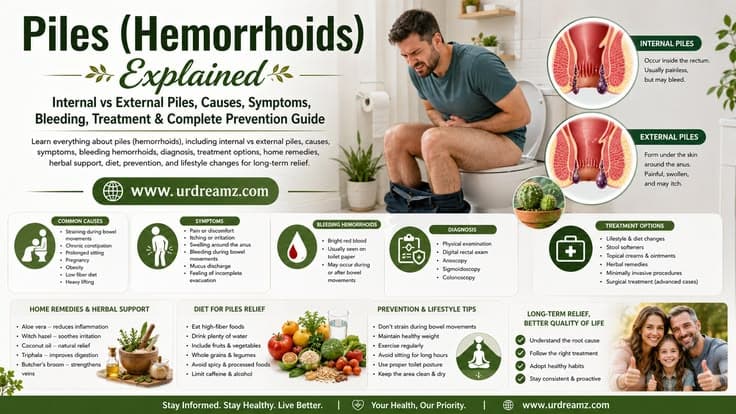
Piles (Hemorrhoids) Explained: Internal vs External Piles, Causes, Symptoms, Bleeding, Treatment and Complete Prevention Guide
Nobody wants to talk about piles, but almost everyone eventually deals with them, or knows someone who does. This guide covers everything in one place: what internal (badi bawaseer) and external (khooni bawaseer) piles actually are, their separate causes, symptoms, complications, foods, diets, herbal support, and medical treatment, so you finally have a clear, honest picture instead of scattered half-answers from random forums.
Introduction: The Condition Everyone Whispers About
Here's an uncomfortable statistic that somehow never comes up at dinner parties: most people will deal with piles at some point in their life, often more than once, yet almost nobody talks about it openly. It's one of those conditions people quietly Google at 2am, embarrassed, in pain, not sure if what they're feeling is normal or something to panic about. That silence is exactly the problem, because piles are usually manageable once you actually understand what's going on, but shame keeps people stuck treating symptoms with random remedies instead of getting a real handle on the condition.
This guide treats piles like the ordinary medical condition it is, not a taboo topic. We're going to walk through internal piles (commonly called badi bawaseer) and external piles (commonly called khooni bawaseer) separately, because they genuinely behave differently, cause different symptoms, and often respond to different foods and treatments. If you've been lumping them together and wondering why nothing seems to work consistently, this separation alone might be the missing piece.
What you won't find here is a rushed, generic "eat more fiber" summary that leaves you with more questions than answers. Instead, expect real numbers, real food lists, an honest breakdown of which type tends to be trickier to manage, and a clear line drawn between what you can reasonably handle at home and what genuinely needs a doctor's attention. Piles are a fixable problem once the confusion is cleared away, and clearing that confusion is exactly what the rest of this guide is built to do.
What Are Piles (Hemorrhoids)?
Piles, medically called hemorrhoids, are swollen, inflamed blood vessels located in the lowest part of your rectum and around your anus. Everyone actually has these vessels; they're a normal part of anatomy, acting like little cushions that help control bowel movements. The trouble starts when repeated pressure, from straining, prolonged sitting, pregnancy, or chronic constipation, causes these vessels to stretch, swell, and become irritated. Once that happens, they stop being a quiet, unnoticed part of your body and start becoming a source of pain, itching, or bleeding.
It helps to think of them a bit like varicose veins, but in a location nobody wants to think about. Just like veins in the legs can bulge and become uncomfortable under repeated pressure, the same thing happens here, except the pressure often comes from something as ordinary and avoidable as sitting on the toilet too long scrolling your phone.
Doctors sometimes distinguish "hemorrhoids" the normal cushion tissue from "hemorrhoidal disease," the symptomatic, swollen version most people mean when they say piles, but in everyday conversation the word piles almost always refers to the problematic, symptomatic kind. That distinction matters mostly because it explains why some hemorrhoids never cause a single symptom their entire life, while others become a genuine daily problem, the difference usually coming down to how much pressure that particular tissue has been exposed to over time.
Why Piles Actually Happen: The Basic Mechanism
At the core, piles come down to sustained pressure on the veins in and around the rectum and anus. Every time you strain during a bowel movement, that pressure pushes blood into these vessels faster than it can drain back out, and over time, repeated episodes of this cause the vessel walls to weaken and bulge. Add in factors like pregnancy, obesity, or hours of sitting, all of which increase pressure in the pelvic and rectal area even outside of bowel movements, and you have a recipe for hemorrhoids to develop and worsen gradually, often over months or years before symptoms become noticeable enough to actually bother someone.
There's a reason this happens so specifically in this part of the body: the veins here don't have the same one-way valve system that veins in your legs rely on to fight gravity, which means blood can pool more easily whenever pressure builds, whether from straining, sitting, or simple abdominal pressure during pregnancy. Combine that anatomical quirk with modern habits, low-fiber diets, desk jobs, and phones in the bathroom, and it starts to make sense why piles are so common rather than some rare unlucky condition.
Table: Hemorrhoid Grades Explained
| Grade | What Happens |
|---|---|
| Grade 1 | Internal swelling only; not visible or felt from outside; may bleed |
| Grade 2 | Protrudes during bowel movement but retracts back on its own |
| Grade 3 | Protrudes and needs to be manually pushed back in |
| Grade 4 | Permanently protruded; cannot be pushed back in; often needs surgery |
Two Main Types: Internal (Badi) vs External (Khooni) Piles
This is where a lot of confusion happens, so let's be precise about it. Internal piles, often referred to as badi bawaseer, form inside the rectum, above the point where you'd normally feel pain, since that internal lining has very few pain-sensing nerves. External piles, often referred to as khooni bawaseer, form under the skin right around the anal opening, an area packed with sensitive nerve endings, which is exactly why external piles tend to hurt so much more even when they're smaller in size. Both types can bleed, both can cause discomfort, but the way they present, and the way you treat them, genuinely differs.
Table: Internal vs External Piles Comparison
| Feature | Internal Piles (Badi Bawaseer) | External Piles (Khooni Bawaseer) |
|---|---|---|
| Location | Inside the rectum | Around the anus, under the skin |
| Pain | Usually little to no pain unless prolapsed | Often quite painful, especially when sitting |
| Bleeding | Bright red blood during bowel movements | May bleed if irritated or thrombosed |
| Visibility | Not visible unless prolapsed | Visible lump around the anus |
| Itching | Mild, if present at all | Common, sometimes intense |
| Typical first-line treatment | Fiber, hydration, medicines, banding if needed | Creams, sitz baths, lifestyle changes |
Internal Piles (Badi Bawaseer) Explained in Depth
Internal piles form in the upper part of the anal canal, and because that tissue lacks the dense nerve supply found further down, a genuinely large internal hemorrhoid can exist for a long time without causing any real discomfort at all. The most common way people discover them is bright red blood on the toilet paper or in the toilet bowl after a bowel movement, sometimes with no pain whatsoever accompanying it. As they progress through the grading system described earlier, they can start to protrude during straining, and in more advanced stages, protrude permanently, at which point they start behaving more like external piles in terms of discomfort, since they're now exposed to friction and irritation from clothing and movement.
What makes internal piles particularly tricky to catch early is that this painless bleeding pattern is exactly the kind of thing people learn to ignore. A little blood once or twice gets brushed off as "probably nothing," and because there's no accompanying pain to reinforce that something's wrong, months can pass before anyone thinks to mention it to a doctor, let alone actually get it checked, which is precisely how a manageable Grade 1 hemorrhoid quietly becomes a more complicated Grade 3 over time.
External Piles (Khooni Bawaseer) Explained in Depth
External piles sit right at the anal opening, covered by regular skin that's rich in nerve endings, which is exactly why they announce themselves so clearly. Even a relatively small external hemorrhoid can cause noticeable pain, swelling, and itching, and sitting becomes genuinely uncomfortable when one flares up. The most painful version, a thrombosed external hemorrhoid, happens when blood pools and clots inside the swollen vessel, creating a hard, tender, often purplish lump that can make walking or sitting feel unbearable for a few days until the clot is reabsorbed or treated.
Interestingly, the intensity of the pain doesn't always match the size of the lump; a thrombosed hemorrhoid smaller than a pea can be every bit as agonizing as one considerably larger, since it's the sudden stretching of highly sensitive skin, not just the volume of swelling, that drives the pain. This is also why external piles, despite generally being considered the less dangerous type long-term, are often what actually pushes someone to finally see a doctor, simply because the discomfort becomes impossible to ignore or work around.
Symptoms of Internal Piles (Badi Bawaseer)
Because internal piles hide in an area with fewer pain receptors, their symptoms tend to be quieter and easier to dismiss at first. The classic sign is painless bright red bleeding, noticed on tissue, in the toilet bowl, or streaked on stool itself. As they advance, people start noticing a sensation of incomplete emptying after a bowel movement, mild mucus discharge, and eventually, physical protrusion during or after straining, which may retract on its own or require gentle manual pushing back in, depending on the grade.
Table: Internal Piles Symptom Checklist
| Symptom | Typical Pattern |
|---|---|
| Bright red bleeding | Painless, seen on tissue or in toilet water |
| Feeling of incomplete evacuation | Common as hemorrhoids enlarge |
| Mild mucus discharge | Can cause slight irritation or dampness |
| Protrusion during straining | Appears in Grade 2 and beyond |
| Need to manually push back in | Typically Grade 3 |
| Permanent protrusion | Grade 4, often uncomfortable and irritated |
Symptoms of External Piles (Khooni Bawaseer)
External piles rarely stay quiet the way internal ones sometimes do. The hallmark symptoms are a visible, palpable lump near the anus, itching that can become intense, especially at night, and pain that ranges from mild discomfort to sharp, throbbing pain if a clot forms inside the swollen tissue. Sitting for extended periods, wiping after a bowel movement, and even walking can all become uncomfortable during a flare-up, and swelling around the anal skin is often visible enough that people notice it simply while cleaning themselves.
Table: External Piles Symptom Checklist
| Symptom | Typical Pattern |
|---|---|
| Visible lump near the anus | Firm or soft, skin-covered swelling |
| Itching | Often intense, worse at night |
| Pain when sitting | Common, ranges from mild to severe |
| Sudden severe pain with a hard lump | Suggests a thrombosed hemorrhoid |
| Bleeding if irritated | Usually from friction, scratching or straining |
| Swelling that fluctuates | Can flare up and calm down over days |
15 Causes of Internal Piles
Internal piles tend to build up gradually from repeated internal pressure rather than any single dramatic event. The causes below cover the most common contributors, and in most real cases, it's not just one of these but several stacking together over months or years.
Table: 15 Causes of Internal (Badi) Piles
| # | Cause |
|---|---|
| 1 | Chronic constipation and straining |
| 2 | Low-fiber diet over an extended period |
| 3 | Chronic diarrhea causing repeated irritation |
| 4 | Pregnancy and increased pelvic pressure |
| 5 | Prolonged sitting on the toilet |
| 6 | Obesity increasing rectal pressure |
| 7 | Aging and natural weakening of supporting tissue |
| 8 | Heavy lifting done frequently or with poor technique |
| 9 | Sedentary lifestyle with minimal daily movement |
| 10 | Family history and inherited vein weakness |
| 11 | Chronic dehydration leading to harder stool |
| 12 | Delayed response to the urge to pass stool |
| 13 | Underlying digestive disorders affecting bowel regularity |
| 14 | Repeated childbirth and cumulative pelvic strain |
| 15 | Long-term overuse of certain laxatives disrupting normal bowel rhythm |
15 Causes of External Piles
External piles share several root causes with internal ones, since both ultimately come down to pressure on rectal and anal veins, but a few additional factors specifically aggravate the external area, given its exposure to friction and direct physical irritation.
Table: 15 Causes of External (Khooni) Piles
| # | Cause |
|---|---|
| 1 | Straining during bowel movements |
| 2 | Sitting on hard surfaces for long stretches |
| 3 | Vigorous or rough wiping after bowel movements |
| 4 | Chronic diarrhea irritating the anal skin |
| 5 | Tight, non-breathable underwear trapping moisture |
| 6 | Heavy weightlifting without proper breathing technique |
| 7 | Pregnancy and childbirth-related straining |
| 8 | Obesity adding constant pressure to the area |
| 9 | Spicy food triggering irritation in sensitive tissue |
| 10 | Anal intercourse without adequate care |
| 11 | Smoking, which affects circulation and tissue healing |
| 12 | Excessive alcohol intake contributing to dehydration |
| 13 | Poor toilet posture that increases straining |
| 14 | Frequent heavy lifting jobs or manual labor |
| 15 | Long-distance driving or travel with limited movement breaks |
Complications of Internal Piles
Left untreated, internal piles can slowly progress from a mild, painless nuisance into something more disruptive. Repeated bleeding, even if it seems minor each time, can add up over months into a meaningful blood loss, particularly concerning if it isn't monitored. As they advance to higher grades, prolapse becomes more frequent and eventually permanent, at which point irritation, mucus leakage, and hygiene difficulties become part of daily life, and the risk of the prolapsed tissue becoming strangulated, losing blood supply, rises, which is a genuine medical emergency requiring prompt care.
Table: Internal Piles Complications
| Complication | What It Means |
|---|---|
| Chronic blood loss | Can lead to iron deficiency anemia over time |
| Progressive prolapse | Moves from occasional to permanent protrusion |
| Mucus discharge and irritation | Affects hygiene and skin comfort |
| Strangulated hemorrhoid | Blood supply cut off; requires urgent treatment |
| Recurrent infection risk | From prolonged irritation of prolapsed tissue |
Complications of External Piles
External piles come with their own set of complications, most notably thrombosis, when blood clots inside the swollen vessel, causing sudden, severe pain and a hard, tender lump that can last anywhere from a few days to a couple of weeks if untreated. Chronic irritation from an ongoing external hemorrhoid can lead to skin tags forming afterward, essentially leftover stretched skin that doesn't cause pain but can be a persistent hygiene annoyance. Repeated scratching from itching can also break the skin, occasionally leading to localized infection if not kept clean.
Table: External Piles Complications
| Complication | What It Means |
|---|---|
| Thrombosed hemorrhoid | Clotted blood causing sudden severe pain |
| Skin tags | Leftover stretched skin after swelling resolves |
| Skin breakdown from scratching | Can increase local infection risk |
| Chronic discomfort while sitting | Affects daily activities and work |
| Recurrent flare-ups | Common if underlying triggers aren't addressed |
Do Piles Raise Blood Pressure? The Real Connection
This is a genuinely common question, and the honest answer is: piles themselves don't directly raise your overall blood pressure the way something like kidney disease or a high-sodium diet would. What actually happens is more of a localized pressure issue, straining during bowel movements briefly raises pressure within the abdomen and rectal veins specifically, which is exactly what damages and swells hemorrhoidal tissue in the first place, but this is a local, momentary spike, not a sustained rise in your systemic blood pressure reading. That said, if you already have high blood pressure, straining hard during a bowel movement isn't a great idea regardless, since that same abdominal pressure spike can briefly affect your cardiovascular system too, which is one more reason avoiding straining matters for more than just your rectal health.
There's also an indirect connection worth mentioning: chronic pain and poor sleep from a bad hemorrhoid flare can raise stress hormones temporarily, and stress hormones do have a genuine, if modest, effect on blood pressure readings. So while piles don't cause hypertension as a disease, a painful, sleep-disrupting flare-up can nudge your numbers slightly during that stretch, which tends to settle back down once the flare itself calms down and pain-related stress eases off.
Which Type Is More Dangerous: Internal or External?
People often assume external piles are more serious simply because they hurt more, but pain and danger aren't the same thing here. Internal piles are arguably the sneakier, potentially more concerning type precisely because they're painless in early stages, meaning they can bleed and progress silently for a long time before anyone notices, occasionally masking or delaying detection of something more serious like colorectal bleeding from another cause. External piles, while more painful and disruptive day to day, are usually more straightforward to monitor since you can see and feel them directly, and thrombosis, while agonizing, typically resolves within a couple of weeks even without aggressive treatment.
Put another way: external piles tend to demand your attention immediately, which, oddly enough, works in your favor, because you're far less likely to ignore something that hurts every time you sit down. Internal piles ask for nothing until they've already progressed a grade or two, which is exactly why regular checkups matter even for people who feel completely fine, since "feeling fine" and "internal piles progressing quietly" are entirely compatible states for the same person to be in at once.
Table: Danger Level and Treatment Difficulty Compared
| Factor | Internal Piles | External Piles |
|---|---|---|
| Risk of being noticed late | Higher, due to lack of pain | Lower, symptoms are obvious quickly |
| Day-to-day discomfort | Usually lower unless prolapsed | Usually higher, especially when sitting |
| Ease of home treatment | Moderate; internal application is trickier | Easier; directly accessible for creams and compresses |
| Likelihood of needing a procedure | Higher in advanced grades (banding, surgery) | Usually lower unless thrombosed repeatedly |
| Overall difficulty to treat | Can be more difficult in later stages | Generally easier to manage day to day |
Diagnosis: How Doctors Tell Them Apart
A doctor typically starts with a simple visual and physical exam, external piles are usually visible right away, while internal ones require a digital rectal exam, where the doctor gently feels inside the rectum, or an anoscopy, a short, lit tube used to directly view the internal rectal lining. If bleeding is present and the cause isn't entirely clear, or if there are risk factors like age or family history of colon issues, a colonoscopy may be recommended to rule out other causes of rectal bleeding, since piles should never be assumed to be the automatic explanation without a proper look.
Understandably, a lot of people delay this exact appointment out of embarrassment, but it's worth remembering that colorectal doctors see this exact concern multiple times a day, every single day; there's genuinely nothing about it that surprises or fazes them. The exam itself is typically brief, and getting a clear answer tends to bring far more relief than the few minutes of awkwardness cost in the first place.
20 Healthy Foods for External (Khooni) Piles
Since external piles are so closely tied to straining and irritation, the food strategy here focuses heavily on softening stool, reducing inflammation, and supporting the skin and vein tissue around the anus. Here are 20 foods worth building into your regular rotation.
Table: 20 Best Foods for External Piles
| # | Food | Why It Helps |
|---|---|---|
| 1 | Psyllium husk (isabgol) | Softens stool, reduces straining |
| 2 | Oats | Soluble fiber for smoother digestion |
| 3 | Papaya | Digestive enzymes support regularity |
| 4 | Figs | Natural laxative effect |
| 5 | Prunes | Well-known natural stool softener |
| 6 | Apples with skin | Pectin fiber adds bulk to stool |
| 7 | Bananas (ripe) | Gentle fiber source, easy on digestion |
| 8 | Plain yogurt | Probiotics support gut regularity |
| 9 | Leafy greens (spinach, kale) | Fiber plus anti-inflammatory nutrients |
| 10 | Brown rice | Whole grain fiber without irritation |
| 11 | Flaxseeds | Fiber and anti-inflammatory omega-3s |
| 12 | Chia seeds | Absorbs water, softens stool naturally |
| 13 | Citrus fruits | Bioflavonoids support vein strength |
| 14 | Pomegranate | Antioxidants reduce inflammation |
| 15 | Berries | Fiber and anti-inflammatory antioxidants |
| 16 | Lentils (moderate portions) | Fiber-rich plant protein |
| 17 | Water-rich vegetables (cucumber, zucchini) | Support hydration and easy digestion |
| 18 | Whole wheat bread | More fiber than refined alternatives |
| 19 | Boiled or grilled chicken | Lean protein without added irritation |
| 20 | Plenty of plain water | Keeps stool soft alongside fiber |
20 Foods to Avoid for External (Khooni) Piles
On the flip side, certain foods make external piles noticeably worse, either by hardening stool, increasing gut irritation, or promoting dehydration. Cutting back on these tends to make a real, felt difference within days.
Table: 20 Foods to Avoid for External Piles
| # | Food or Habit | Why It Makes Things Worse |
|---|---|---|
| 1 | White bread and refined flour | Almost no fiber; hardens stool |
| 2 | Red meat in excess | High fat, low fiber, slows digestion |
| 3 | Fried and greasy foods | Promotes inflammation and sluggish digestion |
| 4 | Spicy food and chili | Irritates inflamed anal tissue |
| 5 | Excess dairy (cheese, cream) | Low fiber, can worsen constipation |
| 6 | Alcohol | Dehydrates the body, hardens stool |
| 7 | Excess caffeine | Diuretic effect contributes to dehydration |
| 8 | Carbonated soft drinks | Sugar and gas can worsen bloating |
| 9 | Processed snack foods | Low nutrient and fiber content |
| 10 | Excess salt | Promotes water retention and swelling |
| 11 | Refined sugar and sweets | Contributes to inflammation |
| 12 | Unripe bananas | Can have a constipating effect |
| 13 | White rice in excess | Low fiber compared to whole grain options |
| 14 | Instant noodles | Low fiber, high sodium |
| 15 | Excess cheese-heavy dishes | Low fiber, can slow digestion |
| 16 | Deep-fried snacks (chips, samosas) | Greasy and inflammatory |
| 17 | Smoking | Affects circulation and tissue healing |
| 18 | Skipping water intake | Leads directly to harder stool |
| 19 | Excess sugary bakery items | Low fiber, promotes inflammation |
| 20 | Long periods without eating fiber-rich meals | Slows overall bowel regularity |
Table: Sample Daily Diet Structure for External Piles
| Meal | Suggested Focus |
|---|---|
| Early morning | Warm water with a spoon of psyllium husk or a squeeze of lemon |
| Breakfast | Oats with fruit or whole grain toast with a boiled egg |
| Mid-morning snack | A piece of fruit like papaya or an apple |
| Lunch | Brown rice or whole wheat roti with lentils and leafy greens |
| Evening snack | Plain yogurt with flaxseeds or chia seeds |
| Dinner | Grilled or boiled chicken or vegetables with a fiber-rich side |
| Throughout the day | Consistent water intake, spaced evenly rather than all at once |
15 Healthy Foods for Internal (Badi) Piles
Internal piles respond well to the same general fiber-and-hydration principle, but with a bit more emphasis on gentle, non-irritating foods since the internal lining can be more sensitive to harsh, spicy, or overly processed items when inflammation is already present.
Table: 15 Best Foods for Internal Piles
| # | Food | Why It Helps |
|---|---|---|
| 1 | Psyllium husk (isabgol) | Core fiber source, reduces straining |
| 2 | Papaya | Enzymes support gentle digestion |
| 3 | Prunes | Natural, gentle laxative effect |
| 4 | Oats | Soluble fiber, easy on the gut |
| 5 | Bananas (ripe) | Gentle fiber without irritation |
| 6 | Spinach and leafy greens | Fiber plus iron, useful if bleeding has occurred |
| 7 | Plain yogurt | Probiotics support regular, softer stool |
| 8 | Figs | Natural fiber and mild laxative effect |
| 9 | Whole grain bread | More fiber than refined bread |
| 10 | Flaxseeds | Adds bulk and softness to stool |
| 11 | Apples (with skin) | Pectin fiber supports bowel regularity |
| 12 | Pears | High water and fiber content |
| 13 | Beetroot | Fiber and nutrients supporting circulation |
| 14 | Lentils (moderate) | Fiber-rich, gentle plant protein |
| 15 | Warm water with lemon | Supports hydration and gentle digestion |
15 Foods to Avoid for Internal (Badi) Piles
Because internal piles bleed more readily and can be aggravated by anything that hardens stool or increases gut irritation, the avoid list here leans toward the same core offenders, refined, processed, dehydrating, and inflammatory foods.
Table: 15 Foods to Avoid for Internal Piles
| # | Food or Habit | Why It Makes Things Worse |
|---|---|---|
| 1 | White bread and refined flour | Hardens stool, increases straining |
| 2 | Red meat in excess | Low fiber, slows digestion |
| 3 | Spicy food | Can irritate already inflamed internal tissue |
| 4 | Fried food | Promotes inflammation and sluggish digestion |
| 5 | Alcohol | Dehydrates the body, hardens stool |
| 6 | Excess caffeine | Diuretic effect worsens dehydration |
| 7 | Excess dairy | Can worsen constipation in sensitive individuals |
| 8 | Processed snacks | Low fiber, low nutrient value |
| 9 | Excess salt | Promotes fluid retention and swelling |
| 10 | Refined sugar | Contributes to inflammation |
| 11 | Carbonated drinks | Can worsen bloating and discomfort |
| 12 | Unripe bananas | Constipating effect |
| 13 | Low water intake | Directly leads to harder stool |
| 14 | Skipping fiber at meals | Slows bowel regularity |
| 15 | Overuse of stimulant laxatives | Can disrupt natural bowel rhythm over time |
Table: Sample Daily Diet Structure for Internal Piles
| Meal | Suggested Focus |
|---|---|
| Early morning | Warm water with lemon, followed by psyllium husk later if needed |
| Breakfast | Oats with banana or whole grain toast |
| Mid-morning snack | Papaya or a pear |
| Lunch | Whole grain roti or brown rice with lentils and spinach |
| Evening snack | Plain yogurt with a few soaked figs |
| Dinner | Light, gentle meal with vegetables and lean protein |
| Throughout the day | Steady water intake spread across the day, not all at once |
Herbal Treatment for External (Khooni) Piles
Because external piles are physically accessible, topical herbal remedies tend to work particularly well here, offering direct, local relief. Aloe vera gel applied gently to the area has a cooling, anti-inflammatory effect that many people find genuinely soothing during a flare. Witch hazel, a natural astringent, helps reduce swelling and can calm irritated skin when applied with a cotton pad. Cooled, used black tea bags, thanks to their tannin content, offer a similar astringent, calming effect when held against the area for a few minutes.
Table: Herbal Remedies for External Piles
| Remedy | How to Use | Effect |
|---|---|---|
| Aloe vera gel | Apply pure gel gently to the area | Cooling and anti-inflammatory |
| Witch hazel | Apply with a cotton pad | Astringent, reduces swelling |
| Coconut oil | Apply a small amount to soothe irritation | Moisturizing and calming |
| Cooled tea bags | Hold against the area for a few minutes | Astringent, mild pain relief |
| Neem leaf sitz bath | Boil neem leaves in water, use for sitz bath | Antibacterial and anti-inflammatory |
| Rose water compress | Apply with a clean, cooled cloth | Soothing, reduces itching |
Herbal Treatment for Internal (Badi) Piles
Internal piles respond better to herbal support taken internally, alongside fiber, rather than topical application, which is harder to direct precisely to internal tissue. Bioflavonoid compounds like diosmin and hesperidin, naturally found in citrus fruits and also available as concentrated supplements, have real clinical research behind them showing they can strengthen vein walls and reduce bleeding and swelling. Turmeric, taken in warm milk, is widely used traditionally for its anti-inflammatory curcumin content, while triphala, a classic Ayurvedic blend of three fruits, is commonly used to gently regulate bowel movements and reduce the straining that aggravates internal hemorrhoids in the first place.
Table: Herbal Remedies for Internal Piles
| Remedy | How to Use | Effect |
|---|---|---|
| Bioflavonoids (diosmin/hesperidin) | Taken as a supplement, ideally under guidance | Strengthens veins, reduces bleeding |
| Turmeric milk | Warm milk with a pinch of turmeric daily | Anti-inflammatory support |
| Triphala | Taken at night as directed | Gentle bowel regulation |
| Aloe vera juice | A small amount on an empty stomach | Supports gut and bowel comfort |
| Psyllium husk (isabgol) | Mixed with water at night | Softens stool, reduces straining |
| Horse chestnut extract | Taken as a standardized supplement | Traditionally used to reduce vein swelling |
Herbal remedies can genuinely help both types of piles feel more manageable, but they work best as support alongside fiber, hydration, and proper medical guidance, not as a replacement for seeing a doctor, especially if bleeding continues or symptoms worsen.
Medical Treatment for External Piles
For external piles, medical treatment usually starts conservatively, over-the-counter hemorrhoid creams containing ingredients like hydrocortisone to reduce inflammation, or lidocaine for temporary numbing, alongside regular sitz baths. If a thrombosed external hemorrhoid is caught early, within the first couple of days, a doctor may perform a quick in-office procedure to remove the clot, providing fairly immediate pain relief. For recurring or particularly bothersome external piles that don't respond to conservative care, a minor surgical excision may be recommended, though this is less common than procedures used for internal piles.
Table: Medical Treatment Options for External Piles
| Treatment | When It's Used |
|---|---|
| Topical hydrocortisone cream | Mild to moderate inflammation and itching |
| Lidocaine-based cream | For temporary pain relief |
| Clot removal procedure | Thrombosed hemorrhoid caught within 72 hours |
| Oral pain relievers | For managing discomfort as directed by a doctor |
| Minor surgical excision | Recurrent or persistent external piles |
Medical Treatment for Internal Piles
Internal piles have a wider range of procedural options, mostly because they're graded and treatment is matched to the stage. Grade 1 and 2 hemorrhoids often respond well to fiber, hydration, and prescription-strength topical or suppository treatments. Rubber band ligation, where a doctor places a small band around the base of the hemorrhoid to cut off its blood supply so it shrinks and falls off within one to two weeks, is a common, minimally invasive option for Grade 2 and 3. Sclerotherapy and infrared coagulation offer similar shrinking effects for earlier grades. Grade 4, or cases that don't respond to less invasive options, typically require a hemorrhoidectomy, a more involved surgical removal with a longer recovery period.
Table: Medical Treatment Options for Internal Piles
| Treatment | Typical Grade Used For |
|---|---|
| Fiber and prescription topical treatment | Grade 1 |
| Rubber band ligation | Grade 2 and 3 |
| Sclerotherapy | Grade 1 and 2 |
| Infrared coagulation | Grade 1 and 2 |
| Hemorrhoidectomy (surgery) | Grade 4 or non-responsive cases |
| Stapled hemorrhoidopexy | Select Grade 3 and 4 cases |
Home Care Habits That Help Both Types
Regardless of which type you're dealing with, a handful of everyday habits genuinely make a difference: never rushing or forcing a bowel movement, cleaning gently rather than wiping harshly, patting the area dry instead of rubbing, and responding to the urge to go rather than holding it in, since delaying only makes stool harder and straining worse later. None of these habits sound dramatic, but consistently applied, they reduce the daily aggravation that keeps piles from healing in the first place.
Sitz Baths: How and Why They Actually Work
A sitz bath is simply sitting in a few inches of warm, not hot, water for 15 to 20 minutes, ideally two to three times a day, particularly after bowel movements. The warmth increases blood flow to the area, which helps relax irritated muscle and reduce swelling, while the water itself gently cleans the area without the friction of wiping. It's genuinely one of the simplest, most consistently helpful home remedies for both internal and external piles, and it costs essentially nothing beyond a basin or a shallow bath.
A few small details make a real difference in how effective a sitz bath actually is: the water should be comfortably warm rather than hot, since overly hot water can actually increase swelling rather than reduce it, and gently patting the area dry afterward, rather than rubbing with a towel, avoids undoing the calming effect you just achieved. Some people like adding a small amount of plain salt or a few boiled neem leaves to the water for an extra soothing, mildly antibacterial effect, though plain warm water alone is perfectly effective on its own.
Lifestyle Changes for Long-Term Prevention
Beyond food and topical remedies, the habits that actually keep piles from coming back are refreshingly unglamorous: moving your body regularly rather than sitting for hours on end, maintaining a healthy weight to reduce constant pressure on rectal veins, avoiding heavy lifting without proper form, and limiting time on the toilet, phone included, to whatever it genuinely takes rather than lingering. None of this is exciting advice, but it's exactly the kind of boring consistency that prevents piles far more reliably than any single remedy ever could.
One habit worth calling out specifically: the position you use on the toilet actually matters more than most people realize. Raising your feet slightly with a small stool so your knees sit higher than your hips shifts your body into a more natural squatting angle, which straightens the rectum and genuinely reduces the amount of straining needed to pass stool. It's a small, almost silly-sounding adjustment, but it's backed by real anatomical logic and costs nothing more than a small footstool tucked under the toilet.
Piles During Pregnancy
Pregnancy is one of the most common triggers for new hemorrhoids, largely due to the growing uterus placing direct pressure on pelvic veins, combined with pregnancy hormones that can relax vein walls and increase constipation. Straining during labor and delivery itself can also trigger or worsen hemorrhoids, which is why they're so common in the weeks immediately after childbirth as well. Treatment during pregnancy needs to stick to genuinely safe options, fiber, hydration, sitz baths, and topical treatments specifically approved for pregnancy, so anything beyond the basics should always be discussed with a doctor first rather than assumed to be safe.
The good news for expectant mothers dealing with this particular discomfort on top of everything else pregnancy brings is that most pregnancy-related hemorrhoids genuinely do improve on their own in the weeks after delivery, once the pressure from the growing uterus is gone and hormone levels return to their usual baseline. That doesn't mean the discomfort in the meantime isn't real or worth addressing; it just means the outlook is generally reassuring rather than something to worry will be permanent.
When Bleeding Is an Emergency
A little bright red blood on the toilet paper from a known hemorrhoid is common and usually not an emergency on its own. What genuinely warrants urgent attention is blood that's dark or tarry in color, bleeding heavy enough to pool in the toilet, bleeding accompanied by dizziness or significant weakness, or any bleeding that occurs without a clear, already-diagnosed hemorrhoid explanation, since these patterns can point toward something more serious than piles, including conditions that genuinely need prompt medical evaluation rather than home treatment.
It's worth being direct about this: no home remedy, herbal or otherwise, should ever be used as a reason to avoid getting new or unexplained bleeding checked out. Piles are, statistically, the most common cause of rectal bleeding, but "most common" doesn't mean "only possible cause," and a quick doctor's visit to confirm the source is a small inconvenience compared to the risk of assuming and being wrong.
Table: Piles Myths vs Facts
| Myth | Fact |
|---|---|
| Only older people get piles | Piles can affect adults of any age, including young adults |
| Spicy food directly causes piles | Spicy food irritates existing piles but doesn't independently cause them |
| Piles always need surgery | Most mild to moderate cases improve with diet, lifestyle and non-surgical care |
| All rectal bleeding is from piles | Bleeding should always be confirmed by a doctor, not assumed |
| Piles are contagious | Piles are not an infection and cannot spread to others |
| Once treated, piles never return | Piles can recur if underlying habits like straining aren't addressed |
Prevention Tips for Life
If there's one genuinely reliable takeaway from everything above, it's that prevention comes down to keeping stool soft and reducing pressure, consistently, not occasionally. That means steady fiber intake, real hydration rather than sporadic water drinking, regular movement throughout the day, never ignoring the urge to go, and limiting long stretches of sitting, whether at a desk, in a car, or on the toilet itself. Building these into an ordinary week, rather than treating them as a temporary fix during a flare-up, is what actually keeps piles from becoming a recurring, lifelong nuisance.
When to See a Doctor
Home care genuinely handles a large share of mild piles cases, but certain signs mean it's time to stop self-treating and get evaluated: bleeding that's heavy, dark, or persists beyond three to four days of home care, severe pain that doesn't improve, a hard, sudden lump suggesting thrombosis, fever alongside swelling, or a hemorrhoid that stays permanently prolapsed. A doctor can confirm the diagnosis, rule out other causes of similar symptoms, and recommend the right next step, whether that's simply better fiber and hydration guidance or a specific procedure.
Frequently Asked Questions
Can piles be cured completely without surgery?
Grade 1 and 2 piles often improve significantly, sometimes fully, with diet, lifestyle changes, and non-surgical care; more advanced grades may still need a procedure for lasting relief.
How long do piles usually take to heal?
Mild flare-ups often improve within one to two weeks with consistent home care, though full resolution depends on grade, type, and how consistently underlying habits are changed.
Is it normal for piles to bleed every time you go to the toilet?
Occasional light bleeding from a known hemorrhoid can be common, but bleeding every single time, or bleeding that's heavy or dark, should be evaluated by a doctor.
Which is worse, internal or external piles?
Neither is universally "worse"; internal piles carry more risk of being noticed late due to lack of pain, while external piles are usually more painful day to day but easier to monitor directly.
Can piles affect fertility?
There's no direct connection between piles and fertility; any indirect effect would come from unrelated complications like severe infection, which is uncommon.
Is walking good for piles?
Yes, regular walking improves circulation and reduces the prolonged sitting pressure that contributes to piles.
Can piles come back after treatment?
Yes, if the underlying causes like constipation, low fiber intake, or prolonged sitting aren't addressed, piles can recur even after successful treatment.
Is it safe to use herbal remedies alongside doctor-prescribed medicine?
Many herbal supports like fiber and topical aloe vera are generally safe alongside medical treatment, but any supplement should be discussed with a doctor, especially during pregnancy or if on other medications.
What is the fastest way to reduce pain from a flare-up?
A warm sitz bath, a cold compress for acute swelling, and an over-the-counter hemorrhoid cream together tend to offer the fastest noticeable relief for most flare-ups.
When should bleeding piles be treated as an emergency?
Heavy bleeding, dark or tarry blood, bleeding with dizziness or weakness, or bleeding without a clear existing hemorrhoid diagnosis all warrant urgent medical evaluation.
Conclusion
Piles are common, uncomfortable, occasionally alarming, and almost always manageable once you actually understand what type you're dealing with and why it's happening. Internal and external piles genuinely differ in how they present and respond to treatment, which is exactly why lumping every remedy together so often leaves people frustrated. Whether you're dealing with the quiet, painless bleeding of badi bawaseer or the sharp, visible discomfort of khooni bawaseer, the fundamentals, fiber, hydration, movement, and not ignoring your body's signals, do the heavy lifting, with herbal support and medical treatment stepping in exactly where and when they're genuinely needed. This guide is intended for general education and does not replace professional medical advice; always consult a qualified doctor for diagnosis and treatment, especially if bleeding is present or symptoms persist.
If you've read this far, you already know more about piles than most people ever bother to learn, and that alone puts you in a much better position to actually fix the problem instead of just managing the discomfort in silence.
The embarrassment that keeps this condition hidden is, honestly, the biggest obstacle standing between most people and a genuinely comfortable resolution. Piles are not a character flaw or something to be ashamed of, they're a mechanical, fixable result of pressure and habits, and treating them with the same straightforward, practical approach you'd apply to any other health issue, food, movement, hydration, and a doctor's visit when needed, is really all it takes to move from quietly suffering to actually getting better.
Related Reading:
- Diabetes Explained: Symptoms, Causes, Blood Sugar and Treatment Guide
- Weight Loss Diet Plan: Best Foods for Fat Loss
- High Blood Pressure vs Low Blood Pressure: Complete Guide
- Heart Health: Complete Guide to Prevention, Symptoms and Diet
- Digestive Problems Explained: Causes, Symptoms and Treatment
- Fatty Liver Disease: Warning Signs, Stages and Complete Guide
- Kidney Health Explained: Symptoms, Causes and Treatment
- Thyroid Disorders Explained: Symptoms, Causes and Treatment
- Joint Pain Explained: Causes, Symptoms and Treatment
- High Cholesterol Explained: Symptoms, Causes, LDL vs HDL and Treatment Guide
- Anemia Explained: Symptoms, Causes, Iron Deficiency and Treatment Guide
- Sleep Health Explained: Causes of Poor Sleep and Complete Guide to Better Sleep
- Eye Health Explained: Causes, Diseases, Treatment and Complete Guide to Healthy Eyes
- Immune System Explained: How Immunity Works and Complete Guide to Boosting Immunity Naturally
This article is for general educational purposes only and is not a substitute for professional medical advice, diagnosis, or treatment. Always consult a qualified doctor regarding piles, hemorrhoids, or any rectal bleeding.