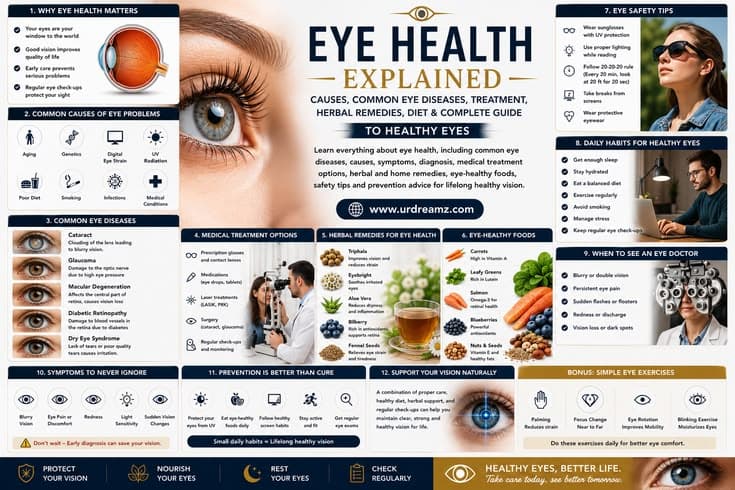
Eye Health Explained: Causes, Common Eye Diseases, Treatment, Herbal Remedies, Diet and Complete Guide to Healthy Eyes
Your eyes work harder than almost any other organ in your body, processing a constant stream of visual information from the moment you wake up until you close them at night. This complete guide explains how healthy vision actually works, what causes the most common eye diseases and vision problems, how doctors diagnose and treat them, which traditional home and herbal practices are genuinely safe to consider, and which everyday foods, habits, and safety measures protect your eyesight for the long run.
Introduction: Why Eye Health Deserves Daily Attention
Vision quietly shapes nearly every part of daily life, from reading a message on your phone to recognizing a loved one's face across a room, yet eye health rarely gets the same attention people give to heart health, weight, or sleep. Many eye conditions develop slowly and painlessly, meaning noticeable vision loss is often the last sign to appear rather than the first, long after damage has already begun. This guide is built to change that by walking through how the eye actually works, what commonly goes wrong, and which medical treatments, traditional home practices, and everyday habits genuinely support long-term vision.
Because eyesight tends to change so gradually, it is easy to unconsciously adapt without realizing how much has shifted, tilting the head slightly to compensate for one weaker eye, holding a phone a little closer each year, or simply assuming tired eyes are just part of a busy schedule. Understanding the underlying causes behind these small adjustments is the first step toward catching problems early, when they are usually far easier to manage.
What Is Eye Health? A Quick Look at Eye Anatomy
The eye is a remarkably compact and precise organ made up of several working parts that must all function correctly together to produce clear vision. Light first passes through the cornea, the clear dome at the front of the eye, then through the pupil, the adjustable opening controlled by the colored iris. Behind the pupil sits the lens, which fine-tunes focus, before light finally lands on the retina at the back of the eye, a light-sensitive layer that converts what you see into signals sent to the brain through the optic nerve.
Eye health, in the broadest sense, refers to the proper functioning of every part of this system, from the clarity of the cornea and lens to the health of the retina and optic nerve, as well as the surrounding structures such as the eyelids, tear film, and eye muscles that keep the eyes moist, protected, and properly aligned.
How the Eye Actually Sees
Vision begins the moment light enters the eye and ends with an image interpreted deep within the brain. As light passes through the cornea and lens, it is bent and focused so that it lands precisely on the retina, much like a camera lens focusing light onto film. Specialized cells in the retina called rods and cones then convert this focused light into electrical signals, with rods handling low-light and peripheral vision and cones handling color and fine detail. These signals travel along the optic nerve to the brain's visual cortex, where they are finally assembled into the coherent image you consciously perceive.
This entire process happens in a fraction of a second and relies on every component working in precise coordination. A problem at any single step, whether a clouded lens, a damaged retina, or a compressed optic nerve, can disrupt the final image even if every other part of the eye is functioning normally, which is why doctors examine the eye as an interconnected system rather than checking just one component in isolation.
Why Eye Health Matters for Overall Wellbeing
Good vision affects far more than the ability to read or drive; it shapes independence, safety, learning, and mental wellbeing across every stage of life. Children with undetected vision problems often struggle in school without anyone realizing the true cause, while older adults with declining vision face a meaningfully higher risk of falls and reduced independence. Vision loss has also been linked to a higher risk of social isolation and depression, particularly in older age, underscoring that protecting eyesight is not simply a cosmetic or convenience issue but a genuine pillar of long-term health and quality of life.
Common Vision Problems: An Overview
Eye conditions generally fall into a few broad categories: refractive errors, which affect how light is focused and can usually be corrected with glasses, contacts, or surgery; structural and age-related diseases, such as cataracts, glaucoma, and macular degeneration, which affect the physical health of the eye's internal structures; surface and lid conditions, such as dry eye, conjunctivitis, and styes, which affect comfort and the eye's outer surface; and functional strain conditions, such as digital eye strain, caused by modern visual habits rather than disease. Understanding which category a symptom falls into is often the first step toward figuring out the right kind of care.
Myopia (Nearsightedness) Explained
Myopia, commonly known as nearsightedness, occurs when the eyeball is slightly too long or the cornea is too curved, causing light to focus in front of the retina instead of directly on it. This makes distant objects appear blurry while close-up vision generally remains clear. Myopia often develops in childhood or adolescence and can continue to progress through the teenage years, and its prevalence has been rising globally in recent decades, a trend many eye specialists link partly to increased near-work activities and reduced time spent outdoors during childhood.
Hyperopia (Farsightedness) Explained
Hyperopia, or farsightedness, is essentially the opposite of myopia, occurring when the eyeball is slightly too short or the cornea is too flat, causing light to focus behind the retina. This typically makes close-up objects appear blurry while distant vision remains relatively clear, though in more significant cases distance vision can be affected as well. Mild hyperopia is common and often goes unnoticed in younger people because the eye can partially compensate by adjusting focus, but this compensation becomes harder to sustain with age, often making symptoms more noticeable later in life.
Astigmatism Explained
Astigmatism occurs when the cornea or lens has an irregular, more football-shaped curve rather than a perfectly round one, causing light to focus at multiple points instead of a single point on the retina. This typically results in blurred or distorted vision at any distance, sometimes accompanied by eye strain, headaches, or difficulty with night vision. Astigmatism frequently occurs alongside myopia or hyperopia and, like both, is usually correctable with properly prescribed glasses, contact lenses, or refractive surgery.
Presbyopia Explained
Presbyopia is an age-related change in which the eye's natural lens gradually loses flexibility, making it harder to focus on close-up objects. Unlike other refractive errors, presbyopia is not caused by an irregular eye shape but by the natural stiffening of the lens that occurs with age, typically becoming noticeable in the early to mid-forties. This is why many people who never needed glasses before find themselves reaching for reading glasses or holding a book slightly farther away once they reach this stage of life, and presbyopia will eventually affect nearly everyone regardless of previous vision history.
Table: Comparing Common Refractive Errors
| Condition | What Is Affected | Typical Onset |
|---|---|---|
| Myopia | Distance vision is blurry | Childhood or adolescence |
| Hyperopia | Near vision is blurry | Can be present from childhood, more noticeable with age |
| Astigmatism | Vision is blurred or distorted at any distance | Any age, often present from birth |
| Presbyopia | Near vision, due to reduced lens flexibility | Typically appears in the early to mid-forties |
Cataracts Explained
A cataract is a gradual clouding of the eye's naturally clear lens, causing vision to become increasingly blurry, hazy, or dim, somewhat like looking through a fogged-up window. Cataracts most commonly develop with age as proteins in the lens slowly clump together, though they can also result from injury, certain medications, prolonged UV exposure, or underlying conditions such as diabetes. Because cataracts develop slowly, many people adapt to the gradual vision loss without realizing how significantly their sight has changed until it is assessed during an eye exam.
Glaucoma Explained
Glaucoma refers to a group of conditions that damage the optic nerve, most commonly associated with elevated pressure inside the eye, and is one of the leading causes of irreversible blindness worldwide. What makes glaucoma particularly dangerous is that it typically causes no early symptoms at all, silently narrowing peripheral vision over years before central vision is eventually affected in more advanced stages. Because vision loss from glaucoma cannot be reversed, only slowed with treatment, routine eye pressure checks are the primary way this condition is caught early enough to preserve remaining vision.
Age-Related Macular Degeneration Explained
Age-related macular degeneration affects the macula, the small central portion of the retina responsible for sharp, detailed central vision needed for tasks like reading and recognizing faces. It generally comes in two forms: a more common "dry" type, involving a gradual thinning of the macula, and a less common but more aggressive "wet" type, involving abnormal blood vessel growth that can cause more rapid vision loss. While macular degeneration primarily affects central vision and typically spares peripheral vision, it can significantly impact independence and quality of life, making early detection and, for the wet form, timely treatment particularly important.
Diabetic Retinopathy Explained
Diabetic retinopathy is a complication of diabetes in which chronically elevated blood sugar damages the small blood vessels of the retina, causing them to leak, swell, or grow abnormally. In its earlier stages it often causes no noticeable symptoms, but as it progresses it can lead to blurred vision, dark spots, and in advanced cases, severe vision loss. Because diabetic retinopathy is directly tied to blood sugar control, consistent diabetes management combined with regular dilated eye exams is central to preventing or slowing this particular threat to vision.
Dry Eye Syndrome Explained
Dry eye syndrome occurs when the eyes do not produce enough tears, or produce tears of poor quality, leading to insufficient lubrication of the eye's surface. This can cause a gritty, burning, or scratchy sensation, redness, sensitivity to light, and, somewhat counterintuitively, sometimes excessive watering as the eyes overcompensate for underlying dryness. Common contributors include aging, prolonged screen use that reduces blinking frequency, dry or air-conditioned environments, certain medications, and underlying conditions that affect tear production.
Conjunctivitis (Pink Eye) Explained
Conjunctivitis, commonly known as pink eye, is inflammation of the conjunctiva, the thin, clear membrane covering the white part of the eye and the inside of the eyelids. It can be caused by viral or bacterial infection, both of which are typically contagious, or by allergies, which are not contagious but can still cause significant redness, itching, and discomfort. Symptoms often include redness, itching, tearing, and sometimes discharge, and while most cases resolve on their own or with appropriate treatment, proper hygiene is important to prevent spreading infectious forms to others.
Stye and Chalazion Explained
A stye is a small, often painful red bump that forms near the edge of the eyelid, typically caused by a bacterial infection of an oil gland or eyelash follicle. A chalazion is a related but distinct condition, a usually painless lump that forms when an oil gland becomes blocked, sometimes developing after a stye has resolved. Both are generally managed with warm compresses to encourage natural drainage and typically resolve within one to two weeks, though persistent, painful, or recurring lumps should be evaluated by a doctor to rule out other causes.
Blepharitis Explained
Blepharitis is a chronic inflammation of the eyelids, most often occurring where the eyelashes grow, and is commonly linked to blocked oil glands, bacterial overgrowth, or an underlying skin condition affecting the scalp and eyebrows. Symptoms typically include red, swollen, itchy eyelids, crusting around the eyelashes, particularly noticeable upon waking, and a gritty or burning sensation. Because blepharitis tends to be a long-term, recurring condition rather than something that resolves permanently, consistent eyelid hygiene is usually the cornerstone of managing symptoms over time.
Color Blindness Explained
Color blindness, more accurately described as color vision deficiency, occurs when the cone cells in the retina responsible for detecting color do not function typically, most commonly affecting the ability to distinguish between certain shades of red and green. The most common forms are inherited genetically and are present from birth, disproportionately affecting men due to the way the relevant genes are inherited, though color vision changes can occasionally develop later in life due to certain eye diseases, injuries, or medications. There is currently no cure for inherited color blindness, though specially tinted glasses and adaptive strategies can help some individuals better distinguish certain colors in daily life.
Computer Vision Syndrome and Digital Eye Strain
Computer vision syndrome, also called digital eye strain, refers to a cluster of eye and vision-related symptoms resulting from prolonged screen use, including eye fatigue, dryness, blurred vision, headaches, and neck or shoulder discomfort from poor screen positioning. A major contributing factor is reduced blink rate during screen use, since people naturally blink less often while focused on a screen, allowing the eye's surface to dry out more quickly than usual. Unlike many of the structural eye diseases discussed earlier, digital eye strain does not cause permanent damage, but it can significantly affect daily comfort and productivity if left unaddressed.
Table: Common Eye Diseases at a Glance
| Condition | What It Affects | Key Feature |
|---|---|---|
| Cataracts | Lens clarity | Gradual clouding and blurred vision |
| Glaucoma | Optic nerve | Often silent, causes irreversible vision loss if untreated |
| Macular degeneration | Central retina (macula) | Affects central vision, spares peripheral vision |
| Diabetic retinopathy | Retinal blood vessels | Linked directly to blood sugar control |
| Dry eye syndrome | Tear film and eye surface | Gritty, burning discomfort |
| Conjunctivitis | Conjunctiva (eye surface membrane) | Redness, itching, sometimes contagious |
| Stye and chalazion | Eyelid oil glands | Localized bump or lump on the eyelid |
| Blepharitis | Eyelid margins | Chronic inflammation and crusting |
Causes of Eye Problems: Age
Age is one of the most consistent risk factors across nearly every major eye condition. The lens naturally stiffens over time, leading to presbyopia, while proteins within it can clump together, forming cataracts. The retina and macula also become more vulnerable to degeneration with age, and the optic nerve becomes more susceptible to pressure-related damage, all of which is why routine eye exams become increasingly important as a person moves through their forties, fifties, and beyond, even without any noticeable symptoms.
Causes of Eye Problems: Genetics and Family History
Many eye conditions, including glaucoma, macular degeneration, certain forms of retinal disease, and color blindness, have a meaningful genetic component, meaning a family history significantly raises an individual's personal risk. Knowing your family's eye health history is a genuinely useful piece of information to share with an eye doctor, since it can influence how early screening begins and how closely certain conditions are monitored over time, even before any symptoms appear.
Causes of Eye Problems: Diabetes and Chronic Disease
Diabetes stands out as one of the most significant systemic contributors to eye disease, primarily through its effect on the small blood vessels of the retina, but chronic conditions such as high blood pressure and high cholesterol can also affect eye blood vessel health over time. This connection between whole-body health and eye health is a strong reminder that protecting vision is not only about the eyes themselves but also about managing broader health conditions that quietly place the eyes at risk.
Causes of Eye Problems: UV Exposure and Environment
Cumulative exposure to ultraviolet light from the sun over a lifetime is a recognized contributor to cataract formation and has also been linked to certain forms of macular degeneration. Environmental factors such as dry or dusty air, air pollution, and prolonged exposure to air conditioning or heating can also aggravate the eye's surface, contributing to dryness and irritation, particularly for people who already have a tendency toward dry eye.
Causes of Eye Problems: Screen Time and Digital Strain
The dramatic rise in daily screen time, spanning phones, computers, and televisions, has made digital eye strain one of the most common eye-related complaints in the modern world. Extended close-up focus reduces blink rate and can contribute to eye fatigue, while some research also suggests that heavy near-work, particularly during childhood, may contribute to the development or progression of myopia. Balancing screen use with regular breaks and outdoor time is increasingly recognized as a meaningful protective habit.
Causes of Eye Problems: Poor Nutrition
The eyes rely on a steady supply of specific nutrients, including vitamin A, vitamin C, vitamin E, zinc, and the antioxidants lutein and zeaxanthin, to maintain healthy function and protect against oxidative damage over time. A diet consistently low in these nutrients, particularly a diet lacking colorful fruits, vegetables, and healthy fats, can leave the eyes more vulnerable to age-related damage, including a higher risk of cataracts and macular degeneration over the long term.
Causes of Eye Problems: Smoking and Lifestyle
Smoking is one of the most significant modifiable risk factors for eye disease, meaningfully increasing the risk of cataracts, macular degeneration, and optic nerve damage through its effects on blood vessels and oxidative stress throughout the body. Other lifestyle factors, including excessive alcohol intake, chronic sleep deprivation, and prolonged unprotected sun exposure, can each independently add to cumulative eye strain and damage over the years, making eye health another compelling reason among many to address these broader lifestyle habits.
Table: Key Risk Factors for Eye Disease
| Risk Factor | Conditions It Raises Risk For |
|---|---|
| Age | Cataracts, glaucoma, macular degeneration, presbyopia |
| Family history | Glaucoma, macular degeneration, color blindness |
| Diabetes | Diabetic retinopathy, earlier cataracts |
| UV exposure | Cataracts, some forms of macular degeneration |
| Excessive screen time | Digital eye strain, dry eye, possible myopia progression |
| Poor nutrition | Cataracts, macular degeneration |
| Smoking | Cataracts, macular degeneration, optic nerve damage |
Symptoms That Need Prompt Attention
While many eye symptoms are minor and temporary, certain signs warrant prompt evaluation rather than a wait-and-see approach. Sudden vision loss or blurring, seeing flashes of light or a sudden increase in floaters, a curtain-like shadow across part of your vision, severe eye pain, and sudden double vision can all signal a serious underlying issue that benefits from urgent assessment. Recognizing these red flags and acting quickly can, in some cases, be the difference between a fully treatable condition and permanent vision loss.
Table: Warning Sign Checklist
| Symptom | Why It Matters |
|---|---|
| Sudden vision loss or blurring | May indicate a retinal or vascular emergency |
| Flashes of light or new floaters | Can signal retinal detachment risk |
| Curtain-like shadow in vision | Classic sign of possible retinal detachment |
| Severe eye pain | Can indicate acute glaucoma or infection |
| Sudden double vision | May reflect a neurological or muscular issue |
| Persistent redness with pain | May indicate infection or inflammation needing treatment |
Diagnosis: The Basic Eye Exam
A comprehensive eye exam is the foundation of eye health screening and typically includes a review of personal and family eye history, a visual acuity test, an assessment of eye pressure, and an examination of the front and back structures of the eye. Even people with no noticeable vision problems are generally advised to have a baseline eye exam by early adulthood and then periodically afterward, since several serious eye conditions, particularly glaucoma, can progress silently without early symptoms.
Diagnosis: Visual Acuity Testing
Visual acuity testing, most commonly performed using a standardized eye chart, measures how clearly a person can see at a specific distance compared to a defined normal standard. This is the familiar test where letters of decreasing size are read from across the room, and the results help determine both whether a refractive error is present and how significant it is, guiding decisions about glasses, contact lens prescriptions, or further evaluation if vision does not correct to a normal level with lenses alone.
Diagnosis: Tonometry and Eye Pressure
Tonometry measures the pressure inside the eye, a key indicator used to screen for and monitor glaucoma. Elevated eye pressure does not always mean glaucoma is present, and not everyone with glaucoma has elevated pressure, but this measurement remains one of the most important and widely used screening tools available, particularly because it can flag early risk long before any noticeable vision changes occur.
Diagnosis: Retinal Exam and OCT Imaging
A dilated retinal exam allows a doctor to directly examine the back of the eye, including the retina, macula, and optic nerve, typically after using eye drops to temporarily widen the pupil for a clearer view. Optical coherence tomography, commonly abbreviated as OCT, is a more advanced, non-invasive imaging technique that produces detailed cross-sectional images of the retina, allowing doctors to detect subtle changes in retinal thickness or structure long before they would be visible through a standard exam alone, making it especially valuable for monitoring conditions like macular degeneration and diabetic retinopathy over time.
Table: Common Eye Tests Explained
| Test | What It Measures |
|---|---|
| Visual acuity test | Clarity of vision at a set distance |
| Tonometry | Pressure inside the eye |
| Dilated retinal exam | Direct view of the retina, macula and optic nerve |
| OCT imaging | Detailed cross-sectional images of retinal structure |
| Visual field test | Extent of peripheral vision, often used for glaucoma |
| Slit-lamp examination | Close-up view of the cornea, lens and front eye structures |
Treatment: Glasses and Contact Lenses
Glasses and contact lenses remain the most common and accessible treatment for refractive errors like myopia, hyperopia, astigmatism, and presbyopia, working by bending light so that it focuses correctly on the retina. Advances in lens technology now offer options such as progressive lenses that smoothly transition between distances and specialized lenses designed to help slow myopia progression in children, reflecting how even this long-standing, straightforward treatment continues to evolve alongside a better understanding of eye health.
Treatment: Eye Drops and Medications
Eye drops are used to treat a wide range of conditions, from lubricating drops that relieve dry eye to antibiotic drops that treat bacterial infections, antihistamine drops that calm allergic reactions, and pressure-lowering drops that form the first line of treatment for many cases of glaucoma. Because different eye conditions require very different types of drops, and because some drops can worsen certain conditions if used incorrectly, any eye drop beyond basic preservative-free lubricating drops should generally be used only as directed by a doctor rather than chosen based on symptoms alone.
Treatment: LASIK and Refractive Surgery
LASIK and related refractive surgeries reshape the cornea using a precisely controlled laser to correct how light focuses on the retina, offering many patients significantly reduced or eliminated dependence on glasses and contact lenses. These procedures are generally safe and effective for well-selected candidates, but they are not appropriate for everyone, since factors such as corneal thickness, overall eye health, and the stability of a person's prescription over time all influence candidacy. A thorough evaluation with an eye surgeon is necessary to determine whether refractive surgery is a suitable option for a given individual.
Treatment: Cataract Surgery
Cataract surgery is one of the most commonly performed and highly successful surgical procedures in modern medicine, involving the removal of the eye's clouded natural lens and its replacement with a clear artificial intraocular lens. The procedure is typically quick, performed on an outpatient basis, and most patients experience significantly improved vision within days. Because cataracts generally worsen gradually rather than resolving on their own, surgery remains the only effective treatment once a cataract has progressed enough to meaningfully interfere with daily activities.
Treatment: Managing Glaucoma Long Term
Because vision lost to glaucoma cannot be restored, treatment focuses entirely on lowering eye pressure to slow or halt further optic nerve damage, typically starting with prescription eye drops, and progressing to laser treatment or surgical procedures if drops alone are not sufficient to control pressure. Glaucoma management is a lifelong commitment rather than a one-time fix, requiring consistent use of prescribed treatment and regular monitoring, since the condition can continue to progress silently even while a person feels their vision is stable.
Table: Treatment Options Overview
| Condition | Common Treatment Approach |
|---|---|
| Refractive errors | Glasses, contact lenses, or LASIK/refractive surgery |
| Cataracts | Surgical lens replacement once vision is significantly affected |
| Glaucoma | Pressure-lowering eye drops, laser treatment, or surgery |
| Macular degeneration | Nutritional support, injections for the wet form, monitoring |
| Diabetic retinopathy | Blood sugar control, laser treatment, or injections as needed |
| Dry eye syndrome | Lubricating drops, environmental changes, prescription drops if needed |
| Conjunctivitis | Depends on cause: supportive care, antibiotics, or antihistamines |
Herbal and Traditional Remedies for Eye Health
Traditional and herbal practices for eye comfort have a long history across many cultures, and several gentle, well-established approaches can genuinely support everyday eye comfort alongside, rather than in place of, proper medical care. Cooled chamomile tea bags or a clean, damp cloth soaked in cooled rosewater applied gently over closed eyelids are commonly used to soothe tired, puffy, or mildly irritated eyes, largely through their calming, mildly anti-inflammatory properties and the simple relief of a cool compress. Cucumber slices, similarly, offer a cooling effect that can reduce the appearance of puffiness around the eyes, though this is a cosmetic comfort measure rather than a treatment for any underlying eye disease.
It is important to approach herbal eye remedies with real caution rather than assuming "natural" automatically means "safe for the eyes." The surface of the eye is extremely delicate and any preparation applied near it should be clean, properly cooled, and used only on closed eyelids rather than dropped directly into the eye unless it is a product specifically formulated, tested, and approved for ophthalmic use. Homemade solutions, herbal infusions, or substances such as raw honey, breast milk, or undiluted plant extracts should never be placed directly inside the eye, since they carry a real risk of introducing bacteria, causing irritation, or triggering a more serious infection or injury.
Table: Traditional Herbal Practices and Safety Notes
| Traditional Practice | Typical Use | Safety Note |
|---|---|---|
| Cooled chamomile tea bags on closed eyelids | Soothing tired or mildly irritated eyes | Apply only to closed eyelids, ensure the tea has fully cooled |
| Cooled rosewater compress on closed eyelids | Reducing puffiness, general comfort | Use a clean cloth; avoid contact with the open eye surface |
| Cucumber slices over closed eyes | Cooling and reducing puffiness | Cosmetic comfort only; not a treatment for eye disease |
| Warm compress on closed eyelids | Helping a stye or blocked oil gland drain | Use a clean, warm (not hot) cloth; discontinue if pain worsens |
| Undiluted herbal extracts, raw honey, or homemade eye washes placed directly in the eye | Sometimes used traditionally for infection or irritation | Not recommended; risk of contamination, irritation or injury to the eye surface |
As a general rule, anything genuinely intended to go inside the eye itself, rather than simply rest against closed eyelids, should be a sterile, properly formulated product recommended by a doctor rather than a homemade preparation, no matter how traditional or well-intentioned the recipe.
Safe Home Care Practices for Everyday Eye Comfort
Beyond traditional remedies, several simple home habits genuinely support everyday eye comfort and are well supported by general eye care guidance. Warm compresses applied to closed eyelids can help loosen debris and support natural oil gland function, which is particularly useful for mild blepharitis or an early stye. Gently cleaning the eyelid margins with a clean cloth and mild, tear-free cleanser can help remove crusting and debris, especially for people prone to blepharitis. Simply resting the eyes periodically during long stretches of close-up work, blinking deliberately and fully every so often, and ensuring adequate room lighting while reading or working all support comfortable, healthy eyes without requiring any special product at all.
Diet and Nutrition for Eye Health
What you eat has a genuine, well-documented influence on long-term eye health. Vitamin A supports the retina's ability to process light and is essential for preventing night blindness, while antioxidants such as vitamin C and vitamin E help protect delicate eye tissue from oxidative stress that accumulates over time. Lutein and zeaxanthin, two plant pigments concentrated specifically in the macula, act almost like an internal pair of sunglasses, filtering harmful high-energy light and supporting long-term macular health. Omega-3 fatty acids, found in fatty fish, support tear film quality and have been linked to a reduced risk of dry eye, while zinc plays a supporting role in transporting vitamin A from the liver to the retina.
Table: Best Foods for Eye Health
| Food | Key Nutrient | How It Helps |
|---|---|---|
| Carrots and sweet potatoes | Vitamin A (beta-carotene) | Supports night vision and retinal health |
| Leafy greens (spinach, kale) | Lutein and zeaxanthin | Protects the macula from light damage |
| Fatty fish (salmon, sardines) | Omega-3 fatty acids | Supports tear film and reduces dry eye risk |
| Citrus fruits and berries | Vitamin C | Antioxidant protection for eye tissue |
| Nuts and seeds | Vitamin E | Protects cells from oxidative damage |
| Eggs | Lutein, zeaxanthin and zinc | Supports macular health and vitamin A transport |
| Whole grains | Zinc and vitamin E | General antioxidant and structural support |
| Bell peppers | Vitamin C | High antioxidant content in a low-calorie food |
Table: Foods and Habits That Harm Eye Health
| Item | Why It Can Harm Eye Health |
|---|---|
| Highly processed foods high in sugar | Linked to increased risk of diabetic eye complications |
| Excessive alcohol intake | Can contribute to nutrient deficiencies affecting eye health |
| Smoking | Significantly raises risk of cataracts and macular degeneration |
| Chronic dehydration | Can worsen dry eye symptoms |
| Extended unprotected screen time | Contributes to digital eye strain and reduced blink rate |
| Unprotected sun exposure | Cumulative UV exposure raises cataract and macular degeneration risk |
Table: Sample Eye-Healthy Daily Meal Ideas
| Meal | Eye-Healthy Option |
|---|---|
| Breakfast | Scrambled eggs with spinach and a side of orange slices |
| Lunch | Grilled salmon salad with bell peppers and leafy greens |
| Snack | A small handful of almonds or walnuts with a piece of fruit |
| Dinner | Baked sweet potato with a side of steamed kale and grilled fish |
| Drink | Water throughout the day; citrus-infused water as a vitamin C boost |
This is a general educational example rather than a personalized nutrition plan, and portion sizes or specific choices should be adjusted with guidance from a doctor or registered dietitian, particularly for people managing diabetes or other medical conditions.
Safety Tips: Screen Time and Blue Light
Reducing the strain of prolonged screen use starts with a simple, widely recommended guideline known as the 20-20-20 rule: every 20 minutes, look at something roughly 20 feet away for at least 20 seconds, giving the eye's focusing muscles a genuine break. Positioning screens slightly below eye level, ensuring adequate room lighting to reduce screen glare, and consciously blinking more often during screen use all help counter the dryness and fatigue that come with extended near-work, particularly for anyone spending many hours a day in front of a computer.
Safety Tips: Sun Exposure and Sunglasses
Protecting the eyes from ultraviolet light is one of the simplest and most effective long-term investments in eye health. Sunglasses that block both UVA and UVB rays help reduce cumulative sun damage linked to cataracts and certain forms of macular degeneration, and wraparound styles offer additional protection by blocking light entering from the sides. This protection matters even on cloudy days, since UV rays penetrate cloud cover, and is especially important during peak sun hours, at high altitudes, or around reflective surfaces such as water and snow, which intensify UV exposure considerably.
Safety Tips: Contact Lens Hygiene
Contact lenses offer excellent vision correction but carry a genuine risk of eye infection when hygiene practices are not followed carefully. Always wash hands thoroughly before handling lenses, use only the specific contact lens solution recommended by an eye doctor rather than water or homemade alternatives, replace lenses according to the prescribed schedule, and never sleep in lenses that are not specifically designed and approved for extended wear. Skipping these steps, even occasionally, meaningfully raises the risk of a serious corneal infection that can, in severe cases, threaten vision itself.
Safety Tips: Workplace and Sports Eye Protection
Eye injuries are among the most preventable causes of vision loss, and appropriate protective eyewear dramatically reduces this risk in higher-risk environments. Safety glasses or goggles should be worn during activities involving flying debris, chemicals, or power tools, while sports-specific eyewear is strongly recommended for activities with a meaningful risk of eye impact, such as racquet sports, basketball, or contact sports. Because a serious eye injury can happen in a single unguarded moment, treating protective eyewear as a standard part of the activity, rather than an optional extra, is one of the most effective and underused eye safety habits available.
Eye Health in Children
Early childhood is a critical window for healthy visual development, and undetected vision problems during this period can affect not only eyesight but also learning and development more broadly. Routine vision screening during well-child visits helps catch conditions such as significant refractive errors, lazy eye, or eye misalignment early, when treatment tends to be most effective. Encouraging regular outdoor time, limiting excessive continuous near-work, and taking any signs of squinting, sitting too close to screens, or academic struggles seriously as potential vision clues can all support healthy visual development through childhood.
Eye Health for People With Diabetes
For people living with diabetes, eye health is directly tied to blood sugar management, since diabetic retinopathy and earlier-onset cataracts are both significantly more common with poorly controlled blood sugar over time. Annual dilated eye exams are strongly recommended for people with diabetes regardless of whether any vision symptoms are present, since diabetic retinopathy can progress silently in its early stages, and catching it early dramatically improves the chances of preserving vision through timely treatment.
Eye Health in Older Adults
Aging brings a higher likelihood of several major eye conditions occurring together, including cataracts, glaucoma, macular degeneration, and presbyopia, making comprehensive, regular eye exams especially important in this stage of life. Beyond disease screening, ensuring adequate home lighting, addressing any vision changes promptly, and considering how declining vision might affect fall risk and driving safety are all practical, protective steps that support both eye health and overall independence and safety in older age.
Eye Health During Pregnancy
Pregnancy can bring temporary changes to vision due to hormonal shifts and fluid retention, which can slightly affect corneal shape and occasionally make a previously stable contact lens prescription feel less comfortable. For women with pre-existing diabetes or those who develop gestational diabetes, monitoring for diabetic eye changes becomes particularly important during pregnancy, since blood sugar fluctuations can influence eye health more noticeably during this period. Most pregnancy-related vision changes resolve after delivery, but any significant or persistent vision change during pregnancy should be discussed with a doctor rather than assumed to be a routine and harmless part of pregnancy.
Table: Eye Health Myths vs Facts
| Myth | Fact |
|---|---|
| Reading in dim light permanently damages your eyes | It can cause temporary eye strain but does not cause lasting damage |
| Sitting too close to the TV ruins your eyesight | It may cause temporary discomfort but does not cause permanent damage |
| Eating carrots alone can give you perfect vision | Carrots support eye health but cannot correct an existing refractive error |
| Wearing glasses makes your eyes dependent and weaker | Glasses correct focus; they do not weaken the underlying eyes |
| You only need an eye exam if your vision feels blurry | Many serious eye conditions, like glaucoma, cause no early symptoms |
| Natural or herbal eye drops are always safer than medical ones | Unregulated homemade preparations can introduce infection or irritation |
Prevention Tips for Lifelong Healthy Vision
Protecting vision over a lifetime relies on a combination of consistent habits rather than any single dramatic intervention. Scheduling regular eye exams even without symptoms, wearing UV-protective sunglasses outdoors, following the 20-20-20 rule during screen work, eating a diet rich in eye-supportive nutrients, avoiding smoking, and practicing careful contact lens hygiene together form a strong, sustainable foundation for long-term eye health. Managing broader health conditions such as diabetes, high blood pressure, and high cholesterol also indirectly protects the eyes, since so many serious eye conditions are closely tied to overall cardiovascular and metabolic health.
As with most areas of long-term health, small consistent habits tend to matter more than occasional intense effort. Wearing sunglasses on most sunny days, taking regular screen breaks most workdays, and keeping up with annual or biennial eye exams as recommended by your doctor will do far more for lifelong vision than a single perfect week followed by months of neglect.
When to See an Eye Doctor
Routine eye exams are recommended periodically for everyone, even without symptoms, with frequency depending on age, risk factors, and existing eye conditions as advised by your eye doctor. You should seek care sooner if you experience sudden vision changes, eye pain, persistent redness, flashes of light or new floaters, difficulty seeing at night, or any of the warning signs discussed earlier in this guide. For people with diabetes, a family history of eye disease, or an existing eye condition, more frequent monitoring is generally recommended, and a doctor can advise on the right schedule for your individual situation.
Frequently Asked Questions
What are the most common causes of poor eyesight?
Refractive errors like myopia, hyperopia, and astigmatism are the most common causes of poor eyesight, though age-related conditions such as cataracts, glaucoma, and macular degeneration also play a major role over time.
Can eye problems be treated naturally at home?
Mild comfort measures like warm compresses and cooled tea bags on closed eyelids can support everyday comfort, but genuine eye diseases require proper medical diagnosis and treatment rather than home remedies alone.
What foods are best for eye health?
Leafy greens, carrots, fatty fish, citrus fruits, nuts, and eggs are among the most consistently supportive foods for long-term eye health.
How often should I get an eye exam?
Most healthy adults are advised to have an eye exam every one to two years, with more frequent exams recommended for people with diabetes, a family history of eye disease, or an existing eye condition.
Is it safe to put herbal remedies directly in the eye?
Generally, no. Homemade or herbal preparations should be used on closed eyelids rather than placed directly in the eye, since the eye surface is delicate and prone to infection or irritation from unregulated substances.
Can screen time permanently damage your eyes?
Screen time causes temporary digital eye strain rather than permanent damage, though it can contribute to discomfort and, in some cases, myopia progression, particularly in children.
What is the earliest sign of glaucoma?
Glaucoma typically has no early symptoms at all, which is why routine eye pressure checks are the primary way it is detected before noticeable vision loss occurs.
Does wearing glasses make your eyes weaker over time?
No, glasses correct how light focuses on the retina; they do not weaken the eyes or cause dependency in a physical sense.
Can diet alone prevent eye disease?
A nutrient-rich diet supports eye health and can reduce risk, but it cannot fully prevent conditions with a strong genetic or age-related component; regular eye exams remain essential.
When should I see an eye doctor urgently?
Sudden vision loss, eye pain, flashes of light, a sudden increase in floaters, or a curtain-like shadow in your vision all warrant urgent evaluation rather than waiting for a routine appointment.
Conclusion
Eye health is easy to take for granted precisely because so many serious eye conditions develop quietly, without pain or obvious early symptoms, until meaningful damage has already occurred. Understanding how the eye works, recognizing the common conditions that affect vision, knowing which home and herbal practices are genuinely safe, and building consistent habits around diet, screen use, sun protection, and regular eye exams together form a realistic, sustainable path toward protecting your eyesight for life. This guide is intended for general education and does not replace professional eye care; always consult a qualified eye doctor for diagnosis, treatment, and personalized guidance regarding your vision and eye health.
If there is one habit worth carrying forward from this guide, it is treating your eyes the way you would treat any other vital organ: worthy of regular checkups even when nothing feels wrong. A routine eye exam costs very little time compared to the years of clear, comfortable vision it can help protect.
Related Reading:
- Diabetes Explained: Symptoms, Causes, Blood Sugar and Treatment Guide
- Weight Loss Diet Plan: Best Foods for Fat Loss
- High Blood Pressure vs Low Blood Pressure: Complete Guide
- Heart Health: Complete Guide to Prevention, Symptoms and Diet
- Digestive Problems Explained: Causes, Symptoms and Treatment
- Fatty Liver Disease: Warning Signs, Stages and Complete Guide
- Kidney Health Explained: Symptoms, Causes and Treatment
- Thyroid Disorders Explained: Symptoms, Causes and Treatment
- Joint Pain Explained: Causes, Symptoms and Treatment
- High Cholesterol Explained: Symptoms, Causes, LDL vs HDL and Treatment Guide
- Anemia Explained: Symptoms, Causes, Iron Deficiency and Treatment Guide
- Sleep Health Explained: Causes of Poor Sleep and Complete Guide to Better Sleep
This article is for general educational purposes only and is not a substitute for professional medical advice, diagnosis, or treatment. Always consult a qualified eye doctor regarding any eye condition, symptom, or vision concern.