Obesity: The Big Picture | What Is Actually Going Wrong?
Obesity is now the single largest contributing factor behind a huge share of chronic disease worldwide — but before diving into causes or consequences, it helps to answer a much more basic question first: how do you actually know whether you are obese in the first place? This guide starts from the ground up — how ideal weight actually scales with height, how the standard BMI screening tool classifies underweight through severe obesity, why that same tool can genuinely mislead a muscular, athletic person, and — most importantly — why not all body fat is created equal, with one specific type sitting dangerously close to your internal organs.
1. Obesity: The Simple Question Behind a Complex Problem
Obesity has become one of the single largest contributing factors behind chronic disease worldwide today, tied directly to heart disease, diabetes, joint problems, and a long list of other serious health conditions. But before addressing causes or treatment, the far more basic and genuinely useful starting question is simply this: how does a person actually know whether they are obese in the first place? Answering this properly requires starting with the most fundamental building block of all — the relationship between height and healthy weight.
2. The Height-Weight Baseline for Men
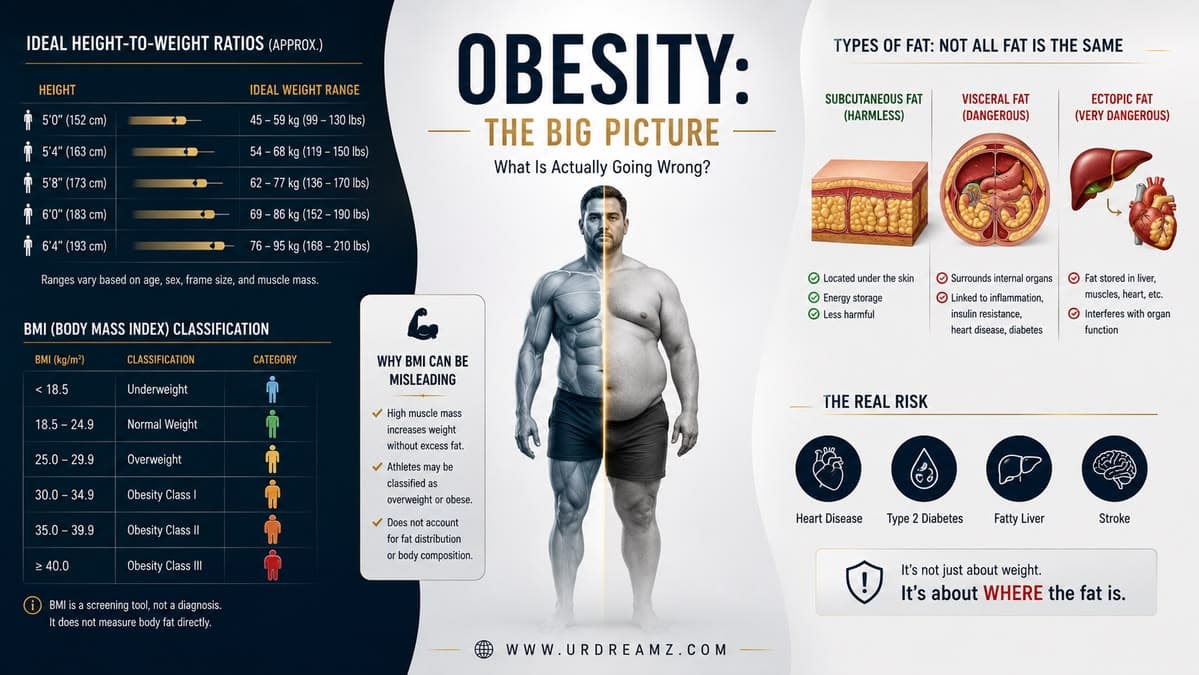
For an average adult male, a commonly used reference point begins at a height of 5 feet, corresponding to an ideal baseline weight of approximately 50 kilograms. This figure serves as the starting anchor point from which weight expectations scale upward as height increases, following a fairly predictable, incremental pattern rather than jumping arbitrarily from one height to the next.
3. How Weight Scales With Every Inch of Height
For every additional 0.1 feet (roughly one inch) of height beyond the 5-foot baseline, a proportional increase of approximately 2.5 kilograms is added to the expected healthy weight for men. Following this incremental pattern: a man standing 5 feet 1 inch (5.1) would have an ideal weight of approximately 52.5 kg, while a man standing 5 feet 2 inches (5.2) would have an ideal weight of approximately 55 kg. This same steady, roughly linear scaling pattern continues predictably as height increases further — for example, a man standing 5 feet 4 inches would correspond to an ideal weight of approximately 60 kg, continuing to add roughly 2.5 kg for every additional inch beyond the original baseline.
4. The Height-Weight Baseline for Women
For an average adult female, the baseline reference point also begins at 5 feet, but corresponds to a somewhat lower ideal weight of approximately 45 kilograms, reflecting the generally different average body composition between men and women discussed in earlier guides on hormonal differences. For every additional inch of height beyond this 5-foot baseline, the expected healthy weight increase for women is approximately 2 to 2.2 kilograms per inch — meaning a woman standing 5 feet 1 inch would have an ideal weight of approximately 47.2 kg.
5. A Full Height-to-Weight Reference Table
Bringing these incremental figures together into a single, easy-to-reference table makes the overall pattern much easier to follow at a glance for both sexes.
| Height | Approx. Ideal Weight (Male) | Approx. Ideal Weight (Female) |
|---|---|---|
| 5'0" | 50 kg | 45 kg |
| 5'1" | 52.5 kg | 47.2 kg |
| 5'2" | 55 kg | 49.2-49.4 kg |
| 5'3" | 57.5 kg | 51.4-51.6 kg |
| 5'4" | 60 kg | 53.4-53.8 kg |
Note: These figures are simplified, commonly used approximations rather than a rigorous clinical formula — actual healthy weight ranges vary based on frame size, muscle mass, and other individual factors, several of which are discussed later in this guide.
6. Introducing BMI: Body Mass Index
Beyond this simple height-to-weight approximation, a more standardized and widely used tool exists for assessing healthy weight: BMI, or Body Mass Index. Rather than relying on a fixed, memorized incremental table, BMI is calculated directly from a person's exact height and weight, producing a single standardized number that can then be compared against established, universally recognized reference ranges.
7. What Anthropometric Screening Actually Means
BMI belongs to a broader category of health assessment tools known as Anthropometric Screening — a formal term referring to methods that use physical body measurements, such as height and weight, to assess and classify a person's general health status. This term may sound clinical and unfamiliar, but the underlying concept is genuinely simple: it is the practice of using measurable physical dimensions of the body as a practical, accessible proxy for evaluating broader health risk.
8. How to Actually Calculate Your BMI
In practice, most people do not need to memorize or manually apply the underlying BMI formula. A simple search on any search engine — entering your height and weight and asking for your BMI to be calculated — will instantly return the result. What matters more than the calculation itself is understanding exactly what the resulting number means, and precisely where it falls along the standardized classification ranges discussed throughout the rest of this guide.
9. The Normal BMI Range: 18.5 to 24.9
A BMI falling between 18.5 and 24.9 is classified as normal — generally considered a healthy weight range relative to height, associated with the lowest overall risk of weight-related health complications among the standard classification categories.
10. Underweight: Below 18.5
A BMI falling below 18.5 is classified as underweight. A person in this category is generally considered to need additional weight gain to reach a healthier range, since being significantly underweight carries its own distinct set of health risks, including reduced immune function, nutrient deficiencies, and, in some cases, bone density concerns.
11. Overweight: 25 to 29.9
A BMI falling between 25 and 29.9 is classified as overweight. A person in this range carries measurably more weight than is generally considered ideal for their height, though this category sits below the formal threshold for obesity, representing an intermediate risk zone.
12. Obesity Begins at 30
Once BMI crosses the threshold of 30, a person is formally classified as having obesity. This single threshold, however, is not a single undifferentiated category — obesity itself is further broken down into three distinct, progressively more severe classes, each carrying its own escalating level of associated health risk.
13. Class I Obesity: 30 to 34.9
A BMI falling between 30 and 34.9 is classified as Class I Obesity, representing the initial, least severe tier within the broader obesity classification.
14. Class II Obesity: 34.9 to 39.9
A BMI falling between 34.9 and 39.9 is classified as Class II Obesity, representing a more advanced and higher-risk tier compared to Class I, generally associated with a correspondingly greater risk of weight-related health complications.
15. Class III (Severe/Chronic) Obesity: 40 and Above
A BMI of 40 or above is classified as Class III Obesity, sometimes also referred to as chronic or severe obesity. This represents the most advanced tier within the standard classification system, generally associated with the highest overall risk of serious weight-related health complications among all the categories discussed in this guide.
16. The Full BMI Classification Chart
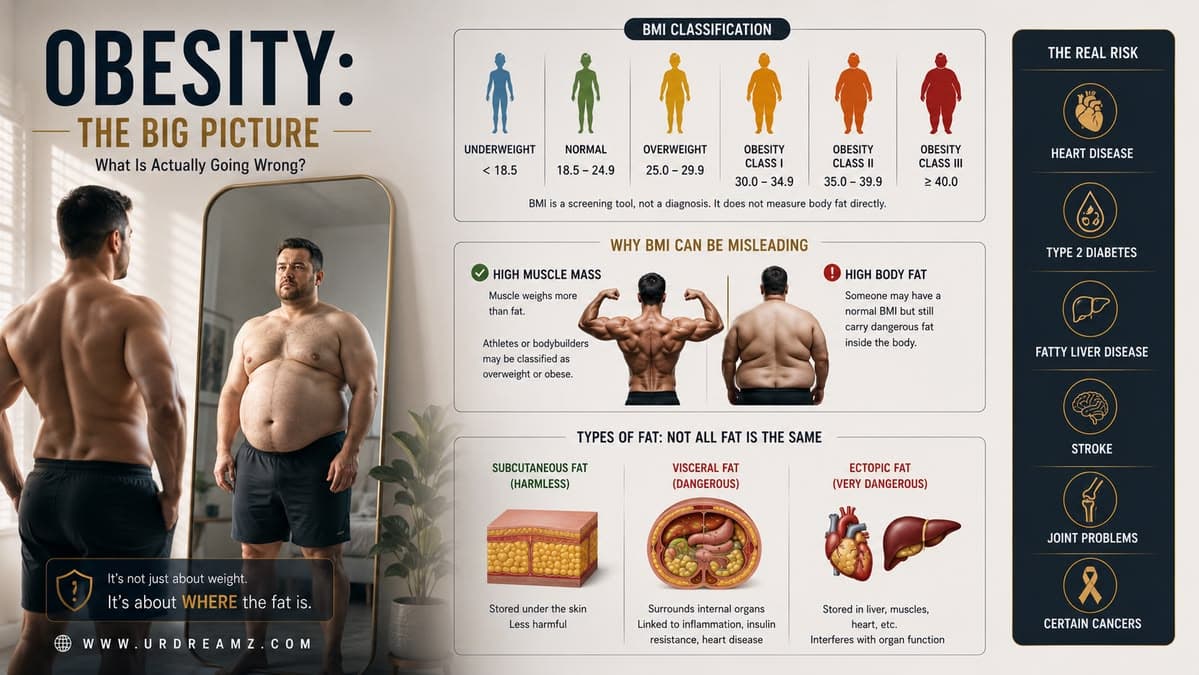
Bringing every tier of this classification system together into a single visual reference makes the overall progression, from underweight through severe obesity, much easier to grasp at a glance.
17. Why BMI Isn't Always Correct: The Three Hidden Variables
Despite its widespread use, BMI has a genuine and important limitation worth understanding clearly: it does not, and cannot, distinguish between the different components that actually make up a person's total body weight. Specifically, BMI has no way of separately accounting for fat, muscle, and bone — it simply divides total body weight by height, treating every kilogram of body mass as functionally identical, regardless of what that mass actually consists of.
18. The Muscular Athlete Problem
This limitation becomes particularly obvious in the case of muscular, athletic individuals. Since muscle tissue is considerably denser and heavier than fat tissue for the same physical volume, a highly muscular person can easily produce a BMI reading that falls into the "overweight" or even "obese" category, purely due to their substantial muscle mass — despite carrying very little actual body fat and being, by essentially every other meaningful health measure, in excellent physical condition. In this specific scenario, BMI's classification is genuinely misleading, since the underlying health risk that BMI is intended to estimate simply does not apply in the same way to this individual.
19. The "Normal BMI, Still Unhealthy" Problem
The opposite scenario is equally important to understand, and arguably more clinically significant: a person can fall entirely within the "normal" BMI range on paper, while still carrying a genuinely unhealthy proportion of body fat relative to muscle — sometimes referred to informally as being "skinny fat." In this scenario, the person's total weight relative to their height appears entirely unremarkable and healthy according to BMI, even though their actual underlying body composition, and the associated health risks that come with excess fat specifically, may be genuinely concerning.
20. Why BMI Alone Is Only a Starting Point
Taken together, these two scenarios — the healthy, muscular person misclassified as overweight, and the unhealthy, fat-dominant person misclassified as normal — make clear that BMI should be understood as a useful, accessible starting point for a broader health assessment, rather than a definitive, final verdict on any individual's actual health status. This is precisely why understanding the deeper distinction between different types of body fat, discussed throughout the remainder of this guide, matters so much more than the single BMI number alone.
21. Going Deeper: Not All Body Fat Is the Same
Perhaps the single most important concept in this entire guide is this: not all body fat carries the same health risk. Where fat is physically located within the body matters enormously, and understanding this distinction is genuinely more clinically meaningful than simply knowing a person's total body fat percentage or overall BMI classification.
22. Subcutaneous Fat: The Relatively Harmless Layer
The first and most familiar type of body fat is called Subcutaneous Fat — the layer of fat sitting directly beneath the skin, distributed across the body. This is the fat most people can physically pinch between their fingers, and it represents the majority of total body fat in most individuals.
23. Why the Body Actually Needs Subcutaneous Fat
Subcutaneous fat plays no significant direct role in metabolic disruption — its primary function relates to temperature regulation, helping insulate the body against both cold and heat, acting as a protective buffer layer that helps maintain stable internal body temperature across varying environmental weather conditions. In this sense, a healthy amount of subcutaneous fat is a genuinely normal, necessary, and largely benign component of overall body composition.
24. Visceral Fat: The Dangerous Fat Around Your Organs
The second, considerably more dangerous type of fat is called Visceral Fat. This fat is not located beneath the skin, but rather deep within the abdominal cavity, physically surrounding and packed closely around internal organs — a pattern of fat accumulation often described informally as fat gathering "around the belly" or around internal organs specifically, rather than being distributed more diffusely across the body's outer surface.
25. Ectopic Fat: When Fat Invades the Liver
The third type of fat, closely related to visceral fat in terms of danger, is called Ectopic Fat — fat that accumulates directly within an organ itself, most notably building up directly on and within the liver, a condition closely associated with non-alcoholic fatty liver disease. Unlike subcutaneous fat sitting harmlessly beneath the skin, ectopic fat physically infiltrates organ tissue itself, directly interfering with that organ's normal structure and function.
26. Why Visceral and Ectopic Fat Disrupt Metabolism
Both visceral fat and ectopic fat share a genuinely important, defining characteristic that distinguishes them from subcutaneous fat: both types are metabolically active, meaning they do not simply sit passively in place — they actively release inflammatory signaling substances and interfere directly with the body's normal metabolic processes, including insulin sensitivity and blood sugar regulation. This is precisely why these two specific fat types carry a significantly elevated risk for conditions such as type 2 diabetes, cardiovascular disease, and fatty liver disease, distinct from the comparatively benign, largely inert nature of ordinary subcutaneous fat.
27. The Three Fat Types, Side by Side
Metabolic Activity: Minimal
Primary Role: Temperature regulation and insulation
Metabolic Activity: High
Risk: Insulin resistance, cardiovascular disease
Metabolic Activity: High
Risk: Fatty liver disease, organ dysfunction
28. Why a Healthy Amount of Fat Is Still Necessary
It is worth emphasizing, given everything discussed above, that the goal is not to eliminate body fat entirely — the body genuinely requires a certain baseline amount of fat, particularly subcutaneous fat, to function properly, regulate temperature, and support various essential biological processes. The real, meaningful distinction worth focusing on is not "fat versus no fat," but rather ensuring that fat remains within a healthy overall quantity, and critically, that it is not disproportionately accumulating in the dangerous visceral and ectopic locations discussed throughout this guide.
29. Putting It All Together: Beyond the Number on the Scale
Bringing this entire guide together: understanding obesity genuinely well requires looking beyond a single number on a scale, or even a single BMI calculation. It starts with a basic height-to-weight expectation, moves into the standardized BMI classification system spanning underweight through Class III obesity, and then requires a further, more nuanced understanding — recognizing that BMI cannot distinguish fat from muscle from bone, and that even among body fat itself, location matters enormously, with visceral and ectopic fat carrying genuinely serious metabolic risk that ordinary subcutaneous fat simply does not share. This layered, more complete understanding is what actually determines meaningful health risk, far more precisely than any single measurement taken in isolation.
30. Frequently Asked Questions
- Q1: What is the ideal weight for a 5-foot-tall man?
- Approximately 50 kg, with roughly 2.5 kg added for every additional inch of height.
- Q2: What is the ideal weight for a 5-foot-tall woman?
- Approximately 45 kg, with roughly 2 to 2.2 kg added for every additional inch of height.
- Q3: What is BMI?
- BMI (Body Mass Index) is a standardized anthropometric screening tool calculated from height and weight, used to classify weight status into categories from underweight to severe obesity.
- Q4: What BMI range is considered normal?
- A BMI between 18.5 and 24.9 is classified as normal.
- Q5: At what BMI does someone become classified as obese?
- Obesity begins at a BMI of 30, and is further divided into Class I (30-34.9), Class II (34.9-39.9), and Class III (40 and above).
- Q6: Why can BMI be misleading for muscular people?
- Because muscle is denser and heavier than fat, a highly muscular person can register a high BMI despite having very low body fat and being genuinely healthy.
- Q7: Can someone with a "normal" BMI still be unhealthy?
- Yes. A person can have a normal BMI while still carrying an unhealthy proportion of body fat relative to muscle, sometimes referred to as "skinny fat."
- Q8: What is subcutaneous fat?
- Subcutaneous fat is the fat layer sitting directly beneath the skin; it is relatively low-risk and primarily functions in temperature regulation.
- Q9: What is visceral fat, and why is it dangerous?
- Visceral fat accumulates deep in the abdominal cavity around internal organs and is metabolically active, releasing inflammatory substances that raise the risk of diabetes and cardiovascular disease.
- Q10: What is ectopic fat?
- Ectopic fat is fat that builds up directly within an organ, most notably the liver, contributing to conditions like fatty liver disease.
- Q11: Is all body fat harmful?
- No. A healthy amount of subcutaneous fat is necessary for temperature regulation and normal bodily function; the real concern is excess fat, particularly visceral and ectopic fat.
- Q12: What is anthropometric screening?
- Anthropometric screening refers to health assessment methods that use physical body measurements, such as height and weight, to evaluate general health status, including tools like BMI.
- Q13: How is Class I obesity different from Class III obesity?
- Class I obesity (BMI 30-34.9) represents the least severe tier, while Class III obesity (BMI 40+), also called severe or chronic obesity, carries the highest associated health risk.
- Q14: Why does fat location matter more than total fat amount?
- Because visceral and ectopic fat are metabolically active and directly disrupt insulin sensitivity and organ function, while subcutaneous fat in similar quantities does not carry the same risk.
- Q15: Should someone rely on BMI alone to assess their health?
- No. BMI is a useful starting screening tool, but should be considered alongside body composition (fat, muscle, bone) and fat distribution for a more complete health picture.
31. Conclusion
Obesity is often reduced to a single number — a scale reading, or a BMI calculation — but the genuine, underlying picture is considerably more layered than that. Starting from the basic expectation that healthy weight scales predictably with height, through the standardized BMI classification system separating underweight from severe Class III obesity, to the deeper, more clinically meaningful recognition that BMI cannot distinguish fat from muscle from bone, and that fat itself comes in genuinely different forms with dramatically different health implications — the real story of "what is actually going wrong" in obesity is fundamentally about where excess fat accumulates, not simply how much total weight a person carries. Understanding the distinction between relatively benign subcutaneous fat and the genuinely dangerous, metabolically active visceral and ectopic fat is the single most important insight this guide offers, and it is precisely this distinction that any meaningful conversation about obesity and its health consequences should be built around.