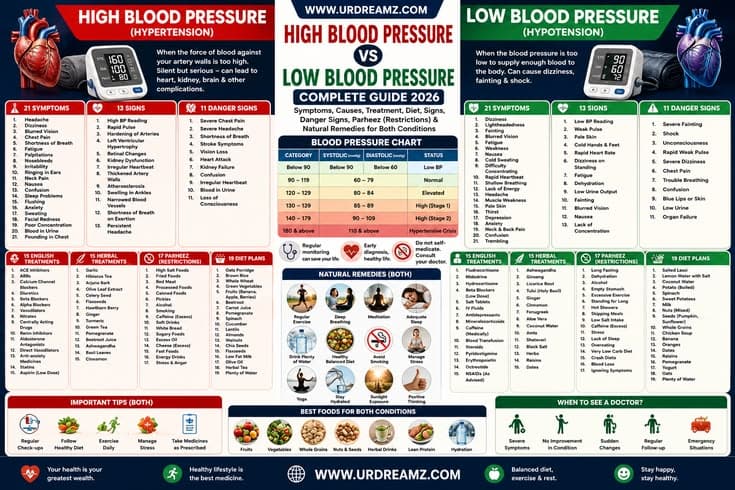
High Blood Pressure vs Low Blood Pressure: Complete Guide 2026
Blood pressure — the pressure of blood — is one of the body's fundamental vital signs. When the heart pumps blood, that pressure is exerted on the walls of blood vessels — this is what we call blood pressure. When this pressure rises more than necessary — it becomes high blood pressure (hypertension). And when it starts to drop — it is called low blood pressure (hypotension). Both conditions can be dangerous — but both have different treatments, diets, and precautions. This guide completely covers both — from symptoms to herbal treatment — everything in plain language, clearly and in depth.
For personalized herbal medicine or further guidance, contact: WhatsApp: +923471936923 | Website: www.urdreamz.com
Blood Pressure Chart — Understanding Normal, High and Low BP
Blood pressure is written as two numbers — the first number (systolic) is the pressure during the heartbeat, the second number (diastolic) is the pressure between beats. Understanding these is essential so you can interpret your own reading.
| Blood Pressure Category | Systolic (mm Hg) — Top Number | Diastolic (mm Hg) — Bottom Number | |
|---|---|---|---|
| Normal / Healthy | Less than 120 | and | Less than 80 |
| Elevated Blood Pressure | 120 to 129 | and | Less than 80 |
| Stage 1 Hypertension | 130 to 139 | or | 80 to 89 |
| Stage 2 Hypertension | 140 or Higher | or | 90 or Higher |
| Hypertensive Crisis (Emergency) | Higher than 180 | and/or | Higher than 120 |
| Low Blood Pressure (Hypotension) | Less than 90 | and/or | Less than 60 |
| Age Group | Normal BP (Men) | Normal BP (Women) | Warning Level |
|---|---|---|---|
| 18–29 years | 119/70 mm Hg | 110/68 mm Hg | Above 130/80 |
| 30–39 years | 122/76 mm Hg | 114/74 mm Hg | Above 130/80 |
| 40–49 years | 125/80 mm Hg | 120/78 mm Hg | Above 135/85 |
| 50–59 years | 130/84 mm Hg | 128/82 mm Hg | Above 140/90 |
| 60+ years | 134/87 mm Hg | 132/84 mm Hg | Above 140/90 |
PART 1: HIGH BLOOD PRESSURE (HYPERTENSION) — COMPLETE GUIDE
High blood pressure — also called hypertension — is one of the world's most common and dangerous chronic diseases. In Pakistan, one in three adults suffers from hypertension. Its biggest danger is that it is a "silent killer" — in most cases there are no symptoms felt while internal damage continues to occur.
HIGH BLOOD PRESSURE: 21 SYMPTOMS
Hypertension is called a silent killer because often there are no symptoms — but when they do appear, never ignore them:
| # | Symptom | Explanation |
|---|---|---|
| 1 | Headache | Especially upon waking up in the morning — heaviness or pain in the back of the head — most common sign of high BP |
| 2 | Dizziness | Sudden dizziness when standing up or bending down — due to difference in blood supply to the brain |
| 3 | Blurred vision | Pressure in blood vessels affects retinal veins — vision becomes blurry |
| 4 | Nosebleed | Fragile blood vessels in the nose can burst due to high pressure — often unexplained nosebleeds |
| 5 | Chest pain or heaviness | The heart has to work harder — chest tightness or discomfort is felt |
| 6 | Breathing difficulty | Impact on heart's pumping capacity causes shortness of breath — especially when walking |
| 7 | Fatigue and weakness | Continuously elevated BP drains the body's energy — unusual fatigue is felt |
| 8 | Heart palpitations | Heartbeat feels irregular or very fast — especially at night |
| 9 | Facial redness | Blood vessels dilate or constrict causing face to be red or flushed |
| 10 | Ringing in the ears | Pressure in blood flow affects the inner ear — whooshing or ringing sound is heard |
| 11 | Sleep disturbances | High BP keeps the nervous system overactive — can't sleep or sleep doesn't stay consistent |
| 12 | Confusion | Lack of oxygen supply to the brain affects thinking ability |
| 13 | Swelling in feet and ankles | High BP affects kidney function — extra fluid accumulates |
| 14 | Neck stiffness | Pressure traveling to the head keeps neck muscles tense |
| 15 | Darkness before the eyes | Pressure on retinal arteries — temporary blackout or floaters in vision |
| 16 | Blood in urine | Too much pressure on kidney blood vessels — hematuria (blood in urine) can occur |
| 17 | Anxiety and restlessness | Hormonal imbalance (cortisol, adrenaline) increases both BP and anxiety |
| 18 | Numbness in hands and feet | Difference in blood circulation causes tingling or numbness in extremities |
| 19 | Nausea | Pressure in the head and difference in brain blood flow causes nausea |
| 20 | Lower back pain | High pressure in kidney arteries — lower back pain or kidney area pain |
| 21 | Excessive sweating | Sympathetic nervous system overactivation — sweating at night or without exertion |
HIGH BLOOD PRESSURE: 13 SIGNS (That Can Be Seen in the Body)
| # | Sign | How to Recognize |
|---|---|---|
| 1 | BP reading of 130/80 or higher | Check with BP machine at home or clinic — most reliable sign |
| 2 | Pulse rate abnormally fast (tachycardia) | Resting pulse above 100 — common companion of high BP |
| 3 | Red face and neck | Vasodilation causes face to appear constantly red |
| 4 | Visible blood vessels in eyes | Doctor sees retinal changes in eye exam — AV nicking, hemorrhages |
| 5 | Enlarged heart (cardiomegaly) | Heart appears enlarged on ECG or chest X-ray — sign of long-term BP |
| 6 | Swelling in feet and calves (edema) | Pressing with finger leaves a pit — sign of fluid retention |
| 7 | Obesity | People with BMI 30+ have 3 times higher risk of hypertension |
| 8 | Frequent urination | Pressure on kidneys increases urination frequency — especially at night |
| 9 | Hands and feet feel too warm | Continuously high pressure in blood vessels keeps extremities warm |
| 10 | Abnormalities in blood tests | Elevated creatinine, changed kidney function markers — detected in lab reports |
| 11 | Recurrent nosebleeds | Nosebleed without injury — epistaxis, a clear sign |
| 12 | Anxiety and restlessness | Continuous feeling of restlessness — nervous system constantly activated |
| 13 | Feeling of head fullness or pressure | Especially after waking up — hypertension headache pattern |
HIGH BLOOD PRESSURE: 11 DANGER SIGNS (Immediate Treatment Required)
These 11 signs demand immediate medical attention. If you experience any of these, go to the hospital IMMEDIATELY or call an ambulance:
| # | Danger Sign | What to Do |
|---|---|---|
| 1 | BP 180/120 or higher | Hypertensive crisis — immediately go to hospital or emergency room |
| 2 | Severe chest pain | Risk of heart attack or aortic dissection — call 911/1122 |
| 3 | Sudden difficulty speaking | Sign of stroke — "Fast" check: Face drooping, Arm weakness, Speech difficulty |
| 4 | Paralysis on face or one side | Stroke — reaching hospital within the golden hour is essential |
| 5 | Sudden blindness or severe vision loss | Retinal artery occlusion or hypertensive retinopathy emergency |
| 6 | Severe headache unlike any before | "Worst headache of life" — subarachnoid hemorrhage or hypertensive emergency |
| 7 | Unable to breathe at all | Acute pulmonary edema — fluid in lungs, immediate ICU |
| 8 | Loss of consciousness | Severely compromised blood flow to the brain — medical emergency |
| 9 | Severe back pain (tearing sensation) | Aortic aneurysm rupture — surgical emergency |
| 10 | Seizures | Hypertensive encephalopathy — crisis of brain blood vessels |
| 11 | Complete stoppage of urination | Acute kidney failure from hypertensive emergency — may require dialysis |
HIGH BLOOD PRESSURE: 15 TREATMENTS (English and Herbal)
| # | Treatment | Type | Details |
|---|---|---|---|
| 1 | Garlic — on empty stomach | Herbal | Crush 2 cloves of garlic daily and swallow with water in the morning — reduces systolic BP by 8–10 mmHg. Allicin compound causes vasodilation |
| 2 | Beetroot juice | Herbal / Natural | Drink 250ml fresh beetroot juice daily — nitrates naturally convert to nitric oxide which relaxes blood vessels — reduces BP by 4–10 mmHg |
| 3 | Hibiscus Tea | Herbal | Boil dried hibiscus flowers and drink like tea — 2 cups daily. Clinical trials show 7.2 mmHg systolic reduction proven. Easily available in Pakistan |
| 4 | Fenugreek Seeds | Herbal | Soak 1 teaspoon fenugreek seeds in water overnight. Drink the water and chew the seeds in the morning. Fiber and potassium both lower BP |
| 5 | Amla (Indian Gooseberry) | Herbal | Drink amla juice or eat fresh amla daily in the morning. Vitamin C and antioxidants improve blood vessel elasticity |
| 6 | Ajwain and black pepper | Herbal | Lightly roast ajwain, grind with black pepper, take 1/2 teaspoon with warm water at night — improves blood circulation |
| 7 | Black Seed (Nigella Sativa) | Herbal | Take 1/2 teaspoon black seed oil or seeds with honey daily — thymoquinone compound is medically proven to control BP |
| 8 | Aerobic Exercise — 30 min daily | English / Lifestyle | Brisk walking, cycling, or swimming 30 minutes daily — within 5 weeks systolic BP can drop 5–8 mmHg. Safest and most effective non-drug treatment |
| 9 | Follow DASH Diet | English / Dietary | Dietary Approaches to Stop Hypertension — most evidence-based dietary approach. Daily sodium under 1500mg, more fruits and vegetables — 8–14 mmHg reduction proven |
| 10 | ACE Inhibitors (Lisinopril, Enalapril) | English / Medical | After doctor's prescription — block angiotensin converting enzyme. Blood vessels relax. Common first-line medication |
| 11 | Beta Blockers (Atenolol, Metoprolol) | English / Medical | Slow and reduce the force of heartbeat — BP naturally decreases. Preferred in hypertension with cardiac issues |
| 12 | Calcium Channel Blockers (Amlodipine) | English / Medical | Blood vessel walls relax — most commonly used BP medicine in Pakistan. Do not take without a doctor |
| 13 | Stress Management — Meditation / Yoga | English / Lifestyle | 15–20 minutes of deep breathing or guided meditation daily reduces cortisol — BP can reduce by up to 5 mmHg without any medicine |
| 14 | Ginger and Honey Mix | Herbal | 1 inch ginger juice + 1 teaspoon honey daily on empty stomach. Gingerols improve blood circulation and reduce BP |
| 15 | Deep breathing exercises | English / Natural | Bhramari pranayama — 10 minutes daily activates parasympathetic nervous system — provides immediate relief in acute BP spikes |
HIGH BLOOD PRESSURE: 17 PRECAUTIONS (Foods and Habits to Avoid)
| # | Precaution | Why It's Important |
|---|---|---|
| 1 | Excess salt and salty food | Sodium retains water — increased blood volume raises BP. Avoid more than 1500mg sodium daily |
| 2 | Processed and packaged food | Chips, biscuits, canned food, instant noodles contain hidden sodium in large amounts |
| 3 | Fast food and biryani (high salt) | One serving of fast food can fulfill the entire day's sodium quota |
| 4 | Cigarettes and Tobacco | Nicotine instantly tightens blood vessels — BP increases by 10 mmHg instantly. Completely quit smoking |
| 5 | Alcohol | Excessive drinking significantly raises BP and reduces the effectiveness of BP medicines |
| 6 | Excess caffeine (Tea / Coffee) | 4+ cups of tea or coffee daily can raise BP — especially for those already sensitive |
| 7 | Fatty and fried foods | Saturated fat creates plaque in arteries — blood vessels narrow — BP naturally rises |
| 8 | White sugar and sweets | Sugar creates insulin spikes which raise BP. Avoid sweets, cold drinks, juices |
| 9 | Excess red meat | Beef, lamb provide excess sodium and saturated fat — both enemies of BP |
| 10 | Cold drinks and energy drinks | Sodium, sugar, and caffeine — all three raise BP. Completely avoid |
| 11 | Taking too much stress | Chronic stress releases cortisol — this directly keeps blood pressure continuously elevated |
| 12 | Sitting too much (Sedentary lifestyle) | Physical inactivity increases weight and reduces heart's pumping efficiency — directly linked to BP |
| 13 | Staying up late at night | Sleep deprivation increases cortisol and adrenaline — regularly staying up after 11 PM raises BP |
| 14 | Pickles and chutneys (high salt) | Desi pickles contain very high sodium concentration — daily consumption is dangerous for BP |
| 15 | Excess NSAID pain killers (Ibuprofen) | These medicines affect kidney function and fluid balance — can raise BP. Do not take without doctor's advice |
| 16 | Excess Licorice (Mulethi) | Licorice contains glycyrrhizin which retains sodium and reduces potassium — BP can rise dramatically |
| 17 | Processed meats (Deli meats, Sausages) | Very high sodium is used for preservation — preserved meats are completely off-limits for BP patients |
HIGH BLOOD PRESSURE: 19 DIET PLAN
Following these 19 dietary rules helps naturally control BP — with or without any medication:
| # | Diet Rule | Explanation |
|---|---|---|
| 1 | Drink 8–10 glasses of water daily | Dehydration thickens blood — water helps manage BP |
| 2 | Eat a banana daily | A common source of potassium — 1–2 bananas daily counter the effect of sodium |
| 3 | Eat more spinach and green vegetables | Potassium, magnesium, and nitrates — nutrients that control high BP |
| 4 | Include beetroot | Nitric oxide precursor — naturally dilates blood vessels |
| 5 | Oatmeal for breakfast | Beta-glucan fiber can reduce BP by up to 8 points — also best for heart health |
| 6 | Use flaxseeds | 1 tablespoon ground flaxseeds daily — omega-3 and fiber both lower BP |
| 7 | Eat watermelon | Contains L-citrulline amino acid which relaxes blood vessels — natural summer BP remedy |
| 8 | Low-fat Yogurt | Calcium and probiotics both help reduce blood pressure |
| 9 | Use olive oil | Polyphenols reduce artery inflammation — use instead of ghee and dalda |
| 10 | Fish twice a week | Omega-3 fatty acids improve blood vessel flexibility — lower BP |
| 11 | Masoor, moong and chickpeas | Plant-based protein, potassium, and magnesium — trifecta of nutrition for BP |
| 12 | Dark chocolate (1 small piece) | Flavonoids lower BP — 70%+ cocoa chocolate, limited quantity |
| 13 | Whole grains | Brown rice, whole wheat roti — instead of refined grains — fiber manages BP |
| 14 | Walnuts | 8–10 walnuts daily — omega-3 and magnesium combination is best nuts for BP |
| 15 | Tomatoes and lycopene | Fresh tomatoes or fresh tomato juice — lycopene protects arteries |
| 16 | Kiwi or citrus fruits | Vitamin C and bioflavonoids strengthen blood vessel walls |
| 17 | Add garlic to food | 2–3 cloves in daily cooking — allicin compound daily dose is the easiest method |
| 18 | Turmeric milk or turmeric water | Curcumin is anti-inflammatory — protects the inner lining of blood vessels |
| 19 | Keep sodium under 1500mg | Don't add extra salt to food — use minimum salt even while cooking |
PART 2: LOW BLOOD PRESSURE (HYPOTENSION) — COMPLETE GUIDE
Low blood pressure — called hypotension — occurs when BP drops below 90/60 mm Hg. While hypertension is silent, the effect of low BP is felt immediately — dizziness, fainting, and weakness. In most people this is not overly concerning — but in some situations it can be serious.
LOW BLOOD PRESSURE: 21 SYMPTOMS
| # | Symptom | Explanation |
|---|---|---|
| 1 | Dizziness | Reduced blood supply to the brain — especially when standing up or after standing for long periods |
| 2 | Fainting or feeling like fainting | When BP drops suddenly, the brain doesn't get oxygen — blackout or fainting |
| 3 | Darkness before the eyes | Reduced blood supply to the retina upon standing — vision temporarily blurs |
| 4 | Extreme fatigue | Less oxygen reaches tissues and muscles — unusual, unexplained fatigue is felt |
| 5 | Body feeling cold | Reduced BP reduces blood flow to body periphery — hands and feet stay cold |
| 6 | Lightheadedness | Feeling like air is trapped in the head — typical sensation of low BP |
| 7 | Rapid heartbeat | Heart compensates for low BP — pumps faster to maintain circulation |
| 8 | Nausea and feeling of vomiting | Reduced blood supply to the brain and inner ear — nausea and sometimes vomiting |
| 9 | Weakness or trembling in joints | Less energy reaches muscles — legs feel unsteady or shaky |
| 10 | Excessive thirst | Dehydration is both a major cause and a symptom of low BP |
| 11 | Difficulty concentrating | Reduced blood flow to the brain causes trouble thinking and focusing |
| 12 | Shortness of breath | Heart pumps harder — breathing becomes faster to meet oxygen demand |
| 13 | Blurry vision | Reduced blood in retinal arteries — vision becomes blurry or double |
| 14 | Tingling in feet | Compromised peripheral blood flow — pins and needles feeling in extremities |
| 15 | Neck and shoulder pain | Cardiovascular system overcompensating — neck and shoulder muscles remain tense |
| 16 | Dizziness after eating | Postprandial hypotension — blood shifts to stomach for digestion — less reaches the brain |
| 17 | Excessive sleepiness | Less oxygen to organs shifts the body into "rest mode" — unusual drowsiness |
| 18 | Pale or yellow complexion | Less blood to skin — pallor or pale complexion — visible sign of low BP |
| 19 | Sounds in the ears | Reduced blood supply inside the ear — tinnitus or muffled sounds |
| 20 | Anxiety and unease | Adrenal glands release adrenaline to compensate — restlessness occurs |
| 21 | Reduced urination | Low BP reduces kidney filtering — urine output decreases |
LOW BLOOD PRESSURE: 13 SIGNS
| # | Sign | How to Recognize |
|---|---|---|
| 1 | BP reading 90/60 or lower | Check with BP machine — most reliable sign |
| 2 | Fast but weak pulse | Check pulse — fast but feels thread-like |
| 3 | Face looking pale from within | Lips, under eyes, nails — paleness is visible |
| 4 | Cold and clammy sweat | Cold clammy sweat — can also be an early sign of shock |
| 5 | Hands and feet very cold | Vasoconstriction in extremities — body prioritizes vital organs |
| 6 | Dark circles under eyes | Reduced blood circulation makes skin around eyes look dull |
| 7 | Getting anxious quickly | Adrenaline surge — unexplained anxiety attacks can be a sign of low BP |
| 8 | Eyes darkening upon standing | Orthostatic hypotension — BP doesn't adjust properly when standing up |
| 9 | Significantly low body weight | BMI below 18.5 — low BP is common in underweight people |
| 10 | Signs of dehydration | Dry lips, dark yellow urine, reduced skin elasticity — dehydration is a common cause of low BP |
| 11 | Low sodium in lab tests | Hyponatremia — low sodium is a linked cause of low BP and dizziness |
| 12 | Concentration and memory issues | Brain fog — fuzzy thinking or forgetfulness is common with low BP |
| 13 | Fatigue without work | Resting fatigue — getting tired without exertion — body's low perfusion state |
LOW BLOOD PRESSURE: 11 DANGER SIGNS
| # | Danger Sign | What to Do |
|---|---|---|
| 1 | BP 70/40 or lower | Risk of circulatory shock — immediately go to hospital |
| 2 | Fainting | Lay them down, raise legs, call ambulance |
| 3 | Cold clammy sweat from head to toe | Septic or hypovolemic shock — immediate emergency care |
| 4 | Breathing difficulty | Cardiogenic shock or severe hypotension — immediate ICU |
| 5 | Chest pain with low BP | BP can drop in heart attack or pulmonary embolism — call 1122 |
| 6 | Complete stoppage of urination | Kidneys are shutting down — acute kidney injury, immediate care |
| 7 | Frequent loss of consciousness | Mental status change — brain hypoperfusion, medical emergency |
| 8 | Skin looks blotchy / mottled | Livedo reticularis — skin mottling in severe shock, critical sign |
| 9 | Shivering and severe restlessness | Sepsis or severe hypotension — shivering with low BP requires urgent care |
| 10 | Severe bleeding | Hemorrhagic shock — BP crash after accident or surgery — immediate intervention |
| 11 | Eyes rolling back or seizure | Blood has stopped reaching the brain — immediately go to emergency room |
LOW BLOOD PRESSURE: 15 TREATMENTS (English and Herbal)
| # | Treatment | Type | Details |
|---|---|---|---|
| 1 | Drink more water (Oral Rehydration) | Natural | Drink 8–10 glasses of water daily — dehydration is the #1 cause of low BP. ORS solution is also helpful when BP drops suddenly |
| 2 | Slightly increase salt (Controlled Sodium) | English / Dietary | Unlike high BP, slightly more salt is helpful in low BP — with doctor's advice take 2000–3000mg sodium daily |
| 3 | Caffeine (Tea or coffee) | Natural | One cup of strong tea or coffee temporarily raises low BP — useful in emergencies, but avoid regular dependency |
| 4 | Holy Basil (Tulsi) consumption | Herbal | Chew 10–15 tulsi leaves on an empty stomach daily or drink juice. Potassium, vitamin C, and magnesium — stabilize BP |
| 5 | Licorice Root (Mulethi) | Herbal | Drink licorice tea daily — glycyrrhizin retains sodium which raises low BP. Note: COMPLETELY AVOID in high BP |
| 6 | Ginger Water | Herbal | Crush fresh ginger and mix in water — improves circulation and slightly raises BP |
| 7 | Eating Raisins | Herbal / Natural | Soak 30–40 raisins in water overnight. Eat on empty stomach in the morning and drink the water. Strengthens adrenal glands — BP naturally rises |
| 8 | Compression Stockings | English / Medical Device | Wear elastic stockings on feet to prevent blood pooling — especially in standing jobs — effective for orthostatic hypotension |
| 9 | Fludrocortisone (Prescription) | English / Medical | Under doctor's supervision — for low BP related to adrenal insufficiency — increases sodium retention |
| 10 | Small frequent meals | English / Lifestyle | 5–6 small meals instead of 3 large ones — most effective way to avoid postprandial hypotension |
| 11 | Rosemary oil | Herbal | Rosemary essential oil fragrance or light massage on hands and feet improves circulation — provides freshness in low BP |
| 12 | Stand up slowly (Positional Changes) | English / Lifestyle | Before getting out of bed, lower feet, wait a few seconds, then stand — simple and effective way to avoid orthostatic hypotension |
| 13 | Vitamin B12 supplementation | English / Medical | B12 deficiency anemia is a cause of low BP — increase B12 levels through eggs, dairy, or supplements |
| 14 | Beetroot and carrot juice | Herbal / Natural | Drink fresh carrot and beetroot juice daily — iron, folic acid, and potassium combination is helpful for anemia-related low BP |
| 15 | Salt and sugar in water | Natural / First Aid | Pinch of salt + spoon of sugar in a glass of warm water — immediate home remedy for low BP. ORS-like effect — BP stabilizes immediately |
LOW BLOOD PRESSURE: 17 PRECAUTIONS
| # | Precaution | Why It's Important |
|---|---|---|
| 1 | Standing up suddenly | Orthostatic hypotension occurs — brain doesn't get blood immediately — dizziness occurs |
| 2 | Standing for too long | Blood pools in the feet — BP drops even further |
| 3 | Bathing in very hot water | Hot shower dilates blood vessels — BP can drop significantly |
| 4 | Excessive urine loss causing exertion | Intense exercise causes dehydration and BP drop — low BP patients should increase exercise slowly |
| 5 | Not drinking water even when thirsty | Dehydration is the #1 trigger for low BP — must stay hydrated at all times |
| 6 | Eating large meals | Postprandial hypotension — BP can drop drastically after a large meal |
| 7 | Alcohol | Alcohol dehydrates and dilates blood vessels — very dangerous in low BP |
| 8 | Low sodium (salt-free) diet | Completely removing salt in low BP is wrong — moderate sodium is necessary |
| 9 | Heavy lifting | Valsalva maneuver causes momentary BP drop — heavy lifting in low BP can cause fainting |
| 10 | Sleep deprivation | Sleep deprivation stresses the nervous system — already low BP drops even further |
| 11 | Excessive heat or sunlight | Heat raises body temperature — sweating causes dehydration and BP drop |
| 12 | Diuretics | Remove water and sodium — never take without doctor's advice in low BP |
| 13 | Standing on an empty stomach | Blood sugar also drops — low BP + low sugar is a double problem |
| 14 | Quickly going to upright position | Every sudden position change doesn't give BP enough time to adjust |
| 15 | Sauna or steam bath | Heat and moisture aggressively dilate blood vessels — low BP patients should completely avoid |
| 16 | Stopping BP-raising medicines without advice | Suddenly stopping medication can cause BP crash — gradual taper is necessary |
| 17 | Excess zinc or selenium supplements | Some supplements affect blood pressure regulation — avoid supplements without lab tests |
LOW BLOOD PRESSURE: 19 DIET PLAN
| # | Diet Rule | Explanation |
|---|---|---|
| 1 | Moderate extra salt | In low BP, salt retains water — increased blood volume raises BP |
| 2 | Eat raisins daily | Iron and natural sugars — best natural food for anemia-related low BP |
| 3 | Eat eggs daily | B12, iron, and protein — essential for blood production — fixes low BP |
| 4 | Walnuts and almonds | Healthy fats and calories — increases weight in underweight people which normalizes BP |
| 5 | Milk and yogurt | Calcium and B12 — both essential for blood production and circulation |
| 6 | Whole grain roti | Complex carbs keep blood sugar stable — prevent postprandial hypotension |
| 7 | Electrolytes in water | Add a pinch of salt or ORS to water — electrolyte balance stabilizes BP |
| 8 | Lean meat | Best source of iron and B12 — animal protein is helpful in low BP |
| 9 | Pomegranate juice | Iron, antioxidants, and natural sugar — improve both blood volume and circulation |
| 10 | Carrot and beetroot | Folic acid and iron — red blood cell production — natural solution for low BP |
| 11 | Dates | Natural sugars, iron, and potassium — 4–5 dates daily for both energy and BP |
| 12 | Fish | Omega-3, vitamin D, and B12 — most complete food for circulatory health |
| 13 | A piece of dark chocolate | Natural stimulant — caffeine and flavonoids improve circulation — also improves mood |
| 14 | Green leafy vegetables | Iron, folic acid, magnesium — essential nutrients for blood production |
| 15 | Lemon water with a pinch of salt | Electrolyte replacement — also improves vitamin C absorption — reliable home remedy for low BP |
| 16 | Sweet potato | Potassium and complex carbs — regulate blood pressure and keep energy levels stable |
| 17 | Chickpeas and masoor lentils | Iron, protein, and folate — best blood-building foods for vegetarians |
| 18 | Strong tea or coffee (limited) | Caffeine temporarily raises BP — definitely have one cup in the morning but avoid in the evening |
| 19 | Small frequent meals | 5–6 small meals daily — large meals cause BP drop — frequent small meals is the best approach |
High BP vs Low BP — At a Glance Comparison
| Feature | High Blood Pressure (Hypertension) | Low Blood Pressure (Hypotension) |
|---|---|---|
| BP Reading | 130/80 or higher | 90/60 or lower |
| Which is more dangerous? | More dangerous long-term — causes silent damage | Immediately dangerous in acute crisis — can cause shock |
| Symptoms | Often no symptoms — hence "silent killer" | Symptoms appear immediately — dizziness, fainting |
| Common Cause | Salt, stress, obesity, genetics | Dehydration, heart issues, medicines, blood loss |
| Role of Salt | Avoid salt — raises BP | Slightly more salt is okay — raises BP |
| Exercise | Regular moderate exercise essential — lowers BP | Light exercise slowly — avoid intense exercise |
| Water | Drink 8–10 glasses — for fluid balance | Must drink 8–10 glasses — dehydration is critical |
| Medicine | ACE inhibitors, beta blockers, calcium channel blockers | Fludrocortisone, midodrine, or cause-specific treatment |
| Licorice | AVOID — raises BP | Helpful — sodium retention raises BP |
| Precautions | Avoid salt, fat, stress, smoking, alcohol | Avoid sudden standing, hot water, large meals, alcohol |
How to Check BP at Home — The Right Way
Use a digital BP monitor (upper arm preferred) to check BP at home. For accurate readings, the following is essential:
- Rest for 5 minutes — sit upright, feet on the ground, don't talk.
- Avoid caffeine or smoking for 30 minutes before checking.
- Straight arm at heart level — place cuff snugly but don't make it too tight on the arm.
- Take 2 readings — wait one minute between them — calculate the average.
- Check at the same time daily — morning after waking and evening — log the readings.
- Note the results — date, time, systolic, diastolic, and pulse — show to the doctor.
Frequently Asked Questions — Blood Pressure
Does BP medication have to be taken for life?
In some people, lifestyle changes can reduce or stop medication — but this can only be done under a doctor's supervision. Never stop BP medication on your own — it can be dangerous.
Can High BP and Low BP occur together?
Yes — in some people blood pressure fluctuates — sometimes high, sometimes low. This can be a sign of Labile Hypertension or autonomic dysfunction. Regular monitoring and consulting a specialist is essential in such cases.
How dangerous is high BP during pregnancy?
High BP during pregnancy (preeclampsia) is a serious risk for both mother and baby — premature birth, organ damage, or seizures can occur. Regular BP monitoring during pregnancy is absolutely essential.
Are herbal medicines safe for BP?
Many herbal medicines are clinically effective — but they can interact with other medications. If you are already taking any medication, consult your doctor before starting herbal treatment. For personalized herbal medicine, contact: WhatsApp +923471936923 or visit www.urdreamz.com
How often should BP be checked daily?
In healthy people, once or twice a year is sufficient. In hypertension patients — morning and evening — once daily. New diagnosis or medication change — 3–4 times a week. Follow what the doctor says.
Final Words
Controlling blood pressure is a lifelong commitment — but it is absolutely possible. Eating right, regular exercise, stress management, sleep, and taking medication on time — all together help maintain blood pressure within the normal range. Neither ignore high BP — nor dismiss low BP — both require treatment and both have treatment available.
If you are interested in personalized herbal and natural treatment — or need guidance about your specific symptoms — contact our team:
WhatsApp: +923471936923
Website: www.urdreamz.com