How Adrenaline Hormone Works In Fight or Flight Situations
Imagine jumping across a gap between two rooftops, or suddenly noticing a dog charging toward you. Within a fraction of a second — long before you have consciously "decided" anything — your heart is already pounding, your breathing has quickened, and your entire body has shifted into a heightened state of readiness. This is Adrenaline at work — one of the most precisely engineered survival hormones in the entire human body. This guide walks through its complete journey: how the brain detects danger in the first place, the direct nerve pathway that bypasses the body's usual slower hormonal signaling, exactly what happens at each of adrenaline's five distinct receptor types throughout the heart, lungs, liver, and blood vessels, and why this hormone can act in milliseconds while its close cousin, cortisol, takes far longer to respond.
1. What Is Adrenaline, and When Does the Body Release It?
Adrenaline is one of the most valuable and precisely timed hormones in the human body. Rather than circulating at a constant, steady level throughout the day, it activates specifically during particular moments: fear, anxiety, physical exercise, illness or acute physical stress, and genuine fight-or-flight emergencies. This hormone exists for one core purpose — to give the body the best possible chance of protecting itself and escaping danger. It functions as a genuine survival tool, granted by the body's own design to help a person navigate and escape from a dangerous situation.
2. Where Adrenaline Actually Comes From
Adrenaline is produced by a pair of small glands sitting directly atop each kidney, called the adrenal glands. This anatomical location is directly reflected in both of the hormone's common names, Adrenaline and Epinephrine, each of which independently encodes the same essential piece of anatomical information through a different ancient language.
3. Breaking Down the Name: Epinephrine
The name Epinephrine comes from Greek. The prefix "epi" means "above" or "upon," while "nephrine" derives from the Greek word "nephros," meaning kidney — the same root found in modern medical terms like nephrology, the medical specialty dedicated to kidney health. Put together, "epinephrine" translates literally to "upon the kidney," a direct, accurate description of where the adrenal glands physically sit.
4. Breaking Down the Name: Adrenaline
The name Adrenaline, meanwhile, comes from Latin rather than Greek, though it conveys essentially the exact same anatomical meaning. The prefix "ad" means "near" or "toward," while "renal" refers to the kidney, the same root found in terms like renal failure or renal function. Put together, "adrenaline" translates to "near the kidney" — two completely different ancient languages, arriving independently at the same essential description of this hormone's site of production.
5. How Danger Is First Detected: The Five Senses
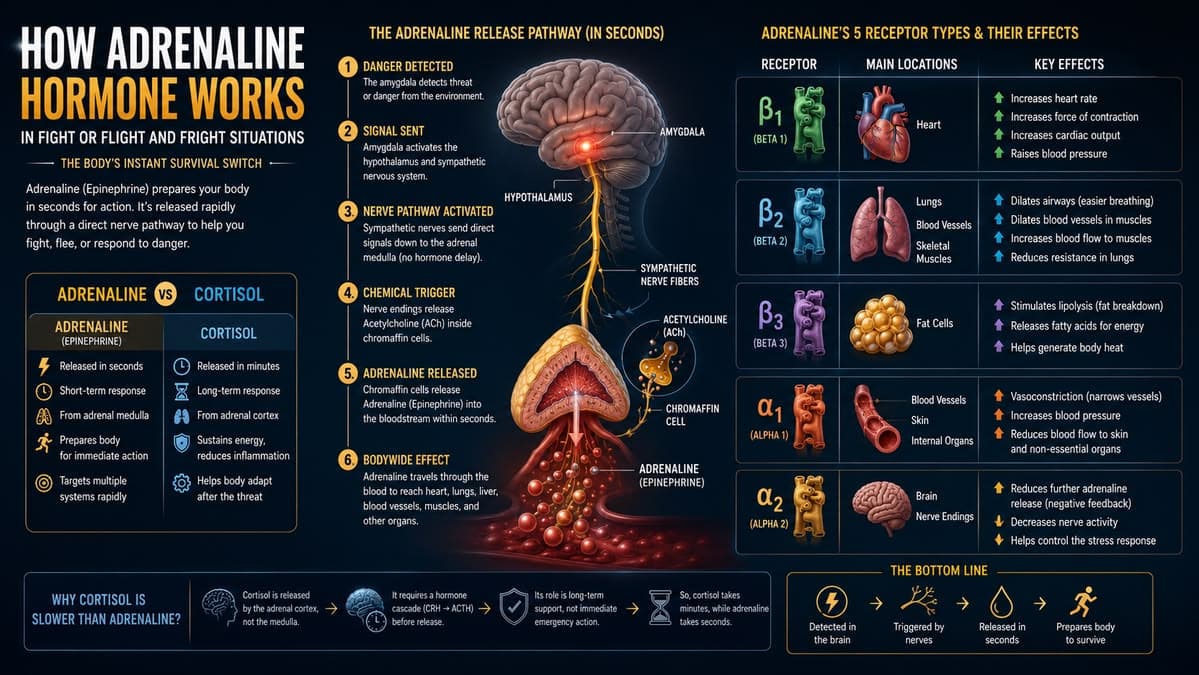
Before adrenaline can be released, the body first needs to actually detect that a threat exists. This detection process can begin through any one of the body's five senses — sight, sound, touch, smell, or taste can each independently register a potential danger signal. Whichever sense first picks up on the threat, that sensory information is relayed as a signal traveling toward one very specific destination within the brain.
6. Meet the Amygdala: The Brain's Fear Center
That destination is a small, almond-shaped structure deep within the brain called the Amygdala, often referred to in scientific literature as the brain's "Fear Center." Regardless of which specific sense first detected the potential danger, the resulting alert signal ultimately converges on this single structure, which then evaluates the incoming information and determines how the rest of the body's stress-response machinery should react.
7. A Real Example: Jumping the Gap
Consider a practical example: imagine jumping from one rooftop or wall to another, where you are consciously aware that the distance involved is considerable. In that exact moment, your heart rate accelerates rapidly — this is adrenaline being released. The visual information about the distance triggers rapid neural firing that reaches the amygdala, which relays a message onward to the hypothalamus, setting the entire adrenaline release cascade into motion.
8. Why the Response Scales With the Threat
Crucially, this response is not simply an all-or-nothing switch — it scales proportionally with the perceived severity of the situation. If the jump in the example above were relatively short and low-risk, the hypothalamus would not become significantly activated, and only a modest adrenaline response would follow. If, by contrast, a person found themselves in a genuine physical altercation or confrontation, the perceived danger and fear would be considerably higher, and adrenaline release would scale up correspondingly. This proportional scaling is precisely why the hormone is associated with three related but distinct scenarios: Fight, Flight, and Fright.
9. Fight, Flight, and Fright: Three Faces of One Response
The phrase "fight, flight, or fright" captures the three general behavioral outcomes this hormonal cascade can prepare the body for: standing and confronting the threat directly (fight), physically escaping the situation as quickly as possible (flight), or, in situations of overwhelming, sudden danger, a brief freeze response before further action (fright). In each of these three scenarios, adrenaline release increases significantly compared to baseline, physically preparing the body for whichever response ultimately proves necessary.
10. Two Nervous Systems: PNS and SNS
To understand exactly how the signal travels from the brain down to the adrenal glands, it helps to understand that the body's involuntary, automatic nervous system operates through two separate branches, often described as two different "currents": the Parasympathetic Nervous System (PNS) and the Sympathetic Nervous System (SNS).
11. Why the Body Switches From PNS to SNS
Under ordinary, calm, non-threatening conditions, the body's nerves operate primarily through the PNS, which governs routine, restful bodily functions. However, once a genuine emergency situation arises, the calmer PNS signaling is simply insufficient for the demands of the moment — the body needs to shift into a fundamentally different operating mode. This is precisely when the SNS takes over, and it is the SNS specifically that carries the emergency signal all the way down through a direct connection to the spinal cord.
12. The Direct Line: Spinal Cord to Adrenal Gland
Once the sympathetic nervous system signal reaches the spinal cord, the spinal cord itself forwards this signal directly onward, applying it specifically to the adrenal glands, effectively instructing them: "release adrenaline now." This entire pathway — from brain, through the sympathetic nervous system, into the spinal cord, and out to the adrenal glands — represents one of the most direct, fastest-acting hormonal release pathways found anywhere in the human body.
13. The Splanchnic Nerves: A Dedicated Emergency Highway
The specific nerve pathway carrying this signal from the spinal cord directly to the adrenal glands is called the Splanchnic Nerves. This dedicated pathway functions almost like a private, direct emergency communication line, bypassing the slower, more roundabout signaling routes used by many of the body's other hormonal systems, and delivering the "release adrenaline" instruction with remarkable speed and precision.
(Fear Center)
System (SNS)
(Chromaffin Cells)
Into Blood
14. Anatomy of the Adrenal Gland: Cortex vs Medulla
If a cross-section of the adrenal gland is examined closely, it reveals two distinct anatomical regions with entirely different functions. The outer region is called the cortex — a region that plays no direct role in the specific adrenaline-release mechanism described throughout this guide (though, as discussed later, it is directly relevant to a separate, related hormone: cortisol). The specific functional activity central to this guide's topic instead occurs in the gland's innermost region, called the medulla.
15. Meet the Chromaffin Cells
Within this innermost medullary region sit specialized cells called Chromaffin Cells. These cells house small internal storage packets, or vesicles, already pre-loaded with adrenaline, waiting in reserve for the specific signal instructing them to release their contents. The splanchnic nerves described earlier deliver their signal directly to these chromaffin cells, specifically targeting this reserve of pre-packaged hormone.
16. The Trigger Chemical: Acetylcholine (ACh)
When the splanchnic nerve signal reaches the chromaffin cells, it does not act directly on its own — it carries along with it a specific chemical messenger called Acetylcholine (ACh). This acetylcholine enters the chromaffin cell and directly triggers the release of the stored adrenaline packets, effectively throwing open the storage vesicles and releasing their adrenaline contents outward.
17. Adrenaline Enters the Bloodstream
Once released from the chromaffin cells through this acetylcholine-triggered process, adrenaline enters directly into general blood circulation, traveling throughout the entire body within seconds. From this point forward, adrenaline's effect depends entirely on where, specifically, it finds a matching receptor to bind to — and it turns out there are several distinct receptor types, each located in a different organ, each producing a different specific effect.
18. Five Doors, Five Destinations: Meet Adrenaline's Receptors
Adrenaline exerts its wide-ranging effects throughout the body by binding to five distinct receptor types, each located on a different target tissue: Beta1, Beta2, Beta3, Alpha1, and Alpha2. Understanding where each of these receptors sits, and what happens when adrenaline binds to it, explains essentially the entire physical experience of the fight-or-flight response.
Effect: Increased heart rate and force of contraction
Effect: Bronchodilation — airways widen
Effect: Glycogen released as glucose for energy
Effect: Vasoconstriction — vessels narrow
Effect: Further vasoconstriction, blood redirection
19. Beta1 Receptors: The Heart Speeds Up
Beta1 receptors are located directly on the heart. When a fear-inducing situation arises and adrenaline reaches these receptors, they become activated, and the heart, which was previously beating at a normal, resting rate, begins beating significantly faster. This increased heart rate serves an obvious, essential purpose: pumping a greater volume of oxygenated blood to the muscles and organs that may urgently need it during a fight-or-flight response.
20. Beta2 Receptors: The Lungs Open Wider
Beta2 receptors are located within the lungs. As the heart rate increases and the body's oxygen demand rises correspondingly, the lungs need to be able to take in and process air more efficiently to keep pace. Beta2 receptor activation produces a specific effect called bronchodilation — the airways within the lungs widen, allowing significantly more air to be inhaled and processed per breath than would otherwise be possible under normal, resting conditions.
21. Beta3 Receptors: The Liver Releases Its Reserves
Beta3 receptors are located within the liver. When activated by adrenaline, these receptors trigger the liver to release its stored energy reserves — specifically, stored glycogen — converting this reserve into readily usable glucose and releasing it into the bloodstream, providing an immediate, accessible source of physical energy exactly when the body needs it most.
22. Alpha1 and Alpha2 Receptors: Redirecting the Blood Supply
Alpha1 and Alpha2 receptors are located primarily on smooth muscle tissue, particularly within the skin and the smooth muscle walls of blood vessels. When adrenaline activates these receptors, it produces a specific effect called vasoconstriction — the affected blood vessels narrow and tighten significantly.
23. Why Blood Gets Redirected to Hands, Feet, Brain, and Lungs
This alpha-receptor-driven vasoconstriction serves a very deliberate, strategic purpose: by narrowing blood vessels in less immediately critical areas, particularly the skin, the body ensures that a much larger proportion of its total available blood supply gets redirected specifically toward the hands, feet, brain, and lungs — the exact tissues most urgently needed to physically fight, flee, or otherwise respond effectively to an emergency situation. This is precisely why a person experiencing significant fear or acute stress may notice their skin becoming visibly pale — blood flow to the skin has been deliberately, temporarily reduced in favor of more critical tissues elsewhere in the body.
24. Pupil Dilation: Sharper Vision in an Instant
Alongside these effects on the heart, lungs, liver, and blood vessels, adrenaline also produces a distinctive change in the eyes: the black, central portion of the eye — the pupil — widens noticeably, a process called pupil dilation, or mydriasis. This widening allows more light to enter the eye, sharpening and enhancing visual perception during a critical moment when clear, rapid visual information genuinely matters.
25. All of This Happens in Milliseconds
What makes this entire cascade genuinely remarkable is its sheer speed: the heart rate increase, the widened airways, the liberated liver glucose reserves, the redirected blood supply, and the dilated pupils all occur within a matter of milliseconds — faster than conscious thought itself. This entire, precisely coordinated, multi-organ physiological response reflects a genuinely elegant design: the body has been built with a specific, calibrated capacity to respond to danger, activated exactly when needed and scaled proportionally to the actual severity of the threat.
26. The Slower Cousin: Cortisol
Adrenaline is not the only stress-related hormone produced by the adrenal glands. A second, closely related hormone, cortisol, is also released during stressful situations — but through a meaningfully different, and notably slower, pathway. While adrenaline is produced in the adrenal medulla, cortisol is produced in a specific region of the adrenal cortex called the Zona Fasciculata.
27. Why Cortisol Takes the Long Route
Because cortisol production occurs in the adrenal cortex rather than the medulla, it cannot make use of the same direct, splanchnic-nerve-based emergency pathway used by adrenaline. Instead, cortisol release follows the more roundabout hypothalamus-pituitary-adrenal pathway discussed in earlier guides — the hypothalamus must first signal the pituitary gland, which must then release its own hormone that travels through the bloodstream down to the adrenal cortex, gradually activating cortisol production. This entire process takes meaningfully longer than the near-instantaneous, direct nerve-based pathway used for adrenaline.
28. A Real Example: The Chasing Dog
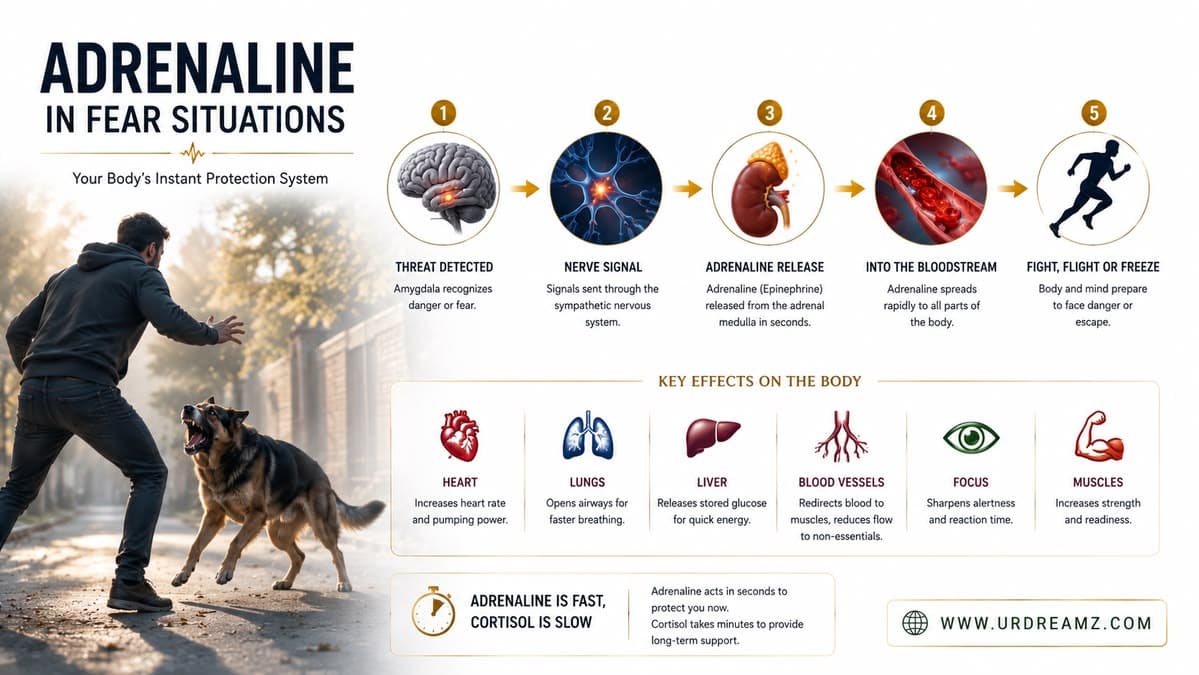
Consider a practical illustration of this speed difference: imagine a dog suddenly chasing you. In this scenario, an immediate, split-second physical response is required — there is no time for slow, deliberate thinking. This is exactly the kind of situation that activates the fast, direct splanchnic-nerve pathway to the adrenal medulla, triggering rapid adrenaline release. By contrast, if you are instead experiencing a more prolonged, ongoing source of stress or worry — tension that builds gradually rather than requiring instantaneous action — this is the kind of situation more closely associated with the slower, pituitary-mediated cortisol pathway, gradually activating over a longer timeframe rather than requiring the split-second urgency of adrenaline.
29. Medical Uses of Adrenaline
Beyond its natural role in the body's own stress response, synthetic adrenaline has become an essential tool in modern emergency medicine. It is used to treat severe, life-threatening allergic reactions (anaphylaxis), commonly administered through an auto-injector device such as an EpiPen. It is also used to help restart the heart during cardiac arrest, and to help control bleeding from small blood vessels during certain surgical procedures — each of these medical applications directly leveraging one or more of the same natural receptor mechanisms described throughout this guide.
30. Putting the Entire System Together
Bringing this entire guide together into a single continuous story: one of the body's five senses detects a potential threat, relaying that information to the amygdala, the brain's fear center, which signals the hypothalamus to activate the sympathetic nervous system. This signal travels down the spinal cord and along the splanchnic nerves directly to the adrenal medulla, where acetylcholine triggers chromaffin cells to release stored adrenaline into the bloodstream. From there, adrenaline binds to five distinct receptor types — Beta1 on the heart, Beta2 on the lungs, Beta3 on the liver, and Alpha1/Alpha2 on blood vessels — producing, within milliseconds, a fully coordinated, whole-body state of heightened readiness: a faster heart, wider airways, liberated energy reserves, redirected blood flow, and sharpened vision. This is fight, flight, and fright — the body's own, precisely engineered emergency response system.
31. Frequently Asked Questions
- Q1: What is adrenaline, and what is it also called?
- Adrenaline, also called Epinephrine, is a hormone produced by the adrenal glands that activates during fear, anxiety, exercise, illness, and fight-or-flight situations.
- Q2: Where does the name "Epinephrine" come from?
- It comes from Greek — "epi" meaning above, and "nephrine" derived from "nephros" meaning kidney — translating to "upon the kidney."
- Q3: Where does the name "Adrenaline" come from?
- It comes from Latin — "ad" meaning near, and "renal" meaning kidney — translating to "near the kidney."
- Q4: What is the amygdala, and what does it do?
- The amygdala is a small brain structure known as the "fear center," which processes danger signals from the five senses and triggers the stress response.
- Q5: What is the difference between PNS and SNS?
- The Parasympathetic Nervous System (PNS) governs calm, routine bodily functions, while the Sympathetic Nervous System (SNS) takes over during emergencies to trigger the fight-or-flight response.
- Q6: What are the splanchnic nerves?
- The splanchnic nerves are a direct nerve pathway connecting the spinal cord to the adrenal glands, delivering the signal to release adrenaline rapidly.
- Q7: What are chromaffin cells?
- Chromaffin cells are specialized cells in the adrenal medulla that store pre-packaged adrenaline and release it when triggered by acetylcholine.
- Q8: What triggers chromaffin cells to release adrenaline?
- Acetylcholine (ACh), delivered via the splanchnic nerves, triggers chromaffin cells to release their stored adrenaline into the bloodstream.
- Q9: What does Beta1 receptor activation do?
- Beta1 receptors, located on the heart, increase heart rate and the force of heart contractions when activated by adrenaline.
- Q10: What does Beta2 receptor activation do?
- Beta2 receptors, located in the lungs, cause bronchodilation, widening the airways to allow more oxygen intake.
- Q11: What does Beta3 receptor activation do?
- Beta3 receptors, located in the liver, trigger the release of stored glycogen as usable glucose for immediate energy.
- Q12: What do Alpha1 and Alpha2 receptors do?
- Alpha1 and Alpha2 receptors, located on smooth muscle in skin and blood vessels, cause vasoconstriction, redirecting blood flow toward the hands, feet, brain, and lungs.
- Q13: Why does skin sometimes look pale during a fear response?
- Because alpha-receptor-driven vasoconstriction reduces blood flow to the skin, redirecting it to more critical tissues needed for immediate physical response.
- Q14: Why is cortisol release slower than adrenaline release?
- Cortisol is produced in the adrenal cortex and depends on the slower hypothalamus-pituitary-adrenal pathway, while adrenaline uses a direct, fast nerve pathway to the adrenal medulla.
- Q15: What are common medical uses of adrenaline?
- Adrenaline is used to treat severe allergic reactions (via EpiPen), to help restart the heart during cardiac arrest, and to control bleeding during certain surgical procedures.
32. Conclusion
Adrenaline represents one of the most elegantly engineered survival systems in the entire human body — a hormone capable of transforming a resting, calm physiological state into full emergency readiness within milliseconds, all triggered by nothing more than a signal from one of the five senses reaching the amygdala. From the direct splanchnic nerve pathway bypassing slower hormonal signaling routes, to the five distinct receptor types each producing a specific, purposeful physical change throughout the heart, lungs, liver, and blood vessels, every part of this system reflects a genuinely coordinated design built for one singular purpose: giving the body its best possible chance of surviving a genuine threat. Understanding this mechanism — and its slower cousin, cortisol — offers a real, practical window into why the body reacts the way it does in moments of fear, and why that reaction, however uncomfortable it may feel in the moment, exists entirely in service of keeping you safe.