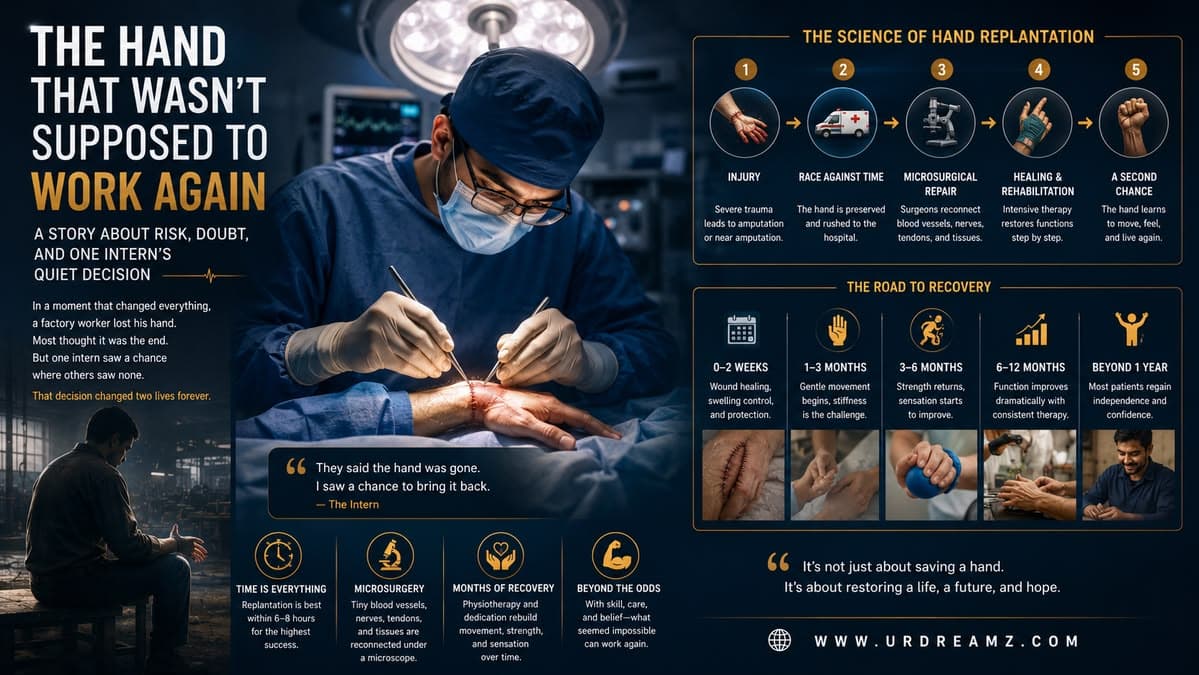
The Hand That Wasn't Supposed to Work Again: A Story About Risk, Doubt, and One Intern's Quiet Decision
A quick note before we begin: this story circulates online as an inspiring account from a hospital in England, but it doesn't come attached to a verifiable hospital name, date, or named patient, and a few of its details, especially the idea of a junior intern independently performing hours of microsurgery without the full knowledge of the senior surgical team, stretch a little beyond how operating rooms actually function, where consent, anesthesia teams, and senior sign-off are always required. So let's treat this the way it deserves to be treated: as a powerful, widely shared story about courage and persistence, not as a verified news report. Along the way, we'll also walk through the real, well-documented science of hand replantation surgery, because the actual medicine behind a story like this is honestly just as remarkable as the legend itself.
The Accident
The story begins in an ordinary industrial setting in England, a factory where large slabs of marble are cut, shaped, and resized for use in kitchens, floors, and building facades around the country. Marble cutting is precise, heavy work, done with powerful resizing machines fitted with rotating cutting blades capable of slicing through solid stone. Like most machinery built to cut through something as dense as marble, these machines are entirely indifferent to what else might accidentally enter their path, a sobering reminder of why industrial safety training and protective equipment exist in the first place, even though, in the moment described here, none of that was enough to prevent what happened next.
According to the story, a factory worker was operating one of these resizing machines when, in a split second most industrial accidents are made of, his hand slipped into the path of the cutter. The result was catastrophic and immediate: his hand was completely severed, cut cleanly away from his wrist. What followed was the kind of chaos that any workplace accident of this severity brings, coworkers rushing to help, someone calling for emergency medical services, and a man in shock, staring at an injury that most people only ever imagine happening to someone else, never truly believing it could happen to them, until suddenly it does.
Arriving at the Hospital
By the time the worker reached the hospital, he was in significant pain and, understandably, in a state of complete shock. The medical team assessed the injury and, in the version of the story being told, delivered a difficult, painful piece of news: his hand could not be reattached, and he should prepare himself for the reality of living with a permanent disability for the rest of his life. The senior doctor, in this telling, framed it almost philosophically, suggesting this outcome was simply beyond anyone's control now, a matter left to fate rather than something modern medicine could still meaningfully change.
This is, understandably, the moment in the story that carries the most emotional weight. A hand is not just a body part. It's how we hold the people we love, how we do the work that supports our families, how we experience so much of daily life without ever thinking twice about it. Being told, in a moment of shock and pain, that this part of yourself is simply gone for good, is about as devastating a piece of news as a person can receive.
The Intern Who Wasn't Ready to Accept That Answer
According to the story, there was a young intern present in the room that day, someone still early in his medical training, watching and learning under the senior doctor's supervision. When he heard the senior doctor's assessment, something inside him refused to simply accept it as final. Rather than agreeing that nothing more could be done, he quietly made a decision: he retrieved the severed hand, placed it carefully in a sealed plastic bag to protect it from drying out and to preserve as much viable tissue as possible, and kept it close, refusing to let this small, crucial window of opportunity slip away while everyone else had already mentally moved on.
This detail, whatever the full factual accuracy of the wider story, actually reflects something completely real and medically important. In real hand and limb replantation cases, how a severed body part is handled in the minutes and hours immediately following an accident genuinely does matter enormously. Emergency medical guidelines consistently teach that an amputated part should be wrapped in clean, moist gauze, placed inside a sealed plastic bag, and then kept cool, ideally by placing that bag inside a second bag or container filled with ice water, never packed in ice directly, which can cause further tissue damage through frostbite. Handled this way, the tissue can often remain viable for several hours, sometimes even up to 24 hours for certain types of tissue, giving surgeons a genuine window of opportunity that would otherwise close within a much shorter, far less forgiving timeframe.
So whether or not this exact intern-versus-senior-doctor moment happened precisely as described, the underlying medical instinct behind it, protect the tissue immediately and don't assume the window has already closed, is grounded in real, standard emergency medicine practice.
What Hand Replantation Surgery Actually Involves
Before continuing with the story, it's worth pausing to properly explain what reattaching a severed hand actually requires, because this is where the story, whatever its exact factual origins, touches on genuinely extraordinary real medicine. Hand replantation is one of the most technically demanding procedures in all of surgery, requiring a coordinated team working under an operating microscope for many hours at a stretch.
The process generally follows a specific sequence. Surgeons first examine and clean the amputated hand and the corresponding stump, removing damaged tissue and identifying which structures are salvageable. Next comes bone fixation: the surgeons must first shorten and stabilize the bone ends, typically using metal plates, screws, or wires, creating a stable skeletal frame that everything else can be rebuilt around. Only once the bone is secured does the truly microscopic work begin: reconnecting the tendons that allow the fingers to move, then the arteries that will bring fresh, oxygenated blood back into the hand, followed by the veins that allow blood to drain back out, and the nerves that will eventually restore sensation and fine motor control. Finally, surgeons repair the surrounding soft tissue, muscle, and skin, closing the wound while leaving room for the swelling that inevitably follows such extensive trauma and repair.
Every one of these steps, especially the vascular and nerve repairs, is performed by sewing together structures often just a millimeter or two in diameter, using sutures finer than a human hair, viewed through a surgical microscope magnifying the work many times over. A single mistake in these repairs can mean the difference between a hand that survives with restored blood flow and one that fails despite every other part of the surgery going perfectly.
Why Timing Matters So Much
One of the most critical, well-documented factors in whether a replantation succeeds is simply how much time passes between the injury and the moment blood flow is restored to the reattached part. This is because tissue without blood supply begins to suffer irreversible damage the longer it goes without oxygen, a process that accelerates the warmer the tissue is kept. This is exactly why proper cooling of the amputated part, exactly the instinct the intern is described as having in this story, makes such a meaningful difference to the odds of success.
Why Every Hour Counts: Replantation Viability Over Time
General surgical guidance on tissue viability windows for major limb replantation (properly cooled tissue)
Figures shown are illustrative, based on general surgical literature on limb replantation timing, not a specific statistic from this particular story. Properly cooled, well-preserved tissue (kept moist, sealed, and chilled rather than frozen) can extend these windows meaningfully compared to tissue left exposed and warm.
The Seven-Hour Surgery
The story describes a marathon surgery lasting roughly seven hours, a duration that lines up closely with real-world hand replantation cases, which commonly take anywhere from six to twelve hours or longer depending on the complexity of the injury and how many structures need to be repaired. This is precisely why replantation surgery is almost never a one-person job. It requires a coordinated team, often including a lead microsurgeon along with additional surgeons assigned to specific structures, nerves, blood vessels, tendons, and skin, working in careful sequence and sometimes simultaneously on different parts of the repair to keep the total surgical time as short as possible without sacrificing precision.
In this story, the intern is described as leading this effort, with two fellow interns assisting: one focused on reconnecting the nerves, one on the blood vessels, and one on the surrounding skin and soft tissue, while the primary figure guiding the operation is described in the story as a cardiologist. It's worth noting, purely for accuracy, that in real hospital settings, replantation surgery is typically led by a hand surgeon, orthopedic microsurgeon, or plastic and reconstructive microsurgeon rather than a cardiologist, whose specialty centers on the heart rather than limb microsurgery. This detail is most likely a simplification or blurring that happened as the story was retold and passed along over time, the kind of small inconsistency that tends to creep into real events the more they're shared secondhand.
Inside the Seven-Hour Operation
How the surgical team's efforts were divided across the reattachment, as described in the story
This breakdown reflects the narrative structure of the story rather than an official surgical record, illustrating how a replantation team typically divides these specialized tasks in real operating rooms.
By the time the surgery concluded, blood flow had reportedly been restored to the reattached hand, a genuinely critical milestone in any replantation case. In real medicine, surgeons closely monitor a reattached limb in the hours and days immediately following surgery, watching for warmth, color, and capillary refill, small but telling signs that blood is successfully circulating through the newly connected vessels. A hand that regains healthy color and warmth in the recovery period is considered a strong early sign that the surgery has succeeded at its most basic, essential level: keeping the tissue alive.
Keeping It Quiet
One of the more dramatic elements of the story is the claim that the senior doctor, the same one who had told the patient nothing could be done, remained unaware of the surgery entirely until the following day. The interns are described as deliberately keeping this information from him, worried perhaps about overstepping, about being wrong, or simply about facing serious professional consequences for acting without full authorization.
Realistically, in any properly functioning modern hospital, a procedure of this scale and seriousness, requiring an operating room, anesthesia, blood products on standby, and hours of microsurgical time, could not actually happen without hospital administration, anesthesiology, and nursing staff being fully aware and involved, even if the specific senior doctor from the initial consultation happened to be off duty or unaware in the moment. This part of the story is almost certainly simplified or dramatized in the retelling. What likely reflects something closer to the truth is that a different team, perhaps a specialized hand surgery or plastics team not present during that initial, discouraging conversation, took over the case and pursued replantation, while the original doctor, who had delivered the initial grim prognosis, simply wasn't present for, or immediately informed of, the decision to attempt surgery.
Whatever the precise sequence of internal hospital communication, the emotional core of the story, a fresh perspective refusing to accept a premature verdict and quietly pursuing a different outcome instead, remains a powerful and relatable image, even if the literal mechanics of "hiding" a seven-hour operation from an entire hospital stretch believability.
The Reveal
The story describes the senior doctor arriving the next day, unaware of what had happened overnight, only to discover that the patient he had told to prepare for permanent disability now had a fully reattached hand, still swollen and immobile, but alive, warm, and connected. This moment, the doctor confronting the direct, physical result of a decision he had explicitly said couldn't succeed, is clearly the emotional centerpiece the story is built around, and it's easy to understand why it resonates so widely when shared.
The Real Work Was Just Beginning: Nerve Recovery
Here's something the dramatic surgery scene doesn't fully capture, but which the story does get right in its own way: successfully reattaching a hand is only the first, and in some ways easier, part of the battle. The far longer, more uncertain journey is what comes after, specifically, whether the nerves that were repaired during surgery will actually regenerate enough to restore meaningful feeling and movement.
Nerves, unlike blood vessels, cannot simply be sewn together and expected to instantly transmit signals again. Once a nerve is severed and then surgically reconnected, the portion of the nerve below the repair site, closer to the fingertips, essentially dies back, and the nerve has to physically regrow from the repair site outward, fiber by fiber, at an average rate of roughly one millimeter per day, sometimes described by surgeons using the simple phrase "an inch a month" as a rough estimate. For an injury at the wrist, this means the regenerating nerve fibers often need to travel the better part of a foot to reach the fingertips, a process that can realistically take anywhere from several months to well over a year to fully complete, and even then, the final result is rarely a full, complete restoration of sensation identical to before the injury.
This is exactly why the seven-month recovery period described in the story lines up so well with real medical expectations. Seven months sits squarely within the realistic window most hand surgeons would describe to a replantation patient as the point where meaningful nerve recovery and functional improvement genuinely start becoming apparent, following months of dedicated, often painstaking physical and occupational therapy.
Seven Months of Quiet, Unglamorous Work
According to the story, the same intern who had insisted on attempting the surgery continued showing up at the patient's home for seven months afterward, personally guiding him through rehabilitation exercises. Whether or not this specific detail is entirely accurate, it captures something genuinely true about how limb replantation recovery actually works: the surgery itself, however dramatic and lengthy, represents only the beginning. Successful outcomes depend enormously on months of consistent, disciplined physical and occupational therapy, retraining the brain and body to use a hand that has been through catastrophic trauma and complex reconstruction. This is a detail worth sitting with on its own, separate from the drama of the operation itself, because it's the part of the story that receives the least attention in most retellings, despite arguably mattering just as much to the eventual outcome.
This rehabilitation typically includes carefully guided range-of-motion exercises to prevent stiffness and scarring around the repaired tendons, sensory re-education exercises designed to help the brain reinterpret the signals coming from a nerve that is still healing and regrowing, and gradual strengthening exercises introduced only once tissue healing has progressed enough to tolerate them safely. Patients and their therapists often work together multiple times a week for months, sometimes longer, and progress during this period tends to be slow, incremental, and easy to become discouraged by, precisely why having someone personally invested in a patient's recovery, checking in, encouraging consistency, celebrating small improvements, can genuinely make a meaningful difference in how fully a patient recovers.
A Realistic Recovery Arc After Hand Replantation
Illustrative functional recovery milestones over a seven-month rehabilitation period
Swelling subsides
Early nerve signals
Grip strength returns
Fine motor gains
Near-full recovery
These percentages are illustrative, reflecting the general shape of a favorable replantation recovery, not exact clinical measurements from a documented case. Real recovery timelines vary significantly based on injury severity, age, and rehabilitation consistency.
The Ending: A Ninety-Nine Percent Recovery
The story concludes with the patient returning to the original doctor, the one who had told him nothing could be done, and demonstrating a hand that had recovered to what's described as ninety-nine percent function. In real clinical terms, achieving this level of recovery after a complete hand amputation and replantation would indeed represent an exceptional, outstanding outcome, well above what many replantation cases achieve, since even successful replantations often result in some permanent reduction in sensation, grip strength, or fine motor precision compared to the hand's original, uninjured state. Whether the exact number holds up to clinical scrutiny or represents storytelling shorthand for "a remarkably successful recovery," the broader point stands: a hand that doctors initially believed was unsalvageable returned to a level of function that genuinely surprised the very person who had delivered the original, discouraging prognosis.
The story closes with the intern being rewarded for his actions and eventually rising to become the dean of the hospital, a dramatic capstone that turns this into not just a medical story, but a story about how a single moment of resolve and follow-through can end up reshaping an entire career.
What This Story Is Really Trying to Say
Setting aside the specific factual uncertainties, this story clearly wants to leave its listener with two central lessons, both of which are worth genuinely sitting with, regardless of how the surgical details actually unfolded. The first lesson centers on risk. People who avoid responsibility, who quietly hand off difficult decisions to someone else and wait to see what happens, rarely end up accomplishing anything remarkable, because meaningful accomplishment almost always requires stepping into some degree of genuine uncertainty and owning the outcome, whatever it turns out to be. The intern in this story didn't have a guarantee that his instinct would work. He simply refused to let a difficult, uncertain situation be settled by default, through inaction, before he'd at least tried, and that willingness to act despite uncertainty is really the thread tying every part of this story together.
The second lesson is about the danger of underestimating people, particularly those still early in their journey, whether that's a junior employee, a student, or, in this case, a medical intern still learning under supervision. Seniority and experience matter enormously in medicine, and for good reason, but this story pushes back gently against the idea that only the most experienced person in the room can see a path forward that others have already dismissed. Sometimes, a fresh, less jaded perspective, one that hasn't yet accepted a certain outcome as simply the way things are, notices a possibility that experience alone might have already talked itself out of pursuing. Dismissing someone purely because of their rank, their age, or how long they've been in a room can mean missing exactly the insight that would have changed everything.
Why Stories Like This Spread So Widely
It's worth pausing to think about why a story like this one travels so far and so fast, shared across forums, social media posts, and casual conversations, often without anyone quite remembering where they originally heard it. Part of the answer is that it combines several deeply satisfying narrative elements all at once: an underdog figure whose instincts are initially dismissed, a ticking clock that raises the stakes, a genuinely awe-inspiring surgical feat, and a clean, uplifting resolution where quiet persistence is rewarded in the end. Stories built this way tap into something almost universal in how people process hope and meaning, especially stories involving medicine, where the stakes are always, quite literally, life and limb. It's also worth noting how neatly this story mirrors a very old, very familiar narrative pattern found across countless cultures: the overlooked figure who sees what the room has already dismissed, and is proven right against the odds.
There's also something specific about medical stories that makes them spread differently than other kinds of viral content. Most people have, at some point, sat across from a doctor delivering difficult news, or watched someone they love receive a diagnosis that felt final and unchangeable. A story suggesting that a determined individual can sometimes push past even a confident, experienced medical verdict speaks directly to a very human hope: that difficult situations aren't always as fixed and unchangeable as they first appear, and that persistence, applied at the right moment, can occasionally rewrite an outcome that seemed already decided.
The Real History Behind Hand and Limb Replantation
It's worth situating this story within the actual, documented history of replantation surgery, because the real history is genuinely remarkable in its own right. The first successful reattachment of a completely severed human limb is widely credited to a team of surgeons in Boston in 1962, who successfully reattached a young boy's arm after it was severed in a train accident. This case is often cited as the true starting point of modern replantation surgery, and it required exactly the kind of innovation, improvisation, and willingness to attempt something previously considered impossible that echoes throughout stories like the one being discussed here.
In the decades since, replantation surgery has advanced enormously, driven by improvements in microsurgical technique, better suture materials fine enough to repair vessels less than a millimeter wide, more sophisticated understanding of how to preserve amputated tissue before surgery, and dramatically improved postoperative care and rehabilitation protocols. Surgeons today can reattach not just entire hands and arms, but individual fingers, and in especially skilled hands, even structures as small and delicate as parts of an ear or scalp. None of this progress happened instantly. It happened because surgeons, generation after generation, kept pushing past what the previous generation had assumed were the outer limits of what was surgically possible, which is precisely the spirit this story, whatever its exact factual origins, is ultimately trying to celebrate.
What Determines Whether a Replantation Actually Succeeds
Beyond simple timing, several other factors genuinely influence whether a replantation surgery like the one described in this story ultimately succeeds. The nature of the injury itself matters enormously: a clean, sharp cut, the kind a stone-cutting blade might cause, generally offers a better chance of successful reattachment than a crushing or tearing injury, because clean cuts damage less surrounding tissue and leave healthier vessel and nerve endings for surgeons to work with. This detail, notably, lines up with the marble-cutting machine described in the story, since a rotating cutting blade would indeed tend to produce a cleaner wound than, say, a crushing industrial accident.
The patient's overall health also plays a meaningful role, since conditions like diabetes or smoking can impair blood vessel healing and reduce the odds of successful reattachment. The specific level of amputation matters too; injuries closer to the fingertips generally have different, sometimes more favorable, healing dynamics than injuries higher up near the wrist, partly because the nerve regeneration distance is shorter. And finally, the skill and experience of the surgical team, along with the quality and consistency of post-operative rehabilitation, both play enormous roles in determining not just whether the reattached part survives, but how much genuine function it eventually regains. This is, again, part of why the seven months of dedicated, hands-on rehabilitation described in the story deserves just as much credit in the narrative as the surgery itself.
What This Story Gets Right About Medical Culture
Even setting aside the specific, hard-to-verify details, this story captures something genuinely real about the internal culture of medicine, particularly the tension that can exist between caution and initiative. Senior doctors are, appropriately, trained to be realistic and measured, delivering honest prognoses rather than false hope, because false hope handled carelessly can cause its own kind of harm. At the same time, medicine has always progressed, in real, documented history, through individuals willing to question an assumed limit and act, carefully and responsibly, on a reasonable belief that more might be possible than the room currently assumes.
The best version of this tension isn't one person being simply right and another simply wrong. It's an entire medical system, built with enough structure to prevent recklessness, but with enough openness to allow a well-reasoned, well-supported attempt when the underlying medical case for it exists. In the real practice of medicine, this usually doesn't look like a lone intern acting secretly against explicit orders; it looks like a second opinion being sought, a specialist team being consulted, or new information changing a decision that had been made under incomplete circumstances. The dramatized version of this tension in the story, one bold individual defying an entire room, makes for a better story than the more common, more collaborative version of how these moments actually tend to unfold in real hospitals, but the underlying value it's pointing toward, staying open to the possibility that more can be done, remains exactly the same.
Carrying the Lesson Beyond the Operating Room
Perhaps the most valuable way to hold onto this story isn't as a literal medical case study, but as a broader parable about ownership, initiative, and the danger of accepting a limitation before every reasonable option has genuinely been explored. This applies far beyond hospitals and operating rooms. In careers, relationships, personal goals, and countless everyday situations, it's remarkably easy to accept the first confident, authoritative answer we're given, especially when that answer comes from someone with more experience, more seniority, or more perceived authority than we currently have.
The intern in this story didn't succeed because he was reckless or because he simply ignored expertise altogether. He succeeded, in the story's telling, because he combined genuine medical knowledge, the same knowledge his more senior colleague possessed, with a refusal to let a difficult, uncertain situation be closed off by default before every reasonable avenue had been pursued. That combination, real competence paired with genuine initiative, rather than either one alone, is really what the story is asking its audience to take away and apply far beyond the walls of any hospital.
Final Thoughts
Whether every detail of this particular story happened exactly as it's been told and retold, or whether it has picked up dramatic embellishments along the way, the way these kinds of stories usually do, it still manages to capture something genuinely true about both medicine and life more broadly. Hand replantation surgery is real, remarkable, and every bit as dramatic as this story suggests, involving hours of microscopic precision work, a race against time measured in single hours, and months of quiet, difficult rehabilitation that matters just as much as the surgery itself. And the broader lesson about refusing to accept a premature verdict, about being willing to carry responsibility rather than deflect it onto someone else, and about never assuming the least experienced person in the room has nothing meaningful to contribute, are lessons worth carrying forward regardless of exactly how this specific story unfolded in real life. Take from it what genuinely resonates, question what deserves questioning, and let the rest simply remind you what real determination, paired with real skill, can occasionally accomplish.