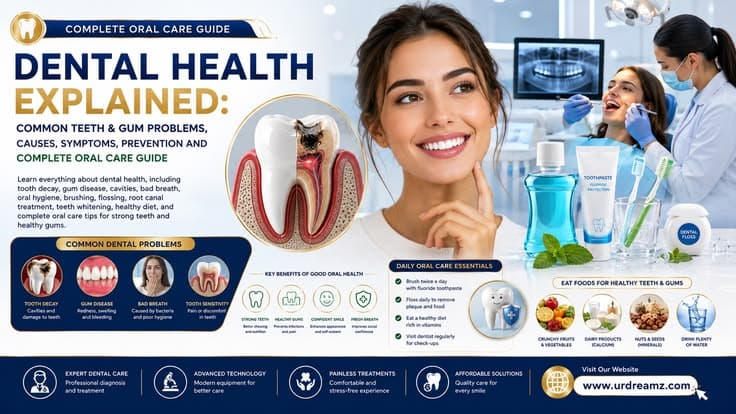
Dental Health Explained: Common Teeth & Gum Problems, Causes, Symptoms, Prevention and Complete Oral Care Guide
Your mouth works harder than almost any other part of your body, chewing, speaking, smiling, and quietly fighting off bacteria thousands of times a day, yet dental health rarely gets attention until something already hurts. This guide breaks down every major tooth and gum problem individually, its causes, symptoms, herbal support, and medical treatment, along with the foods, diet plan, exercises, and daily habits that actually keep your teeth and gums strong for life.
Introduction: The Health Habit Hiding in Plain Sight
Most people brush their teeth on autopilot, half asleep, barely paying attention, and think of the dentist as someone to visit only when something already hurts. That approach quietly costs people more than they realize, since dental problems rarely start as an emergency; they build slowly, invisibly, over months or years of small daily habits, until one day a dull ache turns into a genuine problem that could have been caught, or avoided entirely, much earlier.
This guide takes dental health seriously without making it complicated. We'll walk through every major tooth and gum problem one at a time, what causes it, how to recognize it, what actually helps, herbal and medical, and which foods, habits, and simple exercises keep your mouth in good shape for the long run. No fear-mongering, no vague "brush more" advice, just a clear, complete picture of how your mouth actually works and what it needs.
By the end, you'll have a working understanding of everything from the different types of teeth in your mouth to the difference between plaque and tartar, why gums bleed, why wisdom teeth cause so much trouble, and exactly which foods build stronger enamel versus which ones quietly chip away at it meal after meal. Think of this less as a list of scary warnings and more as the owner's manual nobody hands you for the one part of your body you use every single time you eat, speak, or smile.
What Is Dental Health and Why It Matters
Dental health refers to the overall condition of your teeth, gums, and the supporting structures inside your mouth, including how well they function, how free they are from disease, and how effectively they resist the constant bacterial activity that naturally occurs every time you eat. It's easy to think of oral health as separate from the rest of the body, but the mouth is directly connected to overall health in very real ways; untreated gum disease, for example, has been linked to a higher risk of heart disease, and poorly controlled diabetes makes gum infections both more likely and harder to heal. Taking care of your mouth isn't a cosmetic afterthought, it's a genuine extension of taking care of your whole body.
There's also a quality-of-life dimension that's easy to overlook until it's affected: chronic tooth pain disrupts sleep and concentration, missing or damaged teeth can affect confidence and how comfortably someone speaks or smiles in public, and difficulty chewing properly can even limit which foods someone feels able to eat, gradually narrowing their diet in ways that ripple into broader nutrition. Dental health, in other words, touches far more of daily life than most people give it credit for.
The Structure of a Tooth
Each tooth is built in layers, and understanding them makes it much easier to understand why certain problems hurt the way they do. The enamel is the hard, visible outer layer, the toughest substance in the human body, protecting everything underneath. Beneath that sits dentin, a softer, more porous layer that transmits sensation, which is exactly why exposed dentin causes sensitivity. At the core is the pulp, containing nerves and blood vessels that keep the tooth alive; this is the part that causes real pain once decay or infection reaches it. Below the gum line, the root anchors the tooth into the jawbone through a ligament that also allows for slight natural movement.
Table: Types and Sizes of Teeth
| Tooth Type | Typical Count (Adult) | Main Function |
|---|---|---|
| Incisors | 8 (4 upper, 4 lower) | Cutting and biting food |
| Canines | 4 (2 upper, 2 lower) | Tearing tougher foods |
| Premolars | 8 (4 upper, 4 lower) | Crushing and grinding food |
| Molars | 8 (4 upper, 4 lower) | Grinding food into smaller pieces |
| Wisdom teeth (third molars) | Up to 4 | Additional grinding, often impacted or removed |
In total, a full adult set typically includes 32 teeth once all wisdom teeth have emerged, though many adults have one or more removed due to crowding or impaction.
Table: Baby Teeth vs Permanent Teeth
| Feature | Baby (Primary) Teeth | Permanent Teeth |
|---|---|---|
| Total count | 20 | 32 (including wisdom teeth) |
| Typical eruption age | Starts around 6 months | Starts around age 6 |
| Enamel thickness | Thinner, more prone to decay | Thicker and more resilient |
| Replacement | Fall out and are replaced | Meant to last a lifetime |
Common Dental Problems: An Overview
Most dental issues fall into a handful of recurring categories: decay-related problems affecting the tooth structure itself, gum-related problems affecting the supporting tissue, sensitivity and pain conditions, structural damage like cracks and wear, and developmental issues like wisdom tooth complications. The sections below walk through each of the major conditions individually, since lumping them together, the way a lot of generic oral care advice does, tends to obscure exactly what's actually going wrong and what specifically helps.
Tooth Decay (Cavities) Explained
Tooth decay happens when bacteria in your mouth feed on sugars and starches left behind after eating, producing acid as a byproduct that gradually erodes the enamel. Left unchecked, this acid attack eats through the enamel, then the softer dentin underneath, eventually reaching the nerve-rich pulp if the process isn't stopped. A cavity is essentially the physical hole left behind once this erosion has progressed far enough, and it's one of the most common chronic conditions in the world, affecting people of every age.
What makes decay particularly sneaky is that it's a slow-motion process happening in stages, each one reversible for a while before it isn't. In the earliest stage, enamel is losing minerals faster than saliva and fluoride can replace them, but no actual hole exists yet, meaning it can still be reversed with better hygiene and fluoride exposure. It's only once that mineral loss progresses far enough that an actual cavity forms, and at that point, a filling becomes the only real way to stop it from spreading further.
Causes of Tooth Decay
Decay is driven by a combination of factors working together: frequent consumption of sugary or starchy foods that feed decay-causing bacteria, inadequate brushing and flossing that allows plaque to build up undisturbed, insufficient fluoride exposure that would otherwise help remineralize weakened enamel, dry mouth conditions that reduce saliva's natural protective effect, and deep grooves in molars that trap food and bacteria more easily than smoother tooth surfaces. Genetics also plays a modest role in how resistant or vulnerable someone's enamel naturally is.
Symptoms of Tooth Decay
Early decay often causes no symptoms at all, which is part of why regular checkups matter even without pain. As it progresses, common signs include visible white or brown spots on the tooth surface, sensitivity to sweet, hot, or cold foods, a dull ache that comes and goes, visible holes or pits in the tooth, and in more advanced cases, sharp pain when biting down or a noticeable dark spot that's grown large enough to see without a mirror's help.
Gingivitis (Early Gum Disease) Explained
Gingivitis is the earliest, mildest stage of gum disease, involving inflammation of the gum tissue surrounding the teeth. It's caused by plaque buildup along the gumline that irritates the gums but hasn't yet damaged the deeper structures holding teeth in place. The genuinely good news about gingivitis is that it's fully reversible with proper oral hygiene, unlike its more advanced counterpart, which is exactly why catching it at this stage matters so much.
Causes of Gingivitis
The core cause of gingivitis is plaque accumulation from inconsistent or ineffective brushing and flossing, but several factors make it more likely: smoking or tobacco use, which reduces the gums' ability to heal, hormonal changes during puberty, pregnancy, or menopause that make gums more sensitive to plaque, certain medications that reduce saliva flow, poorly fitting dental restorations that trap plaque, and underlying conditions like diabetes that impair the body's normal inflammatory response.
Symptoms of Gingivitis
Gingivitis typically shows up as red, puffy gums rather than the healthy pale pink they should be, gums that bleed easily during brushing or flossing, mild tenderness, and sometimes persistent bad breath. Importantly, gingivitis usually doesn't cause pain in its early stages, which is exactly why bleeding during brushing gets dismissed so often as "normal," when it's actually one of the clearest early warning signs something needs attention.
Periodontitis (Advanced Gum Disease) Explained
When gingivitis is left untreated, it can progress into periodontitis, a more serious condition where inflammation spreads below the gumline and starts breaking down the bone and connective tissue that hold teeth in place. Unlike gingivitis, periodontitis causes permanent damage; pockets form between the teeth and gums, trapping bacteria and debris, and over time, teeth can become loose or even fall out if the condition isn't controlled.
The distinction between gingivitis and periodontitis is genuinely one of the most important things to understand in this entire guide, because it's the difference between a fully reversible situation and one that can only be managed and slowed down. This is exactly why dentists push so hard about early gum bleeding, not because bleeding gums alone are dangerous, but because they represent the last easy off-ramp before the condition potentially becomes permanent.
Causes of Periodontitis
Periodontitis develops from long-standing, untreated gingivitis, but its progression is accelerated by several factors: heavy smoking, which is one of the strongest risk factors for severe gum disease, poorly controlled diabetes, genetic predisposition toward aggressive gum disease, chronic stress that weakens immune response, certain medications that affect gum tissue, and nutritional deficiencies that impair the body's ability to repair damaged tissue.
Symptoms of Periodontitis
Symptoms include gums that have visibly receded, making teeth look longer than before, persistent bad breath that doesn't improve with brushing, pus between the teeth and gums, noticeable spacing changes between teeth as the supporting bone weakens, loose or shifting teeth, and pain while chewing. By the time these symptoms are obvious, meaningful bone loss has often already occurred, which is why periodontitis requires professional treatment rather than home care alone.
Bad Breath (Halitosis) Explained
Bad breath, medically called halitosis, is most often caused by bacteria breaking down food particles and producing sulfur compounds inside the mouth, though it can also stem from causes outside the mouth entirely. Chronic bad breath that persists despite regular brushing is usually a sign of an underlying issue rather than simply needing more mouthwash, which is why understanding the actual cause matters more than masking the smell temporarily.
Causes of Bad Breath
Common causes include poor oral hygiene allowing bacteria and food debris to accumulate, gum disease, a coated tongue harboring odor-causing bacteria, dry mouth reducing saliva's natural cleansing effect, certain foods like garlic and onions that release odor through the bloodstream after digestion, tobacco use, chronic sinus infections or postnasal drip, and less commonly, digestive issues or untreated tooth decay creating pockets where bacteria thrive undisturbed.
Symptoms and Signs Behind Bad Breath
Beyond the odor itself, people with chronic halitosis often notice a persistent bad or sour taste in the mouth, a visibly coated or white-ish tongue, dry mouth sensation, and sometimes thick saliva. Because people generally can't smell their own breath accurately, a dry mouth feeling combined with a visibly coated tongue is often a more reliable self-check than trying to assess the smell directly.
Tooth Sensitivity Explained
Tooth sensitivity is a sharp, temporary discomfort triggered by hot, cold, sweet, or acidic foods and drinks, or sometimes even cold air. It happens when the protective enamel has worn thin or the gums have receded, exposing the underlying dentin layer, which contains tiny tubules that lead directly to the tooth's nerve, allowing external stimuli to trigger a pain response far more easily than they would through intact enamel.
Causes of Tooth Sensitivity
Sensitivity commonly results from enamel erosion caused by acidic foods and drinks, aggressive brushing with a hard-bristled brush that wears down enamel and irritates gums, gum recession exposing the tooth root, teeth grinding that gradually wears down enamel, recent dental procedures like whitening or a filling, and cracked teeth that allow stimuli to reach the nerve more directly than they normally would.
Symptoms of Tooth Sensitivity
The hallmark symptom is a quick, sharp jolt of pain triggered by a specific stimulus, hot coffee, ice cream, a sugary snack, or even a cold breeze, that fades relatively quickly once the trigger is removed. Unlike a toothache, sensitivity pain is usually brief rather than constant, though if it starts lingering longer after the trigger is gone, that can be a sign of a deeper problem like decay or an infection rather than simple sensitivity.
Dental Abscess (Infection) Explained
A dental abscess is a pocket of pus caused by a bacterial infection, usually developing at the root of a tooth or in the surrounding gum tissue. It typically results from untreated tooth decay that has reached the pulp, a cracked tooth that allowed bacteria in, or advanced gum disease. An abscess is a genuine infection, not just a painful inconvenience, and it needs prompt professional treatment since it can spread to surrounding tissue, the jaw, or in rare but serious cases, beyond the mouth entirely.
Causes of a Dental Abscess
Abscesses most often develop from untreated cavities that have progressed deep enough to infect the pulp, cracked or chipped teeth that let bacteria reach the inner tooth structure, advanced gum disease creating deep pockets where infection can take hold, a weakened immune system that struggles to contain minor bacterial invasions, and previous dental work, like a filling or crown, that has failed or developed a gap allowing bacteria back in.
Symptoms of a Dental Abscess
Symptoms include a severe, persistent, throbbing toothache, swelling in the face, cheek, or jaw, sensitivity to pressure or chewing, a foul taste in the mouth from draining pus, fever, and swollen lymph nodes under the jaw or in the neck. A dental abscess with facial swelling or fever is considered a genuine dental emergency and needs same-day or urgent attention rather than waiting for a routine appointment.
Cracked Teeth and Enamel Erosion
Cracked teeth and enamel erosion are structural problems rather than infections, though left untreated, both can eventually lead to decay or infection by exposing the tooth's inner layers. A cracked tooth can range from a barely visible hairline fracture to a more significant break, while enamel erosion refers to the gradual, widespread thinning of the protective enamel layer across the tooth surface, often from years of acid exposure rather than a single event.
Causes of Enamel Erosion and Cracked Teeth
Enamel erosion is typically caused by frequent consumption of acidic foods and drinks, including citrus fruits, soft drinks, and wine, acid reflux or frequent vomiting exposing teeth to stomach acid, and aggressive brushing technique. Cracked teeth more often result from biting down on something hard, teeth grinding, an old filling that has weakened the surrounding tooth structure, or a direct injury or impact to the mouth.
Symptoms of Enamel Erosion and Cracked Teeth
Enamel erosion often shows up as increasing tooth sensitivity, a yellowish tint as the underlying dentin becomes more visible through thinned enamel, and smoother, sometimes glossy-looking tooth surfaces. Cracked teeth typically cause pain when chewing or releasing a bite, sensitivity to temperature that comes and goes unpredictably, and sometimes visible fracture lines, though many cracks are small enough that a dentist's examination is needed to actually confirm them.
Wisdom Tooth Problems Explained
Wisdom teeth, the third and final set of molars, typically emerge between the ages of 17 and 25, but many jaws simply don't have enough room to accommodate them properly, leading to impaction, where the tooth is blocked from erupting normally or comes in at an awkward angle. Impacted wisdom teeth are one of the most common reasons for dental surgery, particularly in younger adults, and can cause a cascade of problems for neighboring teeth if left unaddressed.
Not every wisdom tooth causes trouble; some emerge in perfect alignment and never need to come out at all. The issue almost always comes down to available space in the jaw, which is largely determined by genetics and the size of an individual's jawbone relative to their tooth size, which is why some people sail through this stage of life without a single issue while others end up needing surgery in their late teens or early twenties.
Causes of Wisdom Tooth Pain
Pain typically stems from insufficient jaw space causing the tooth to grow at an angle or become trapped beneath the gum line, partial eruption that creates a flap of gum tissue prone to trapping food and bacteria, infection developing around a partially erupted tooth, and pressure against neighboring teeth as the wisdom tooth tries to find room to emerge, sometimes contributing to crowding or shifting elsewhere in the mouth.
Symptoms of Wisdom Tooth Problems
Common symptoms include pain or tenderness at the back of the jaw, swelling and redness of the gum around the emerging tooth, difficulty opening the mouth fully, a bad taste or odor from infection around a partially erupted tooth, and occasionally headaches or jaw stiffness. Symptoms often flare intermittently rather than constantly, worsening for a few days at a time as the tooth shifts or the surrounding tissue becomes irritated.
Bruxism (Teeth Grinding) Explained
Bruxism refers to the unconscious clenching or grinding of teeth, most often happening during sleep, though some people also do it during the day, particularly under stress. Over time, bruxism can flatten and wear down tooth surfaces, contribute to cracks, and strain the jaw joint. It's frequently linked to stress and anxiety, misaligned bite, or sleep disorders, and many people don't realize they're doing it until a dentist notices unusual wear patterns or a partner mentions the grinding sound at night.
Plaque vs Tartar: What's the Difference?
Plaque is a soft, sticky, colorless film of bacteria that forms on teeth continuously, within hours of brushing, and can still be removed at this stage through regular brushing and flossing. Tartar, also called calculus, is what plaque becomes once it hardens on the tooth surface, typically within a day or two if not removed, at which point it can no longer be brushed away and requires professional scaling to remove. Understanding this distinction is exactly why brushing consistency matters so much: you're working against a very short window before soft, removable plaque turns into something only a dentist can take off.
Once tartar has formed, it also creates a rough surface that makes it even easier for new plaque to stick and accumulate on top of it, which is part of why gum problems tend to accelerate once tartar builds up along the gumline. Breaking that cycle really does require a professional cleaning; no amount of at-home brushing, however thorough, can remove tartar once it has fully hardened.
Table: Which Dental Problems Are Most Common?
| Condition | General Prevalence |
|---|---|
| Tooth decay (cavities) | Extremely common; affects the large majority of people at some point |
| Gingivitis | Very common; most adults experience it at some stage |
| Bad breath | Very common; experienced occasionally by nearly everyone |
| Tooth sensitivity | Common, especially with age and enamel wear |
| Periodontitis | Common in adults, more prevalent with age and smoking |
| Wisdom tooth impaction | Common in younger adults with limited jaw space |
| Bruxism | Common, often stress-related and underdiagnosed |
| Dental abscess | Less common but serious; usually follows untreated decay |
Tooth decay and gingivitis are consistently the two most widespread dental issues worldwide, largely because both stem directly from everyday plaque buildup, which makes consistent daily brushing and flossing the single highest-leverage habit for preventing the most common problems people actually face.
Herbal Remedies for Tooth Decay and Gum Disease
Several traditional remedies genuinely support gum and tooth health when used alongside, not instead of, proper brushing and dental care. Clove, long used in traditional dentistry, contains eugenol, a natural compound with antibacterial and mild numbing properties, useful for temporary relief. Neem, widely used in South Asian oral care, has natural antibacterial properties that can help reduce plaque-forming bacteria when used as a chewing stick or in a mouth rinse. Salt water rinses remain one of the simplest, most genuinely effective home practices for reducing bacteria and soothing irritated gum tissue.
Table: Herbal Support for Tooth Decay and Gum Disease
| Remedy | How to Use | Benefit |
|---|---|---|
| Clove oil | Dab a small amount on affected area with a cotton swab | Antibacterial, temporary pain relief |
| Neem | Chew stick or use as a mouth rinse | Antibacterial, supports gum health |
| Warm salt water rinse | Rinse for 30 seconds after meals | Reduces bacteria, soothes gums |
| Turmeric paste | Apply gently to gums | Anti-inflammatory support |
| Green tea rinse | Use cooled, unsweetened tea as a rinse | Antioxidants that may reduce plaque bacteria |
Herbal Remedies for Bad Breath
Fresh herbs like mint and parsley have long been used to freshen breath, and there's genuine logic behind it, their natural chlorophyll and essential oils help neutralize odor rather than just masking it briefly. Fennel seeds, commonly chewed after meals in South Asian households, stimulate saliva production, which helps wash away odor-causing bacteria naturally. Cinnamon has mild antibacterial properties and a pleasant natural scent that can help freshen breath when used in a mouth rinse.
Table: Herbal Support for Bad Breath
| Remedy | How to Use | Benefit |
|---|---|---|
| Fennel seeds | Chew a small amount after meals | Stimulates saliva, freshens breath naturally |
| Fresh mint or parsley | Chew fresh leaves | Natural odor-neutralizing properties |
| Cinnamon rinse | Use as a diluted mouth rinse | Mild antibacterial and freshening effect |
| Clove | Chew a whole clove briefly | Antibacterial and freshening |
| Green tea | Drink or use as a rinse | Reduces odor-causing bacteria |
Herbal Remedies for Tooth Sensitivity and Pain
For sensitivity and mild pain, clove oil remains one of the most consistently useful traditional remedies thanks to its natural numbing effect. A cooled chamomile tea bag applied gently to a sore area can offer mild soothing relief thanks to its anti-inflammatory properties. Warm salt water rinses double up here too, helping reduce inflammation around a sensitive or mildly painful tooth. It's worth being clear, though: herbal remedies can genuinely ease discomfort temporarily, but they don't reverse the underlying enamel loss, gum recession, or decay actually causing the sensitivity, which still needs proper dental evaluation.
Table: Herbal Support for Sensitivity and Pain
| Remedy | How to Use | Benefit |
|---|---|---|
| Clove oil | Dab lightly on the sensitive area | Natural numbing and antibacterial effect |
| Cooled chamomile tea bag | Hold gently against the sore area | Mild anti-inflammatory relief |
| Warm salt water rinse | Rinse gently, avoid aggressive swishing | Reduces inflammation and bacteria |
| Garlic paste (used cautiously) | Applied briefly, not left on for long | Traditional antibacterial use |
English (Medical) Treatment Overview
Once a dental problem moves past what home care and herbal support can reasonably manage, professional treatment becomes necessary, and the specific approach depends heavily on which condition and how advanced it is. Modern dentistry offers a genuinely wide range of options, from simple fillings for early decay to more involved procedures for advanced gum disease or structural damage, and matching the right treatment to the right stage of a problem is exactly what a proper dental exam is designed to determine.
Table: Medical Treatment by Dental Condition
| Condition | Common Medical Treatment |
|---|---|
| Early tooth decay | Fluoride treatment or a simple filling |
| Deep decay reaching the pulp | Root canal treatment |
| Gingivitis | Professional cleaning and improved home care |
| Periodontitis | Deep scaling, root planing, sometimes surgery |
| Dental abscess | Drainage, antibiotics, root canal or extraction |
| Cracked tooth | Bonding, crown, or extraction depending on severity |
| Wisdom tooth impaction | Surgical extraction |
| Bruxism | Custom night guard, stress management |
| Severe sensitivity | Desensitizing treatment or bonding |
Root Canal Treatment: When Is It Needed?
A root canal becomes necessary when decay or injury has reached the pulp, the inner nerve and blood vessel-filled core of the tooth, causing infection or irreversible inflammation. Contrary to its intimidating reputation, the procedure itself is generally no more uncomfortable than getting a filling, since it's performed under local anesthesia; the pain people associate with root canals almost always comes from the infection itself beforehand, not the treatment that resolves it. During the procedure, the infected pulp is removed, the space is cleaned and sealed, and the tooth is typically capped with a crown afterward to restore strength.
This mismatch between reputation and reality is worth repeating, because it genuinely keeps people from seeking help sooner: the throbbing, sleep-disrupting pain someone feels before a root canal comes from the untreated infection, and the procedure is actually what makes that pain go away, not what causes it. Once the tooth is properly treated and crowned, it typically functions normally for many years, often for the rest of a person's life with reasonable care.
Fillings, Crowns and Bridges Explained
A filling repairs a tooth after decay has been removed, using material like composite resin to restore its shape and function, and is typically used for smaller cavities. A crown is a full cap placed over a tooth that's been significantly weakened, whether from a large cavity, a root canal, or a crack, essentially rebuilding the tooth's outer structure entirely. A bridge is used to replace one or more missing teeth by anchoring a false tooth to the crowns of the teeth on either side of the gap, restoring both appearance and chewing function.
Scaling and Deep Cleaning Explained
Scaling is the professional removal of plaque and tartar from the tooth surface, something that simply can't be undone with a toothbrush once tartar has hardened. Deep cleaning, also called scaling and root planing, goes further, cleaning below the gumline and smoothing the tooth root to help gums reattach more securely, typically recommended once gum disease has progressed beyond simple gingivitis. Both procedures are generally quick, done under local numbing if needed, and make a genuinely noticeable difference in gum health almost immediately afterward.
Tooth Extraction Explained
Extraction, the removal of a tooth entirely, is generally considered a last resort when a tooth is too damaged, decayed, or infected to be reasonably saved, or in the case of impacted wisdom teeth causing ongoing problems. Simple extractions are performed on visible, accessible teeth under local anesthesia, while surgical extractions, often needed for impacted wisdom teeth, involve a more involved procedure to access a tooth that hasn't fully emerged. Recovery typically takes about a week for simple extractions, with proper aftercare playing a real role in avoiding complications like dry socket.
15 Healthy Foods for Strong Teeth
What you eat directly shapes how resilient your teeth and gums actually are, since certain nutrients build stronger enamel while others support healthy gum tissue and saliva production. Building these into regular meals does more for long-term dental health than any single remedy ever could.
Table: 15 Best Foods for Healthy Teeth
| # | Food | Why It Helps |
|---|---|---|
| 1 | Milk | Calcium and phosphorus for enamel strength |
| 2 | Plain yogurt | Calcium plus probiotics for gum health |
| 3 | Cheese | Calcium and helps neutralize mouth acid |
| 4 | Leafy greens (spinach, kale) | Calcium and folic acid support gum tissue |
| 5 | Almonds | Calcium and protein without added sugar |
| 6 | Apples | Crunchy texture stimulates saliva and cleans surfaces |
| 7 | Carrots | Crunchy, fibrous, stimulates saliva flow |
| 8 | Celery | Natural fibrous cleaning action while chewing |
| 9 | Strawberries | Vitamin C supports healthy gum tissue |
| 10 | Oranges (in moderation) | Vitamin C, though rinse after due to acidity |
| 11 | Salmon | Vitamin D supports calcium absorption |
| 12 | Eggs | Vitamin D and protein for tooth structure |
| 13 | Water | Rinses food particles, supports saliva production |
| 14 | Green tea | Antioxidants that may reduce bacteria |
| 15 | Sugar-free chewing gum | Stimulates saliva, helps clear food debris |
15 Foods to Avoid for Dental Health
Just as certain foods build stronger teeth, others actively work against you, feeding decay-causing bacteria, wearing down enamel, or sticking around on tooth surfaces far longer than they should. Cutting back on these makes a genuinely measurable difference in cavity risk over time.
Table: 15 Foods to Avoid for Healthy Teeth
| # | Food or Drink | Why It Harms Teeth |
|---|---|---|
| 1 | Candy and hard sweets | Feeds decay-causing bacteria for extended periods |
| 2 | Sticky sweets (caramel, toffee) | Clings to teeth, prolonging sugar exposure |
| 3 | Soda and soft drinks | High sugar plus acidity erodes enamel |
| 4 | Sports and energy drinks | Highly acidic, wears down enamel |
| 5 | Citrus fruits in excess | Acidic, can erode enamel over time |
| 6 | Ice (chewing it) | Can crack or chip teeth |
| 7 | Chips and starchy snacks | Starch converts to sugar, sticks in crevices |
| 8 | White bread | Sticky starch residue feeds bacteria |
| 9 | Dried fruit | Sticky, concentrated sugar clings to teeth |
| 10 | Alcohol | Dries out the mouth, reducing protective saliva |
| 11 | Coffee (excess, without rinsing) | Stains teeth and can contribute to dry mouth |
| 12 | Tobacco and smoking | Major risk factor for gum disease and oral cancer |
| 13 | Pickled or highly acidic foods | Repeated acid exposure wears enamel |
| 14 | Sugary flavored coffee drinks | Combines sugar and prolonged sipping exposure |
| 15 | Popcorn kernels | Hard, unpopped kernels can crack teeth |
Table: A Sample Healthy Diet Plan for Teeth
| Meal | Suggested Focus |
|---|---|
| Breakfast | Plain yogurt with berries, or eggs with whole grain toast |
| Mid-morning snack | A crunchy apple or a handful of almonds |
| Lunch | Leafy greens with lean protein like grilled chicken or fish |
| Afternoon snack | Carrot or celery sticks with cheese |
| Dinner | Salmon or eggs with a side of vegetables |
| After meals | Rinse with water; sugar-free gum if brushing isn't possible |
| Throughout the day | Steady water intake instead of sugary or acidic drinks |
Oral and Jaw Exercises for Dental Health
While exercise isn't usually the first thing people associate with dental health, simple jaw and mouth exercises can genuinely help with jaw tension, bruxism-related discomfort, and circulation to the gums. These aren't a replacement for brushing or dental visits, but they're a useful, often overlooked complement, particularly for people who deal with jaw clenching, TMJ discomfort, or general facial tension from stress.
Table: Simple Oral and Jaw Exercises
| Exercise | How to Do It | Benefit |
|---|---|---|
| Jaw relaxation stretch | Slowly open mouth wide, hold 5 seconds, release | Reduces jaw tension from clenching |
| Side-to-side jaw movement | Gently move jaw left and right slowly | Improves jaw joint mobility |
| Tongue press | Press tongue to roof of mouth and hold briefly | Strengthens tongue and supports oral muscle tone |
| Cheek puff exercise | Puff cheeks with air, hold, release | Improves circulation to gum and cheek tissue |
| Gentle gum massage | Massage gums lightly with a clean finger | Stimulates blood flow to gum tissue |
| Deep breathing for jaw tension | Slow breathing while consciously relaxing the jaw | Reduces stress-related clenching |
Daily Oral Care Routine
A solid daily routine doesn't need to be complicated: brush twice a day, floss once daily, use an antibacterial or fluoride mouthwash if recommended by your dentist, clean your tongue gently to reduce bacteria and freshen breath, and rinse with water after meals when brushing isn't immediately possible. Consistency matters far more than intensity here; a simple routine followed every single day beats an elaborate one followed sporadically.
Proper Brushing Technique
Good brushing technique matters just as much as brushing frequency. Use a soft-bristled brush held at a 45-degree angle to the gumline, moving in gentle, small circular motions rather than aggressive back-and-forth scrubbing, which can wear down enamel and irritate gums over time. Spend at least two minutes covering every surface, outer, inner, and chewing surfaces, and don't forget the tongue, where a large share of odor-causing bacteria tends to accumulate.
Proper Flossing Technique
Flossing reaches the roughly 40 percent of tooth surface that brushing alone simply can't access, the tight spaces between teeth where plaque loves to hide. Use about 18 inches of floss, wrapping most of it around your middle fingers and using a clean section for each tooth, gently guiding it in a C-shape against each tooth surface rather than snapping it straight down, which can injure the gums. Doing this once daily, ideally before bed, prevents plaque in these hidden spaces from ever getting the chance to harden into tartar.
Dental Care by Age
Dental needs shift meaningfully across life stages. In childhood, the focus is establishing good habits early, supervised brushing, limiting sugary snacks, and starting regular dental visits by the first birthday or first tooth. Teenagers face a higher cavity risk due to snacking habits and, often, orthodontic treatment requiring extra cleaning attention. Adults need to stay vigilant about gum disease, which becomes more common with age, while pregnant women face increased gum sensitivity due to hormonal shifts and should maintain regular dental visits throughout pregnancy. Older adults often deal with dry mouth from medications and a higher risk of root decay as gums naturally recede, making consistent care and more frequent checkups increasingly valuable rather than less.
Across every one of these stages, the underlying principle stays the same even as the specific risks shift: consistent, age-appropriate care prevents far more than it fixes. A toddler who gets used to brushing early builds a habit that carries into adulthood; an older adult who stays on top of dry mouth and root exposure avoids the kind of late-life dental crisis that's far harder, and more expensive, to resolve once it's already underway.
Table: Dental Health Myths vs Facts
| Myth | Fact |
|---|---|
| Sugar is the only cause of cavities | Poor hygiene, dry mouth and acidic foods all contribute independently |
| Bleeding gums during brushing are normal | Bleeding gums usually signal early gum disease and need attention |
| Baby teeth don't need much care since they fall out | Baby teeth decay can affect permanent teeth developing underneath |
| Brushing harder cleans better | Hard brushing wears enamel and irritates gums instead |
| You only need a dentist when something hurts | Many dental problems progress silently before causing pain |
| Whitening damages enamel | Professionally guided whitening is generally safe when used as directed |
Prevention Tips for Lifelong Oral Health
The foundation of lifelong dental health is refreshingly simple, even if it isn't always easy to stick with: brush twice daily with proper technique, floss once a day, limit sugary and acidic foods, stay hydrated to support natural saliva production, avoid tobacco entirely, and keep up with regular dental checkups even when nothing feels wrong. None of this is complicated, but consistency over years, not occasional bursts of extra care, is genuinely what keeps teeth and gums healthy for a lifetime.
It also helps to think about timing, not just the actions themselves. Brushing right after highly acidic foods or drinks can actually do more harm than good, since enamel is temporarily softened right after acid exposure; rinsing with water and waiting about thirty minutes before brushing gives enamel time to reharden first. Small timing details like this are easy to miss but genuinely add up over years of daily repetition.
When to See a Dentist
Routine checkups every six months are generally recommended for most people, even without symptoms, since many dental problems progress silently. You should see a dentist sooner if you notice persistent tooth pain, swelling in the face or gums, bleeding gums that don't improve with better hygiene, a tooth that's become loose, visible decay, or any signs of infection like fever alongside dental pain, since these situations shouldn't wait for a routine appointment.
Frequently Asked Questions
How often should you brush and floss your teeth?
Brushing twice a day and flossing once a day is the standard recommendation for most people to effectively control plaque buildup.
Why do my gums bleed when I brush?
Bleeding gums usually indicate early gum inflammation, gingivitis, caused by plaque buildup, and typically improves with more consistent brushing and flossing.
Can gum disease be reversed?
Gingivitis, the early stage, is fully reversible with good oral hygiene; periodontitis, the more advanced stage, can be managed but not fully reversed once bone loss has occurred.
What causes bad breath even after brushing?
Persistent bad breath despite brushing often points to a coated tongue, dry mouth, gum disease, or an underlying digestive or sinus issue rather than simple hygiene.
Is fluoride toothpaste necessary?
Fluoride helps strengthen enamel and resist decay, making it a widely recommended, well-supported addition to a daily oral care routine.
When is a root canal actually needed?
A root canal becomes necessary when decay or damage has reached the tooth's inner pulp, causing infection or irreversible inflammation.
What foods strengthen tooth enamel?
Dairy products, leafy greens, nuts, and crunchy fruits and vegetables all support enamel strength and healthy saliva production.
Can teeth whitening damage enamel?
Properly guided whitening, done as directed, is generally considered safe; overuse or unsupervised at-home products carry more risk of sensitivity.
How do I know if I need my wisdom teeth removed?
Pain, swelling, difficulty opening the mouth, or signs of infection around a partially erupted wisdom tooth are common signs that removal may be needed.
How often should I visit the dentist?
Most people are advised to visit every six months for a checkup and cleaning, though your dentist may recommend more frequent visits based on your specific oral health needs.
Conclusion
Dental health isn't one single habit or one single problem; it's a collection of small daily choices, how you brush, what you eat, whether you floss, whether you show up for checkups even when nothing hurts, that quietly determine whether your teeth serve you well for decades or start causing problems far earlier than they should. Understanding each condition individually, what causes it, how to spot it early, and what genuinely helps, herbal support alongside proper medical care when needed, puts you in a much stronger position than vague, generic advice ever could. This guide is intended for general education and does not replace professional dental care; always consult a qualified dentist for diagnosis and treatment of any tooth or gum concern.
Your mouth does an enormous amount of quiet, unglamorous work every single day, and it doesn't ask for much in return, just consistent care, decent food choices, and the willingness to see a dentist before something becomes an emergency rather than after.
If nothing else stays with you from this guide, let it be this: nearly every dental problem covered here starts small, quiet, and completely manageable, and turns into something painful, expensive, or permanent mainly through delay. Two minutes of proper brushing twice a day, a bit of floss, sensible food choices, and a dentist visit even when you feel fine will handle the overwhelming majority of what's covered above, long before it ever has the chance to become a real problem.
Related Reading:
- Diabetes Explained: Symptoms, Causes, Blood Sugar and Treatment Guide
- Weight Loss Diet Plan: Best Foods for Fat Loss
- High Blood Pressure vs Low Blood Pressure: Complete Guide
- Heart Health: Complete Guide to Prevention, Symptoms and Diet
- Digestive Problems Explained: Causes, Symptoms and Treatment
- Fatty Liver Disease: Warning Signs, Stages and Complete Guide
- Kidney Health Explained: Symptoms, Causes and Treatment
- Thyroid Disorders Explained: Symptoms, Causes and Treatment
- Joint Pain Explained: Causes, Symptoms and Treatment
- High Cholesterol Explained: Symptoms, Causes, LDL vs HDL and Treatment Guide
- Anemia Explained: Symptoms, Causes, Iron Deficiency and Treatment Guide
- Sleep Health Explained: Causes of Poor Sleep and Complete Guide to Better Sleep
- Eye Health Explained: Causes, Diseases, Treatment and Complete Guide to Healthy Eyes
- Immune System Explained: How Immunity Works and Complete Guide to Boosting Immunity Naturally
- Piles (Hemorrhoids) Explained: Internal vs External Piles and Complete Treatment Guide
This article is for general educational purposes only and is not a substitute for professional dental advice, diagnosis, or treatment. Always consult a qualified dentist regarding any tooth, gum, or oral health concern.