Child Behavior Explained: Normal vs Abnormal Behavior, Causes, Symptoms, Treatment, Diet, Exercise & Screen Time — Complete Parent's Guide
Everything a parent needs to understand child behavior — what is normal, what is not, why it happens, and how food, exercise, and screen time shape it.
Introduction: Behavior Is a Child's First Language
Long before a child can explain what they feel in words, they show it through behavior. A slammed door, a sudden meltdown in the supermarket, a refusal to eat vegetables, or a fist thrown at a sibling — none of these happen in a vacuum. Behavior is communication. A child who cannot yet say "I am overwhelmed" or "I am scared of being left alone" will often show you instead of tell you.
This is the single most important idea every parent should hold onto while reading this guide: almost every difficult behavior has a reason behind it, even when that reason is not obvious in the moment. Hunger, tiredness, a change in routine, a new sibling, a stressful day at school, or simply a brain that has not yet finished developing self-control can all show up as "bad behavior."
At the same time, not every behavior is simply a phase that will pass on its own. Some patterns are early signals of a deeper emotional, developmental, or medical concern that benefits enormously from early support. The goal of this guide is to help you tell the difference — to understand what is developmentally typical, what deserves closer attention, what causes it, and what you as a parent can actually do about it, starting today.
Parents often arrive at this question after a particularly hard day — a public tantrum, a note home from school, a sudden refusal to cooperate with even the simplest request. In that moment, it is easy to jump straight to labels: "naughty," "spoiled," "difficult." But behavior is rarely that simple, and labels rarely help. A more useful question than "why is my child being bad?" is "what is my child trying to tell me right now, and what skill haven't they built yet to say it another way?" Shifting the question this way does not excuse harmful behavior, and it does not mean boundaries disappear — it simply changes the starting point from judgment to curiosity, which almost always leads to a calmer, more effective response.
This guide is written for exactly that kind of parent: someone who wants to understand their child a little better, respond a little more consistently, and know clearly when a pattern has crossed from "typical but tiring" into "worth a professional conversation." Nothing here replaces individualized medical or psychological advice, but it will give you a solid, evidence-informed foundation to work from.
We will walk through normal behavior by age, the most common behavioral problems, root causes, red-flag warning signs, fifteen behavioral and emotional conditions explained in plain language, treatment options, positive discipline techniques, food and nutrition that genuinely affects mood and self-control, exercise, and screen time — because in 2026, screens are one of the biggest daily influences on a child's behavior, for better or worse.
What Is Child Behavior?
Child behavior refers to the full range of actions, reactions, and responses a child shows in daily life — how they speak, play, express anger, handle disappointment, interact with siblings and classmates, follow or resist instructions, and manage their emotions. It is shaped by three things working together at the same time: biology, environment, and relationships.
- Biology — a child's temperament, brain development, and any underlying neurological or medical condition.
- Environment — home routine, sleep, nutrition, screen exposure, school environment, and community.
- Relationships — how parents, siblings, teachers, and friends respond to and shape the child's actions.
It helps to think of behavior as the visible tip of an iceberg. What a parent sees — the shouting, the refusal, the tears, the silence — is only the surface. Underneath sits a mix of temperament the child was born with, the amount of sleep they got last night, whether they ate recently, what happened at school that day, and how safe and predictable their environment currently feels. Two children can display the exact same surface behavior for entirely different underlying reasons, which is precisely why a single, universal "fix" for any behavior rarely works for every family.
Behavior is not fixed. A toddler who bites today is not destined to be aggressive as a teenager. A shy four-year-old is not automatically an anxious adult. Behavior evolves constantly as a child's brain matures, especially the prefrontal cortex — the part responsible for impulse control, planning, and emotional regulation — which continues developing well into the early twenties. This single fact explains why young children physically cannot regulate emotions the way adults expect them to; the biological hardware for that skill simply is not finished yet.
Normal Child Behavior by Age
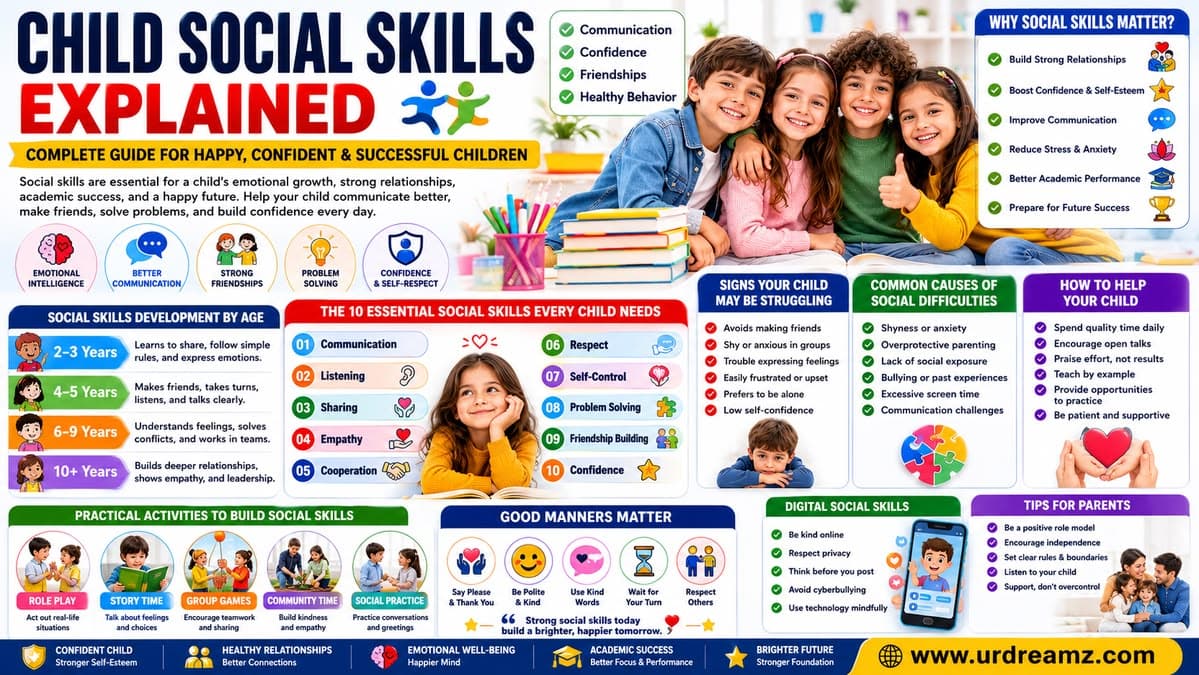
Every stage of childhood comes with its own set of behaviors that look "difficult" to an outsider but are, in fact, completely age-appropriate. Below is a general roadmap. Remember that every child develops at their own pace, and a few months of variation in either direction is completely normal.
| Age Group | Typical Behaviors | What It Usually Means |
|---|---|---|
| 0–1 year (Infant) | Crying, fussing, separation anxiety, clinginess | Only way to communicate needs; attachment forming |
| 1–3 years (Toddler) | Tantrums, saying "no," biting, hitting, throwing objects | Testing independence; limited language and impulse control |
| 3–5 years (Preschool) | Emotional outbursts, imaginative lying, arguing over toys, defiance | Developing imagination, emotional vocabulary still forming |
| 6–9 years (School age) | Testing rules, mood swings, complaining, occasional rudeness | Balancing home rules with new social/school pressures |
| 10–12 years (Tween) | Mood swings, wanting privacy, back-talk, peer influence | Early identity formation and hormonal changes beginning |
| 13–18 years (Teen) | Withdrawal, risk-taking, arguing, strong desire for independence | Identity development, brain's reward system maturing faster than impulse control |
It also helps to remember that development is rarely a straight line. A child may handle transitions beautifully one week and struggle the next simply because of a growth spurt, a change in sleep, or an unrelated stressor like a cold. Regression — a potty-trained child suddenly having accidents, or an independent sleeper suddenly wanting a parent nearby at bedtime — is common after a stressful event and usually resolves on its own with patience and reassurance rather than pressure.
Notice a pattern? At almost every age, a behavior that feels frustrating to a parent is, from the child's point of view, an attempt to gain independence, express an emotion they cannot name yet, or navigate a brain and body that is still under construction. Understanding this does not mean you should never correct the behavior — it means you correct it with realistic expectations instead of frustration or shame.
Common Everyday Behaviors Parents Worry About Unnecessarily
Many behaviors that alarm parents are, in isolation, part of healthy development. Recognizing them as normal can reduce a lot of unnecessary stress at home.
| Behavior | Why It's Usually Normal | What Helps |
|---|---|---|
| Tantrums / emotional outbursts | Child is learning to express big feelings with limited tools | Stay calm, name the feeling, wait it out |
| Messiness | Reflects exploration and creativity, not laziness | Teach organization gradually with routines |
| Picky eating | Taste preferences shift naturally through childhood | Keep offering variety without pressure or bribery |
| Fear of dark or strangers | Common at certain developmental stages | Reassurance, night lights, gradual exposure |
| Saying "no" frequently | Building independence and testing limits | Offer safe choices instead of open-ended control |
| Short attention span | Normal for developing brains, especially under age 8 | Short, engaging tasks; break work into chunks |
| Needing extra attention | Reassurance-seeking, especially after change | Dedicated one-on-one time daily |
| High energy levels | Natural in growing bodies | Outdoor play and physical outlets |
It is worth noticing how many of these "worrying" behaviors are actually signs of healthy development rather than something going wrong. Messiness reflects a mind busy exploring rather than a lack of discipline. Picky eating is a near-universal phase tied to a child's evolving sense of taste and control, not a sign of poor parenting. Fear of the dark or of strangers reflects a growing, healthy awareness of the world rather than excessive anxiety. Recognizing these as normal does not mean ignoring them — gentle, patient guidance still helps a child move through each phase — but it does mean parents can respond with far less stress once they know the behavior is expected rather than exceptional.
None of these behaviors, taken alone or occasionally, are cause for alarm. Problems arise only when a behavior becomes extreme, constant, or starts interfering with the child's daily functioning, friendships, or schoolwork — which brings us to the next section.
What Is Abnormal or Concerning Behavior?
Abnormal behavior is not simply "worse" misbehavior — it is behavior that is significantly out of step with a child's age, persists over time, and disrupts their ability to function at home, in school, or with friends. Clinicians generally look at three markers together: intensity, duration, and impact.
- Intensity — the reaction is far bigger than the situation calls for (e.g., hours-long meltdowns over minor changes).
- Duration — the pattern continues for six months or longer rather than fading with age or guidance.
- Impact — the behavior interferes with friendships, school performance, family life, or safety.
A single tantrum is normal. Daily, hour-long, physically aggressive meltdowns that continue past age seven and disrupt the whole household are a different story. Context, frequency, and severity always matter more than any one incident.
It also helps to compare a behavior against the child's own baseline rather than against other children. A naturally energetic, talkative child who becomes even more so is different from a normally quiet child who suddenly becomes withdrawn — both can be worth watching, but for very different reasons. Parents typically know their own child better than any checklist ever could; when something feels genuinely different from "who my child usually is," that instinct is worth trusting enough to ask a professional for a second opinion, even if the behavior does not perfectly match every item on a formal list.
Causes of Behavior Problems in Children
Behavior problems rarely have a single cause. Instead, several factors usually combine and interact.
| Category | Examples |
|---|---|
| Developmental | Immature impulse control, language delays, learning difficulties |
| Emotional | Anxiety, grief, fear, low self-esteem, unresolved anger |
| Environmental | Chaotic routines, inconsistent rules, family conflict, divorce, moving homes |
| Physical / medical | Poor sleep, hunger, undiagnosed pain, sensory sensitivities, ADHD, autism |
| Learned behavior | Modeling aggressive or disrespectful behavior seen at home or media |
| Social | Bullying, peer pressure, difficulty making friends, exclusion |
| Digital | Excessive screen time, violent content, gaming addiction, disrupted sleep from devices |
Looking at each category a little closer helps explain why the same behavior can look so different from one child to the next. Developmental causes are often the most misunderstood — a four-year-old who cannot sit still through a long dinner is not being defiant; their brain simply has not yet built the capacity for that level of self-control. Emotional causes tend to hide behind the behavior itself: a child who is anxious about a school test may show it as irritability rather than saying "I'm nervous." Environmental causes are frequently the fastest to fix, because routines, consistency, and calm communication are entirely within a parent's control, even during stressful periods like a house move or a new sibling's arrival. Physical and medical causes are the ones most often missed, since hunger, poor sleep, ear infections, or undiagnosed sensory sensitivities can all produce behavior that looks purely emotional on the surface. Learned behavior deserves particular attention from parents, since children are remarkably accurate mirrors of the tone, language, and conflict style they see modeled daily. Social causes such as bullying or exclusion often surface first as behavior changes at home rather than direct complaints. Finally, digital causes have grown rapidly in recent years — a child overtired from late-night device use, or unsettled by content beyond their developmental stage, can show classic signs of a behavior problem that actually has a very simple root cause.
Researchers who study aggression in particular point to a mix of learning and biology. Children imitate aggressive behavior they see modeled by others, especially when that behavior appears to be rewarded or powerful — a concept famously demonstrated in behavioral psychology research on observational learning. Frustration and blocked goals can trigger negative emotion that spills into aggression. Family patterns matter too: when a child's aggressive outburst repeatedly gets them attention or lets them avoid something unpleasant, that outburst is reinforced and becomes more likely to happen again. Group dynamics, competition among peers, exposure to violent media, and how a child interprets an ambiguous situation — assuming hostile intent versus assuming an accident — all shape whether a child reacts aggressively or calmly to the same event.
Warning Signs Parents Should Never Ignore
While most behavior swings are temporary, certain signs deserve prompt attention from a pediatrician, school counselor, or child psychologist.
| Warning Sign | Why It Matters |
|---|---|
| Behavior persists more than 6 months | Suggests a pattern rather than a passing phase |
| Sudden, unexplained change in behavior | May signal bullying, abuse, illness, or emotional distress |
| Loss of interest in favorite activities | Possible sign of depression or anxiety |
| Major changes in sleep or eating patterns | Often linked to emotional or physical health issues |
| Harm or threats toward self, others, or animals | Requires immediate professional attention |
| Negative self-talk ("I'm useless," "nobody likes me") | May indicate low self-esteem or emotional distress needing support |
| Withdrawal from family and friends | Possible social, emotional, or mental health concern |
| Struggles noticeably affecting school performance | May point to learning difficulty, attention issue, or emotional stress |
If your child ever talks about not wanting to be alive, expresses hopelessness, or you are worried about their immediate safety, treat it seriously and reach out to a mental health professional or a local crisis line right away rather than waiting to see if it passes. This is a sensitive topic — if you are personally going through a difficult time as a parent as well, please know support is available, and I'm happy to help you find the right resources if that would be useful.
It is worth stressing that noticing one of these signs does not automatically mean something is seriously wrong — children go through ordinary rough patches too, especially around illness, exams, or family stress. The purpose of this checklist is not to create worry over every bad week, but to help parents recognize the difference between a passing rough patch and a pattern that genuinely deserves professional eyes on it.
15 Behavioral and Emotional Disorders Explained
These conditions range from mild to more significant, and only a qualified professional can diagnose any of them. This section is for awareness, not self-diagnosis.
| # | Condition | Key Features |
|---|---|---|
| 1 | ADHD (Attention-Deficit/Hyperactivity Disorder) | Inattention, hyperactivity, impulsivity affecting school/home life |
| 2 | Oppositional Defiant Disorder (ODD) | Persistent anger, defiance, and arguing with authority figures |
| 3 | Conduct Disorder | Repeated rule-breaking, aggression, disregard for others' rights |
| 4 | Autism Spectrum Disorder (ASD) | Differences in social communication, repetitive behaviors, sensory sensitivities |
| 5 | Generalized Anxiety Disorder | Excessive, ongoing worry about everyday situations |
| 6 | Separation Anxiety Disorder | Intense fear of being apart from caregivers beyond typical age range |
| 7 | Social Anxiety Disorder | Strong fear of social or performance situations |
| 8 | Childhood Depression | Persistent sadness, irritability, loss of interest in activities |
| 9 | Sensory Processing Differences | Over- or under-reaction to sounds, textures, light, or movement |
| 10 | Specific Learning Disorder | Difficulty with reading, writing, or math despite normal intelligence |
| 11 | Tic Disorders / Tourette Syndrome | Involuntary, repeated movements or sounds |
| 12 | Selective Mutism | Consistent inability to speak in specific social settings despite speaking normally elsewhere |
| 13 | Attachment-related difficulties | Trouble forming secure bonds, often linked to early caregiving disruption |
| 14 | Intermittent Explosive Outbursts | Sudden, disproportionate anger outbursts out of character for the child |
| 15 | Post-Traumatic Stress Reactions | Behavioral and emotional changes following a frightening or traumatic event |
A closer look at each condition helps replace worry with understanding. ADHD shows up as a child who genuinely struggles to sit through a lesson or finish a task, not because they are unmotivated, but because their brain's attention system works differently. Oppositional Defiant Disorder goes beyond ordinary stubbornness — it is a persistent pattern of anger and argument with almost every authority figure, most days, for months. Conduct Disorder involves more serious, repeated rule-breaking that clearly disregards others' rights or safety, well beyond typical misbehavior. Autism Spectrum Disorder is a difference in how a child communicates, socializes, and processes sensory input — not a behavior problem to be "corrected," but a different wiring that benefits from understanding and tailored support. Generalized Anxiety Disorder looks like constant worry that seems disproportionate to the situation — about grades, safety, or family — that the child cannot easily shake off. Separation Anxiety Disorder is intense, developmentally inappropriate distress at being apart from a caregiver, well past the age when this is typical. Social Anxiety Disorder shows as a strong, persistent fear of being judged or embarrassed in front of others, often leading to avoidance of school or group activities. Childhood Depression can look like irritability and anger just as often as sadness, along with a noticeable loss of interest in things the child once enjoyed. Sensory Processing Differences mean ordinary sounds, textures, or lights can feel overwhelming or barely noticeable, which can look like overreaction or inattention to others. Specific Learning Disorder causes a mismatch between a child's effort and their results in reading, writing, or math, often mistaken for laziness. Tic Disorders involve involuntary movements or sounds the child cannot simply choose to stop, which can be confused with attention-seeking behavior. Selective Mutism is not shyness by choice — it is a genuine anxiety-driven inability to speak in specific settings despite talking freely at home. Attachment-related difficulties often trace back to early disruptions in consistent caregiving and can affect how a child trusts and connects with others. Intermittent explosive outbursts stand out because they are dramatically out of character for the child and disproportionate to the trigger. Post-traumatic stress reactions can follow any frightening event — an accident, a loss, or witnessing violence — and often show up as behavior change rather than the child directly describing fear.
Two things are worth repeating here. First, having one or two traits from this list does not mean a child has the disorder — every condition is defined by a specific combination, severity, and duration of symptoms assessed by a trained professional. Second, an early, accurate evaluation is almost always a source of relief rather than alarm for families, because it opens the door to the right support instead of years of guesswork.
How Abnormal Behavior Is Treated
Treatment is rarely a single fix — it is usually a combination of approaches tailored to the child and family.
| Approach | What It Involves |
|---|---|
| Behavioral therapy | Structured techniques to reinforce positive behavior and reduce problem behavior |
| Cognitive Behavioral Therapy (CBT) | Helps children (especially older ones) reframe unhelpful thoughts driving anxiety or anger |
| Play therapy | Uses play to help younger children express and process emotions |
| Parent training programs | Equip parents with consistent, evidence-based responses to challenging behavior |
| Family therapy | Addresses communication and dynamics affecting the whole household |
| School-based support | Individualized education plans, classroom accommodations, counselor check-ins |
| Medical evaluation | Rules out physical causes; may include medication for certain diagnosed conditions under a doctor's supervision |
| Occupational therapy | Supports sensory regulation and daily-life skills |
In practice, treatment usually begins with a thorough evaluation to understand exactly what is driving the behavior, since the same outward symptom — say, frequent meltdowns — can stem from anxiety in one child, sensory overload in another, and unmet sleep needs in a third. Behavioral therapy and parent training programs tend to be the first line of support for younger children, since parents spend the most hours with the child and can apply consistent techniques throughout the day, not just during a weekly session. Cognitive behavioral therapy becomes increasingly useful as children get older and can reflect on their own thought patterns, particularly for anxiety, low mood, or anger. Play therapy remains one of the most effective tools for younger children who do not yet have the vocabulary to discuss feelings directly but can express them naturally through play scenarios a trained therapist can interpret. Medication is never the automatic first step; when it is used, it is typically reserved for specific diagnosed conditions like ADHD, prescribed and monitored carefully by a physician, and paired with behavioral strategies rather than used alone.
The most effective plans almost always combine professional guidance with consistent effort at home — no single therapy session can outweigh an unpredictable home environment, and no amount of parental effort can replace a diagnosis that genuinely requires professional treatment. The two work together.
Positive Discipline vs Punishment
Discipline means "to teach," not "to punish." Positive discipline focuses on guiding a child toward better choices while preserving their sense of safety and self-worth.
| Positive Discipline | Traditional Punishment |
|---|---|
| Explains the reason behind a rule | Demands obedience without explanation |
| Uses natural or logical consequences | Uses fear, shouting, or physical punishment |
| Builds long-term self-control | Produces short-term compliance only |
| Strengthens the parent-child bond | Can damage trust and increase secrecy |
| Teaches emotional regulation by modeling it | Often models the very behavior it tries to stop |
Nine practical techniques that work particularly well for reducing aggression and defiance:
- Praise good behavior specifically and immediately — catch them being kind and name it out loud.
- Teach alternatives through role-play — practice using words instead of hitting.
- Limit screen time, especially for children already showing aggressive tendencies.
- Limit unsupervised time around peers who model aggressive behavior.
- Never let aggression "work" — don't give in to demands made through outbursts, even once.
- Stay calm yourself; your regulated response is the behavior you want your child to copy.
- Apply consequences immediately and consistently, without long warnings or exceptions.
- Acknowledge the feeling first ("I see you're really frustrated"), then state the boundary clearly ("...but hitting is not okay").
- Be consistent — enforce the same rule the same way every time to avoid confusion.
Good Habits vs Bad Habits: A Simple Daily Checklist
Alongside discipline techniques, everyday habits quietly shape a child's behavior over months and years. Small, repeated habits — good or bad — compound into a child's default way of handling the world, so it helps to know which ones to encourage and which ones to gently redirect.
| Good Habits to Encourage | Bad Habits to Gently Redirect |
|---|---|
| Washing hands regularly | Not washing hands before meals |
| Brushing teeth twice a day | Skipping hygiene routines |
| Eating healthy food and drinking plenty of water | Wasting food or refusing balanced meals repeatedly |
| Sleeping on time and getting enough rest | Watching TV or using a mobile device for too long, especially before bed |
| Saying "please," "thank you," and "sorry" | Talking loudly or using rude words |
| Sharing toys and being kind to others | Fighting or hitting others |
| Listening to teachers and parents | Throwing toys instead of putting them away |
| Keeping toys and books in the right place | Throwing trash on the ground |
None of these habits form overnight, and none of the "bad" ones make a child a bad person — they are simply patterns still being learned. Small, consistent habits practiced daily make a genuinely big difference over time, far more than any single dramatic lecture or punishment ever could.
Additional habits that support all of the above: give advance warning before transitions ("in five minutes, it's time to stop playing"), offer small safe choices so children feel some control, and avoid physical punishment — it may stop a behavior in the moment, but it does not teach emotional regulation and can increase fear or aggression over time.
15 Healthy Foods That Improve Child Behavior
Blood sugar swings, poor sleep from heavy or sugary meals, and nutrient gaps can all show up as irritability, poor focus, or hyperactivity. The following foods support steady energy, mood, and brain function.
| # | Food | Behavior/Brain Benefit |
|---|---|---|
| 1 | Oats | Slow-release energy supports steady mood and focus |
| 2 | Eggs | Protein and choline support memory and attention |
| 3 | Fatty fish (salmon, sardines) | Omega-3s linked to improved attention and emotional regulation |
| 4 | Greek yogurt | Protein and probiotics support gut-brain mood connection |
| 5 | Leafy greens (spinach, kale) | Iron and folate support cognitive function |
| 6 | Berries | Antioxidants support brain health and reduce inflammation |
| 7 | Nuts (age-appropriate serving) | Healthy fats and magnesium support calm nervous system |
| 8 | Whole grain bread | Stable blood sugar reduces irritability |
| 9 | Beans and lentils | Steady protein and fiber prevent energy crashes |
| 10 | Bananas | Natural sugars plus fiber for gentle, sustained energy |
| 11 | Avocado | Healthy fats support brain development |
| 12 | Milk / dairy alternatives (fortified) | Calcium and vitamin D support nervous system function |
| 13 | Sweet potatoes | Complex carbs support steady mood without sugar spikes |
| 14 | Chicken and lean meats | Protein and iron support attention and energy |
| 15 | Water (plenty of it) | Even mild dehydration can worsen mood and concentration |
15 Foods and Drinks to Avoid or Limit
| # | Food/Drink | Why to Limit It |
|---|---|---|
| 1 | Sugary cereals | Quick sugar spikes followed by energy crashes and irritability |
| 2 | Candy and sweets | Blood sugar swings linked to mood changes |
| 3 | Soda and sweetened drinks | High sugar and caffeine can affect sleep and hyperactivity |
| 4 | Energy drinks | Caffeine unsuitable for children; disrupts sleep and mood |
| 5 | Fried, greasy fast food | Heavy fats linked to sluggishness and poor concentration |
| 6 | Highly processed snacks (chips, packaged cakes) | Low nutrients, high sodium, artificial additives |
| 7 | Artificial food coloring (in excess) | Some studies link certain additives to hyperactivity in sensitive children |
| 8 | White bread / refined carbs (excess) | Rapid blood sugar spikes and crashes |
| 9 | Excess chocolate | Sugar and mild caffeine content can affect sleep late in the day |
| 10 | Instant noodles (frequent use) | High sodium, low nutritional value |
| 11 | Packaged fruit juices | Often as sugary as soda despite a "healthy" label |
| 12 | Excess dairy-based desserts (ice cream, etc.) | High sugar content best kept occasional |
| 13 | Processed deli meats | High sodium and preservatives, best limited |
| 14 | Sports drinks (routine use) | Unnecessary sugar for children not doing intense sports |
| 15 | Late-night heavy snacks | Can disturb sleep quality, indirectly worsening next-day mood |
None of these need to be eliminated entirely — the goal is moderation and an overall pattern built around whole foods, not perfection.
Healthy Diet and Exercise Plan by Age
| Age Group | Diet Focus | Recommended Physical Activity |
|---|---|---|
| 1–3 years | Small, frequent balanced meals; whole milk; iron-rich foods | Free play, walking, climbing — at least 3 hours of activity daily |
| 4–6 years | Variety of fruits, vegetables, whole grains, lean protein | Active play, running, simple sports — 60+ minutes daily |
| 7–12 years | Balanced plate model; limit sugary snacks; regular meal times | 60 minutes of moderate-to-vigorous activity daily, including team sports |
| 13–18 years | Adequate protein, iron, calcium for growth spurts; watch fast-food frequency | 60 minutes daily; strength-based activity 3x/week is beneficial |
Breakfast in particular deserves special attention, since children who skip it are far more likely to show irritability, poor concentration, and low energy by mid-morning — a pattern teachers notice quickly in the classroom. A simple, protein-and-fiber-based breakfast, even something as basic as eggs with whole grain toast or oatmeal with fruit, tends to produce a noticeably calmer, more focused morning than sugary cereal alone. Hydration matters just as much as food choice; children frequently mistake thirst for hunger or restlessness, and something as simple as a glass of water before assuming a behavior problem needs a bigger intervention can make a real difference.
Exercise deserves special mention for behavior specifically: physical activity burns off excess energy, improves sleep quality, releases mood-boosting brain chemicals, and gives children a healthy outlet for frustration that might otherwise appear as irritability or aggression at home.
Screen Time Guidelines by Age
| Age Group | General Guideline |
|---|---|
| Under 18 months | Avoid screen use except video calls with family |
| 18–24 months | If introduced, only high-quality content, watched together with a parent |
| 2–5 years | No more than 1 hour per day of high-quality, supervised content |
| 6–12 years | Consistent daily limits; prioritize sleep, activity, and homework first |
| 13–18 years | Encourage balance; watch for signs of gaming or social media overuse affecting mood, sleep, or grades |
| Children already showing aggression | Consider reducing to 0–30 minutes daily while working on behavior goals |
Signs that screen time may be affecting a child's behavior more than expected include increased irritability specifically when a device is taken away, declining interest in previously enjoyed offline activities, sleep that has quietly shifted later and later, and schoolwork that has started to slip without another clear explanation. None of these signs alone confirm a problem, but together they are a reasonable cue to reassess the household's daily screen habits before assuming a separate behavioral cause.
Screen time is not inherently harmful in small, well-chosen doses, but excessive or unsupervised use is consistently linked to poorer sleep, reduced attention span, increased irritability, and higher exposure to content that models aggression or unrealistic social comparison. A simple house rule — screens off at least one hour before bedtime, no screens during meals, and no devices in bedrooms overnight — solves a large share of screen-related behavior issues without a single argument about content.
Why Children Mirror Their Parents
Every technique, food choice, and screen-time rule in this guide works best inside one larger context: the emotional atmosphere of the home itself. Perhaps the single most powerful influence on a child's behavior is not a technique, a food, or a screen-time rule — it is the parent's own behavior. Children do not lack respect; they mirror the respect (or disrespect) modeled around them every day. Your tone becomes their tone. The way you react to stress becomes the template for how they respond to their own frustration.
If a child yells often, it is worth quietly asking what tone they hear every day at home. Children absorb emotional energy before they fully understand the words attached to it — a calm household tends to raise calmer children, not because of luck, but because calm has been demonstrated, repeatedly, as the normal response to stress. Before correcting a child's behavior, it helps to briefly look at what behavior is being modeled for them. Small, consistent changes in a parent's own tone and reactions often produce the biggest shifts in a child's behavior over time.
When and Where to Seek Professional Help
Consult a pediatrician or child mental health specialist if a behavior persists for more than six months, is intense or highly disruptive, interferes with school or daily life, or involves any harm or threats toward the child, others, or animals. Trust your instincts as a parent — if something consistently feels "off" compared to your child's usual self, it is always reasonable to ask a professional.
For families in Peshawar and the wider Khyber Pakhtunkhwa region, the Department of Pediatrics at Khyber Teaching Hospital (KTH) and Lady Reading Hospital (LRH) both offer psychiatric and developmental evaluations for children. Specialized centers such as the Pakistan Institute of Community Ophthalmology (PICO) in Peshawar also provide developmental and behavioral assessments. A first step can simply be a conversation with your child's school counselor or family doctor, who can refer you further if needed.
Before a first appointment, it helps to jot down specific examples of the behavior — what happened right before it, how long it lasted, how the child was afterward, and how often it occurs in a typical week. Bringing notes from a teacher or another caregiver, if relevant, gives the professional a fuller picture across different settings rather than a single environment. Most parents find that this first conversation brings relief rather than added worry, since it usually replaces uncertainty with a clear, practical next step.
Frequently Asked Questions
What is normal child behavior by age?
Normal behavior shifts with each developmental stage — tantrums and boundary-testing in toddlers, emotional outbursts in preschoolers, mood swings and rule-testing in school-age children, and independence-seeking with occasional defiance in teens. See the age table above for full detail.
Why is my child suddenly behaving badly?
Sudden change is usually triggered by something specific — a new sibling, a house move, school stress, poor sleep, illness, bullying, or a shift in family routine. Look for a recent change before assuming a deeper problem.
What causes behavior problems in children?
A mix of developmental, emotional, environmental, medical, learned, social, and digital factors, often combined rather than acting alone. See the causes table above.
How can I improve my child's behavior?
Consistency, predictable routines, positive reinforcement of good behavior, clear and calm boundaries, adequate sleep, balanced nutrition, regular exercise, and limited screen time all contribute meaningfully.
What are the signs of a behavioral disorder in children?
Persistent (6+ months), intense, and disruptive patterns — such as constant defiance, aggression, extreme anxiety, or sudden withdrawal — that clearly interfere with daily life warrant a professional evaluation.
How do I discipline my child without yelling?
Use calm, immediate, consistent consequences; acknowledge the feeling before stating the boundary; and rely on natural or logical consequences rather than fear-based reactions.
What is positive parenting?
An approach that teaches rather than punishes — using clear expectations, warmth, consistency, and encouragement to build long-term self-discipline instead of short-term fearful compliance.
How do I stop temper tantrums?
Stay calm, avoid giving in to demands made through the tantrum, name the child's feeling, and offer comfort once they begin to settle. Prevention — regular meals, naps, and warnings before transitions — reduces frequency significantly.
Why does my child not listen?
Common reasons include inconsistent follow-through on rules, instructions given from a distance rather than close and direct, overtiredness, or simply a normal, age-appropriate push for independence.
Why is my child aggressive?
Aggression often stems from frustration, modeled behavior at home or in media, unmet needs, or, in some cases, an underlying developmental or emotional condition. The nine techniques in the discipline section above are a strong starting point.
How do I handle a stubborn child?
Offer limited, safe choices so they feel some control, stay firm and consistent on non-negotiables, and pick your battles — not every disagreement needs to become a power struggle.
What should I do if my child lies?
Respond calmly rather than with anger, which encourages more honesty next time. Distinguish between imaginative "pretend" stories in young children and deliberate lying in older children, and address the underlying reason for the lie.
Why do children hit other children?
Usually a mix of undeveloped impulse control, frustration, imitation of aggression seen elsewhere, or a way of getting a reaction. Teaching words instead of hitting through role-play is one of the most effective long-term fixes.
How can I teach respect to children?
Model it consistently yourself — respectful tone, active listening, and calm conflict resolution at home teach far more than any lecture about respect.
What is the best way to reward good behavior?
Specific, immediate praise ("I love how you shared your toy just now") works better long-term than generic praise or material rewards alone, though small reward charts can help build consistency for younger children.
How do I set boundaries for children?
State the rule clearly, explain the reason briefly, apply the same consequence every time, and remain calm and firm rather than negotiating repeatedly in the moment.
Is screen time affecting my child's behavior?
Excessive or unsupervised screen time is linked to poorer sleep, shorter attention span, and increased irritability. Following the age-based guidelines above generally reduces these effects.
Can poor sleep cause behavior problems?
Yes — insufficient sleep in children frequently shows up as irritability, poor focus, and emotional outbursts, sometimes mimicking attention or mood disorders.
How does diet affect child behavior?
Blood sugar swings from sugary or highly processed foods, along with nutrient gaps, can worsen irritability and concentration, while balanced meals support steadier mood and energy.
What are ADHD behavior symptoms?
Persistent inattention, hyperactivity, and impulsivity that noticeably affect school performance and daily functioning, beyond what is typical for the child's age.
How is autism different from typical behavior problems?
Autism spectrum disorder centers on differences in social communication, restricted interests, and repetitive behaviors or sensory sensitivities, rather than simple defiance or discipline issues.
When should I see a child psychologist?
When behavior is intense, persistent beyond six months, affecting school or friendships, or involves any safety concern — a professional evaluation provides clarity and a path forward.
How do I build confidence in children?
Praise effort over outcome, allow age-appropriate independence, avoid comparing them to siblings or peers, and provide consistent encouragement.
Why is consistency important in parenting?
Inconsistent responses confuse children about what is actually expected, which can increase testing behavior. Predictable rules and consequences build security and cooperation.
How can I reduce sibling fighting?
Set clear shared-space rules, avoid taking sides immediately, teach conflict-resolution language, and give each child individual attention so competition for it decreases.
What is the 3-3-3 rule for children?
A simple calming technique: naming three things you can see, three sounds you can hear, and moving three body parts — used to help a child (or adult) refocus during anxiety or overwhelm.
What are common behavior problems in toddlers?
Tantrums, biting, hitting, throwing objects, and resisting instructions are all common in toddlers because language and impulse control are still developing rapidly at this age.
How do I manage teenage behavior?
Keep communication open rather than purely restrictive, pick battles carefully, maintain a few firm non-negotiable boundaries around safety, and respect their growing need for independence and privacy.
How do I create a healthy daily routine for kids?
Keep wake times, meals, homework, play, and bedtime consistent each day. Predictability reduces power struggles because children know what to expect next.
What are the five most common behavioral issues?
Temper tantrums, defiance or refusal to follow rules, aggression toward peers or siblings, difficulty focusing or sitting still, and excessive clinginess or separation anxiety are among the most frequently reported concerns by parents.
How do reward charts improve behavior?
They make progress visible and immediate, which especially helps younger children connect a specific action with a positive outcome, building consistency over time when paired with genuine praise.
Why is my child suddenly behaving differently after a family change?
Events such as divorce, a new sibling, moving homes, or starting a new school are common triggers for temporary behavior shifts as a child processes the change; patience and extra reassurance usually help it settle.
What are red flags for toddler behavior?
Frequent, prolonged meltdowns well beyond age-typical frequency, no interest in interacting with caregivers, significant language delay, or aggressive behavior that is escalating rather than improving with guidance are worth discussing with a pediatrician.
How do I talk to my child's school about a behavior concern?
Share specific examples and patterns rather than general impressions, ask what the teacher observes in a different setting, and work together on a consistent approach between home and school.
Conclusion
Most of what looks like "bad behavior" in children is simply an underdeveloped brain doing its best with big emotions and limited tools. Understanding what is normal for each age, staying alert to genuine warning signs, addressing root causes rather than just the surface reaction, and building daily habits around consistent routines, balanced nutrition, regular exercise, and sensible screen time will resolve the overwhelming majority of everyday behavior challenges.
For the smaller number of situations where behavior is persistent, intense, or affecting a child's safety or daily functioning, professional support is not a last resort — it is simply the next right step, and one that helps far more families than it alarms. Above everything else, remember that your own calm, patience, and consistency are the most powerful behavior tools you have; children learn respect, regulation, and resilience largely by watching you practice them first.
No parent gets this perfectly right every day, and that is not the goal. Progress in child behavior is measured in small, repeated shifts over weeks and months, not in a single perfect conversation or one flawless bedtime. If today did not go the way you hoped, tomorrow morning is simply the next opportunity to try the same calm, consistent approach again — and over time, that steady repetition is what actually changes a child's behavior for good.
Related Guides:
- Healthy Sleep for Children Guide
- Positive Parenting Guide
- Child Development Guide
- Healthy Child Nutrition Guide
- Child Immunity Guide
- Breastfeeding Guide
- Child Vaccination Guide
- Child Growth Chart Guide
- Child Dental Care Guide
- Child Eye Care Guide
- Child Safety Guide
- Child Mental Health Guide
More Ideas & Inspiration: