Child Development Guide: Physical, Cognitive, Emotional and Social Growth Milestones
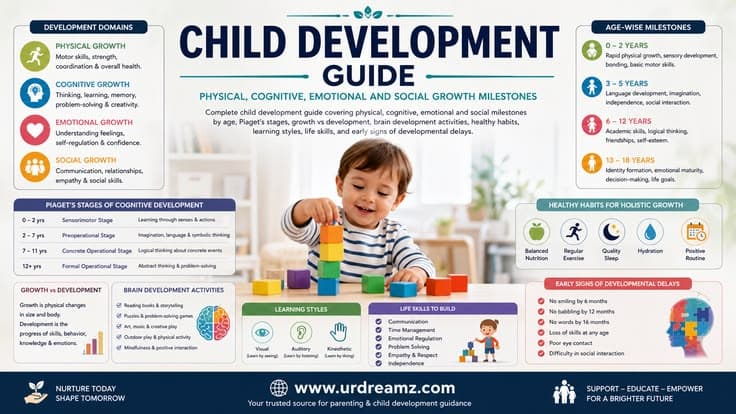
Every child who has ever lived is a unique, unrepeatable human being unfolding at their own pace across a journey that begins before birth and continues across decades. Yet within this beautiful individuality, developmental science has identified predictable patterns, sequences, and windows of development that help parents and caregivers understand what to expect, how to support optimal growth, and when to seek professional guidance. Understanding child development is not about turning parenting into a clinical exercise or comparing your child to a benchmark. It is about having the knowledge to create the environments, relationships, and daily experiences that allow each child's potential to flourish. This comprehensive guide covers every major dimension of child development from the foundational principles through physical, cognitive, emotional, and social growth, the major developmental theories every parent benefits from understanding, practical activities for each domain, healthy habits that support development, warning signs of delays, and the life skills and lessons that prepare children for successful adulthood.
1. What Is Child Development and Why It Matters
Child development is the scientific study of how children change and grow across biological, psychological, emotional, social, and cognitive dimensions from conception through adolescence. It encompasses every transformation from the first reflexive grasping of a newborn's fingers to the complex abstract reasoning of a teenager, and every smaller step in between. Understanding this process helps parents, educators, and caregivers make better decisions about the environments they create, the responses they give, and the experiences they provide to support each child's optimal growth.
Development matters because the early years of life represent a period of extraordinary brain plasticity when the architecture of lifelong cognitive, emotional, and social capacity is being laid down at a pace that will never be repeated. In the first five years alone, a child's brain forms approximately one million new neural connections per second. The quality of experiences during this foundational period, the consistency of nurturing relationships, the richness of language exposure, the safety of the environment, and the nutrition provided to the growing brain shape developmental trajectories that influence health, learning capacity, and wellbeing across an entire lifetime.
| Why It Matters | The Evidence | What Parents Can Do |
|---|---|---|
| Brain architecture is built early | 90 percent of critical brain development occurs before age 5. Neural connections formed early are the foundation for all later learning | Provide rich language, responsive relationships, and stimulating safe environments from infancy |
| Early experiences shape lifelong trajectories | Research shows that quality of early childhood experiences predicts academic achievement, mental health, and even physical health decades later | Prioritize warm, consistent caregiving and age-appropriate stimulation in the first years |
| Intervention is more effective early | The earlier developmental concerns are identified and addressed, the more effectively they can be supported due to brain plasticity | Monitor milestones. Seek early evaluation if you have concerns rather than waiting to see if children grow out of it |
| Relationships are the primary developmental engine | The quality of the child-caregiver relationship is the single most researched and consistently powerful predictor of positive development across all domains | Build a secure attachment through responsive, consistent, loving caregiving |
2. Growth vs Development: Understanding the Difference
Growth and development are terms often used interchangeably in everyday conversation, but they refer to distinct processes that are both important and complementary aspects of a child's journey. Understanding the difference helps parents track each dimension appropriately and ensures that neither is overlooked in focus on the other.
| # | Dimension | Growth | Development |
|---|---|---|---|
| 1 | Nature | Quantitative and measurable. You can count it and measure it with numbers | Qualitative and not directly measurable. It reflects improvement in functioning and capacity |
| 2 | What Changes | Increase in size, height, weight, and physical dimensions | Improvement in skills, abilities, behavior, thinking, and emotional capacity |
| 3 | Aspect | Physical change only. Body size and organ development | Mental, social, emotional, and cognitive change |
| 4 | Depends On | Primarily heredity (genes) and nutrition | Learning, environment, experiences, relationships, and opportunities |
| 5 | Direction | Follows a definite pattern and predictable sequence | May proceed in any direction based on experience and environment |
| 6 | Measurability | Easily measured with scales, tape measures, and growth charts | Assessed through observation, developmental assessments, and behavioral evaluation |
| 7 | Continuity | Has a natural endpoint when physical maturity is reached | Continuous throughout the entire lifespan. Never truly stops |
| 8 | Control | Limited parental control beyond providing adequate nutrition and healthcare | Significantly influenced by parental decisions about environment, experience, and relationship quality |
| 9 | Example | Increase in height, weight, head circumference, bone length | Learning to speak, solving problems, developing empathy, becoming independent, forming values |
The key insight that every parent benefits from understanding is that growth is about size while development is about quality. A child can grow physically while their development is being compromised by inadequate relationships, poor nutrition for the brain, or an unsafe environment. Both dimensions deserve attention, but development is more profoundly shaped by parental choices and environmental factors than growth.
3. Six Core Principles of Child Development
| # | Principle | What It Means | Practical Example |
|---|---|---|---|
| 1 | Development Is Continuous | Development is a lifelong process that starts before birth and continues until death. There is no point at which development is complete | A child continues developing language, emotional regulation, and social skills throughout childhood, adolescence, and beyond. Learning never stops |
| 2 | Development Follows a Sequence | Development occurs in a definite order. Each skill or capacity must develop before the next can build upon it. The sequence is the same for all children even if the pace varies | A child must first learn to sit before standing, stand before walking, and walk before running. A child must understand simple cause and effect before grasping complex logical reasoning |
| 3 | Different Rates of Development | Different children develop different abilities at different rates. Some develop certain skills faster and others more slowly. Both can be entirely within the normal range | One child may start talking at 10 months while another does not speak clearly until 18 months, yet both are developing normally. Some children walk at 9 months and others at 16 months |
| 4 | Development Is From General to Specific | Children first develop broad, general abilities before refining them into specific, detailed skills. Large movements precede small precise movements | A baby first swings the whole arm toward objects before developing the pincer grasp to pick up small items with two fingers. A child first makes random marks with a crayon before learning to form letters |
| 5 | Development Is Holistic | All areas of development are interrelated and influence each other. Progress or delay in one domain affects all other domains | Good physical health supports better cognitive learning. Secure emotional attachment supports language development. Social skills development depends on cognitive and emotional development. All domains develop together |
| 6 | Every Child Is Unique | No two children develop in exactly the same way. Children differ in their abilities, interests, behaviors, temperament, and the pace of their development, all of which can be entirely healthy | Some children excel in physical skills, others in language, others in creative expression. A child who talks early may walk later. A child who seems slow in one area may be advanced in another |
4. The Five Domains of Child Development
| Domain | What It Covers | Key Examples | How to Support It |
|---|---|---|---|
| Physical Development | Changes in the body and physical capabilities including gross motor skills (large movements), fine motor skills (precise small movements), coordination, balance, and overall physical health | Crawling, walking, running, jumping, drawing, writing, cutting with scissors, catching a ball | Outdoor play, physical activity, adequate nutrition, sleep, and safe spaces for movement exploration |
| Cognitive Development | Development of thinking, learning, memory, attention, language, problem-solving, reasoning, and understanding of the world | Learning to speak, remembering information, solving puzzles, understanding cause and effect, reading, mathematical reasoning | Reading together, educational play, conversations that challenge thinking, puzzles, STEM activities, and rich language exposure |
| Emotional Development | Development of the ability to recognize, understand, express, and manage emotions in healthy ways, including building self-concept, confidence, and resilience | Recognizing and naming feelings, managing frustration without aggression, building self-confidence, coping with disappointment | Emotional coaching, naming emotions, teaching coping strategies, providing a safe environment for emotional expression |
| Social Development | Development of the capacity to form and maintain relationships, cooperate with others, understand social rules and expectations, and navigate the social world | Sharing, taking turns, making friends, resolving conflicts, understanding social rules, working as part of a team | Playdates, group activities, family time, modeling healthy relationships, teaching conflict resolution skills |
| Language and Communication Development | Development of both receptive language (understanding what is communicated) and expressive language (ability to communicate with others) through speaking, listening, reading, and writing | Babbling, first words, sentence construction, reading, writing, understanding complex instructions, communicating needs and feelings effectively | Talking with children constantly, reading aloud daily, responding to communication attempts, expanding vocabulary, storytelling |
5. Heredity vs Environment: What Shapes a Child
One of the oldest and most fundamental questions in developmental science is the relative contribution of nature (heredity, genetics) and nurture (environment, experience) to how children develop. Modern developmental science has moved well beyond the old nature versus nurture debate to a sophisticated understanding of how genes and environment interact in complex and dynamic ways to shape the developing child.
| Dimension | Heredity (Inborn Factors) | Environment (External Factors) |
|---|---|---|
| Meaning | The inborn biological characteristics a child inherits from their parents through genes | All the external conditions, influences, and experiences surrounding a child from conception onward |
| Nature | Natural and biological. Present from the moment of conception. Cannot be changed after birth | External and social. Changes constantly with time, place, relationships, and circumstances |
| Control | Cannot be controlled or modified by the individual or their parents after conception | Can be significantly controlled, modified, and improved through intentional parenting and environmental design |
| Sources | Parents, grandparents, and biological ancestors transmit genetic information through DNA | Family, school, peer group, cultural environment, media, diet, socioeconomic conditions, and physical environment |
| Examples | Eye color, skin tone, height potential, certain intellectual capacities, temperament tendencies, genetic disease susceptibilities | Language learned, values developed, skills acquired, educational opportunities, quality of relationships, nutritional quality |
| Role in Development | Sets the range of potential and capacity for development. Provides the biological raw material | Determines how much of the genetic potential is actually expressed and developed |
| Key Insight | Heredity gives the potential. Genes set what is possible but rarely determine outcomes absolutely | Environment provides the opportunity to achieve the potential. What actually happens depends heavily on experience |
The most important insight from modern epigenetics is that genes are not destiny. Environmental experiences can turn genes on or off, amplify or suppress genetic tendencies, and either support or undermine the expression of genetic potential. A child with genetic potential for high intelligence requires a rich, stimulating, supportive environment to realize that potential. A child with genetic vulnerability to anxiety can develop resilience through secure attachment and effective coping skills teaching. Both heredity and environment are essential and neither can be ignored.
6. Child Development Theories Every Parent Should Know
Developmental theories are not dry academic abstractions. They are powerful explanatory frameworks that help parents understand why their children behave as they do at different ages, what developmental tasks are driving the behaviors they observe, and how to respond most effectively. Understanding even the basics of the major theories transforms many confusing or frustrating child behaviors into understandable, predictable developmental processes.
| Theory | Theorist | Core Idea | Key Insight for Parents |
|---|---|---|---|
| Cognitive Development Theory | Jean Piaget | Children actively construct their understanding of the world through four sequential stages. Each stage involves a qualitatively different way of thinking that cannot be rushed | Do not try to teach children concepts they are not developmentally ready for. Match your expectations and teaching to the child's current cognitive stage |
| Psychosocial Development Theory | Erik Erikson | Development proceeds through eight stages across the lifespan, each presenting a central psychosocial conflict whose resolution shapes personality and development | Understanding the developmental conflict of each stage helps you respond to behaviors in developmentally appropriate ways rather than treating all challenges as defiance |
| Zone of Proximal Development | Lev Vygotsky | Children learn best at the edge of their current capacity with appropriate support from a more skilled partner. Social interaction is the primary engine of cognitive development | Support children with challenges that are slightly beyond what they can do independently. Provide scaffolding then gradually withdraw support as they develop mastery |
| Attachment Theory | John Bowlby and Mary Ainsworth | Children have an innate biological need to form a secure emotional bond with a primary caregiver. The quality of this attachment shapes social, emotional, and cognitive development across the entire lifespan | Responsiveness, consistency, and warmth in the early years are not indulgences. They are the foundation of the child's developing brain and future relationships |
| Social Learning Theory | Albert Bandura | Children learn behaviors primarily by observing and imitating the people around them, particularly significant adults. Modeling is more powerful than instruction | Children learn far more from what you do than from what you tell them to do. Be the person you want them to become |
| Ecological Systems Theory | Urie Bronfenbrenner | Children develop within nested systems of influence including family, school, community, culture, and broader society. All these layers interact and jointly shape development | Child development does not happen in isolation. The quality of schools, communities, cultural messages, and societal conditions all matter and interact with family influences |
7. Piaget's Four Stages of Cognitive Development
Jean Piaget's theory of cognitive development remains one of the most influential frameworks in developmental psychology. Based on decades of careful observation of children including his own, Piaget proposed that children move through four qualitatively distinct stages of cognitive development, each representing a fundamentally different way of thinking about and understanding the world. Children cannot skip stages and cannot be meaningfully rushed through them, though the exact age at which they transition can vary.
| Stage | Age Range | Core Characteristics | Key Milestone | Parenting Implications |
|---|---|---|---|---|
| Sensorimotor Stage | Birth to 2 years | The infant learns about the world entirely through sensory experiences and motor actions. Learning happens through touch, taste, sight, sound, and physical exploration. There is no internal mental representation of objects initially | Object permanence: the understanding that objects continue to exist even when not visible. Develops around 8 to 12 months. Before this, out of sight genuinely means out of mind | Provide rich sensory experiences. Do not hide things and expect the very young infant to search. Play peek-a-boo to reinforce emerging object permanence. Allow safe physical exploration |
| Preoperational Stage | 2 to 7 years | Thinking is characterized by egocentrism (seeing the world only from one's own perspective), magical thinking, symbolic representation through play and language, and animism (believing inanimate objects have feelings). Logic is limited | Symbolic play: the ability to use objects, words, and gestures to represent other things. A banana becomes a telephone. A cardboard box becomes a spaceship. Language develops rapidly | Do not expect logical reasoning. Understand that egocentric thinking is normal, not selfishness. Engage in imaginative play. Accept magical thinking as healthy at this stage. Read stories together |
| Concrete Operational Stage | 7 to 11 years | Logical thinking emerges but is tied to concrete, tangible objects and situations rather than abstractions. Children understand conservation (that quantity remains the same despite change in appearance), classification, and seriation | Conservation: understanding that water poured from a short wide glass into a tall thin glass is the same amount despite looking different. Logical problem-solving with real, hands-on situations | Use hands-on, concrete examples for teaching new concepts. Abstract explanations will not be fully understood. Provide opportunities for classification, sorting, and logical thinking with real materials |
| Formal Operational Stage | 12 years and above | Abstract thinking emerges. The adolescent can reason about hypothetical situations, think about possibilities not just actualities, develop and test hypotheses, and engage in idealistic and philosophical thinking | Hypothetical reasoning: the ability to consider what might be rather than only what is. Ability to debate abstract concepts like justice, morality, and future possibilities | Engage teenagers in discussion of abstract ideas, moral dilemmas, and hypothetical scenarios. Their new capacity for abstract thought drives questioning of rules and authority, which is developmentally appropriate |
8. Erikson's Stages of Psychosocial Development
Erik Erikson proposed that human development proceeds through eight stages across the entire lifespan, each characterized by a central psychosocial conflict between two opposing forces. The resolution of each conflict, toward the positive or the negative pole, shapes the individual's developing personality, sense of self, and capacity for healthy relationships. Understanding which developmental conflict your child is currently navigating transforms many behavioral patterns from puzzling to predictable.
| Stage | Age | Central Conflict | Positive Resolution | What Parents Can Do |
|---|---|---|---|---|
| Trust vs Mistrust | Birth to 18 months | Can I trust the world to meet my needs? Is my caregiver reliable and responsive? | Hope and trust that the world is safe and that needs will be met. Foundation for all future relationships | Respond consistently and warmly to the infant's needs. Feeding, holding, soothing, and eye contact all build trust. Inconsistency builds mistrust |
| Autonomy vs Shame and Doubt | 18 months to 3 years | Can I do things myself? Am I capable of independence? Or will my attempts at independence be met with shame? | Will and self-control. Confidence in one's ability to manage oneself | Allow toddlers to do things independently even when it is inefficient. Avoid harsh criticism of failed attempts. Offer limited choices. Do not shame toileting accidents or developmental struggles |
| Initiative vs Guilt | 3 to 6 years | Is it okay for me to initiate activities, make plans, and assert myself? Or is my initiative inappropriate? | Purpose and direction. Confidence to pursue goals and imagination | Encourage imaginative play and self-initiated projects. Avoid excessive criticism of ideas and plans. Support the child's natural initiative and curiosity without judging results too harshly |
| Industry vs Inferiority | 6 to 12 years | Am I competent at the skills that matter in my world? Can I succeed in what I attempt? Or am I less capable than my peers? | Competence. Confidence in one's ability to master skills and contribute | Support academic and skill development without creating excessive pressure. Recognize effort not just outcomes. Help children find areas of genuine competence and pride |
| Identity vs Role Confusion | 12 to 18 years | Who am I? What do I value? Where am I going? What is my place in the world? | Fidelity and a coherent sense of self and identity that guides future life | Support identity exploration without insisting on premature closure. Tolerate questioning and experimentation. Remain a consistent, available presence as teenagers find their own answers |
9. Vygotsky's Theory of Social Learning
Lev Vygotsky's contribution to developmental theory centers on the fundamental role of social interaction in cognitive development. Where Piaget saw the child as a lone scientist constructing knowledge through individual exploration, Vygotsky proposed that children learn primarily through guided participation with more knowledgeable others, and that social interaction is not just helpful for learning but is the primary engine through which higher cognitive functions develop.
Vygotsky's most influential concept is the Zone of Proximal Development (ZPD): the distance between what a child can do independently and what they can accomplish with appropriate guidance and support from a more skilled partner. Learning is most effective and efficient when it occurs in this zone. Tasks that are too easy produce no new learning because they require no effort. Tasks that are too hard produce only frustration because they exceed the child's current capacity even with support. Tasks in the ZPD stretch the child appropriately and, with scaffolded support, build new competencies that gradually become independent skills.
The practical implication for parents is profound. When a child is struggling with a task, the goal is not to do it for them (which bypasses learning) or to leave them entirely alone with it (which may exceed their ZPD). The goal is to provide the minimum necessary support to enable success, then gradually reduce that support as the child develops mastery. This process of scaffolding and then fading the scaffold is how human beings have taught each other skills across all of human history.
10. Child Development Milestones by Age: Birth to 10 Years
| Age Stage | Key Learnings | Training and Support |
|---|---|---|
| Birth to 2 Years | Learning through all five senses including sight, sound, touch, taste, and smell. Early language skills begin with babbling, then single words, then two-word combinations. Rapid physical growth. Beginning of cause-and-effect understanding | Building trust and secure attachment through consistent responsive caregiving. Supporting physical milestones from tummy time through crawling and walking. Rich sensory experiences. Talking, singing, and reading aloud constantly |
| 2 to 4 Years | Rapid vocabulary increase from approximately 50 words at 2 to 1,000 or more words at 4. Beginning to understand simple rules and social expectations. Imaginative and pretend play flourishes. Egocentrism is normal and expected | Encouraging independence through toilet training and basic self-care. Introducing simple sharing and parallel play with other children. Consistent, simple rules with calm, clear follow-through. Rich imaginative play opportunities |
| 4 to 6 Years | Readiness for early writing, number concepts, and pre-literacy skills. Beginning to understand symbols and abstract concepts through concrete experience. Questioning why as a primary mode of engagement with the world | Family routines that build predictability and sense of contribution such as setting the table. Team play and developing understanding of fairness and taking turns. Kindergarten readiness activities. Phonological awareness through songs, rhymes, and stories |
| 6 to 8 Years | Formal reading, writing, and arithmetic skills develop. Logical thinking begins in concrete situations. Peer relationships become very important. Understanding of rules, fairness, and social comparison increases | Supporting a 12 to 24-minute concentration span through structured tasks. Building confidence through sports, arts, and academic achievements. Homework habits and study skills introduction. Emotional coaching for increasingly complex social situations |
| 8 to 10 Years | Critical thinking and ability to handle complex ideas. Developing capacity to understand others' perspectives and genuinely empathize. Beginning awareness of their own learning strengths and challenges. Stronger peer relationships | Life skills introduction including basic money management, organization, and time management. Digital safety and online responsibility education. Supporting growing independence and decision-making. Problem-solving conversations rather than parental solutions |
11. Physical Development: Fine and Gross Motor Skills
| Type | Definition | Examples | Activities to Develop | Milestones |
|---|---|---|---|---|
| Gross Motor Skills | Large muscle movements involving the arms, legs, feet, and core that allow for larger whole-body movements and overall physical coordination | Rolling, crawling, walking, running, jumping, climbing, throwing and catching a ball, swimming, dancing, riding a bicycle | Outdoor play in large spaces, climbing frames, ball games, dancing, swimming, riding bikes and scooters, obstacle courses, sports | Rolls over (4-6 months), sits unsupported (6-9 months), pulls to stand (9-12 months), walks (10-18 months), runs (18-24 months), jumps (2-3 years), hops on one foot (4-5 years), skips (5-6 years) |
| Fine Motor Skills | Precise small movements involving the hands, fingers, and wrists that allow for detailed, controlled manipulation of objects and tools | Picking up small objects, drawing, coloring, cutting with scissors, writing, buttoning clothes, tying shoelaces, using utensils, playing with small toys, threading beads | Playdough and clay, puzzles, threading activities, drawing and coloring, cutting practice, building blocks, lacing cards, finger painting, playing with small manipulatives | Palmar grasp (3-4 months), transfers objects (6-7 months), pincer grasp (9-12 months), scribbles (12-18 months), turns pages (2 years), cuts paper (3 years), draws recognizable shapes (4 years), writes letters (5-6 years) |
12. Cognitive Development Guide for Parents
| Cognitive Skill | When It Develops | How to Nurture It |
|---|---|---|
| Object Permanence | 8 to 12 months | Play peek-a-boo. Hide toys partially and let baby find them. Demonstrate things disappearing and reappearing |
| Cause and Effect Understanding | 4 to 12 months emerging, 1 to 2 years strengthening | Allow children to experiment with toys that respond to their actions. Rattles, stacking toys, cause-and-effect electronic toys for infants |
| Language and Vocabulary | Continuous from birth through adolescence. Critical window birth to age 5 | Talk constantly with children about everything. Name objects, describe actions, read aloud daily, expand on their utterances, engage in real conversations |
| Memory | Short-term memory from infancy. Long-term memory developing through childhood. Working memory continues developing into adolescence | Routines that provide predictable memory hooks. Songs and rhymes. Repetitive reading of favorite books. Memory games. Telling stories about past shared experiences |
| Executive Function (Planning, Focus, Inhibition) | Begins in toddlerhood. Develops rapidly ages 3 to 7. Continues into mid-twenties | Games requiring turn-taking and waiting. Structured play that requires following rules. Activities requiring planning and sequencing. Reducing screen time which can undermine executive function development |
| Logical Reasoning | Concrete logical reasoning ages 7 to 11. Abstract logical reasoning from adolescence | Puzzles, strategy games, sorting and classification activities, math through real-world problems, science experiments at home |
| Creativity and Problem-Solving | Emerges in early childhood through play. Develops continuously with support | Open-ended play materials. Creative arts. Asking open questions rather than directing. Allowing children to struggle with problems before offering solutions |
13. Emotional Development in Children
| Age | Emotional Development Milestones | How Parents Can Support |
|---|---|---|
| 0 to 12 months | Expresses basic emotions through crying, smiling, and body language. Develops social smile. Begins to show preference for familiar caregivers. Forms primary attachment. Experiences separation anxiety around 8 to 12 months | Respond consistently and warmly to all emotional expressions. Maintain predictable routines. Provide comfort during distress. Build secure attachment through reliable responsiveness |
| 1 to 3 years | Experiences intense emotions with very limited regulation capacity. Tantrums are developmentally normal. Begins recognizing basic emotions in self and others. Parallel play rather than cooperative play. Strong need for autonomy creating frequent power struggles | Stay calm during tantrums. Name emotions. "You're feeling really angry right now." Co-regulate by remaining regulated yourself. Offer limited choices to satisfy autonomy need |
| 3 to 5 years | Developing empathy and interest in others' emotional states. More ability to use words for feelings. Still limited emotional regulation. Imaginative play rich with emotional themes. Beginning to understand cause and effect in social situations | Use books, stories, and play to explore emotions. Role-play social situations. Teach simple regulation strategies: deep breathing, counting. Validate feelings consistently |
| 6 to 8 years | Can understand that multiple emotions can occur simultaneously. Developing genuine empathy. Better emotional regulation emerging. Peer comparison and social evaluation become emotionally significant. Pride and shame are more complex | Discuss real emotional situations with curiosity and support. Help think through social conflicts. Teach specific emotional regulation strategies. Maintain open communication about emotional experiences |
| 9 to 12 years | Can mask emotions from others. Increasingly complex emotional experiences related to peer relationships, academic performance, and developing identity. Self-consciousness increases. Friendships become deeply emotionally important | Take their emotional experiences seriously even when they seem small. Maintain open communication without pressure. Be available without intruding. Discuss social situations with curiosity not judgment |
14. Social Development and Communication Skills
| Age | Social Milestones | Activities to Support Social Development |
|---|---|---|
| 0 to 12 months | Social smile at 6 to 8 weeks. Recognizes and prefers familiar people. Imitates facial expressions. Responds to emotional tone of voice. Stranger anxiety develops around 8 to 12 months | Face-to-face interaction. Responding to the baby's social bids. Introducing to other friendly people gradually. Singing and talking constantly |
| 1 to 3 years | Parallel play (playing alongside but not with other children). Imitates adults in play. Enjoys company but limited actual cooperative play. Beginning of sharing though very difficult at this age. Sees world primarily from own perspective | Playgroups and playdates for social exposure. Teaching simple turn-taking through games. Modeling sharing without forcing it. Simple cooperative games |
| 3 to 5 years | Associative and cooperative play emerges. Beginning to make genuine friendships. Learning to take turns and share more consistently. Understanding of simple social rules. Increasing empathy. Preference for playing with same-gender peers begins | Playdates and preschool socialization. Games requiring turn-taking. Role-play of social situations. Modeling conflict resolution. Books about friendship and social situations |
| 6 to 10 years | Peer relationships become central to social identity. Best friendships develop. Team sports and cooperative play important. Understanding of social rules, fairness, and loyalty. Peer comparison becomes significant. Group membership becomes important | Team sports and group activities. Support friendship development through playdates. Help navigate conflict without taking over. Teach conflict resolution skills. Maintain family connection as peer world expands |
15. Fifteen Brain Development Activities for Children
| # | Activity | Brain Benefit | How to Do It |
|---|---|---|---|
| 1 | Read Books Together | Builds vocabulary, improves working memory, strengthens imagination, enhances concentration, and develops neural pathways for language and comprehension | Read aloud daily from infancy. Point to pictures and name them. Ask questions about the story. Visit the library regularly and let children choose books |
| 2 | Play with Building Blocks | Develops spatial reasoning, problem-solving, mathematical thinking, creativity, and hand-eye coordination simultaneously | Provide open-ended building materials at every age. Wooden blocks, LEGO, magnetic tiles. Resist directing. Let children build what they imagine |
| 3 | Drawing and Coloring | Boosts creativity, develops fine motor control, improves visual-spatial skills, and helps children express and process emotional experiences through imagery | Provide art materials without prescribed subjects. Ask open questions about their artwork rather than guessing what it is |
| 4 | Sing Songs and Nursery Rhymes | Develops phonological awareness essential for reading, enhances memory through melody, builds language skills, and promotes emotional bonding | Sing daily from infancy. Songs with actions engage more brain areas simultaneously. Rhyming books and songs are particularly powerful for pre-literacy |
| 5 | Sensory Play | Builds neural connections through multisensory stimulation, supports sensory processing development, encourages curiosity and scientific thinking | Water play, sand, playdough, rice bins, finger painting, kinetic sand, ice exploration. Supervise closely for safety. Allow mess in a contained area |
| 6 | Outdoor Play and Nature Exploration | Running, climbing, and outdoor exploration boost physical brain health, improve coordination, stimulate curiosity and scientific thinking, and reduce stress hormones that can impair learning | Unstructured outdoor time daily. Nature walks that encourage observation and questions. Outdoor games that involve problem-solving and teamwork |
| 7 | Puzzles and Shape Matching | Improves logical thinking, spatial reasoning, problem-solving persistence, pattern recognition, and fine motor skills simultaneously | Age-appropriate puzzles that challenge without frustrating. Start simple and progress. Resist completing puzzles for them. Celebrate persistence not just completion |
| 8 | Pretend and Imaginative Play | Develops creativity, communication skills, emotional understanding, empathy, planning capacity, and the ability to take others' perspectives | Provide props but do not script the play. Join imaginatively on the child's terms. Encourage elaborate scenarios. Dress-up, kitchen play, superhero play are all valuable |
| 9 | Practice Mindfulness Together | Improves focus and attention, enhances emotional regulation, reduces anxiety and stress that interferes with learning, and builds metacognitive awareness | Simple breathing exercises. Body scan relaxation at bedtime. Nature mindfulness walks noticing sounds and sensations. Five things you can see, hear, touch practice |
| 10 | Simple Problem-Solving Challenges | Builds logical thinking, confidence, persistence, and independence through the satisfaction of solving problems independently | Pose age-appropriate challenges then wait before helping. "How could you get the ball down from there?" Let them struggle productively. Celebrate the thinking process |
| 11 | Music and Rhythm Activities | Music training is one of the most powerful brain development activities known, improving mathematical reasoning, language processing, memory, and emotional intelligence | Music lessons from age 5 or 6. Rhythm games and clapping. Dancing freely to music. Making simple instruments. Listening to diverse types of music together |
| 12 | Cooking and Baking Together | Teaches mathematical concepts through measuring, develops sequencing and planning, builds scientific thinking through chemistry of cooking, and creates rich language opportunities | Assign age-appropriate cooking tasks. Simple recipes with children. Let them measure and pour. Discuss what is happening and why at each stage |
| 13 | Strategy Board Games and Card Games | Develops planning, working memory, strategic thinking, attention regulation, sportsmanship, and the capacity to think ahead | Start with simple games like Snakes and Ladders, then progress to chess, checkers, and strategy games as children develop. Regular family game nights |
| 14 | Science Experiments at Home | Builds the scientific method of observation, hypothesis, testing, and conclusion. Develops curiosity, logical thinking, and understanding of cause and effect | Simple kitchen science: baking soda and vinegar, density experiments with water and oil, growing plants, observing insects. Frame all activities with wondering questions |
| 15 | Storytelling and Story Creation | Builds narrative thinking, language creativity, sequencing ability, emotional processing, and the capacity to understand experiences through story which is how the brain naturally organizes memory | Take turns adding to a story. Encourage children to make up stories about their own experiences. Create family story journals. Ask them to tell the story of their day as a narrative |
16. Thirteen Daily Habits That Support Healthy Child Growth
| # | Habit | Why It Matters for Development | How to Build the Habit |
|---|---|---|---|
| 1 | Eat Nutritious, Balanced Meals | The brain requires specific nutrients to develop and function. Inadequate nutrition in early childhood has irreversible effects on brain architecture and cognitive capacity | Three balanced meals daily with protein, complex carbohydrates, healthy fats, and abundant fruits and vegetables. Minimize processed foods and added sugar |
| 2 | Stay Physically Active Daily | Physical activity increases blood flow to the brain, promotes neuroplasticity, reduces stress hormones that impair learning, builds strong bones and muscles, and improves mood and sleep quality | Sixty minutes of moderate to vigorous activity daily. Outdoor play counts. Family walks, sports, dancing, and playground time all qualify |
| 3 | Get Sufficient Quality Sleep | Growth hormone is released primarily during deep sleep. Memory consolidation, emotional regulation, immune function, and cellular repair all depend on adequate sleep. Sleep-deprived children show impaired learning and behavioral difficulties | Consistent bedtime routines. Age-appropriate sleep duration. Screen-free bedroom. Cool, dark, quiet environment. Same bedtime every night including weekends |
| 4 | Drink Adequate Water Throughout the Day | Even mild dehydration causes measurable impairment in attention, memory, and cognitive performance. The brain is approximately 75 percent water | Water bottle always available. Water at every meal. Limit sugary drinks. Set gentle reminders for school-age children |
| 5 | Read Every Day | Daily reading builds vocabulary, improves comprehension, develops imagination, and is the single most consistently supported academic advantage parents can provide | Read aloud to children from birth. Independent reading time for older children. Visit the library regularly. Make books visible and accessible throughout the home |
| 6 | Spend Quality Connection Time Together | Secure parent-child attachment built through regular quality time is the foundation of emotional security, social development, and cognitive capacity. Connection is not optional for development | Daily one-on-one time with each child. Screen-free family meals. Bedtime conversations. Shared activities that the child enjoys and directs |
| 7 | Encourage Play and Creative Activities | Play is the primary vehicle of development in childhood. Self-directed creative play builds cognitive flexibility, emotional processing, social skills, and problem-solving that structured activities cannot replace | Protect unstructured play time daily. Provide open-ended materials. Avoid over-scheduling. Allow boredom which drives creative self-direction |
| 8 | Teach Kindness and Empathy Daily | Empathy and prosocial behavior are learned through experience and modeling. Children who develop strong empathy have better relationships, better mental health, and are more successful academically and professionally | Model empathy in your own behavior. Discuss others' feelings in daily situations. Praise kind behavior specifically. Involve children in helping others |
| 9 | Limit Screen Time Appropriately | Excessive screen time displaces the sleep, physical activity, face-to-face interaction, and creative play that are essential for healthy development. It also overstimulates the reward system in ways that can impair attention capacity | Follow age-appropriate guidelines. Screen-free mealtimes and bedrooms. Ensure screens never displace sleep, physical activity, homework, or family time |
| 10 | Praise Effort and Encourage Growth Mindset | Children who receive specific praise for effort and process rather than generic praise for ability develop growth mindset, greater resilience, and willingness to take on challenges that develop their capacities | Specific, descriptive praise: "I noticed you kept trying even when it was hard." Avoid "You're so smart" which creates fear of failure. Discuss mistakes as learning opportunities |
| 11 | Maintain Consistent Routines | Predictable daily routines reduce anxiety, support self-regulation, improve sleep, and allow children to develop internal organization and time management skills | Consistent morning, after-school, and bedtime routines. Involve children in creating routines they will follow. Visual schedules for younger children |
| 12 | Spend Time Outdoors in Nature | Regular time in natural environments reduces stress, improves attention, boosts mood, supports physical development, and stimulates curiosity and scientific thinking in ways that indoor environments cannot replicate | Daily outdoor time in any weather. Nature walks, parks, gardens, beaches. Observe and discuss what you find. Let children touch, explore, and get dirty |
| 13 | Talk With Your Child Constantly | The quantity and quality of language children hear in the early years is one of the most powerful predictors of language development, vocabulary, and academic achievement. There is no substitute for rich conversation | Narrate daily activities. Ask open questions. Listen genuinely. Expand on what children say. Read and tell stories. Eat meals together with real conversation |
17. Child Development Then vs Now: What Has Changed and Why It Matters
The science and practice of child development has changed profoundly over the past several decades, not because children themselves have changed but because our understanding of how children develop has advanced dramatically through neuroscience research, longitudinal studies, and better integration of findings across disciplines.
| Dimension | Old Understanding (Pre-1990s) | Current Understanding |
|---|---|---|
| Purpose of Discipline | Obedience and compliance were the primary goals. Punishment including physical punishment was widely accepted | The goal is self-regulation and internalized values. Behavior is communication. Connection before correction is more effective than punishment |
| Children's Emotions | Emotional expression was often discouraged. Big feelings were minimized or dismissed. Boys particularly were taught not to cry or show vulnerability | All emotions are valid and developmental. Emotional coaching produces emotionally intelligent, resilient adults. Suppression causes long-term harm |
| Brain Development | The brain was largely thought to be fully formed by early childhood with limited plasticity thereafter | The brain retains significant plasticity throughout childhood and adolescence. Early experience shapes architecture but later experience continues to matter significantly |
| Attachment and Closeness | Responding to babies' cries was thought to spoil them. Independence was pushed early. Emotional closeness was sometimes seen as creating dependency | Secure attachment built through responsive caregiving is the foundation of future independence and resilience. You cannot spoil an infant with love and responsiveness |
| Child Behavior | Behavior was primarily interpreted as deliberate choice or defiance requiring correction through punishment | Behavior is communication. Challenging behaviors often signal unmet needs, undeveloped skills, emotional overload, or sensory overwhelm. Address the underlying cause |
| Neurodiversity | Children who developed differently were often seen as lazy, naughty, or difficult. Many neurodevelopmental conditions went unrecognized and unsupported | Neurodiversity is recognized and respected. Autism, ADHD, sensory processing differences, and other variations are understood as neurological differences requiring support, not behavioral correction |
| Trauma and Stress | Childhood trauma was often minimized or not identified. The long-term effects of adverse childhood experiences were not well understood | Childhood trauma has measurable neurological effects on brain development. Adverse childhood experiences have dose-dependent effects on health, learning, and behavior throughout life. Early identification and support are critical |
The overarching shift is from seeing children as objects to be shaped and controlled toward seeing them as developing people to be understood and supported. Modern developmental science offers these practical guidelines for today's parents: when a child is distressed, stay close and breathe slowly. When a child behaves badly, ask what the behavior is communicating rather than immediately punishing. Narrate what you observe in play using rich, descriptive language. Spend at least 10 minutes daily in child-led play with no corrections or directions. Use predictable visual schedules and transitions. Offer quiet, calm spaces for children who become overwhelmed. Replace "Stop that" with "Let's try this together."
18. Seven Habits to Improve Emotional Intelligence in Children
| # | Habit | How to Teach It to Children | Long-Term Benefit |
|---|---|---|---|
| 1 | Pause Before Reacting | Teach the STOP technique: Stop, Take a breath, Observe what you are feeling, Proceed with awareness. Model this yourself when you feel reactive | Impulse control and thoughtful response over reactive behavior. Prevents words and actions that damage relationships |
| 2 | Pay Attention to Emotions and Name Them | Create a family culture of naming feelings. Use an emotion wheel or feelings chart for younger children. Practice: "I notice I'm feeling... because..." | The ability to identify and name an emotion literally reduces its intensity (name it to tame it). Foundation for all emotional regulation |
| 3 | Learn Personal Triggers | Help children identify what situations, times of day, and circumstances reliably produce strong emotional reactions. "You always seem to get upset when..." This is self-knowledge not criticism | Self-awareness that allows proactive preparation and management rather than repeated reactive meltdowns |
| 4 | Listen to Understand Rather Than Reply | Teach children to make eye contact, not interrupt, and summarize what they heard before responding. Model this yourself in conversations with them | The foundation of empathy and meaningful relationships. The most consistently reported quality people want in others is that they feel listened to |
| 5 | Accept Feedback Without Defensiveness | Reframe feedback as information, not attack. Practice receiving feedback with "Thank you for telling me that" rather than justifying or dismissing. Model gracious reception of feedback yourself | Growth mindset and continuous improvement capacity. Defensiveness stops learning. Openness accelerates it |
| 6 | Avoid Making Assumptions | Teach the practice of checking facts before drawing conclusions. "What actually happened was... What I'm making it mean is... Let me check whether that's true." | Reduces conflict created by misinterpretation. Promotes accurate understanding of social situations that reduces anxiety and aggression |
| 7 | Reflect on the Day | Daily brief reflection: What went well today? What was hard? What would I do differently? This can be done as a conversation at bedtime or in a journal for older children | Metacognitive awareness and continuous self-development. People who regularly reflect learn faster from experience than those who simply move from one event to the next |
19. Nine Ways to Instill a Love of Learning in Children
| # | Strategy | How to Apply It |
|---|---|---|
| 1 | Help Children Discover Their Interests and Passions | Expose children to diverse experiences: museums, nature, music, sports, crafts, cooking, storytelling. Watch what lights up their attention and energy and follow that spark. Visit libraries and choose books on varied topics |
| 2 | Provide Hands-On Experiential Learning | When a child is learning about something in school, find a real-world encounter with it. Learning about aquatic animals? Visit an aquarium. Learning about plants? Grow one. Make learning an adventure by connecting abstract knowledge to tangible experience |
| 3 | Make Learning Fun Through Play and Creativity | Even apparently dry subjects become engaging through games, songs, creative projects, and movement. Learning measurements through baking, Roman history through building models, geography through cooking foods from different countries |
| 4 | Demonstrate Your Own Passion for Learning | Children learn what to value from watching what adults value. Show your own enthusiasm for learning. Talk about what you are reading, what you discovered, what you found surprising. Curiosity is contagious |
| 5 | Find and Support Each Child's Learning Style | Children learn differently. Some learn best through visual information, others through movement and physical experience, others through language, others through social interaction. Observe how your child best absorbs new information and support that pathway |
| 6 | Have Discussions Rather Than Delivering Lectures | When children ask questions, transform the moment into a conversation. Ask what they think before telling them the answer. Ask follow-up questions starting with why, how, and what would happen if. Questions open thinking. Answers close it |
| 7 | Be Supportive During Struggle and Failure | Children who experience failure in a supportive environment learn that challenges are conquerable and that effort matters. Children who are over-protected from failure or excessively criticized for it develop fear of challenge that limits their learning |
| 8 | Connect Learning to Real Life and Purpose | Children are more motivated to learn things that matter in the real world. "Why do I need to learn this?" deserves a genuine answer. Math in cooking. Science in gardening. Writing for communication. Reading for stories and information they actually care about |
| 9 | Celebrate Effort, Curiosity, and the Learning Process | Specifically praise the learning behaviors you want to see more of: "I love that you kept asking questions until you understood it." "I'm impressed by how you tried three different ways to solve that." This builds intrinsic motivation that sustains learning for life |
20. How to Support Children with Home Learning
| Area | How to Support | What to Avoid |
|---|---|---|
| Keeping Positive Attitude | Show genuine enthusiasm for learning activities. Your emotional tone about learning is absorbed by your child. Even if a subject is challenging for you, approach it with curiosity rather than dread | Expressing your own anxiety or negativity about certain subjects in front of your child. "I was always terrible at math too" normalizes failure unnecessarily |
| Setting Appropriate Time Limits | Children have limited attention spans that do not match adult expectations. Younger children (ages 5 to 6) may manage 15 to 20 minutes of focused work. Older children gradually more. Build in breaks every 20 to 30 minutes | Requiring children to sit with homework for hours until it is perfect. Exhausted, forced learning produces resentment and does not improve outcomes |
| Managing Screen Time for Learning | Educational screen use is different from entertainment screen use. Balance screen-based learning with offline activities. Take breaks from screens every 45 to 60 minutes | Treating all screen time as equivalent. A child doing video calls with a teacher or creating with educational software is having a different experience than passive entertainment viewing |
| Providing Parent Support Without Doing the Work | When your child asks for help, ask them first to explain what they think they need to do. Often they know more than they let on and just want reassurance. Provide the minimum support needed for them to succeed themselves | Completing assignments for your child. The finished assignment may look better but the learning is entirely lost |
| Being Creative About Teaching Methods | If the standard approach to a subject is not working for your child, try a completely different angle. Cooking for measurements and fractions. Building models for history. Nature walks for science. Songs for memorization | Insisting on a single method when it clearly is not working. If a particular approach is not producing understanding, trying harder with the same approach rarely helps |
| Encouraging Reading in All Forms | Support reading in every format your child accepts: physical books, ebooks, audiobooks, graphic novels, magazines on topics they love. The habit and love of reading matters more than the format | Insisting only on serious literary fiction when a child shows interest in comics, non-fiction, or other formats. Any reading develops reading capacity |
| Maintaining Open Communication | Be honest with teachers about what is and is not working at home. If your child cannot manage an assigned quantity of work, say so clearly. Teachers need accurate feedback to calibrate expectations | Pretending everything is fine when your child is struggling. Teachers cannot help problems they do not know about |
21. Twenty-Three Reasons Children Develop Challenging Behaviors
Challenging behaviors in children are almost always signals of something, not random misbehavior or character flaws. Understanding the most common underlying causes of difficult behavior transforms a parent's response from reactive punishment to responsive support. Bad habits are often signals of unmet needs, not bad parenting.
| # | Reason | What It Means for Parents |
|---|---|---|
| 1 | They copy what they see | Children learn behaviors primarily through observation and imitation of significant adults. The behaviors you model are the behaviors you are teaching, regardless of what you tell them |
| 2 | They need attention | Children who do not receive sufficient positive attention will seek negative attention as a substitute. Even attention in response to bad behavior is more rewarding to a child than being consistently ignored |
| 3 | Inconsistent boundaries create confusion | Rules that apply sometimes but not others, or that differ depending on the parent's mood, create anxiety and constant boundary-testing as the child tries to locate the actual limit |
| 4 | Excessive screen exposure | Excessive screen use can dysregulate the nervous system, reduce tolerance for less stimulating activities, disrupt sleep that affects self-control, and model behaviors observed in digital content |
| 5 | Lack of routine and predictability | Children without predictable daily structures live in a state of low-level anxiety that manifests as behavioral dysregulation. Predictability is a primary source of security for children |
| 6 | Immature skills not defiance | Many behaviors that look like deliberate misbehavior are simply the child being unable to do better yet. The capacity for impulse control, emotional regulation, and social reasoning is still developing |
| 7 | Stress at home or school | Children cannot always articulate stress in words. They express it through behavior. A sudden change in behavior is often a sign something in the child's world has changed and deserves investigation |
| 8 | Basic needs are unmet | Hunger, fatigue, overstimulation, illness, and pain all dramatically reduce a child's capacity for self-regulation and cooperation. Many behavioral challenges dissolve when basic physical needs are addressed |
| 9 | Behaviors are being rewarded unintentionally | Parents frequently reinforce the exact behaviors they are trying to eliminate by giving attention, giving in, or negotiating when children escalate. Any response to a behavior can be a reinforcer |
| 10 | Difficulty with emotional regulation | Children are not born knowing how to manage intense feelings. Emotional regulation is a skill that develops over the entire childhood period with appropriate support and coaching |
| 11 | Growing peer influence | From middle childhood onward, peers exert increasing influence on behavior and values. Behaviors that emerge in the school years often have peer group dynamics as a primary cause |
| 12 | Boredom and insufficient engagement | Under-stimulated children often create their own stimulation in ways that adults find disruptive. Ensuring adequate creative play and meaningful engagement reduces this significantly |
| 13 | Seeking comfort through familiar behaviors | Thumb-sucking, nail-biting, hair-twirling, and excessive snacking often emerge or intensify during periods of stress as self-soothing behaviors. Address the stress, not just the behavior |
| 14 | Unrealistic expectations and excessive pressure | Children who are regularly expected to perform beyond their developmental capacity develop anxiety, perfectionism, and various coping behaviors that look like behavioral problems |
| 15 | Missing connection with primary caregivers | Children consistently behave better when they feel genuinely seen, valued, and connected to their primary caregivers. Connection is one of the most powerful behavioral regulators available |
| 16 | Sensory processing differences | Many children have heightened sensory sensitivities that make certain environments, textures, sounds, or transitions overwhelming. What looks like defiance may be genuine neurological overwhelm |
| 17 | Transitions and change | Many children find transitions from one activity or environment to another particularly challenging. Warning before transitions and predictable transition routines significantly reduce behavioral difficulties |
| 18 | Language limitations | Children who cannot yet verbally express needs, emotions, or frustration often express them physically or through behavior. Language development and behavioral regulation are closely linked |
| 19 | Testing limits as developmental task | Limit-testing is developmentally normal at certain ages (particularly toddlerhood and early adolescence) as children explore where boundaries lie and develop their own sense of autonomy and identity |
| 20 | Neurological differences such as ADHD | Some children have genuine neurological differences that make impulse control, attention regulation, and behavioral self-management significantly more difficult than for neurotypical children |
| 21 | Sleep deprivation | Chronically sleep-deprived children show behavior remarkably similar to ADHD including impulsivity, emotional dysregulation, poor concentration, and increased aggression. Sleep is not optional for behavioral regulation |
| 22 | Unidentified learning challenges | Children who struggle academically due to unidentified learning differences often develop behavioral problems as a way of avoiding situations that expose their difficulties or as expressions of frustration |
| 23 | The behavior is working for them | If a behavior persists, something about it is meeting a need for the child. Identify what the behavior gets the child (attention, escape, sensory input, control) and find a way to meet that need more appropriately |
22. Twenty-Three Life Lessons to Teach Your Child Before Age 18
| # | Life Lesson | How to Teach It |
|---|---|---|
| 1 | Be kind even when others are not | Model unconditional kindness in your own behavior. Discuss real situations where kindness required courage |
| 2 | Take responsibility for your actions | Hold children accountable with calm, consistent consequences rather than accepting excuses. Model accountability yourself by acknowledging your own mistakes |
| 3 | Failure is a part of learning | Celebrate effort and learning from mistakes explicitly. Share your own failures and what you learned. Remove the shame from making mistakes |
| 4 | Money must be earned and managed wisely | Give children age-appropriate experience with earning, saving, and spending from early childhood. Involve them in appropriate family financial conversations |
| 5 | Time is your most valuable asset | Discuss how time is finite and irretrievable. Help children evaluate how they are spending their time and whether it aligns with what they value |
| 6 | Respect is earned not demanded | Model genuine respect for all people including those in service roles, younger people, and those with less power. Discuss what respect looks like in practice |
| 7 | Stand up for what is right even when alone | Share stories of moral courage. Discuss bystander situations. Role-play speaking up when something is wrong. Acknowledge when this is genuinely hard |
| 8 | Your mindset shapes your life | Teach growth mindset through language and modeling. The difference between "I cannot do this" and "I cannot do this yet" is enormous |
| 9 | Hard work beats talent when talent does not work hard | Share examples of people who succeeded through sustained effort rather than innate talent. Praise effort and strategy not just results |
| 10 | Listen more than you speak | Model genuine listening. Practice the listening skills described in this guide. Point out when you observe someone feeling truly heard |
| 11 | Your health is your true wealth | Build healthy habits from childhood. Frame health behaviors as investment in the quality and length of their life rather than as restrictions |
| 12 | Choose friends who lift you higher | Discuss the influence of close relationships openly and regularly. Help children evaluate whether their friendships are bringing out their best |
| 13 | Be honest even when it is hard | Model honesty at cost. Acknowledge when honesty is difficult. Show that relationships survive and are strengthened by honest communication |
| 14 | Learn to say no with confidence | Role-play saying no to peer pressure. Practice declining requests with both firmness and courtesy. Value and model boundary-setting in your own life |
| 15 | Ask questions and stay curious | Honor every question your child asks. Explore answers together rather than always having ready answers. Model lifelong curiosity in your own learning |
| 16 | Apologize when you are wrong | Model sincere, actionable apologies when you make mistakes. Teach that a genuine apology involves acknowledging what you did, expressing understanding of how it affected the other person, and committing to do differently |
| 17 | Not everything deserves your reaction | Discuss emotional regulation and the power of choosing your response. Model not reacting to every provocation. The pause between stimulus and response is where wisdom lives |
| 18 | Give more than you take | Involve children in service and giving from an early age. Discuss what you contribute to communities and relationships. Model generosity in your own life |
| 19 | Protect your mental health as fiercely as your physical health | Normalize mental health conversations. Model seeking support when you need it. Reduce stigma around mental health challenges through open, matter-of-fact discussion |
| 20 | You cannot control others but you can always control your response | This is one of the most liberating insights available. Teach and model choosing your response rather than being controlled by others' behavior or external circumstances |
| 21 | Keep your commitments to yourself as seriously as to others | Follow through on your commitments to your child. Model keeping your word consistently. Discuss how self-trust is built through keeping promises to yourself |
| 22 | Comparison is the thief of joy | Create a family culture where each person's unique journey is celebrated rather than measured against others. Address competitive comparison and sibling comparison directly when they arise |
| 23 | The quality of your relationships determines the quality of your life | Invest time and energy in relationships and help children see you doing this. Discuss openly that no achievement, possession, or success compares in importance to meaningful relationships |
23. Early Signs of Developmental Delays
| Age | Warning Signs That Warrant Professional Evaluation |
|---|---|
| By 3 months | Does not follow moving objects with eyes. Does not react to loud sounds. Does not smile at people. Does not bring hands to mouth |
| By 6 months | Does not reach for objects. Does not laugh or squeal. Shows no affection for caregivers. Does not respond to surrounding sounds. Does not make vowel sounds (ah, oh, eh) |
| By 12 months | Does not crawl. Cannot stand even with support. Does not use gestures like pointing or waving. No babbling. Does not respond to own name. No words at all |
| By 18 months | Cannot walk independently. Does not have at least 6 words. Does not point to show things of interest. Does not imitate actions. Does not notice when a caregiver is hurt or upset |
| By 2 years | Cannot use 2-word phrases. Does not imitate actions or words. Cannot follow simple 2-step instructions. Does not know what to do with common objects |
| By 3 years | Frequent falls or difficulty with stairs. Drooling significantly or very unclear speech. Cannot use simple sentences. Cannot operate simple toys. Does not engage in pretend play. Does not understand simple instructions |
| By 4 years | Cannot jump in place. Ignores other children or does not show interest in interactive games. Cannot draw a circle. Cannot tell a simple story or retell recent events |
| By 5 years | Cannot tell what is real from make-believe in developmentally appropriate contexts. Does not show a wide range of emotions. Extreme behavior (very aggressive or very fearful or very shy). Cannot give first and last name. Cannot follow 3-part instructions |
| Any Age | Loss of skills previously mastered at any age always warrants immediate medical evaluation. Regression can signal neurological, medical, or significant psychological issues that need assessment |
24. Nutrition and Brain Development
| Nutrient | Brain Role | Best Food Sources |
|---|---|---|
| DHA Omega-3 (Docosahexaenoic Acid) | Structural component of brain tissue and retina. Essential for synaptic connections and neural signal transmission. Directly linked to cognitive performance and learning | Fatty fish (salmon, sardines, mackerel), omega-3 fortified eggs, walnuts, flaxseeds, chia seeds |
| Iron | Essential for oxygen delivery to brain cells. Iron deficiency is the most common nutritional cause of attention difficulties, learning impairment, and cognitive delays in children worldwide | Red meat, chicken, fish, lentils, beans, fortified cereals, dark leafy greens. Pair plant sources with vitamin C to enhance absorption |
| Iodine | Required for thyroid hormone production which regulates brain development and metabolism. Severe deficiency causes irreversible cognitive impairment | Iodized salt, seafood, dairy products, eggs |
| Choline | Required for acetylcholine neurotransmitter production that supports memory and cognitive function. Also essential for neural tube development | Eggs (especially yolks), liver, beef, chicken, fish, soybeans |
| Zinc | Supports brain growth, neurotransmitter synthesis, and cognitive function. Zinc deficiency impairs learning and memory | Meat, shellfish, legumes, nuts, seeds, whole grains, dairy |
| B Vitamins (B12, B6, Folate) | Support energy production in brain cells, nervous system development, and neurotransmitter synthesis. B12 deficiency can cause neurological damage | Meat, fish, dairy, eggs for B12. Legumes, whole grains, leafy greens for B6 and folate |
| Glucose from Complex Carbohydrates | The brain's exclusive fuel source. Complex carbohydrates provide sustained glucose without the spikes and crashes of simple sugars that impair concentration | Oats, whole grain bread and rice, sweet potato, lentils, quinoa, fruit |
| Antioxidants (Vitamins C and E, flavonoids) | Protect brain cells from oxidative damage. Support immune function that protects the brain from infection-related damage | Berries, colorful vegetables, citrus fruits, nuts, seeds, dark chocolate in moderation |
25. Screen Time and Child Development
The research on screen time and child development has become increasingly clear and consistently concerning at high levels of exposure, particularly for young children. The core issue is not that screens are inherently harmful but that excessive screen use displaces the activities that are genuinely essential for healthy development: physical activity, sleep, face-to-face social interaction, creative unstructured play, and direct sensory exploration of the physical world.
Children under 18 to 24 months cannot learn effectively from screen content because the developing brain requires three-dimensional, interactive, responsive experience to build understanding. A toddler watching a screen sees two-dimensional moving images that their brain cannot yet translate into meaningful learning the way older children and adults can. When parents sit with young children and actively mediate screen content by discussing, pointing, and connecting what is seen to real-world experience, some learning is possible, but passive screen consumption provides minimal developmental benefit and significant displacement costs.
For older children, quality of content matters alongside quantity. Educational or creative content engaged with actively is fundamentally different from passive entertainment consumption. The most harmful screen patterns are those that displace sleep (screens before bed suppress melatonin production), displace physical activity, displace face-to-face socializing, or expose children to violent, frightening, or inappropriate content that increases stress hormones and anxiety.
26. Sleep and Child Development
| Age | Recommended Sleep | What Happens During Sleep | Signs of Insufficient Sleep |
|---|---|---|---|
| Newborns 0 to 3 months | 14 to 17 hours total including naps | Rapid brain development. 50 percent of sleep is active (REM) sleep essential for neural connection building | Excessive crying, difficulty feeding, poor weight gain |
| Infants 4 to 11 months | 12 to 15 hours total including naps | Memory consolidation. Physical growth. Immune development | Excessive fussiness, difficulty self-settling, frequent night waking |
| Toddlers 1 to 2 years | 11 to 14 hours including one nap | Growth hormone release. Language learning consolidation. Emotional memory processing | Intense tantrums, extreme clingy behavior, falling asleep during the day unexpectedly |
| Preschoolers 3 to 5 years | 10 to 13 hours. Nap still beneficial for many | Skill consolidation from daily learning. Immune strengthening. Emotional regulation capacity | Behavioral difficulties, reduced attention, emotional dysregulation, hyperactivity |
| School Age 6 to 12 years | 9 to 11 hours | Memory consolidation from school learning. Physical growth. Executive function development | Academic difficulties, attention problems, mood disturbance, hyperactivity mimicking ADHD |
| Teenagers 13 to 18 years | 8 to 10 hours | Adolescent brain development continues in sleep. Critical for emotional regulation, impulse control, and learning consolidation | Poor academic performance, emotional dysregulation, risk-taking behavior, mood disorders |
27. Play and Learning: Why Play Is Serious Business
The United Nations Convention on the Rights of the Child recognizes play as a fundamental right of every child. This is not sentimentality. It reflects decades of developmental research demonstrating that self-directed play is the primary vehicle through which children develop the cognitive, emotional, social, and physical capacities that constitute healthy development. Play is not what children do instead of learning. Play is how children learn.
During free, self-directed play, children are simultaneously exercising executive function skills (planning, organizing, sustaining attention), emotional regulation (managing frustration, negotiating with peers, tolerating losing), social competence (reading others' emotions, communicating needs, cooperating), language development (vocabulary, narrative structure, communication), physical development (coordination, balance, proprioception), and creative problem-solving. No structured activity packages all these benefits simultaneously in the way that free play does.
The most important thing parents can do to protect their children's development is protect unstructured play time. In an era of over-scheduled children, heavy academic pressure even in preschool, and constant screen competition, the deliberate choice to leave children with unstructured time and open-ended materials is one of the most developmentally supportive decisions a family can make.
28. Supporting Learning at Different Ages
| Age Stage | How Children Learn Best | What Parents Can Do | What to Avoid |
|---|---|---|---|
| Infants 0 to 12 months | Through sensory experience and responsive relationship. Every interaction with a warm, responsive caregiver is a learning opportunity. Mirror neurons help babies learn through imitation | Talk, sing, and narrate constantly. Respond to all communication attempts. Provide safe sensory exploration. Face-to-face interaction. Read aloud even though they cannot understand words yet | Screen exposure. Long periods of no human interaction. Ignoring communication attempts. Comparison to other babies' developmental rates |
| Toddlers 1 to 3 years | Through physical exploration, imitation, and play. Learning is primarily hands-on and experiential. Language is exploding and every new word is a learning event | Provide safe spaces to explore. Label everything they touch. Follow their attention and curiosity. Read books with simple, clear pictures. Provide open-ended play materials. Dramatic play | Excessive correction and no. Over-scheduled structured activities that crowd out free play. Rushing cognitive milestones. Screen time beyond recommended limits |
| Preschoolers 3 to 5 years | Through imaginative play, story, song, and social interaction. Pre-literacy and pre-numeracy skills develop naturally through playful activities. Questions are the primary learning tool | Answer every question genuinely. Read daily. Provide art and creative materials. Simple board games for learning rules and number sense. Outdoor exploration. Songs and rhymes | Formal academic instruction that is developmentally premature. Sitting still for long periods. Shaming learning struggles. Comparing to older children |
| School Age 6 to 12 years | Through structured learning combined with hands-on experience, social learning, and application to real problems. Motivation is increasingly important as capacity for formal learning grows | Support homework without doing it. Provide real-world applications of school subjects. Encourage reading independently and together. Discuss school experiences with genuine interest | Excessive pressure for academic performance. Doing homework for them. Dismissing learning struggles. Over-scheduling that leaves no time for play and rest |
29. When to See a Pediatrician or Specialist
One of the most important messages in child development is that seeking evaluation early, when concerns first arise, is always better than waiting to see if children grow out of it. The brain's plasticity is highest in the earliest years, which means that early intervention for developmental concerns is substantially more effective than the same intervention provided later. There is no benefit to waiting and potentially significant cost.
Seek evaluation from a pediatrician or developmental specialist if your child is not meeting the milestones described in this guide, if you observe a loss of skills previously mastered at any age, if your child's behavior is significantly different from peers in ways that affect their daily functioning, if your child is experiencing significant distress, anxiety, or behavioral difficulties that do not respond to consistent positive parenting approaches, if teachers or childcare providers are raising concerns about development or behavior, or if your parental instinct tells you something is not quite right. Parents know their children, and parental concern is always worth taking seriously with a professional evaluation.
30. Complete Child Development Action Plan for Parents
| Priority | Action | When |
|---|---|---|
| Priority 1 | Talk with your child constantly throughout daily activities. Name objects, describe actions, ask questions, and have real conversations. Language exposure in the early years is the single most impactful developmental investment available | Starting today and every day |
| Priority 2 | Read aloud to your child daily regardless of age. For infants, the exposure to language and your voice is the benefit. For older children, shared reading builds vocabulary, comprehension, and relationship | Daily from birth |
| Priority 3 | Protect unstructured play time. Resist the urge to fill every hour with structured activities. Ensure children have time with open-ended materials and freedom to follow their own imagination and curiosity | Daily and non-negotiable |
| Priority 4 | Track developmental milestones and seek evaluation without hesitation if you have any concerns. Early intervention is dramatically more effective than later intervention and there is no downside to being evaluated | Ongoing and immediately when concerns arise |
| Priority 5 | Ensure age-appropriate sleep with consistent bedtime routines. Sleep is not optional for brain development, emotional regulation, or physical growth | Establish this week if not already in place |
| Priority 6 | Provide daily physical activity and outdoor time. Active children develop better brains, better emotional regulation, and better physical health | Daily |
| Priority 7 | Build a secure, responsive relationship with your child through consistent, warm, sensitive caregiving. The quality of the parent-child relationship is the most powerful developmental factor within parental control | Every interaction is an opportunity |
| Priority 8 | Learn and understand your child's current developmental stage. Understanding what is developmentally normal transforms many frustrating behaviors from apparent defiance into understandable developmental processes | Ongoing education. This guide is a starting point |
| Priority 9 | Support your child's emotional development by naming emotions, validating feelings, teaching simple regulation strategies, and modeling healthy emotional expression and management in your own life | Starting today in everyday interactions |
| Priority 10 | Take care of your own wellbeing. Stressed, depleted, or mentally unwell parents provide lower quality caregiving regardless of their intentions. Your health is part of your child's developmental environment | A continuing priority and responsibility |
Child development is one of the great marvels of human existence, a process of breathtaking complexity unfolding in every child at every moment of every day. Understanding it does not require a degree in developmental psychology. It requires curiosity about your specific child, respect for the science that illuminates the common patterns underlying their unique journey, and a commitment to providing the relationships, environments, and experiences that allow their fullest potential to emerge. You do not need to be a perfect parent. You need to be a curious, caring, consistent one.
Internal links for further reading:
- Healthy Nutrition for Children: Essential Foods, Vitamins and Balanced Diet Guide
- Positive Parenting Guide: Effective Discipline, Communication and Building Strong Family Relationships
- Human Brain Explained: Parts, Functions, Structure and Amazing Facts
- Newborn Baby Care Guide for First Time Parents
- Breastfeeding Guide for First Time Mothers
Medical Disclaimer: This article provides general educational information about child development and does not constitute medical advice. Every child develops uniquely, and the milestones described represent general ranges rather than absolute standards. If you have concerns about your child's development, consult a qualified pediatrician, developmental pediatrician, or child psychologist for professional assessment. Early evaluation and intervention, when needed, is always preferable to waiting.