Child Safety Explained: Home, School, Online and Outdoor Safety Tips Every Parent Should Know
Every parent's deepest instinct is to keep their child safe. Yet safety is not simply about preventing the most dramatic dangers. It is a daily practice built from small consistent habits, the right knowledge, and the kind of environment where children feel secure enough to speak up when something feels wrong. The truth is that most childhood accidents and safety incidents are preventable, not inevitable. They happen in ordinary places, during ordinary moments, when attention has lapsed, hazards have not been addressed, or children have not yet been taught what to do.
In Pakistan, where rapid urbanization, increasing internet access, rising traffic density, and limited safety infrastructure combine with traditional challenges, child safety requires parents to be informed and proactive across multiple dimensions simultaneously. A child who knows how to cross the road safely but has never been taught what to do if a stranger makes them uncomfortable is only partially protected. A home that is childproofed against falls but has unlocked medicine cabinets creates a different kind of risk. Complete child safety is layered, comprehensive, and continuous.
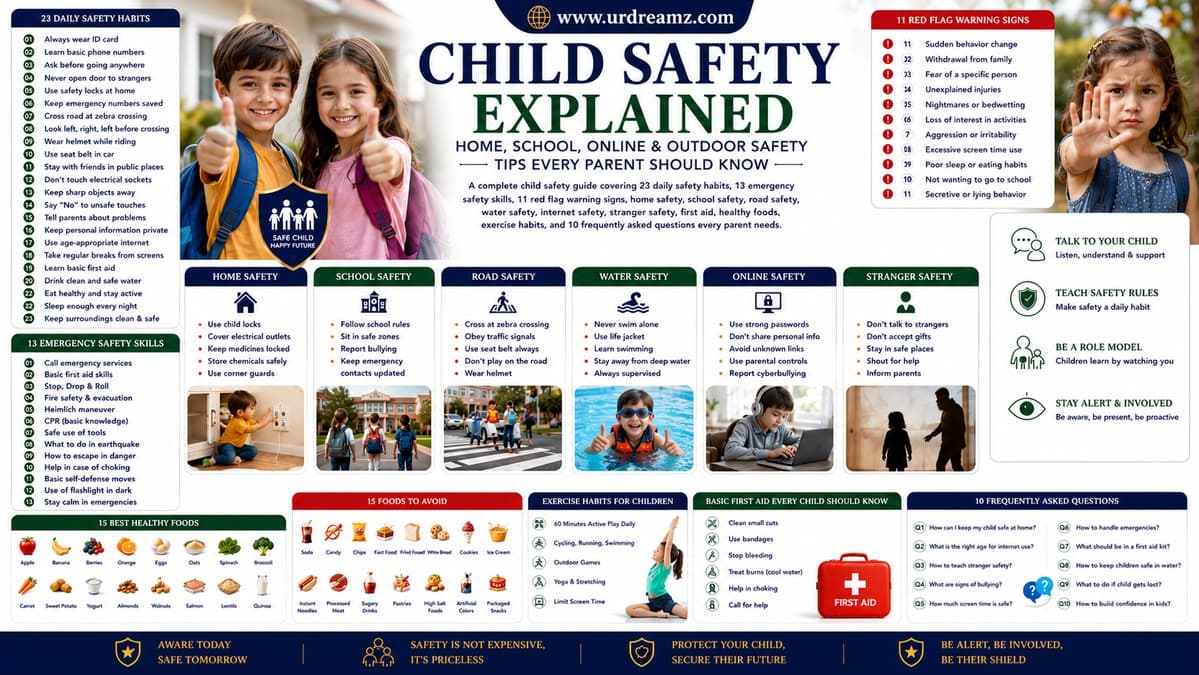
This guide covers every dimension of child safety that modern parents need to understand: physical safety at home, school, on roads, and near water; personal safety including body safety and stranger awareness; digital safety in an increasingly connected world; emergency preparedness and first aid; the nutrition and exercise habits that build a physically resilient child; and the red flag warning signs that tell parents something needs immediate attention. It is organized to be practical and actionable so that the information in these pages translates directly into safer daily life for your family.
1. What Is Child Safety and Why It Matters
Child safety refers to the comprehensive protection of children from physical harm, emotional distress, exploitation, abuse, and all forms of preventable injury across every environment they inhabit. It is not a single act but a continuous state of awareness, preparation, and action that parents, caregivers, educators, and communities maintain around the children in their care. Children are uniquely vulnerable: they are still developing the cognitive ability to assess risk, lack the physical strength and experience to protect themselves in many situations, and trust adults instinctively in ways that can be exploited if they have not been guided with the right knowledge.
Unintentional injuries are the leading cause of death and disability in children aged 1 to 14 globally. Drowning, road traffic accidents, burns, falls, and poisoning together account for the majority of preventable childhood deaths. Beyond physical injury, online exploitation, bullying, and emotional harm affect millions of children annually. What makes these numbers meaningful for parents is that the overwhelming majority of these incidents were preventable. The goal of child safety education is not to create fearful, overprotected children who cannot navigate the world independently. It is to create competent, confident children who know how to assess situations, make safe choices, ask for help when needed, and speak up when something feels wrong.
2. 23 Daily Safety Habits Every Child Should Practice
Safety habits are behaviors practiced so consistently that they become automatic. Building these habits begins in early childhood and requires patient, consistent reinforcement through praise, repetition, and adult modeling.
| # | Habit | Why It Matters | How to Teach |
|---|---|---|---|
| 1 | Always look both ways before crossing any road | Road accidents are among the leading causes of child injury. Children often assume roads are safe if they cannot see a car. The habit of looking both ways must be automatic every single time | Practice together every time you cross a road. Let the child lead the looking and praise correct behavior. Never rush across a road with a child |
| 2 | Never open the door to strangers when home | Children are naturally trusting. Teaching them that the door is not their responsibility removes them from potentially dangerous situations | Role play at home. When the doorbell rings, practice having the child call the adult rather than going to the door themselves |
| 3 | Wash hands thoroughly before eating and after using the toilet | Most childhood infections spread through hands. This single habit prevents a significant proportion of preventable childhood illness | Make it a non-negotiable routine. Teach the full 20-second wash technique with soap |
| 4 | Wear a helmet every time riding a bicycle, scooter, or wheeled vehicle | Head injuries from bicycle accidents are a leading cause of preventable childhood death. A helmet reduces serious head injury risk by approximately 70 percent | Establish it as a rule from the very first ride. Never allow even a short ride without a helmet. Model it yourself |
| 5 | Always wear a seatbelt in a car, every trip including short ones | Most serious car accident injuries occur in short familiar trips because seatbelts are skipped when drivers feel safe. The habit must apply to every journey | Car does not move until every person is buckled. No exceptions, no negotiations |
| 6 | Never touch medicines, chemicals, or cleaning products without adult permission | Accidental poisoning is one of the most common childhood emergencies. A single adult dose of many common medicines can be fatal to a toddler | Teach that medicines and cleaning products are not for children. Childproof storage combined with consistent verbal instruction |
| 7 | Never go anywhere with an adult without telling their parent first | This habit protects against child abduction and exploitation. Even trusted adults should not ask children to go somewhere without parental knowledge | Practice the response: I have to ask my mum or dad first. Praise the child every time they demonstrate this even with completely safe people |
| 8 | Always stay within sight of a trusted adult near water | Drowning can happen in seconds and in surprisingly shallow water regardless of swimming ability | Make the rule clear and non-negotiable. Establish what within sight means. Never use devices when responsible for a child near water |
| 9 | Tell a trusted adult immediately if someone makes them feel uncomfortable | Children who have permission and encouragement to report uncomfortable situations are the safest children. The habit of immediate disclosure is the most powerful child protection tool available | Regularly affirm: if anything makes you feel uncomfortable or scared, tell me immediately and you will never be in trouble for telling |
| 10 | Never share personal information online including name, school, address, or photos | Online predators use personal information to locate, target, and manipulate children. Information shared once online can never be fully retrieved | Teach as part of internet use from the very first device. Practice what information is private and why |
| 11 | Keep floors clear of clutter and objects that can cause trips and falls | Falls are the most common cause of childhood injury at home. Many happen because toys, shoes, or bags are left on stairs or floors | Make tidying up part of the daily routine before bed and before leaving rooms. Frame it as safety as well as tidiness |
| 12 | Use scissors, knives, and sharp tools only with adult supervision | Teaching correct use with supervision is safer than prohibition which leads to unsupervised experimentation | Teach correct technique with age-appropriate tools. Begin with child safety scissors and progress when the child demonstrates reliable care |
| 13 | Never play with fire, matches, lighters, or electrical outlets | Fire and electrical injuries cause severe burns and permanent injury. Children are naturally curious about fire and electricity | Explain the danger simply and clearly. Store matches and lighters out of reach. Use outlet covers throughout the home |
| 14 | Always tell an adult where they are going and when they will return | A parent who knows their child's location can respond quickly if something goes wrong. This habit of checking in protects through all stages of childhood | Model and expect it from early childhood. Praise check-ins. Make it the family norm that everyone tells someone where they are going |
| 15 | Never keep secrets from parents, especially secrets asked for by adults | Abusive adults maintain access by asking children to keep secrets. Teaching children that adults should never ask them to keep secrets from parents removes this manipulation tool | Distinguish between surprises (birthday presents) and secrets (things you are asked never to tell your parents). Teach that good adults do not ask children to keep secrets from their parents |
| 16 | Eat regular healthy meals and drink adequate water daily | A well-nourished, well-hydrated child has better concentration, better physical coordination, and better energy levels, all of which contribute to safer navigation of daily activities | Establish consistent mealtimes. Have healthy snacks available. Keep water accessible throughout the day |
| 17 | Get adequate sleep every night according to their age | A sleep-deprived child has reduced attention, slower reaction times, impaired judgment, and poorer coordination, all of which increase accident risk | Consistent bedtimes. No screens in bedroom. Create a calming bedtime routine |
| 18 | Wear appropriate protective gear for every sport and physical activity | Sports injuries including concussions and fractures are significantly reduced by appropriate protective equipment | Ensure appropriate equipment before any activity begins. Never allow activity without equipment even for short practice |
| 19 | Check before sitting on or climbing furniture | Young children are injured by furniture because they do not check before climbing or sitting on unstable surfaces | Teach the habit of looking and checking. Childproof home furniture with edge guards and corner protectors |
| 20 | Speak up immediately if something breaks, spills, or creates a hazard | Children often hide accidents out of fear of punishment, leaving hazards in place. A child who knows they will not be punished for reporting accidents will report them immediately | Thank the child for reporting problems rather than focusing on the problem itself. Never punish a child for an honest accident report |
| 21 | Always trust their own feelings if a situation or person feels wrong | Children have instinctive discomfort responses when situations are unsafe. Teaching them to trust and act on these feelings overrides social pressure to be polite that can override protective instincts | Regularly validate: if your body or feelings tell you something is wrong, listen to that feeling and tell me or another trusted adult immediately |
| 22 | Keep emergency phone numbers memorized and accessible | In an emergency, a child who knows how to call for help and what to say can save lives including their own | Practice calling and what to say. Memorize Rescue 1122, Police 15, and at least one parent's phone number. Practice until automatic |
| 23 | Follow internet safety rules every single time they go online | Online safety habits must be as automatic as road safety habits. Consistent application every session prevents the moment of curiosity that leads to unsafe online behavior | Establish and review internet safety rules regularly. Keep devices in family spaces during younger years. Maintain open communication about online experiences |
3. 13 Emergency Safety Skills Every Child Needs Before Age 10
Emergency safety skills are specific knowledge and practiced responses that allow a child to act correctly in a crisis. They should be taught, practiced, and regularly reviewed so they are available when needed most, because stress and fear reduce cognitive access to knowledge that has only been discussed not practiced.
| # | Emergency Skill | How to Teach and Practice |
|---|---|---|
| 1 | Know their full name, parents' full names, home address, and at least one parent's mobile number by heart | Practice regularly as a family game. Drill it until as automatic as their own name. For younger children, write on a card inside their school bag as backup |
| 2 | Know how to call emergency services and exactly what to say | Pakistan emergency numbers: Rescue 1122, Police 15, Edhi Foundation 115. Practice: say your name, where you are, what has happened, stay on the line. Role play this conversation multiple times until the child is confident |
| 3 | Know what to do if they smell smoke or see fire at home | Get out immediately. Do not stop for possessions. Feel doors before opening. Crawl below smoke. Go to the family meeting point outside. Call fire services from outside. Practice home fire drills at least twice a year |
| 4 | Know what to do if home alone and someone knocks or tries to enter | Do not open the door. Call a parent immediately. If someone forces entry, call emergency services and go to a room with a lock. Practice the response until automatic |
| 5 | Know how to identify safe people and places to approach if lost in public | Safe people: police officers in uniform, shopkeepers in shops, families with children. Practice before crowded outings: if we get separated, find a police officer or go to a shop and ask the shopkeeper to call this number |
| 6 | Know how to respond if a stranger approaches or tries to take them | Make noise immediately: shout No, I do not know you. Run toward people and public spaces, never away from them. Never get in a vehicle with someone. Practice shouting loudly without embarrassment |
| 7 | Know what to do when a smoke alarm sounds | When the alarm sounds: do not investigate, do not wait, follow the fire escape plan immediately. Regular testing of the alarm makes the sound familiar so the child does not panic when it is real |
| 8 | Know what to do if someone at home becomes unconscious or stops breathing | Call emergency services immediately and stay on the line. Give the address clearly. Do not move the person unless in immediate danger. Tell a neighbor immediately. Age-appropriate CPR awareness for older children and adolescents |
| 9 | Know what to do if they or someone else is choking | If alone and choking: thrust abdomen hard against a chair or table edge. If witnessing: call for an adult immediately and know the universal choking sign. Older children and teens should learn the Heimlich maneuver |
| 10 | Know what to do in an earthquake | Drop, Cover, Hold: get down on hands and knees, take cover under a sturdy table or against an interior wall away from windows, hold on until shaking stops. After: check for injuries, exit carefully, go to family meeting point. Practice regularly especially in seismically active regions |
| 11 | Know how to safely exit a vehicle if involved in an accident | Unbuckle seatbelt. If door will not open, use window. Move away from vehicle and road to safe distance. Call for help. Never return to a damaged vehicle. Teach the priority: people before possessions |
| 12 | Know basic first aid for minor injuries: cuts, burns, and nosebleeds | Minor cut: apply pressure with clean cloth, elevate. Minor burn: cool running water for 20 minutes, never ice or butter. Nosebleed: lean slightly forward, pinch soft part of nose, breathe through mouth. Practice until responses are automatic under stress |
| 13 | Know the family emergency meeting point and backup contacts | Every family needs a designated meeting point outside the home and a secondary meeting point further away. Children should know at least one trusted family friend or relative's contact number. Review and update regularly |
4. 11 Red Flag Warning Signs Parents Should Never Ignore
Red flags are signals that something has happened, is happening, or is developing that requires immediate parental attention. These are not signals to wait and see. Children often communicate distress through behavior, physical signs, and emotional shifts rather than direct words. Knowing these signals means parents can recognize when a child needs help before a crisis develops.
| # | Red Flag | May Indicate | Action |
|---|---|---|---|
| 1 | Unexplained injuries, bruises, or marks especially in unusual locations (torso, back, upper arms) or patterns that do not match the explanation given | Physical abuse. Accidental injuries typically appear on shins, knees, and foreheads. Injuries in unusual locations or patterns that do not match the story are red flags | Seek medical evaluation immediately. Report to child protection authorities if abuse is suspected |
| 2 | Sudden dramatic change in behavior including withdrawal, aggression, nightmares, regression, or loss of previously acquired skills | Trauma, abuse, significant stressor, bullying, or witnessing violence. Behavioral change is the primary language through which children communicate overwhelming experiences they cannot verbalize | Investigate gently without pressure. Consult a mental health professional. Create safe space for disclosure |
| 3 | Any statement about not wanting to live, wanting to hurt themselves, or that others would be better off without them | These statements are always serious regardless of how they are said or the context. Never dismiss as attention-seeking | Take seriously immediately. Seek mental health assessment same day. Remove access to means of self-harm. Do not leave child alone until assessed |
| 4 | Unexplained marks that appear self-inflicted (cuts, burns, scratches in hidden body locations) | Self-harm as a coping response to overwhelming emotional pain. Not attention-seeking behavior. Indicates serious distress requiring professional support | Approach with calm and care not anger or punishment. Seek mental health assessment urgently. Address underlying cause |
| 5 | Inappropriate sexual knowledge or behavior significantly beyond what is expected for the child's age | Sexual abuse or exposure to sexual exploitation. Young children demonstrate this through play, drawings, or statements reflecting knowledge they should not have | Do not react with shock that shuts the child down. Seek professional assessment. Report to authorities |
| 6 | Refusal to go to a previously attended school, activity, or be with a specific person without clear explanation | Bullying at school. Abuse or inappropriate behavior by the specific person. Something frightening the child experienced in that environment | Investigate the specific environment and person carefully. Do not force the child back before understanding what is causing the refusal |
| 7 | Secretive behavior around devices, hiding screens, deleting messages, or extreme distress when devices are taken away | Online exploitation, contact with predators, cyberbullying, or exposure to content the child fears being discovered. Excessive distress beyond normal reluctance suggests the device is meeting an emotional need | Maintain calm. Check device usage with parental monitoring tools. Open non-judgmental conversation. Seek professional support if exploitation is suspected |
| 8 | Unexplained gifts, money, or items especially received from an adult or older person | Grooming by an abuser. Adults who give children gifts in secret, have private relationships with children, or provide money the child cannot explain are exhibiting classic grooming behavior | Ask calmly who gave the item and in what context. If the explanation involves secrecy, investigate further. Report to authorities if grooming is suspected |
| 9 | Sudden loss of interest in food, dramatic weight changes, food restriction behavior, or rituals around eating | Depression, anxiety, eating disorder developing, or physical illness. Any significant change in eating behavior persisting more than 2 to 3 weeks warrants professional evaluation | Consult pediatrician to rule out physical causes. If excluded, seek mental health assessment. Address eating disorders early as they worsen rapidly without intervention |
| 10 | Chronic unexplained physical complaints including recurring stomachaches, headaches, or nausea especially before specific situations | Anxiety commonly presents through physical symptoms particularly before anxiety-provoking situations. Physical symptoms are real, not fabricated. Consistent pattern before specific situations signals anxiety about those situations | Medical evaluation to rule out physical causes. If situational pattern exists, assess for anxiety or stressor related to those situations |
| 11 | Significant decline in academic performance or loss of interest in previously enjoyed activities and hobbies | Depression, anxiety, bullying, or significant family stressor. A child who was engaged and is no longer engaged has a reason even if they cannot articulate it | Investigate through school communication and gentle home discussion. Seek mental health assessment if no clear environmental cause is found |
5. Home Safety: Complete Childproofing Guide
The home is where children spend most of their time, and where most childhood accidents happen. Falls, burns, poisoning, drowning in bath water, and choking all occur most frequently in the home environment. Childproofing must be updated as the child grows, develops new abilities, and accesses new areas of the home.
| Area | Key Hazards | Safety Measures |
|---|---|---|
| Stairs | Falls from stairs are a leading cause of serious childhood injury especially in toddlers | Safety gates at top and bottom of stairs until child confidently uses stairs. Non-slip stair treads. Adequate lighting on stairs at all times |
| Living Areas | Furniture tip-overs, sharp corners, small swallowable objects, blind and curtain cords | Anchor all tall furniture to the wall with furniture straps. Corner and edge guards on sharp furniture. Secure or remove blind cords (strangulation risk). Keep batteries, coins, and small objects out of reach |
| Windows and Balconies | Window falls, screens provide no fall protection | Window guards or locks limiting opening to less than 10cm on all upper-floor windows. Never place climbable furniture near windows. Secure balcony gates with childproof locks |
| Electrical | Outlet insertion, cord pulling, appliance access | Outlet covers on all unused outlets. Secure electrical cords out of reach. Keep appliances out of reach. Regularly check cords for damage |
| Baby and Nursery | Cot falls, suffocation from soft bedding, cord strangulation | Firm flat mattress with no loose bedding, pillows, or soft toys for infants under 12 months. Cot bars less than 6.5cm apart. Baby monitor cords kept well away from crib |
6. Kitchen Safety for Children
The kitchen contains burns from hot surfaces, scalds from hot liquids, cuts from sharp utensils, poisoning from cleaning products, and choking risks. A comprehensive kitchen safety approach combines childproofing with age-appropriate supervised kitchen involvement that teaches safe habits.
| Hazard | Safety Measure |
|---|---|
| Burns from cooker | Turn pot handles inward so they cannot be grabbed by a child. Use back burners when possible. Apply cooker knob covers. Create a child-free zone around the cooker during cooking |
| Scalds from hot liquids | Never carry hot liquids while carrying a child. Keep hot drinks away from table edges. Never leave hot liquids unattended at accessible heights |
| Knife injuries | Knives stored in locked drawer or high cabinet not in a reachable knife block. Teach safe knife handling to older children before supervised use. Never leave sharp utensils in sink water where they cannot be seen |
| Cleaning product poisoning | All cleaning products in locked cabinet or high shelf. Never decant into food or drink containers. Childproof locks on all lower cabinets. Keep in original clearly labeled containers |
7. Bathroom Safety for Children
Bathrooms present drowning risk from bath water, slip and fall injuries, burns from hot water, and medication ingestion. Never leave a child under 6 years alone in the bath even for a moment. Drowning can happen in less than 5 centimeters of water and in less than 2 minutes. If you must leave the bathroom, take the child with you. Set water heater thermostat below 49 degrees Celsius to prevent hot water scalds. Use non-slip bath mats inside and outside the bath. Apply childproof locks to bathroom cabinets containing medicines and razors.
8. Medicine and Poison Safety at Home
| Safety Rule | Why It Is Critical |
|---|---|
| All medications in locked cabinet at adult height | A single adult dose of many common medications including iron supplements, blood pressure medicines, and diabetes medicines can be fatal to a toddler. Grandparents' homes are high-risk as medications are often kept on bedside tables |
| Never tell children medicine is candy to encourage them to take it | Directly undermines the message that medicines are not for children and can encourage unsupervised medication seeking |
| All cleaning products in original containers with original labels in locked storage | Transferring cleaning products to food or drink containers causes accidental ingestion. Original labels contain critical first aid information needed in a poisoning emergency |
| Know the poison control contact for your area | In Pakistan: Aga Khan University Hospital Poison Control Center. If ingestion is suspected, call immediately before attempting any home treatment. Do not induce vomiting unless specifically instructed by poison control |
9. Fire Safety and Emergency Evacuation
Every home needs a working smoke alarm on every floor, tested monthly and with batteries replaced annually. Create a fire escape plan with two exits from every room, a designated outdoor meeting point, and the clear rule that everyone exits immediately and does not stop for possessions. Practice the plan twice a year including one nighttime drill. Teach children to feel doors before opening, to crawl low under smoke, and to shout for help from a window rather than hiding if they cannot escape. Once outside, do not go back in for any reason.
10. Electrical Safety for Children
Electrical injuries range from mild shocks to fatal electrocution and severe burns. Cover all unused outlets with outlet covers. Ensure cords are not frayed or running under rugs. Keep appliances away from water sources. Teach children never to put anything in an electrical outlet. For older children and adolescents in Pakistan, teach specifically about the risks of flying kites or climbing near power lines, a significant electrical injury cause in South Asian settings. Regularly check extension cords and multi-plugs as these are commonly overloaded creating fire risk.
11. School Safety Complete Guide
| Safety Area | Key Measures | How Parents Can Support |
|---|---|---|
| Physical Environment | Safe buildings with clear emergency exits. Secure perimeter preventing unauthorized entry. Adequate supervision during breaks. Safe playground equipment | Know the school's safety systems. Ask about emergency evacuation procedures. Ensure school knows who is authorized to collect your child |
| Transportation | Safe vehicles with seatbelts. Qualified vetted drivers. Fixed pickup and drop-off procedures. Children escorted to vehicle by school staff | Know the vehicle registration and driver. Establish a clear pickup routine. Teach children what to do if the expected person does not come |
| Behavioral Safety | Clear anti-bullying policies. Trained staff who recognize and respond to bullying. Safe reporting channels. Consistent consequences for violent or aggressive behavior | Know the anti-bullying policy. Teach children how to report concerns. Maintain communication with teachers about how the child experiences school socially |
| Emergency Preparedness | Fire drills practiced regularly. Emergency contact procedures clear. First aid trained staff. Clear communication with parents in emergency | Ensure school has current emergency contact information. Know the emergency communication plan. Ensure child knows what to do if an emergency happens at school |
12. Playground Safety
Playground safety assessment: adequate protective surfacing (sand, bark, rubber) of sufficient depth under all climbing equipment extending at least 2 meters in all directions. Equipment in good repair with no protruding bolts, broken parts, or sharp edges. Age-appropriate equipment used correctly. No entrapment hazards where a child's head could become trapped. Adequate adult sight lines covering all areas. Teach children not to push or roughhouse on climbing equipment, to wait at the bottom of slides rather than climbing up them, and to exit equipment safely rather than jumping from height.
13. Bullying and Cyberbullying Prevention
| Aspect | Guidance |
|---|---|
| Signs a child is being bullied | Reluctance to go to school. Unexplained injuries. Missing possessions or money. Withdrawal from activities. Mood changes after school or device use. Unexplained physical complaints. Refusing to talk about school |
| What to teach children | Bullying is never the victim's fault. Tell a trusted adult immediately and keep telling until something happens. Assertive response (saying stop firmly) can deter some bullying. Walking away and seeking safety is always the right choice if physical safety is at risk |
| Cyberbullying prevention | Keep devices in family spaces. Maintain open communication about online experiences. Know passwords. Teach children to screenshot evidence rather than deleting. Block and report rather than retaliate. Never share anything online they would not want parents to see |
| How parents should respond | Believe and validate without minimizing. Document incidents with dates and details. Contact school through formal channels. Report serious cyberbullying to the platform and if criminal elements exist, to police. Do not advise physical fighting back as this creates additional risk |
14. Road Safety for Children
Children under 8 cannot reliably judge vehicle speed and distance and should not cross roads independently. Between 8 and 10 years they are developing but not fully reliable and should be supervised. Above 10 years, a child who has been consistently taught and practiced road safety can begin crossing familiar roads independently with a gradual transition monitored by parents. Road safety habits must be practiced every time, never rushed, and never undermined by adults taking shortcuts that children then adopt.
| Rule | How to Teach |
|---|---|
| Always use pedestrian crossings where available | Consistently use crossings even when jaywalking would be faster. Children adopt the shortcuts adults use |
| Stop at the pavement edge and look right, left, then right again before crossing | Practice every time. Hold the child's hand and narrate the check until they do it automatically |
| Make eye contact with drivers before crossing in front of vehicles | Even at a crossing, never assume a driver has seen you. Look for eye contact or a clear stop before stepping out |
| Never walk near traffic while looking at a phone or wearing headphones | Model this behavior yourself. Distracted pedestrian walking is becoming a major accident cause even in children |
| Wear bright or reflective clothing near roads at dusk and night | In Pakistani traffic conditions with varying street lighting, visibility is a significant safety factor |
15. Car Seat and Seat Belt Safety
| Age or Weight | Correct Restraint | Key Points |
|---|---|---|
| Birth to approximately 9kg | Rear-facing infant car seat | Rear-facing provides superior protection for head, neck, and spine in frontal crashes. Keep rear-facing as long as the seat's weight and height limits allow |
| Approximately 9kg to 18kg (9 months to 4 years) | Forward-facing car seat with harness | Harness provides far superior restraint than seatbelt at this age and size. Keep in forward-facing with harness until reaching the seat's maximum limits |
| Approximately 18kg to 36kg (4 to 10 years) | High-back booster seat with adult seatbelt | Booster positions the adult seatbelt correctly on the child's body. Never allow a child to tuck the shoulder belt behind them |
| Above approximately 36kg or 135cm tall | Adult seatbelt only when it fits correctly | Adult seatbelt appropriate only when lap belt sits across bony hips not soft abdomen and shoulder belt across chest not neck |
16. Bicycle and Helmet Safety
A properly fitted helmet reduces the risk of serious head injury in a cycling accident by approximately 70 percent and must be worn on every single ride without exception from the very first time. Choosing a correct helmet: it must meet certified safety standards. It should sit level two finger-widths above the eyebrows. The side straps form a V shape under and slightly in front of each ear. The buckle fastens under the chin with room for only two fingers. It should not rock forward, backward, or sideways when the child shakes their head. Replace any helmet after a significant impact even if no visible damage is apparent. Never allow a child to ride any wheeled vehicle without a helmet even for short distances.
17. Water Safety and Drowning Prevention
In Pakistan, the combination of open water bodies including rivers, canals, and wells, limited access to formal swimming instruction, and insufficient public awareness of drowning risk creates a particularly significant hazard. Drowning happens silently and very quickly. Unlike the dramatic splashing depicted in films, a drowning child typically cannot call for help because the body's instinctive response directs all effort toward breathing rather than signaling distress.
| Rule | Why It Is Critical |
|---|---|
| Never leave a child under 6 within arm's reach of water without an adult present and focused exclusively on the child | Drowning can happen in seconds and in as little as 5 centimeters of water. No device, toy, floatation aid, or older sibling replaces focused adult supervision |
| Fence all home pools with a four-sided fence at least 1.2 meters high with self-closing, self-latching gates | Pool fencing reduces child drowning risk in home pools by approximately 80 percent. The single most evidence-supported pool safety measure |
| Empty all water containers immediately after use | Young children can drown in buckets and paddling pools. Remove the hazard by emptying immediately |
| Children near open water should always wear a properly fitted life jacket | Even children who can swim can drown in open water conditions including currents and unexpected depth changes |
| Swimming lessons from age 4 significantly reduce drowning risk | Early swimming instruction is one of the highest-impact preventive health investments parents can make |
| Never swim alone at any age | A buddy ensures that if something goes wrong, help can be summoned |
18. Swimming Safety Rules
Key swimming safety rules: always enter pools feet first unless entering a designated diving area. Never run on pool surrounds. Stay within designated swimming areas. Obey all lifeguard instructions immediately. Do not swim when tired. Know the depth of water before entering. Never hold another swimmer underwater even in play. Learn and recognize signs of swimmer distress. Know the location of life-saving equipment at any swimming facility. Teach children about cold water shock: sudden immersion in cold water causes involuntary gasping that can cause water inhalation even in strong swimmers. Entering cold water slowly rather than jumping reduces this risk significantly.
19. Stranger Safety: Teaching Children the Right Way
The traditional stranger danger message has limitations: too broad because children sometimes need to approach strangers for help when lost, and too narrow because most abuse is perpetrated by known adults not strangers. The modern approach focuses on behavior rather than labels. What children should understand is that most adults are safe and kind, but some adults try to hurt children and these adults do not look different from safe ones. Safe adults do not ask children to keep secrets from parents. Safe adults do not offer gifts or special attention in secret. If any adult makes a child feel uncomfortable or asks them to do something that feels wrong, the child should say no clearly, leave immediately, and tell a trusted adult right away.
| Concept | What to Teach |
|---|---|
| If lost: who to approach | Police officers in uniform, shop staff behind a counter, families with children. Teach: go into a shop or public building and ask for help rather than waiting alone on the street |
| Warning signs of unsafe adult behavior | Wants to be with a child without other adults present. Asks a child to keep secrets from parents. Gives gifts or special attention in private. Asks a child to come somewhere without parents knowing. Makes a child feel uncomfortable in any way |
| The No-Go-Tell rule | If something feels wrong: say No firmly. Go away immediately toward safety and people. Tell a trusted adult right away. Assure the child they will never be in trouble for telling |
| Online strangers | People met online are strangers even after many communications. Never meet an online contact without parents present. Never share personal information or photos with online contacts |
20. Body Safety and Safe Touch vs Unsafe Touch
Body safety education is the most important child protection education parents can provide. Children who understand their body rights, know correct names for body parts, have been taught the difference between safe and unsafe touch, and have clear permission to disclose any uncomfortable experience are significantly less vulnerable to sexual abuse and more likely to disclose it if it occurs.
| Concept | What to Tell Your Child |
|---|---|
| Your body belongs to you | Nobody has the right to touch your body without your permission. Even family members should not hug or kiss you if you do not want them to. You always have the right to say no to any touch that makes you uncomfortable |
| Private body parts | The parts of your body covered by your swimming costume are your private parts. Nobody should touch your private parts except a doctor when a parent is present and you understand why |
| Safe touch vs unsafe touch | Safe touch: hugs from people you choose, medical examination by a doctor with a parent present. Unsafe touch: any touch to private parts that is not medical. Any touch that makes you feel uncomfortable, confused, or scared even if the person says it is okay |
| Secrets about touch | No adult should ever ask you to keep a secret about touch. If anyone touches you and asks you to keep it secret, tell me immediately. You will never be in trouble no matter what happened |
| You choose who touches you | You can choose who you hug and who you do not hug. Being polite does not mean you have to allow physical contact you do not want |
21. Internet Safety for Children
Internet safety for children is not simply about blocking content or controlling access. It is a set of ongoing conversations that must evolve as the child grows and their online engagement expands. Children who can identify risks, manage privacy settings, understand that online strangers are still strangers, and feel safe telling parents about concerning online experiences are far safer than children with the most restrictive monitoring but no internal awareness or permission to speak up.
| Rule | Why It Matters |
|---|---|
| Never share personal information online: full name, address, school name, phone number, or photos you wouldn't want the world to see | Information shared online cannot be fully retrieved. Predators use personal information to target children. What seems like harmless sharing can be used to locate or manipulate a child |
| Never talk to strangers online the same way you wouldn't in person | Online strangers are still strangers regardless of how long you have been chatting, how friendly they seem, or what they know about you. Many predators build trust over time before revealing harmful intentions |
| Never agree to meet an online contact in person without a parent present | The single most dangerous action a child can take online is meeting someone they have only known digitally. No exceptions to this rule |
| Tell a trusted adult immediately about any content, message, or request that feels uncomfortable, confusing, or scary | Children who can report concerning experiences immediately are protected from grooming and exploitation. The rule of instant disclosure to a safe adult is the most powerful online safety tool available |
| Use privacy settings on all accounts and limit who can see posts, photos, and personal information | Privacy settings are not optional. They are a critical barrier between a child and people who would misuse their information. Review these settings together regularly |
| Never post anything that could embarrass you or hurt someone else | Digital footprints are permanent. A post that seems funny now can have real consequences later. Think before posting: would I want a teacher, grandparent, or future employer to see this? |
| Devices stay in family spaces, not bedrooms, for younger children and teens | When devices are in common areas, online activity is naturally more accountable and safer. Bedroom device use is where the most dangerous online encounters happen because they are secret |
22. Social Media Safety for Older Children and Teens
Social media presents specific risks for older children and adolescents including cyberbullying, social comparison leading to negative mental health effects, exposure to inappropriate content, contact with predators, and permanent digital footprint creation. The approach must balance protection with the developmental need for increasing autonomy and social connection during adolescence.
- Age-appropriate access: Most social media platforms set a minimum age of 13 years. Delaying access beyond this age where possible protects younger teens from content and social pressures their developing brains are less equipped to handle. When access is granted, maintain open conversation about what they see and how it makes them feel.
- Privacy settings: Every social media account should be set to private, not public. Help your teen set this up and check it regularly, as platform updates sometimes reset settings. Only accept follow or friend requests from known people.
- Sharing awareness: Teens often share location information, school names, and real-time updates about their whereabouts without realizing the risk. Establish a principle of asking themselves: would I be comfortable with a stranger knowing this about me? If not, don't share it.
- Digital footprint: Once something is online, it can be copied, saved, and shared beyond the original audience. Posts that seem private can become public in seconds. Teach that everything posted should be something they would be comfortable seeing on a billboard.
- Open communication: Create a relationship where teens feel able to share concerning experiences without fear of having devices taken away or being blamed. When a teen shares a mistake, the first response should always be gratitude and support, not punishment, which ensures they will share next time as well.
23. Screen Time Safety and Digital Wellbeing
Screen time safety is not only about the content children access but also about how screen use affects physical health, sleep, attention, mental health, and social development. The goal is not to eliminate screens, which is neither realistic nor necessary, but to manage screen use so that it does not displace sleep, physical activity, face-to-face connection, or other essential developmental activities.
- Age-based guidelines: Under 18 months: avoid screen time except video calling. 2 to 5 years: limit to 1 hour of high-quality content daily. 6 to 12 years: consistent limits balancing educational and recreational use. 13 to 18 years: no strict hour limit but ensure screen use does not displace sleep, physical activity, and face-to-face interaction.
- Bedroom rule: No screens in the bedroom at any age. This one rule protects sleep quality, prevents late-night content exposure, and reduces the friction of enforcing screen time limits.
- Screen-free meal times: Family meals should be device-free zones. This protects family connection time, which is itself a protective factor for child mental health, and models that real-time interaction matters.
- Sleep hygiene: Device use within one hour of bedtime delays sleep onset through blue light exposure and alerting content. A device-free hour before bed, with devices charged outside the bedroom, significantly improves sleep quality.
- Quality over quantity: Not all screen time is equal. Educational, creative, and social screen time that maintains real relationships is more beneficial than passive scrolling through algorithmically driven feeds. Encourage content that builds skills, knowledge, or connections rather than pure consumption.
24. First Aid Every Parent Must Know
First aid knowledge is essential for every parent and caregiver. In emergencies, the correct response given within the first moments can make the difference between a full recovery and a permanent injury, or between life and death. First aid skills should be learned through hands-on training in addition to reading about them. However, having the conceptual knowledge means parents can act when the window for effective intervention is narrowest.
25. Choking First Aid for Children
Choking is among the most frightening and time-critical emergencies in children. The correct first aid response depends on the child's age and whether they are conscious.
Conscious child over 1 year: Stand behind the child, make a fist with one hand and place the thumb side against the child's abdomen just above the navel. Grasp the fist with the other hand and perform quick upward thrusts. Continue until the object is expelled or the child becomes unconscious.
Conscious infant under 1 year: Hold the infant face down along your forearm, supporting the head and jaw. Give up to 5 back slaps between the shoulder blades. If unsuccessful, turn the infant face up and give up to 5 chest thrusts with two fingers on the breastbone. Alternate back slaps and chest thrusts until the object clears or the infant becomes unconscious.
If the child becomes unconscious: Call emergency services immediately. Begin CPR with chest compressions. After each set of 30 compressions, check the mouth for a visible object. If you can see an object, sweep it out. Do not perform blind finger sweeps as this can push the object deeper. Continue until help arrives.
26. Burns and Scalds First Aid
Burns and scalds are one of the most common childhood injuries. Correct first aid dramatically affects outcomes.
Immediate action: Place the burned area under cool (not cold) running water for at least 20 minutes. This is the most important intervention and should be done even before seeking medical help. Do not use ice, ice water, butter, oil, or ointments on fresh burns. These trap heat in the tissue and worsen damage.
After cooling: Cover the area loosely with a clean, non-stick dressing or cling film to protect it from infection. Remove clothing and jewelry from the burned area if possible, but never attempt to remove anything stuck to the burn. Seek medical help for any burn larger than the child's palm, any burn to the face, hands, feet, or genitals, or any burn that looks deep or has affected breathing.
27. Cuts, Wounds and Bleeding First Aid
For minor cuts and wounds: wash hands before treating the wound. Clean the wound with clean water, not soap directly in the wound. Apply gentle pressure with a clean cloth to stop bleeding. Apply a sterile dressing and bandage. Keep the wound elevated above the heart if possible to reduce swelling.
When to seek medical help: Any wound that does not stop bleeding after 10 minutes of pressure. Any wound with an embedded object. Any wound longer than 2 centimeters or deep enough to see deeper tissue. Any wound to the face. Any wound caused by an animal or human bite. Any sign of infection including increased redness, swelling, pain, or fever.
28. Poisoning: Recognition and Emergency Response
Poisoning in children usually occurs from ingestion of household cleaning products, medications, or chemicals. In Pakistan, other common causes include the ingestion of kerosene, pesticides, and traditional medicines.
Signs of poisoning: Vomiting, drowsiness or confusion, burns around the mouth, unusual odor on the breath, difficulty breathing, or sudden behavioral change. If you suspect poisoning: call the poison control center immediately. Do not induce vomiting unless specifically instructed by poison control, as some substances cause more damage if vomited. If the child has ingested a corrosive substance (drain cleaner, bleach), do not attempt to neutralize with another substance as this can cause a chemical reaction causing further injury. Keep the child calm and still to slow absorption. If the substance is on the skin, remove contaminated clothing and wash the skin thoroughly with water for 20 minutes. If in the eyes, flush with running water for 20 minutes.
In Pakistan, immediate phone numbers to know: Rescue 1122 is the primary emergency number in many areas. Aga Khan University Hospital Poison Control Center in Karachi also provides advice for poison emergencies. Know your local poison control contact and keep it visible in your home.
29. Head Injuries in Children
Head injuries are common in childhood. Most are mild and resolve without problems, but some require urgent medical attention. The challenge is distinguishing between them.
Mild head injury signs: Crying immediately after the injury but settling. Brief loss of consciousness (less than a minute). Bump or bruise. Normal behavior after the initial response. These generally only require observation at home.
Seek urgent care for: Loss of consciousness lasting more than a minute. Child not returning to normal behavior within 30 minutes. Repeated vomiting. Difficulty waking the child. Slurred speech, confusion, or unusual behavior. Unequal pupil size. Seizure. Bleeding or clear fluid from the nose or ears. Severe headache that worsens. Any of these signs requires immediate medical attention.
30. Fever: When It Becomes an Emergency
Fever is a normal immune response to infection. Most fevers in children are viral, self-limiting, and require only supportive care including fluids, rest, and appropriate fever medication if the child is uncomfortable. However, fever in certain contexts requires urgent evaluation.
When to seek emergency care: Fever in any infant under 3 months old requires immediate medical attention. Fever above 104°F (40°C) that does not respond to fever medication. Fever accompanied by: stiff neck, severe headache, difficulty breathing, non-blanching rash (rash that does not fade when pressed), seizure, lethargy or difficulty waking, dehydration (no urine output for more than 8 hours), or persistent vomiting preventing fluid intake. If a child with a fever also has signs of dehydration or appears unwell beyond the fever alone, seek medical care.
31. Family Emergency Preparedness Plan
Every family should have an emergency preparedness plan that all members understand and that is reviewed and practiced regularly. This ensures that if a natural disaster, fire, or other emergency occurs, the family can respond coherently rather than reactively.
Plan components: A designated meeting point outside the home and a secondary meeting point further away. A family member outside the immediate area designated as the contact person that all family members can call if separated. Emergency contacts (Rescue 1122, Police 15, nearest hospital, family doctor) displayed where everyone can see them. A basic emergency kit with water, non-perishable food, flashlights, batteries, first aid supplies, copies of important documents, medications, and cash for 3 days. Regular drills for fire evacuation (twice yearly), earthquake drop-cover-hold (in seismically active areas), and practicing the emergency communication plan.
32. 15 Best Foods for a Safe and Healthy Child
Good nutrition supports physical resilience. Well-nourished children have stronger immune systems, better concentration, more stable energy levels, and better physical coordination, all of which contribute to safer daily function. These fifteen foods are among the most nutrient-dense choices for supporting children's health.
| # | Food | Why It Matters |
|---|---|---|
| 1 | Oats and whole grains | Sustained energy for stable blood sugar and concentration |
| 2 | Eggs | Complete protein, choline for brain development |
| 3 | Fatty fish (salmon, sardines) | Omega-3 for brain development |
| 4 | Lean chicken or turkey | Protein for growth and immune function |
| 5 | Lentils and beans | Protein, iron, and zinc |
| 6 | Leafy greens | Iron, folate, and B vitamins |
| 7 | Sweet potatoes and carrots | Vitamin A for immunity and vision |
| 8 | Yogurt | Calcium, protein, probiotics |
| 9 | Nuts and seeds | Healthy fats, vitamin E, magnesium |
| 10 | Fresh fruits (berries, apples, oranges) | Vitamin C, antioxidants, hydration |
| 11 | Wholemeal roti or bread | B vitamins and sustained energy |
| 12 | Tomatoes | Lycopene, vitamin C |
| 13 | Plain water | Hydration for concentration and physical function |
| 14 | Milk | Calcium, vitamin D, protein |
| 15 | Brown rice | B vitamins, magnesium, fiber |
33. 15 Foods to Avoid for Child Safety and Health
| # | Food | Why to Avoid or Limit |
|---|---|---|
| 1 | Sugary drinks (soda, packaged juices) | Linked to obesity, tooth decay, energy crashes |
| 2 | Candy and sweets | Dental decay, displaces nutritious foods |
| 3 | Very salty snack foods (chips, namkeen) | High sodium, displace whole foods |
| 4 | Fried fast food | High unhealthy fats, low nutritional value |
| 5 | Refined white bread and maida products | Low fiber, blood sugar spikes |
| 6 | Processed meats (sausages, nuggets) | High sodium and additives |
| 7 | High-sugar breakfast cereals | Spike blood sugar, provide little nutrition |
| 8 | Energy drinks | High caffeine and sugar, not for children |
| 9 | Very spicy or heavily seasoned foods | Can cause digestive discomfort |
| 10 | Unripe or green fruits | May cause stomach upset |
| 11 | Undercooked meat, fish, or eggs | Risk of food poisoning |
| 12 | Whole nuts under age 5 | Choking hazard |
| 13 | Caffeinated drinks | Interfere with sleep and cause restlessness |
| 14 | Very hot foods and drinks | Risk of burns to mouth and throat |
| 15 | High-mercury fish (shark, swordfish, king mackerel) | Mercury affects developing nervous system |
34. Healthy Exercise Habits That Build a Safer Child
Regular physical activity develops coordination, balance, strength, and confidence. These physical attributes directly reduce the risk of injuries from falls and accidents. Exercise also builds bone density and supports overall health.
- Preschool years: Minimum 3 hours of active play daily including running, climbing, playing catch, and ball play.
- School-age children: Minimum 60 minutes of moderate to vigorous activity daily including organized sports, swimming, cycling, and active play.
- Strength and conditioning: Age-appropriate activities that build muscle and bone strength, including gymnastics, team sports, and active outdoor play.
- Bone density building: Impact activities like running, jumping, and skipping promote bone density development.
- Sports safety: Protective equipment appropriate for the activity; proper technique taught; adequate supervision; appropriate water and rest during activity.
35. Sleep Safety and Healthy Sleep Habits
- Infants under 12 months: Place babies on their back to sleep on a firm, flat surface with no loose bedding, pillows, soft toys, or crib bumpers. The same room for sleep for at least the first 6 months reduces SIDS risk. Avoid overheating by dressing the baby appropriately and keeping the room at a comfortable temperature.
- Toddlers and older children: Maintain consistent bedtimes and wake times even on weekends. The bedroom should be cool, dark, and quiet. Avoid screens at least one hour before bed, as blue light disrupts melatonin production and delays sleep onset. Keep devices out of the bedroom. A consistent calming bedtime routine (bath, story, quiet talk) prepares the brain for sleep.
- Nighttime fears: Validate the child's fear rather than dismissing it. Use a dim nightlight if helpful. Check for monsters in the closet or under the bed as a calming ritual. Teach the child relaxation techniques like belly breathing. Avoid scary content before bed.
36. Age-Specific Safety Guide: Newborn to Teen
| Age | Safety Focus |
|---|---|
| Newborn to 6 months | Safe sleep, fall prevention, car seat safety, drowning prevention in bath water, temperature regulation (overheating), choking on small objects, caregiver support for safe care |
| 6 months to 2 years | Fall prevention, choking prevention, poisoning prevention, drowning prevention, kitchen and bathroom safety, furniture tip-over prevention, outlet covers, stair gates, window safety |
| 3 to 5 years | Road safety, water safety (swimming lessons), stranger awareness, body safety, fire safety, bicycle and scooter helmet use, kitchen safety with supervision, playground safety |
| 6 to 10 years | Road and traffic safety independent crossing skills, stranger and online safety, cyberbullying prevention, bullying prevention, basic first aid and emergency response, helmet and protective gear use |
| 11 to 13 years | Online safety and cyberbullying, social media safety, substance use prevention, peer pressure safety, body and relationship safety, mental health awareness, independent navigation skills in community |
| 14 to 18 years | Driving and passenger safety, online safety, substance use prevention, relationship safety, mental health awareness and suicide prevention, self-defense awareness, peer pressure resistance, independence with safety skills, transition to adult healthcare and emergency readiness |
37. Child Safety in Pakistan: Resources and Helplines
In Pakistan, several organizations and helplines exist to support child safety. However, awareness of these resources remains limited, and reaching specialized help can be challenging in many areas. Keeping the primary emergency number, Rescue 1122 (in many cities), and police emergency number 15 in your phone, with the address of the nearest hospital, and knowing your local poison control and child protection contacts, are essential first steps. Parents should also know their local police station contact, the nearest hospital emergency department, and the school's emergency communication procedure.
- For all emergencies: Rescue 1122 (in many cities) or local police emergency 15.
- For child abuse and exploitation reporting: Contact local police, child protection units where they exist, or NGOs working in child protection. The Ministry of Human Rights and provincial child protection bodies provide reporting mechanisms.
- For medical emergencies: Go to the nearest hospital emergency department. If poisoning is suspected, call the Aga Khan University Hospital Poison Control Center in Karachi. For families outside Karachi, know your local poison control or nearest emergency department's contact.
- For mental health emergencies: For immediate mental health support, contact a psychiatrist or psychologist through local hospitals or trusted mental health organizations. For children experiencing a mental health crisis, go to the nearest hospital emergency department.
- For women's and child safety in domestic situations: Helplines like the National Commission on the Status of Women can provide referrals to support services.
38. Child Safety Myths vs Facts
| Myth | Fact |
|---|---|
| Accidents just happen. There is nothing you can do to prevent them | The vast majority of childhood injuries and deaths from injury are preventable. Childproofing, supervision, education, and safety equipment reduce injury risk significantly |
| Children are safer when they are more fearful and cautious | Excessive fear makes children less able to assess real risk and respond competently. Safety education builds confident, capable children who make safe choices, not fearful children |
| Strangers are the biggest risk to children | Most children who are abused or exploited are harmed by someone they know. This is why teaching based on behavior rather than stranger labels is more effective |
| My child is too young to understand safety. I will teach them when they are older | Safety education begins in infancy through consistent habits and age-appropriate language. Starting early builds the foundation for more complex safety skills later. Waiting until a child is older misses the developmental window when habits are formed |
| If I talk to my child about safety, they will become anxious and scared | Safety education delivered calmly and appropriately does not create anxiety. It empowers children with knowledge and confidence. Children who know what to do in an emergency are less likely to freeze in panic |
| Drowning only happens in deep water | Children can drown in as little as 5 centimeters of water. Buckets, bathtubs, and shallow water are all drowning hazards for young children. Constant supervision within arm's reach is the only reliable prevention |
| Car seats and seatbelts are not needed for short trips | Most serious car accidents happen on familiar short trips where people are less cautious. Every trip requires the same safety measures |
| Leaving children alone for a short time is safe after a certain age | Age alone is not a reliable guide. The maturity of the child, the environment, and the duration all matter. A child should not be left home alone before age 10, and even then with clear preparation and rules. Many Pakistani families leave younger children alone out of economic necessity, but this practice carries serious risk and should be avoided where possible, with alternative supervision arrangements sought from family or community when available |
39. Daily Child Safety Checklist for Parents
This daily checklist helps parents maintain consistent safety practices without needing to rely on memory or noticing hazards only when something goes wrong.
| Area | Daily Check |
|---|---|
| Home Environment | Stair gates secure. Window locks in place. Choking hazards out of reach. Medicines and cleaning products in locked cabinets. Fire extinguisher accessible and charged. Smoke alarms functional. No frayed electrical cords or accessible outlets uncovered. No cluttered floors causing trip hazards |
| Car Travel | Age-appropriate car seat installed and buckled correctly. Seatbelts used by everyone. No loose objects in the car that could become projectiles. Driver is not distracted. Child knows what to do in an accident or if separated |
| Road and Walking | Safe route to school with crossing points identified. Reflective or bright clothing for low light. Child knows road safety rules. If walking alone, safe route and check-in procedure established |
| Water and Swimming | Full attention on child near any water. Life jacket worn appropriately. Pool fencing secure and gate closed. Water hazards in the home (buckets, baths) empty or inaccessible |
| Online Safety | Devices in family spaces, not bedrooms. Parental controls and privacy settings checked. Open communication about online activity. Child knows not to share personal information online. Child feels safe reporting concerning online encounters |
| Communication | Child knows emergency numbers and how to call. Child knows family meeting points. Child knows they can talk to you about anything and will not be in trouble. You have checked in with the child about their day and any concerns they have |
| Emergency Readiness | Family emergency plan reviewed. Emergency contacts visible. First aid kit is stocked. Child knows basic first aid for minor injuries. Everyone in the family knows what to do in fire, earthquake (in seismically active areas), and medical emergency |
| Health and Wellbeing | Child had a nutritious breakfast. Adequate water intake. Appropriate physical activity. Consistent bedtime routine. Sleep environment safe and calming. Child's emotional state checked in on. You have connected with the child emotionally that day |
40. Frequently Asked Questions About Child Safety
| Question | Answer |
|---|---|
| What are the most common causes of injury in children? | The most common causes include: falls, road traffic accidents, drowning, burns and scalds, poisoning, and choking. Each is preventable with appropriate safety measures |
| How can I keep my child safe online? | Keep devices in family spaces, use parental controls and privacy settings, teach about the permanence of digital footprints, create open communication about online experiences, and ensure the child knows they can tell you about anything concerning without punishment |
| When is my child old enough to be home alone? | No child under 10 should be left home alone. Even then, the decision depends on the child's maturity, the length of time, and the safety of the environment. The child must know emergency numbers, what to do in a fire, and how to reach a parent. Home alone should be gradual and prepared for |
| When should I teach my child about body safety? | Body safety education begins as early as preschool age with age-appropriate language. Use correct names for body parts. Teach the difference between safe and unsafe touch. Teach that no one has the right to touch their body without permission, and that they can always tell you if something has made them uncomfortable. Children who can name body parts and know body safety rules are less vulnerable to abuse and better able to disclose if it occurs |
| How can I tell if my child is being bullied? | Signs include: reluctance to go to school, unexplained injuries, missing possessions or money, mood changes after school or device use, social withdrawal, unexplained physical complaints, and refusal to talk about school. If you notice these, start a gentle conversation. Believe them and act without blaming |
| What do I do if I think my child has been abused? | Stay calm so the child does not feel blamed or frightened. Listen without judgment. Do not interrogate; let the child tell in their own way. Reassure them that they are not at fault. Seek medical evaluation immediately. Contact child protection authorities. Seek psychological support for the child. Report the concern to police |
| How can I prepare my child for an emergency? | Practice emergency responses rather than just talking about them. Make drills regular, calm, and matter-of-fact. Ensure the child knows their address, parents' phone numbers, and emergency numbers. Practice what to say to emergency services. Review the family emergency plan together. Practice the plan in low-stress conditions so it becomes automatic |
| How important is car seat safety? | Car seats and seatbelts are the single most effective injury prevention measure for children in vehicles. Correct use of age-appropriate restraints reduces the risk of fatal injury by approximately 70 percent. Every trip requires the same safety measures |
| At what age can a child safely cross the road independently? | Children under 8 lack the cognitive development to judge vehicle speed and distance reliably. Between 8 and 10 they are developing but not fully reliable. Safe independent road crossing generally begins after age 10 with consistent supervised experience. Every child is different. Start gradually with supervised crossing and only allow independent crossing when the child consistently demonstrates safe behavior |
| What should every parent know about childhood poisoning? | Keep all medicines and cleaning products locked and out of reach. Never store poisons in food or drink containers. Know the local poison control number. If you suspect poisoning, call poison control immediately. Do not induce vomiting unless specifically instructed by poison control. Keep the number visible in your home |
| How can I teach my child to stay safe from strangers? | Modern stranger safety education is behavior-based. Safe adults do not ask children to keep secrets. Safe adults do not try to be alone with children. If an adult makes a child uncomfortable, the child should say no, leave immediately, and tell a trusted adult. If lost, approach a police officer in uniform or a shopkeeper and ask for help. Teach the No-Go-Tell rule |
| What should a first aid kit for children contain? | A basic first aid kit for children should include: adhesive bandages in various sizes, sterile gauze pads, medical tape, antiseptic wipes or solution, antibiotic ointment, pain/fever medication appropriate for the child's age, children's antihistamine, a thermometer, tweezers, scissors, emergency contact numbers, and a first aid reference guide. Check regularly and replace expired items |
Conclusion
Child safety is not a single achievement. It is a continuous practice that evolves with the child and changes as they grow. The principles are consistent: prevention through environment and supervision, education through conversation and practice, early intervention through recognition and response. A child who has been taught consistently, allowed to practice safety skills, and assured that they can always tell a parent when something feels wrong is a child who is genuinely safer than one whose safety is managed entirely through rules and restrictions without understanding.
Children do not need to be afraid of the world to be safe in it. They need to understand it, know how to navigate its risks, and know that they have adults who will listen, believe, and act when something is wrong. The work of child safety is not easy, but it is among the most important work parents will ever do.
Internal Links for Further Reading:
- Newborn Baby Care Guide
- Healthy Child Nutrition Guide
- Positive Parenting Guide
- Child Development Guide
- Child Immunity Guide
- Healthy Sleep for Children
- Child Mental Health Guide
- Child Vaccination Guide
- Child Eye Care Guide
- Breastfeeding Guide
Medical Disclaimer: This article provides general educational information about child safety and does not constitute professional medical, psychological, or legal advice. Every child and family is unique. For specific safety concerns, medical emergencies, or suspected abuse or exploitation, consult qualified professionals and appropriate authorities immediately. If a child is in immediate danger, call emergency services (Rescue 1122 or Police 15 in Pakistan) without delay.