Child Dental Care Explained: Teething, Tooth Decay Prevention, Brushing Habits and Complete Oral Health Guide
A child's smile is one of the most joyful things in the world, and the health of the teeth behind that smile matters far more than most parents realize. Dental disease is the most common chronic condition of childhood, affecting more children globally than asthma, diabetes, and heart disease combined. Tooth decay, also called dental caries, affects approximately 530 million children worldwide and is almost entirely preventable through consistent daily habits established early in life. Yet many parents do not know when to start cleaning their child's gums, when to introduce a toothbrush, how much toothpaste to use, when to schedule the first dental appointment, or what the real facts are behind the many myths surrounding fluoride, teething, and children's dental care.
The decisions parents make about their children's dental health in the first years of life have consequences that extend far beyond childhood. The habits, knowledge, and dental health established in early childhood predict oral health across the entire lifespan. Baby teeth matter profoundly despite the fact that they will eventually be replaced. They hold space for permanent teeth, support proper speech development, enable comfortable eating that supports nutrition and growth, and build the dental habits and attitudes toward oral care that children carry into adulthood. This comprehensive guide gives parents everything they need to understand and support their children's dental health from birth through adolescence.
1. Why Child Dental Health Matters
Dental disease is the most common chronic condition of childhood worldwide, yet it is almost entirely preventable. Tooth decay in children does not just cause pain at the time of the cavity. It affects the child's ability to eat comfortably, which impacts nutrition and growth. It affects the ability to concentrate in school when dental pain is present. It affects speech development when teeth are lost prematurely. It affects self-confidence and social interactions through visible dental problems. And it establishes patterns of oral bacteria, dental habits, and dental anxiety that persist into adult life.
The health of baby teeth directly affects the health of permanent teeth. Baby teeth serve as natural space holders for permanent teeth, guiding them into the correct position as they develop and erupt. When a baby tooth is lost prematurely due to decay, the surrounding teeth drift into the space, causing crowding and alignment problems for the permanent teeth that erupt later. This is one of the most common reasons children need orthodontic treatment: early loss of baby teeth due to preventable decay.
Perhaps most importantly, the dental habits established in childhood persist throughout life. Children who learn to brush twice daily, who develop positive associations with dental visits, who understand which foods support or damage dental health, and who grow up in families where oral hygiene is a valued daily priority carry these habits into adulthood. The investment parents make in their children's dental health is one of the highest-return health investments available.
| Function | Why It Matters |
|---|---|
| Space Holders | Baby teeth hold the space in the jaw that permanent teeth will occupy. Premature loss causes neighboring teeth to drift, leading to crowding and misalignment of permanent teeth |
| Chewing and Nutrition | Healthy teeth are required for proper chewing. Children with decayed or missing teeth may avoid nutritious foods that require chewing, compromising their diet and growth |
| Speech Development | Front teeth are essential for producing certain speech sounds including s, th, and f sounds. Premature tooth loss or significant decay affects speech development |
| Jaw Development | The presence of baby teeth stimulates proper jaw bone development. Early loss affects the growth and shape of the jaw |
| Self-Confidence | Visible dental problems, discoloration, and missing teeth affect how children feel about their appearance and their confidence in social situations |
| Habit Formation | The dental habits, attitudes toward oral care, and oral microbiome established in childhood persist into adult life |
2. Baby Teeth: Development and Importance
Baby teeth, also called primary teeth, deciduous teeth, or milk teeth, begin developing before birth. By the time a baby is born, the crowns of all 20 primary teeth have already formed within the jaw and are waiting to erupt through the gum tissue. This is why dental care technically begins during pregnancy: the nutrition a mother receives while pregnant, including adequate calcium, vitamin D, phosphorus, and fluoride, contributes to the formation of both baby teeth that are already forming and the earliest permanent teeth that begin calcifying during the fetal period.
Most children develop a complete set of 20 primary teeth. These include 8 incisors (4 upper central, 4 lower central and lateral), 4 canines, and 8 molars. The primary teeth erupt in a generally predictable sequence, beginning with the lower central incisors and ending with the second molars, with the complete primary dentition typically in place by around age 2.5 to 3 years. Lower teeth tend to erupt slightly before their upper counterparts.
The primary teeth are not miniature versions of permanent teeth in terms of structure. Their enamel (the hard outer coating of the tooth) is significantly thinner than permanent tooth enamel, making them more vulnerable to decay. Their pulp chambers (the inner living tissue of the tooth) are proportionally larger relative to the tooth size, meaning decay progresses more quickly to the nerve in primary teeth than in permanent teeth. These structural differences mean that cavity prevention is even more important in baby teeth than in permanent teeth.
3. Baby Teeth Eruption Chart
| Tooth | Eruption Age (Upper) | Eruption Age (Lower) | Shedding Age |
|---|---|---|---|
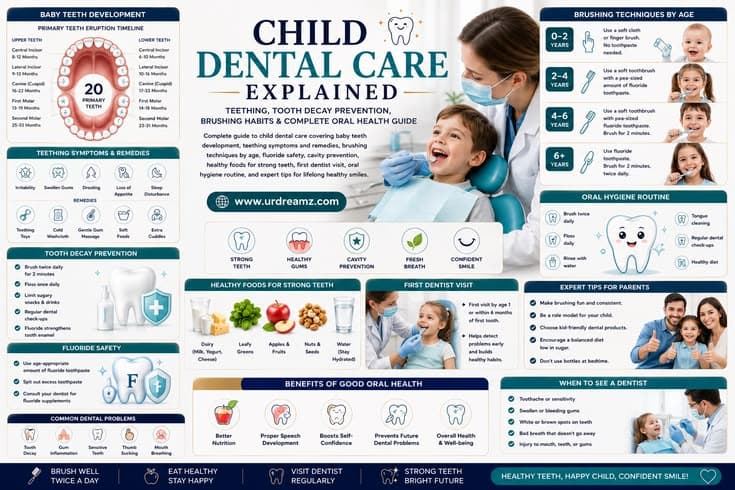
| Central Incisor (Front Middle) | 6 to 10 months | 5 to 7 months (lower first) | 6 to 7 years |
| Lateral Incisor (Next to Front) | 9 to 13 months | 7 to 10 months | 7 to 8 years |
| Canine (Cuspid) | 16 to 22 months | 16 to 22 months | 9 to 12 years |
| First Molar (Back Chewing Tooth) | 13 to 19 months | 14 to 18 months | 9 to 11 years |
| Second Molar (Back Chewing Tooth) | 25 to 33 months | 23 to 31 months | 10 to 12 years |
These age ranges are averages with significant normal variation. Some children get their first tooth as early as 3 months, others not until 14 months. Both extremes can be entirely normal. The sequence of eruption is generally more consistent than the exact timing. Lower central incisors typically erupt first, followed by upper central incisors, then lateral incisors, first molars, canines, and second molars. Full primary dentition of 20 teeth is usually complete by approximately 2.5 to 3 years of age.
4. When Baby Teeth Fall Out
Baby teeth begin falling out (shedding or exfoliating) as the permanent teeth underneath them develop and push upward through the jaw. The roots of the baby teeth are gradually resorbed (dissolved) by this process until the crown is no longer anchored and falls out. This process generally begins around age 6 and continues through approximately age 12, with teeth typically falling out in roughly the same order they erupted.
The first permanent teeth to erupt are usually the lower central incisors and the first permanent molars around age 6. The first molars erupt behind the baby teeth, not replacing any of them. These six-year molars are permanent teeth and their care is extremely important as they are frequently mistaken by parents for baby teeth and not given appropriate attention.
| Age | What Is Happening | Parent Action |
|---|---|---|
| 5 to 7 years | Lower front teeth begin loosening and falling out. Lower central incisors typically first. First permanent molars erupt behind baby teeth | Celebrate each tooth! Reassure child. Note that permanent teeth sometimes appear before baby teeth fall out (shark teeth) and consult dentist if persisting |
| 6 to 8 years | Upper front teeth shed. All four central and lateral incisors replacing with permanent versions | Permanent front teeth are initially proportionally very large relative to the child's face. This is normal and the face grows to match |
| 9 to 12 years | Canines and first molars shed. Permanent replacements erupt. Second permanent molars begin erupting | Continue twice-daily brushing and regular dental checkups. These permanent teeth must last a lifetime |
| 11 to 13 years | Remaining baby molars shed. Second permanent molars erupt. Most permanent teeth in place | Wisdom teeth (third molars) typically erupt in late teens or early twenties and may require evaluation for adequate space |
5. Teething: What It Is and When It Happens
Teething is the process by which an infant's primary teeth erupt through the gum tissue. It is a normal developmental process that all children experience, typically beginning between 4 and 7 months of age, though the range of normal extends from as early as 3 months to as late as 14 months. Teething typically continues until approximately age 3 when the last of the 20 primary teeth have fully emerged.
Teething begins before the teeth are visible through the gums. In the days or weeks before a tooth erupts, the tooth is pushing upward through the jaw and through the gum tissue, causing the gum to become sensitive, swollen, and tender. This pressure and tissue disruption is the source of teething discomfort. The amount of discomfort varies significantly between children and even between different teeth in the same child. Some children teethe with minimal apparent discomfort while others experience significant distress.
One important thing for parents to understand is that teething is an episodic process that comes in waves corresponding to each new tooth. From approximately 4 months of age until 3 years, a child may periodically experience teething-related symptoms, not continuously but in phases when specific teeth are erupting. Understanding this helps parents contextualize their child's periodic distress throughout this period.
6. Early Signs of Teething
Teething often begins with signs that appear before any tooth is visible through the gum. Recognizing these early signals helps parents understand and respond appropriately to their baby's discomfort and behavior changes.
| Sign | Why It Happens | What It Looks Like |
|---|---|---|
| Increased drooling | Teething stimulates saliva production. This begins noticeably around 2 to 3 months, often before any teeth erupt, as the salivary glands are maturing simultaneously | Wetter than usual around the chin and mouth. May cause chin rash if skin not kept dry. Baby's clothes front often wet |
| Chewing on everything | The counterpressure of biting helps relieve the pressure sensation caused by teeth pushing through the gum tissue from below | Baby puts hands, toys, clothing, and any available object in mouth and chews or gnaws purposefully |
| Swollen or red gums | The gum tissue above the erupting tooth becomes inflamed as the tooth pushes through | A reddened, slightly puffy area on the gum, sometimes with a blue-grey blister (eruption cyst) that contains fluid and usually resolves without treatment |
| Fussiness and increased clinginess | Gum discomfort makes babies irritable and more in need of comfort from their caregivers | Baby is more cranky or difficult to settle than usual, particularly in the evening when fatigue amplifies discomfort |
| Sleep disturbances | Discomfort that can be distracted from during the busy daytime becomes more noticeable during the quiet of nighttime | Trouble falling asleep, waking more often at night, needing more settling than usual |
| Reduced appetite | Gum tenderness makes sucking and eating uncomfortable | Less interest in breastfeeding or bottle feeding. Resistance to solid foods that require gum or jaw pressure |
| Rubbing cheek or pulling ear on one side | The pain from gum discomfort can radiate along the jaw to the ear and cheek | Baby tugs at one ear and rubs the cheek on the same side where a tooth is erupting. Important to rule out actual ear infection if fever is also present |
7. Common Teething Symptoms Explained
| Symptom | Is It Caused by Teething? | When to Seek Medical Advice |
|---|---|---|
| Drooling | Yes, teething significantly increases saliva production. Drooling is one of the most consistent and well-established teething symptoms | Drooling alone does not require medical attention. Protect skin from rash with petroleum jelly |
| Chewing and mouthing objects | Yes, this is a reliable teething symptom as babies seek counterpressure to relieve gum discomfort | Ensure objects are safe, age-appropriate, and cannot be broken into small pieces |
| Gum swelling and redness | Yes, local gum inflammation where a tooth is erupting is expected | If a blue-grey bubble appears on the gum this is an eruption cyst and usually resolves alone. If very large or painful, consult dentist |
| Mild irritability and fussiness | Yes, mild temporary fussiness associated with teething is well-documented and normal | If fussiness is extreme and inconsolable, consider other causes |
| Low-grade temperature elevation (below 38 degrees Celsius) | Possibly. Some studies show teething may cause a slight rise in body temperature but below what is considered a true fever. The mechanism may involve local gum inflammation | Any temperature above 38 degrees Celsius (100.4 degrees Fahrenheit) should be evaluated as a possible infection, not attributed to teething. True fever is not caused by teething |
| Loose stools | Not directly. Teething does not cause diarrhea. However, increased mouthing during teething means more exposure to germs from objects, which may incidentally cause gastrointestinal illness at the same time as teething | Significant diarrhea should not be attributed to teething. Seek medical evaluation for significant gastrointestinal symptoms |
| Rash on the face and chin | The drool itself can cause skin irritation and rash around the mouth, chin, and sometimes chest, not teething directly but a consequence of the increased saliva production | Keep area clean and dry. Apply a barrier cream. If rash is widespread or severe, consult a doctor |
8. Teething Myths vs Facts
| Common Myth | Scientific Fact |
|---|---|
| Teething causes high fever | True fever (above 38 degrees Celsius) is not caused by teething. Any significant fever in a teething baby should be evaluated as a possible illness. The coincidence of teething and fever simply reflects that teething spans years during which babies also frequently get infections |
| Teething causes diarrhea | Diarrhea is not a proven symptom of teething. The association exists because teething babies put everything in their mouths, increasing infection exposure. Significant diarrhea requires medical evaluation regardless of whether a tooth is erupting |
| Teething gels are safe and effective for all babies | Benzocaine-containing teething gels are not recommended for infants as benzocaine can cause methemoglobinemia, a serious blood condition. Only use teething gels specifically formulated for infants and consult your doctor before use |
| Teething necklaces (amber) relieve teething pain | Amber teething necklaces have no scientific evidence of effectiveness. They are a significant choking and strangulation hazard and are not recommended by any major pediatric or dental organization |
| Babies should not be given anything cold during teething as it can cause illness | Chilled (not frozen) teething toys are a safe and effective comfort measure. Cold reduces local inflammation and numbs the gum tissue providing genuine relief. Frozen items should be avoided as they can be too hard and damage delicate gum tissue |
| Teething toothache can be relieved by rubbing alcohol on the gums | Alcohol of any kind should never be applied to an infant's gums. Alcohol is toxic for babies and provides no documented dental benefit |
| Baby teeth do not need care because they will fall out anyway | Baby teeth are essential for eating, speech, jaw development, and spacing of permanent teeth. Decay in baby teeth can cause pain, infection, and permanent damage to the developing permanent teeth underneath. All baby teeth deserve proper care |
9. Safe Teething Remedies Parents Actually Use
| # | Remedy | How It Helps | Safety Notes |
|---|---|---|---|
| 1 | BPA-free teething toys | Allow baby to chew on a safe object, providing the counterpressure that relieves gum discomfort. Chewing on something firm stimulates the gum in a way that helps the tooth erupt through | Choose toys specifically designed for teething. BPA-free, non-toxic materials. Clean regularly. Inspect for cracks or damage |
| 2 | Chilled washcloth | A clean damp washcloth chilled in the refrigerator (not frozen) can be given to the baby to chew on. The cold reduces local inflammation and numbs gum tissue temporarily | Never freeze the cloth as frozen items can be too hard for delicate gum tissue. Ensure cloth is clean. Supervise at all times |
| 3 | Food-grade silicone teethers | Soft silicone teethers are gentle on tender gums while providing the pressure relief babies seek. Easy to hold for babies and easy to clean | Choose reputable brands using food-grade silicone. Inspect regularly for damage. Do not tie around neck |
| 4 | Gentle gum massage | A clean finger pressed gently against the swollen gum where the tooth is erupting provides counterpressure and comfort. Can also help the parent feel the tooth position and progress | Ensure hands are thoroughly washed first. Use gentle pressure, not rubbing which can cause friction discomfort |
| 5 | Cold fruit in mesh feeder (for babies 6 months and older eating solids) | Chilled fruit such as banana or mango in a mesh feeder allows baby to safely chew on cold soft food that soothes gums and introduces new flavors simultaneously | Only for babies who have started complementary foods. Supervise always. Ensure mesh is in good condition |
| 6 | Extra cuddling and comfort | Sometimes the most effective teething remedy is simply the comfort and warmth of a caring caregiver. Skin-to-skin contact, rocking, and calm reassurance address the emotional component of distress | Always appropriate. Responsive caregiving during this difficult period strengthens the parent-child attachment relationship |
| 7 | Age-appropriate teething gel if recommended by doctor | Some infant-formulated teething gels (not containing benzocaine) can provide temporary relief. Use only products specifically formulated for infants | Always consult a doctor or pharmacist before using any teething gel. Avoid benzocaine products for infants. Follow dosage instructions strictly. Do not use before 4 months |
10. Dental Care Before the First Tooth
Most parents wait until they see a tooth before beginning any oral care, but dental care should actually begin before birth in the sense of maternal nutrition, and actively in the newborn period through gum cleaning. The oral cavity contains bacteria from the very first days of life, and establishing healthy oral hygiene habits from the beginning creates the best foundation for dental health.
From birth until the appearance of the first tooth, the gums should be wiped with a clean damp cloth or a piece of soft gauze after each feeding. This removes milk residue, saliva, and bacteria from the gum tissue and gets the baby accustomed to the sensation of oral cleaning, which makes the introduction of toothbrushing easier when teeth appear. This simple habit also reduces the transmission of cavity-causing bacteria between caregiver and infant through shared utensils or testing food temperature with the same spoon.
Parents and caregivers should avoid sharing spoons, cups, and food utensils with infants, and should not clean a pacifier by placing it in their own mouth. The cavity-causing bacteria Streptococcus mutans is transmitted from caregiver to infant through saliva sharing, and earlier transmission is associated with higher cavity rates in baby teeth. Keeping the caregiver's own oral health in good order reduces the bacterial load they transmit to their infant.
11. When to Start Brushing Baby Teeth
Brushing should begin as soon as the first tooth erupts, regardless of how old the child is. If the first tooth appears at 6 months, brushing begins at 6 months. The moment a tooth is present in the mouth it is exposed to the bacteria and sugars that cause tooth decay, and it requires the protective effect of daily brushing with fluoride toothpaste to prevent decay.
In the earliest stages with just one or two teeth, brushing is very simple: a small soft brush with a tiny amount of fluoride toothpaste (see section 17 for amounts by age) gently cleaning all surfaces of the tooth. As more teeth emerge, brushing becomes more systematic. The key is establishing the habit early so that by the time the full primary dentition is present, brushing is already a well-established part of the child's daily routine.
Parents should brush their children's teeth, not supervise them doing it themselves, until approximately age 7 to 8 when children develop sufficient manual dexterity to brush effectively. Before this age, allowing the child to brush first followed by parent brushing to ensure all surfaces are adequately cleaned is a good approach that gives the child a sense of participation while ensuring effective cleaning actually occurs.
12. Brushing Techniques by Age
| Age | Who Brushes | Toothbrush | Toothpaste Amount | Technique |
|---|---|---|---|---|
| Birth to first tooth | Parent only | Soft cloth or gauze over finger | None (water only) | Gently wipe gums after each feeding. Establish the routine of oral cleaning from birth |
| First tooth to 18 months | Parent only | Very soft infant toothbrush with small head | Grain-of-rice-sized smear (under 3 years per AAP guidance) | Gentle circular motions on all tooth surfaces and along the gumline. Focus on all sides of each tooth. Brief and gentle |
| 18 months to 3 years | Parent with child beginning to participate | Soft toothbrush sized for child. Replace every 3 months | Grain-of-rice to pea-sized amount of fluoride toothpaste | Parent brushes thoroughly. May allow child to attempt first but always follow with parent brushing. Brush inside surfaces first, then outside, then chewing surfaces |
| 3 to 6 years | Parent and child together | Child-sized soft toothbrush | Pea-sized amount of fluoride toothpaste | Child begins to brush with supervision and assistance. Parent checks and completes cleaning after. Introduce angling bristles toward gumline |
| 6 to 8 years | Child with parent supervision and checking | Child-sized soft toothbrush or electric toothbrush | Pea-sized amount of fluoride toothpaste | Child brushes independently but parent checks quality of cleaning. Electric toothbrushes can improve effectiveness. Begin flossing where teeth are touching |
| 8 years and above | Child independently, with periodic parent monitoring | Child to adult-sized toothbrush. Replace every 3 months | Pea-sized amount of fluoride toothpaste | Independent brushing with proper technique. Brush all surfaces for two full minutes twice daily. Floss daily. Continue monitoring habit consistency |
13. How to Make Toothbrushing Enjoyable for Children
| # | Strategy | Why It Works |
|---|---|---|
| 1 | Build it into a consistent routine. Associate brushing with a beloved activity such as after a favorite breakfast or before a bedtime story | Routine reduces resistance. When brushing is always followed by something pleasant, children anticipate and accept it more readily. Predictability is comforting to children |
| 2 | Make it musical. Play a two-minute song, sing while brushing, or use a timer-enabled toothbrush. Many children's electric toothbrushes play music for the correct brushing duration | Music provides entertainment and a concrete end point. Children who are focused on a song they enjoy stop focusing on their resistance to the activity. Also establishes the two-minute duration habit |
| 3 | Use imaginative play. Let the child brush their favorite stuffed animal's teeth after their own brushing. Frame brushing as fighting sugar bugs or protecting the tooth army | Play is children's primary language and mode of engagement. Making brushing part of a story or imaginative scenario transforms it from imposed task to game |
| 4 | Give appropriate choice and control. Let the child choose between two acceptable toothbrush options. Let them choose the sequence (top first or bottom first). Let them choose the timer song | Young children have a strong developmental drive for autonomy. Offering genuine choices within the non-negotiable framework of brushing reduces power struggles while maintaining the habit |
| 5 | Use the right amount of toothpaste in an appealing flavor. Many children's toothpastes come in fruity flavors that make brushing more acceptable | A toothpaste the child likes the taste of reduces one source of resistance. The amount matters too: too much causes excess foam and gagging that makes brushing unpleasant |
| 6 | Experiment with tools. Try different toothbrush styles including soft-bristled, silicone finger brushes for infants, or electric toothbrushes. Warmer water is sometimes preferred by children with sensitivity | Finding the right tool that the child accepts reduces sensory-related resistance. Electric toothbrushes often fascinate young children and can significantly improve their engagement with brushing |
14. How Long Should Children Brush Their Teeth
All major dental health organizations recommend brushing for a minimum of two minutes, twice daily. Research consistently shows that most people, adults and children alike, significantly underestimate how long two minutes actually feels during brushing and typically brush for only 45 to 70 seconds when brushing without timing. This means that without deliberate attention to duration, most children are cleaning their teeth for less than half the recommended time.
Practical approaches to ensuring two-minute brushing include using a timer or a timer app, using a toothbrush with a built-in timer, playing a two-minute song during brushing, counting or singing while brushing, or using a sand timer visible to the child. For children, two minutes can feel very long, particularly in the early stages of establishing the habit. Building up gradually and making the time engaging with music or a story being told simultaneously helps.
The two minutes should be distributed systematically across all tooth surfaces: the inside surfaces (closest to the tongue and palate), the outside surfaces (closest to the cheeks and lips), and the chewing surfaces of the back teeth. A useful approach is to divide the mouth into four quadrants and spend approximately 30 seconds on each, working systematically rather than brushing in random movements that tend to overclean some areas and miss others.
15. Choosing the Right Toothbrush for Children
| Age | Recommended Toothbrush | Key Features to Look For | When to Replace |
|---|---|---|---|
| Birth to first tooth | Silicone finger brush or soft gauze | Very soft. Safe if accidentally chewed. Easy for parent to use to access small mouth | Replace when showing wear or regularly wash |
| First tooth to 2 years | Small-headed soft baby toothbrush | Very soft bristles designed for infant gums and thin enamel. Handle easy for parent to hold. Head small enough to access all areas of small mouth | Every 3 months or sooner if bristles splay |
| 2 to 5 years | Child-sized manual toothbrush | Soft bristles only (never medium or hard for children). Small head for small mouth. Handle appropriate for small hands or parent use. Child-appropriate design | Every 3 months. Also replace after any illness |
| 5 years and above | Child-sized manual or electric toothbrush | Soft bristles. Child-sized head transitioning to adult size as appropriate. Electric toothbrushes are particularly effective and often well-received by children | Every 3 months for manual. Replace brush heads every 3 months for electric |
Electric toothbrushes deserve particular mention as they can be significantly more effective than manual toothbrushes when used properly. The oscillating or rotating motion removes plaque more consistently than manual brushing, the built-in timer ensures correct brushing duration, and many children are genuinely excited by electric toothbrushes in ways they are not by manual ones. For children who are resistant to brushing, an electric toothbrush is often worth trying.
16. Fluoride Toothpaste for Children Explained
Fluoride is one of the most thoroughly researched substances in dental science, with decades of consistent evidence demonstrating its safety and effectiveness in preventing tooth decay. Fluoride works by incorporating into tooth enamel during tooth development, making the enamel more resistant to acid attack from bacteria. It also directly inhibits the bacteria that produce the acid responsible for tooth decay and promotes remineralization of early tooth damage.
The question of whether children should use fluoride toothpaste is not a matter of scientific debate: every major dental and pediatric health organization in the world, including the World Health Organization, American Academy of Pediatrics, American Academy of Pediatric Dentistry, and British Dental Association, recommends fluoride toothpaste for children from the time of first tooth eruption.
Concerns about fluoride relate primarily to dental fluorosis, a cosmetic condition that can occur when excessive fluoride is ingested during the period when teeth are forming beneath the gum (approximately age 0 to 8 for permanent teeth). Dental fluorosis ranges from barely perceptible white specks to more visible white marks on the tooth surface and in severe cases, pitting. The risk of dental fluorosis from appropriate use of correctly dosed fluoride toothpaste is minimal, and the significant benefits of fluoride in preventing tooth decay vastly outweigh this cosmetic risk. The key is using the correct amount for the child's age and ensuring toddlers do not swallow large amounts of toothpaste, which is why the amounts recommended are deliberately small.
17. How Much Toothpaste Should Children Use
| Age | Amount | Fluoride Concentration | Key Notes |
|---|---|---|---|
| Under 3 years | A smear the size of a grain of rice | At least 1000 ppm fluoride (parts per million). Use low-fluoride children's toothpaste or family toothpaste in the smear amount | This tiny amount means that even if the toddler swallows all of it, the fluoride intake is minimal and safe. Do not use more as toddlers cannot spit reliably |
| 3 to 6 years | A pea-sized amount | At least 1000 ppm. Can transition to 1350 to 1500 ppm (standard family toothpaste) from age 3 with pea-sized amount | Teach children to spit out after brushing at this age. Do not swallow. The pea-sized amount is specifically calibrated to minimize ingestion risk |
| 6 years and above | A pea-sized amount | Standard family fluoride toothpaste 1350 to 1500 ppm | Children who can reliably spit can use standard family toothpaste. Continue pea-sized amount. Do not encourage swallowing |
18. Flossing for Children
Flossing should begin as soon as a child has two teeth that are touching each other (with no gap between them). Once two teeth are in contact, a toothbrush cannot clean the area where the teeth touch, making flossing the only way to remove plaque and food from these surfaces. This typically applies to the back teeth (molars) first, as front teeth in young children often have small natural gaps between them.
For very young children, parents should floss for them using standard dental floss or child-specific floss picks. Child-specific floss picks (small handles with floss stretched between two prongs) are often easier to use than winding floss around fingers in a small mouth. Gentle threading between each pair of touching teeth and a gentle C-shape motion against each tooth surface removes plaque effectively without damaging the gum tissue.
Children typically develop the dexterity to floss independently around age 10 to 11. Between the ages of approximately 6 and 10, children can be taught to floss and attempt it themselves with parent supervision and assistance as needed. Making flossing part of the nightly routine alongside brushing establishes a complete oral hygiene habit. Dental organizations recommend flossing once daily.
19. Tongue Cleaning for Children
The tongue is a significant reservoir for oral bacteria, including the bacteria that contribute to bad breath and to the overall bacterial load in the mouth. Teaching children to clean their tongue as part of their oral hygiene routine is a simple addition that improves overall oral freshness and hygiene.
Tongue cleaning can be done with the toothbrush itself: after brushing the teeth, gently brushing the top surface of the tongue from back to front removes bacterial film. Dedicated tongue scrapers are also available and can be slightly more effective at removing the bacterial coating. For young children, using the toothbrush in a gentle sweeping motion is entirely adequate and simpler to manage. Tongue cleaning should be gentle to avoid triggering the gag reflex, and a few gentle strokes are sufficient.
20. What Is Tooth Decay and How Does It Develop
Tooth decay, also called dental caries or cavities, is a preventable infectious disease caused by specific bacteria in the mouth. The primary culprit is Streptococcus mutans, a bacterium that metabolizes sugars and produces acid as a byproduct. This acid attacks and dissolves the mineral structure of tooth enamel in a process called demineralization. When demineralization outpaces remineralization (the natural process of replacing lost mineral from saliva and fluoride), a cavity forms.
The development of tooth decay follows a predictable sequence. First, bacteria in the mouth organize into a sticky film called plaque that coats the tooth surface. When sugars are consumed, the bacteria in plaque ferment them and produce acid within seconds. This acid drops the pH at the tooth surface below the critical level at which enamel begins to dissolve. Each acid attack lasts approximately 20 to 30 minutes before saliva neutralizes it. This is why the frequency of sugar consumption matters more than the total amount: drinking a sugary drink continuously throughout the day exposes teeth to many acid attacks, while drinking the same amount with a meal exposes teeth to fewer attacks.
The early stage of enamel breakdown appears as a white spot lesion, a chalky white area on the tooth surface where mineral has been removed but the surface is still intact. At this stage, decay can be reversed through remineralization with fluoride and improved oral hygiene. If the process continues, the surface breaks down and a cavity forms, requiring dental treatment to remove the decayed tissue and restore the tooth.
21. Baby Bottle Tooth Decay: Causes and Prevention
Baby bottle tooth decay, also called early childhood caries or nursing bottle syndrome, is a specific and particularly serious pattern of tooth decay affecting infants and toddlers. It results from prolonged and frequent exposure of baby teeth to sugary liquids, most commonly when babies are put to sleep with a bottle containing milk, formula, juice, or any other sweetened liquid.
During sleep, saliva flow decreases dramatically. Saliva is the mouth's natural defense against acid and bacterial growth: it washes away food residue, neutralizes acid, and provides minerals for remineralization. When an infant falls asleep with a bottle, the sugary liquid pools around the teeth with very little saliva to counteract the resulting acid production. This creates an ideal environment for rapid and severe tooth decay, which is why this pattern of decay often destroys the front upper teeth very quickly while the lower front teeth (protected by the tongue) may be initially spared.
| Risk Factor | Prevention Strategy |
|---|---|
| Putting baby to sleep with a bottle of milk, formula, or juice | Never put a baby to bed with a bottle. If the baby needs a bottle to settle, offer water only. Better still, establish settling without a bottle through a consistent bedtime routine |
| Allowing prolonged feeding throughout the night in toddlers | After the first birthday, if the child is still breastfeeding or bottle feeding at night, work with your pediatrician or a sleep consultant to night-wean as extended nighttime feeding significantly increases decay risk |
| Frequent sugary drinks throughout the day | Offer milk and water only. No juice for infants under 1 year. Very limited juice for toddlers (no more than 120ml per day). Serve juice with meals only, never in a bottle or sippy cup carried throughout the day |
| Transition from bottle to cup delayed beyond 12 to 18 months | Begin transitioning to an open cup or straw cup around 12 months. Complete the transition by 18 months. Sippy cups are not ideal for dental health as they allow continuous sipping throughout the day |
| Not cleaning teeth after nighttime feeds | After any nighttime feed in infants with teeth, gently wipe the teeth with a damp cloth before returning the baby to sleep |
22. Why Children Get Cavities
| # | Cause | Why It Damages Teeth |
|---|---|---|
| 1 | Frequent sugary foods and drinks | Sugar is the fuel for acid-producing bacteria. The more frequently sugar is consumed, the more acid attacks teeth sustain. Frequency of exposure is more damaging than total amount consumed |
| 2 | Sugary drinks and packaged juices throughout the day | Continuous sipping of sugary or acidic drinks (including fruit juices, sports drinks, flavored milk) means teeth are under almost constant acid attack with no recovery time between exposures |
| 3 | Poor brushing habits or skipping brushing | Not brushing allows plaque containing bacteria to build up on tooth surfaces. The more plaque, the more acid production and the greater the risk of decay |
| 4 | Sleeping with a bottle | Pooling of sugary liquid around teeth during sleep when saliva is minimal creates perfect conditions for rapid and severe early childhood tooth decay |
| 5 | Sticky sweets and candies | Sticky foods (toffees, gummy candies, dried fruit) adhere to tooth surfaces and are very difficult to remove by rinsing alone. They provide sustained sugar exposure long after eating |
| 6 | Not visiting the dentist regularly | Early decay can be identified and treated before it progresses to a painful cavity. Missed dental appointments allow small treatable problems to develop into large painful ones |
| 7 | Thin enamel from nutritional factors | Inadequate calcium, vitamin D, or phosphorus during tooth formation results in weaker enamel more vulnerable to acid attack |
23. Signs of Dental Problems in Children
| Sign | What It May Indicate | Action to Take |
|---|---|---|
| Toothache or tooth pain when eating or touching | Tooth decay that has progressed to the inner layers of the tooth. May indicate infection if severe | Schedule dental appointment promptly. Do not delay as tooth infection can spread |
| White, brown, or black spots on teeth | White spots may indicate early demineralization (can be reversed). Brown or black spots indicate progressing or established decay | Dental appointment needed. Early white spots can sometimes be managed without drilling if caught early |
| Visible holes or pits in teeth | Established cavities where decay has broken through the enamel surface | Dental treatment needed to remove decay and restore the tooth |
| Swelling of the gum near a tooth | Dental abscess or infection. Pus from a tooth infection | Urgent dental appointment. Dental infections can spread to surrounding tissue and in severe cases become a serious medical emergency |
| Sensitivity to hot, cold, or sweet foods | Enamel loss or decay exposing the inner tooth layers. Beginning of cavity formation | Dental appointment for evaluation |
| Bad breath that does not resolve with brushing | Cavities, gum disease, dental abscess, or oral infection. Less commonly, systemic health issues | Dental appointment to identify and address the oral cause |
| Red or bleeding gums when brushing | Gingivitis (early gum inflammation) from plaque accumulation at the gumline | Improve brushing technique especially along the gumline. If persisting after improved brushing, dental appointment |
| Discolored teeth (yellow or brown) | Plaque buildup, staining from food or beverages, or in some cases enamel development problems | Dental appointment for professional cleaning and evaluation |
24. Foods and Drinks That Damage Children's Teeth
| Food or Drink | Why It Is Harmful | Better Alternative |
|---|---|---|
| Sugary drinks (cola, energy drinks, flavored juices, sports drinks) | High sugar content fuels acid-producing bacteria. Also acidic themselves, directly dissolving enamel. Continuous sipping throughout the day is particularly damaging | Water as the primary drink. Milk at meals. Diluted juice occasionally with meals only, not throughout the day |
| Sticky candies and gummy sweets | Adhere to tooth surfaces and between teeth. Provide prolonged sugar exposure that conventional rinsing cannot easily remove. Extremely high cavity risk compared to non-sticky sweets | If sweets are given, prefer chocolate which dissolves more quickly. Always brush after sweet treats |
| Hard candies and lollipops | Slow dissolving means prolonged sugar exposure. Children suck on them for extended periods bathing teeth in sugar continuously | Reserve for very occasional treats. Rinse mouth with water after and brush as soon as possible |
| Dried fruits (raisins, dried mango, fruit leather) | Concentrated sugar combined with very sticky texture that adheres to tooth surfaces makes dried fruit one of the highest cavity-risk snacks despite being perceived as healthy | Fresh whole fruit contains the same nutrients with less sugar concentration and no stickiness. Rinse mouth after fresh fruit as well |
| Packaged fruit juices and smoothies | Even 100 percent fruit juice contains concentrated free sugars and acids. No fiber to slow absorption. The health marketing surrounding juice misleads many parents about its dental impact | Whole fruit. Water. If juice is given, maximum 120ml per day with meals, never in a sippy cup carried throughout the day |
| Crackers and starchy snacks | Often overlooked as cavity-risk foods. Starchy foods break down to sugars in the mouth and have sticky textures that adhere to tooth surfaces, particularly in the grooves of back teeth | If giving crackers or starchy snacks, pair with cheese which neutralizes acid. Rinse with water after and brush when possible |
| Bedtime milk bottle or sippy cup | Even plain milk contains lactose (a sugar) that can cause significant decay when teeth are bathed in it overnight without saliva to neutralize it | No bottle or sippy cup in bed at all. If breastfeeding at night, wipe teeth with a damp cloth after feeding if the child has teeth |
25. Foods That Strengthen Children's Teeth
| Food | Key Dental Benefit | How to Include Daily |
|---|---|---|
| Dairy products (milk, cheese, yogurt) | Excellent source of calcium and phosphorus which are the primary minerals of tooth enamel. Cheese is particularly beneficial as it raises mouth pH, neutralizing acid after meals. Yogurt contains probiotics that may reduce cavity-causing bacteria | Milk at meals. Cheese as snack or after meals. Plain yogurt daily. Full-fat dairy for young children |
| Eggs | Provide protein for tissue development, vitamin D for calcium absorption, and phosphorus for enamel mineralization | Daily at breakfast or as part of main meals |
| Fatty fish (salmon, sardines) | Excellent source of vitamin D, the nutrient required for calcium absorption and utilization in teeth and bones. Sardines with bones also provide direct calcium | Twice weekly minimum |
| Leafy greens (spinach, kale, broccoli) | High in calcium, phosphorus, folate, and vitamins A and K. Calcium from leafy greens contributes to enamel mineralization | Daily as part of meals or snacks |
| Nuts and seeds (almonds, sesame seeds) | Almonds are one of the highest non-dairy calcium sources available. Sesame seeds are extremely calcium-dense. Nuts also provide phosphorus and protein | Small handful as snack. Ground in foods for younger children. Tahini as dip |
| Crunchy fruits and vegetables (apples, carrots, celery) | The physical act of chewing crunchy produce stimulates saliva production which neutralizes acids and washes away food particles. The abrasive texture provides mild natural tooth cleaning | As snacks. After meals. Raw carrot sticks and apple slices are particularly beneficial |
| Water especially fluoridated water | Rinses away food and sugar residue. Dilutes acids. Maintains saliva volume. Fluoridated water provides ongoing low-level fluoride exposure that continuously supports enamel strength | Main drink throughout the day. After every meal and snack |
| Sugarless cheese after meals | Cheese specifically has very strong evidence for acid neutralization, raising mouth pH above the threshold at which enamel dissolves. It is also an excellent calcium source | As a dessert or after-meal snack replacing sweet options |
26. Calcium for Children's Teeth
Calcium is the primary mineral in tooth enamel and dentine, the main structural components of teeth. Approximately 70 percent of the dry weight of tooth enamel is calcium phosphate in a crystal structure called hydroxyapatite. Adequate calcium intake during the period when teeth are forming (primarily the first several years of life for baby teeth and continuing through approximately age 12 to 14 for most permanent teeth) is directly related to the strength and quality of the enamel that forms.
Children with inadequate calcium intake may develop teeth with weaker, thinner, or defective enamel that is more vulnerable to acid attack and decay. Calcium also plays a role in the ongoing maintenance of teeth through its presence in saliva, which continuously bathes teeth and contributes to remineralization of early enamel damage.
| Age | Daily Calcium Requirement | Best Calcium Foods |
|---|---|---|
| 0 to 6 months | 200 mg (provided by breast milk or formula) | Breast milk or formula provides all required calcium |
| 7 to 12 months | 260 mg | Breast milk or formula plus calcium from complementary foods |
| 1 to 3 years | 700 mg | Approximately 2 to 3 servings of dairy plus calcium from other foods |
| 4 to 8 years | 1000 mg | Approximately 3 servings of dairy or equivalent calcium from other sources |
| 9 to 18 years | 1300 mg (peak requirement during puberty) | 3 to 4 servings of dairy or equivalent. Puberty is the most critical period for bone and tooth mineral accumulation |
One serving of dairy that provides approximately 300mg calcium includes a glass of milk (250ml), a pot of yogurt (150g), or two slices of cheese (approximately 40g). Non-dairy calcium sources include calcium-set tofu, almonds, tahini (sesame paste), canned sardines and salmon with bones, calcium-fortified plant milks, and dark leafy greens including kale, broccoli, and bok choy. Vitamin D is essential for calcium absorption from all these sources, making vitamin D adequacy equally critical.
27. Vitamin D and Phosphorus for Dental Health
Vitamin D and phosphorus are the two nutrients most closely partnered with calcium in dental health. Vitamin D is required for the intestinal absorption of calcium. Without adequate vitamin D, even a calcium-rich diet results in poor calcium absorption and consequently inadequate enamel mineralization. This is why vitamin D deficiency during tooth development is associated with a condition called enamel hypomineralization, where patches of the enamel are softer and more vulnerable to decay.
Vitamin D deficiency is remarkably common in children even in countries with good sunlight, because the lifestyle factors that limit sun exposure (indoor time, clothing, high-SPF sunscreen, high-rise living) affect even children in sunny regions. Children with limited sun exposure, darker skin (which requires more sun exposure to produce the same vitamin D as lighter skin), or diets with little fatty fish or fortified dairy are at particular risk. Pediatricians in many countries now routinely recommend vitamin D supplementation for infants and young children.
Phosphorus is the second major mineral in tooth enamel, working with calcium to form hydroxyapatite crystals. It is found abundantly in protein-rich foods including meat, poultry, fish, eggs, dairy, nuts, and legumes. Children eating an adequate protein-containing diet are generally not phosphorus-deficient, making it less of a commonly identified concern than calcium or vitamin D deficiency.
28. Vegetables and Fruits That Support Oral Health
| Food | Dental Health Benefit | How to Serve |
|---|---|---|
| Carrots | High in vitamin A (from beta-carotene) which supports healthy enamel formation and oral mucous membranes. Crunchy texture stimulates saliva production | Raw sticks as snack with hummus. Roasted. In soups |
| Celery | Natural fiber strands have a mild cleaning action on teeth. High water content promotes hydration and saliva production. Very low sugar | Raw sticks with dip. In salads and soups |
| Broccoli | High in calcium, vitamin C, and vitamin K. Vitamin C is essential for healthy gum tissue and collagen production that supports gum health | Steamed, roasted, in pasta or soups |
| Spinach and leafy greens | High in calcium, folate, and magnesium. Folate may help protect against gum disease. Calcium contributes to enamel strength | In smoothies, pasta, soups, and egg dishes |
| Apples | Crunchy texture stimulates saliva flow which neutralizes acid. High fiber. While apples do contain sugar, the fiber and crunchy texture make them much less harmful to teeth than processed sweet foods | Sliced raw as snack. Rinse mouth with water afterward |
| Kiwi fruit | One of the highest vitamin C sources available. Vitamin C is essential for healthy gum collagen production. Gum health directly affects tooth health and longevity | Sliced in fruit bowls, as snack, in smoothies |
29. Healthy Daily Food Habits for Dental Health
| Habit | Dental Health Benefit |
|---|---|
| Eat meals at defined mealtimes rather than grazing continuously | Each eating occasion creates an acid attack on teeth. Three meals and maximum two planned snacks per day means teeth experience five acid attacks. Continuous grazing means near-constant acid exposure with no recovery time between attacks |
| Finish meals with cheese or water | Cheese raises mouth pH above the critical level at which enamel dissolves. Water rinses away food particles and sugars. Either ending a meal this way provides a simple protective measure |
| Drink water throughout the day and after every meal | Rinsing the mouth with water after eating dilutes acids and washes away sugars before bacteria can fully metabolize them. In areas with fluoridated water, drinking tap water also provides ongoing low-level fluoride exposure |
| Limit sugary snacks to mealtimes rather than between meals | When sugary foods are consumed with a meal, the saliva and other foods in the meal partially buffer the acid challenge. A sugary snack eaten alone between meals creates a pure acid attack with no buffering |
| Provide crunchy raw vegetables and fruits as snacks | Crunchy produce stimulates saliva production and provides mild abrasive cleaning of tooth surfaces. Both effects protect teeth compared to soft sugary snacks |
30. Sugar and Children's Teeth: The Real Story
The relationship between sugar and tooth decay is one of the most thoroughly established facts in dental science. The bacteria that cause tooth decay (primarily Streptococcus mutans) feed specifically on fermentable carbohydrates, primarily sucrose (table sugar) and glucose, producing lactic acid that dissolves tooth enamel. Without sugar, these bacteria cannot produce significant acid, and without significant acid, enamel does not dissolve.
However, the relationship is more nuanced than simply saying sugar causes cavities. The key variables are the frequency of sugar exposure, the form of the sugar (liquid sugars are particularly damaging as they coat all tooth surfaces; solid sticky sugars remain in contact longer), the timing of exposure (at mealtimes when saliva flow is higher is less damaging than between meals), and whether sugar exposure is followed by tooth cleaning.
This means that occasional sweet treats are less concerning than continuous sugar exposure throughout the day. A child who drinks a small glass of juice at breakfast with meals, brushes their teeth twice daily, and drinks water the rest of the day is at much lower risk than a child who sips on a juice box or sugary drink throughout the entire day, even if the total amount of sugar consumed is the same. The frequency pattern is more important than the total amount when it comes to tooth decay risk.
31. Water: The Most Underrated Dental Health Tool
Water is simultaneously the most effective and most underutilized dental health tool available to parents. Its benefits for dental health operate through several distinct mechanisms. Water rinses away food particles and dissolved sugars from tooth surfaces before bacteria can fully metabolize them into acid. It stimulates saliva production, and saliva is the mouth's primary natural defense: it neutralizes acids, provides minerals for remineralization, and contains antibacterial proteins. Where tap water contains fluoride, drinking water throughout the day provides continuous low-level fluoride exposure that supports enamel strength from the outside.
The dental benefit of choosing water over any other drink cannot be overstated. Every time a child reaches for juice, a flavored drink, or a sweetened milk, they are choosing a drink that increases cavity risk. Every time they choose water, they are choosing a drink that actively supports dental health. This single choice, made consistently over years, has a profound cumulative effect on dental outcomes.
Water should be the default drink for children. This means water available at all times, water offered first at every meal and snack, water as the only acceptable drink between meals, and a family culture that treats water as the expected daily drink for everyone including adults, who model drinking habits for their children.
32. The First Dentist Visit: When, Why and What to Expect
Both the American Academy of Pediatric Dentistry and the American Academy of Pediatrics recommend that a child's first dental visit should occur when the first tooth appears or by the child's first birthday, whichever comes first. This recommendation surprises many parents who expect to wait until the child has more teeth or is older. There are compelling reasons for early dental visits that go beyond treating dental problems.
The first dental visit is an opportunity for the dentist to examine the early teeth for any signs of decay or developmental concerns, assess the bite as it develops, review the parents' current oral hygiene practices and offer specific guidance, assess teething progress and answer teething-related questions, discuss nutrition and dietary habits as they relate to dental health, and most importantly, establish the dental practice as a familiar and friendly place for the child before any treatment is needed.
Children who begin dental visits in infancy and have consistently positive early dental experiences are significantly less likely to develop dental anxiety than those whose first dental experience is a treatment visit for a painful problem. The early dental relationship established with a gentle, child-friendly dentist is one of the most protective factors for lifelong dental health compliance.
33. Preparing Your Child for the First Dental Visit
| Preparation Strategy | Why It Helps |
|---|---|
| Use positive, matter-of-fact language about the dentist. Describe it as a tooth doctor who keeps teeth healthy and strong | Children pick up on parental anxiety about dental visits. Neutral positive framing prevents the transfer of dental anxiety from parent to child before they have any direct experience |
| Read books about dental visits in the weeks before the appointment | Familiarity with what to expect through story reduces the anxiety of the unknown. Several age-appropriate children's books specifically address dental visits positively |
| Play dentist at home. Practice opening wide, counting teeth with a clean finger, and smiling | Rehearsing the physical sensations and activities of the dental visit in a playful safe context makes the real experience less startling |
| Bring a comfort object or favorite toy | A familiar beloved object provides emotional security in an unfamiliar environment |
| Schedule the appointment at a time when the child is typically well-rested and not hungry | An overtired or hungry child is far more likely to be difficult and distressed than one who is comfortable and alert |
| Do not warn the child that it might hurt or that they will need to be brave | Comments like be brave or it might pinch a little create anticipatory anxiety. The first visit for a healthy child with no dental problems should not be painful |
| Let the dentist lead the interaction with the child. Avoid hovering anxiously or speaking for the child unnecessarily | Experienced pediatric dentists are skilled at building rapport with children. Parent anxiety transmitted through hovering behavior can undermine the dentist's relationship-building with the child |
34. First Dentist Visit Checklist for Parents
| Before the Visit | During the Visit | After the Visit |
|---|---|---|
| Schedule the first visit by the first birthday or when the first tooth appears | Stay calm and positive. Children read parental emotional cues | Praise the child specifically for what they did well during the visit |
| Choose a dentist experienced with young children or a pediatric dentist | Let the dentist engage with the child in their own way without overly directing | Reinforce the positive experience in conversation in the following days |
| Read books about dental visits with the child in advance | Hold the child on your lap if the dentist allows and the child finds this comforting | Mark the next appointment in your calendar before the current one is forgotten |
| Bring the child's current toothbrush and toothpaste to show the dentist | Ask all your questions about brushing, fluoride, teething, and diet | Follow any specific recommendations the dentist has provided |
| Write down any specific questions about the child's teeth to ask | Note the dentist's recommendations for toothpaste, brushing technique, and next visit schedule | Continue building positive associations by mentioning the dentist positively in normal conversation |
35. How Often Should Children Visit the Dentist
The standard recommendation from all major dental organizations is dental checkups every six months for most children. This twice-yearly schedule ensures that any early decay is caught before it progresses, allows professional cleaning to remove tartar that cannot be removed by home brushing, provides regular fluoride varnish application in high-risk children, monitors the development of the bite and jaw as primary teeth shed and permanent teeth erupt, and maintains the child's positive relationship with the dental practice through frequent low-stakes visits.
Some children at higher risk of decay may benefit from more frequent visits, perhaps every three to four months. This includes children who have had previous cavities, children with poor dietary habits or difficulty maintaining brushing habits, children with certain medical conditions that affect saliva production (such as some medications), and children with specific dental anatomy that makes cleaning harder. Your dentist will advise the appropriate interval for your individual child.
Children at lower risk may be seen annually by age 10 to 12 if they have consistently good oral hygiene and diet. However, the default recommendation remains every six months and parents should not use perceived low risk as a reason to skip appointments, as dental problems can develop quickly and quietly and are much easier and less expensive to treat when caught early.
36. Dental Treatments for Children
| Treatment | When It Is Used | What to Expect |
|---|---|---|
| Dental examination and cleaning | Routine preventive visits every 6 months. No dental problem present | Examination of all teeth, gums, bite, and oral development. Professional cleaning removes tartar. Very comfortable, no pain |
| Fluoride varnish application | Applied at dental visits, particularly for younger children and those at higher cavity risk | A concentrated fluoride coating painted onto the tooth surfaces in seconds. Slightly sticky feel that resolves within hours. No eating for 30 minutes after. Extremely effective cavity prevention |
| Dental sealants | Applied to the deep grooves of permanent back teeth (molars) typically between ages 6 to 14 | A thin plastic coating flowed into the grooves where bacteria accumulate. Painless with no injections needed. Very effective at preventing cavities in the most vulnerable tooth surfaces |
| Tooth-colored fillings | When a cavity has formed and requires the removal of decay and restoration of the tooth | Local anesthesia to numb the area. Decay removal. Tooth-colored resin material placed and hardened |
| Stainless steel crowns | When decay has destroyed a large portion of a baby tooth. Needed to restore the tooth and maintain the space until the permanent tooth erupts | Local anesthesia. Tooth preparation. A pre-made stainless steel crown cemented over the remaining tooth structure. Strong and durable |
| Tooth extraction | When a tooth is too badly decayed to save or when a baby tooth is preventing a permanent tooth from erupting correctly | Local anesthesia for the procedure. Space maintainer may be placed if the tooth was lost before its natural shedding time |
37. Fluoride Treatment and Dental Sealants
Fluoride varnish applied professionally by a dentist contains a significantly higher concentration of fluoride than toothpaste and is one of the most evidence-supported preventive dental interventions available. Applied every six months (or more frequently for high-risk children), it provides sustained fluoride release to the enamel surface that significantly reduces the risk of cavity formation. The application is quick, painless, and can be done with very young children.
Dental sealants deserve particular attention as one of the most effective and underused preventive dental treatments available. The permanent back molars have deep complex grooves on their chewing surfaces where food and bacteria accumulate and where toothbrushes cannot adequately clean. These grooves are the most common site of tooth decay in children, accounting for the majority of cavities in school-age children. Dental sealants are thin plastic coatings flowed into these grooves, sealing them from bacteria and food, and dramatically reducing the risk of decay in these vulnerable surfaces.
Sealant placement is quick, painless, requires no injections, and is appropriate for children as soon as the first permanent molars have fully erupted (typically around age 6 to 7). Studies show sealants reduce the risk of decay in treated teeth by approximately 80 percent. Any parent whose child has permanent molars that are fully erupted should ask their dentist about sealants if they have not already been placed.
38. Daily Oral Hygiene Routine for Children
| Age | Morning | Throughout Day | Evening |
|---|---|---|---|
| Infants (first tooth to 18 months) | Parent wipes gums and teeth with soft cloth or brushes with infant toothbrush and smear of fluoride toothpaste | Water as primary drink. Wipe gums after feeds | Parent brushes teeth before bed. No bottle or feeding after cleaning. No milk bottle in bed |
| Toddlers 18 months to 3 years | Parent brushes teeth with pea-to-grain amount of fluoride toothpaste. Child may participate | Water between meals. Nutritious snacks at defined times. Limit sugary foods | Parent brushes teeth thoroughly. Floss if teeth are touching. Child spits out toothpaste |
| Preschoolers 3 to 6 years | Child brushes first, parent follows with thorough brushing. Pea-sized fluoride toothpaste. Spit out | Water as primary drink. Milk at mealtimes. Sugary foods at mealtimes only | Parent brushes teeth thoroughly. Floss touching teeth. Spit toothpaste. No eating or drinking after except water |
| School Age 6 to 12 years | Child brushes independently for 2 minutes. Pea-sized fluoride toothpaste. Spit out | Water throughout day. Healthy snacks. Limited sugary treats at meals | Child brushes for 2 minutes. Flosses all teeth. Parent checks cleaning quality periodically. No eating after brushing |
| Teenagers 12 plus | Independent brushing for 2 minutes with fluoride toothpaste | Water as primary drink. Limit sugary energy drinks, sports drinks, and sodas | Independent brushing 2 minutes, flossing, tongue cleaning. Can use mouthwash if recommended by dentist |
39. Children's Daily Dental Checklist
| Morning | Throughout the Day | Evening |
|---|---|---|
| Brush teeth for 2 minutes with fluoride toothpaste (correct amount for age) | Drink water throughout the day | Brush teeth for 2 minutes with fluoride toothpaste |
| Spit out toothpaste (do not rinse with water for maximum fluoride benefit) | Choose water or milk over sugary drinks | Floss all teeth where teeth are touching |
| Clean tongue with toothbrush | Eat sugary snacks at mealtimes rather than between meals | Clean tongue with toothbrush |
| Eat a tooth-friendly breakfast including calcium-rich foods | Rinse mouth with water after eating when brushing is not possible | No eating or drinking anything except water after brushing |
| Replace toothbrush if bristles are splayed (every 3 months) | Limit sticky candies, sweets, and sugary drinks | Ensure toothbrush is rinsed and stored upright to dry |
40. Ten Habits That Harm Children's Smiles
| # | Harmful Habit | Why It Damages Teeth | Better Approach |
|---|---|---|---|
| 1 | Skipping brushing before bed | Overnight, saliva flow decreases and bacteria have uninterrupted hours to produce acid on unbrushed teeth. Night is the highest risk period for cavity formation | Evening brushing is non-negotiable. Build into the bedtime routine so it happens before the child is too tired to cooperate |
| 2 | Using teeth to open bottles, packaging, or bite nails | Teeth are designed for chewing food, not acting as tools. Using them as tools risks chipping, cracking, or fracturing tooth enamel | Always use appropriate tools. Teach children from the beginning that teeth are not tools |
| 3 | Ignoring bleeding gums as normal | Bleeding gums are never normal and always indicate inflammation (gingivitis) from plaque accumulation. Untreated gingivitis can progress to periodontal disease | Improve brushing technique especially at the gumline. Gentle flossing removes plaque between teeth. Consult dentist if bleeding persists after improved technique |
| 4 | Brushing aggressively with hard pressure | Hard brushing with medium or hard bristle brushes damages enamel and causes gum recession, exposing sensitive root surfaces. Effective plaque removal requires only gentle pressure | Soft bristle toothbrush only. Gentle circular motions at the gumline. Let the toothpaste and correct technique do the work, not force |
| 5 | Continuous sipping of sugary drinks throughout the day | Every sip of a sugary or acidic drink triggers an acid attack. Continuous sipping means near-constant acid exposure with no recovery time | Water as the default drink throughout the day. Sugary or milk drinks only at mealtimes |
| 6 | Sharing utensils or cleaning pacifiers by mouth | Transmits decay-causing bacteria from caregiver to infant, establishing cavity-causing bacteria in the mouth before the baby even has teeth | Never share spoons, cups, or food with infants. Clean pacifiers with water, not your mouth |
| 7 | Ignoring persistent bad breath | Persistent bad breath in children usually indicates either dental decay, gum disease, a dental abscess, or an oral infection. All require treatment | If bad breath persists despite good brushing and flossing, schedule a dental appointment for evaluation |
| 8 | Postponing dental treatment for tooth pain | Tooth pain indicates a problem that is progressing. Delaying treatment allows the problem to worsen, become more expensive to treat, and potentially become a dental emergency | Any significant tooth pain in a child is a reason to schedule a dental appointment promptly, not to wait and see |
| 9 | Sharing toothbrushes | Transfers decay-causing bacteria, viruses, and other oral pathogens between family members. Each person needs their own toothbrush | Each family member has their own dedicated toothbrush. Replace every 3 months or after illness |
| 10 | Missing dental checkups when no obvious problem is present | Many significant dental problems including early decay, gum disease, and developmental issues develop without symptoms. The dentist finds and addresses problems before they become painful and expensive | Routine checkups every 6 months regardless of whether problems are apparent. Prevention is always less costly and painful than treatment |
41. Ten Ways to Healthy Teeth for Children
| # | Healthy Habit | Key Benefit |
|---|---|---|
| 1 | Brush twice daily for 2 minutes with fluoride toothpaste using correct amount for age | Removes plaque, delivers fluoride to enamel, establishes the most important lifelong dental habit |
| 2 | Clean the tongue as part of the brushing routine | Reduces oral bacterial load, improves breath freshness, reduces total bacterial reservoir in mouth |
| 3 | Use age-appropriate fluoride toothpaste (not fluoride-free) | Fluoride is the single most effective chemical preventive against tooth decay. Fluoride toothpaste is the most important dental health product available |
| 4 | Floss as important as brushing wherever teeth are in contact | The toothbrush cannot reach between teeth. Cavities most commonly form between touching teeth. Flossing is the only way to prevent interproximal decay |
| 5 | Do not avoid flossing because it is difficult | Floss picks for children make flossing easier. The habit is worth building even if imperfect initially. Any flossing is better than none |
| 6 | Consider using mouthwash at age and on dentist advice | Fluoride mouthwash provides additional fluoride delivery. Antimicrobial mouthwash can reduce bacterial load. Use only if dentist recommends and child can spit reliably (generally from age 6) |
| 7 | Drink water throughout the day as the primary beverage | Rinses teeth, stimulates saliva, provides fluoride if fluoridated. Replaces sugary drinks that damage teeth |
| 8 | Eat crunchy fruits and vegetables as snacks | Stimulates protective saliva flow. Provides vitamins and minerals for tooth health. Healthier alternative to sugary snacks |
| 9 | Limit sugary and acidic foods and beverages | Directly reduces the fuel for acid-producing bacteria. Frequency reduction is more impactful than total amount reduction |
| 10 | See the dentist every 6 months from the first birthday | Catches problems early when treatment is simple. Receives professional cleaning and fluoride. Maintains positive relationship with dental care |
42. Thumb Sucking and Pacifier Effects on Teeth
Thumb sucking and pacifier use are normal and common comfort behaviors in infants and toddlers. They serve genuine functions including soothing, calming, and facilitating sleep. In the first two to three years of life, these habits typically cause minimal lasting dental effects because the primary teeth and jaw are still highly adaptable.
However, if vigorous thumb sucking or pacifier use continues beyond approximately age 3 to 4, it can begin to cause dental changes including an open bite (the front teeth do not meet when the back teeth are together), a narrowed upper palate, and protrusion of the upper front teeth. The severity of dental changes depends on the intensity, frequency, and duration of the habit.
Most children spontaneously give up pacifiers and thumb sucking between ages 2 and 4 as peer interaction and other developmental changes make these habits less necessary. Parental strategies to help with stopping when developmentally appropriate include positive reinforcement, distraction, gentle reminders during the habit, and if necessary, a physical barrier. Punishment and shaming are ineffective and damaging to the child's emotional wellbeing. If a child over age 4 is still heavily using these habits, discuss with a pediatric dentist who can assess any dental effects and suggest approaches.
Between pacifier and thumb sucking, pacifier use may be marginally preferable because it is easier to limit in terms of hours per day and can be taken away when the time comes. A thumb cannot be taken away. If using a pacifier, choose orthodontic designs, avoid dipping it in honey or syrup (severe cavity risk), and limit to sleep and settling times rather than all-day use.
43. Mouth Guards for Active Children
Children who participate in contact sports or activities with a risk of facial impact should wear a properly fitted mouth guard to protect their teeth. Sports-related dental injuries are one of the most common causes of dental trauma in children, and a properly fitted mouth guard can prevent the majority of these injuries including chipped, cracked, and knocked-out teeth as well as soft tissue injuries to the lips, cheeks, and tongue.
Custom-fitted mouth guards made by a dentist offer the best fit and protection, though they are more expensive than over-the-counter options. Boil-and-bite mouth guards available from sports shops provide reasonable protection at lower cost and are appropriate for many recreational activities. Stock mouth guards that do not custom-fit are the least protective option and should be avoided. Mouth guards should be worn for all contact sports including football, hockey, basketball, martial arts, gymnastics, and any other activity where facial impact is possible.
44. Bad Breath in Children: Causes and Solutions
Occasional bad breath in children is normal and usually related to temporary factors including the foods eaten, dry mouth upon waking, or not brushing thoroughly enough. However, persistent bad breath in a child that does not resolve with good oral hygiene warrants investigation as it often indicates an underlying dental or medical issue.
| Cause | Other Signs | Solution |
|---|---|---|
| Poor oral hygiene and plaque accumulation | Visible plaque on teeth, especially near gumline | Improve brushing technique especially at gumline. Begin flossing. Professional cleaning at dental appointment |
| Tooth decay or dental abscess | Visible dark spots on teeth, tooth pain, swelling near a tooth | Dental appointment for treatment |
| Gum disease | Red or swollen gums, gum bleeding | Improved oral hygiene and dental treatment |
| Dry mouth | Reduced saliva, sticky feeling in mouth | Increase water intake. Identify medication causes. Consult doctor if significant |
| Sinus infection or tonsillitis | Nasal congestion, throat discomfort, post-nasal drip | Medical treatment of the underlying infection resolves the bad breath |
| Enlarged adenoids or tonsils with mouth breathing | Snoring, open-mouth breathing, nasal voice | Medical evaluation. Mouth breathing bypasses the nasal filtration of air and dries the mouth |
45. Gum Health in Children
Gum health is inseparable from tooth health. The gum tissue and the bone beneath it provide the foundation in which teeth are anchored, and the health of this supporting tissue determines whether teeth remain firmly in place throughout life. Gum disease (periodontal disease) begins as gingivitis, inflammation of the gum tissue, and can progress to periodontitis, which involves bone loss around the teeth and is the most common cause of tooth loss in adults.
Gingivitis in children is much more common than parents realize. Signs include red or swollen gums, gums that bleed when the child brushes or flosses, and persistent bad breath. The cause is almost always plaque accumulation at the gumline that has not been adequately removed by brushing. Gingivitis in children is entirely reversible with improved oral hygiene and professional cleaning: no permanent damage has occurred at this stage, and the gums return to healthy pink, firm tissue with consistent plaque removal.
Parents whose children have swollen, red, or bleeding gums should improve the child's brushing technique (ensuring the toothbrush angle reaches the gumline), begin or improve flossing, and schedule a professional cleaning with their dentist. The combination of professional cleaning to remove hardened tartar and improved home hygiene to prevent its re-accumulation consistently resolves childhood gingivitis.
46. How Parents' Habits Affect Children's Dental Health
Children are extraordinary observers of parental behavior, and their dental health is profoundly influenced by what they see their parents do. Parents who brush their teeth twice daily, who visit the dentist regularly, who drink water rather than sugary drinks, who speak positively about dental care, and who treat oral hygiene as a natural and important daily priority are providing their children with the most powerful dental health intervention available: environmental modeling.
Conversely, children who see their parents skip brushing, avoid the dentist, and drink sugary beverages continuously learn that these are acceptable choices. The family culture around oral health created in the first years of a child's life is one of the strongest predictors of that child's own lifelong oral health behavior.
| Habits Children May Copy Negatively | Positive Habits Worth Modeling |
|---|---|
| Brushing for less than 2 minutes | Brushing for a full 2 minutes consistently and visibly |
| Skipping brushing before bed | Consistent evening brushing as a family non-negotiable |
| Continuous sipping of sugary or caffeinated drinks | Choosing water as the default drink throughout the day |
| Eating sweets or snacks continuously between meals | Defined mealtimes with water between meals |
| Using teeth as tools to open packages | Always using appropriate tools for opening |
| Expressing fear or dislike of dental visits | Speaking positively about dental visits and keeping appointments without complaint in front of children |
| Avoiding dental appointments for years | Attending dental appointments twice yearly as a visible family practice |
47. Infant Dental Care Checklist
| Age | Dental Care Actions |
|---|---|
| Birth to first tooth | Wipe gums gently with a clean damp cloth or soft gauze after each feeding. Avoid sharing spoons or cleaning pacifiers by mouth. Only water or breast milk after the last feed of the day |
| When first tooth appears (approximately 6 months) | Begin brushing with a soft infant toothbrush and grain-of-rice smear of fluoride toothpaste. Schedule first dental appointment. Never put baby to bed with a bottle of milk, formula, or juice |
| 6 to 12 months | Continue daily brushing. Introduce a cup alongside the bottle. Offer water between feeds. Begin the transition away from nighttime feeding if teeth are present |
| 12 months | First dental appointment if not already done. Begin transitioning from bottle to cup. Avoid juice. Continue twice-daily brushing with fluoride toothpaste. Switch from bottle to cup completed by 18 months |
| 12 to 18 months | Ensure complete bottle-to-cup transition. No bottle in bed. Water as the default drink between meals. Continue twice-daily parent-led brushing. Grain-of-rice amount of fluoride toothpaste |
48. School-Age Child Dental Care Guide
| Age | Key Dental Priorities | Parent Actions |
|---|---|---|
| 6 to 7 years | First permanent molars erupting: these are often mistaken for baby teeth. They are permanent and must last a lifetime. Baby front teeth beginning to shed | Ask dentist about sealants for first permanent molars as soon as they are fully erupted. Continue twice-daily brushing and begin teaching independent brushing with parent checking |
| 7 to 9 years | Major transition period with many teeth shedding and permanent teeth erupting. Bite changes rapidly | Ensure permanent front teeth are brushed thoroughly. Continue dental checkups every 6 months. Begin teaching independent flossing |
| 9 to 12 years | Most permanent teeth in place. Second permanent molars erupting. Orthodontic evaluation if not already done | Ask about sealants for second permanent molars. If orthodontic braces are in place, extra brushing care around brackets and wires is essential |
| School lunch habits | Children eat lunch away from parental control. School canteen choices and packed lunch content affect dental health | Pack water rather than juice or sugary drinks. Avoid sticky sweets in lunch boxes. Encourage rinsing with water after lunch |
| Sports participation | Increasingly active children participate in contact sports where dental injury risk increases | Ensure properly fitted mouth guard for all contact sports and appropriate recreation activities |
49. Child Dental Care Myths vs Facts
| Myth | Scientific Fact |
|---|---|
| Baby teeth do not need care because they fall out anyway | Baby teeth are essential for eating, speech, jaw development, and spacing of permanent teeth. Decay in baby teeth causes pain, infection, and can permanently damage the permanent teeth developing underneath. All baby teeth deserve proper daily care |
| Milk does not cause cavities | Milk contains lactose, a sugar that can cause tooth decay when teeth are bathed in it for extended periods. This is the cause of baby bottle tooth decay. While milk is nutritionally important, it should not be given in a bottle at sleep times |
| Fruit juice is a healthy alternative to sugary drinks | Fruit juice contains concentrated free sugars and acids that are just as damaging to tooth enamel as other sugary drinks. The fact that the sugars come from fruit does not protect teeth. Fresh whole fruit is always preferable to juice from a dental health perspective |
| You should brush teeth immediately after every meal | After consuming acidic foods or drinks, the enamel surface is temporarily softened by acid. Brushing immediately can abrade this softened enamel. It is better to wait 30 to 60 minutes after a very acidic meal before brushing. Rinsing with water immediately after is appropriate |
| Fluoride toothpaste is dangerous for children | Fluoride toothpaste in the correct age-appropriate amount is safe and highly effective at preventing tooth decay. It is recommended from the time of first tooth eruption by all major pediatric and dental organizations. The risk of dental fluorosis from correct use is minimal compared to the significant protection against tooth decay |
| Children's teeth are too sensitive for flossing | Flossing between touching teeth is appropriate and important as soon as teeth are in contact with each other. The areas between touching teeth are the most common sites of cavity formation in children and cannot be adequately cleaned by brushing alone |
| If there is no pain, there is no dental problem | Most tooth decay is painless until it has progressed to the nerve of the tooth. Regular dental checkups catch decay in its early painless stages when treatment is simple, quick, and inexpensive. Waiting for pain means waiting until the problem is more serious |
50. Frequently Asked Questions About Child Dental Health
| Question | Answer |
|---|---|
| When should I start brushing my baby's teeth? | As soon as the first tooth erupts, regardless of the child's age. Do not wait until more teeth appear. Use a soft infant toothbrush and a grain-of-rice smear of fluoride toothpaste |
| How much toothpaste should a toddler use? | A grain-of-rice smear for children under 3 years. A pea-sized amount for children 3 to 6 years. These small amounts are specifically calibrated to minimize ingestion risk while providing fluoride protection |
| When should my child first visit the dentist? | When the first tooth appears or by the child's first birthday, whichever comes first. This early visit establishes a preventive relationship before problems develop |
| How often should children visit the dentist? | Every six months for most children. Some higher-risk children may benefit from more frequent visits. Your dentist will advise the appropriate interval for your child |
| Is fluoride toothpaste safe for babies and toddlers? | Yes. All major pediatric and dental organizations recommend fluoride toothpaste from first tooth eruption. The key is using the correct small amount for the child's age to minimize ingestion |
| Can baby teeth get cavities? | Yes. Baby teeth have thinner enamel and larger pulp chambers than permanent teeth, making them more vulnerable to decay and more likely to progress quickly once decay begins. Cavities in baby teeth require treatment just as cavities in permanent teeth do |
| Are cavities in baby teeth serious even though they fall out? | Yes. Decay in baby teeth causes pain, can lead to infection that spreads to surrounding tissue, can damage the permanent tooth developing underneath, and causes premature tooth loss that leads to crowding of permanent teeth |
| Can I give my baby a bottle to sleep with? | No. Milk, formula, juice, or any sweetened liquid pooling around teeth during sleep when saliva flow is minimal causes baby bottle tooth decay, one of the most destructive and preventable dental conditions. If a bottle is needed for settling, offer water only |
| When should children start flossing? | As soon as any two teeth are touching each other (with no gap between them). The areas between touching teeth cannot be reached by a toothbrush and require flossing to prevent decay |
| Does teething cause fever? | No. True fever above 38 degrees Celsius is not caused by teething. Any significant fever in a teething baby should be evaluated as a possible infection. Teething may cause a slight temperature elevation but below true fever threshold |
| When do children lose their baby teeth? | Baby teeth typically begin falling out around age 6, starting with the lower front teeth. The process continues until approximately age 12 as all baby teeth are gradually replaced by permanent teeth |
| Is it normal for permanent teeth to come in before baby teeth fall out? | This is called shark teeth and is relatively common, particularly with lower front teeth. Often the baby tooth falls out on its own within a few weeks. If the permanent tooth is fully erupted and the baby tooth has not loosened at all, consult a dentist |
| What is the best toothbrush for a child? | A soft-bristled toothbrush with a head small enough to access all areas of the child's mouth. Replace every 3 months or sooner if bristles splay. Electric toothbrushes are often very effective for school-age children |
| Should I rinse after brushing? | Most dental organizations now recommend spitting out the toothpaste but not rinsing with water afterward, as rinsing washes away the fluoride film that continues protecting teeth after brushing. This applies to standard fluoride toothpaste |
| How can I prevent cavities in my child? | Brush twice daily with fluoride toothpaste, floss where teeth touch, limit sugary drinks to mealtimes and choose water otherwise, avoid bedtime bottles except water, ensure regular dental checkups, and ask your dentist about sealants and fluoride varnish |
| When should my child have sealants? | Sealants are appropriate as soon as the first permanent molars are fully erupted, usually around age 6 to 7. They can also be applied to the second permanent molars when they erupt around age 11 to 13. Ask your dentist about sealants at the next checkup |
| How much calcium does my child need for healthy teeth? | Children aged 1 to 3 years need 700mg daily, 4 to 8 years need 1000mg, and 9 to 18 years need 1300mg. Three servings of dairy daily meets most of this need. Non-dairy sources include calcium-set tofu, almonds, sardines, and leafy greens |
| Why do my child's gums bleed when brushing? | Bleeding gums indicate gingivitis, inflammation from plaque accumulation at the gumline. This is common and entirely reversible with improved brushing technique at the gumline and flossing. If bleeding persists after two weeks of improved hygiene, schedule a dental appointment |
| Is thumb sucking harmful to teeth? | Thumb sucking in the first two to three years has minimal lasting dental effects. Beyond age 3 to 4 with vigorous ongoing habit, it can cause dental alignment changes. Most children stop independently between ages 2 and 4. Consult a pediatric dentist if concerned |
| What should I do if my child's tooth is knocked out? | For a permanent tooth: retrieve it, hold by the crown not the root, rinse gently with water if dirty (do not scrub), keep moist (in milk or the child's saliva between cheek and gum if cooperative), and get to a dentist immediately within 30 to 60 minutes. For a baby tooth, do not replant it, but see a dentist to check there are no fragments and that the permanent tooth was not damaged |
Every healthy smile begins with simple daily habits: brushing twice, drinking water, eating nutritious foods, and seeing the dentist regularly. These habits, started early and maintained consistently, are among the most impactful health investments parents can make for their children. A child who grows up with healthy teeth, positive dental associations, and good oral hygiene habits is equipped for a lifetime of confident healthy smiles. The daily moments of brushing and caring for a child's teeth are not just dental hygiene, they are an expression of love and investment in the child's lifelong health and wellbeing.
Internal links for further reading:
- Newborn Baby Care Guide for First Time Parents
- Breastfeeding Guide for First Time Mothers
- Healthy Nutrition for Children: Essential Foods, Vitamins and Balanced Diet Guide
- Positive Parenting Guide
- Child Development Guide
- Child Immunity Guide
- Healthy Sleep for Children
- Child Mental Health Guide
- Child Vaccination Guide
- Child Growth Chart Guide
Medical Disclaimer: This article provides general educational information about child dental health and does not constitute professional dental or medical advice. Every child has unique dental health needs. For specific dental concerns, treatment recommendations, and personalized guidance, always consult a qualified pediatric dentist or general dentist experienced with children. If your child has a dental emergency including severe pain, dental abscess, or knocked-out tooth, seek emergency dental care immediately.