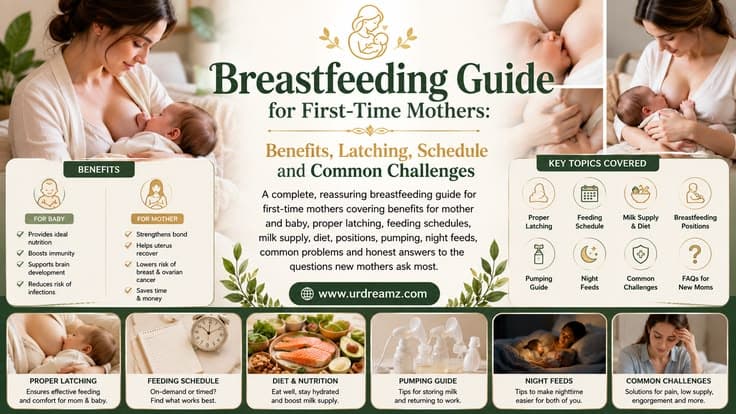
Breastfeeding Guide for First-Time Mothers: Benefits, Latching, Schedule and Common Challenges
Breastfeeding is often described as natural, and biologically it is, but that doesn't mean it always comes easily on the first try. For many first-time mothers, it's a skill that both mother and baby learn together over days and weeks, with plenty of trial, error and adjustment along the way. This guide walks through the genuine benefits of breastfeeding, how to get a comfortable and effective latch, what a realistic feeding schedule looks like, how to recognize whether your baby is getting enough milk, and the honest troubleshooting needed for the problems that come up most often — sore nipples, engorgement, low supply, and more.
Why Breastfeeding Matters for the Baby
Breast milk changes its composition to match a baby's needs almost day by day, which is part of why it's so often described as a living fluid rather than a fixed formula. In the first few days, the body produces colostrum, a thick, golden, antibody-rich fluid that primes the newborn's digestive system and delivers a concentrated dose of immune protection before regular milk comes in. Over the following weeks, the milk's balance of fat, protein and carbohydrate continues shifting to support the baby's changing growth needs.
Beyond nutrition, breastfeeding is associated with a meaningfully lower risk of certain infections in infancy, support for healthy digestion, and a reduced likelihood of some allergic conditions, particularly with exclusive breastfeeding in the earliest months. Some research also points to associations between breastfeeding and long-term outcomes such as healthier weight trajectories and cognitive development, although these effects are influenced by many overlapping factors and shouldn't be treated as guarantees.
| Benefit Area | What Breastfeeding Typically Supports |
|---|---|
| Immune protection | Antibodies and immune factors that help fight early infections |
| Digestive health | Easily digested nutrients and supportive gut bacteria balance |
| Growth and weight | Milk composition adjusts naturally to the baby's changing needs |
| Allergy risk | Some reduction in certain allergic conditions, especially with exclusivity |
| Brain development | Nutrients like fatty acids that support early neurological growth |
| Bonding | Frequent close contact that supports attachment and comfort |
Why Breastfeeding Matters for the Mother Too
The benefits of breastfeeding aren't one-directional. For mothers, breastfeeding triggers the release of oxytocin, a hormone that helps the uterus contract back toward its pre-pregnancy size and may ease postpartum bleeding in the early days. Many mothers also notice it burns extra calories, which can gradually support a return toward pre-pregnancy weight, although this varies widely and shouldn't be treated as a guaranteed weight-loss method.
Longer term, breastfeeding has been associated with a somewhat lower lifetime risk of certain breast and ovarian cancers, and some research links it to better bone density recovery after pregnancy. On the emotional side, the closeness and rhythm of regular feeding sessions can offer a real sense of connection and calm for many mothers, even on otherwise exhausting days, although it's worth noting this isn't universal — some mothers find the demands of breastfeeding stressful rather than soothing, and both reactions are entirely valid.
| Maternal Benefit | How It Tends to Help |
|---|---|
| Uterine recovery | Oxytocin release supports the uterus contracting back to size |
| Calorie use | Extra energy expenditure that may support gradual weight changes |
| Long-term cancer risk | Some association with lower risk of certain breast and ovarian cancers |
| Bone health | Possible support for bone density recovery after pregnancy |
| Emotional connection | Close, repeated contact that many mothers find calming and bonding |
Getting a Proper Latch: The Foundation of Comfortable Breastfeeding
Most early breastfeeding pain traces back to one root cause: a latch that isn't deep enough. A shallow latch, where the baby is mostly gripping just the nipple rather than a generous mouthful of breast tissue, tends to cause sharp pain and inefficient milk transfer, while a deep latch is usually far more comfortable and effective for both mother and baby.
A simple way to remember good alignment is to keep the baby "tummy to tummy," with their whole body turned toward you rather than twisted at the neck. Their nose should sit roughly level with your nipple before latching, not below it, which encourages them to tip their head back slightly and take in more of the breast. Waiting for a wide, yawn-like mouth opening before bringing the baby to the breast — rather than pushing the breast toward a partially open mouth — usually produces a much deeper, more comfortable latch.
| Latch Sign | Good Latch | Latch That Needs Adjusting |
|---|---|---|
| Pain level | Brief tenderness at first contact, easing quickly | Sharp or continuing pain throughout the feed |
| Lip position | Lips flanged outward, like a fish | Lips tucked inward |
| Mouth coverage | Wide mouth covering a good portion of the areola | Latched mostly onto the nipple itself |
| Sound | Rhythmic swallowing sounds | Clicking or smacking sounds |
| Nipple shape after feed | Round, unchanged | Flattened, creased or pinched |
Common Latching Problems and What Tends to Help
- Shallow latch: Break the suction gently with a clean finger and try again, aiming the nipple toward the baby's nose rather than the center of the mouth.
- Baby falling asleep too quickly at the breast: Undress them slightly or gently stroke their cheek or feet to keep them actively feeding.
- Pain that doesn't ease after the first week: This is often a sign the latch needs adjusting and is worth raising with a lactation consultant rather than assuming it's simply something to endure.
- Tongue tie: A restricted tongue movement can make a deep latch physically difficult regardless of positioning, and is something a pediatrician or lactation specialist can assess.

Breastfeeding Positions Worth Knowing
No single position works best for every mother and baby, and many women end up rotating between a few favorites depending on the time of day, how recovered they're feeling, or which side feels more comfortable. Learning two or three positions well tends to be more useful than trying to master every possible hold.
| Position | Best For | Quick Description |
|---|---|---|
| Cradle hold | General everyday feeding | Baby lies along your forearm, facing your breast |
| Cross-cradle hold | Newborns still learning to latch | Opposite arm supports the head for more control |
| Football (clutch) hold | After a C-section, or for smaller babies | Baby tucked under the arm, away from the incision |
| Side-lying position | Night feeds and postpartum recovery | Mother and baby lie facing each other on their sides |
| Laid-back breastfeeding | Relaxed feeding using gravity and instinct | Mother reclines, baby rests on her chest |
A nursing pillow can help with positioning in almost any hold by lifting the baby to breast height and reducing strain on the arms, shoulders and back, especially during the early weeks when feeding sessions are frequent and sometimes lengthy.
How Often Newborns Need to Feed
In the first weeks, breastfeeding works best as a demand-driven process rather than a fixed clock schedule. Newborns typically need to nurse somewhere between eight and twelve times across a 24-hour period, which usually averages out to roughly every two to three hours, including overnight. Because breast milk digests quickly, this frequency is normal and expected rather than a sign that something is off with supply.
Cluster feeding — a stretch where the baby wants to nurse almost continuously for a few hours, often in the evening — is also a common and normal pattern, particularly during growth spurts. It can feel relentless in the moment, but it typically passes within a day or two and tends to coincide with the baby's body asking for an increase in milk supply.
| Baby's Age | Typical Feeding Frequency |
|---|---|
| First 24 hours | Several short feeds, sometimes irregular, as colostrum is established |
| First week | 8-12 feeds per 24 hours, roughly every 2-3 hours |
| 2-4 weeks | Similar frequency, sessions sometimes growing more efficient |
| 1-3 months | Gradually longer stretches between feeds as stomach capacity grows |
| Growth spurts (any age) | Temporary cluster feeding, often lasting 24-48 hours |
How Long Should Each Session Last?
There's no single correct length for a feeding session — some babies finish efficiently in ten minutes, while others take thirty or more, especially in the earliest weeks. A more useful marker than the clock is whether the baby's sucking pattern slows and softens near the end, and whether the breast feels noticeably softer afterward, both of which suggest a satisfying feed rather than a rushed one.
Signs Your Baby Is Getting Enough Milk
This is one of the most common worries among first-time breastfeeding mothers, largely because breast milk intake can't be measured the way a bottle's markings can. Fortunately, there are several reliable indirect signs that tend to give a clear picture of whether feeding is going well.
| Sign | What to Look For |
|---|---|
| Wet diapers | At least 5-6 heavy wet diapers a day once milk supply is established |
| Dirty diapers | Several soft, yellowish stools daily in the early weeks |
| Weight gain | Steady gain after the initial newborn weight dip, tracked at checkups |
| Swallowing sounds | Audible or visible swallowing during active feeding |
| Breast softening | Breasts feel noticeably less full after a feed |
| Baby's demeanor | Generally settled and content between feeds, not constantly frantic |
If several of these signs seem consistently off — very few wet diapers, no real weight gain, or a baby who seems perpetually unsatisfied — it's worth contacting a pediatrician or lactation consultant promptly rather than waiting to see if things improve on their own.
Low Milk Supply: Causes, Myths and Realistic Solutions
Worry about milk supply is extremely common, but true low supply is actually less common than the worry itself suggests. Many of the signs mothers interpret as low supply — frequent feeding, cluster feeding, or a baby who seems to want to nurse constantly — are simply normal newborn feeding patterns rather than evidence that something is wrong.
That said, genuine low supply does happen and has identifiable causes, including infrequent feeding or pumping, certain medications, retained placental tissue, some hormonal conditions, and in some cases simply not enough time for supply to fully establish yet. The most effective lever for increasing supply is almost always more frequent, effective removal of milk — through nursing, pumping, or both — since the breast responds to demand more reliably than it responds to any specific food or supplement.
| Common Myth | More Accurate Picture |
|---|---|
| Small breasts mean less milk | Breast size has little connection to milk-producing capacity |
| Frequent feeding means low supply | Frequent feeding is normal newborn behavior, not a supply problem |
| Stress instantly stops milk production | Stress can affect letdown temporarily, but doesn't halt production outright |
| Drinking more milk increases supply | Hydration matters generally, but milk consumption isn't the key driver |
| A growth spurt means supply has dropped | It usually means the baby's needs have temporarily increased |
Foods Often Associated With Supporting Milk Supply
Several foods have a long-standing reputation for supporting lactation, though the supporting evidence varies in strength. Oats, fenugreek, fennel seeds, moringa and garlic are among the most commonly mentioned, often as part of a broader pattern of staying well-fed and well-hydrated rather than as a guaranteed fix on their own.
| Food or Habit | Traditional Reputation |
|---|---|
| Oats | A widely recommended, easy-to-add breakfast staple for nursing mothers |
| Fenugreek seeds | A traditional lactation support herb, used cautiously and in moderation |
| Fennel seeds | Often used in teas alongside meals |
| Garlic | Believed by many cultures to support supply, used in regular cooking |
| Consistent hydration | Supports overall energy and comfort, even if not a direct supply driver |
If supply concerns persist despite frequent feeding and reasonable nutrition, a lactation consultant can assess latch quality, feeding frequency, and other contributing factors far more precisely than self-diagnosis through online searching.
A Practical Breastfeeding Diet Plan for Mothers
Nutrition needs increase somewhat during breastfeeding, largely to support both milk production and the mother's own recovery. Rather than following a rigid, restrictive plan, most lactation guidance points toward a varied diet built around protein, whole grains, healthy fats, and a wide range of fruits and vegetables, with attention to a handful of nutrients that tend to run low during this stage.
| Nutrient | Why It Matters | Good Sources |
|---|---|---|
| Protein | Supports milk production and tissue repair | Eggs, lentils, dairy, lean meat, tofu |
| Iron | Replenishes stores depleted during pregnancy and birth | Red meat, spinach, beans, fortified cereals |
| Calcium | Supports bone density during the breastfeeding period | Dairy, leafy greens, fortified plant milk |
| Omega-3 fatty acids | Supports infant brain development through breast milk | Fatty fish, walnuts, flaxseed |
| Folate | Supports cell repair and recovery | Leafy greens, legumes, citrus fruit |
| Vitamin D | Supports bone health for both mother and baby | Sunlight exposure, fortified foods, supplements if advised |
A Simple One-Day Meal Outline
| Meal | Example |
|---|---|
| Breakfast | Oatmeal with milk, walnuts and berries, plus a glass of water |
| Mid-morning snack | A handful of nuts and a piece of fruit |
| Lunch | Lentils or beans with rice, a side of leafy greens |
| Afternoon snack | Yogurt with seeds or a boiled egg |
| Dinner | Grilled fish or chicken with vegetables and a whole grain |
| Evening | A warm glass of milk or herbal tea, if desired |
Most breastfeeding mothers need a modest increase in daily calories compared to before pregnancy, generally a few hundred extra, though exact needs vary based on activity level, body size, and whether feeding is exclusive or combined with formula. Weight loss is usually safest when it happens gradually, since very restrictive dieting during this period can affect both energy levels and milk supply.
Foods Often Recommended to Limit
- High-mercury fish, due to potential effects on the baby through breast milk.
- Excessive caffeine, since some passes into milk and can affect a sensitive baby's sleep.
- Alcohol, which should be limited and carefully timed if consumed at all, in line with a doctor's guidance.
- Heavily processed foods, less because of any specific danger and more because they tend to crowd out the nutrient-dense foods that matter more during this period.
Breast Pumps and Safe Milk Storage
Pumping becomes relevant for many mothers at some point, whether to build a small backup supply, return to work, manage oversupply, or simply give someone else the chance to handle a feed. Manual pumps work well for occasional, low-volume use, while electric pumps — especially double electric pumps — are usually more practical for mothers pumping regularly or exclusively.
| Pump Type | Best Suited For |
|---|---|
| Manual pump | Occasional use, travel, or as a lightweight backup |
| Single electric pump | Moderate, semi-regular pumping needs |
| Double electric pump | Frequent pumping, returning to work, exclusive pumping |
| Wearable/hands-free pump | Multitasking while pumping, discreet use outside the home |
Once milk is expressed, safe storage matters as much as safe pumping. Breast milk holds up well at room temperature for a few hours, considerably longer in the refrigerator, and for months in a freezer, though exact guidelines vary slightly depending on the source and storage container.
| Storage Location | General Safe Duration |
|---|---|
| Room temperature | Up to about 4 hours |
| Refrigerator | About 4 days |
| Standard freezer | About 6 months for best quality |
| Deep freezer | Up to about 12 months |
| Thawed milk (previously frozen) | Use within 24 hours, do not refreeze |
Warming milk gently in warm water rather than a microwave helps preserve its nutrients and avoids uneven hot spots that could burn a baby's mouth. Labeling stored milk with the date it was expressed makes it easier to use the oldest milk first and avoid waste.
Breastfeeding at Night
Night feeds are an unavoidable part of the early months, since a newborn's small stomach capacity means they genuinely need to eat through the night, not just during the day. Rather than fighting this reality, most mothers find it easier to streamline the process: keeping lighting low, minimizing stimulation, and using a comfortable position like side-lying to conserve energy during these frequent wake-ups.
Night feeding also plays a practical role in milk supply, since prolactin — the hormone most responsible for milk production — tends to be higher overnight, meaning night feeds can meaningfully support overall supply, not just meet the baby's immediate hunger.
| Night Feeding Element | Helpful Approach |
|---|---|
| Lighting | Dim or no light to support both the baby's and mother's return to sleep |
| Position | Side-lying for comfort, when done according to safe sleep guidance |
| Stimulation | Minimal talking or play, keeping the mood calm and quiet |
| Dream feeding | Feeding a sleepy baby before the mother's own bedtime, sometimes extending the first stretch of sleep |
| Frequency expectations | Decreasing gradually over months as stomach capacity grows |
Common Breastfeeding Problems and How to Work Through Them
Breastfeeding difficulties are common enough that experiencing one doesn't suggest anything has gone wrong with your ability to nurse — it usually just means something needs adjusting. Knowing the most frequent issues in advance makes them far less alarming when they show up.
| Problem | Likely Cause | What Typically Helps |
|---|---|---|
| Sore or cracked nipples | Shallow latch or prolonged friction | Adjusting the latch, air-drying nipples, lanolin-based cream if needed |
| Engorgement | Milk coming in faster than it's removed | Frequent feeding, warm compress before, cool compress after |
| Blocked milk duct | Incomplete drainage in one area of the breast | Gentle massage, varied feeding positions, continued nursing on that side |
| Mastitis | A blocked duct that progresses into infection | Continued feeding, rest, medical evaluation if fever or worsening symptoms appear |
| Baby refusing the breast | Illness, teething, distraction, or a change in routine | Patience, calm environment, trying different positions or times of day |
| Oversupply | Overstimulated milk production, often from excessive pumping | Block feeding on one side at a time, gradual adjustment rather than abrupt changes |
When a Problem Needs Professional Attention
Most early breastfeeding hiccups resolve with small adjustments and a bit of time, but certain signs deserve prompt medical attention rather than waiting it out: a fever alongside breast pain, a hard, red, hot patch on the breast that doesn't improve with home measures, persistent pain despite a seemingly good latch, or a baby who isn't gaining weight as expected. A lactation consultant or pediatrician can quickly clarify whether something simple is going on or whether closer medical care is needed.
Breastfeeding Twins: What Changes and What Stays the Same
The core mechanics of breastfeeding don't change much with twins, but the logistics certainly do. Many mothers of twins eventually move toward tandem feeding — nursing both babies at the same time — once latching and positioning feel more confident, since it can significantly cut down total feeding time across a day.
| Twin Feeding Consideration | Practical Note |
|---|---|
| Tandem feeding | Often easier once each baby's latch is well established individually first |
| Best positions | Double football hold or a combination hold using a twin nursing pillow |
| Milk supply | The body generally responds to combined demand, though it may take time to fully establish |
| Feeding schedule | Often more practical to feed both babies around the same windows rather than strictly separately |
| Support needs | Extra hands for positioning, especially in the early weeks, make a noticeable difference |
Mixed Feeding: Combining Breast Milk and Formula
Combination feeding is a legitimate, common choice rather than a fallback or compromise, and it works well for many families balancing supply concerns, return-to-work schedules, or simply a desire for shared feeding responsibilities. The main consideration is supply: since milk production responds to demand, reducing breastfeeding sessions too quickly can lower supply faster than intended, so a gradual transition tends to work more smoothly than an abrupt one.
| Mixed Feeding Approach | What to Know |
|---|---|
| Introducing one bottle a day | Usually has a minimal effect on overall supply |
| Replacing several sessions quickly | Can noticeably reduce supply if not paired with pumping |
| Choosing a formula | Standard infant formula is appropriate for most healthy babies; a pediatrician can advise on special cases |
| Switching between breast and bottle | Goes more smoothly with a similarly shaped nipple and a relaxed, unhurried approach |
When and How Mothers Choose to Stop Breastfeeding
There's no single "right" age to stop breastfeeding, and major health organizations generally describe exclusive breastfeeding for around the first six months as beneficial, with continued breastfeeding alongside solid foods for a year or longer being a reasonable and supported choice for families who want it — though plenty of mothers stop earlier for entirely valid personal, medical, or practical reasons.
Whenever the decision is made, a gradual approach tends to be more comfortable for both mother and baby than stopping abruptly, both physically — to avoid sudden engorgement — and emotionally, since the routine and closeness of nursing often carries meaning beyond nutrition alone.
| Weaning Approach | What It Involves |
|---|---|
| Gradual weaning | Dropping one session at a time over several weeks |
| Partial weaning | Keeping a few sessions (often morning or night) while replacing others |
| Night weaning first | A common starting point once the baby is eating solids and gaining well |
| Sudden weaning | Sometimes medically necessary, but generally harder physically and emotionally |
Breastfeeding Myths Worth Setting Aside
- Myth: Small breasts can't produce enough milk. Milk-producing tissue, not overall breast size, determines supply capacity.
- Myth: Spicy food should always be avoided. Most babies tolerate flavors passed through milk just fine; only a minority show sensitivity worth adjusting for.
- Myth: Breastfeeding should never hurt at all. Some tenderness in the first days is common, though ongoing sharp pain usually signals a latch issue worth addressing.
- Myth: Formula and breast milk are nutritionally identical in every respect. They're both capable of supporting healthy growth, but they aren't identical; this doesn't make formula a poor choice, simply a different one.
- Myth: Breastfeeding reliably prevents pregnancy. Exclusive, frequent breastfeeding can reduce fertility temporarily, but it isn't a dependable form of contraception on its own.
- Myth: Working mothers can't breastfeed successfully. With pumping, planning and supportive workplaces, many mothers continue breastfeeding well after returning to work.
The First 24 Hours: What Breastfeeding Actually Looks Like at the Start
The earliest hours after birth are unlike any other stage of breastfeeding, and knowing what to expect helps enormously with managing expectations. Right after delivery, many hospitals encourage immediate skin-to-skin contact, partly because it triggers a newborn's natural rooting instinct and often leads to a first latch within the baby's first hour of life. This early window is sometimes called the "golden hour," and while missing it for medical reasons doesn't doom breastfeeding in any way, taking advantage of it when possible tends to make the first latch a little easier.
In these first 24 hours, feeds are often short, irregular, and sometimes frustratingly inconsistent — a baby might latch well for one feed and seem disinterested an hour later. This is normal. Colostrum is produced in very small quantities, matching a newborn's tiny stomach capacity, which at birth holds roughly the volume of a small marble or cherry. There is no need to worry that small colostrum volumes mean the baby is going hungry; the amount produced is intentionally matched to what a newborn's stomach can actually hold.
| Hour After Birth | What's Typical |
|---|---|
| First hour | Skin-to-skin contact, possible first latch attempt |
| 2-6 hours | Short, sometimes sleepy feeding attempts |
| 6-24 hours | Feeding becomes slightly more frequent as the baby wakes more |
| 24-72 hours | Colostrum gradually transitions toward mature milk ("milk coming in") |
Skin Conditions and Discomfort Beyond the Nipple
Sore nipples get most of the attention in breastfeeding discussions, but several other physical discomforts show up regularly and are worth knowing about in advance so they don't feel alarming when they appear.
- Thrush: A yeast infection that can affect both the nipple and the baby's mouth, often causing burning pain that persists even with a good latch. It typically needs treatment for both mother and baby simultaneously to fully resolve.
- Vasospasm: A blanching, throbbing pain in the nipple after feeds caused by blood vessels constricting, sometimes linked to cold temperatures or a tight latch.
- Overactive letdown: A forceful initial flow of milk that can cause a baby to gag, pull off, or choke slightly at the start of a feed; expressing a small amount before latching often helps.
- Plugged ducts that recur in the same spot: Sometimes linked to a tight bra, sleeping position, or incomplete drainage from one particular angle, and often resolved by varying feeding positions to drain different areas of the breast.
| Discomfort | Typical Cause | Common Relief Approach |
|---|---|---|
| Thrush | Yeast overgrowth, often after antibiotic use | Antifungal treatment for both mother and baby |
| Vasospasm | Blood vessel constriction in the nipple | Warmth after feeds, adjusting latch |
| Overactive letdown | Strong initial milk flow | Hand-expressing briefly before latching |
| Recurring plugged duct | Incomplete drainage from one angle | Rotating feeding positions, gentle massage |
Returning to Work While Continuing to Breastfeed
Many mothers want to continue breastfeeding after going back to work, and with some planning this is very achievable, even if it requires more logistics than feeding at home. The general approach involves building a small frozen milk reserve in the weeks leading up to the return, introducing a bottle gradually so the baby accepts it without a fight, and establishing a pumping rhythm at work that roughly matches the baby's usual feeding times.
- Start introducing a bottle two to four weeks before returning to work, ideally offered by someone other than the breastfeeding parent.
- Build a modest freezer stash gradually rather than trying to accumulate a huge supply all at once, which can create unnecessary pressure.
- Pump on a schedule that mirrors the baby's typical feeding times as closely as work allows, since this helps maintain supply.
- Know your workplace rights regarding pumping breaks and a private space, which are legally protected in many regions.
- Be flexible with yourself if the routine takes a few weeks to settle into a comfortable rhythm.
| Timeline Before Return to Work | Suggested Action |
|---|---|
| 4 weeks before | Begin offering one bottle of expressed milk every few days |
| 2-3 weeks before | Increase bottle frequency, start building a small freezer stash |
| 1 week before | Practice the planned pumping schedule at home to test timing |
| First week back | Expect some adjustment; supply and routine often stabilize within a couple of weeks |
Breastfeeding Premature or Lower Birth-Weight Babies
Premature babies often need a somewhat different breastfeeding approach, partly because they may tire more easily during feeds and have weaker initial sucking reflexes than full-term newborns. Many hospitals support a combination of direct breastfeeding, expressed milk given by bottle or tube, and close monitoring of weight gain during this period, gradually shifting toward more direct breastfeeding as the baby's strength and coordination develop.
- Skin-to-skin contact, sometimes called kangaroo care, is especially encouraged for premature babies and supports both bonding and physiological stability.
- Pumping to establish and protect supply is often necessary in the early period if the baby isn't yet able to nurse efficiently.
- Specialized nipple shields or paced bottle feeding techniques are sometimes used temporarily to support weaker feeding patterns.
- Progress is usually measured patiently over weeks, with neonatal and lactation specialists closely involved in feeding decisions.
Breastfeeding and Sleep: How the Two Connect
New parents often notice that breastfeeding and sleep are tangled together in ways that aren't always intuitive. Breast milk contains naturally occurring melatonin that rises and falls with the time of day, generally higher at night and lower during the day, which may play a small role in helping a baby's body eventually align with a day-night rhythm. This doesn't mean breastfeeding alone will produce a sleeping-through-the-night baby on any particular timeline, but it does mean the relationship between feeding and sleep is more biologically intertwined than it might first appear.
Many mothers also find that nursing itself becomes a natural settling tool, since the hormone oxytocin released during feeding has a calming effect on both mother and baby. This is sometimes called "nursing to sleep," and while some parents actively try to avoid it out of concern about creating a dependency, there's nothing inherently wrong with it in the early months — it becomes more of a personal preference question later on, often around the time solid foods and more independent sleep habits are introduced.
| Sleep-Related Question | Practical Answer |
|---|---|
| Does breastfeeding cause more night waking than formula? | Breast milk digests faster, which can mean slightly more frequent waking, though many factors contribute to night waking overall |
| Is nursing to sleep harmful? | Not in the early months; it becomes a matter of personal preference as the baby grows older |
| Does pumped milk affect sleep differently than direct nursing? | Not meaningfully on its own; timing and routine matter more than delivery method |
| When do night feeds typically reduce naturally? | Often gradually between 3 and 9 months, varying widely by baby |
Building a Support System Around Breastfeeding
Breastfeeding success is rarely just about technique — it's heavily influenced by the support a mother has around her, both practically and emotionally. A partner who handles diaper changes between feeds, family members who bring meals rather than just advice, and a willingness to ask for professional help early all make a measurable difference in how sustainable breastfeeding feels over the weeks and months.
- Lactation consultants: Trained specifically in feeding mechanics, positioning and troubleshooting, and often able to solve in a single visit what weeks of guesswork couldn't.
- Pediatricians: The right resource for weight concerns, growth tracking, and any medical symptoms beyond feeding mechanics itself.
- Peer support groups: Other breastfeeding mothers, whether in person or online, often provide the kind of reassurance that comes specifically from shared experience.
- Partners and family: Practical help with household tasks and emotional encouragement that takes pressure off the breastfeeding parent specifically.
| Type of Support | What It's Best For |
|---|---|
| Lactation consultant | Latch troubleshooting, supply concerns, positioning |
| Pediatrician | Weight gain, growth tracking, medical symptoms |
| Peer support group | Emotional reassurance, shared lived experience |
| Partner or family help | Practical relief, reduced overall stress load |
Taking Care of Yourself While Breastfeeding
It's easy for a breastfeeding mother's own needs to slip to the very bottom of the list, but neglecting basic self-care tends to catch up eventually, often through exhaustion, irritability, or a drop in milk supply tied to stress and depletion. A few simple habits, even imperfectly maintained, tend to make a meaningful difference over weeks and months of feeding.
- Keep a water bottle within reach during most feeding sessions, since thirst often goes unnoticed until it's already significant.
- Eat something, even something small, regularly rather than skipping meals during particularly demanding stretches.
- Accept help with household tasks specifically so that rest and recovery aren't constantly being traded away.
- Watch for persistent low mood, anxiety or detachment that goes beyond ordinary tiredness, and bring it up with a doctor rather than assuming it will pass on its own.
- Give yourself permission to supplement, pause, or stop breastfeeding if it's no longer serving your wellbeing or your baby's — a fed, well-supported baby with a healthy mother is the actual goal, not adherence to any particular feeding method at all costs.
How can I increase my milk supply quickly?
The most reliable approach is more frequent, effective removal of milk through nursing or pumping, since supply responds primarily to demand rather than any single food or supplement.
What is the general rule of thumb for newborn feeding frequency?
Most newborns feed roughly every two to three hours, totaling eight to twelve feeds across 24 hours, though demand-based feeding rather than strict timing tends to work best in the early weeks.
Which foods are commonly believed to support milk production?
Oats, fenugreek, fennel seeds and garlic show up often in traditional lactation advice, generally as part of a varied, well-fed diet rather than a guaranteed fix on their own.
What are reliable signs my baby is getting enough milk?
Steady weight gain, several heavy wet diapers daily, audible swallowing during feeds, and a baby who seems generally settled between sessions are the clearest indicators.
What foods should I avoid while breastfeeding?
High-mercury fish, excessive caffeine, and alcohol are the items most commonly flagged for moderation or avoidance, alongside generally limiting heavily processed foods.
Is it normal for breastfeeding to be painful at first?
Some tenderness in the very first days is common, but ongoing sharp pain usually points to a latch that needs adjusting rather than something to simply tolerate.
Can I breastfeed successfully after a C-section?
Yes. Positions like the football hold or side-lying that keep the baby's weight off the incision area tend to make early feeding more comfortable after a C-section.
Breastfeeding in Public and Everyday Life
Many first-time mothers feel some anxiety about feeding outside the home, and that anxiety often fades faster than expected once a few outings go smoothly. Most places that welcome families also welcome breastfeeding, and in many regions it's legally protected regardless of where a mother chooses to feed. Practical comfort, more than modesty itself, tends to be what makes public feeding feel manageable: a nursing cover or loose layered clothing if it feels reassuring, a comfortable seat when one's available, and a willingness to simply step into a quiet corner if that feels easier on a particular day.
- Layered clothing — a loose top with a tank underneath — allows easy access without needing to fully undress.
- A baby carrier can make feeding on the move more discreet and comfortable once both mother and baby are confident with latching.
- Practicing at home in front of a mirror a few times can build confidence before the first outing.
- Most discomfort around public feeding fades with repetition, much like any new skill performed in front of others.
| Public Feeding Concern | Practical Response |
|---|---|
| Feeling exposed | Layered clothing or a light cover, used only if it adds comfort |
| Finding a comfortable spot | Many public spaces, malls and family facilities offer nursing areas, though feeding anywhere is generally acceptable |
| Managing a fussy latch in public | A quiet corner or car can reduce distractions during a tricky latch |
| Confidence over time | Tends to improve naturally with repeated, low-stakes practice |
How Breastfeeding Patterns Shift Over the First Year
The intensity and frequency of breastfeeding in the newborn period isn't a permanent state — it changes substantially as a baby grows, and knowing roughly what to expect month by month can make the early, more demanding stretch feel less endless.
| Approximate Age | General Feeding Pattern |
|---|---|
| 0-1 month | Frequent, often irregular feeding, 8-12+ times daily |
| 1-3 months | Sessions become more efficient, slightly longer stretches between feeds |
| 3-6 months | More predictable rhythm; many babies settle into roughly 5-7 feeds a day |
| 6-12 months | Solid foods introduced alongside continued breastfeeding, frequency gradually decreasing |
| 12+ months | Breastfeeding often becomes more about comfort and connection alongside a full diet of solid foods, for families who continue |
None of these timelines are rigid rules — some babies feed more frequently than this chart suggests well past the newborn period, and that's not inherently a problem as long as growth and development continue on track. The broader point is simply that the relentless-feeling frequency of the earliest weeks is a phase, not a permanent state.
Matching Breastfeeding Choices to Different Family Situations
Not every mother starts breastfeeding from the same place, and the advice that helps one family most isn't always the most relevant for another. Thinking through your own specific circumstances first makes it easier to apply the rest of this guide sensibly rather than trying to follow every recommendation at once.
For mothers recovering from a C-section, comfort and reduced pressure on the abdomen tend to matter most in the early days, which usually points toward the football hold or side-lying position rather than positions that rest the baby's weight directly across the incision. Pain management and mobility limitations in the first week or two often mean accepting more help than usual with positioning and burping, which is a practical accommodation rather than a shortcut.
For mothers managing a demanding return-to-work timeline, the priority often shifts toward building supply resilience early — frequent nursing or pumping in the weeks before returning, and a realistic pumping schedule once back at work — rather than aiming for an exclusively at-the-breast routine that may not survive the transition intact. Combination feeding, introduced thoughtfully, is frequently the most sustainable answer here rather than a sign of falling short.
For mothers with twins or other multiples, the logistics of feeding two babies dominate decision-making more than any single technique does. Tandem feeding, careful tracking of which baby fed from which side, and accepting more outside help than a single-baby household might need are all practical responses to a genuinely more demanding feeding workload, not signs that something is going wrong.
For mothers facing low supply, a history of breast surgery, or other physiological factors that limit exclusive breastfeeding, mixed feeding or formula feeding from the start can be the healthiest, most sustainable path forward. The emotional weight some mothers carry around this choice often exceeds what the actual nutritional difference between approaches would justify, and recognizing that gap can ease a significant amount of unnecessary guilt.
| Family Situation | Practical Priority | Helpful Approach |
|---|---|---|
| Recovery from C-section | Comfort, reduced pressure on the abdomen | Football hold or side-lying position, extra help with positioning |
| Returning to work soon | Supply resilience, realistic logistics | Early pumping practice, gradual bottle introduction |
| Feeding twins or multiples | Managing workload across two babies | Tandem feeding, tracking, accepting extra support |
| Physiological supply limits | A sustainable, guilt-free feeding plan | Mixed feeding or formula feeding without unnecessary self-blame |
| First feeding experience overall | Building confidence and basic technique | Lactation support early, patience with the learning curve |
Whichever situation describes your own circumstances most closely, the underlying principle from this guide still applies: a comfortable latch, attentive feeding based on your baby's cues, reasonable self-care, and willingness to ask for help all matter more than rigidly following any single template drawn from someone else's very different situation.
Final Thoughts
Breastfeeding sits somewhere between a biological process and a learned skill, and most of the difficulty first-time mothers run into has far more to do with the learning curve than with anything going wrong. A deep, comfortable latch, frequent demand-based feeding, reasonable attention to nutrition and hydration, and a willingness to ask for help early rather than waiting out a problem cover the overwhelming majority of what makes breastfeeding go smoothly. Whatever combination of breastfeeding, pumping or formula ends up working for your family, the goal underneath all of it stays the same: a fed, growing baby and a mother who isn't running herself into the ground trying to meet an impossible standard. That's worth remembering on the harder days as much as the easy ones.
However your breastfeeding experience unfolds — whether it stretches comfortably across a full first year or looks quite different from what you originally pictured — what matters most is a routine that keeps your baby fed and growing while leaving you with enough energy and wellbeing to actually enjoy the rest of early parenthood alongside it.
A Quick Reference Glossary for New Breastfeeding Terms
Breastfeeding comes with its own vocabulary, and running into unfamiliar terms in the early weeks can add an extra layer of confusion on top of everything else that's new. Keeping a quick reference handy tends to make conversations with doctors, lactation consultants and other parents easier to follow.
| Term | Plain-Language Meaning |
|---|---|
| Colostrum | The thick, early milk produced in the first few days after birth |
| Letdown | The release of milk from the breast triggered by suckling or stimulation |
| Cluster feeding | A pattern of frequent, closely spaced feeds, often in the evening |
| Engorgement | Breast fullness and firmness when milk supply exceeds immediate demand |
| Latch | How the baby's mouth attaches to the breast during feeding |
| Hindmilk | The richer, fattier milk released later in a feeding session |
| Foremilk | The thinner, more watery milk released at the start of a feed |
| Tandem feeding | Nursing two babies, typically twins, at the same time |
| Block feeding | Feeding from one breast for a set period to help manage oversupply |
| Exclusive breastfeeding | Feeding only breast milk, with no formula, water or solids |