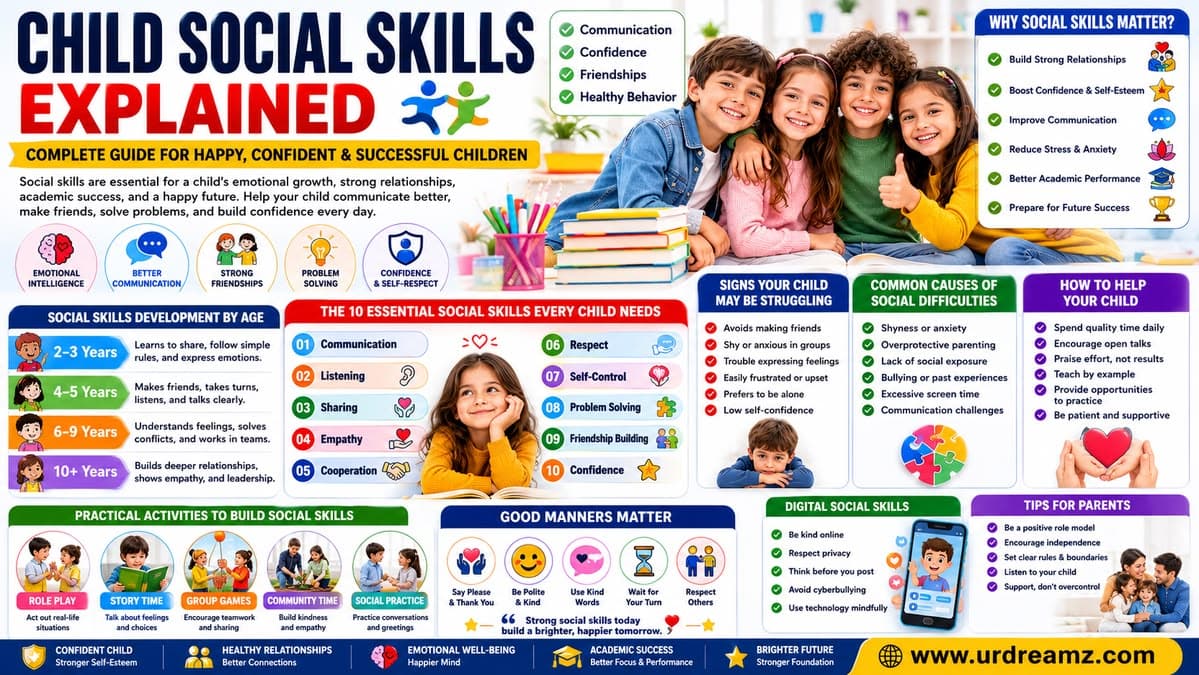
Child Social Skills Explained: Communication, Confidence, Friendships and Healthy Social Behavior — Complete Guide
How children learn to talk, listen, make friends, resolve conflict, and build the relationships that shape the rest of their lives.
Introduction: The Skill Nobody Formally Teaches
Nobody sits a child down for a formal lesson on when to make eye contact, how long to wait before speaking, or what it means when someone glances at the door mid-conversation. These rules simply get absorbed, mostly without anyone noticing the exact moment they were learned. For most children, this absorption happens naturally through thousands of small daily interactions with parents, siblings, classmates, and teachers. For some children, though — including many with autism, ADHD, speech and language differences, or simply a slower social maturation timeline — these unwritten rules need to be taught directly, patiently, and repeatedly, the same way reading or arithmetic would be.
It is a strange feature of social skills that the people who possess them most fluently are often the least able to explain how they acquired them. Ask a socially confident adult exactly how they learned to recognize when a conversation partner wants to end a chat, or how they know when a joke has landed badly, and most will struggle to name a specific lesson — because there wasn't one. This invisibility is precisely why children who don't pick these cues up automatically can be mistakenly seen as simply not trying hard enough, when in reality they may genuinely need the same information spelled out explicitly that other children absorbed passively.
Social skills are sometimes treated as a soft, secondary concern compared to academics, but the research consistently tells a different story. A child's ability to communicate, cooperate, read emotional cues, and resolve conflict peacefully predicts long-term outcomes across nearly every area of life — friendships, school performance, mental health, and even future employment. Social competence is not a bonus skill sitting alongside development; it is one of its central pillars.
What makes this topic genuinely reassuring for parents is that social skills, unlike some other traits, are almost entirely learnable. A child is not born with a fixed amount of "social ability" any more than they are born already knowing how to read. What varies from child to child is not potential, but pace and pathway — some children pick up social nuance almost by osmosis simply from being around other children, while others need the same nuance broken down, named, and practiced explicitly before it clicks. Neither path reflects a deficiency in the child or a failure by the parent; it simply reflects the normal range of human development.
This guide walks through what social skills actually are, how they typically develop by age, the specific skills every child benefits from building, warning signs worth paying attention to, what causes social difficulties, and practical, everyday ways parents and caregivers can teach these skills — through modeling, coaching, play, and patient repetition, without turning childhood into a lecture series.
What Are Social Skills?
Social skills are the verbal, nonverbal, and emotional tools a person uses to interact, communicate, and build relationships with others. They are not something children are simply born knowing — they are learned gradually through observation, practice, and repeated real-world experience, which means they can also be consciously taught and strengthened at any age, in any family, regardless of where a child currently stands.
| Category | Examples |
|---|---|
| Basic skills | Greeting others, starting a conversation, active listening, saying thank you |
| Advanced skills | Asking for help, giving instructions, making suggestions, expressing opinions respectfully |
| Affective (emotional) skills | Empathy, assertiveness, recognizing emotions in oneself and others |
| Negotiation skills | Conflict resolution, mediating disagreements, reaching fair compromises |
| Stress-management skills | Staying calm under pressure, self-control, emotional regulation |
| Planning skills | Setting goals, making decisions, organizing tasks and priorities |
These categories build on each other in a fairly predictable order. Basic skills like greeting and listening tend to appear first, in toddlerhood and preschool. Affective and negotiation skills — reading emotions, resolving disagreements — develop more fully through the school-age years as a child's brain matures. Planning and advanced strategic skills continue developing well into adolescence and even early adulthood, which is exactly why social skill-building never really has a fixed end point; it is a lifelong, continually refined ability rather than a box checked off in childhood.
It also helps to recognize that these skill categories rarely develop in strict isolation from one another. A child working on basic conversational turn-taking is, at the same time, quietly building the foundation for the far more advanced negotiation skills they will need years later during a disagreement with a close friend or, eventually, a colleague at work. Viewing early social skills as building blocks for later, more sophisticated ones — rather than as separate, unrelated milestones — helps explain why investing early attention in something as simple as greeting a neighbor politely pays dividends far beyond that single interaction.
Why Social Skills Matter So Much for Children
It would be easy to assume social skills are simply about being liked or popular. The research points to something far more consequential: social competence in childhood is linked to outcomes across almost every domain of a person's future life.
| Area | How Social Skills Help |
|---|---|
| Friendships | Enable children to form, maintain, and repair meaningful peer relationships |
| Academic success | Strong social skills correlate with better engagement, confidence, and classroom performance |
| Language development | Social interaction is one of the primary drivers of vocabulary and communication growth |
| Mental health | Strong peer connection is protective against anxiety, depression, and chronic stress |
| Future employment | Better social competence in childhood is associated with higher rates of stable, full-time employment later in life |
| Safety | Children who read social cues well are generally better equipped to notice and respond to unsafe situations |
| Self-esteem | Positive peer interactions build confidence and a stable sense of self-worth |
The safety dimension deserves particular attention, since it is often overlooked. Children who struggle to read social cues can have a harder time recognizing when someone's intentions toward them are not trustworthy, which makes strong social skill development not just a matter of popularity or comfort, but a genuine protective factor in a child's overall wellbeing.
It is also worth noting how tightly connected social competence is to mental health outcomes specifically. Loneliness and peer rejection in childhood are among the more consistent predictors researchers find for later anxiety and depressive symptoms, while children with even one or two solid friendships tend to show considerably more resilience when facing ordinary life stress — a difficult transition, a family change, or academic pressure. This is part of why school counselors and pediatricians increasingly treat social skill-building as a genuine component of preventive mental health care, not merely a matter of etiquette or likability.
The Building Blocks Behind Social Skills
Social competence is not one single skill — it is an accumulation of several underlying abilities working together, each developing at its own pace and each responsive to focused attention. For children who struggle broadly with socializing, it often helps to focus on strengthening one specific building block at a time rather than tackling "social skills" as one enormous, undefined goal.
| Building Block | What It Involves |
|---|---|
| Attention and concentration | Staying engaged in a conversation or activity without becoming distracted |
| Emotional self-control and regulation | Identifying feelings in oneself and others, and responding appropriately rather than reactively |
| Understanding and using language | Comprehending what others say and communicating clearly in return |
| Nonverbal communication | Reading and using facial expressions, gestures, tone, and eye contact |
| Play skills | Engaging in shared, voluntary, non-goal-oriented activity purely for enjoyment and connection |
If a child can strengthen even a few of these individual building blocks, overall social ability tends to improve as a natural byproduct, even without ever directly addressing "social skills" as an abstract category. This building-block approach is especially useful for children with autism, ADHD, or speech and language differences, since it turns a large, vague challenge into a series of smaller, more approachable, and more measurable goals.
A practical way to apply this framework at home is to spend a week simply observing, without intervening, which building block seems to break down most often during your child's social struggles. Does the difficulty appear mainly during longer conversations, suggesting an attention challenge? Does it appear mainly when a game doesn't go their way, suggesting an emotional regulation challenge? Does it appear mainly around new or unfamiliar children, suggesting a nonverbal or language-processing challenge? This kind of specific, patient observation tends to reveal a far clearer, more actionable starting point than trying to address "poor social skills" as one single, undifferentiated problem.
Social Development Milestones by Age
Social development follows a fairly predictable general sequence, though individual children vary considerably in pace.
It is worth stating plainly that these milestone ages are general guideposts, not strict deadlines. A three-year-old who still struggles significantly with parallel play, or a five-year-old whose special friendships haven't yet formed, is not necessarily behind in any concerning sense — variation within a range of several months, in either direction, is entirely typical and expected. Milestones become genuinely useful not as a scorecard to worry over, but as a rough map for knowing roughly what to expect next, and as a helpful reference point if a parent, teacher, or pediatrician does eventually want to discuss whether a more significant, persistent delay might benefit from extra support.
| Age | Typical Social Milestones |
|---|---|
| Infants (0–1 year) | Recognizing familiar faces, responding to voices, early smiling and babbling exchanges |
| Toddlers (1–3 years) | Parallel play near other children, early sharing struggles, first words used socially |
| Preschool, age 3 | Playing near a friend, difficulty sharing and taking turns, first true friendships beginning to form |
| Preschool, age 4 | Beginning cooperative play, offering things to others, understanding simple turn-taking |
| Preschool, age 5 | Enjoying group play, cooperating well, forming special friendships, understanding right and wrong |
| School-age (6–12 years) | Deeper friendships, understanding fairness and group rules, growing capacity for empathy and negotiation |
| Teenagers (13–18 years) | Complex peer group dynamics, identity formation through social belonging, more abstract moral and social reasoning |
Between ages three and five specifically, several notable shifts occur: children begin using more verbal aggression (insults, teasing) rather than physical aggression, start to understand the power of social rejection, begin distinguishing "on purpose" from "by accident," and start reading emotions like anger and sadness in others fairly reliably, even though more abstract emotions like gratitude or pity remain difficult to grasp until later. This is also the age range where imagination expands enough that fears and nightmares can intensify, since children increasingly struggle to separate fantasy from reality.
By the elementary school years, children generally develop a more sophisticated sense of fairness — noticing, for instance, when a game's rules are applied unevenly, or when a friend takes credit for shared work — and this growing sense of justice becomes a major driver of peer conflict, but also a major opportunity for teaching negotiation and compromise. By the tween and early teenage years, peer groups themselves become a significant source of identity, and a child's sense of self-worth becomes considerably more entangled with peer acceptance than it was in earlier childhood, which is part of why social difficulties tend to feel especially painful and high-stakes during this particular window, even when, from an adult perspective, the specific conflict driving it seems relatively minor.
10 Essential Social Skills Every Child Needs
Across developmental psychology resources, ten specific skills come up again and again as the foundation of healthy social functioning.
| # | Skill | What It Involves |
|---|---|---|
| 1 | Communication | Expressing thoughts clearly and practicing active listening |
| 2 | Empathy | Recognizing and caring about another person's feelings |
| 3 | Cooperation | Sharing, following rules, and helping accomplish a shared goal |
| 4 | Conflict resolution | Identifying the source of a disagreement and working toward a fair solution |
| 5 | Manners and etiquette | Basic politeness, including please, thank you, and respectful behavior in public |
| 6 | Respect for diversity | Recognizing and valuing the differences between peers and backgrounds |
| 7 | Self-control | Regulating emotions and thinking before acting on impulse |
| 8 | Assertiveness | Expressing one's own needs and opinions while respecting others' views |
| 9 | Patience | Waiting calmly and honoring a process rather than demanding instant results |
| 10 | Positivity | Staying optimistic and resilient even while processing honest criticism or setbacks |
Each of these skills develops gradually and benefits from specific, gentle reinforcement rather than abstract instruction. Praising a child specifically for communicating well ("I know you were excited, but I'm glad you let me finish speaking"), modeling empathy out loud during a sibling dispute, or gently coaching assertiveness by helping a child practice a polite "no thank you" all teach these skills far more effectively than a single conversation about "being nice."
It is worth noticing that several of these ten skills can, on the surface, look like they pull in opposite directions — assertiveness asks a child to speak up for themselves, while cooperation and patience ask them to yield and wait. In reality, a socially skilled child is not simply agreeable or simply outspoken; they are flexible, able to read a given situation and choose the right tool from this list for that specific moment. Helping a child understand that assertiveness and cooperation are not opposites, but two skills used at different times for different purposes, prevents the common confusion where a child assumes being kind always means going along with whatever others want.
Signs a Child May Be Struggling Socially
Social interaction naturally changes as children age, and different children develop these nuances at different rates. Certain patterns, though, are worth discussing with a pediatrician or specialist if they persist.
| Sign | What It May Indicate |
|---|---|
| Inconsistent eye contact (too fleeting or too intense) | Possible difficulty with nonverbal communication norms |
| Difficulty taking turns in conversation, frequent interrupting | Underdeveloped conversational reciprocity |
| Standing unusually close to or far from others | Difficulty reading personal space cues |
| Rarely using polite phrases like please, thank you, or excuse me | May reflect a social skills gap rather than rudeness |
| Trouble staying on one conversation topic | Possible attention or language-processing difficulty |
| Frequently asking questions that seem out of place | Difficulty reading social context |
| Not understanding jokes, sarcasm, or idioms | Difficulty with abstract or figurative language |
| Difficulty reading facial expressions or body language | Possible nonverbal communication challenge |
| Unusual speech speed, tone, or rhythm | Possible speech or language processing difference |
| Limited apparent empathy for others' feelings | May reflect a developmental difference worth evaluating |
These difficulties are collectively sometimes referred to as speech, language, and communication needs, and they can significantly affect a child's ability to interact successfully with peers. It is worth remembering that most children showing several of these signs still want to socialize and form friendships — they are not choosing isolation, they simply lack some of the specific tools needed to connect successfully, which is precisely why targeted teaching, rather than mere encouragement to "try harder," tends to help the most.
It is also important to distinguish a single instance of one of these signs from a genuine, persistent pattern. Every child occasionally interrupts, misses a social cue, or asks an out-of-place question — these moments alone say very little about a child's overall social development. What matters more is whether a cluster of these signs shows up consistently, across multiple settings and multiple peers, over an extended period, and whether the child themselves seems distressed, confused, or frustrated by their social difficulties rather than simply uninterested in socializing by personal preference.
What Causes Social Skill Difficulties?
| Cause | How It Affects Social Skills |
|---|---|
| Developmental delays | Slower overall pace of skill acquisition across communication and play |
| Autism Spectrum Disorder | Differences in social communication, nonverbal cues, and flexible thinking |
| ADHD | Difficulty sustaining attention in conversation and controlling impulsive responses |
| Speech and language disorders | Direct difficulty understanding or producing the language social interaction depends on |
| Sensory processing differences | Overwhelm in busy or loud social settings, affecting comfort and engagement |
| Social anxiety | Fear of judgment or embarrassment that leads to avoidance of social situations |
| Limited social exposure or opportunity | Fewer chances to practice, especially during periods of isolation or limited peer contact |
Importantly, none of these causes reflect a parenting failure or a character flaw in the child. Each points toward a specific, addressable area — whether that means speech therapy, social skills coaching, gradual anxiety exposure, or simply more structured opportunities for peer practice — rather than a vague, unfixable trait.
It is also common for more than one of these causes to overlap in a single child, which can make the picture harder to untangle at first glance. A child with ADHD, for instance, may also develop secondary social anxiety after repeated difficult peer interactions caused by their attention challenges — meaning the anxiety is a downstream effect of the ADHD rather than a separate, unrelated cause. A thorough evaluation from a pediatrician, speech-language pathologist, or child psychologist can help sort out which factor is driving which symptom, which in turn makes it far easier to target support effectively rather than addressing surface behavior without understanding its root.
How Parents Can Teach Social Skills at Home
Social skills are rarely absorbed from lectures or worksheets — they are learned through doing, and parents are in a uniquely powerful position to create everyday opportunities for that practice.
| Technique | How It Works |
|---|---|
| Modeling | Demonstrate turn-taking, perspective-taking, and flexibility out loud so children can observe the process directly |
| Descriptive commenting | Narrate what a child is doing ("You waited so patiently for your turn") to connect language with social behavior |
| Coaching specific phrases | Give children exact words to use — "Can I play with you?" or "How can I help?" — rather than vague encouragement |
| Emotional language coaching | Label feelings out loud ("It looks like you're feeling frustrated") to build emotional vocabulary and self-awareness |
| Providing real opportunities | Arrange playdates, group activities, or shared chores that create natural practice moments |
Modeling deserves special emphasis, since children absorb far more from watching how a parent handles a real social situation than from any explicit lesson. Talking through your own decisions out loud — explaining why you changed a plan after noticing a colleague seemed overwhelmed, for instance — gives a child a concrete, real example of perspective-taking in action, something considerably more memorable than being told "think about how others feel."
Descriptive commenting in particular is worth practicing deliberately, since it is a technique many parents have never been explicitly taught but which produces disproportionately strong results for the small amount of effort it requires. Rather than instructing a child what to do next, a parent simply narrates what the child is already doing well, in the moment, using specific and concrete language: "You noticed your friend looked sad and you asked if they were okay" carries far more teaching power than a generic "good job." Over weeks of consistent narration like this, children begin to internalize the specific vocabulary and framework for describing their own social behavior, which in turn makes it easier for them to repeat and build on it independently.
Teaching Through Play, Puppets, and Stories
Young children learn social skills far more effectively through doing than through direct instruction, which is exactly why play-based teaching methods tend to outperform lecture-style approaches at almost every age under ten.
| Method | Why It Works |
|---|---|
| Child-directed play | Following the child's lead builds a safe space to practice sharing, turn-taking, and problem-solving in real time |
| Puppet play | Lets children observe and rehearse social situations without the pressure of a real peer conflict |
| Guided role-play | Provides realistic rehearsal of specific scenarios with adult coaching and encouragement |
| Books and stories | Gives children a low-pressure way to reflect on friendship challenges and connect lessons to their own experiences |
A key principle underlying all of these methods is prevention rather than correction. An adult who stays actively engaged during play can model calm responses, reinforce positive behavior in the moment, and gently guide interactions before a small disagreement escalates into a full conflict — building stronger long-term social habits than repeatedly stepping in only after something has already gone wrong.
Puppet play in particular deserves a moment of extra attention, since it is often underestimated as "just for younger kids." Almost any object can become a puppet — a sock, a stuffed animal, even a stapler animated with a silly voice — and the low-stakes, slightly absurd nature of puppet play is precisely what makes it effective. A child who would freeze up rehearsing "what to say if someone won't share" in a serious, direct conversation will often happily work through the exact same scenario when it's a puppet doing the asking, because the emotional pressure of a real, face-to-face interaction has been removed. This makes puppet play a genuinely useful bridge between understanding a social skill in theory and being able to produce it under real social pressure.
Fun Social Skills Activities for Kids
Practice is most effective, and most likely to stick, when it doesn't feel like practice at all.
| Activity | Skill It Builds |
|---|---|
| Emotion charades | Recognizing and expressing emotions through facial expression and body language |
| Conversation-topic games (e.g., a "conversation jenga" style game) | Turn-taking and sustaining a two-way conversation |
| Blindfolded obstacle course with a partner giving directions | Clear verbal communication and trust |
| Simon Says and similar listening games | Following instructions and impulse control |
| Board games and cooperative games | Turn-taking, patience, handling both winning and losing gracefully |
| Group playdates and team sports | Cooperation, communication, and empathy in a live social context |
None of these activities need to be presented as "social skills practice" to a child — in fact, they tend to work best when they are simply framed as fun, ordinary play. Children build these skills almost as a side effect of enjoying themselves, which is precisely the point: social learning through play feels natural, low-pressure, and repeatable in a way that formal instruction rarely does.
When choosing which activity to try first, it often helps to match the game to the specific building block a child is currently struggling with, rather than picking activities at random. A child who interrupts frequently may benefit most from a structured turn-taking game with clear, visible cues for whose turn it is. A child who misreads facial expressions may benefit most from emotion charades, repeated often enough that recognizing common expressions becomes close to automatic. A child who struggles with losing gracefully may benefit from repeated, low-stakes practice with simple board games specifically designed around short rounds, so the sting of losing passes quickly and a new round begins again soon after.
9 Small Actions That Build Better Friendships
Strong friendships are rarely built through one grand gesture — they grow from small, repeated actions practiced consistently over time.
| # | Action | Why It Matters |
|---|---|---|
| 1 | Be a good listener | Listening with ears, eyes, and attention shows genuine care |
| 2 | Be kind and respectful | Kind words and fair treatment draw friends closer |
| 3 | Share and take turns | Shows consideration for others and keeps play enjoyable for everyone |
| 4 | Be supportive | Celebrating a friend's success strengthens the bond between you |
| 5 | Solve problems together | Talking and listening as a team keeps friendships resilient through disagreements |
| 6 | Be honest and trustworthy | Keeping promises and telling the truth builds the foundation of trust |
| 7 | Include everyone | Making sure no one feels left out builds a sense of belonging |
| 8 | Be patient and understanding | Forgiving mistakes keeps friendships strong through inevitable missteps |
| 9 | Express gratitude | Regularly showing appreciation deepens lasting connection |
These nine habits are simple enough for even young children to grasp, and they translate directly into nearly every social setting a child will encounter — the classroom, the playground, extended family gatherings, and eventually the workplace. Reinforcing even two or three of these consistently tends to noticeably improve a child's friendships over just a few months.
Parents sometimes ask which of these nine matters most, and while all of them contribute meaningfully, being a good listener and including everyone tend to have an outsized effect relative to how simple they are to teach. A child known among peers as someone who listens genuinely and makes sure no one is left out tends to accumulate friendships steadily over time, even without being the most outgoing or charismatic child in the group — because these two habits directly address the two things most children quietly fear in social settings: not being heard, and being excluded. Addressing those two fears consistently, even imperfectly, builds a level of trust that flashier social behaviors rarely match.
Teaching Good Manners
Manners are one of the most concrete, teachable entry points into broader social competence, since they translate abstract respect into specific, memorable actions.
| Step | How to Teach It |
|---|---|
| 1. Be a role model | Children absorb manners primarily by watching adults use them consistently, not by being told to use them |
| 2. Teach early and often | Start with simple manners young, and repeat them consistently rather than expecting one lesson to stick |
| 3. Explain and practice | Explain why a manner matters, then give the child real chances to practice it |
| 4. Praise and encourage | Notice and praise good manners specifically, rather than only correcting when they're missed |
| 5. Use gentle reminders | Kind, low-key reminders work better than shame or anger |
| 6. Set clear expectations | A short, agreed-upon list of household manners rules provides useful structure |
| 7. Create opportunities | Use everyday moments — mealtimes, outings, playtime — as natural teaching moments |
| 8. Be patient and consistent | Manners take time to become habit; consistency matters more than intensity |
Manners worth prioritizing early include saying please and thank you, greeting people warmly, apologizing for mistakes, sharing and taking turns, using kind words, respecting others' feelings and personal space, waiting patiently, and using phrases like "excuse me" and "may I." The underlying message matters more than any specific rule: manners are not about achieving perfection, but about practicing kindness, respect, and consideration — corrected gently rather than harshly, and taught with warmth rather than fear.
One aspect of manners that deserves specific mention is cultural and family variation. What counts as polite differs somewhat from household to household and culture to culture — some families place heavy emphasis on formal greetings, others on directness, others on deference to elders. There is no single universally "correct" set of manners a child must master; the goal is teaching the specific expectations of your own family and community consistently, while also helping children understand, as they grow older, that other families may reasonably do things somewhat differently without either version being wrong.
Good Choices vs Bad Choices
Framing behavior in terms of choices, rather than fixed good or bad character traits, helps children understand that their actions — and the outcomes that follow — are within their own control.
| Good Choices | Bad Choices |
|---|---|
| Being honest — builds trust | Lying — hurts others and breaks trust |
| Being kind — makes everyone happier | Being mean — hurts others' feelings |
| Respecting others — strengthens relationships | Disrespect — causes arguments and problems |
| Working hard — helps achieve goals | Being lazy — stops growth and learning |
| Sharing — shows you care about others | Being selfish — makes others feel bad |
| Taking responsibility — shows reliability | Blaming others — doesn't solve the problem |
The simple, repeatable message behind this framework — "every choice shapes what comes next" — helps children connect an abstract value like honesty or kindness to a concrete, everyday decision they are actually capable of making, rather than treating good behavior as something only naturally "good kids" are capable of.
Discipline, Self-Control, and Social Success
Self-discipline and social competence are closely linked, since so much of successful social interaction depends on managing impulses, emotions, and attention in the moment.
| # | How Discipline Supports Social Success |
|---|---|
| 1 | Helps children become responsible and reliable in relationships |
| 2 | Teaches time management, which supports keeping commitments to friends |
| 3 | Builds consistent good habits that others come to trust and rely on |
| 4 | Improves focus, supporting better listening and conversation |
| 5 | Encourages healthy routines that support the energy and mood needed for social interaction |
| 6 | Teaches self-control over words, actions, and emotions during conflict |
| 7 | Builds confidence, which supports assertiveness in social settings |
| 8 | Teaches respect for others through politeness and honesty |
| 9 | Supports long-term achievement, which strengthens self-esteem in social contexts |
| 10 | Creates an organized, predictable life that reduces the stress spilling into social interactions |
None of this requires strict or harsh discipline — the connection here is simply that a child who has learned to manage their own impulses, time, and emotions has considerably more capacity left over to focus on being a thoughtful, present friend.
This connection also works in reverse, which is useful for parents to know: strengthening a child's social skills often improves their self-discipline as well, not just the other way around. A child who has practiced waiting their turn in conversation, tolerating a friend's disagreement without an outburst, or calming down after a disappointing game outcome is, in effect, practicing exactly the same self-regulation muscles that show up later in unrelated areas like completing homework independently or managing frustration during a difficult task. Viewed this way, time spent on social skill-building is rarely time taken away from other developmental priorities — it tends to reinforce them.
Social Skills in the Classroom
School is one of the most significant training grounds for social development outside the home, and strong social skills feed directly back into academic performance.
| Benefit | How It Shows Up in School |
|---|---|
| Language and literacy growth | Peer interaction builds vocabulary and comprehension alongside formal instruction |
| Engagement in learning | Socially confident children tend to participate more actively and perform better academically |
| Self-esteem | Comfortable social interaction builds the confidence that supports academic risk-taking |
| Classroom behavior | Understanding social rules translates directly into following classroom expectations, like waiting to speak |
| Teamwork | Group projects and cooperative learning depend directly on empathy and communication skills |
Teachers can support this development directly by encouraging eye contact, explicitly teaching about emotions, creating structured opportunities for interaction such as buddy systems or group work, and consistently modeling respectful, attentive communication themselves — the same core techniques parents use at home, simply applied within a classroom setting.
Parents can reinforce this classroom learning at home in a simple, low-effort way: asking specific, social-focused questions after school rather than only academic ones. "Who did you sit with at lunch?" or "did anything happen with friends today?" opens a different conversational door than "how was your test," and over time signals to a child that their social world is something a parent takes seriously and wants to hear about, not just an afterthought to the academic day. This kind of consistent, curious check-in also tends to surface early warning signs of social struggles — a persistent lack of lunch companions, repeated exclusion from a group — well before those patterns become entrenched or seriously affect a child's wellbeing.
Conflict Resolution and Handling Rejection
Disagreement and disappointment are inevitable parts of any friendship, and teaching a child how to handle them well is arguably as important as teaching them how to make friends in the first place.
| Step | What It Looks Like |
|---|---|
| 1. Identify the feeling | Help the child name what they are experiencing — sad, embarrassed, frustrated |
| 2. Identify the source | Pinpoint exactly what happened, separate from the emotional reaction to it |
| 3. Use "I" statements | Encourage phrasing like "I felt sad when you didn't want to play" instead of blame |
| 4. Brainstorm a solution together | Guide the child toward a workable next step rather than solving it for them |
| 5. Practice handling rejection | Reassure the child that being turned down for one activity or friendship isn't a reflection of their overall worth |
When two children are in active conflict, a calm adult response matters enormously: attend first to whichever child is hurt or injured, use a brief time-out only to help an overwhelmed child calm down rather than as pure punishment, and once both children are calm, ask what happened and how each of them felt before guiding them toward their own proposed solution. Praising children for arriving at a solution themselves reinforces the skill considerably more effectively than simply imposing one from above.
Handling rejection deserves its own careful attention, since it is a skill many adults themselves never fully mastered. Children need to hear, clearly and repeatedly, that being turned down for a specific playdate or excluded from a specific game is not the same as being fundamentally unlikable or unworthy of friendship — a distinction that feels obvious to an adult but is genuinely difficult for a young child to separate in the moment. Helping a child develop a simple, repeatable internal script — something like "that didn't work out today, but it doesn't mean nobody wants to play with me" — gives them a concrete tool to reach for the next time rejection stings, rather than leaving them to draw sweeping, painful conclusions about their own worth from a single disappointing moment.
Digital Social Skills and Online Safety
An increasing share of children's social lives now happens through screens, making digital social skills as essential as in-person ones.
| Skill | Why It Matters |
|---|---|
| Digital etiquette | Understanding tone, timing, and appropriate content in online messages |
| Recognizing cyberbullying | Knowing how to identify and respond to unkind or harmful online behavior |
| Privacy awareness | Understanding what personal information should never be shared publicly online |
| Healthy screen balance | Maintaining in-person social connection alongside digital interaction |
| Knowing when to involve a trusted adult | Feeling safe reporting anything online that feels confusing, uncomfortable, or unsafe |
Even during periods when in-person contact is limited, children can maintain and build social skills through supervised video chats, online games with friends, and thoughtful discussion of what they watch. Talking through a show or movie together — pausing to explain unspoken social rules, sarcasm, or a character's body language — can turn ordinary screen time into a genuine, low-pressure social skills lesson, particularly for children who find real-time social cues difficult to interpret on their own.
Digital communication actually strips away several of the nonverbal cues — tone of voice, facial expression, body language — that children rely on heavily to interpret meaning in person, which means a message intended as playful teasing can easily land as genuinely hurtful once it's reduced to plain text on a screen. Explicitly discussing this gap with children — pointing out that a joke which would clearly read as friendly in person might sound harsh in a text message — helps them develop the specific digital literacy needed to both send and receive online messages more thoughtfully, rather than assuming online communication should work exactly the same way as face-to-face conversation.
Helping Shy, Introverted, or Socially Anxious Children
Not every child needs — or wants — to be highly outgoing, and it is important to distinguish a naturally introverted temperament from a genuine social skill difficulty or anxiety that is limiting a child's life.
| Approach | Why It Helps |
|---|---|
| Follow the child's interests | Socializing feels far more natural around a shared hobby or activity the child already enjoys |
| Know your child's limits | Respect an introverted temperament rather than forcing constant socializing |
| Normalize mistakes | Reassure children that awkward moments are a normal, expected part of learning to socialize |
| Start small | One-on-one playdates are often far less overwhelming than large group settings for an anxious child |
| Debrief after interactions | Ask what went well and what felt hard after a playdate or group activity, without pressure |
The goal is never to transform an introverted child into an extroverted one — introversion itself is not a problem to fix. The goal is making sure a child has the basic tools to connect comfortably when they choose to, and that any anxiety present is manageable rather than limiting their friendships, schoolwork, or daily happiness. When social withdrawal is accompanied by clear distress, avoidance of school, or a marked change from the child's own usual baseline, a conversation with a pediatrician or child psychologist is a reasonable and often reassuring next step.
It also helps parents to notice their own assumptions here, since introversion is frequently misread as a problem simply because it looks different from a more outgoing sibling or peer. A child who prefers one close friend over a large group, who needs quiet recovery time after a busy social event, or who observes a new group for a while before joining in is not necessarily struggling socially at all — they may simply be temperamentally wired to socialize in a lower-key, more selective way, which is a completely valid and often deeply loyal way of forming relationships. The clearer signal to watch for is not quietness itself, but whether the child seems consistently unhappy, isolated against their own wishes, or distressed by social situations they actually want to be part of.
Frequently Asked Questions
What are social skills for children?
The verbal, nonverbal, and emotional tools children use to communicate, cooperate, and build relationships with others.
Why are social skills important for child development?
They support friendships, academic performance, language growth, mental health, safety, and long-term life outcomes including future employment.
How can parents improve their child's social skills?
Through modeling, descriptive commenting, coaching specific phrases, emotional language coaching, and providing regular real-world opportunities to practice.
At what age do children develop social skills?
Social skills begin developing in infancy and continue building steadily through toddlerhood, preschool, school age, and adolescence.
What causes poor social skills in children?
Developmental delays, autism, ADHD, speech and language disorders, sensory processing differences, social anxiety, or limited social opportunity can all contribute.
How do shy children make friends?
By starting with one-on-one interactions built around a shared interest, at a pace that respects the child's comfort level rather than forcing large group settings.
What are the signs of weak social skills in children?
Inconsistent eye contact, difficulty taking turns in conversation, trouble reading facial expressions, limited empathy, and difficulty maintaining a topic of conversation.
How can schools teach social skills?
Through structured group activities, buddy systems, explicit emotion-focused lessons, and teachers consistently modeling respectful communication.
What are the best social skills activities for kids?
Emotion charades, conversation games, cooperative board games, group playdates, and team sports all build skills through natural, enjoyable practice.
How do I teach my child empathy?
Model noticing and caring about others' feelings out loud, discuss characters' emotions in books or shows, and involve children in small acts of kindness.
How can I improve my child's communication skills?
Practice active listening together, encourage full sentences and storytelling, and praise clear expression specifically when it happens.
What is emotional intelligence in children?
The ability to recognize, understand, and manage one's own emotions, and to recognize and respond appropriately to the emotions of others.
How can I help my child with social anxiety?
Start with small, low-pressure social settings, avoid forcing constant exposure, and involve a professional if anxiety is limiting school attendance or daily functioning.
What are examples of positive social behavior?
Sharing, taking turns, including others, listening attentively, expressing gratitude, and resolving disagreements calmly and fairly.
How do children learn teamwork?
Through structured group activities, cooperative play, household chores done together, and school group projects that require shared effort toward a goal.
How can I teach my child conflict resolution?
Help them name the feeling, identify the actual source of disagreement, use "I" statements, and brainstorm a fair solution together rather than solving it for them.
How does screen time affect children's social skills?
Excessive, unsupervised screen time can reduce face-to-face practice time, while thoughtful, co-viewed or interactive screen use can actually support social learning.
What role do parents play in social development?
Parents are a child's primary social role model and coach, shaping social skills through everyday modeling, conversation, and structured opportunities to practice.
How can I boost my child's confidence?
Praise effort and specific behaviors, allow age-appropriate independence, and celebrate small social successes rather than focusing only on outcomes like popularity.
What are the developmental milestones for social skills?
They progress from early attachment and parallel play in infancy and toddlerhood, through cooperative play and early friendships in preschool, to deeper peer relationships and abstract social reasoning by adolescence.
How to help a child who struggles socially?
Focus on one specific building block at a time — attention, emotional regulation, language, nonverbal cues, or play skills — rather than treating "social skills" as one large, undefined goal.
What is the 3-3-3 rule for children?
A simple calming technique involving naming three things you can see, three sounds you can hear, and moving three body parts, often used to help a child refocus during social overwhelm or anxiety.
Do gifted children lack social skills?
Not inherently — some gifted children may prefer older peers or different interests, which can affect same-age friendships, but giftedness itself does not cause social difficulty.
What happens if a child doesn't socialize enough?
Limited social practice can slow language development, reduce classroom confidence, and make forming friendships more difficult later, though it is rarely too late to build these skills with support.
What are the top 3 social skills for young children?
Communication, empathy, and cooperation are commonly cited as the three most foundational skills that other social abilities build upon.
How to socialize a shy child without overwhelming them?
Introduce one new person or small group at a time, follow their interests, and let them set the pace rather than pushing for large gatherings immediately.
Why is my child not sociable compared to peers?
Differences in temperament, pace of development, or specific skill gaps can all explain this; observing which specific building block seems hardest for them is often more useful than broad comparison to peers.
How do I teach my child to handle rejection?
Validate the disappointment, reassure them it doesn't reflect their overall worth, and help them brainstorm what they might try differently next time.
What are good conversation starters for kids?
Simple, interest-based questions like "what's your favorite game?" or "what did you build?" tend to work well as low-pressure openers for children practicing conversation skills.
How can teachers support socially anxious students?
By offering smaller group options, structured buddy systems, and predictable routines that reduce the unpredictability that often fuels social anxiety.
What is social-emotional learning (SEL)?
An educational approach that explicitly teaches self-awareness, self-regulation, social awareness, and relationship skills alongside traditional academics, often through guided activities, discussion, and coached practice.
How can I tell if my child's social struggles are age-typical or a genuine concern?
Compare the specific behavior to age-typical milestones, note whether it appears consistently across settings and peers, and consider a professional evaluation if it persists for several months and causes the child visible distress.
Can social skills be taught to older children and teenagers too?
Yes — while early childhood is a particularly efficient window for social learning, social skills remain teachable throughout adolescence and adulthood through coaching, practice, and reflection.
How do I help my child who is being excluded by peers?
Listen without immediately problem-solving, help them identify one or two peers who might be a better fit, and loop in a teacher or school counselor if exclusion is persistent or appears to involve bullying.
What's the difference between social skills and personality?
Personality traits like introversion or sensitivity are relatively stable temperament features, while social skills are learnable behaviors and techniques that any personality type can develop and strengthen.
How much unstructured playtime do children need for social development?
Regular, frequent opportunities for unstructured peer play — daily where possible — give children the natural repetition social skills depend on, though exact amounts vary by age and family circumstance.
Should I intervene every time my child has a small social conflict?
Not necessarily — allowing children to attempt to resolve minor disagreements themselves, with adults ready to step in only if needed, builds independent conflict-resolution skills over time.
Conclusion
Social skills are not a single trait a child either has or lacks — they are a large, learnable collection of specific abilities, each one built gradually through everyday practice, modeling, and patient repetition. A child who struggles today with turn-taking, reading a friend's tone, or handling disappointment gracefully is not destined to struggle forever; these are skills, not fixed personality traits, and skills respond to consistent, gentle teaching over time.
This is, in many ways, the most encouraging fact in this entire guide: unlike height, eye color, or other fixed traits, social ability moves in response to attention and practice throughout a child's entire development. A rough start in kindergarten does not lock in a difficult social future, and a naturally confident toddler is not guaranteed effortless friendships forever either — both trajectories remain genuinely open to change, shaped continuously by the small, repeated interactions and lessons that fill an ordinary childhood.
Parents do not need formal training to make a meaningful difference here. Narrating a child's small social wins out loud, modeling calm perspective-taking during your own daily interactions, creating low-pressure opportunities to practice through play, and responding to social struggles with curiosity rather than worry all compound, quietly, into a child who feels genuinely equipped to connect with the people around them — in the classroom, on the playground, and eventually, in every relationship that follows.
It is worth remembering, too, that progress in this area rarely looks dramatic in the moment. A child does not typically go from struggling to make eye contact to confidently leading a group conversation in a single week; the change shows up gradually, almost invisibly, across dozens of small ordinary interactions — an extra second of eye contact held a little longer, a turn taken without needing a reminder, a disagreement resolved with a shaky but genuine attempt at compromise. Noticing and naming these small moments, rather than waiting for one large visible breakthrough, keeps both parent and child encouraged through what is, for most families, a genuinely gradual and genuinely rewarding process.
Wherever your child currently sits on this spectrum — naturally outgoing, quietly observant, or actively working through a specific social challenge with extra support — the underlying message stays the same: social skills are built, not born, and every small, patient moment of modeling, coaching, and practice adds up to a child considerably more ready for the relationships waiting for them ahead.
And if today felt like a hard social day for your child — a friendship hiccup, a misunderstood joke, an awkward silence at recess — remember that these are not setbacks in the larger picture. They are simply the ordinary, necessary practice reps of a skill still being built, exactly as expected, exactly on schedule.
Related Guides:
- Child Behavior Explained: Complete Guide
- Positive Parenting Guide
- Child Mental Health Guide
- Child Development Guide
- Special Needs Parenting Guide
- Child Safety Guide
More Ideas & Inspiration: