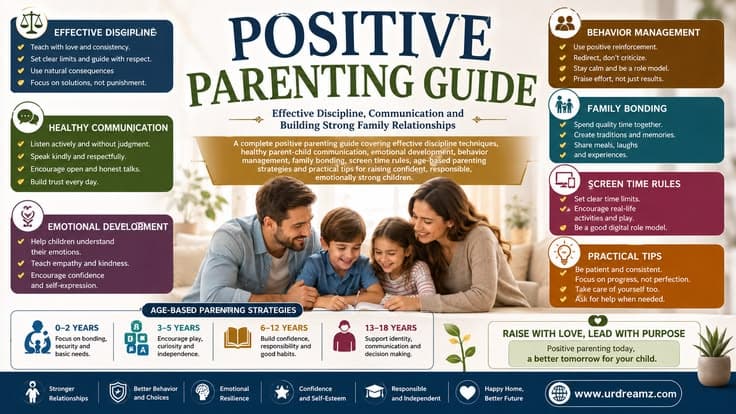
Positive Parenting Guide: Effective Discipline, Communication and Building Strong Family Relationships
Parenting is the most important job most people will ever do, yet it is the one role that comes with no formal training, no instruction manual, and very little ongoing support. Every parent is doing their best with the knowledge and tools they have, but often those tools were inherited from their own upbringing without questioning whether they are the most effective approaches available. Positive parenting is not a set of permissive rules that lets children do whatever they want, nor is it a magical system that eliminates all behavioral challenges. It is a research-backed framework for building the kind of parent-child relationship that raises children who are confident, emotionally strong, responsible, and genuinely kind, while making the daily experience of parenting more rewarding and less exhausting for parents themselves. This comprehensive guide covers every dimension of positive parenting from the foundational principles through to practical strategies for discipline, communication, emotional development, family bonding, screen time management, and age-specific parenting challenges.
1. What Is Positive Parenting and Why It Works
Positive parenting is an approach to raising children that prioritizes building a strong, trusting relationship between parent and child as the foundation from which all guidance, teaching, and discipline flows. Rather than relying on fear, punishment, or control to manage behavior, positive parenting works by establishing genuine connection, clear and consistent expectations, and a home environment where children feel safe, valued, and understood enough to cooperate, learn, and grow.
The research base supporting positive parenting is substantial and spans several decades of developmental psychology, neuroscience, and family studies. Children raised with positive parenting approaches demonstrate stronger emotional regulation, higher academic achievement, better social skills, more positive peer relationships, and significantly lower rates of anxiety, depression, and behavioral problems compared to children raised with authoritarian or permissive approaches. Importantly, the benefits extend into adulthood. Adults who describe their childhood as warm, supportive, and structured show better mental health outcomes, more stable relationships, and higher life satisfaction.
Positive parenting works because it aligns with how the human brain actually develops. The developing brain responds to chronic fear and punishment by activating the stress response system and shutting down the prefrontal cortex, which is precisely the part of the brain responsible for learning, reasoning, and impulse control. When a child is frightened or shamed, they literally cannot access the cognitive resources needed to understand and internalize the lesson being taught. Positive parenting, by contrast, keeps the child's stress system calm enough for the prefrontal cortex to remain engaged, creating the neurological conditions under which genuine learning and behavior change actually occur.
| Factor | Punishment-Based Parenting | Positive Parenting |
|---|---|---|
| Brain State During Correction | Stress response activated. Prefrontal cortex (learning center) shuts down. Child cannot absorb lesson | Child remains calm enough for prefrontal cortex to stay engaged. Genuine learning occurs |
| Child's Motivation for Good Behavior | Fear of punishment. Behavior is good only when threat is present | Internalized values and desire to maintain connection. Behavior is good even without supervision |
| Parent-Child Relationship | Trust erodes over time. Child becomes secretive to avoid punishment | Trust deepens over time. Child is more likely to come to parent with problems |
| Child's Self-Concept | Shame and inadequacy from repeated punishment. Child feels bad about who they are | Mistakes are learning opportunities. Child learns from behavior without feeling bad about their core self |
| Long-Term Outcomes | Higher rates of anxiety, depression, defiance in adolescence, and relationship difficulties in adulthood | Better emotional regulation, higher self-esteem, stronger relationships, and better mental health outcomes |
2. The Five Principles of Positive Parenting
| Principle | What It Means | In Practice |
|---|---|---|
| 1. Connection First | The parent-child relationship is the most powerful tool available. Children cooperate with, listen to, and are influenced by the adults they feel genuinely connected to. Connection must come before correction | Spend dedicated one-on-one time with each child daily even if only 10 to 15 minutes. Make eye contact. Get on their level physically. Show genuine interest in what matters to them |
| 2. Respect Goes Both Ways | Children deserve the same basic respect as adults. How we speak to children, how we respond to their emotions, and how we handle disagreements all teach them how people in relationships treat each other | Speak to children the way you would speak to someone you respect. Avoid shaming, yelling, and dismissing their feelings. Model the respect you want them to show others |
| 3. Behavior Is Communication | Children behave in challenging ways because they have an unmet need, an undeveloped skill, or an emotional experience they cannot yet express in words. The behavior is the message, not the problem | When challenging behavior occurs, ask yourself what need or feeling is driving it rather than immediately responding to the surface behavior. Address the underlying cause |
| 4. Consistency Creates Safety | Children need predictable, consistent responses from caregivers to feel safe. Inconsistency (rules that apply sometimes but not others, unpredictable emotional responses) creates anxiety and behavioral dysregulation | Establish clear family expectations and follow through consistently. Be predictable in your emotional responses. Children should be able to accurately predict what will happen when they behave in certain ways |
| 5. Teaching Over Punishing | The goal of parenting is to teach children the skills, values, and emotional capacities they need to function well in the world. Punishment temporarily stops unwanted behavior but does not teach what to do instead | When children make mistakes or behave poorly, focus on what they need to learn rather than what consequence they deserve. Ask how you can help them do better next time |
3. Positive Parenting vs Traditional Parenting vs Gentle Parenting
| Dimension | Traditional or Authoritarian Parenting | Gentle Parenting | Positive Parenting | Permissive Parenting |
|---|---|---|---|---|
| Core Philosophy | Obedience and respect for authority through discipline and control | Following the child's lead with empathy and emotional validation as primary tools | Balancing warmth and connection with clear structure and consistent boundaries | Minimal rules, child leads all decisions, conflict avoided |
| Discipline Approach | Punishment including spanking, time-outs used punitively, privilege removal | Empathetic redirection, natural consequences, no punishment at all | Natural and logical consequences, problem-solving together, teaching over punishing | Little to no discipline. Behavior goes uncorrected to avoid conflict |
| Emotional Expression | Emotions often minimized or dismissed. "Stop crying," "You're fine" | All emotions welcomed and explored at length | All emotions are valid. Emotional expression is supported while behavior is guided | All emotions accepted with no guidance on how to manage or express them |
| Structure and Boundaries | High structure with rigid rules. Little explanation given | Variable. Some gentle parents have very few rules | Clear consistent boundaries explained with reasoning appropriate to child's age | Very few or no firm rules or boundaries |
| Research Outcomes | Higher compliance in childhood but higher rates of rebellion in adolescence, lower self-esteem, and higher anxiety | Strong emotional attunement but some research suggests insufficient structure can increase anxiety in children who need predictability | Strong overall outcomes. Higher self-esteem, better emotional regulation, stronger academic performance, lower rates of behavioral problems | Poor outcomes. Higher rates of behavioral problems, lower self-regulation, poor academic performance |
| Best Summary | Do what I say because I said so | I follow your emotional lead and we figure it out together | I set the container, you have freedom within it, and we do this together | You decide everything and I will not interfere |
4. Building Strong Parent-Child Communication
The quality of communication between parents and children is perhaps the single strongest predictor of how well children navigate every challenge they will face, from early peer relationships through teenage social complexity to adult relationship patterns. Children who have open, trusting communication with their parents are more likely to seek help when they need it, more likely to resist negative peer pressure, more likely to make better decisions when facing difficult situations, and more likely to maintain close family relationships through the often-turbulent teenage years.
Building strong communication is not primarily about having the right conversations at the right moments. It is about creating a daily relational environment in which open communication is the norm rather than the exception. This means being genuinely interested in your child's daily life not just the big milestones. It means responding to small disclosures with curiosity rather than immediate advice or judgment. It means making your home a place where your child learns through experience that sharing their thoughts, feelings, and mistakes with you is safe and worthwhile.
| Strategy | What to Do | What to Avoid |
|---|---|---|
| Be available and present | Put your phone down during conversations with your child. Make eye contact. Get physically at their level for younger children. Show with your body that they have your full attention | Half-listening while scrolling. Responding without looking up. Multitasking during important conversations |
| Ask open-ended questions | Ask questions that cannot be answered with yes or no. "What was the best part of your day?" "How did that make you feel?" "What do you think about that?" | "Did you have a good day?" produces a one-word response and closes conversation. Closed questions signal you want quick closure not genuine sharing |
| Respond to feelings before facts | When your child shares something upsetting, acknowledge the emotion first before moving to problem-solving. "That sounds really frustrating" before "Have you tried..." | Jumping immediately to advice or solutions before acknowledging the child's emotional experience. This signals their feelings are less important than solving the problem |
| Share appropriate things about yourself | Tell your child age-appropriate things about your own day, feelings, and experiences. Reciprocal sharing models that communication goes both ways and normalizes talking about feelings | Using your child as an emotional support for your own adult problems. There is an appropriate limit to parental self-disclosure with children |
| Choose the right moment | Many children open up more during side-by-side activities (car rides, cooking together, bedtime) than in face-to-face conversations which can feel like interrogation | Demanding conversation at moments your child is emotionally unavailable, distracted, or immediately after conflict when they are not yet regulated |
5. Active Listening: The Most Powerful Parenting Skill
Active listening is the practice of giving your complete attention to your child, seeking genuinely to understand what they are communicating including the emotional content behind the words, and demonstrating that understanding through your responses. It sounds simple but is genuinely difficult to practice consistently, particularly when what your child is saying creates worry, frustration, or the strong parental impulse to fix things immediately.
Active listening with children requires suppressing the urge to reassure too quickly, to minimize concerns, to provide immediate advice, or to share your own similar experience before the child feels fully heard. The single most powerful thing you can do when your child is sharing something difficult is to be genuinely present and curious about their experience rather than rushing to move past it.
| Skill | How to Practice It | Example |
|---|---|---|
| Reflect back what you hear | Paraphrase what your child has told you in your own words to confirm you understood correctly | "So it sounds like you felt left out when your friends didn't include you in the game. Is that right?" |
| Name the emotion you observe | Gently name the feeling you think your child is experiencing based on what they have shared and how they are expressing themselves | "You look really upset about this. You must be feeling really hurt." |
| Validate without agreeing | Acknowledge that your child's feelings are understandable given how they see the situation, even if you see it differently | "I can understand why you felt that was unfair from your perspective." |
| Ask questions to understand more | Show genuine curiosity about their experience rather than steering toward what you think the point is | "Tell me more about what happened. What was going on before that?" |
| Tolerate silence | After a reflection or question, pause and allow your child time to think and respond rather than filling the silence immediately | Pause for five to ten seconds after asking a meaningful question before speaking again |
| Ask before giving advice | Before offering solutions or advice, ask whether your child wants help thinking through options or whether they just needed to express their feelings and feel heard | "Would you like me to help you think of ways to handle this, or did you mainly need to tell someone about it?" |
6. How to Build Trust with Your Child
Trust between a parent and child is not an event. It is a pattern that is built or eroded through thousands of small interactions over time. Children trust parents who are reliably emotionally available, who follow through on their word, who respond to disclosures without overreacting, who acknowledge their own mistakes, and who make their child feel consistently loved regardless of their behavior. This trust is the foundation that makes every other aspect of positive parenting work.
| Trust-Building Action | How to Do It | Why It Matters |
|---|---|---|
| Keep your promises | Only make promises you can keep. If you say you will do something, do it. If you cannot follow through, explain honestly and apologize | Reliability is the foundation of trust. Children who cannot trust their parents to keep promises begin to distrust other relationships too |
| Respond without overreacting to disclosures | When your child tells you something concerning, regulate your own response before reacting. Stay calm. Thank them for telling you. Ask questions before drawing conclusions | If a child experiences your reaction to a disclosure as scary or unpredictable, they will stop disclosing to protect themselves and you |
| Acknowledge and repair mistakes | When you lose your temper, misunderstand your child, or handle something poorly, go back and acknowledge it honestly. "I was too hard on you earlier. I was stressed and I took it out on you. I'm sorry." | Repair after rupture is one of the most powerful trust-building experiences available. It models accountability and shows children that relationships survive imperfection |
| Keep appropriate confidences | When your child asks you not to share something with other family members, honor that unless safety requires otherwise. Explain clearly in the rare cases where you must share | Children who feel their disclosures will be immediately shared with others stop sharing |
| Show up consistently | Be present and emotionally available in the ordinary moments of your child's life, not just for big events. Notice when they seem worried or sad and gently check in | Trust is built in everyday moments not just significant ones. A parent who is reliably attentive in small ways is trusted to be there when it really matters |
7. Talking to Children About Difficult Topics
One of the most anxiety-inducing aspects of parenting is navigating conversations about topics that feel too heavy, too complex, or too uncomfortable for children. Yet research consistently shows that children who receive age-appropriate, honest information from trusted adults at home are far better equipped to navigate difficult realities than children who are protected from all discussion and encounter these topics from peers, media, or the internet without any parental guidance.
The principles for navigating difficult conversations with children are consistent across topics. Use simple, truthful, age-appropriate language and let the child's questions guide how much detail to provide. Ask before explaining to find out what they already know or think. Normalize asking questions and make clear there are no topics they cannot bring to you. Follow their emotional lead and stop when they signal they have had enough for now. Return to the topic in subsequent conversations as they process and develop new questions.
8. Positive Discipline: Discipline Without Punishment
Positive discipline is perhaps the most misunderstood aspect of positive parenting. Many parents assume it means no discipline at all, or that children simply get to do whatever they want. In reality, positive discipline is a more demanding and thoughtful approach than punishment precisely because it requires the parent to teach rather than simply react. It maintains firm, consistent limits while using methods that actually teach children what they need to know rather than simply stopping behavior through fear.
The goal of positive discipline is to develop inner discipline in the child: the capacity to regulate their own behavior based on internalized values rather than external surveillance and threat of punishment. Children who behave well because they fear punishment only behave well when they might get caught. Children who develop inner discipline through positive discipline continue to make good choices even when no one is watching, which is ultimately the only kind of good behavior that matters in adulthood.
| Technique | How to Use It | Best For |
|---|---|---|
| Natural Consequences | Allow the natural result of the child's choice to be the teacher wherever it is safe to do so. Do not rescue the child from the consequence of their own decision | Situations where the natural consequence is clear, safe, and directly related to the behavior. Child leaves coat at home and is cold at school |
| Logical Consequences | When natural consequences are not available or appropriate, create a consequence that is logically connected to the behavior and explained in advance | Behavior that does not have a clear natural consequence. Child leaves toys out after being asked repeatedly so toys are put away for a day |
| Problem-Solving Together | After everyone is calm, sit down with the child and together identify what went wrong, why, and what can be done differently next time | Repeated behavioral patterns that need a plan for change. Works well for children ages 4 and above who can engage in conversation |
| Natural Redirection | For younger children, redirecting attention to an acceptable alternative rather than simply saying no or stopping behavior | Toddlers and preschoolers whose behavior is driven by exploration and natural developmental impulses rather than defiance |
| Positive Reinforcement | Specifically acknowledge and describe the behavior you want to see more of when you see it. "I noticed you shared your toy with your sister when she asked. That was really kind." | Building new positive behaviors and encouraging emerging skills in all ages. Be specific rather than generic in your praise |
| Connection before Correction | Before addressing the behavior, reconnect with the child briefly. Get at their level, make eye contact, perhaps a gentle hand on the shoulder. Then address behavior | Any situation where the child is emotionally escalated or the parent-child connection feels strained |
| Taking a break together | Rather than punitive time-out (which involves isolation as punishment), suggest a calm-down space both parent and child can use to regulate before addressing the situation | Moments of high emotional intensity where neither parent nor child can communicate productively |
9. Natural Consequences vs Logical Consequences
| Type | Definition | Example | When to Use | When NOT to Use |
|---|---|---|---|---|
| Natural Consequences | What happens automatically as a direct result of the child's behavior without any parental intervention | Child refuses to eat dinner. The natural consequence is that they are hungry later. Child does not do homework. The natural consequence is a poor grade | When the consequence is safe, not humiliating, and directly related to the behavior. And when the parent can allow it to occur without rescuing the child | When the natural consequence is dangerous (child runs toward traffic). When it affects someone else negatively. When the learning would come too late or the consequence is too severe |
| Logical Consequences | Consequences created by the parent that are logically connected to the child's behavior and ideally discussed in advance as part of family agreements | Child uses screen time beyond the agreed limit. Logical consequence is reduced screen time the next day. Child breaks a toy carelessly. Logical consequence is using their own money toward a replacement | When natural consequences are not available, appropriate, or safe. When the behavior affects others. When the connection between behavior and consequence needs to be taught | When they are disguised punishments with no real logical connection to the behavior. When they are delivered in anger. When they are disproportionate to the behavior |
The key test for a logical consequence is whether a child can understand why the consequence follows from their behavior when it is calmly explained. "You left your bike in the rain so it got rusty. You will need to use your savings to help pay for fixing it" has a clear logical connection. "You left your bike in the rain so you cannot watch TV tonight" is a punishment that happens to be called a consequence but has no logical relationship to the behavior.
10. Setting Healthy Boundaries with Children
Boundaries in positive parenting are not rules imposed through force but clear, consistent expectations that are explained, modeled, and enforced through natural consequences and calm follow-through rather than punishment. Children actually feel safer and more secure when they have clear boundaries because predictability is one of the primary sources of psychological security in childhood.
| Principle | How to Apply It |
|---|---|
| Be clear and specific | Boundaries need to be stated in concrete, observable terms. "Be nice to your sister" is too vague. "We do not hit, push, or name-call" is specific and enforceable |
| Explain the reason | Give children age-appropriate reasons for your rules. "We don't run near the pool because the wet tiles can make you slip and hurt yourself" teaches the principle behind the rule |
| Be consistent | Boundaries only work when they are consistently maintained. A rule that applies sometimes but not others creates confusion and boundary-testing behavior |
| Follow through calmly | When a boundary is crossed, respond with calm, quiet follow-through rather than escalating emotion. The calmer your response, the more effective it is |
| Revisit rules as children grow | Boundaries that made sense for a five-year-old may be developmentally inappropriate for a ten-year-old. Regularly review family expectations with growing children and involve them in updating rules appropriately |
| Model the boundaries yourself | Children learn far more from what they observe than from what they are told. If you want your child to speak respectfully, they need to hear respectful speech between adults |
11. How to Respond to Tantrums Positively
Tantrums are one of the most universally challenging parenting experiences, and they are also one of the most misunderstood. A tantrum is not a manipulative performance designed to embarrass parents or control situations. It is an involuntary emotional meltdown that occurs because the child's emotional experience has exceeded their current capacity to regulate it. Young children literally do not yet have the brain development necessary to manage intense emotions without external support.
| DO This | NOT This |
|---|---|
| Stay calm and respond with confidence. Your regulated nervous system co-regulates your child. When you stay calm, it helps their nervous system settle | Do not overreact or yell. Parental escalation intensifies the tantrum. Two dysregulated nervous systems cannot help each other |
| Stay close and be emotionally available even if you say little. Presence communicates safety | Do not walk away, ignore, or isolate the child during the meltdown. Abandonment during distress increases fear and intensity |
| Encourage all feelings. "I can see you're really upset. That's okay. I'm here." | Do not shame the child for having big feelings. "Big kids don't cry" teaches children that emotions are shameful |
| Remember that behavior is communication. Ask yourself what need or overwhelm is driving this | Do not guilt the child or use the tantrum against them in future conversations |
| Respond in the moment and move on afterward. Brief, calm acknowledgment when the storm passes | Do not lecture, process, or discuss extensively immediately after. The child's brain is not yet able to absorb lessons in a flooded state |
| Problem-solve afterward when everyone is calm. Work on the skill that broke down | Do not punish the tantrum itself. The tantrum is a symptom of an undeveloped skill, not a character failure |
12. Twenty-Two Alternatives to Saying No to Children
This does not mean never saying no. Firm, clear limits are essential in positive parenting. However, reflexive overuse of no often triggers automatic oppositional responses in children and shuts down communication and cooperation. These alternatives communicate the same limit while maintaining connection and providing reasoning that children can internalize.
| # | Instead of No, Try This | Why It Works Better |
|---|---|---|
| 1 | "Maybe you can do that some other time." | Acknowledges the desire and postpones rather than flat refusal |
| 2 | "You know better than to do that." | Appeals to the child's sense of self and existing knowledge rather than external control |
| 3 | "Let's stop and think about this together." | Invites collaborative problem-solving and models reflective thinking |
| 4 | "Tell me why this is important to you." | Shows respect for the child's perspective and may reveal information that changes your response |
| 5 | "That's not what we had talked about doing." | Refers back to prior agreements and consistency without a confrontational refusal |
| 6 | "I need you to come away from there right now." | Clear, direct redirection with no confrontational no |
| 7 | "Let's try doing something else instead." | Offers an alternative and keeps the interaction positive and forward-moving |
| 8 | "Here, let me show you how to do it a different way." | Teaches rather than just stops behavior |
| 9 | "This is not a good idea. Can you tell me why?" | Engages the child's reasoning and teaches them to evaluate their own decisions |
| 10 | "I know you want to, but it is not a good time right now." | Validates the desire while clearly setting a time limit |
| 11 | "I agree it would be fun, but we cannot do it because..." | Acknowledges your child's perspective as valid before giving a reason |
| 12 | "Is there a different way you could go about doing that?" | Invites the child to problem-solve and find acceptable alternatives themselves |
| 13 | "That is not in our budget right now." | Honest, specific reason that teaches financial reality without a dismissive no |
| 14 | "We do not have time for this right now. Let's plan it for another day." | Clear time limit with a positive future commitment |
| 15 | "What you are doing is hurting. You need to stop." | Names the impact clearly without a confrontational refusal |
| 16 | "Yes, that is one answer. Try again for a better one." | Maintains limits while keeping the problem-solving interaction open |
| 17 | "If you want to buy that, you can use your allowance." | Teaches financial independence and responsibility rather than parental refusal |
| 18 | "We cannot stay longer. We talked about this." | Refers back to prior agreement and keeps the limit consistent |
| 19 | "I am disappointed to see you doing that." | Expresses your feeling and the standard expected rather than a confrontational stop command |
| 20 | "This is not helpful. I would like you to stop." | Direct, clear, and respectful without escalation |
| 21 | "Tell me what our family rule is about this." | Invites the child to recall and apply the rule themselves rather than imposing it |
| 22 | "I know you want to do that but it is too dangerous." | Acknowledges the desire, gives an honest reason, and keeps the limit firm |
13. Teaching Responsibility to Children
| Age Group | Responsibility Tasks | How to Teach |
|---|---|---|
| Toddlers 2 to 3 years | Putting toys back in their container, putting dirty clothes in the laundry basket, bringing their plate to the sink | Make it a game. Do it alongside them. Celebrate enthusiastically when they complete it |
| Preschoolers 3 to 5 years | Dressing themselves, making their bed simply, helping set the table, feeding a pet with supervision, picking up their play area | Teach the skill in stages. Provide simple visual reminders. Focus on effort not perfection |
| School Age 6 to 9 years | Making their own breakfast or lunch, doing laundry with guidance, taking care of a pet, completing homework independently, helping with grocery shopping | Give them real responsibility not just tasks under constant supervision. Allow natural consequences when they forget |
| Older Children 10 to 12 years | Cooking simple meals, babysitting younger siblings for short periods, managing their own homework schedule, budgeting a small allowance, doing their own laundry | Step back and let them manage. Be available to consult but do not over-supervise |
| Teenagers 13 to 18 years | Contributing to household finances by managing their expenses within a set budget, planning and cooking family meals, managing their academic schedule, part-time work | Treat them as capable young adults. Consult them on family decisions that affect them |
14. Child Emotional Development Guide
| Age | Emotional Development | How Parents Can Support |
|---|---|---|
| Birth to 1 year | Develops basic emotional communication through crying, facial expressions, and body language. Begins to distinguish familiar from unfamiliar faces. Attachment forms with primary caregivers | Respond consistently and sensitively to the baby's signals. Build secure attachment through predictable, warm caregiving |
| 1 to 3 years | Experiences intense emotions but has almost no capacity to regulate them. Tantrums are developmentally normal. Begins to name some emotions. Parallel play rather than cooperative play | Co-regulate by staying calm. Name emotions for them. "You seem frustrated." Do not punish emotional expression |
| 3 to 5 years | Beginning to understand that others have feelings. Can identify basic emotions in self and others. Still has significant difficulty managing big feelings. Imagination and fantasy rich | Use books and stories to explore emotions. Practice emotion vocabulary. Role-play how to handle social situations |
| 6 to 8 years | Developing capacity for empathy. Can understand that multiple emotions can occur simultaneously. Increasingly able to use words to express feelings. Peer relationships become important | Discuss emotions in real situations. Help them think through social conflicts. Model healthy conflict resolution |
| 9 to 12 years | More complex emotional understanding. Can hide feelings from others. Peer approval becomes very important. Beginning to think about their own emotional patterns | Maintain open communication. Avoid dismissing their concerns as unimportant. Take their emotional experiences seriously |
| 13 to 18 years | Intense emotional experiences combined with reduced emotional regulation capacity due to brain changes. Identity development. Increasingly turns to peers over parents | Stay connected without controlling. Listen without lecturing. Be available consistently. Pick your battles carefully |
15. Building Emotional Intelligence in Children
Emotional intelligence, the ability to recognize, understand, and manage one's own emotions while accurately reading and responding to others' emotions, is one of the strongest predictors of adult success and wellbeing across every domain including relationships, career, and physical health. The good news is that emotional intelligence is not a fixed trait that children either have or do not have. It is a set of skills that can be actively taught and developed throughout childhood.
| Activity | Age Range | How to Do It | Skill Developed |
|---|---|---|---|
| Emotion vocabulary building | All ages starting from 2 | Name emotions throughout the day as they naturally arise. Use a feeling chart with faces. Read books that explore emotional experiences | Emotional awareness and vocabulary. Children cannot manage what they cannot name |
| Feelings check-in | Ages 4 and above | A brief daily family ritual where everyone shares one feeling word about their day. At dinner, bedtime, or during a car ride | Regular emotional self-reflection and normalizing sharing feelings as part of daily life |
| Emotion detective | Ages 4 to 10 | When reading books or watching family-appropriate films, pause and ask "What do you think that character is feeling right now? How can you tell?" | Reading emotional cues in others. Empathy development |
| Calm-down strategies practice | Ages 3 to 12 | Teach and regularly practice specific strategies: deep breathing, counting slowly, body scan, movement breaks. Practice when calm so they are available when upset | Emotional regulation. Ability to manage overwhelming feelings without harmful behavior |
| Problem-solving together | Ages 5 and above | When a conflict or challenge arises and the emotional temperature has settled, work through it together: What happened? How did everyone feel? What are all the possible ways we could handle this? | Social problem-solving and consideration of others' perspectives |
| Gratitude practice | Ages 4 and above | Daily practice of naming one to three things they are grateful for. Can be at dinner, bedtime, or in a gratitude journal for older children | Positive emotional orientation. Research shows gratitude practice increases wellbeing and reduces anxiety |
16. Building Confidence and Self-Esteem in Children
Genuine confidence in children does not come from being told they are wonderful or from protecting them from all failure. It comes from the accumulating experience of facing challenges, making effort, developing skills, and discovering that they can handle difficulties and recover from setbacks. Parents who over-protect children from struggle, who do for children what children could do for themselves, and who rely excessively on praise actually undermine the confidence development they are trying to support.
| Builds Real Confidence | Creates False Confidence or Undermines Confidence |
|---|---|
| Allowing children to struggle with age-appropriate challenges and supporting without rescuing | Completing tasks for children to protect them from frustration |
| Specific, descriptive praise of effort and process: "You kept trying even when it was hard. I noticed that." | Empty global praise: "You are so smart" or "You are amazing" which children do not believe because it does not match reality |
| Giving children real responsibilities and letting them succeed through genuine effort | Doing everything for children to ensure perfect outcomes |
| Treating mistakes as information and learning rather than failures | Expressions of disappointment, frustration, or criticism when children make normal mistakes |
| Expressing genuine pride in specific observations: "I loved watching you figure that out." | Competitive comparisons: "Why can't you be more like your sister?" |
| Asking for the child's opinions and taking their perspective seriously in family decisions | Dismissing a child's views as unimportant or not yet valid |
17. Teaching Resilience to Children
Resilience is the capacity to adapt well in the face of adversity, setback, failure, or significant stress. It is not an innate quality that some children have and others lack. It is developed through the experience of facing and navigating challenges while having the support of a caring, stable adult relationship as the anchor. Research by developmental psychologist Ann Masten found that the single most consistent predictor of childhood resilience across every type of adversity studied was having at least one stable, caring relationship with a competent adult.
Parents support resilience development not by protecting children from all difficulty but by being a reliable secure base to which children can return after encountering difficulty. When a child falls, scrapes their knee, and looks to their parent and sees calm concern rather than panic, they learn that the injury is manageable and that they are capable of handling it. When they fail a test and instead of anger they encounter a parent asking "What do you think happened and what could you do differently?" they learn that failure is information rather than catastrophe.
18. Thirty-Seven Positive Things to Say to Your Child Every Day
The words parents use with children become part of the internal narrative those children carry with them for the rest of their lives. Research on self-talk and inner dialogue shows that the voices of significant caregivers literally become internalized as the critical or encouraging inner voice that motivates or undermines the adult. What you say to your child today may still be influencing how they speak to themselves thirty years from now.
| Category | What to Say |
|---|---|
| Capability and Strength (7 phrases) | "You can achieve anything you set your mind to." "I believe in your abilities." "You are capable and strong." "You can overcome any challenge." "You have everything you need to succeed." "You are an important part of our family." "You are worthy of love and respect." |
| Unconditional Love (6 phrases) | "I love you just the way you are." "You are perfect exactly as you are." "You deserve to feel proud of yourself." "No one can take away your unique talents and gifts." "I'm always here for you, no matter what." "You are so loved, by me and by our whole family." |
| Kindness and Compassion (7 phrases) | "Your kindness makes the world a better place." "I'm proud of how you treat others with respect." "You have the power to make others feel good with your words and actions." "Being kind to yourself is as important as being kind to others." "Helping others is one of your superpowers." "Compassion makes you strong, not weak." "You have a big heart and a beautiful mind." |
| Emotional Safety (6 phrases) | "It's okay to feel every emotion you have." "I'm here to listen whenever you need me." "Crying doesn't make you weak. It shows you're strong enough to feel." "Taking deep breaths can help you feel calmer." "You're brave for sharing your feelings with me." "You have the strength to overcome sadness and tough days." |
| Growth and Learning (6 phrases) | "Learning new things can be fun, even if it's hard." "Every time you try, you're growing." "Mistakes help you learn. They're part of growing up." "You're always learning, and I'm so proud of that." "It's okay if you don't get it right the first time." "You're a lifelong learner, and that's amazing." |
| Mistakes Are Okay (5 phrases) | "It's okay to make mistakes. That's how we learn." "Don't be afraid to try new things. I'm here to support you." "I'm proud of how you handled that difficult situation." "You're doing your best and that's all anyone can ask." "What can we learn from this for next time?" |
19. What NOT to Teach Children: Ten Lessons That Hurt
| # | Do NOT Teach This | Teach This Instead |
|---|---|---|
| 1 | Fear of mistakes. When children fear errors, they stop taking the risks necessary for learning and growth | Confidence. Mistakes are data that help you improve. They mean you are trying. Brave people make mistakes |
| 2 | Comparison with others. Constantly comparing children to siblings or peers undermines self-worth and breeds resentment | Kindness. Your progress compared to yourself is what matters. Everyone is on their own journey |
| 3 | Yelling as a way to solve problems. Children who grow up with yelling as conflict resolution tool use it themselves | Problem-solving. Calm conversations resolve conflicts better than raised voices. Use words not volume |
| 4 | Hiding emotions. Teaching children that feelings should be suppressed creates adults with poor emotional regulation | Respect. All emotions are valid. The question is how we express and manage them, not whether we feel them |
| 5 | Gender restrictions on emotion. "Boys don't cry" and "Girls can't do that" limit human potential and create shame | Patience. Every person regardless of gender deserves the right to feel their emotions and pursue their interests |
| 6 | Always pleasing everyone. Children who learn that their worth depends on others' approval develop anxiety and people-pleasing patterns that harm them in adulthood | Responsibility. You are responsible for your own behavior and wellbeing, not for making everyone happy |
| 7 | Excessive screen dependence for entertainment. Children who learn to rely on screens for all stimulation struggle with boredom tolerance, creativity, and self-directed activity | Emotional expression. Creative play, outdoor time, and human connection are more nourishing than screens |
| 8 | Disrespect toward helpers, elders, or animals. Children who are not taught respectful treatment of all beings develop an attitude of entitlement that damages relationships | Gratitude. Every person deserves respect regardless of their role or status. Appreciate those who help you |
| 9 | Using food as an emotional reward or comfort tool. "You did well, let's get ice cream" creates associations between food and emotional validation that can lead to eating difficulties | Responsibility. We eat because our bodies need fuel. Celebration happens through experiences and connection, not food rewards |
| 10 | Success matters more than kindness. A child who is taught to value achievement over character becomes an adult who has succeeded but cannot sustain healthy relationships | All of the above. Raise kind kids. Build a better world. Teach love, not fear. Teach values, not victory |
20. Family Bonding Activities That Strengthen Relationships
| Category | Activity Ideas | Why It Builds Connection |
|---|---|---|
| Daily Rituals | Family dinner together without screens, bedtime stories and conversations, good morning and goodnight hugs, a brief daily check-in question | Consistent small rituals create the reliable sense of togetherness that children draw on as secure base |
| Weekend Activities | Hiking or nature walks, cooking a new recipe together, family game nights, visiting a new place, gardening, home projects that involve children | Shared experiences and memories become the fabric of family identity that children carry through life |
| Creative Activities | Family art projects, building things together, music and singing, storytelling, creating a family cookbook, making a photo album together | Collaborative creativity requires communication and cooperation that strengthens connection |
| Service Together | Volunteering as a family, helping a neighbor, contributing to a community project, random acts of kindness planned together | Shared values expressed in action create a family identity and build children's sense of purpose and contribution |
| Traditions | Weekly family movie night, annual family trip, birthday traditions unique to your family, holiday rituals that belong specifically to your family | Traditions give children a predictable, beloved structure that provides deep security and lifelong positive memories |
| One-on-One Time | Each child gets individual time with each parent regularly. Even 15 to 20 minutes of focused attention weekly makes a significant difference | Individual attention communicates to each child that they are uniquely seen and valued, not just one member of the group |
21. Creating Healthy Family Routines
Routines are the scaffolding of family life. Children who live within predictable daily routines show lower anxiety, better behavior, stronger academic performance, and more positive relationships with parents compared to children in households without consistent structure. This is because routines reduce the cognitive and emotional load on children by making the expected sequence of daily events predictable without requiring constant decision-making or negotiation.
| Routine | Key Elements | Tips for Making It Stick |
|---|---|---|
| Morning Routine | Wake at consistent time, personal hygiene, breakfast together, check bags and homework, positive send-off | Prepare as much as possible the night before. Create a simple visual checklist for children to manage independently |
| After School Routine | Snack and brief connection time, homework period, physical activity or outdoor time, screen time within limits | Provide the after-school snack and connection time first before homework. Children need to decompress before they can focus |
| Dinner Time | Family meal together, screens away, take turns sharing about the day, meaningful conversation, everyone helps clear up | Even 20 minutes of shared family dinner provides significant benefits. Quality of connection matters more than elaborate meals |
| Evening Routine | Homework completion check, personal hygiene, wind-down without screens, reading, bedtime conversation and connection, consistent bedtime | Screen-free hour before bed dramatically improves sleep quality for all ages including parents |
| Weekend Routine | Some structure maintained even at weekends. Regular family time, physical activity, some unstructured play, family responsibilities | Complete absence of structure at weekends can be disorienting for children who rely on predictability for security |
22. Screen Time Management for Children
| Age Group | Recommended Limit | Content Guidelines | What to Do Instead |
|---|---|---|---|
| Under 18 months | No screens except video calling with family members | No content. The developing infant brain needs human interaction, not screen stimulation | Talking, reading, playing, outdoor time, sensory exploration, human connection |
| 18 to 24 months | If any, only high-quality programming watched with a parent who explains what is being seen | Educational content only. Parent present to support comprehension | Play-based learning, reading together, music, movement |
| 2 to 5 years | Maximum 1 hour per day of high-quality content | Age-appropriate educational or creative content. No violent, frightening, or commercial-heavy content | Creative play, outdoor play, reading, art, music, physical activity, social play |
| 6 to 12 years | 2 hours maximum recreational screen time daily. Educational use is additional | Know what your child watches and plays. Co-view regularly. Discuss content and values | Sports, hobbies, reading, family activities, creative play, outdoor exploration, socializing |
| Teenagers 13 to 18 years | No specific hour limit but screens should not displace sleep, physical activity, homework, or face-to-face socializing | Maintain family tech agreements. Discuss social media use and online safety regularly | Maintain agreed no-screen zones: bedrooms at night, mealtimes, family activities |
Family technology rules work best when developed collaboratively rather than imposed. Sitting down with children old enough to contribute and creating a family technology agreement together dramatically increases buy-in and compliance compared to rules dictated from above. Include screen-free zones (bedroom at night, mealtimes), screen-free times, content expectations, and what to do before screens go on (homework done, outdoor time completed, chores done).
23. Internet Safety and Cyber Safety for Kids
| Risk Area | How to Protect Your Child | What to Teach Your Child |
|---|---|---|
| Inappropriate Content | Use parental controls on devices and routers. Keep devices in common areas. Regularly check browsing history for younger children | Teach children to close content that makes them uncomfortable and come tell a parent immediately without fear of getting in trouble |
| Online Strangers | Monitor who children communicate with online. Know their online friends. Check social media contacts regularly | Never share personal information with online strangers. Never agree to meet someone met online without parent knowledge and presence |
| Cyberbullying | Maintain open communication so children feel safe reporting. Check social media for concerning interactions | Save evidence of bullying. Do not respond to the bully. Report to a trusted adult immediately. Blocking is always acceptable |
| Privacy and Personal Information | Review privacy settings on all platforms your child uses. Teach before accounts are created | Full name, address, school name, phone number, and location are private information never shared online |
| Screen Addiction | Monitor emotional responses when screens are limited. Ensure adequate offline activities, sleep, and social connection | Screens should add to life not replace it. Regular breaks, physical activity, and face-to-face connection are non-negotiable |
24. Age-Based Parenting Guide
One of the most common sources of parenting frustration is applying the same expectations, communication style, and responses across all ages. A parenting approach that works beautifully for a seven-year-old will fall completely flat with a fourteen-year-old, and a strategy that effectively guides a toddler is developmentally inappropriate for an eight-year-old. Understanding how parenting needs to evolve as children grow is essential for maintaining connection and effectiveness across the entire childhood journey.
25. Parenting Toddlers Ages 1 to 3
Toddlerhood is one of the most physically and emotionally demanding parenting stages. The toddler's developmental agenda centers on two contradictory drives: an intense desire for autonomy and independence combined with a still-strong need for the security of parental proximity. This tension explains almost every behavioral characteristic of toddlerhood including the famous toddler no, the emotional explosions, the clingy moments that alternate with boundary-testing independence, and the extraordinary inconsistency in how cooperative or resistant a toddler is from moment to moment.
| Challenge | Positive Parenting Response |
|---|---|
| Frequent NO and resistance | Offer limited choices to satisfy autonomy need. "Do you want the red cup or the blue cup?" rather than open choices or commands. Choose your battles carefully. Many toddler refusals can simply be accommodated |
| Tantrums and emotional meltdowns | Stay calm and physically present. Resist the urge to lecture or fix during the meltdown. Simple empathy. "You're really upset. I'm here." Follow up when calm with connection, not consequences |
| Separation anxiety | Practice gradual separations. Create a consistent goodbye ritual and always follow through. Never sneak away. Reassure that you always come back |
| Hitting, biting, and aggression | Respond calmly and immediately. "I won't let you hit. Hitting hurts." Redirect to appropriate physical expression. Ensure child is not overtired or overstimulated which dramatically increases toddler aggression |
| Sleep resistance | Maintain a predictable, calming bedtime routine. Same order, same time every night. The routine itself becomes the sleep signal |
26. Parenting Preschoolers Ages 3 to 5
The preschool years bring wonderful cognitive and linguistic leaps that make connection easier while simultaneously introducing new parenting challenges. Preschoolers are becoming genuinely curious about the world and the people in it. Their questions about how things work, why people behave as they do, and what the rules of the world are reflect a rapid expansion of their understanding. They are also developing the capacity for imaginative play, which is both the primary vehicle of their learning and a source of tremendous joy at this age.
The primary positive parenting focus during preschool years is building the emotional vocabulary and regulation skills that will serve children well throughout their lives, continuing to use play as the primary teaching medium, and beginning to introduce age-appropriate responsibilities and the concept of natural consequences. Preschoolers can begin to understand simple explanations for family rules and are increasingly capable of participating in simple problem-solving conversations when they are calm.
27. Parenting School-Age Children Ages 6 to 12
The school years bring a rapid expansion of the child's world beyond the family. Peer relationships become increasingly central to their social development and their sense of self. Academic demands introduce new success and failure experiences. Extracurricular activities begin to reveal developing interests and talents. This period requires parents to gradually but consistently shift from manager to consultant as children develop greater capacity for independent decision-making and self-management.
| Area | Positive Parenting Approach |
|---|---|
| Homework and academics | Create a consistent homework routine. Be available for support but do not complete work for them. Praise effort and strategy rather than grades. Teach that struggle is part of learning |
| Peer relationships and conflict | Listen to friendship challenges without immediately offering solutions. Help them think through options. Role-play difficult conversations. Avoid dismissing their social concerns as trivial |
| Growing independence | Gradually increase independence in age-appropriate ways. Allow children to walk to school, stay home briefly alone, manage their own time with clear expectations |
| Screen time and gaming | Set clear limits collaboratively. Know their online world. Maintain family meal and activity times that are screen-free. Stay informed about games and platforms they use |
| Chores and responsibility | Assign meaningful household responsibilities that contribute to family functioning. These should be non-negotiable family contributions rather than jobs done only for payment |
28. Parenting Teenagers Ages 13 to 18
Parenting teenagers is the stage that most challenges the positive parenting parent because the teenager's developmental drive toward peer connection and independence from parents can feel like rejection. The teenager who once sought their parent's company now prefers friends. The child who accepted parental guidance now argues and pushes back. This is not pathology. It is the necessary developmental work of adolescence.
The most important shift in parenting teenagers is from authority to influence. You cannot control a teenager the way you could manage a younger child's behavior. Attempting to maintain control through force results in power struggles that damage the relationship without changing behavior. What remains powerful is influence, and parental influence is maintained through relationship quality, genuine respect for the teenager's growing autonomy, consistent availability without intrusiveness, and being genuinely interested in who they are becoming.
| Principle | What It Means in Practice |
|---|---|
| Stay connected without controlling | Maintain family rituals like dinner together. Show interest in their world without interrogating. Create low-pressure settings (driving, cooking together) where they talk more naturally |
| Pick battles very carefully | Decide which issues are genuinely important (safety, values, school) versus preference and expression (hair, music, fashion). Fighting over preferences costs the relationship without gaining compliance |
| Listen far more than you speak | When your teenager does share, respond with curiosity rather than immediate advice, judgment, or alarm. Your reaction to small disclosures determines whether bigger ones follow |
| Share your values, not your demands | Teenagers who feel their parents genuinely understand their world and share values through conversation rather than dictation are more influenced by those values in their actual decisions |
| Maintain firm limits on safety issues | Non-negotiable limits around substance use, unsafe sexual behavior, dangerous activities, and mental health crises should be maintained firmly and explained honestly |
| Acknowledge their growing maturity | Explicitly recognizing and responding to increasing maturity with increasing privilege and responsibility is one of the most powerful motivators of continued mature behavior in teenagers |
29. Raising Confident and Responsible Children
| Practice | How to Implement | What It Builds |
|---|---|---|
| Let them struggle appropriately | Resist the urge to immediately help when a child faces difficulty. Watch, wait, and let them try before offering support | Self-efficacy: the belief that they can handle challenges. The most important ingredient of genuine confidence |
| Give them real responsibilities | Assign household contributions that genuinely matter to the family's functioning. Children know the difference between busy work and real contributions | A sense of genuine competence and belonging that comes from making real contributions |
| Trust them with decisions | Within appropriate parameters, let children make real decisions and live with the consequences | Decision-making capacity and understanding of cause and effect |
| Express specific confidence in them | "I know you can figure this out." "I've watched you handle hard things before. I trust you on this one." | Children internalize the confidence their important adults express in them |
| Model accountability yourself | Acknowledge your own mistakes openly. Make repairs when you have treated someone poorly. Follow through on your own commitments | The understanding that responsibility means owning your actions, not being perfect |
30. Teaching Life Skills Every Child Needs
| Life Skill | When to Begin Teaching | How to Teach It |
|---|---|---|
| Basic cooking and food preparation | Ages 3 to 4 for simple tasks, full cooking by ages 10 to 12 | Include children in meal preparation from young ages with age-appropriate tasks. Gradually increase responsibility |
| Money management and budgeting | Ages 5 to 6 for basic concepts, allowance management from ages 7 to 8 | Give a regular small allowance with no strings attached. Let them make and learn from spending decisions |
| Household management skills | Laundry from ages 8 to 9, all household maintenance skills by early teenage years | Teach the complete skill, not just the task. Explain why it needs doing and how to do it properly |
| Emotional regulation | From toddlerhood. Building skills continuously through adolescence | Name, validate, and support emotion expression from infancy. Teach specific strategies and practice them when calm |
| Conflict resolution | Ages 4 to 5 for simple peer conflicts. Increasingly sophisticated through teenage years | Role-play difficult situations. Help think through perspectives of all parties. Model healthy conflict resolution in the family |
| Organization and time management | Basic planning from ages 8 to 9. Full organizational skills by early teenage years | Teach planning systems and let children manage their own schedule with decreasing oversight over time |
| Critical thinking and media literacy | Basic questioning from ages 5 to 6. Media literacy specifically from ages 8 to 9 onward | Ask questions together: "How do we know that is true?" "Who made this and why?" "What is the other side of this story?" |
31. Healthy Lifestyle Habits for Children
| Habit | Recommended Standard | How Parents Can Support |
|---|---|---|
| Physical Activity | 60 minutes of moderate to vigorous activity daily for school-age children. Active outdoor play for younger children | Build activity into daily routine. Participate yourself. Prioritize unstructured outdoor play |
| Sleep | Toddlers 11 to 14 hours. Preschoolers 10 to 13 hours. School-age 9 to 11 hours. Teenagers 8 to 10 hours | Consistent bedtime routine. Screen-free bedroom. Cool, dark, quiet environment. Same wake time including weekends |
| Nutrition | Three balanced meals plus healthy snacks. Limit processed foods, sugary drinks, and excess salt | Keep nutritious food accessible. Eat meals together. Model healthy eating. Involve children in food preparation |
| Hygiene | Daily tooth brushing morning and night, regular bathing, hand washing before eating and after bathroom | Establish hygiene routines from toddlerhood. Make it a non-negotiable part of daily structure |
| Mindfulness and stress management | Age-appropriate practices: deep breathing, simple meditation, gratitude practice, journaling for older children | Practice together. Normalize talking about stress. Model healthy stress management in your own life |
32. Learning Through Play and Early Development
Play is not merely what children do between the serious parts of childhood. Play is the primary way young children learn about the world, themselves, and other people. Through play, children develop language, social skills, emotional regulation, problem-solving capacity, creativity, and physical coordination. Research neuroscience confirms that the brain states created during free, self-directed play are optimal for the deep learning and neural connection-building that supports every domain of development.
Parents support children's learning most powerfully not by structuring every moment with educational activities but by protecting time for unstructured play, providing rich play environments, and occasionally joining play on the child's terms. The parent who sits on the floor and lets the child direct the game, following their narrative and responding to their leads, is doing some of the most developmentally significant parenting available.
33. Common Parenting Mistakes to Avoid
| Mistake | Why It Causes Problems | Better Approach |
|---|---|---|
| Reacting in anger | Parental anger activates the child's stress response and prevents learning. It also models anger as an appropriate conflict response | Regulate before you respond. It is completely acceptable to say "I need a minute to calm down before we talk about this" |
| Inconsistency in limits | Children whose limits shift depending on the parent's mood or energy become anxious and boundary-test constantly to locate the current edge | Maintain consistent limits regardless of your own state. Follow through every time you say you will |
| Over-protecting from all difficulty | Children need age-appropriate struggle to develop competence, confidence, and resilience. Over-protected children are anxious and less capable | Allow appropriate struggle. Support without rescuing. Trust your child's capacity to handle normal difficulties |
| Comparing children to each other | Comparison breeds resentment between siblings and undermines each child's sense of individual worth | Honor each child's unique personality, strengths, and timeline. Avoid all comparisons even positive ones |
| Making threats you do not follow through on | Empty threats teach children that your words have no meaning and train them to ignore warnings | Only say what you mean and mean what you say. Follow through on every consequence you describe |
| Neglecting your own wellbeing | Parenting from a state of chronic depletion, stress, or unhappiness is the most significant predictor of parenting difficulties. You cannot pour from an empty cup | Treat your own physical and mental health as a parenting responsibility. Parents who take care of themselves parent better |
| Focusing only on problems | Children who primarily receive parental attention when they are behaving badly learn that problems get attention. Positive behavior goes unnoticed | Actively notice and acknowledge the good. Spend more time catching your child doing well than correcting them |
34. Parenting Success: Habits of Strong Families
| Habit | What It Looks Like | How to Build It |
|---|---|---|
| Regular family meals together | Shared meals without screens at least four to five times weekly. Genuine conversation about each person's day | Protect dinner time as family time. It is worth more than virtually any other activity you might schedule instead |
| Expressing appreciation regularly | Family members regularly notice and acknowledge what they appreciate in each other. Both parents and children express gratitude | Start a weekly appreciation ritual. Go around the table and each person says one thing they appreciate about another family member |
| Shared family values | Family has explicit conversations about what they believe, value, and stand for. Children know the family's moral compass | Talk about values in everyday situations not just abstract lectures. Discuss news events, stories, and situations through the lens of what your family believes |
| Repairing after conflict | Family members make repairs after disagreements. Apologies are given and accepted. Conflicts are addressed rather than swept under the carpet | Model repair. When you have handled something badly, go back and acknowledge it honestly |
| Individual recognition | Each family member feels genuinely seen as an individual with their own unique qualities, not just as a role | Spend one-on-one time with each child regularly. Know their current interests, worries, friends, and dreams |
| Laughing together | Families who share humor, play, and lightness build resilience against the inevitable stresses of family life | Do not take parenting so seriously that the joy disappears. Play with your children. Be silly together. Laughter is bonding |
35. Complete Positive Parenting Action Plan
| Priority | Action | Start When |
|---|---|---|
| Priority 1 | Identify one parenting habit you want to change. Pick just one. What do you do now that you wish you could do differently? Start there and work on only that until it shifts | Today |
| Priority 2 | Create a daily connection ritual with each of your children. Even 10 to 15 minutes of undivided attention daily has measurable effects on child behavior and parent-child relationship quality | This week |
| Priority 3 | Establish a consistent family dinner routine without screens at least four times weekly. This single habit delivers more child wellbeing benefits than almost any other family practice | This week |
| Priority 4 | Learn and begin practicing the repair skill. The next time you lose your temper or handle something badly, go back to your child and acknowledge it. "I was too hard on you earlier. I'm sorry. Let me try that again." | As needed, starting now |
| Priority 5 | Create a family technology agreement together with your children including screen-free zones, screen-free times, and content expectations | This month |
| Priority 6 | Begin regularly using emotion vocabulary with your children. Name your own emotions out loud. Name emotions you observe in them. Read books with rich emotional content for younger children | Starting today |
| Priority 7 | Identify one age-appropriate responsibility each child can take on in the family. Assign it, teach it, and follow through consistently on expecting it | This month |
| Priority 8 | Review your discipline responses. Identify any punishments you currently use and consider what consequence or teaching response would better serve the behavior you want to change | This month |
| Priority 9 | Schedule time for your own wellbeing. A parent who is rested, supported, and not chronically depleted is a more patient, more present, and more effective parent. This is not selfish. It is a parenting responsibility | This week |
| Priority 10 | Pick one positive parenting principle from this guide and practice it deliberately for two weeks before adding another. Sustainable change happens through small, consistent steps rather than comprehensive overhaul | Today |
Positive parenting is not a destination at which you arrive. It is a practice that you return to every day, imperfectly and with love. You will lose your temper. You will say things you regret. You will handle situations in ways you later recognize you could have handled better. None of this means you have failed. It means you are a human being doing the most complex and important job there is. What matters most is not perfection but the quality of your presence, the warmth of your connection, the consistency of your care, and your willingness to repair when you inevitably fall short. That is what children remember. That is what forms them.
Internal links for further reading:
- Healthy Nutrition for Children: Essential Foods, Vitamins and Balanced Diet Guide
- Human Brain Explained: Parts, Functions, Structure and Amazing Facts
- Diabetes Explained: Symptoms, Causes, Blood Sugar Levels and Complete Treatment Guide
- Heart Health Explained: Causes of Heart Disease, Warning Signs and Prevention Guide
Disclaimer: This article provides general parenting information and education. It is not a substitute for professional guidance from a pediatrician, child psychologist, or family therapist. If your child is experiencing significant behavioral, emotional, or developmental challenges, consult a qualified professional for personalized assessment and guidance.