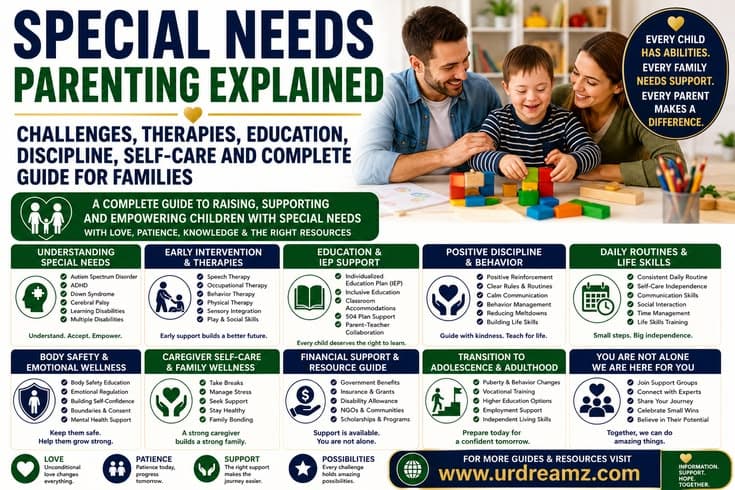
Special Needs Parenting Explained: Challenges, Therapies, Education, Discipline, Self-Care and Complete Guide for Families
Everything a parent needs to understand about raising a child with special needs — diagnosis, therapies, school advocacy, discipline, daily life, safety, self-care, and long-term planning.
Introduction: A Different Journey, Not a Lesser One
No parent plans for a specific diagnosis before their child is born. Most imagine ordinary milestones — first steps, first words, first day of school — arriving roughly on schedule. When a child turns out to have autism, ADHD, Down syndrome, cerebral palsy, a learning disability, or another developmental difference, the picture a parent carried in their mind quietly shifts, sometimes overnight and sometimes slowly over months of unanswered questions.
Somewhere between the first worried conversation with a pediatrician and the years of appointments, paperwork, and small daily victories that follow, most parents describe a quiet shift in how they measure success. A milestone that once seemed unremarkable — a first word at age five instead of age one, a full day at school without an incident, a new food finally accepted at dinner — can become one of the proudest moments of a parent's life. This recalibration of what "progress" means is not lowering the bar; it is learning to see your own child clearly, on their own terms, rather than through someone else's timeline.
This shift is real, and it deserves to be acknowledged rather than rushed past. At the same time, it is not the end of the story a parent imagined — it is simply a different version of it, with its own milestones, its own victories, and its own definition of progress. Families raising children with special needs consistently describe two truths sitting side by side: this parenting path asks more of them in almost every practical sense, and it also gives back a depth of connection, patience, and perspective that many say reshaped them for the better.
This guide walks through what special needs parenting actually looks like day to day — from understanding a new diagnosis, to therapies and school advocacy, to discipline, daily routines, safety, and the long, sometimes invisible work of caring for yourself while you care for your child. None of this replaces individualized medical, therapeutic, or legal advice, but it is meant to give you a clear, honest map of the territory ahead.
What Is Special Needs Parenting?
Special needs parenting describes the approach parents and caregivers take to support a child who has a physical, intellectual, emotional, behavioral, or developmental condition that requires extra care, accommodation, or advocacy beyond what is typically expected in raising a child. It is less a single fixed skill set and more an ongoing process of learning your specific child — their strengths, their triggers, their pace, and what genuinely helps them thrive — and then translating that knowledge into consistent support at home, at school, and in the wider community.
It also helps to recognize that special needs parenting is not a single fixed identity a parent either has or doesn't — it is something most parents grow into gradually, often starting with far less confidence than they eventually build. Nobody arrives at their first developmental evaluation already fluent in IEP terminology, therapy schedules, or insurance paperwork. That knowledge is acquired, slowly and sometimes painfully, through direct experience, and every parent currently confident in this role once started exactly where you may be starting now.
Three responsibilities tend to define this role more than any single diagnosis does. First, caregiving — the direct, hands-on work of meeting a child's daily physical, emotional, and medical needs, which can be considerably more involved than typical childcare. Second, advocacy — speaking up for a child's rights and needs in schools, clinics, and public spaces where systems were not always built with that child in mind. Third, adaptation — continuously adjusting routines, expectations, and environments as a child grows and their needs change. Parents who embrace all three tend to report the greatest sense of confidence and control, even when the underlying diagnosis itself cannot be changed.
Common Types of Special Needs Explained
"Special needs" is a broad umbrella term covering a wide range of conditions, each with its own profile of strengths and challenges. Below is a plain-language overview of the conditions parents encounter most often.
| Condition | What It Involves |
|---|---|
| Autism Spectrum Disorder (ASD) | Differences in social communication, repetitive behaviors or routines, and sensory sensitivities, ranging widely in presentation from child to child |
| ADHD | Persistent difficulty with attention, impulse control, and/or hyperactivity that affects school and daily functioning |
| Down Syndrome | A genetic condition causing developmental delays and a distinct set of physical features, often alongside strong social and emotional strengths |
| Cerebral Palsy | A neurological condition affecting muscle coordination and movement, usually from early brain development differences |
| Learning Disabilities (dyslexia, dysgraphia, dyscalculia) | Specific difficulty with reading, writing, or math despite average or above-average intelligence |
| Intellectual Disability | Below-average cognitive functioning alongside challenges in adaptive, everyday life skills |
| Sensory Processing Disorder | Over- or under-reaction to sound, touch, light, or movement compared to typical sensory response |
| Speech and Language Delay | Slower-than-typical development of spoken language, comprehension, or clear articulation |
| Genetic Disorders (various) | Inherited or spontaneous genetic conditions affecting physical, cognitive, or developmental function |
| Physical Disability | Conditions affecting mobility, strength, or physical function, from mild to significant |
Looking a little closer at each condition helps replace unfamiliarity with understanding. Autism Spectrum Disorder exists on a genuinely wide spectrum — some children need significant daily support, while others are highly verbal and academically strong but still experience the world differently in ways that deserve accommodation. ADHD is not simply "high energy"; it reflects real differences in how the brain regulates attention and impulse control, regardless of how intelligent or capable the child is otherwise. Down syndrome brings a well-documented set of physical and cognitive characteristics, but individual children vary enormously in ability, personality, and independence achieved over a lifetime. Cerebral palsy can range from a mild coordination difference barely noticeable to others, to significant mobility needs requiring assistive devices, and it does not necessarily affect cognitive ability at all. Learning disabilities such as dyslexia, dysgraphia, and dyscalculia frequently appear in otherwise bright children, which is exactly why they are so often mistaken for laziness before a proper evaluation clarifies what is really happening. Intellectual disability is defined by both cognitive and everyday adaptive skills together, not by IQ alone, and support needs can shift considerably with the right training and environment. Sensory processing disorder can make an ordinary classroom feel overwhelming or, conversely, leave a child seeking out intense sensory input others would find uncomfortable. Speech and language delay sometimes resolves with therapy alone and sometimes signals a broader underlying condition, which is why an evaluation matters even when the delay seems mild. Genetic disorders vary enormously by specific diagnosis, and a genetics specialist is often the best source of condition-specific guidance. Physical disabilities affect mobility or physical function but frequently leave cognitive and academic ability entirely unaffected, a distinction worth remembering when advocating for inclusive classroom placement.
It is worth remembering that a diagnosis describes a set of traits and support needs — it does not describe a child's personality, sense of humor, capacity for joy, or ultimate potential. Two children with the exact same diagnosis can look, behave, and develop in strikingly different ways.
Early Signs Parents Should Watch For
Early identification consistently leads to earlier support, and earlier support tends to produce better long-term outcomes. None of the signs below confirm a diagnosis on their own — they are simply reasons to bring up a conversation with your pediatrician.
| Area | Possible Early Signs |
|---|---|
| Social communication | Limited eye contact, not responding to their name, little interest in shared play by the expected age |
| Language | Few or no words by 18–24 months, loss of previously used words, unclear speech well past the typical age |
| Motor skills | Delayed sitting, crawling, or walking; noticeably uneven strength or coordination on one side |
| Attention and activity level | Extreme difficulty sitting still, constant impulsivity, or an inability to follow simple multi-step instructions for their age |
| Sensory response | Strong distress over certain sounds, textures, or lights; or unusually little reaction to pain or temperature |
| Learning | Persistent difficulty recognizing letters, numbers, or basic reading skills despite consistent teaching |
| Emotional regulation | Frequent, intense meltdowns well beyond what is typical for the child's age and situation |
If you notice several of these signs together, or your instinct as a parent tells you something is different, trust that instinct enough to ask for a formal developmental evaluation. An early evaluation is never wasted, even if it ultimately rules out a concern — and it is almost always the fastest path to real answers and real support if a concern is confirmed.
Common Challenges Special Needs Families Face
Every family's situation differs, but certain challenges surface again and again across special needs parenting communities.
| Challenge | What It Looks Like Day to Day |
|---|---|
| Emotional weight | Grief over the future once imagined, guilt, anxiety, and occasional resentment that coexist with deep love |
| Balancing responsibilities | Juggling therapy appointments, work, other children, and household demands with little spare time |
| Navigating healthcare and education systems | Researching diagnoses, coordinating specialists, and learning legal rights almost like a second job |
| Public judgment | Stares, comments, or unsolicited advice from strangers unfamiliar with the child's condition |
| Financial strain | Therapy costs, specialized equipment, and reduced work hours for one or both parents |
| Marriage and relationship strain | Less time and energy for a partner amid the demands of caregiving |
| Isolation | Fewer chances to attend typical social events, playgroups, or family gatherings that don't accommodate the child's needs |
| Uncertainty about the future | Ongoing questions about independence, education, and long-term care as the child grows |
The marriage and relationship strain deserves particular honesty, since it is often the most quietly under-discussed item on this list. Two parents can love the same child equally and still cope with the stress of caregiving in very different ways — one leaning toward research and control, the other toward emotional processing and talking things through — and without deliberate, regular communication, those differing coping styles can drift into real conflict rather than shared teamwork. Couples who schedule even brief, protected time together, and who explicitly discuss how they will divide caregiving labor rather than letting it default silently to one parent, tend to sustain both their partnership and their caregiving capacity far longer than couples who let the division happen by accident.
What makes these challenges particularly heavy is that many of them are largely invisible to people outside the family. A friend might see a parent skip a birthday party and assume disinterest, without knowing that the venue simply was not equipped to handle their child's sensory needs safely. A colleague might notice reduced work hours without knowing they reflect a fourth therapy appointment that week, not a lack of commitment. This invisibility is precisely why connecting with other special needs parents — people who instantly understand without lengthy explanation — tends to feel like such a relief the first time it happens.
Naming these challenges openly is not complaining — it is the first step toward addressing them. Families who acknowledge the weight of these challenges, rather than minimizing them, tend to reach out for support sooner and burn out less often than families who try to carry everything silently.
The 5 Emotional Stages of Special Needs Parenting
Parents who have been on this journey for years frequently describe a recognizable emotional arc, even though every family's timeline and details differ. Understanding these stages can help you make sense of feelings that might otherwise feel confusing or isolating.
| Stage | Typical Age Range | Central Feeling |
|---|---|---|
| 1. Before diagnosis | Infancy – preschool | Confusion and self-doubt as expected parenting strategies don't seem to work |
| 2. Getting the diagnosis | Preschool – early elementary | Relief mixed with grief; an urge to research and "solve" the condition |
| 3. Early adjustment | Early elementary – middle school | Aching for the child during exclusion or difficulty, alongside growing expertise |
| 4. Building acceptance | Middle school – high school | Rebuilding parenting confidence, connecting with other parents, focusing on coping skills over "fixing" |
| 5. Looking back | Young adulthood | Pride in redefined milestones and a clearer, calmer perspective on the whole journey |
Each stage carries its own particular weight. The first stage, before any diagnosis exists, is often the loneliest, because a parent senses something is different long before anyone can name it, and standard parenting advice from books, family members, or well-meaning strangers simply does not seem to work. The diagnosis stage frequently brings an unexpected wave of grief even when it was anticipated — hearing a name attached to what you already suspected can hit harder than expected, alongside genuine relief that answers are finally within reach. The early adjustment years are often defined by a parent's fierce protectiveness, feeling every exclusion or difficulty their child faces almost as intensely as the child does. By the acceptance-building stage, many parents describe a hard-won shift away from trying to "cure" or "fix" the underlying condition, and toward building practical coping tools and celebrating smaller, more personal milestones. Finally, looking back from young adulthood, many parents report genuine surprise at how far their child traveled — often further than the parent's own early fears allowed them to imagine.
Most parents move through these stages unevenly — some revisit earlier feelings during new challenges, like starting a new school or reaching an unexpected medical hurdle, even after reaching later stages in other areas. This is completely normal. The goal is not to rush toward "acceptance," but to notice that wherever you currently are, thousands of other parents have stood in that exact same spot and moved forward from it.
Therapies and Early Intervention Explained
Therapy can feel like an overwhelming new vocabulary at first. Here is a plain-language breakdown of the most common types.
| Therapy | What It Helps With |
|---|---|
| Speech-Language Therapy | Communication, articulation, understanding language, and social use of language |
| Occupational Therapy (OT) | Fine motor skills, sensory regulation, and everyday tasks like dressing or handwriting |
| Physical Therapy (PT) | Gross motor skills, strength, balance, and mobility |
| Applied Behavior Analysis (ABA) | Building specific skills and reducing challenging behaviors through structured, positive reinforcement |
| Behavioral Therapy (general) | Managing emotional and behavioral responses using consistent, evidence-based techniques |
| Sensory Integration Therapy | Helping a child process and respond appropriately to sensory input |
| Play Therapy | Using play to help younger children express and work through emotions |
| Early Intervention Programs | Coordinated therapy and support services for children typically from birth to age three |
Choosing the right combination of therapies rarely happens all at once. Most families start with whichever area causes the most immediate concern — often speech or behavior — and add other therapies as an evaluation clarifies additional needs. It helps enormously to ask each therapist not just what they are working on, but why, and what specific home practice would reinforce that goal between sessions; therapy tends to progress fastest when the techniques used in a clinical session are echoed consistently in ordinary daily life at home.
Early intervention deserves particular emphasis: a child's brain has its greatest capacity for change in the first few years of life, which is why services started early — even before a formal diagnosis is finalized — tend to produce the strongest long-term gains. If a pediatrician, teacher, or your own instinct raises a concern, requesting an evaluation for early intervention services is almost always worth doing immediately rather than waiting to "see if it resolves on its own."
Special Education, IEPs, and Advocating for Your Child
Special education is not a single classroom or building — it is a set of services designed to give a child the structure, staff training, and accommodations they need to access an appropriate education, whether that support happens in a separate classroom, alongside typical peers, or some blend of both. An Individualized Education Program, or IEP, is the formal document that outlines a child's specific goals, services, and accommodations, created together by parents, teachers, and specialists.
Parents are legally recognized as equal members of their child's IEP team, not passive recipients of a school's decisions. That means you have the right to request evaluations, ask questions about progress data, and push back if services outlined in the plan are not being delivered as written — even during periods when schools face genuine staffing shortages in specialist positions like speech-language pathologists, occupational therapists, or school psychologists. A shortage of staff does not remove a school's legal obligation to provide the services a child is entitled to; it simply means parents may need to ask more direct questions to make sure those services are actually delivered.
| If the School Says… | A Strong Parent Response |
|---|---|
| "We're short-staffed right now." | "I understand. What is the plan to make sure my child still receives the services in the IEP?" |
| "We're working on filling the position." | "Can you share a timeline, and how services will be delivered until then?" |
| "Let's wait and see how it goes." | "I'd like to document this concern in writing and request a plan moving forward." |
Many parents describe their first IEP meeting as intimidating simply because of the unfamiliar acronyms and the number of professionals in the room. It helps to remember that every person at that table, including the parent, is there to answer one shared question: what does this specific child need to make genuine progress? Coming prepared with your own observations from home — what helps your child calm down, what triggers difficulty, what you have noticed working or not working — gives the team information they cannot get anywhere else, and it reinforces that a parent's daily, lived expertise carries real weight in that room, alongside each specialist's formal training.
Four habits make advocacy noticeably more effective: put every concern and request in writing rather than relying on verbal conversations alone; ask for concrete data such as service logs or progress reports rather than general reassurances; request a formal IEP meeting whenever services are reduced or delayed; and follow up consistently until the issue is genuinely resolved, not just acknowledged. Written communication carries real weight in special education — a documented request creates a clear record that a verbal conversation simply cannot.
Positive Discipline for Children with Special Needs
Discipline for a child with special needs follows many of the same principles as discipline for any child, adapted to the way that specific child communicates and processes information.
| Principle | How to Apply It |
|---|---|
| Communicate clearly | Use pictures, visual schedules, gestures, or simplified language matched to your child's communication style |
| Set predictable consequences | Use simple "if-then" language so cause and effect stays clear and consistent |
| Stay consistent | Apply the same rule and consequence every time, across every caregiver, to build predictability |
| Offer generous praise | Reinforce effort and small wins immediately and specifically |
| Manage your own stress first | A calmer parent response tends to produce a calmer child response, and the reverse is also true |
It can be tempting to let certain behaviors slide simply because enforcing a boundary feels harder or slower with a child who has additional needs. In the long run, though, children with special needs benefit from clear, consistent boundaries just as much as any other child — the boundaries simply need to be communicated in a way that matches how that particular child understands the world.
It also helps to separate a behavior from its underlying cause before deciding how to respond. A meltdown driven by sensory overload calls for a very different response than defiance driven by a desire for control — the first often needs a calmer, quieter environment and less talking, while the second may respond better to clear choices and consistent limits. Taking a moment to ask "what is actually driving this right now?" before reacting often leads to a far more effective response than a one-size-fits-all consequence applied automatically.
Daily Routine, Nutrition, Sleep, and Life Skills
Predictability is one of the most powerful, low-cost tools available to special needs families. A stable daily rhythm reduces anxiety, supports emotional regulation, and makes transitions easier to manage.
| Area | Practical Guidance |
|---|---|
| Daily schedule | Feed, bathe, and engage in activities at roughly the same times each day; use visual schedules for children who benefit from them |
| Nutrition | Offer balanced meals with familiar textures where sensory sensitivities exist; introduce new foods gradually and without pressure |
| Sleep | Keep a consistent bedtime routine; limit screens before bed; address sleep disturbances with a pediatrician rather than assuming they will resolve alone |
| Assistive technology | Explore tools such as communication devices, mobility aids, or hearing supports that genuinely improve daily independence |
| Life skills training | Teach self-care tasks — dressing, hygiene, simple cooking — in small, repeatable steps matched to the child's current ability |
| Outings and transitions | Plan for off-peak times, allow extra time, and prepare your child in advance for what to expect |
Small, repeated routines that look unremarkable from the outside — the same morning sequence, the same phrase before leaving the house — are often what allow a child with special needs to feel safe enough to handle the unpredictability of the wider world.
It also helps to build in intentional flexibility around the edges of an otherwise consistent routine, since real life inevitably brings disruptions — a canceled therapy session, a sick day, a holiday schedule. Preparing a child in advance for a known change, using the same visual or verbal cues used for any other transition, tends to prevent far more distress than the change itself would otherwise cause. Consistency in the core structure of the day, paired with clear advance notice for the exceptions, gives a child both the stability and the adaptability they need to handle an unpredictable world with far less anxiety.
Teaching Body Safety and Boundaries
As children with special needs grow more independent — attending camps, spending time with extended family, or simply being out in the community more — body safety becomes an essential life skill, taught directly rather than assumed. Body safety is not about instilling fear; it is about building understanding, communication, and confidence.
| Core Idea | What to Teach |
|---|---|
| Body ownership | Their body belongs to them, and some parts are private |
| Safe vs. unsafe touch | The difference between everyday helpful touch and touch that feels confusing or secretive |
| Saying no | Simple, practiced phrases like "no," "stop," and "I don't like that," said in a strong, confident voice |
| Trusted adults | A specific, named list of safe adults your child can go to, with the understanding that they can try another if one doesn't listen |
| Speaking up without fear | Reassurance that they will never get in trouble for telling you something uncomfortable or something they were told to keep secret |
Body safety conversations tend to work best when they are folded naturally into everyday moments — bath time, getting dressed, or a conversation sparked by something on television — rather than treated as a single formal, heavy sit-down talk that both parent and child dread. The goal is for these ideas to become such an ordinary, repeated part of daily conversation that your child absorbs them the same way they absorb any other consistent house rule, without extra fear or drama attached.
These skills are built gradually, not delivered in a single conversation. Short, calm practice sessions — a few minutes at a time, repeating the same simple words — tend to work far better than one long, serious talk. If your child ever tells you something that feels concerning, the most protective response is to stay calm, listen without interrupting or asking leading questions, and reassure them clearly that they did the right thing by telling you, before deciding on next steps with a professional or trusted support if needed.
Summer, camps, sleepovers, and other periods of increased independence are a natural, low-pressure time to revisit these conversations, since children are often more receptive when a skill connects to something happening in their actual life rather than an abstract lesson. For children who communicate non-verbally or with limited speech, these same concepts can be taught through picture cards, social stories, or role play with a trusted therapist, adapted to whatever communication method your child already uses successfully in daily life.
Parent Self-Care and Preventing Caregiver Burnout
Caregiver burnout is a real, well-documented state of emotional, mental, and physical exhaustion — and it is far more common among special needs parents than many realize. Left unaddressed, it does not just harm the parent; it reduces the very capacity to care for the child that the parent is trying so hard to protect.
| Self-Care Area | Practical Ideas |
|---|---|
| Physical activity | Short walks, stretching, or activities you can do together with your child |
| Sleep | Protect a consistent bedtime for yourself, not just your child |
| Mindfulness | Brief breathing exercises or guided meditation during high-stress moments |
| Connection | Regular contact with a friend, family member, therapist, or caregiver support group |
| Couple's relationship | Scheduled time together, even briefly, to maintain the partnership underneath the caregiving |
| Self-compassion | Accepting imperfect days without treating them as failure |
One dynamic is worth naming directly: research consistently shows a two-way relationship between parental stress and a child's behavior — a stressed parent tends to respond less calmly, which can increase a child's distress, which in turn increases parental stress further. Breaking this cycle anywhere — through even five minutes of daily self-care — benefits both the parent and the child simultaneously. Asking for help is not an admission of failure; recruiting specific, concrete help from family, friends, or respite care services is one of the most protective things a caregiving parent can do for their own long-term capacity to keep showing up.
It also helps to be specific when asking for support rather than making a vague, general request. Instead of telling a friend "let me know if you can ever help," naming an exact task — "could you sit with my son for one hour on Saturday morning while I go for a walk" — makes it far easier for people who genuinely want to help to actually say yes. Most special needs parents report that the hardest part of accepting support is not finding people willing to give it, but allowing themselves to ask clearly and without guilt in the first place.
Supporting Siblings
Brothers and sisters of a child with special needs often carry their own complicated mix of love, pride, protectiveness, jealousy, and occasional resentment — all of which are normal and none of which need to be hidden away. Age-appropriate honesty about a sibling's condition, rather than avoidance, tends to build the strongest long-term family bond. Younger children may just need simple, concrete explanations, while older children benefit from more detail and, eventually, a role in understanding how they might support their sibling over time.
Dedicated one-on-one time with siblings — even a short weekly outing or a regular few minutes of undivided attention — reassures them that their own needs and feelings matter just as much, even during periods when a sibling's care understandably takes up more visible time and energy. Open, ongoing conversation, rather than a single explanation delivered once, allows the topic to grow naturally as children mature and their questions change.
Many adult siblings of people with special needs describe growing up with a distinct blend of early maturity, empathy, and occasional complicated feelings they didn't always know how to name as children. Giving siblings language for those feelings early — telling them directly that it is normal to feel proud and frustrated in the same week, or even the same afternoon — tends to prevent the kind of guilt that can otherwise build quietly over years of staying silent about it.
Financial Help and Community Support
No family should have to navigate the financial and logistical side of special needs parenting entirely alone — a wide range of support exists, though it often requires some research to locate in your specific area.
| Support Type | What It Offers |
|---|---|
| Government disability benefits | Financial assistance tied to a child's specific diagnosis and documented needs |
| Special Needs Trusts / ABLE accounts | Long-term financial planning tools that protect a child's eligibility for benefits while building savings |
| Respite care services | Temporary, trained caregiving support that gives parents planned breaks |
| Nonprofit and advocacy organizations | Condition-specific resources, legal guidance, and community connection |
| Support groups | Peer connection with other parents who understand the day-to-day reality without needing lengthy explanation |
| School and community programs | Local inclusion programs, adapted sports, and recreational activities |
A useful first step is a direct conversation with your child's pediatrician, school counselor, or a local disability services office — they often know which specific programs exist locally that a general search engine would not easily surface.
Eligibility rules, application processes, and available programs vary considerably by country, state, or region, and they change periodically, so it is worth revisiting this research every year or two rather than assuming an earlier search remains fully up to date. Many families find that a single well-connected caseworker, disability nonprofit, or support group can shortcut months of independent searching by pointing directly toward the programs most relevant to their child's specific diagnosis and family circumstances.
Transition to Adulthood and Long-Term Planning
As children with special needs approach their teenage years, planning conversations naturally shift toward independence, education beyond high school, employment, and long-term care arrangements.
| Planning Area | What to Consider |
|---|---|
| Independent living skills | Building daily self-care, money management, and household skills gradually through the teen years |
| Vocational training | Programs that build specific job skills matched to a young adult's interests and abilities |
| Employment support | Supported employment programs that provide on-the-job coaching and accommodations |
| College support | Disability services offices at colleges that provide accommodations similar to a school-age IEP |
| Guardianship or supported decision-making | Legal planning for decision-making support once a child reaches legal adulthood |
| Long-term financial planning | Special Needs Trusts and similar tools to secure a child's future without jeopardizing benefit eligibility |
Many parents describe this stage as one of the most emotionally complex of the entire journey — a mix of pride in how far their child has come and quiet worry about a future they cannot fully control. Starting these conversations early, well before the transition actually arrives, tends to reduce that anxiety considerably by turning a vague fear into a concrete, manageable plan.
When to Seek Professional Help
Children with special needs face a somewhat higher likelihood of anxiety and depression than their peers, yet these struggles are frequently harder for parents to detect, in part because children may worry about upsetting a parent who already carries so much. Watch for persistent sadness or irritability, a loss of interest in previously enjoyed activities, changes in sleep or appetite, or withdrawal from family and friends, and take these seriously rather than assuming they will pass.
If your child ever expresses hopelessness, talks about not wanting to be alive, or you are genuinely worried about their immediate safety, treat it as urgent and reach out to a mental health professional or a crisis line right away rather than waiting. This is a sensitive topic — if you as a parent are also feeling overwhelmed or unsafe in your own mental health, please know that support exists for you too, and I'm glad to help you find the right resources if that would be useful.
On a day-to-day level, it is worth seeking a professional opinion whenever a behavior or symptom is intense, persistent, or clearly interfering with your child's daily functioning — not only when a crisis has already occurred. Early conversations with a pediatrician, therapist, or school counselor are almost always easier and less overwhelming than a delayed one.
Frequently Asked Questions
What is special needs parenting?
It is the approach parents take to raise and support a child with a physical, intellectual, emotional, behavioral, or developmental condition, combining direct caregiving, advocacy, and ongoing adaptation as the child grows.
How do you raise a child with special needs?
By learning your specific child deeply, building consistent routines, connecting with the right therapies and educational supports, disciplining with clear and adapted communication, and protecting your own well-being along the way.
What are the biggest challenges of parenting a child with disabilities?
Emotional weight, navigating healthcare and school systems, financial strain, public judgment, isolation, and uncertainty about the future are among the most commonly reported challenges.
How can parents support a child with autism?
Consistent routines, clear and literal communication, sensory-friendly environments, and early speech, occupational, or behavioral therapy all provide strong support.
What are the early signs of autism?
Limited eye contact, delayed language, little interest in shared play, repetitive behaviors, and strong reactions to certain sensory input are common early indicators worth discussing with a pediatrician.
What are the symptoms of ADHD in children?
Persistent inattention, impulsivity, and/or hyperactivity that is disproportionate to the child's age and clearly affects school or home functioning.
How do you manage ADHD at home?
Consistent routines, short and clear instructions, immediate positive reinforcement, and close coordination with the child's school and, where prescribed, medical treatment.
What is an Individualized Education Program (IEP)?
A formal, legally binding document outlining a child's specific educational goals, services, and accommodations, developed jointly by parents, teachers, and specialists.
How does special education help children?
It provides smaller classrooms, specially trained staff, consistent structure, and tailored accommodations that help a child access an appropriate education alongside or apart from typical peers.
What therapies are available for children with special needs?
Speech-language therapy, occupational therapy, physical therapy, applied behavior analysis, general behavioral therapy, sensory integration therapy, and play therapy are among the most common.
What is ABA therapy?
Applied Behavior Analysis is a structured therapy that builds specific skills and reduces challenging behaviors through consistent, positive reinforcement techniques.
What is occupational therapy for children?
Therapy focused on fine motor skills, sensory regulation, and everyday functional tasks such as dressing, writing, or eating independently.
What is speech therapy for children?
Therapy that supports communication development, including articulation, language comprehension, and the social use of language.
What is sensory processing disorder?
A condition where a child over- or under-responds to sensory input like sound, touch, light, or movement compared to typical responses.
What causes developmental delays?
Causes vary widely and can include genetic factors, prenatal or birth complications, premature birth, or in many cases, no single identifiable cause at all.
How do you help a child with speech delay?
Early speech-language therapy, frequent talking and narrating daily activities, reading together often, and following your therapist's specific home-practice guidance.
What are the signs of learning disabilities?
Persistent difficulty with reading, writing, or math that is clearly out of step with a child's effort and overall intelligence.
How can parents reduce caregiver stress?
Protecting daily self-care time, seeking support from other parents or a therapist, requesting concrete help from family and friends, and using respite care when available.
How do you build independence in children with disabilities?
Teach self-care and life skills in small, repeatable steps, use assistive technology where helpful, and gradually increase responsibility as skills develop.
What daily routines help children with special needs?
Predictable wake, meal, therapy, and bedtime schedules, along with visual schedules for children who benefit from seeing what comes next.
How do you improve communication skills in autistic children?
Speech therapy, visual supports and picture schedules, patient repetition, and consistent, calm modeling of language during everyday activities.
What financial support is available for families with special needs children?
Government disability benefits, Special Needs Trusts, ABLE accounts, nonprofit grants, and local community assistance programs are common sources of support.
What are disability benefits for children?
Financial assistance programs, varying by country, that provide support based on a documented diagnosis and its impact on the child's daily functioning.
How can schools support children with disabilities?
Through an IEP or similar formal plan providing accommodations, specialist services, and, where appropriate, inclusive classroom placement.
What is inclusive education?
An approach where children with disabilities learn alongside typically developing peers, with accommodations and support built into the general classroom setting.
What are life skills for children with special needs?
Self-care tasks like dressing and hygiene, basic household tasks, money handling, and social or communication skills needed for daily independence.
How do you prepare a child with disabilities for adulthood?
Start early with independent living skills, explore vocational training or college disability services, and put long-term legal and financial planning in place well before adulthood begins.
What are the best resources for special needs parents?
Pediatricians, school special education staff, condition-specific nonprofit organizations, and local or online caregiver support groups are strong starting points.
How do support groups help parents?
They provide peer understanding without lengthy explanation, practical day-to-day tips, and a reminder that a parent's struggles and feelings are shared by many others.
How can siblings support a child with special needs?
Through age-appropriate understanding, patience, and inclusion in family life, supported by parents who give siblings their own dedicated attention and space to express their feelings.
What is the 7-7-7 rule for parenting?
A general guideline suggesting a balance of structured routine, downtime, and connection across a child's day — used loosely by some parents as a simple planning framework rather than a strict clinical rule.
What is the 3-3-3 rule for children?
A calming technique involving naming three things you can see, three sounds you can hear, and moving three body parts to help refocus during anxiety or sensory overwhelm.
How to discipline a child with special needs?
Use clear, consistent, and communication-adapted rules and consequences, paired with generous praise for effort, while managing your own stress response as the model for calm behavior.
How can I recognize the signs of special needs in my child?
Watch for delayed milestones, difficulty with speech, challenges with social interaction or emotional regulation, and trouble with motor skills, then discuss any concerns with your pediatrician for a formal evaluation.
How do parents cope with a special needs child long-term?
Most parents describe a gradual shift from initial overwhelm toward practical coping tools, community connection, and a redefined, more personal sense of what progress and success look like for their specific child.
What is the difference between special education and inclusive education?
Special education refers to the specific services and accommodations a child receives, while inclusive education specifically means delivering those services alongside typically developing peers in a general classroom setting wherever appropriate.
How do I choose the right therapy for my child?
Start with a professional evaluation to identify your child's specific areas of need, then prioritize the therapy addressing the most immediate concern, adding others as further needs are identified over time.
What are Special Needs Trusts and ABLE accounts?
They are legal and financial planning tools that allow families to save and manage funds for a child's future care and needs without jeopardizing their eligibility for government disability benefits.
How can I help a special needs child make friends?
Focus on nurturing one or two individual friendships rather than broad peer group acceptance, prepare your child with simple social scripts in advance, and involve a therapist or counselor if social difficulties are significant.
Conclusion
Special needs parenting asks for more patience, more advocacy, more learning, and often more quiet resilience than most people ever fully see from the outside. It also tends to build a depth of connection, perspective, and pride in small, hard-won milestones that many parents describe as reshaping who they are, in ways they would not trade back even if they could.
Understanding your child's specific condition, connecting early with the right therapies, learning to advocate confidently within school and healthcare systems, building consistent routines and discipline suited to how your child communicates, and — just as importantly — protecting your own well-being along the way will carry your family through the vast majority of the challenges ahead. For the moments that feel bigger than what you can manage alone, professional support and community resources exist precisely for this journey, and reaching for them is a sign of strength, not a last resort.
Wherever you are in this journey today — newly navigating a diagnosis, deep in the daily grind of therapies and school meetings, or looking back with hard-earned pride — know that thousands of families have stood exactly where you are standing now, and moved forward from it, one ordinary, consistent day at a time.
If there is one thought worth carrying forward from everything in this guide, it is this: your child's diagnosis describes a set of support needs, not a ceiling on their life, and your own daily effort — imperfect, exhausted, and repeated anyway — is precisely what turns that support into real, lasting progress. That is not a small thing. It is, quite genuinely, the work of a lifetime, done one day at a time.
Related Guides: