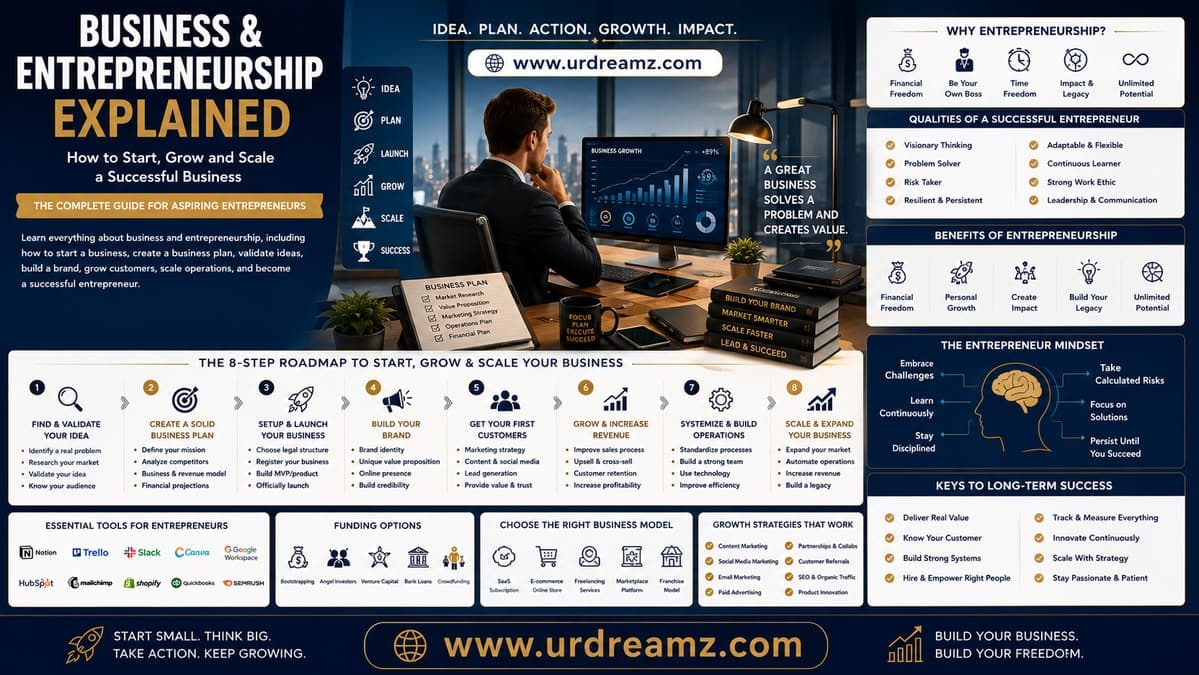
Business & Entrepreneurship Explained: How to Start, Grow and Scale a Successful Business
Every major company in the world - from a single-person Etsy shop to a global technology brand - started as one idea that someone was willing to act on despite not knowing exactly how it would turn out. This guide covers the complete picture: what actually separates a business from entrepreneurship, the personality traits and skills that tend to show up in people who succeed at it, a real step-by-step path from idea to launch, how to fund and structure a business, the mistakes that quietly kill most startups, and the failure stories behind some of the most successful entrepreneurs in history.
This guide continues the Digital Marketing Learning Center and builds on everything already covered: Blogger vs WordPress, Amazon Associates: Complete Guide to Affiliate Marketing, SEO for Beginners, Digital Marketing Explained, Content Marketing Complete Guide, Email Marketing Explained, Social Media Marketing Explained, Facebook Marketing Explained, Instagram Marketing Explained, Pinterest Marketing Explained, TikTok Marketing Explained, and WhatsApp Marketing Explained. Everything you learn here about starting and growing a business pairs directly with those marketing guides once you're ready to actually bring in customers.
1. What Is Business, and What Is Entrepreneurship?
A business is any organized activity that produces and sells a product or service in exchange for money. Entrepreneurship is the specific process of identifying an unmet need, taking on the financial and personal risk of building something new to meet it, and organizing the people, money, and resources required to make that idea real. In short: a business is the structure, while entrepreneurship is the act of creating it, often where nothing existed before.
2. Business vs Entrepreneurship: Key Differences
A traditional business owner often focuses on running an established model efficiently - a franchise, a local shop, a service that already has a known customer base and a known way of operating. An entrepreneur, by contrast, is usually focused on identifying a genuine gap in the market and building something new to fill it, accepting far more uncertainty in exchange for the potential to create outsized value or disruption. Every entrepreneurial venture eventually becomes "just a business" once it matures - the entrepreneurial phase is really the earlier, riskier period of building something from nothing.
3. Types of Entrepreneurship
Entrepreneurship isn't one single path. Small business entrepreneurship covers the vast majority of real-world businesses - local shops, freelancers, service providers - built to support an owner and their family rather than to grow explosively. Scalable startup entrepreneurship targets a large market with a repeatable model designed for rapid growth, often backed by outside investment. Large-company entrepreneurship (sometimes called intrapreneurship) happens inside existing corporations, where employees build new products or divisions with the same innovative mindset as an independent founder. Social entrepreneurship applies the same core skills toward solving a social or environmental problem rather than pursuing profit alone.
4. The Anatomy of an Entrepreneur: Common Traits
While no two entrepreneurs are identical, a recognizable cluster of traits shows up again and again among people who succeed at building something from scratch.
| Trait | Why It Matters |
|---|---|
| Calculated and logical | Grounds decisions in data and honest evaluation rather than guesswork |
| Motivated and focused | Genuine interest in the work sustains effort through the inevitable slow periods |
| Confident and outgoing | Belief in the product or service is what makes selling it to others possible |
| Willing to take calculated risks | Growth requires stepping into uncertainty, without being reckless about it |
| Strong work ethic | Meaningful results rarely arrive without sustained, consistent effort |
| Creative and innovative | Differentiation in a crowded market usually comes from a genuinely fresh angle |
| Patient and persistent | Most real success is built slowly, through repeated setbacks, not overnight |
| Versatile and adaptable | Markets, customers, and competitors keep changing, and rigid plans break under that pressure |
5. Core Entrepreneurial Competencies
Beyond personality, a specific set of learnable skills tends to separate entrepreneurs who succeed from those who stall out: creativity and innovation, genuine risk-taking judgment, leadership, clear communication, structured problem-solving, decisive decision-making, disciplined planning and management, and enough self-confidence and motivation to keep going without constant external validation. None of these are fixed personality traits alone - they can all be deliberately built through practice and honest reflection over time.
6. The Core Functions of an Entrepreneur
Running a venture involves several distinct functions happening simultaneously: generating and refining ideas, mobilizing resources like people, money, and materials, planning a clear course of action, organizing a team and assigning responsibility, directing and motivating that team, coordinating every moving part so things function smoothly together, monitoring performance and correcting course when needed, driving ongoing innovation, and actively managing risk rather than simply hoping it doesn't materialize.
7. Risks Every Entrepreneur Faces
| Risk Type | Common Examples |
|---|---|
| Financial risk | Lack of funds, poor cash flow, unexpected expenses |
| Market risk | Shifting demand, strong competition, changing customer preferences |
| Operational risk | Production issues, supply chain problems, quality control failures |
| Legal and regulatory risk | Compliance requirements, licensing, shifting government policy |
| Technological risk | Rapid tech change, product obsolescence, cybersecurity threats |
| Human resource risk | Hiring difficulty, employee turnover, skill gaps |
| Personal risk | Stress, burnout, strained work-life balance, health impact |
8. The Benefits of Entrepreneurship
Beyond personal financial reward, entrepreneurship creates real employment opportunities for others, contributes directly to broader economic growth, pushes innovation forward across entire industries, offers a level of financial independence that a fixed salary rarely provides, and, cumulatively, tends to raise living standards in the communities where successful ventures take root.
9. How to Start a Business: A Realistic Step-by-Step Path
Stripped of hype, starting a business follows a fairly consistent sequence regardless of industry. Choose an idea that genuinely matches your skills, interests, and a real, provable demand rather than one you simply find exciting in the abstract. Study your market honestly - who exactly are your customers, what do they actually need, and who else is already serving them. Start smaller than feels comfortable: a limited product line, a modest first batch, a simple version of the offer, rather than trying to launch a fully built-out operation on day one.
From there, choose a clear, professional, memorable business name, and begin building visibility through social media and basic content marketing rather than waiting for a big-budget launch. Learn the fundamentals of posting strategy, simple video editing, and paid promotion early, since most modern businesses live or die on their ability to reach customers directly online. Treat customer service as a genuine growth engine, not an afterthought - fast, respectful, helpful responses turn first-time buyers into repeat ones and, eventually, into free word-of-mouth marketing.
Resist the urge to spend every dollar of early profit; reinvesting into better inventory, tools, or marketing compounds far more effectively than spending it immediately. Expect early mistakes and treat them as tuition rather than failure - virtually every experienced entrepreneur made costly early errors that directly shaped the better decisions they make now. Build an actual brand identity - consistent visuals, a recognizable tone, a reputation for quality - since this is what eventually lets people remember and recommend you without needing to be reminded who you are. Keep learning continuously: marketing, sales, basic AI tools, and general business management all compound in value over a career, not just a single launch.
Network deliberately with other business owners, creators, and potential customers, since real opportunities disproportionately come through genuine relationships rather than cold outreach alone. Use AI and modern software wherever it genuinely saves time - content editing, customer support, automation, and design are all areas where a solo founder can now operate at a scale that once required a full team. Avoid comparing your early, messy beginning to someone else's polished, established result; every visible success story had its own invisible, difficult starting chapter. Build real discipline into your daily routine rather than relying purely on motivation, since motivation fades and discipline is what actually keeps the work moving on the hard days.
Focus relentlessly on solving a real, specific problem for real people - faster delivery, more affordable pricing, a simpler process - since durable businesses are built on genuine value, not clever marketing alone. Keep asking how the product or service can improve, and believe in the underlying vision even through periods of low sales or genuine stress, since nearly every successful business survived at least one period that looked, from the outside, like it might not make it. Above all, don't give up prematurely - meaningful business success is rarely an overnight event, and small, consistent daily progress is what actually compounds into it over months and years.
10. Ten Things Every New Entrepreneur Must Do
- Define your "why" clearly - your purpose, your passion, and the specific problem you're solving
- Validate your idea through real market research before investing serious time or money
- Create a solid, honest plan covering your goals, strategy, target market, and finances
- Manage your finances carefully - track cash flow, build a real budget, protect your runway
- Build the right network of mentors, peers, and a genuinely supportive community
- Build a real brand identity that clearly communicates the value you provide
- Focus on earning your first customers by delivering genuine value, not just chasing volume
- Track, measure, and learn from real data rather than relying on gut feeling alone
- Build systems that can scale - document your processes and automate wherever possible
- Stay consistent and resilient, since meaningful success takes real time to materialize
11. Business Planning and Market Research
A business plan doesn't need to be a hundred-page document to be useful - it needs to honestly answer who you're serving, what specific problem you solve, how you'll reach those customers, and what your realistic costs and revenue expectations look like. Market research, at minimum, means directly asking or observing your potential customers rather than assuming you already know what they want; a great product built for a need nobody actually has will still fail no matter how well it's executed.
12. Business Model Explained
A business model is simply the specific way a company creates, delivers, and captures value - whether that's a one-time product sale, a recurring subscription, a commission-based marketplace, or an advertising-supported free service. Choosing the right model matters as much as the product itself, since the same great idea can succeed or struggle purely based on how it's monetized.
13. Startup Funding Options Explained
Bootstrapping means funding the business entirely from personal savings or early revenue, keeping full ownership but limiting how fast you can grow. Angel investors are individuals who invest their own money into early-stage companies, often in exchange for equity, typically bringing valuable mentorship alongside the capital. Venture capital comes from professional investment firms funding higher-growth startups in exchange for equity, usually at a larger scale and with higher growth expectations than angel investment. Crowdfunding raises smaller amounts of money from a large number of individual backers, often in exchange for early product access or rewards rather than equity at all. Each path suits a different kind of business - a local service business rarely needs venture capital, while a scalable tech startup often can't grow fast enough on bootstrapped funds alone.
14. Business Registration and Legal Basics
Formally registering a business - choosing a legal structure, registering the business name, and obtaining any required licenses - protects both the owner and customers, and is generally required before a business can legally open a bank account, sign contracts, or hire employees. Requirements vary significantly by country and industry, so checking local regulations early avoids costly compliance problems later.
15. Twelve Profitable Online Business Ideas
| Business Idea | What It Involves |
|---|---|
| Online course creation | Packaging your knowledge into a paid course on a platform or your own site |
| Ecommerce store | Selling physical or digital products through your own online storefront |
| Freelance writing | Writing articles, blog posts, or copy for businesses on a per-project basis |
| Social media management | Running and growing social accounts on behalf of other businesses |
| Email marketing services | Building lists and campaigns that nurture leads for client businesses |
| Affiliate marketing | Earning a commission by promoting other companies' products |
| Print-on-demand | Selling custom-designed products without holding any physical inventory |
| YouTube channel | Creating ongoing video content monetized through ads, sponsorships, and affiliates |
| Podcasting | Building an audience around audio content, monetized through sponsorships |
| Stock photography | Selling your own photos for ongoing passive royalty income |
| Digital products | Creating and selling ebooks, templates, planners, or design presets |
| Web design services | Designing functional, professional websites for paying clients |
Across all twelve, the same underlying advice applies: pick a niche you can sustain genuine interest in, start small enough to actually finish and launch, stay consistent even when early results are modest, and focus on adding real value first - the income tends to follow that, rather than the other way around.
16. Branding for Beginners
Branding is the consistent visual style, tone of voice, and overall reputation that makes your business instantly recognizable and, ideally, memorable for the right reasons. A clear logo, consistent colors, and a genuinely reliable customer experience matter more early on than an expensive, elaborate brand identity - consistency compounds into recognition far more than a single polished launch moment ever does.
17. Digital Marketing for Business Growth
Once a business exists, it still needs to be discovered, which is exactly where digital marketing comes in - content marketing, SEO, email marketing, and social platforms like Facebook, Instagram, Pinterest, LinkedIn, TikTok, and WhatsApp each offer a different path to reaching customers. Rather than trying to master every channel at once, most successful small businesses start by mastering just one or two that genuinely match where their specific customers already spend time.
18. Customer Acquisition and Retention
Customer acquisition is the process of earning a brand-new customer's first purchase, while retention is what keeps that same customer coming back afterward - and retention is consistently cheaper and more profitable than constantly chasing new customers alone. Fast, genuine customer service, a product that reliably delivers on its promise, and the occasional unexpected extra touch are what actually build the kind of loyalty that turns customers into repeat buyers and, eventually, into referrals.
19. Business Finance Basics
Managing cash flow - the actual timing of money coming in versus going out - matters just as much as overall profitability, since a genuinely profitable business can still fail if it runs out of usable cash at the wrong moment. Building a simple, realistic budget, tracking expenses honestly, and keeping a cash reserve for slower periods are basic habits that prevent an enormous share of otherwise avoidable small business failures.
20. Scaling a Business
Scaling means growing revenue and reach without a matching, proportional increase in cost and complexity - achieved by documenting processes clearly, automating repetitive tasks, and building systems that don't depend entirely on the founder's personal, hands-on involvement in every single transaction. A business that only grows by the owner personally working more hours isn't really scaling - it's just getting busier.
21. Leadership and Team Management
As a business grows beyond a single founder, leadership becomes as important as the original idea - clear communication, fair delegation, and genuine trust in a team are what let a business grow past what one person alone could ever build. Hiring the first employee is often one of the hardest transitions for a founder, since it requires letting go of direct control over tasks that were previously handled personally.
22. Productivity and Time Management for Entrepreneurs
Entrepreneurs rarely suffer from a lack of things to do - the real challenge is prioritizing the handful of tasks that genuinely move the business forward over the many smaller tasks that simply feel urgent in the moment. Structured routines, clear daily priorities, and a willingness to say no to low-value distractions consistently separate founders who make steady progress from those who stay busy without actually advancing.
23. Common Startup Mistakes to Avoid
- Launching before validating that real demand actually exists
- Underpricing a product or service out of fear of losing customers
- Trying to serve everyone instead of a clearly defined target audience
- Spending too much on branding and tools before earning a single real customer
- Ignoring cash flow until it becomes an urgent, avoidable crisis
- Giving up right before consistency would have started paying off
24. Failure Stories Behind Famous Entrepreneurs
Nearly every widely admired entrepreneur has a genuinely difficult failure buried somewhere earlier in their story. Steve Jobs was famously pushed out of the very company he co-founded in the mid-1980s, faced that setback publicly, and only returned more than a decade later to rebuild Apple into one of the most valuable companies in the world. Elon Musk has spoken openly about a period when both Tesla and SpaceX were simultaneously close to bankruptcy, forcing him to put a significant share of his personal fortune on the line just to keep both companies alive long enough to eventually succeed.
Walt Disney's very first animation company went bankrupt due to a lack of consistent funding and creative disputes, long before he built what became one of the most recognizable entertainment brands on earth. Colonel Harland Sanders, according to the widely repeated story behind KFC, was turned down by an enormous number of restaurants before finally finding one willing to license his fried chicken recipe, eventually building a global franchise from that single yes after so many rejections. Bill Gates dropped out of Harvard partway through his degree to pursue what became Microsoft, a decision that looked deeply uncertain at the time and only appears obviously correct in hindsight. Jack Ma is widely known for facing repeated rejection early in his career - turned down from numerous jobs, including a well-known fast-food chain, before eventually building Alibaba into one of the largest companies in the world. Arianna Huffington has spoken about her first book being rejected by dozens of publishers before she eventually found success, first as an author and later as the founder of The Huffington Post.
The common thread across every one of these stories isn't luck - it's that each of these entrepreneurs treated an early, painful failure as information rather than a final verdict, and kept building afterward rather than stopping at the setback itself.
25. Wisdom From Successful Entrepreneurs
Across decades of interviews and public reflections, a handful of consistent themes show up again and again among highly successful founders. Several have warned that early success can actually be dangerous, since it can breed overconfidence that makes people underestimate how easily things can still go wrong. Others have emphasized that the connections between early, seemingly unrelated decisions and choices often only make sense looking backward, which means a founder has to make peace with real uncertainty in the present moment rather than needing every step to make perfect sense in advance.
A recurring theme around competition is the danger of becoming so focused on rivals that a founder loses sight of what's actually meaningful about the work itself. Multiple founders have stressed that genuine customer focus - building around what people actually need rather than reacting purely to what competitors are doing - tends to produce more durable, forward-looking businesses. Others emphasize reputation as something built slowly over years but capable of being damaged in minutes, a reminder to treat trust as a genuinely fragile asset worth protecting deliberately. A final recurring theme is risk itself: several highly successful entrepreneurs have argued that in a fast-changing world, refusing to take any risk at all is frequently the riskiest strategy of all.
26. Entrepreneur Mindset and Success Habits
Beyond specific tactics, a genuine entrepreneurial mindset tends to combine a few consistent habits: treating setbacks as data rather than identity, making decisions based on evidence rather than ego, protecting personal energy and health as seriously as the business's finances, and returning, again and again, to the same simple question of what would genuinely help the customer right now.
27. Business Myths vs Facts
| Myth | Fact |
|---|---|
| You need a huge amount of money to start a business | Many successful businesses started with a very small budget and grew through reinvested profit |
| Successful entrepreneurs rarely fail | Most widely admired entrepreneurs experienced significant, well-documented failures before succeeding |
| A perfect business plan guarantees success | Adaptability in response to real market feedback matters more than a rigid original plan |
| You need a completely original idea to succeed | Many successful businesses simply execute an existing idea better than current competitors do |
28. Long-Term Business Success
Businesses that last well beyond their first few years tend to share a few traits: they stay genuinely close to their customers rather than assuming past success guarantees future relevance, they reinvest deliberately in both people and systems rather than only chasing short-term profit, and they treat consistency as a competitive advantage in itself, since so many competitors quietly give up before consistency ever gets the chance to compound.
Frequently Asked Questions
What is the difference between a business and entrepreneurship?
A business is the organized structure that sells a product or service, while entrepreneurship is the process of identifying an opportunity and taking on the risk of building something new to address it.
How much money do I need to start a business?
It depends entirely on the type of business - many online businesses can start with minimal investment, while others require more substantial upfront capital, which is why starting small and reinvesting profit is often the safer path for beginners.
What is the best business idea for beginners?
The best starting idea genuinely combines your existing skills or interests with a real, provable demand, rather than simply chasing whatever currently looks trendy.
What is the biggest reason startups fail?
Building something without first validating that real customer demand exists is one of the most common and most avoidable causes of early business failure.
Do I need investors to start a business?
No - many successful businesses are entirely bootstrapped, and outside investment is really only necessary for ventures aiming at rapid, large-scale growth.
What makes a business successful long-term?
Consistency, genuine customer focus, disciplined finances, and the willingness to adapt based on real feedback rather than assumptions all show up repeatedly among businesses that last.
Conclusion
Business and entrepreneurship reward exactly what this guide has covered: honest self-awareness about your own strengths and risks, a real, validated idea, disciplined execution, and the resilience to treat inevitable setbacks as part of the process rather than a reason to quit. Every entrepreneur profiled in this guide once stood exactly where a beginner stands today - uncertain, under-resourced, and untested - and the difference between the ones who succeeded and the ones who didn't was rarely talent alone. It was showing up, adjusting, and continuing, long after the excitement of the original idea had worn off.