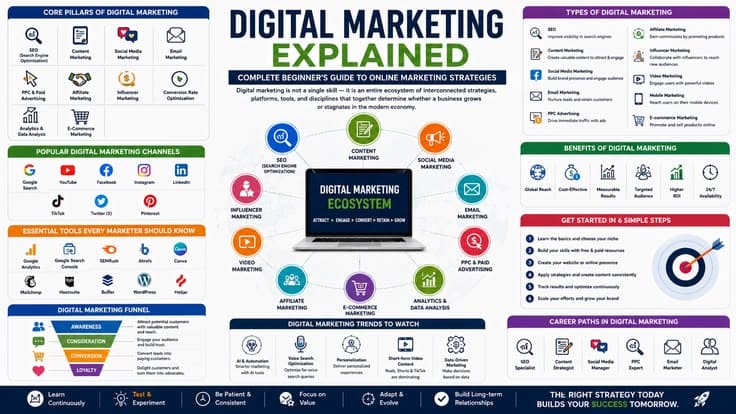
Digital Marketing Explained: Complete Beginner's Guide to Online Marketing Strategies
Digital marketing is not a single skill — it is an entire ecosystem of interconnected strategies, platforms, tools, and disciplines that together determine whether a business grows or stagnates in the modern economy. Whether you are a complete beginner trying to understand what digital marketing actually is, a small business owner looking to attract more customers online, a blogger wanting to monetize your content, or someone considering a career in this field — this comprehensive guide covers every major topic in depth. From SEO and content marketing to paid advertising, email campaigns, affiliate income, AI tools, analytics, social media strategy, and e-commerce — everything is here, explained clearly and practically.
1. What Is Digital Marketing? Complete Overview
Digital marketing is the promotion of products, services, brands, or ideas through digital channels — primarily the internet, but also including mobile devices, search engines, social media platforms, email, websites, apps, and emerging technologies like artificial intelligence and augmented reality. It encompasses every marketing effort that uses an electronic device or the internet to connect a business or creator with its target audience.
At its core, digital marketing solves the same problem that all marketing has always tried to solve: how do you put the right message in front of the right person at the right time? What makes digital marketing uniquely powerful is that it allows you to do this with unprecedented precision, measurability, scalability, and cost-efficiency compared to any previous form of advertising in human history. A small business owner in a rural town can now compete for customers with billion-dollar corporations — using nothing more than a laptop, an internet connection, and the right knowledge.
The digital marketing industry is enormous and growing rapidly. Global digital advertising spending surpassed $600 billion in 2024 and continues to expand as more commerce, communication, and entertainment moves online. In most developed countries, more than 90% of the population is online daily. Consumers now research products extensively before purchasing, seek recommendations from social media, read reviews, watch tutorial videos, and subscribe to email lists — all before reaching for their wallet. Businesses that do not show up meaningfully in these digital touchpoints are effectively invisible to a vast portion of their potential market.
| Aspect | Detail |
|---|---|
| Definition | Promotion of products, services, or brands through digital channels and technologies |
| Primary channels | Search engines, social media, email, websites, mobile apps, video platforms |
| Primary goal | Attract, engage, convert, and retain customers online |
| Key advantage over traditional marketing | Precise targeting, real-time measurement, scalability, lower cost per acquisition |
| Who uses it | Businesses of all sizes, bloggers, creators, nonprofits, governments, individuals |
| Global industry size (2024) | Over $600 billion in digital ad spending annually |
| Skills required | SEO, content writing, analytics, paid ads, email, social media, data interpretation |
| Career potential | High demand globally; median salaries $50,000–$120,000+ depending on specialization |
2. How Digital Marketing Works
Digital marketing works by creating a structured system that moves potential customers through a journey — from first becoming aware of your brand, to considering your offering, to making a purchase decision, and ultimately becoming a loyal repeat customer or advocate. This journey is commonly called the marketing funnel, and understanding it is fundamental to building any effective digital marketing strategy.
At the top of the funnel (awareness stage), the goal is to be discovered. This is where SEO brings your content to the top of Google search results, where social media posts introduce your brand to new audiences, where paid ads appear in front of people who match your target demographic, and where content marketing creates genuinely useful material that attracts visitors who have never heard of you before. At this stage you are not selling — you are being found.
In the middle of the funnel (consideration stage), interested prospects learn more about you. They read your blog posts, watch your videos, browse your product pages, sign up for your email list, or follow your social media accounts. Email marketing, retargeting ads, case studies, and lead magnets all operate primarily at this stage. At the bottom of the funnel (conversion stage), targeted messaging — through email sequences, landing pages, product reviews, limited offers, and personalized ads — converts interested prospects into paying customers. After conversion, email marketing, loyalty programs, and community building drive customer retention, repeat purchases, and referrals — the most cost-effective customer acquisition method of all.
| Funnel Stage | Goal | Primary Channels | Key Metrics |
|---|---|---|---|
| Awareness (Top) | Be discovered by new audiences | SEO, social media, paid ads, content marketing, PR | Impressions, reach, organic traffic, brand searches |
| Consideration (Middle) | Build trust and educate prospects | Email marketing, blog content, retargeting, YouTube, lead magnets | Email sign-ups, time on site, content downloads, video views |
| Conversion (Bottom) | Turn prospects into customers | Landing pages, email sequences, PPC, product pages, reviews | Conversion rate, cost per acquisition (CPA), sales revenue |
| Retention (Loyalty) | Keep customers and generate referrals | Email, loyalty programs, community, re-marketing, customer support | Customer lifetime value (CLV), churn rate, NPS, repeat purchase rate |
3. Digital Marketing vs Traditional Marketing
Traditional marketing encompasses every form of promotion that predates the internet: television commercials, radio advertisements, print ads in newspapers and magazines, billboards, direct mail, trade shows, and cold calling. For most of the twentieth century, these were the only options available to businesses wanting to reach mass audiences. They worked — but they came with significant limitations: high cost, limited targeting capability, no real-time feedback, and virtually no ability to measure the precise return on investment of any specific campaign.
Digital marketing fundamentally changed every one of these constraints. Rather than broadcasting a message to everyone within range of a television signal and hoping some percentage were interested, digital marketing allows you to show your message specifically to 35-year-old women in Chicago who have recently searched for running shoes, follow fitness influencers on Instagram, and have previously visited your website. This level of precision targeting was completely impossible with traditional media and represents the most transformative shift in the history of advertising.
| Factor | Traditional Marketing | Digital Marketing |
|---|---|---|
| Cost | High (TV ads can cost millions; even print ads cost thousands) | Scalable — can start with $0 (organic) or $5/day (paid) |
| Targeting precision | Broad (geographic area, demographic estimates) | Extremely precise (age, interest, behavior, search intent, device, time) |
| Measurability | Difficult — difficult to attribute sales to specific ads | Precise — track clicks, conversions, revenue per campaign in real time |
| Reach | Local or national; limited by media distribution | Global — reach anyone with an internet connection |
| Speed | Slow — campaigns take weeks or months to produce and deploy | Fast — campaigns can launch in hours; results visible within days |
| Interactivity | One-way broadcast — audience cannot immediately respond | Two-way — comments, shares, replies, reviews, direct conversations |
| Personalization | One message for all (or very broad segments) | Highly personalized by individual behavior, preferences, and history |
| ROI tracking | Estimated and indirect | Precise — revenue, cost per click, cost per acquisition all trackable |
| Lifespan of content | Fixed (ad runs for the duration it is paid for) | Evergreen — a blog post or video can generate traffic for years |
| Barrier to entry | High — requires significant capital to advertise meaningfully | Low — beginners can start with free tools and organic strategies |
4. All Types of Digital Marketing Explained
Digital marketing is not a single thing — it is a broad category that encompasses more than a dozen distinct disciplines, each with its own techniques, platforms, skills, and specialists. Understanding the full landscape helps you decide which channels to focus on for your specific goals, audience, and resources.
| Type | What It Is | Primary Goal | Best For | Key Platforms/Tools |
|---|---|---|---|---|
| SEO (Search Engine Optimization) | Optimizing websites and content to rank higher in search engine results organically | Long-term organic traffic | Blogs, content sites, e-commerce, local businesses | Google Search Console, Ahrefs, Semrush, Yoast SEO |
| SEM (Search Engine Marketing) | Paid advertising on search engines to appear at the top of results for target keywords | Immediate targeted traffic | Businesses with ad budget, product launches, competitive niches | Google Ads, Microsoft Advertising (Bing Ads) |
| Content Marketing | Creating valuable, relevant content to attract and retain a defined audience | Brand authority, organic traffic, lead generation | Bloggers, brands, B2B companies, e-commerce | WordPress, HubSpot, Canva, BuzzSumo |
| Social Media Marketing | Using social platforms to build brand awareness, engage audiences, and drive traffic | Brand awareness, community, traffic | All businesses, creators, B2C brands | Facebook, Instagram, Pinterest, LinkedIn, TikTok, YouTube |
| Email Marketing | Sending targeted emails to subscribers to nurture relationships and drive sales | Conversions, retention, revenue | E-commerce, bloggers, SaaS, coaches, all businesses | Mailchimp, ConvertKit, Brevo, Klaviyo, ActiveCampaign |
| Affiliate Marketing | Earning commissions by promoting other companies' products or services | Passive income, performance-based revenue | Bloggers, content creators, niche websites | Amazon Associates, ClickBank, ShareASale, CJ Affiliate |
| PPC (Pay-Per-Click) | Paying for ads where you are only charged when someone clicks | Targeted traffic, immediate results | E-commerce, service businesses, any business with ad budget | Google Ads, Facebook Ads, Instagram Ads, YouTube Ads |
| Influencer Marketing | Partnering with individuals who have established followings to promote your brand | Brand awareness, social proof, sales | Consumer brands, beauty, fashion, fitness, food | Instagram, TikTok, YouTube, AspireIQ, Grin |
| Video Marketing | Creating and distributing video content to market products and build audiences | Engagement, education, conversions | All businesses — particularly product-based and education | YouTube, TikTok, Instagram Reels, Vimeo |
| AI Marketing | Using artificial intelligence tools to automate, personalize, and optimize marketing activities | Efficiency, personalization, scale | All marketers who want to save time and improve results | ChatGPT, Claude, Jasper, Copy.ai, Surfer SEO, Midjourney |
| Marketing Automation | Using software to automate repetitive marketing tasks including emails, social posts, and ad optimization | Efficiency, consistency, nurturing at scale | Growing businesses, e-commerce, SaaS, agencies | HubSpot, ActiveCampaign, Zapier, Klaviyo |
| Local Marketing | Targeting customers in a specific geographic area through local SEO and relevant content | Foot traffic, local leads, local brand awareness | Restaurants, retail, healthcare, service businesses | Google Business Profile, Apple Business Connect, Yelp |
| E-commerce Marketing | Promoting online stores to drive traffic, increase conversions, and maximize revenue | Sales, revenue, customer acquisition | Online stores, dropshipping, Amazon sellers | Shopify, WooCommerce, Google Shopping, Klaviyo |
| Analytics and CRO | Measuring marketing performance and systematically improving conversion rates | Data-driven optimization, improved ROI | All digital marketers who want to improve results | Google Analytics 4, Hotjar, Microsoft Clarity, Optimizely |
5. 50 Digital Marketing Concepts You Must Know
Before diving deep into individual channels and strategies, it is essential to have a working vocabulary of core digital marketing concepts. These are the terms and ideas that appear across every discipline — from conversations with clients to strategy meetings to job interviews.
| # | Concept | Definition |
|---|---|---|
| 1 | SEO (Search Engine Optimization) | The practice of optimizing websites and content to rank higher in organic search engine results |
| 2 | SEM (Search Engine Marketing) | Paid advertising on search engines to appear prominently in search results immediately |
| 3 | Content Marketing | Creating and distributing valuable content to attract, engage, and convert a defined audience |
| 4 | SMM (Social Media Marketing) | Using social platforms to promote brands, engage communities, and drive traffic or sales |
| 5 | Email Marketing | Sending targeted, personalized emails to subscribers to build relationships and drive revenue |
| 6 | Affiliate Marketing | Earning commissions by promoting another company's products and driving sales or sign-ups |
| 7 | Influencer Marketing | Partnering with individuals who have social influence to promote products to their audience |
| 8 | PPC (Pay-Per-Click) | An advertising model where you pay only when someone clicks your ad |
| 9 | Display Advertising | Visual ads (banners, images, videos) shown on websites and apps within ad networks |
| 10 | Native Advertising | Paid content designed to blend seamlessly with the surrounding editorial content of a platform |
| 11 | Remarketing | Showing ads to users who have previously visited your website or interacted with your brand |
| 12 | Retargeting | Often used interchangeably with remarketing — targeting past visitors with relevant ads across platforms |
| 13 | CTR (Click-Through Rate) | The percentage of people who click on a link or ad after seeing it (clicks ÷ impressions × 100) |
| 14 | Conversion Rate | The percentage of visitors who complete a desired action (purchase, sign-up, download) |
| 15 | CRO (Conversion Rate Optimization) | Systematically improving website elements to increase the percentage of visitors who convert |
| 16 | ROI (Return on Investment) | The profit generated relative to the cost of a marketing campaign or activity |
| 17 | ROAS (Return on Ad Spend) | Revenue generated for every dollar spent on advertising (revenue ÷ ad spend) |
| 18 | CPC (Cost Per Click) | The amount paid for each click on an advertisement |
| 19 | CPM (Cost Per Mille) | The cost per 1,000 ad impressions — a standard metric for display and awareness advertising |
| 20 | CPA (Cost Per Acquisition) | The total cost to acquire one paying customer through a campaign |
| 21 | CAC (Customer Acquisition Cost) | The total marketing and sales cost divided by the number of new customers acquired |
| 22 | CLV (Customer Lifetime Value) | The total revenue a business can expect from a single customer relationship over its entire duration |
| 23 | Bounce Rate | The percentage of visitors who leave a website after viewing only one page without interacting further |
| 24 | Organic Traffic | Website visitors who arrive through unpaid search engine results |
| 25 | Paid Traffic | Website visitors who arrive through paid advertisements |
| 26 | Lead Generation | The process of attracting and capturing interest in a product or service for the purpose of developing a sales pipeline |
| 27 | Lead Magnet | A free resource (ebook, checklist, webinar, template) offered in exchange for a visitor's contact information |
| 28 | Landing Page | A standalone web page designed specifically to receive traffic from an ad or campaign and drive a specific conversion action |
| 29 | Sales Funnel | The step-by-step journey that moves a prospect from awareness to purchase (and beyond) |
| 30 | Marketing Automation | Software that automates repetitive marketing tasks including email sequences, social posting, and lead nurturing |
| 31 | A/B Testing | Comparing two versions of a webpage, email, or ad to determine which performs better |
| 32 | Attribution Modeling | The method of determining which marketing channels or touchpoints deserve credit for a conversion |
| 33 | KPI (Key Performance Indicator) | A measurable metric that indicates how effectively a business is achieving a key marketing objective |
| 34 | On-Page SEO | Optimizing individual webpage elements including titles, headings, meta descriptions, keywords, and content |
| 35 | Off-Page SEO | Building external authority through backlinks, brand mentions, and signals from other websites |
| 36 | Technical SEO | Optimizing the technical aspects of a website including speed, crawlability, indexing, and mobile-friendliness |
| 37 | Backlinks | Links from external websites pointing to your site — a primary signal of authority in Google's ranking algorithm |
| 38 | Domain Authority (DA) | A score (1–100) that predicts how well a website will rank in search engines based on its backlink profile |
| 39 | Keyword Research | The process of identifying the search terms your target audience uses so you can create content that appears in those results |
| 40 | Search Intent | The underlying reason or goal behind a person's search query — informational, navigational, commercial, or transactional |
| 41 | UGC (User-Generated Content) | Content (reviews, photos, videos) created by customers or community members rather than the brand itself |
| 42 | Hashtag Marketing | Using relevant hashtags to increase the discoverability of social media content |
| 43 | Social Listening | Monitoring social media platforms and the internet for mentions of your brand, competitors, or relevant topics |
| 44 | Engagement Rate | The percentage of an audience that interacts with content through likes, comments, shares, or clicks |
| 45 | Customer Persona | A detailed, semi-fictional profile of your ideal customer based on research and real data |
| 46 | Customer Journey | The complete sequence of experiences a customer goes through when interacting with your brand from first awareness to post-purchase |
| 47 | Omnichannel Marketing | Providing a seamless, integrated customer experience across all digital and physical touchpoints |
| 48 | Programmatic Advertising | Automated buying and selling of digital advertising using data and algorithms to target specific audiences in real time |
| 49 | Heatmaps | Visual representations of where users click, scroll, or focus their attention on a webpage |
| 50 | AI in Marketing | The application of artificial intelligence tools and algorithms to personalize, automate, and optimize marketing campaigns and content creation |
6. Digital Marketing Roadmap for Beginners
Starting digital marketing can feel overwhelming when you see the full landscape of channels, tools, and skills available. The key to learning it effectively is to follow a structured roadmap that builds foundational knowledge before adding complexity. You do not need to master everything at once — you need to learn the right things in the right order and then practice them consistently.
| Phase | Timeframe | Topics to Master | Practical Actions | Goal |
|---|---|---|---|---|
| Phase 1: Foundations | Weeks 1–4 | What digital marketing is, how the internet works, marketing funnel basics, Google Analytics basics | Complete Google Digital Garage course (free); set up Google Analytics on a test site; study this guide thoroughly | Understand the full digital marketing ecosystem |
| Phase 2: Content and SEO | Weeks 5–10 | Keyword research, on-page SEO, content writing, blog setup, basic technical SEO | Start a blog; write 10 SEO-optimized posts; use Google Search Console to track performance; study Moz Beginner's Guide to SEO | Get your first organic visitors from search engines |
| Phase 3: Social Media | Weeks 10–16 | Platform-specific strategies (choose 1–2 initially), content planning, scheduling, engagement tactics | Build a consistent presence on 1–2 platforms; post 3x per week; engage with your community daily; analyze performance weekly | Build a small but engaged following; drive social traffic to your site |
| Phase 4: Email Marketing | Weeks 16–22 | Email list building, lead magnets, welcome sequences, newsletter creation, email automation basics | Set up Mailchimp or ConvertKit (free tiers); create a lead magnet; build your first welcome email sequence; send a weekly newsletter | Build an email list of your first 100–500 subscribers |
| Phase 5: Monetization | Weeks 22–32 | Affiliate marketing, digital products, display ads, sponsored content, paid advertising basics | Join 2–3 affiliate programs; apply for Google AdSense if eligible; create a simple digital product; run your first $10 test ad | Generate your first online income |
| Phase 6: Analytics and Optimization | Months 6–12 | Google Analytics 4, Google Search Console deep dive, A/B testing, CRO, KPI tracking, campaign optimization | Set up full GA4 tracking; analyze what content converts best; test different headlines, CTAs, and landing pages; optimize weakest areas | Understand what is working and systematically improve every metric |
| Phase 7: Advanced and Specialization | Year 2+ | Paid advertising mastery, AI marketing tools, marketing automation, advanced analytics, specialization in 1–2 channels | Take paid courses in your chosen specialization; freelance or consult for others; build case studies; pursue Google Ads certification | Become a specialist; generate full-time income |
7. Search Engine Optimization (SEO) Explained
Search engine optimization is the practice of improving your website and its content so that search engines like Google rank it higher in their results pages for relevant queries. When someone searches for a term related to your business, product, or content, appearing near the top of the results means dramatically more visibility, traffic, and ultimately revenue than appearing on page two or three — where very few people ever scroll.
Understanding why SEO matters requires understanding how dominant search engines are in directing internet traffic. Google alone processes more than 8.5 billion searches per day. The first organic result in Google gets approximately 27–30% of all clicks for a given query. The second gets about 15%. By position 10, click-through rate drops below 3%. Position one versus position ten is not a small difference — it is an entire order of magnitude in traffic potential. And appearing on page two or beyond is, for most practical purposes, not appearing at all.
SEO is a long-term strategy. Unlike paid advertising, which delivers results immediately but stops the moment you stop paying, SEO builds compounding returns over time. A well-optimized blog post can continue generating organic traffic for years after it is published — making it one of the highest-return investments in digital marketing when approached with patience and consistency. The three fundamental pillars of SEO are content quality and relevance (creating genuinely useful content that matches search intent), authority (earning trust signals through backlinks and engagement), and technical health (ensuring search engines can properly crawl, index, and understand your site).
| Factor Category | Examples | Impact Level |
|---|---|---|
| Content quality and relevance | Depth, accuracy, search intent match, uniqueness, freshness | Very High |
| Backlinks and authority | Number and quality of external links pointing to your site | Very High |
| Keyword optimization | Strategic use of target keywords in title, headings, content, meta description | High |
| User experience signals | Bounce rate, time on page, pages per session, click-through rate from search | High |
| Page speed and Core Web Vitals | Loading time, interactivity, visual stability (Google's CWV metrics) | High |
| Mobile-friendliness | Responsive design, mobile usability, mobile page speed | Very High (mobile-first indexing) |
| Technical health | Crawlability, indexability, XML sitemap, robots.txt, structured data | High |
| E-E-A-T | Experience, Expertise, Authoritativeness, Trustworthiness (particularly for YMYL topics) | Very High |
8. On-Page SEO: What It Is and How to Do It
On-page SEO refers to all the optimization actions you take directly on your webpage and within your content to help search engines understand what the page is about and to signal that it deserves to rank for specific queries. Unlike off-page SEO (which involves earning external signals), on-page SEO is entirely within your control — making it the most logical and actionable starting point for any beginner.
The title tag is one of the most important on-page SEO elements. It appears as the clickable headline in search results and should include your primary target keyword as close to the beginning as possible while still reading naturally for humans. Aim for 50–60 characters to avoid truncation in search results. The meta description — the brief summary shown below the title in search results — does not directly influence rankings but strongly influences click-through rate. Write it as a compelling summary (150–160 characters) that includes your keyword and gives searchers a clear reason to click.
Heading tags (H1, H2, H3) structure your content for both readers and search engines. Your H1 should include your primary keyword and appear only once per page. H2 and H3 subheadings should incorporate related keywords and secondary phrases naturally. Content should be comprehensive, well-structured, and genuinely answer the full scope of the query — thin, superficial content that does not truly address what users are searching for consistently underperforms in modern Google rankings. Internal links connect your pages to each other, distributing authority throughout your site and helping users and search engine bots navigate between related content.
| Element | Best Practice | Priority |
|---|---|---|
| Title Tag | Include primary keyword near the beginning; 50–60 characters; unique for each page | Critical |
| Meta Description | 150–160 characters; include keyword; compelling and click-worthy; unique per page | High |
| H1 Heading | Include primary keyword; only one H1 per page; describes the page's core topic clearly | Critical |
| H2/H3 Subheadings | Use related keywords and LSI phrases naturally; structure content logically | High |
| URL Structure | Short, descriptive, include keyword; use hyphens not underscores; lowercase | High |
| Content depth | Comprehensively cover the topic; match search intent; aim for the right length (quality over quantity) | Critical |
| Keyword usage | Include primary keyword in first 100 words; use naturally throughout; avoid keyword stuffing | High |
| Image optimization | Descriptive file names; include keywords in alt text; compress for fast loading | Medium |
| Internal links | Link to 3–5 relevant pages within your site using descriptive anchor text | High |
| External links | Link to authoritative, relevant external sources to support claims and add value | Medium |
| Page speed | Aim for under 2.5 seconds loading time; compress images; minimize scripts | High |
| Mobile optimization | Responsive design; readable font size on mobile; no horizontal scrolling | Critical |
9. Off-Page SEO: Building Authority and Backlinks
Off-page SEO refers to actions taken outside of your own website that influence your site's authority, trustworthiness, and rankings in search engines. While on-page SEO helps search engines understand what your content is about, off-page SEO signals help them evaluate how much that content should be trusted and respected relative to the millions of other pages competing for the same rankings.
Backlinks — also called inbound links or incoming links — are the most important off-page SEO signal. A backlink is simply a link from another website pointing to yours. Search engines, particularly Google, treat backlinks as votes of confidence: when a respected, authoritative website links to your content, it is essentially telling Google "this resource is valuable enough to direct our readers to." Not all backlinks are equal — a single link from a high-authority site like a major newspaper, government organization, or industry leader can be worth more than hundreds of links from low-quality or spammy sites.
Legitimate link-building strategies include: creating genuinely excellent, comprehensive content that earns links naturally (the so-called "link magnet" approach); guest posting on relevant, reputable websites in your niche; digital PR — generating newsworthy stories or studies that journalists and bloggers naturally cite; broken link building — finding dead links on other sites and offering your content as a replacement; and building strong relationships with other content creators in your space who may naturally link to your work over time. Avoid black-hat tactics like buying links, link farms, or private blog networks — these violate Google's guidelines and can result in severe ranking penalties.
10. Technical SEO: The Foundation Beneath Your Content
Technical SEO ensures that search engine crawlers can efficiently access, crawl, interpret, and index your website's content. No matter how good your content is or how many backlinks you have earned, if search engines cannot properly reach and understand your pages, they will not rank. Technical SEO is the invisible foundation on which all other SEO efforts rest.
Site speed is one of the most important technical factors. Google has explicitly stated that page speed is a ranking signal, and user experience research consistently shows that 53% of mobile users abandon a page that takes more than 3 seconds to load. Google measures site speed through its Core Web Vitals metrics: Largest Contentful Paint (LCP — how long until the main content is visible), First Input Delay (FID — how quickly the page responds to user interaction), and Cumulative Layout Shift (CLS — how much the page layout unexpectedly shifts during loading). Achieving "Good" scores on all three is a meaningful ranking advantage.
Other critical technical SEO elements include: XML sitemaps (which tell search engines which pages on your site exist and how frequently they are updated); robots.txt files (which tell crawlers which pages to access or avoid); structured data and Schema markup (which help search engines understand the type of content on your page and can earn rich results like star ratings or FAQ boxes in search results); canonical tags (which prevent duplicate content issues by telling search engines which version of a page is the "official" one); HTTPS (secure connection — a ranking signal and a trust signal for users); and a clean, logical site architecture that allows crawlers to efficiently reach all important pages without having to traverse long chains of internal links.
11. Local SEO: Ranking in Your City or Region
Local SEO is the practice of optimizing your online presence to attract more business from relevant local searches — queries that include a geographic modifier (like "dentist in Chicago" or "best pizza near me") or that Google interprets as having local intent based on the searcher's location. For brick-and-mortar businesses, service-area businesses, and professionals serving specific geographic markets, local SEO is often the single most impactful digital marketing investment available.
The most important action for local SEO is claiming and fully optimizing your Google Business Profile (GBP) — formerly known as Google My Business. GBP is the information box that appears in Google Maps and in the right-hand panel of local search results. A fully completed, verified, and actively maintained GBP significantly increases your chances of appearing in the coveted "local pack" — the map and three business listings that appear prominently above organic results for local searches. Complete every field in your GBP: business name, address, phone number, website, business hours, business category, description, photos, and products or services.
Customer reviews are the second most powerful local SEO factor. Both the quantity and quality of reviews on Google — and on secondary review platforms like Yelp, TripAdvisor, or industry-specific directories — directly influence local rankings and, critically, conversion rates (people read reviews before choosing a local business). Consistently earning genuine positive reviews, and professionally responding to all reviews including negative ones, is a powerful and sustainable local SEO strategy. Local citations — mentions of your business name, address, and phone number (NAP) on third-party websites like Yelp, Yellow Pages, and local directories — also contribute to local ranking authority, particularly when the NAP information is consistent across all platforms.
12. Keyword Research: Finding What People Actually Search
Keyword research is the process of discovering the specific words and phrases that people type into search engines when looking for information, products, or services related to your niche. It is the strategic foundation of both SEO and SEM — without understanding what your target audience is searching for, you are essentially creating content and running ads based on guesswork rather than data.
Effective keyword research involves three key considerations beyond simply finding high-volume search terms. Search volume (how many times a keyword is searched per month) indicates the potential traffic available. Keyword difficulty (how competitive a keyword is based on the authority of existing ranking pages) indicates how hard it will be to rank for that term. Search intent (what the person actually wants when they search that phrase) determines whether your content or landing page will satisfy the searcher well enough to convert them. The most valuable keywords balance moderate-to-high volume with manageable difficulty and clear, well-matched search intent.
| Keyword Type | Characteristics | Example | Best For |
|---|---|---|---|
| Short-tail (Head) | 1–2 words; very high volume; very high competition; broad intent | "digital marketing" | Established sites with high authority — very hard for beginners to rank |
| Mid-tail | 2–3 words; moderate volume; moderate competition; clearer intent | "digital marketing guide" | Growing sites with some established authority |
| Long-tail | 4+ words; lower volume; lower competition; very specific intent | "digital marketing guide for beginners 2026" | New sites and beginners — high conversion intent, easier to rank |
| Informational | "how to," "what is," "why" — seeking information | "how to start digital marketing" | Top-of-funnel content, blog posts, educational guides |
| Commercial | Research before purchase — "best," "review," "comparison" | "best email marketing software" | Review content, comparison posts, affiliate marketing |
| Transactional | Ready to buy — "buy," "discount," "coupon," "sign up" | "sign up for Mailchimp free" | Product pages, landing pages, PPC campaigns |
| Navigational | Looking for a specific site or brand | "Mailchimp login" | Brand protection ads; not useful for content marketing |
| Local | Include location or imply local intent | "digital marketing agency Chicago" | Local businesses, service-area businesses |
13. Search Engine Marketing (SEM): SEO vs Paid Search Explained
Search Engine Marketing (SEM) in its broadest definition encompasses all strategies to gain visibility in search engine results pages — including both SEO (organic) and paid search advertising. In practice, many marketers use SEM to specifically refer to paid search advertising — paying for ads that appear at the top and bottom of search results pages for target keywords.
The fundamental distinction between SEO and paid search is the difference between earning your position and paying for it. With SEO, you invest time, expertise, and content creation effort to build authority that causes Google to rank your pages organically — and once you achieve those rankings, the traffic is free. With paid search, you bid on keywords in an auction system and pay Google a fee for every click on your ad. The moment your budget runs out or you stop paying, your visibility disappears completely.
| Factor | SEO (Organic) | SEM (Paid Search) |
|---|---|---|
| Cost structure | Free traffic once ranked; cost is time and expertise investment | Pay per click (CPC); costs continue as long as you advertise |
| Speed to results | Slow — typically 3–12 months to see significant organic rankings | Immediate — ads appear as soon as campaign is approved (hours) |
| Traffic sustainability | Long-lasting — ranked content continues to generate traffic | Stops the moment you stop paying |
| Trust and credibility | Higher — users trust organic results more than ads | Lower — clearly labeled as "Sponsored" or "Ad" |
| Control | Less direct control — Google's algorithm determines rankings | Full control over budget, targeting, scheduling, ad copy, bids |
| Targeting precision | Targets broad keyword intent; limited demographic targeting | Highly precise — keyword, location, device, time, audience targeting |
| Scalability | Scales through more content creation over time | Scales instantly by increasing budget |
| Best use case | Long-term brand building, sustainable traffic, content marketing | Product launches, time-sensitive promotions, competitive keyword testing, immediate traffic needs |
| Combined strategy | Most effective when used together — SEO builds long-term authority while SEM delivers immediate results; paid ads data reveals which keywords convert best for SEO prioritization | |
14. Content Marketing Explained
Content marketing is the strategic practice of creating and distributing valuable, relevant, and consistent content to attract and retain a clearly defined audience — and ultimately, to drive profitable customer action. The crucial word here is "valuable." Content marketing is not advertising — it is not about interrupting people with promotional messages about your product. It is about providing genuinely useful information, entertainment, or inspiration that serves your audience's interests and needs, building trust and authority over time that naturally converts into business results.
The Content Marketing Institute defines content marketing as "a strategic marketing approach focused on creating and distributing valuable, relevant, and consistent content to attract and retain a clearly defined audience — and, ultimately, to drive profitable customer action." Major brands like Red Bull (which produces its own media channels and extreme sports content), HubSpot (which built a $1+ billion business largely through educational blog content), and Patagonia (which tells stories about environmental activism) are frequently cited as examples of content marketing done exceptionally well — brands that earn attention by providing genuine value rather than purchasing it.
Content marketing works because it aligns with how modern buyers actually make decisions. Before purchasing, the vast majority of consumers research extensively online — reading reviews, watching how-to videos, comparing options, reading expert guides, and consuming content that helps them understand their problem and evaluate their options. If your brand creates the content that helps them through this process, you earn trust and preference that translates into sales with far more reliability and at far lower cost per acquisition than traditional advertising.
| Content Format | Best Platform | Strengths | Best For |
|---|---|---|---|
| Blog posts and articles | Your website | SEO-friendly, evergreen, establishes authority, drives organic traffic | Information, tutorials, lists, comparisons, guides — any informational or commercial intent |
| Long-form guides and pillar pages | Your website | Extremely high SEO value; comprehensive topic coverage earns backlinks naturally | Core topic authority — cornerstone content that defines your expertise |
| Video content | YouTube, TikTok, Instagram, website | High engagement, demonstrates skills, builds personal connection | How-to demonstrations, storytelling, product reviews, entertainment |
| Infographics | Pinterest, blog posts, social media | Highly shareable, visually communicates complex information | Statistics, processes, comparisons, step-by-step guides |
| Podcasts | Spotify, Apple Podcasts, YouTube | Builds deep loyalty, reaches commuters, growing medium | Interviews, industry discussions, educational series |
| Email newsletters | Email (directly to subscribers) | Highest engagement rate of any channel; owned audience; direct relationship | Updates, curated content, product announcements, community building |
| Case studies | Website, LinkedIn, email | Builds trust through proof of results; highly persuasive for B2B | Demonstrating results for potential customers in the consideration stage |
| Free tools and templates | Website | Earns natural backlinks; high-value lead magnets; builds email list | Attracting links and email subscribers from target audience |
15. Pillar Content and Topic Clusters Strategy
The pillar content and topic clusters model is one of the most effective modern SEO content strategies, developed in response to how Google's search algorithm has evolved. Google increasingly rewards comprehensive topical authority — sites that thoroughly cover a subject from multiple angles — over sites that simply produce keyword-stuffed individual posts. The topic cluster model creates this authority deliberately and systematically.
A pillar page is a comprehensive, long-form piece of content that covers a broad topic at a high level while linking to more detailed "cluster" pages for each subtopic. For example, a pillar page on "Digital Marketing" covers all major aspects (SEO, content marketing, social media, email, PPC, etc.) and links to dedicated detailed guides on each. Each cluster page, in turn, links back to the pillar page and potentially to other related cluster pages, creating a tightly interwoven web of topically related content that signals to Google that your site is an authoritative, comprehensive resource on the subject.
This structure benefits SEO in multiple ways: the internal links between pillar and cluster pages distribute link authority throughout the entire content cluster; Google can clearly understand the topical relationship between all the pages; users spend more time on the site navigating between related content (a positive user experience signal); and the comprehensive nature of the cluster naturally attracts backlinks from other sites referencing your content as an authoritative resource. Building topic clusters rather than disconnected individual posts is one of the highest-leverage content strategy decisions you can make for long-term SEO success.
16. Six Content Ideas That Never Fail
One of the most common struggles for digital marketers and content creators is consistently generating content ideas that will perform well. Fortunately, certain content formats have proven over and over to attract, engage, and convert audiences across virtually every niche. These six content archetypes are the most reliably effective in content marketing history.
- How-To Guides: People search for solutions to problems. Step-by-step instructional content that solves a real, specific problem is consistently among the most searched and most linked-to content on the internet. Great for blogs, YouTube, Pinterest, and every other platform. Example: "How to Start Digital Marketing in 30 Days."
- List Posts (Listicles): Lists are easy to read, easy to share, and set clear expectations ("10 things" communicates exactly what you will get). They perform exceptionally well for both traffic and social sharing across all niches. Example: "15 Free Digital Marketing Tools That Actually Work."
- Case Studies: Real documented results build trust and credibility more effectively than any other content format. Show the problem, the process, and the measurable outcome. Case studies are particularly powerful for B2B marketing and for establishing authority in competitive niches. Example: "How I Grew My Blog from 0 to 50,000 Monthly Visitors in 12 Months."
- Comparison Posts: When people are evaluating their options before a decision, comparison content is exactly what they need. These posts also convert extremely well for affiliate marketing. Example: "Mailchimp vs ConvertKit: Which Is Better for Beginners?"
- Myths vs Facts: Debunking common misconceptions in your niche establishes your expertise, positions you as a trustworthy authority, and often generates strong social engagement. Example: "10 SEO Myths That Are Costing You Traffic."
- Trending Topics: Creating content around current trends, breaking news, or seasonal events can generate rapid, significant traffic spikes. Timely content also demonstrates that your site is current and actively maintained — a subtle trust signal for both users and search engines. Example: "How AI Is Changing Digital Marketing in 2026."
17. Copywriting: Writing That Sells
Copywriting is the art and science of writing persuasive text — called "copy" — that motivates readers to take a specific action: click a button, buy a product, sign up for a newsletter, download a resource, or make a phone call. While content writing informs and educates, copywriting converts. The most effective digital marketers understand both disciplines and know which to deploy in different contexts.
Great copywriting is built on understanding your audience's desires, fears, frustrations, and aspirations at a deep level, and speaking to those psychological drivers in language that resonates authentically. The most foundational copywriting framework is AIDA: Attention (capture the reader's attention with a compelling headline or opening), Interest (build interest by connecting your message to their specific situation or problem), Desire (create desire for the solution you are offering by showing its benefits), and Action (give a clear, specific call to action that tells them exactly what to do next). This structure underlies virtually every high-converting piece of marketing copy ever written.
Key copywriting principles for digital marketing include: writing benefit-focused headlines (what does the reader get, not what the product does); using social proof (testimonials, numbers, case study results) to reduce skepticism; creating urgency without being manipulative; writing in second-person ("you") to speak directly to the reader; keeping sentences and paragraphs short for easy scanning; using active voice rather than passive; and ending every piece of copy with a clear, specific call to action that removes all ambiguity about what you want the reader to do next.
18. Social Media Marketing: Platforms, Strategy and Growth
Social media marketing is the use of social platforms to connect with your audience, build brand awareness, increase engagement, drive traffic, and grow sales. It encompasses both organic social media activity (posting content, engaging with followers, building community) and paid social advertising (targeted ads to reach specific audiences based on detailed demographic and behavioral data).
With more than 5 billion social media users worldwide as of 2025, and the average person spending nearly 2.5 hours per day on social platforms, social media marketing represents one of the most significant opportunities in digital marketing for reaching virtually any audience. However, social media marketing is also one of the most misunderstood and misused channels — many businesses invest significant time creating content without a clear strategy, posting inconsistently, or choosing the wrong platforms for their audience.
| Platform | Monthly Active Users | Audience Strength | Best Content Types | Best For |
|---|---|---|---|---|
| 3+ billion | Broad demographic (25–65+); community groups; local | Text posts, videos, events, groups, stories, lives | Community building, local marketing, broad consumer brands, event promotion, Facebook Ads | |
| 2+ billion | 18–34 year olds; visual-first; lifestyle, fashion, beauty, food | Photos, Reels, Stories, carousels, shopping posts | Visual brands, influencer marketing, e-commerce, lifestyle businesses | |
| 500+ million | Predominantly female (60–70%); planning mindset; high purchase intent | Vertical images, infographics, idea pins, step-by-step visuals | Bloggers, e-commerce, home decor, fashion, food, travel, DIY — drives website traffic | |
| 1 billion+ | Professionals, B2B decision makers, executives | Text posts, articles, carousels, video, company updates | B2B marketing, professional services, thought leadership, talent acquisition | |
| TikTok | 1.5+ billion | Under-35 (especially Gen Z); entertainment first; viral content | Short-form vertical video (15 seconds to 10 minutes) | Consumer brands targeting younger demographics, entertainment, product discovery |
| YouTube | 2.7 billion | All ages; second-largest search engine; high engagement and trust | Long-form tutorials, reviews, vlogs, documentaries, courses | Education, how-to content, product reviews, brand storytelling, monetization through ads |
| X (Twitter) | 600+ million | Tech, news, finance, media professionals; real-time conversation | Short text posts, threads, polls, links | Real-time updates, customer service, thought leadership, news-related industries |
19. Social Media Marketing Strategy: 6-Step Framework
Successful social media marketing is never accidental — it is the product of a clear strategy executed consistently over time. Without strategy, most businesses end up posting randomly, switching platforms frequently, chasing trends without direction, and eventually abandoning social media after concluding "it doesn't work for us." The 6-step framework below creates the structure for a social media strategy that actually delivers measurable business results.
- Set Clear, Measurable Goals: Define exactly what you want social media to achieve. Brand awareness (reach, impressions)? Website traffic (clicks, sessions)? Leads (form completions, email sign-ups)? Sales (direct conversions)? Each goal requires different content, different platforms, and different metrics. Without clear goals, there is no way to evaluate whether your efforts are working.
- Know Your Audience Deeply: Identify where your ideal customers spend time online, what type of content they engage with, what problems they are trying to solve, and what tone of voice resonates with them. Conduct surveys, analyze competitor audiences, and study the demographics data in each platform's analytics tools.
- Create Valuable, Platform-Specific Content: The content that works on LinkedIn (professional, insight-driven) is completely different from what works on TikTok (entertaining, fast-paced, trend-aware) or Pinterest (visual, aspirational, practical). Adapt your content to each platform's native format and culture rather than posting identical content everywhere.
- Plan and Publish Consistently: Create a content calendar at least 2–4 weeks in advance. Consistency is the single most important factor in social media growth — irregular posting breaks algorithmic momentum and erodes audience trust. Aim for a posting frequency you can sustain indefinitely rather than an aggressive schedule you will abandon in weeks.
- Engage and Build Community: Social media is not a broadcast channel — it is a conversation. Reply to every comment, acknowledge mentions, ask questions, participate in discussions, and create opportunities for your audience to interact with each other. Genuine community engagement dramatically amplifies organic reach and builds loyalty that no advertising budget can replicate.
- Analyze and Optimize: Review performance metrics weekly. Which posts generated the most reach, engagement, and website clicks? What time of day performs best? Which content format resonates most? Use this data to double down on what works and stop wasting time on what does not. Social media algorithms reward content that earns engagement — so continuously improving your content quality directly improves your organic reach.
20. Facebook Marketing Guide
Facebook remains the largest social media platform in the world with over 3 billion monthly active users across all age groups, and it offers the most sophisticated advertising targeting capabilities of any social platform. For businesses, Facebook marketing encompasses both organic presence (posting on your business page, participating in groups, creating events) and the extraordinarily powerful Facebook Ads platform — which allows you to reach highly specific audiences with precision that was unimaginable in traditional advertising.
Facebook's organic reach has declined significantly over the past decade — today, only 2–5% of your page's followers typically see any given organic post. This makes Facebook Groups far more valuable than Facebook Pages for organic community building, as group content is shown to members far more reliably. Creating or participating actively in relevant Facebook Groups — providing genuine value, answering questions, and building authority — is one of the most underutilized free Facebook marketing strategies available to small businesses and content creators.
Facebook Ads (now part of Meta Ads alongside Instagram ads) offers targeting based on demographics, interests, behaviors, life events, job titles, and crucially, custom audiences (uploading your email list to target existing contacts) and lookalike audiences (finding new users who statistically resemble your best existing customers). Facebook Ads work through an auction system — you set a budget and bid, and Facebook shows your ad to users it predicts are most likely to take your desired action. The most important elements of a successful Facebook ad are: the creative (image or video — this is what stops the scroll and determines whether anyone reads your copy), the headline, and the call-to-action. Always test multiple creative variations to identify which performs best before scaling your budget.
21. Instagram Marketing Guide
Instagram is a visual-first platform with over 2 billion monthly active users, particularly strong in the 18–34 age demographic, and consistently one of the most important platforms for consumer brands, lifestyle businesses, e-commerce, influencer marketing, and content creators. Instagram's content formats have expanded significantly beyond photos: Stories (24-hour ephemeral content ideal for behind-the-scenes and interactive content), Reels (short-form vertical video that Instagram's algorithm aggressively distributes to non-followers), carousels (multiple images or graphics in a single swipeable post — excellent for educational content), and Shopping (allowing businesses to tag products directly in posts for purchase).
Reels is currently Instagram's highest-reach format. Instagram's algorithm prioritizes Reels content for distribution to non-followers, making it the most powerful organic growth tool available on the platform. Creating Reels that are entertaining, educational, or shareable — and doing so consistently — is the fastest path to organic audience growth on Instagram in 2025–2026. The first 1–2 seconds of a Reel must immediately capture attention, as users scroll rapidly and will abandon content that does not hook them instantly.
The Instagram algorithm primarily rewards: engagement (saves are weighted very heavily — content that users save for later reference is treated as a strong quality signal), shares (sending content to friends via DM signals high relevance), watch time on Reels, and consistency. For businesses, Instagram Shopping integration with an online store (Shopify integration is seamless) creates a frictionless path from discovery to purchase that can significantly increase e-commerce conversion rates. Instagram Ads, managed through Meta Ads Manager, shares the same powerful targeting capabilities as Facebook Ads and allows you to run the same ad simultaneously across both platforms.
22. Pinterest Marketing for Bloggers and Businesses
Pinterest is one of the most misunderstood and underutilized platforms in digital marketing — yet for the right types of businesses and content creators, it can be a phenomenally powerful source of targeted website traffic. Unlike Instagram or TikTok, where content is primarily consumed on the platform and traffic generation to external sites is limited, Pinterest functions more like a visual search engine — users actively search for ideas, products, and inspiration, and each pin can contain a link that drives them directly to your website.
Pinterest users are in a fundamentally different mindset from users on other social platforms. They are planning — weddings, home renovations, meal prep, travel, style choices, craft projects — and they are actively looking for content, products, and ideas to save and revisit. This planning mindset, combined with the predominantly female user base (approximately 60–70% of Pinterest users are women), makes Pinterest exceptionally powerful for bloggers, e-commerce businesses, and brands operating in categories like food, fashion, home decor, DIY, health, beauty, travel, and personal finance.
Pinterest SEO is particularly valuable because pins have a very long lifespan compared to posts on other social platforms. While a tweet or Instagram post may generate most of its engagement within hours, a well-optimized Pinterest pin can continue driving traffic for months or years after it is published. Optimizing pins for Pinterest SEO involves using keyword-rich descriptions, relevant board titles and descriptions, high-quality vertical images (1000×1500 pixels is the recommended aspect ratio), and linking to specific, relevant content on your website rather than just your homepage. Consistently pinning fresh content (aim for 5–15 pins per day using a scheduler like Tailwind) signals to Pinterest's algorithm that you are an active, quality contributor worth distributing to more users.
23. LinkedIn Marketing: B2B Lead Generation
LinkedIn is the world's largest professional network with over 1 billion members in more than 200 countries, and it is by far the most powerful digital marketing platform for B2B businesses, professional services, consultants, coaches, SaaS companies, recruiters, and anyone whose target customer is a professional or business decision maker. LinkedIn offers both organic marketing (building a personal brand through thought leadership content) and paid advertising (LinkedIn Ads with unmatched professional targeting capabilities).
LinkedIn's organic algorithm has become increasingly favorable for content creators on the platform. Text posts from personal profiles (rather than company pages) consistently receive far more organic reach than equivalent content on any other major platform. Sharing original insights, professional lessons, industry perspectives, and personal stories of professional growth consistently generates high engagement, significant reach, and direct business opportunities. The LinkedIn newsletter feature allows creators to build and communicate directly with subscribers — creating an owned audience on the platform similar to email marketing.
LinkedIn Ads offer targeting capabilities that no other platform matches for B2B purposes: job title, company name, company size, industry, seniority level, skills, educational background, and LinkedIn Group membership. While LinkedIn Ads are significantly more expensive than Facebook or Google Ads on a cost-per-click basis, they can generate exceptional ROI for B2B products and services because of the quality of the targeting — reaching the exact decision-makers who have authority to purchase what you sell. LinkedIn Lead Gen Forms, which allow users to submit their pre-populated LinkedIn profile information with one click, can generate leads at impressive conversion rates for high-value B2B offers like webinars, white papers, demos, and consultations.
24. TikTok and YouTube Marketing
TikTok and YouTube represent the two dominant video marketing platforms — one built on short-form, algorithm-driven discovery, and one built on search-driven long-form content. Understanding the distinct strengths and mechanisms of each allows digital marketers to deploy video content strategically across both platforms for complementary benefits.
TikTok's defining characteristic is its unprecedented organic reach for new creators. Unlike other social platforms where organic reach requires building a follower base first, TikTok's algorithm distributes content to non-followers based on engagement signals from the first hours after posting. A brand new account with zero followers can publish a video today and have it seen by 100,000 people tomorrow if it resonates. TikTok's content culture prioritizes authenticity, entertainment, trend participation, and fast-paced storytelling. The platform skews toward younger demographics (Gen Z and Millennials) but has significant adoption across all age groups. TikTok Shop has made the platform increasingly powerful for direct product sales through short video content.
YouTube is the second-largest search engine in the world and the second most-visited website, processing over 3 billion searches per month. YouTube content has a dramatically longer lifespan than TikTok — a well-optimized YouTube video can continue generating views and driving traffic for years through YouTube search and suggested video recommendations. YouTube audiences also tend to spend much more time with individual pieces of content, making it exceptional for building deep trust, demonstrating expertise, and creating the kind of parasocial connection that converts viewers into loyal buyers. YouTube monetization through the Partner Program (ad revenue), channel memberships, Super Chats, and merchandise shelves makes it one of the most valuable platforms for creator income alongside affiliate marketing and sponsored content.
25. Email Marketing: The Highest-ROI Digital Channel
Email marketing consistently delivers the highest return on investment of any digital marketing channel. Industry data shows that for every $1 spent on email marketing, the average return is $36–$42 — a return that dwarfs social media, paid advertising, and most other channels. This extraordinary ROI exists because email is a direct, personal, permission-based communication with people who have already expressed genuine interest in what you offer by voluntarily subscribing.
Unlike social media followers, which are effectively rented audiences on platforms you do not control and where algorithm changes can devastate your reach overnight, your email list is an owned asset. No platform can take it away. No algorithm change can reduce its value. The relationship you have with your email subscribers is direct, unmediated, and permanent — making email list building one of the most important long-term investments in digital marketing, regardless of what other channels you use.
| # | Strategy | Why It Works |
|---|---|---|
| 1 | Always preview emails on mobile before sending | Over 60% of emails are opened on mobile devices; poor mobile rendering destroys conversions |
| 2 | Avoid spam trigger words in subject lines | Words like "FREE," "EARN MONEY," "CLICK NOW" trigger spam filters that prevent delivery |
| 3 | Check every link before sending | Broken links destroy trust and eliminate conversion opportunities |
| 4 | Set up an automated welcome series for new subscribers | New subscribers have peak engagement — automated welcome sequences capitalize on this moment |
| 5 | Use emojis wisely in subject lines | Well-placed emojis can increase open rates; excessive use reduces credibility |
| 6 | Segment your audience for higher CTR and conversions | Sending relevant content to relevant segments consistently outperforms broadcast emails |
| 7 | Use storytelling to engage subscribers | Stories are inherently compelling and dramatically improve read-through rates |
| 8 | Create drip campaigns to sell on autopilot | Automated email sequences nurture leads 24/7 without additional manual effort |
| 9 | Use visual elements including images and GIFs | Visual content increases engagement and breaks up text-heavy content effectively |
| 10 | Craft compelling, curiosity-driven subject lines | The subject line determines whether the email is opened — it is the most important line you write |
| 11 | Use clear, specific calls to action | One clear CTA per email outperforms multiple competing CTAs every time |
| 12 | Provide genuine value in every email | Subscribers stay for value; they unsubscribe when emails feel promotional without benefit |
| 13 | Ask for feedback through surveys | Survey data informs better segmentation and content — and makes subscribers feel valued |
| 14 | Use interactive elements like polls and quizzes | Interactive emails dramatically increase engagement and provide valuable audience data |
| 15 | Create re-engagement campaigns for inactive subscribers | Reactivating inactive subscribers is far cheaper than acquiring new ones |
| 16 | Plan seasonal campaigns well in advance | Timely campaigns around holidays, events, and seasons consistently generate elevated sales |
| 17 | Provide exclusive offers to subscribers | Subscriber-exclusive deals make list membership feel valuable, reducing unsubscribes |
| 18 | Personalize emails with recipient name and relevant content | Personalized emails generate 6x higher transaction rates than non-personalized |
26. How to Build an Email List from Zero
Building an email list is one of the most valuable long-term investments in digital marketing, yet many beginners are intimidated by the process of attracting their first subscribers. The fundamental principle is straightforward: give people a compelling reason to share their email address with you. Nobody gives out their email for nothing — you must offer something genuinely valuable in exchange, reduce friction in the sign-up process, and make the ongoing experience worth continuing to be subscribed.
The most effective list-building tool is the lead magnet — a free resource offered in exchange for an email address. Effective lead magnets are specific (solving a very particular problem rather than promising vague general value), immediately useful (delivering value within minutes of being received), and genuinely high-quality (if your free resource is impressive, subscribers will trust that your paid offerings are excellent). Strong lead magnet formats include: checklists, templates, swipe files, mini-courses, guides or ebooks, resource libraries, free tools, quizzes (which also provide powerful segmentation data), and free trials or samples.
Your lead magnet should be promoted through every available channel: a prominent opt-in form on your website (particularly on your highest-traffic pages, in your site header, and as an exit-intent popup); your social media bios and posts; dedicated landing pages built specifically to convert ad traffic; within your existing content (contextual opt-in forms embedded naturally within blog posts are consistently the highest-converting placement); and through collaborations with other creators in complementary niches who can introduce their audiences to your lead magnet. Growing your list from zero to 1,000 subscribers requires deliberate, consistent promotion — it does not happen passively.
27. Paid Advertising (PPC): Complete Beginner's Guide
Pay-Per-Click (PPC) advertising is a digital marketing model where advertisers pay a fee each time one of their ads is clicked. Rather than earning traffic organically through SEO and content, PPC is buying targeted traffic — placing your message directly in front of people who are searching for relevant terms (search ads) or who match your target audience profile (social and display ads).
The most widely used PPC platform is Google Ads (formerly Google AdWords), which allows advertisers to bid on keywords and have their text ads displayed at the top and bottom of Google search results pages. When a user searches for one of your target keywords, Google runs an instantaneous auction to determine which ads appear and in what order. The auction considers both your bid (how much you are willing to pay per click) and your Quality Score — a composite measure of your ad's relevance, expected click-through rate, and landing page experience. A higher Quality Score means your ad can appear in a higher position at a lower cost, making it directly profitable to improve your ad relevance and landing page quality.
| # | Strategy | Why It Matters |
|---|---|---|
| 1 | Define clear campaign goals before launching | Goals (leads, sales, traffic, brand awareness) determine campaign type, bid strategy, and success metrics |
| 2 | Research and understand different ad formats before choosing | Search, display, video, shopping, and app ads all serve different purposes and audiences |
| 3 | Write compelling, benefit-focused ad copy | Ad copy is the first impression — it determines whether people click or scroll past |
| 4 | Target your audience precisely using all available options | Demographic, location, device, time, interest, and in-market targeting prevent wasted budget |
| 5 | Choose the right keywords (and keyword match types) | Broad, phrase, and exact match types determine when your ad appears — wrong choice wastes budget |
| 6 | Set appropriate daily and monthly budgets | Starting with a test budget before scaling prevents costly mistakes on unproven campaigns |
| 7 | Monitor campaign performance daily in the early stages | Early data reveals what is working and what is wasting budget before losses accumulate |
| 8 | Continuously test different ad variations | A/B testing ad copy, headlines, and images consistently improves click-through and conversion rates |
| 9 | Optimize campaigns based on performance data | Adding negative keywords, adjusting bids, and pausing underperforming ads maximizes ROI |
| 10 | Consider working with a PPC specialist for complex campaigns | Professional management can dramatically reduce wasted spend and improve results for significant budgets |
28. Google Ads: How It Works and How to Succeed
Google Ads is the world's largest and most widely used digital advertising platform, processing billions of ad auctions every day across Google Search, the Google Display Network (over 2 million websites and apps), YouTube, Gmail, and Google Maps. For businesses seeking immediate targeted traffic, Google Ads offers unmatched reach and intent-based targeting — you can put your message in front of people at the precise moment they are actively searching for what you offer.
Google Search Ads appear as text ads above and below organic search results, clearly labeled as "Sponsored." When a user searches for keywords you are bidding on, your ad enters an auction against other advertisers targeting the same terms. Google determines ad position using Ad Rank — a formula that combines your maximum bid, Quality Score (ad relevance × expected CTR × landing page experience), and contextual signals. Quality Score is critical: an ad with a Quality Score of 10 can achieve a higher position at a lower cost than a competitor with a Quality Score of 3, even if that competitor is bidding more. This means that investing in high-quality, highly relevant ad copy and landing pages directly reduces your advertising costs.
Google Ads campaign types include: Search (text ads triggered by keyword searches), Display (visual banner ads on partner websites and apps), Shopping (product listing ads for e-commerce), Video (ads on YouTube), App (promoting mobile apps), and Performance Max (AI-driven campaigns that automatically serve ads across all Google channels). For beginners, starting with Search campaigns targeting high-intent keywords in your niche — using phrase or exact match keyword types to control when your ads appear — and ensuring your landing pages are specifically designed to convert the traffic you are paying for is the highest-leverage starting strategy.
29. Facebook Ads vs Google Ads: Which Is Right for You?
Facebook Ads (Meta Ads) and Google Ads are the two dominant paid advertising platforms in digital marketing, and the choice between them — or how to use both together — is one of the most common strategic questions facing digital marketers. The answer depends on your business type, your audience, your goals, and where in the customer journey you are trying to engage people.
The fundamental difference lies in intent. Google Ads captures demand — people are actively searching for something related to what you offer. Facebook Ads create demand — you show your message to people who match your target audience profile even if they are not actively searching for your product at that moment. Google is best when people already know they have a need (searching "best project management software" or "dentist near me"). Facebook is best for products or services where people do not know they want until they see them — or for building brand awareness and nurturing audiences who are earlier in the purchase journey.
| Factor | Google Ads | Facebook Ads |
|---|---|---|
| User intent at time of ad exposure | High — actively searching for solution | Variable — browsing feed, not actively searching |
| Targeting basis | Keywords, search intent, demographics, location | Demographics, interests, behaviors, custom and lookalike audiences |
| Primary ad format | Text-based search ads; visual display, shopping, video | Visual — image, video, carousel, stories, Reels |
| Average cost per click | Higher — typically $1–$5+ (varies widely by industry) | Generally lower — $0.50–$2.00 average but varies widely |
| Best for conversion stage | Bottom-of-funnel — purchase intent searches | All stages — particularly awareness and consideration |
| Product/service discovery | Limited — requires user to already know to search | Excellent — reaches people who did not know they wanted your product |
| Visual creativity requirement | Low for search; high for display and YouTube | High — visual creative is the most important element of ad performance |
| Best industries | Professional services, e-commerce with search demand, local services, B2B with clear search terms | E-commerce, consumer goods, fashion, beauty, lifestyle brands, app installs, B2C with visual products |
| Audience size | Limited to people actively searching at a given time | Enormous — can reach billions of users matching defined criteria |
| Ideal strategy | Use Google Ads to capture existing search demand; use Facebook Ads to create awareness and retarget website visitors who found you through search — both platforms complement each other powerfully | |
30. Affiliate Marketing: Complete Beginner's Guide
Affiliate marketing is a performance-based marketing model where you (the affiliate) promote another company's product or service and earn a commission for every sale, lead, or action generated through your unique referral link. It is one of the most popular and accessible ways to generate online income — requiring no product creation, no inventory, no customer service, and no upfront investment beyond the time spent creating content and building an audience.
The affiliate marketing ecosystem involves three parties: the merchant (the company that creates and sells the product), the affiliate (the content creator or marketer who promotes it), and the customer (who purchases through the affiliate's link). Merchants benefit because they only pay for results — they pay affiliate commissions only when actual sales or leads are generated, making affiliate marketing one of the most cost-effective customer acquisition channels available. Affiliates benefit because they can earn income from products they genuinely recommend without the operational complexity of running a product business. Customers benefit because they often discover genuinely excellent products through trusted content creators who have researched and tested what they recommend.
| Platform | Type | Commission Range | Best For | Payment Method |
|---|---|---|---|---|
| Amazon Associates | Physical and digital products | 1–10% (varies by category) | Beginners; product review sites; almost any niche | Direct deposit, gift card, check |
| ClickBank | Digital products (courses, software, ebooks) | 20–75% — very high commissions | Digital product promotion; health, wealth, relationships niches | Direct deposit, wire transfer, check |
| ShareASale | Mixed — many categories | Varies by merchant (typically 5–50%) | Diverse niches; retail and services | Direct deposit, check, Payoneer |
| CJ Affiliate (Commission Junction) | Major brands and retailers | Varies widely by brand | Established sites; mainstream consumer brands | Direct deposit, check |
| Impact | SaaS, e-commerce, services | Varies — many high-value programs | Tech, SaaS, travel, finance niches | Direct deposit, PayPal, wire |
| Digistore24 | Digital products; strong in European markets | 20–70% | Digital marketers promoting courses and software | PayPal, bank transfer |
| PartnerStack | SaaS and B2B software | Typically 20–50% recurring | B2B, SaaS, business software niches | Direct deposit, PayPal |
| Direct brand programs | Individual company affiliate programs | Highly variable (5–50%+ for SaaS) | Affiliates who specialize in specific brands or software | Varies by company |
31. Analytics and Google Analytics 4 (GA4) Guide
Web analytics is the measurement, collection, analysis, and reporting of website data to understand and optimize web usage. Without analytics, digital marketing is guesswork — you would have no way of knowing which content attracts traffic, which pages convert visitors into customers, where in the sales funnel people are dropping off, or which marketing channel is driving the most revenue. Analytics transforms digital marketing from an art into a data-driven science.
Google Analytics 4 (GA4) is the current version of Google's free web analytics platform, which replaced Universal Analytics in 2023. GA4 is fundamentally different from its predecessor in several important ways: it is built on an event-based data model (tracking every user action as an event rather than page views), it uses machine learning to fill data gaps created by cookie restrictions and privacy regulations, it provides cross-platform tracking (combining website and app data), and it integrates deeply with Google Ads and Google Search Console for comprehensive marketing performance reporting.
Key metrics every digital marketer should monitor in GA4 include: Users (unique individuals who visited your site), Sessions (individual visits, including multiple page views per visit), Engagement Rate (percentage of sessions with meaningful engagement — replaces Bounce Rate), Average Engagement Time per Session (how long people actually interact with your content), Conversions (completed goals like purchases, form submissions, or email sign-ups), and Revenue (for e-commerce sites). Setting up proper conversion tracking in GA4 — so you can attribute sales and leads back to specific marketing channels, campaigns, and content — is the highest-priority analytics task for any business using digital marketing to drive revenue.
| Metric | What It Measures | Good Benchmark | How to Improve It |
|---|---|---|---|
| Users | Unique individuals who visited in the selected time period | Growing month-over-month | More SEO content, paid traffic, social media promotion |
| Sessions | Individual visits (one user can have multiple sessions) | Growing; sessions should grow faster than users as retention improves | Email newsletters, push notifications, retargeting campaigns |
| Engagement Rate | Percentage of sessions where user was actively engaged (10+ seconds, conversion, or 2+ pages) | 60%+ is generally positive; depends heavily on content type | Better content quality, faster page load, stronger internal linking |
| Average Engagement Time | Average time users actively engaged with your site per session | Longer is better; blog content should see 2–5+ minutes | More comprehensive content, video embeds, better formatting |
| Conversion Rate | Percentage of sessions resulting in a completed goal (purchase, sign-up, download) | 1–5% for e-commerce; 2–10%+ for lead gen depending on traffic quality | CRO — better landing pages, clearer CTAs, A/B testing, social proof |
| Traffic Source | Where your visitors are coming from (organic search, social, email, paid, direct) | Diversified mix with organic growing over time | SEO for organic growth; email marketing for direct/email traffic |
32. Google Search Console: Your SEO Command Center
Google Search Console (GSC) is a free tool provided by Google that gives you direct insight into how Google views and indexes your website. While Google Analytics tells you what happens when people arrive at your site, Search Console tells you what happens before they arrive — how your pages appear in search results, what queries are triggering your pages, how often people click through, and whether Google is experiencing any issues crawling or indexing your content.
The Performance report in Google Search Console is one of the most valuable tools available to any SEO practitioner. It shows you the exact search queries that display your pages (Queries), the specific pages that appear in search results (Pages), the countries and devices your search traffic comes from, and for each — the number of impressions (how many times your page appeared in results), clicks (how many times people clicked through), average position, and click-through rate. This data is available nowhere else and reveals extraordinary opportunities: pages with high impressions but low CTR suggest your title or meta description needs improvement; pages ranking in positions 11–20 are just off the first page and may only need modest improvements to reach far higher-traffic positions; and queries you are appearing for but had not intentionally targeted can reveal new content opportunities.
The Coverage and Indexing reports in GSC reveal whether Google is successfully crawling and indexing all your important pages — or whether technical issues are preventing pages from appearing in search results at all. Common issues revealed here include: pages marked "noindex" that should be indexed, pages with crawl errors (404s, server errors), duplicate content issues, and mobile usability problems. Reviewing and addressing these issues regularly is essential technical SEO maintenance that directly impacts your site's search performance.
33. Conversion Rate Optimization (CRO) Guide
Conversion Rate Optimization (CRO) is the systematic process of increasing the percentage of website visitors who take a desired action — making a purchase, filling out a form, subscribing to an email list, downloading a resource, or calling your business. The fundamental premise is powerful: most businesses spend the vast majority of their marketing budget on getting more traffic to their website, while neglecting the fact that improving the conversion rate of existing traffic can be equally or more impactful at zero additional traffic cost.
A simple illustration: if your e-commerce site receives 10,000 visitors per month and converts at 1% (100 sales), driving more traffic is one way to grow sales. But improving your conversion rate from 1% to 2% — without changing traffic at all — doubles your sales. Combined with traffic growth, CRO creates compounding returns. The businesses that consistently outperform their competitors are almost universally those that are relentlessly focused on both acquiring traffic and converting it more effectively.
Core CRO methodologies include: A/B testing (creating two versions of a page and randomly splitting traffic between them to determine which performs better), heatmap analysis (using tools like Hotjar or Microsoft Clarity to see exactly where users click, scroll, and focus attention on your pages), user session recordings (watching real user sessions to identify frustration points and UX failures), customer surveys (asking actual customers what influenced their decision to purchase or what nearly prevented it), and landing page optimization (systematically improving headline, value proposition, social proof, trust signals, and call-to-action elements on your highest-traffic conversion pages).
34. Marketing Automation: Working Smarter at Scale
Marketing automation refers to software platforms and technologies that automatically execute and manage marketing tasks, campaigns, and workflows — eliminating the need for manual intervention in repetitive processes. At its most basic level, marketing automation sends the welcome email when someone subscribes to your list. At its most sophisticated, it orchestrates complex multi-channel campaigns that adapt in real time based on individual user behavior, delivering the right message to the right person through the right channel at the right moment — automatically.
The business case for marketing automation is compelling: it allows small teams to execute at the scale of much larger operations, ensures consistent follow-up that human teams invariably miss, personalizes communication at scale (impossible manually), and operates 24/7 without human intervention. A well-built automation system is effectively a sales and marketing team member who never sleeps, never forgets to follow up, and never makes your prospects wait for a response.
| Automation Type | Trigger | Purpose | Typical Results |
|---|---|---|---|
| Welcome sequence | New email subscriber joins list | Introduce brand, deliver lead magnet, establish relationship, make first offer | Highest email open rates (50–80%); first revenue from list |
| Abandoned cart | E-commerce visitor adds to cart but does not purchase | Recover lost sales with reminder emails and potential incentive | Recovers 5–15% of abandoned carts; high ROI |
| Lead nurture drip | Lead downloads a resource or signs up for a free trial | Educate, build trust, and guide prospect toward purchase decision over time | Significantly higher conversion rates vs cold outreach |
| Post-purchase follow-up | Customer completes a purchase | Onboard customer, encourage review, upsell related products, build loyalty | Increased customer lifetime value; more reviews |
| Re-engagement campaign | Subscriber has not opened email in 90+ days | Attempt to re-engage inactive subscribers before removing them to protect list health | Recovers 5–10% of inactive subscribers; improves overall list health metrics |
| Birthday and anniversary emails | Subscriber's birthday or anniversary of joining your list | Personal touch that builds loyalty; excellent vehicle for special offers | 3–5x average revenue per email |
| Behavior-triggered emails | User visits specific pages, clicks specific links, or views specific products multiple times | Deliver highly relevant content or offers based on demonstrated interest | Much higher relevance and conversion rates than batch emails |
35. AI Marketing: Tools, Strategies and the Future
Artificial intelligence has rapidly moved from a theoretical future technology to a practical, accessible, and genuinely transformative set of tools that digital marketers can use today. AI marketing encompasses the application of machine learning, natural language processing, computer vision, and predictive analytics to automate, personalize, and optimize marketing activities — enabling marketers to work faster, smarter, and at a scale that would be impossible with human effort alone.
The most immediately accessible AI marketing capability for most marketers is AI-powered content generation. Tools like ChatGPT, Claude, Jasper, and Copy.ai can draft blog posts, email subject lines, social media captions, ad copy, product descriptions, and video scripts in seconds. While AI-generated content requires human review, editing, and fact-checking to ensure accuracy, originality, and brand voice consistency, it can dramatically accelerate content production — allowing a solo marketer or small team to produce content at a volume and speed that would otherwise require a much larger team.
| Category | Tool | Primary Use | Free Tier? |
|---|---|---|---|
| AI Writing / Content | ChatGPT (OpenAI) | Content drafting, brainstorming, copy writing, research assistance | Yes (GPT-3.5 free; GPT-4o in free tier) |
| AI Writing / Content | Claude (Anthropic) | Long-form content, analysis, nuanced writing, document processing | Yes (Claude Sonnet 4.6 available free) |
| AI SEO | Surfer SEO | Content optimization against top-ranking competitors; keyword density analysis | No (paid; free trial available) |
| AI SEO | Frase | AI-powered content brief creation and optimization against SERP competitors | Limited free tier |
| AI Image Generation | Midjourney | Creating high-quality marketing images, social media visuals, blog illustrations | No (subscription required) |
| AI Image Generation | DALL·E (via ChatGPT) | Marketing graphics, product visualization, creative imagery | Limited in free tier |
| AI Design | Canva AI | Marketing graphics, social media posts, presentations with AI features | Yes (free tier; AI features in Pro) |
| AI Video | CapCut AI | Video editing, auto-captions, AI effects for social media content | Yes |
| AI Automation | Zapier (with AI) | Connecting apps and automating workflows with AI-enhanced actions | Limited free tier |
| AI Analytics | Google Analytics 4 | AI-powered insights, anomaly detection, predictive metrics | Yes (free) |
| AI Email | Klaviyo AI | Subject line optimization, send time prediction, product recommendations | Free tier available |
| AI Copywriting | Copy.ai | Marketing copy, social media captions, email copy, product descriptions | Yes (free tier with limits) |
36. E-commerce Marketing: Growing an Online Store
E-commerce marketing encompasses all the digital marketing strategies specifically applied to promote and grow an online store — from driving traffic and building brand awareness to optimizing product pages, recovering abandoned carts, and retaining customers for repeat purchases. It requires orchestrating multiple channels simultaneously — SEO, paid advertising, email marketing, social media, and content marketing — each playing a distinct role in the customer acquisition and retention ecosystem.
For e-commerce businesses, product page optimization is the foundational conversion lever. A product page that clearly communicates the product's benefits (not just features), includes high-quality multiple-angle photography, features genuine customer reviews prominently, answers common objections, and presents a clear and frictionless path to purchase will convert a far higher percentage of visitors than one that simply lists product specifications with a single photo. Studies consistently show that including 3+ high-quality product photos can increase conversion rates by 20–30%, and genuine customer reviews with photos increase purchase confidence dramatically.
Email marketing is the highest-ROI channel for most e-commerce businesses — particularly automated email sequences triggered by user behavior. The three most valuable automated email flows for e-commerce are: the welcome series (which converts new subscribers into first-time buyers at the moment of peak interest), the abandoned cart sequence (which recovers a meaningful percentage of the 70%+ of carts that are abandoned before checkout), and the post-purchase follow-up sequence (which drives reviews, repeat purchases, and referrals — collectively the most cost-effective customer retention strategy available).
37. Lead Generation Strategies That Work
Lead generation is the process of attracting and capturing interest from potential customers — converting anonymous website visitors or social media followers into identified prospects with contact information who have expressed genuine interest in what you offer. Effective lead generation is the lifeblood of most businesses, particularly those with longer sales cycles (B2B services, high-ticket products, professional services) where immediate conversion is unlikely and relationship building over time is necessary before a purchase decision is made.
The most important concept in lead generation is the value exchange: people do not give you their contact information for free — they trade it for something they perceive as valuable. Your lead magnet (the free resource or benefit you offer in exchange for contact details) must be genuinely valuable enough to justify the exchange. The specificity of your lead magnet is crucial: "Free Marketing Guide" is generic and uninspiring; "Free 30-Day Social Media Content Calendar Template for Health Coaches" is specific, immediately actionable, and clearly addresses a real problem for a defined audience.
| Channel | Strategy | Cost | Speed to Results | Best For |
|---|---|---|---|---|
| Content Marketing + SEO | Create comprehensive guides, tools, and resources that rank for high-intent keywords and include opt-in forms or content upgrades | Low (time investment) | Slow (3–12 months) | Long-term sustainable lead generation; all business types |
| Paid Advertising | Run targeted ads to a landing page with a compelling lead magnet offer; use lead gen forms on Facebook and LinkedIn to reduce friction | Medium–High | Immediate | Businesses with ad budget who need leads quickly |
| Social Media | Promote lead magnets in bio links, stories, and posts; use live events and webinars to capture registrations | Low (organic) to High (paid) | Moderate | Consumer brands, coaches, creators |
| Email Marketing | Capture leads via opt-in forms; use referral programs to incentivize subscribers to share your list | Low | Moderate | Growing lists from existing traffic |
| Webinars and Events | Host free live training sessions; require registration to attend; follow up with non-converters afterward | Low–Medium | Immediate | B2B, coaches, consultants, SaaS companies |
| Partnerships and Co-marketing | Partner with complementary businesses or creators to cross-promote lead magnets to each other's audiences | Low (reciprocal value exchange) | Moderate | All business types; excellent for growing faster without paid budget |
38. Branding in Digital Marketing
Branding is the strategic process of shaping how your business, product, or personal identity is perceived by your target audience — the associations, emotions, and expectations that form in someone's mind when they encounter your name, logo, content, or communication. In digital marketing, branding is not a one-time activity (designing a logo and picking a color palette) but an ongoing, intentional effort communicated through every digital touchpoint: your website design, your social media tone of voice, the quality and style of your content, how you respond to comments and reviews, and the visual consistency of your creative assets.
Strong branding serves multiple concrete business functions beyond aesthetic appeal. It reduces price sensitivity — consumers consistently pay premiums for brands they trust and identify with. It accelerates decision-making — when someone familiar with your brand encounters your product or content, they require far less persuasion to take action than a stranger would. It builds customer loyalty — people who feel emotionally connected to a brand become repeat customers and advocates. And it creates a protective moat against competitors — it is very difficult to compete against a brand with strong emotional resonance among its audience, even if competitors offer similar or slightly superior products.
For digital marketing purposes, the most important branding elements to establish and maintain consistently are: your brand voice and tone (how you write, speak, and communicate across all channels — formal or casual? authoritative or friendly? technical or accessible?); your visual identity system (consistent logo, color palette, typography, and imagery style that makes your content instantly recognizable); and your value proposition (the specific, clear statement of who you serve, what problem you solve, and why your solution is distinctively better than alternatives). Applying these consistently across every piece of content you publish is what transforms random marketing activity into building a recognizable, trusted brand.
39. Marketing Funnel: Guiding Customers from Awareness to Loyalty
The marketing funnel is the conceptual model that describes the journey a potential customer takes from first becoming aware of your brand to making a purchase and becoming a loyal advocate. Understanding the funnel helps digital marketers create the right content for the right stage, use the right channels effectively, and measure success appropriately at each phase of the customer journey.
The traditional funnel metaphor is useful but somewhat misleading: it implies a linear progression that rarely reflects real-world customer behavior, where people move back and forth between stages, encounter your brand through multiple channels simultaneously, and sometimes skip stages entirely. A more useful mental model is to think of the funnel as a set of conversion opportunities at each touchpoint — and to ensure that wherever a potential customer encounters your brand, the experience is compelling enough to advance them toward a purchase decision.
| Funnel Stage | Customer State | Key Goal | Best Content Types | Best Channels | Key Metrics |
|---|---|---|---|---|---|
| Awareness (TOFU) | Does not know you exist or has a problem but does not know solutions | Get discovered; create first impression | Blog posts, social media, videos, infographics, podcasts | SEO, social media, YouTube, paid reach ads | Impressions, reach, new users, brand search volume |
| Interest (TOFU/MOFU) | Aware of you; beginning to engage with your content | Generate curiosity; build initial trust | Educational content, how-to guides, comparison posts, webinars | Blog, social media, email (welcome series), YouTube | Email subscribers, content downloads, video watch time, pages per session |
| Consideration (MOFU) | Evaluating your offering against alternatives | Demonstrate value; overcome objections; position advantage | Case studies, testimonials, product comparisons, free trials, demos | Email nurture sequences, retargeting ads, landing pages, sales calls | Lead quality, demo requests, free trial sign-ups, engagement with consideration content |
| Intent (MOFU/BOFU) | Seriously considering purchase; researching specifics | Reduce friction; address final objections; create urgency | Product pages, FAQ content, ROI calculators, limited-time offers, reviews | Email (conversion sequences), remarketing ads, sales pages, checkout optimization | Cart additions, checkout initiations, conversion rate |
| Purchase (BOFU) | Ready to buy | Complete the transaction; ensure frictionless purchase experience | Optimized checkout flow, trust seals, guarantees, easy payment options | Website checkout, email (cart recovery), customer service chat | Conversion rate, average order value, payment failures, cart abandonment rate |
| Loyalty (Post-Purchase) | Customer; evaluating their decision; forming long-term view | Deliver on promises; encourage repeat purchase; generate referrals | Onboarding emails, tutorials, loyalty rewards, exclusive content, community | Email, SMS, loyalty programs, community platforms | Repeat purchase rate, customer lifetime value, NPS, referrals |
40. Video Marketing Strategy
Video is the dominant content format across virtually every digital platform — it consistently generates more engagement, more shares, more time-on-site, and more conversions than any other content format. Research from HubSpot found that video content is 50 times more likely to drive organic search results than text content, and studies consistently show that including video on a landing page can increase conversions by 80% or more. The rise of TikTok, YouTube Shorts, Instagram Reels, and LinkedIn Video has made short-form video in particular an essential component of any modern digital marketing strategy.
The most important principle of video marketing is understanding the difference between video formats and optimizing for each platform's native content style. Long-form YouTube videos (10–20+ minutes) that thoroughly educate on a topic earn the most loyal audiences and the deepest trust — viewers who spend significant time with your video content develop parasocial connections that translate powerfully into product recommendations and affiliate conversions. Short-form videos on TikTok, Instagram Reels, and YouTube Shorts must capture attention within the first 1–2 seconds, deliver clear value or entertainment quickly, and are optimized for algorithmic distribution to non-followers rather than just your existing audience.
For businesses new to video marketing, starting with one platform and one consistent video format (such as weekly educational YouTube videos or three Instagram Reels per week) and executing that consistently for 3–6 months before expanding is far more effective than attempting to produce multiple formats across multiple platforms simultaneously without the resources to do any of them well. Consistency and improving quality over time matters far more than production value in the early stages — audiences forgive imperfect production when the content is genuinely useful, entertaining, or inspiring.
41. Influencer Marketing Guide
Influencer marketing is the practice of partnering with individuals who have established audiences — on social media, YouTube, podcasts, or blogs — to promote your products, services, or brand to their followers. It leverages the trust and credibility that influencers have built with their communities to introduce your brand in a more authentic, personal context than traditional advertising can achieve.
The influencer landscape has evolved significantly beyond traditional celebrity endorsements. Today, nano-influencers (1,000–10,000 followers), micro-influencers (10,000–100,000 followers), and mid-tier influencers (100,000–500,000 followers) often outperform mega-influencers and celebrities for most marketing objectives. Smaller influencers typically have higher engagement rates (their audiences are more genuinely interested in their specific content), higher trust levels (their recommendations feel more personal and less commercial), lower fees, and better conversion rates for specific product categories that align tightly with their niche.
| Tier | Follower Range | Avg Engagement Rate | Typical Cost Per Post | Best For |
|---|---|---|---|---|
| Nano-Influencer | 1,000–10,000 | 5–8% | $10–$100 (or product exchange) | Hyper-niche products, local marketing, authentic UGC generation |
| Micro-Influencer | 10,000–100,000 | 3–5% | $100–$1,000 | Niche product launches, direct sales conversion, community trust building |
| Mid-Tier Influencer | 100,000–500,000 | 1.5–3% | $1,000–$10,000 | Brand awareness at scale with reasonable conversion potential |
| Macro-Influencer | 500,000–1 million | 1–1.5% | $5,000–$25,000 | Mass awareness, brand legitimacy signal, reaching broad audiences |
| Celebrity / Mega | 1 million+ | 0.5–1% | $25,000–$1 million+ | Maximum brand visibility, major product launches, mass market brands |
42. Local Marketing and Google Business Profile Optimization
Local marketing encompasses all digital strategies designed to attract customers within a specific geographic area — particularly for businesses that serve customers at a physical location or within a defined service area. For restaurants, retail stores, healthcare providers, contractors, real estate agents, and any other location-dependent business, local digital marketing is often the highest-priority and highest-return investment in the entire marketing mix.
Google Business Profile (GBP) is the cornerstone of local digital marketing. Your GBP listing appears in Google Maps and in the local pack (the map with three business listings that appears above organic results for local searches), and it provides searchers with your address, phone number, website, hours, photos, reviews, and other essential information. Optimizing your GBP completely — filling every available field with accurate, keyword-rich information; uploading high-quality photos of your business, team, and products; regularly posting updates through the Posts feature; and actively managing and responding to reviews — is the single most impactful local SEO action most businesses can take.
Online customer reviews are the second most critical element of local marketing success. Research consistently shows that 87% of consumers read online reviews before choosing a local business, and that positive reviews are the primary factor for 73% of trust decisions. The most effective review generation strategy is simply to ask satisfied customers directly — either in-person at the moment of greatest satisfaction (immediately after a positive service experience) or via a follow-up email or SMS that makes reviewing easy by providing a direct link to your Google review page. Always respond to every review — both positive and negative — professionally and promptly. A thoughtful response to a negative review often builds more trust than no negative reviews at all.
43. Online Reputation Management
Online reputation management (ORM) is the practice of monitoring, influencing, and managing how your brand appears in search results, review platforms, social media, and online conversations. In an era where potential customers research businesses extensively before making contact — and where a single negative review or damaging social media post can be seen by thousands of people — proactively managing your online reputation is no longer optional for any serious business.
The foundation of good ORM is creating enough positive, authoritative content about your brand that genuinely reflects your value — so that it dominates the first page of Google results when someone searches your brand name. This includes: a well-optimized website, active and positive-toned social media profiles, genuine customer testimonials, case studies, press mentions, and guest posts on respected industry platforms. When positive content fills the first page of search results for your brand name, occasional negative content (whether legitimate criticism or unfair attacks) has much less impact.
Responding to negative reviews professionally and constructively is one of the most powerful reputation management tools available. A defensive or dismissive response to a negative review compounds the damage; a genuinely empathetic, solution-focused response demonstrates customer care to the vast majority of readers who never write their own review. Online social listening tools (Google Alerts, Mention, Brandwatch) that notify you whenever your brand is mentioned online allow you to respond quickly to both positive mentions (amplifying them) and negative ones (addressing them before they escalate).
44. Digital Marketing for Small Businesses
Digital marketing represents an extraordinary opportunity for small businesses — giving them tools and channels to compete for customers alongside businesses with far larger budgets. The advantages that large corporations once had in marketing (massive advertising spend, extensive market research, professional creative teams) have been significantly leveled by free and low-cost digital marketing tools that any small business can access. A small bakery with a well-optimized Google Business Profile, excellent customer reviews, and active Instagram presence can attract more local customers than a competitor with a much larger budget who neglects their digital presence.
For small businesses with limited time and budget, the highest-priority digital marketing investments are: Google Business Profile (free; directly impacts local search visibility immediately), an SEO-optimized website (the digital storefront that works 24/7), a focused social media presence on one or two platforms where their specific audience actually spends time, a basic email list (even 100 engaged local customers is valuable), and genuine customer reviews on Google and other relevant platforms. Starting with these five fundamentals and executing them consistently will outperform an unfocused attempt to be everywhere at once.
The most common digital marketing mistakes small businesses make are: trying to be on every platform simultaneously without the resources to do any well; neglecting their Google Business Profile despite it being the single highest-impact free marketing tool for local businesses; not collecting customer email addresses at all; posting on social media sporadically without a strategy; and investing in paid advertising before establishing a converting website and landing page. Start with organic foundations, master one or two channels, and add paid amplification only once you have clarity on what converts.
45. Digital Marketing Careers and Skills
Digital marketing is one of the fastest-growing career fields globally, offering diverse specialization paths, strong salary potential, remote work flexibility, and genuine entrepreneurial application. The global demand for skilled digital marketers continues to outpace supply in virtually every market, creating excellent career opportunities for those who invest in developing genuine expertise.
| Role | Primary Skills | Entry Salary | Experienced Salary | Freelance Potential |
|---|---|---|---|---|
| SEO Specialist | Keyword research, on/off-page SEO, technical SEO, analytics, content strategy | $40,000–$55,000 | $70,000–$120,000+ | Very High — $50–$200/hour |
| Content Marketing Manager | Content strategy, SEO writing, editorial planning, analytics, distribution | $45,000–$60,000 | $75,000–$130,000+ | High — $50–$150/hour |
| PPC / Paid Advertising Specialist | Google Ads, Facebook Ads, bid management, analytics, copywriting, CRO | $45,000–$65,000 | $80,000–$140,000+ | Very High — $75–$250/hour |
| Social Media Manager | Platform expertise, content creation, community management, analytics, scheduling | $35,000–$50,000 | $60,000–$100,000+ | High — $30–$100/hour |
| Email Marketing Specialist | Email platform expertise, copywriting, automation, segmentation, analytics | $40,000–$55,000 | $65,000–$115,000+ | High — $50–$150/hour |
| Digital Marketing Manager | Multi-channel strategy, team management, analytics, budget management, all major channels | $60,000–$80,000 | $90,000–$160,000+ | Very High — $75–$300/hour |
| Analytics Specialist | GA4, data analysis, SQL (often), visualization, attribution modeling, CRO | $50,000–$70,000 | $85,000–$150,000+ | High — $75–$200/hour |
| Affiliate Marketer (Independent) | Content creation, SEO, email marketing, niche selection, conversion optimization | Variable ($0–$50,000 starting) | $100,000–$1,000,000+ (uncapped) | Income is entirely self-determined |
46. 40 Free Resources for Learning Digital Marketing
One of the greatest advantages of learning digital marketing is the extraordinary quality and quantity of free educational resources available. The leading companies in digital marketing — Google, Meta, HubSpot, Semrush — make professional-quality training courses freely available because educating the market grows their own user base. Here is a curated selection of the best free learning resources organized by topic.
- Google Digital Garage — Fundamentals of Digital Marketing (free, Google-certified): learndigital.withgoogle.com
- Google Skillshop — Google Ads and Google Analytics certifications (free): skillshop.withgoogle.com
- Google Analytics Academy — Free GA4 courses: analytics.google.com/analytics/academy
- Meta Blueprint — Facebook and Instagram Ads courses (free): facebook.com/business/learn
- HubSpot Academy — Digital marketing, content marketing, email, inbound certifications (free): academy.hubspot.com
- Semrush Academy — SEO, PPC, content marketing courses (free): semrush.com/academy
- LinkedIn Learning — Digital marketing courses (free trial + subscription): linkedin.com/learning
- Moz Beginner's Guide to SEO — The most comprehensive free SEO guide available: moz.com/beginners-guide-to-seo
- Ahrefs SEO Learning Hub — Free SEO tutorials and guides: ahrefs.com/seo
- Yoast SEO Academy — Free SEO fundamentals training: yoast.com/academy
- Backlinko — Advanced SEO guides by Brian Dean: backlinko.com/blog
- Neil Patel Blog and YouTube — Digital marketing tutorials across all channels: neilpatel.com/blog
- Content Marketing Institute — Free guides and research on content marketing: contentmarketinginstitute.com
- Copyblogger — Content marketing and copywriting education: copyblogger.com
- Mailchimp Email Marketing Guides — Free email marketing resources: mailchimp.com/resources
- Social Media Examiner — Social media marketing news, tutorials, research: socialmediaexaminer.com
- Hootsuite Academy — Free social media marketing courses: education.hootsuite.com
- WordStream PPC University — Free paid advertising learning: wordstream.com/learn
- Canva Design School — Visual content creation for marketers: designschool.canva.com
- OpenAI ChatGPT — Free AI writing and marketing assistance tool: chat.openai.com
47. 50 Reasons Digital Marketing Can Change Your Financial Life
Digital marketing skills are not merely a career path — for those who pursue them seriously, they represent a genuine path to financial independence and lifestyle freedom that few other skill sets can match. Here are 50 concrete reasons why digital marketing stands apart as a transformative financial skill.
| # | Benefit | # | Benefit |
|---|---|---|---|
| 1 | No degree required to get started | 26 | High profit margins — low overhead business model |
| 2 | Low startup cost compared to traditional businesses | 27 | Personal brand growth compounds over time |
| 3 | Work from anywhere with an internet connection | 28 | Skill improves with use — gets more valuable over time |
| 4 | Unlimited income potential — not capped by salary | 29 | Evergreen demand — businesses always need marketing |
| 5 | You control your time and schedule | 30 | Multiple platforms available to generate income |
| 6 | Build scalable income systems that work without you | 31 | Pinterest organic traffic potential (long-lasting) |
| 7 | Create passive income through affiliate marketing and content | 32 | Instagram monetization through products and partnerships |
| 8 | High demand skill globally — remote job opportunities | 33 | TikTok audience reach and shop integration |
| 9 | Global audience access — not limited to local market | 34 | YouTube ad revenue and channel monetization |
| 10 | Multiple income streams from one set of skills | 35 | Email list marketing power — highest ROI channel |
| 11 | Can start as a complete beginner — no experience required | 36 | Funnel building creates automated sales systems |
| 12 | Fast learning curve compared to traditional professional skills | 37 | Dropshipping and print-on-demand opportunities |
| 13 | Freelance opportunities available immediately with any skill level | 38 | Service-based income (agencies, consulting, management) |
| 14 | Freedom to create and sell digital products (courses, ebooks, templates) | 39 | Coaching and consulting income potential |
| 15 | No physical inventory needed for digital businesses | 40 | Digital freelancing on global platforms (Upwork, Fiverr) |
| 16 | Easy to start from home with a laptop | 41 | Easy to scale globally — no geographic limitations |
| 17 | Social media monetization across multiple platforms | 42 | Data-driven growth — improvements are measurable and optimizable |
| 18 | Affiliate marketing income from promoted products | 43 | No location barrier — earn from any country |
| 19 | Digital product sales at near-100% profit margin | 44 | Path to financial independence |
| 20 | Marketing automation allows earning while you sleep | 45 | Side hustle potential — start part-time, scale to full-time |
| 21 | Builds long-term digital assets that appreciate over time | 46 | Full-time income potential within 1–2 years of serious effort |
| 22 | No boss, no salary cap, no corporate ceiling | 47 | Low failure cost — most experiments cost time not capital |
| 23 | Performance-based earnings — better skills = more income | 48 | Builds real-world skills applicable across industries |
| 24 | Websites and content work 24/7 generating traffic and sales | 49 | High earning ceiling for top specialists and agency owners |
| 25 | Low-risk business model — test ideas cheaply before scaling | 50 | Freedom lifestyle — work when and where you choose |
48. 25 Ways to Make Money Online with Digital Marketing Skills
Digital marketing skills open doors to an extensive range of income-generating opportunities — from employment and freelancing to independent businesses and fully passive income streams. Here are 25 specific, actionable ways to generate income online using the skills covered in this guide.
- Freelance Content Writing: Write SEO-optimized blog posts, articles, and web copy for businesses and agencies. Rates range from $0.05 to $0.50+ per word depending on expertise and niche.
- Graphic Design for Marketing: Create social media graphics, ad creatives, infographics, and brand assets using Canva or Adobe tools for businesses.
- Virtual Assistant for Marketing Tasks: Manage social media scheduling, email newsletters, basic analytics reporting, and content publishing for businesses remotely.
- Online Tutoring or Teaching: Teach digital marketing skills through online platforms, private coaching, or your own courses.
- Affiliate Marketing: Build a content site, blog, or YouTube channel that recommends products and earns commission on sales through your referral links.
- Start a Blog: Create a niche blog that earns through display ads (Google AdSense, Mediavine), affiliate marketing, digital products, and sponsored content.
- YouTube Channel: Build an audience through educational or entertaining video content; monetize through YouTube ads, affiliates, sponsorships, and channel memberships.
- Sell Digital Products: Create and sell ebooks, Canva templates, spreadsheet tools, courses, or printables through your website or platforms like Etsy and Gumroad.
- Print on Demand: Design graphics for t-shirts, mugs, phone cases, and other products sold through Printful, Printify, or Redbubble without holding inventory.
- Dropshipping: Build and market an e-commerce store that sells products from suppliers who handle fulfillment — focusing on marketing rather than operations.
- Social Media Management: Manage content creation, scheduling, and community management for business clients across their social platforms.
- Email Marketing Services: Build and manage email marketing campaigns, automation sequences, and newsletter strategies for clients.
- Create and Sell an Online Course: Package your digital marketing expertise into a structured course sold on Teachable, Udemy, or your own website.
- Translation Services: Combine multilingual skills with digital marketing knowledge to localize content and campaigns for global markets.
- Voice Over Work: Provide voice recordings for explainer videos, ads, audiobooks, and marketing content.
- Web Development and Design: Build and optimize websites for businesses using WordPress, Shopify, or custom development alongside SEO and conversion optimization.
- Podcast Production: Produce, edit, and distribute podcasts for brands and individuals as a service provider.
- PPC Campaign Management: Manage Google Ads or Facebook Ads campaigns for clients on a monthly retainer — high earning potential for experienced specialists.
- SEO Consulting: Audit and optimize client websites for search engine rankings on a project or ongoing retainer basis.
- Influencer Marketing Coordination: Connect brands with relevant influencers and manage influencer marketing campaigns as an agency service.
- Stock Photography: Upload quality photography to stock sites (Shutterstock, Getty, Adobe Stock) and earn passive income per download.
- Online Coaching: Package your expertise in any area — digital marketing, productivity, fitness, personal finance — into one-on-one or group coaching programs.
- Write an Ebook: Write a comprehensive guide on any digital marketing topic; sell it indefinitely with near-zero ongoing cost once published.
- Website Testing: Earn payment for testing websites and apps and providing user experience feedback on platforms like UserTesting.
- Digital Marketing Agency: Build a team of specialists and offer comprehensive digital marketing services to clients — the highest-ceiling business model for someone who has mastered multiple channels.
49. Common Digital Marketing Mistakes to Avoid
Even experienced marketers make predictable errors that waste budget, time, and opportunity. Understanding the most common digital marketing mistakes — and actively avoiding them — can dramatically accelerate your progress and prevent costly setbacks.
| Mistake | Why It Happens | The Impact | The Fix |
|---|---|---|---|
| No clear strategy or goals | Jumping into tactics before defining what success looks like | Unfocused activity that does not build toward any measurable business result | Define SMART goals first; build strategy around them; measure consistently |
| Trying to be on every platform | Fear of missing out; believing more presence equals more results | Thin, low-quality presence everywhere rather than meaningful presence somewhere | Choose 1–2 platforms where your audience actually is; master those before expanding |
| Ignoring analytics and data | Lack of tracking setup; intimidation by data; preference for intuition | No way to identify what is working; continued investment in ineffective activities | Set up GA4 and Search Console immediately; review data weekly; make decisions based on evidence |
| Creating content without SEO | Prioritizing creative expression over strategic keyword targeting | Content that does not rank and generates no sustainable organic traffic | Research target keywords before writing; optimize every piece for search intent |
| Neglecting email list building | Prioritizing social media following (which is rented) over email (which is owned) | No direct audience relationship; vulnerable to platform algorithm changes | Add opt-in forms everywhere; create a compelling lead magnet; start collecting email addresses from day one |
| Running ads to an unconverted website | Believing traffic is the bottleneck when conversion is the real problem | Paying for traffic that immediately leaves without taking action — expensive with no return | Optimize landing pages for conversion before investing in paid traffic |
| Inconsistent posting and communication | Enthusiasm fades; no content calendar or system; underestimating required consistency | Algorithmic penalties; audience trust erosion; stalled growth | Create a realistic content calendar; batch produce content; use scheduling tools |
| Copying competitors blindly | Seeing what appears to work for others and replicating without context | Derivative content without a distinct value proposition; no competitive differentiation | Study competitors to understand the landscape; differentiate through unique angle, voice, or depth |
| Not testing and optimizing | Treating first launch as final product | Leaving significant improvement in conversion rate, CTR, and ROI on the table | Build A/B testing into every campaign; treat everything as a hypothesis to be tested and improved |
| Giving up too early | Expecting fast results from strategies (like SEO) that require sustained effort | Abandoning strategies before they reach the compounding returns phase | Understand realistic timelines for each channel; measure leading indicators (content published, links earned) not just lagging results |
50. Your Digital Marketing Action Plan: Start Today
Knowledge without action produces nothing. The purpose of this guide is not just to inform — it is to equip you with everything you need to take real, concrete steps toward digital marketing success. Whether your goal is to grow an existing business, build a blog that generates income, launch a new online venture, or pursue a career in digital marketing, the following action plan gives you a structured path forward.
| Timeframe | Priority Actions | Tools to Set Up | Success Indicators |
|---|---|---|---|
| Today | Define your primary goal (traffic, leads, sales, brand, career). Choose your niche or focus area. Start the Google Digital Garage free course. | Google account, GA4 (sign up), Google Search Console (sign up) | Goal is clearly written down. Course started. |
| This Week | Audit your existing digital presence. Set up Google Analytics 4 on your website. Claim and fully complete your Google Business Profile if local. Do your first keyword research session. | GA4, Google Search Console, Google Keyword Planner, Semrush (free tier) | Analytics tracking active. GBP verified. First keyword list created. |
| This Month | Publish first 3–5 SEO-optimized blog posts or content pieces targeting specific keywords. Create a lead magnet and add an opt-in form to your website. Choose 1–2 social media platforms and post 3x per week. | WordPress or existing CMS, Mailchimp or ConvertKit (free), Canva, Buffer or Later for scheduling | Content published and indexed. First email subscribers. Social media posting consistently. |
| Months 2–3 | Build email welcome sequence (3–5 emails). Join 2–3 affiliate programs relevant to your niche. Analyze GA4 and Search Console data — identify what is getting traction. Continue publishing content weekly. | Email automation platform, affiliate program accounts, Ahrefs or Semrush for rank tracking | Welcome sequence live. Affiliate links in top content. First keyword rankings appearing. |
| Months 4–6 | Begin link-building outreach. Consider running first small paid ad test ($5–$20/day). Improve top-performing content based on analytics. Start growing email list more aggressively with lead magnet promotion. | GA4 (advanced setup), Google Ads or Meta Ads Manager, Hotjar (free tier) for heatmaps | Backlinks being earned. First ad campaign data. Email list growing. Traffic increasing monthly. |
| 6–12 Months | Deep-dive into what is converting best — double down on it. Consider creating a digital product or expanding affiliate content. Pursue Google Ads or Meta Ads certification. Begin thinking about specialization. | Course platform (Teachable, Gumroad) if creating digital products; advanced analytics tools | Multiple income streams active. Clear specialization direction. Measurably growing revenue or traffic. |
| Year 2 and Beyond | Hire or outsource tasks outside your expertise. Build systems and processes. Scale what works. Develop case studies from your results. Pursue agency, consulting, or full passive income path based on goals. | Project management tools, CRM, advanced automation, team communication | Sustainable income. Documented systems. Clear path to your specific financial or business goals. |
Digital marketing is not a destination — it is a continuous journey of learning, testing, optimizing, and growing. Every expert you admire started exactly where you are now: with no audience, no email list, no rankings, and no track record. The difference between those who succeed and those who do not is almost never intelligence or talent — it is consistency, patience, willingness to learn from failure, and the decision to keep going when progress feels slow. Start where you are. Use what you have. Do what you can. And trust that consistent, intelligent effort in digital marketing builds real, lasting wealth and freedom over time.
Disclaimer: Income figures mentioned in this guide represent ranges observed in the industry and are not guarantees of individual results. Digital marketing income depends on skills developed, effort invested, niche chosen, and many other factors. All marketing activities should comply with platform policies, advertising regulations, and applicable laws in your jurisdiction.