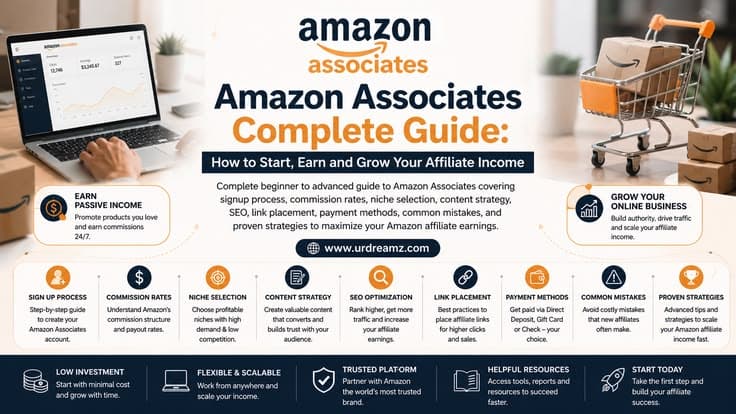
Amazon Associates Complete Guide: How to Start, Earn and Grow Your Affiliate Income
Amazon Associates is the world's largest and most recognized affiliate marketing program, with over 900,000 active publishers promoting products from Amazon's catalog of more than 350 million items. Whether you are a complete beginner who has never earned a dollar online or an experienced blogger looking to add a reliable income stream, Amazon Associates offers one of the most accessible entry points into affiliate marketing. This comprehensive guide covers everything you need to know, from creating your account and choosing your niche to advanced strategies for maximizing commissions, optimizing content for conversions, and scaling your affiliate income long-term.
1. What Is Amazon Associates
Amazon Associates, officially known as the Amazon Associates Program, is the affiliate marketing arm of Amazon.com. It was launched in 1996, making it one of the oldest affiliate programs in the world and the program that essentially popularized the entire concept of affiliate marketing as we know it today. The program allows website owners, bloggers, content creators, app developers, and social media influencers to earn referral commissions by promoting Amazon products through special tracking links.
When a visitor clicks your Amazon affiliate link and purchases a product on Amazon within the specified cookie window, you receive a percentage of the sale as your commission. This applies not only to the specific product you promoted but to any eligible product in the same shopping session, meaning if someone clicks your link for a book and then adds a camera, laptop, and kitchen appliance to their cart before checking out, you earn commissions on all of those items.
Amazon Associates is free to join, requires no upfront investment, and gives you access to one of the most trusted online shopping destinations in the world. When you link to Amazon, you are linking to a brand that hundreds of millions of people already trust, which significantly reduces the psychological barrier to purchase that affiliates face with less-known retailers.
2. How Amazon Associates Works
The mechanics of Amazon Associates are straightforward but understanding each step helps you optimize every part of your strategy. Here is how the process flows from beginning to commission payment.
| Step | What Happens | Your Role |
|---|---|---|
| 1. You Join | You create a free Amazon Associates account and receive a unique Associate ID (also called a tracking ID) | Complete the application and provide website, app, or social media details |
| 2. You Create Links | Using Amazon's SiteStripe toolbar or the Associates dashboard, you generate special affiliate links that contain your Associate ID | Find products relevant to your content and generate affiliate links for them |
| 3. You Publish Content | You place these affiliate links within your website articles, YouTube videos, social media posts, or other approved content formats | Create valuable content that naturally incorporates Amazon product recommendations |
| 4. Visitor Clicks | A reader or viewer clicks your Amazon affiliate link and is redirected to Amazon's website with your Associate ID attached in the URL | Drive quality traffic to your content through SEO, social media, or other channels |
| 5. Cookie Activates | Amazon places a tracking cookie in the visitor's browser. This cookie records that this visitor came through your affiliate link | No action required. Amazon handles all tracking automatically |
| 6. Purchase Occurs | If the visitor makes an eligible purchase within the cookie window, Amazon attributes that purchase to your Associate ID | No action required. You simply benefit from the visitor's natural purchasing behavior |
| 7. Commission Earned | Amazon calculates your commission based on the product category's commission rate and adds it to your account balance | Monitor your earnings through the Associates dashboard |
| 8. Payment Received | Amazon pays you monthly once your balance exceeds the minimum threshold, via direct bank transfer, check, or Amazon gift card | Set up your preferred payment method in your account settings |
3. Amazon Associates Commission Rates by Category
One of the most important factors to understand about Amazon Associates is that commission rates vary significantly by product category. These rates are set by Amazon and have changed over time, with notable reductions occurring in April 2020. Understanding which categories offer the best commissions helps you select niches that maximize your earning potential.
| Product Category | Commission Rate | Notes |
|---|---|---|
| Amazon Games | 20% | Highest rate. Physical and digital Amazon-brand games |
| Luxury Beauty, Luxury Stores Beauty, Amazon Explore | 10% | High-value category with strong commission |
| Amazon Fashion Women, Men, Kids and Baby Private Label | 10% | Amazon's own fashion brands only |
| Shoes, Handbags, Accessories | 4% | Good category for fashion-focused sites |
| Digital Music, Physical Music, Handmade | 5% | Niche but consistent earner |
| Physical Books, Kitchen, Automotive | 4.5% | Very high traffic categories with reasonable commissions |
| Toys, Furniture, Home, Home Improvement, Lawn and Garden, Pets | 3% | Extremely popular categories with massive product selection |
| Headphones, Beauty, Musical Instruments, Business and Industrial Supplies | 3% | Popular consumer electronics adjacent category |
| Outdoors, Power Tools | 3% | Good for outdoor and DIY focused sites |
| Electronics, Computers, DVD and Blu-Ray | 2.5% | High purchase values compensate for lower rates |
| Sports, Baby Products | 3% | High demand year-round with seasonal spikes |
| Amazon Fresh, Health and Personal Care, Beauty | 1% | Very low commission but extremely high purchase volume |
| Televisions, Digital Video Games | 2% | High product prices can still generate good earnings |
| Amazon Devices including Fire TV, Kindle, Echo | 4% | Amazon's own devices. Reliable seller |
| All Other Categories | 4% | Default rate for categories not listed above |
A critical insight for maximizing Amazon commissions: focus not just on the commission percentage but on the combination of commission rate and average order value. Electronics may only pay 2.5 percent but a 500-dollar laptop earns 12.50 dollars per sale. A kitchen gadget at 4.5 percent on a 30-dollar item earns only 1.35 dollars. Volume and average order value together determine your actual income.
4. Amazon Associates vs Other Affiliate Programs
| Factor | Amazon Associates | ClickBank | CJ Affiliate | ShareASale |
|---|---|---|---|---|
| Commission Rate | 1% to 20% (most categories 2.5% to 4.5%) | 25% to 75% (digital products) | Varies widely by merchant (2% to 50%) | Varies by merchant (5% to 30% common) |
| Cookie Duration | 24 hours (90 days for items added to cart) | 60 days | Varies by merchant (7 to 90 days) | Varies by merchant (30 to 90 days typical) |
| Product Selection | 350+ million products across virtually every category | Digital products primarily. Limited physical goods | Thousands of merchants. Varied selection | Thousands of merchants. Strong retail focus |
| Brand Trust | Extremely high. Amazon is universally recognized and trusted | Moderate. Variable merchant quality | High for established brands on the network | High for established brands on the network |
| Ease of Joining | Easy but requires sales within 180 days to stay active | Very easy. Minimal requirements | Moderate. Individual merchant approval needed | Moderate. Individual merchant approval needed |
| Payment Frequency | Monthly with 60-day delay | Weekly or biweekly | Monthly typically | Monthly typically |
| Best For | Physical product niches. Blog and YouTube content | Digital products, courses, e-books | Established niches with brand partnerships | Retail and e-commerce adjacent niches |
5. Who Should Join Amazon Associates
Amazon Associates is not the right fit for every affiliate marketer, but it is an excellent choice for specific types of content creators and website owners. Understanding whether Amazon Associates aligns with your situation saves you time and directs you toward the program most likely to succeed for your specific content model.
| Content Creator Type | Why Amazon Associates Works | Potential Monthly Earnings Range |
|---|---|---|
| Product Review Bloggers | Content naturally aligns with purchase intent. Readers looking for reviews are already in buying mode | 500 to 10,000+ dollars depending on traffic and niche |
| YouTube Product Reviewers | Affiliate links in video descriptions are widely accepted. Viewers trust on-camera demonstrations | 300 to 5,000+ dollars with a loyal subscriber base |
| Lifestyle and Home Decor Bloggers | Furniture, home goods, and lifestyle products sell very well through aspirational content | 200 to 3,000+ dollars monthly |
| Tech and Gadget Websites | High purchase intent searches. Readers actively researching before buying | 1,000 to 20,000+ dollars for established sites |
| Outdoor and Hobby Enthusiasts | Passionate audiences make repeat purchases and trust fellow enthusiasts | 300 to 5,000+ dollars depending on niche size |
| Pinterest Content Creators | Visual products perform extremely well. Pinterest users are discovery-mode buyers | 100 to 2,000+ dollars monthly |
| Beginners Building First Affiliate Site | Simplest program to understand. Universal product catalog eliminates niche restrictions | 50 to 500 dollars in the first 6 to 12 months |
Amazon Associates is probably not your best choice if you primarily promote digital products, courses, or software (where ClickBank and SaaS programs offer much higher commissions), if you are in a pure information niche with no clear product recommendations, or if you need very long cookie windows (60 to 90 days) for high-consideration purchases where 24 hours is insufficient.
6. Requirements to Join Amazon Associates
| Requirement | Details | Important Notes |
|---|---|---|
| Website, App, or Social Channel | You must have at least one qualifying website, mobile app, or qualifying social media account (YouTube, Instagram, Facebook, TikTok, or Twitter with at least 500 followers) | Websites must have original content. Sites that are primarily empty, under construction, or designed purely for affiliate links will be rejected |
| Content Quality | Your website must have meaningful, original content that provides value to visitors beyond simply listing affiliate links | Amazon reviewers manually check your site during the application review process |
| Age Requirement | You must be 18 years or older to have a qualifying Amazon Associates account | In some countries, 18 may not be the legal age of contract. Check your local laws |
| Geographic Eligibility | Amazon Associates programs exist for numerous countries. You must join the program corresponding to the Amazon marketplace where your audience shops | US, UK, Canada, Germany, France, Italy, Spain, Japan, India, and more all have separate programs |
| Tax Information | US-based associates must provide tax information (W-9 for US persons, W-8BEN for non-US persons) before receiving payment | International affiliates are subject to US tax withholding rules for commissions from US sales |
| Three Sales in 180 Days | After approval, you must generate at least 3 qualifying sales within 180 days or your account will be automatically closed | This is the most common reason new affiliates lose their account. Have a traffic and content strategy ready before applying |
7. Step-by-Step Signup Process
| Step | Action | Tips for Success |
|---|---|---|
| Step 1 | Go to affiliate-program.amazon.com and click the Sign Up button | Use an existing Amazon customer account or create a new one specifically for your business |
| Step 2 | Enter your account information including name, address, and contact details | Use your real legal name or registered business name as this will appear on tax documents and payments |
| Step 3 | Add your website, app, or social media channel URLs in the Website and Mobile App List section | Add all relevant platforms where you plan to use affiliate links. You can add more later |
| Step 4 | Enter your Preferred Associates Store ID. This becomes your base tracking ID | Choose something memorable and related to your website name. For example mywebsite-20 for a US account |
| Step 5 | Describe your website, indicate what types of products you plan to promote, and describe how you drive traffic | Be honest and specific. Amazon reviews this information. Generic answers may trigger manual review |
| Step 6 | Select your payment and tax information or choose to enter it later | You can skip payment setup initially but you must complete it before any payments can be made |
| Step 7 | Your account is provisionally approved and you receive your Associate ID immediately | You can begin creating affiliate links right away while Amazon reviews your application |
| Step 8 | Ensure you generate at least 3 qualifying sales within 180 days to keep your account active | Start creating content and driving traffic immediately. Do not wait to publish content after signing up |
8. Understanding the Amazon Associates Dashboard
The Amazon Associates dashboard is your control center for managing links, tracking earnings, analyzing performance, and accessing all program tools. Navigating it effectively helps you optimize your strategy based on real data.
| Dashboard Section | What You Find There | How to Use It |
|---|---|---|
| Home / Overview | Summary of recent clicks, orders, conversion rate, and estimated earnings at a glance | Check daily or weekly to monitor overall performance trends |
| Reports | Detailed breakdown of clicks, orders, conversion rates, revenue, and commissions by date, tracking ID, and product | Use to identify your best-performing content and products. Double down on what converts |
| Product Linking | Tools to create standard affiliate links, text and image links, product carousels, and native shopping ads | Generate links for specific products you want to promote in your content |
| Promotions | Current Amazon deals and seasonal promotions you can highlight to boost conversions | Time your content publishing around major Amazon sales events like Prime Day and Black Friday |
| Payments | Payment history, current balance, estimated future payments, and payment settings | Update payment method here. Understand the 60-day delay between earning and payment |
| Account Settings | Associate ID, tax information, website list, and notification preferences | Add new websites as you create them. Keep tax information current |
| Performance Dashboard | Visual analytics showing your clicks to orders conversion funnel with comparison data | Identify traffic patterns and conversion gaps to optimize your content strategy |
9. How to Create Amazon Affiliate Links
Creating affiliate links is one of the core daily activities of any Amazon Associate. There are three main ways to generate links, each suited to different workflows and content types.
| Method | How It Works | Best For | Pros and Cons |
|---|---|---|---|
| SiteStripe Toolbar | A toolbar that appears at the top of Amazon pages when you are logged into your Associates account. Lets you generate text links, image links, or text plus image links with one click | Individual product links while browsing Amazon naturally | Pro: Fastest method. Con: Only works when browsing Amazon directly in your browser |
| Associates Dashboard Product Linking | Search for products within the Associates backend and generate links there without visiting the main Amazon site | Bulk link creation, finding ASINs, creating native ads and widgets | Pro: No need to browse Amazon. Con: Slightly slower workflow for individual links |
| Manual ASIN URL Construction | Build your affiliate link manually using Amazon's standard URL structure with your Associate tag appended | Developers, advanced users, or those managing links programmatically | Pro: Maximum control. Con: Error-prone for manual users |
| Third-Party Affiliate Link Management Plugins | WordPress plugins like AAWP (Amazon Affiliate WordPress Plugin), EasyAzon, or Lasso manage link creation, display, and updating automatically | WordPress website owners managing large numbers of Amazon links | Pro: Automates updates, beautiful displays. Con: Costs money. Must comply with Amazon's ToS |
10. Amazon SiteStripe Explained
Amazon SiteStripe is a browser toolbar that automatically appears at the top of Amazon product pages when you are logged into your Associates account. It is the fastest and most convenient tool for creating affiliate links during your normal Amazon browsing sessions.
When you find a product you want to promote, simply look at the SiteStripe bar at the top of the Amazon product page. You will see options to get a Text link (a simple URL), an Image link (just the product image with your affiliate link), or a Text plus Image combination (image and title together). You can also use the Share button to share directly to social media platforms.
A critical rule about SiteStripe: Amazon prohibits using short URL services like bit.ly to mask your affiliate links. Your affiliate links must clearly show they are Amazon links. The SiteStripe generates proper Amazon affiliate URLs that are fully compliant. You can use a plugin to redirect them to cleaner looking URLs on your own domain, but you must disclose the affiliate relationship.
11. Amazon OneLink for International Traffic
If your website receives traffic from multiple countries, Amazon OneLink is an essential tool that can significantly increase your affiliate earnings. The problem without OneLink is that a US Amazon affiliate link will not earn you commissions if a UK or Canadian visitor clicks it and shops on their local Amazon marketplace.
OneLink solves this by automatically detecting a visitor's location and redirecting them to the appropriate local Amazon marketplace (Amazon UK, Amazon CA, Amazon DE, Amazon JP, etc.) while still attributing the sale to your account through the corresponding international program. This means you earn commissions on purchases from international visitors that would otherwise be completely lost.
To use OneLink you need to join the corresponding Amazon Associates programs for each country marketplace where your traffic comes from (UK, Canada, Germany, etc.) and then link those accounts through the OneLink settings in your Associates dashboard. The setup takes approximately 30 minutes but can meaningfully increase your total monthly earnings if you have international readership.
12. Choosing the Right Niche for Amazon Affiliate
Niche selection is possibly the single most important decision you will make as an Amazon affiliate. The right niche determines your audience size, purchase intent, competition level, and commission potential. Getting this decision right from the beginning saves you months or years of working in the wrong direction.
| Evaluation Factor | What to Look For | Red Flags to Avoid |
|---|---|---|
| Purchase Intent | People in this niche actively buy products to solve problems or pursue passions. High purchase frequency | Purely informational niches where people seek knowledge but rarely buy products as a result |
| Amazon Product Availability | Hundreds or thousands of relevant products available on Amazon with good reviews and price variety | Niches where products are not well represented on Amazon or where buyers prefer other retailers |
| Average Order Value | Products with prices of 50 dollars or more so that even a 3 to 4 percent commission generates meaningful income | Niches where everything costs under 10 dollars. The math makes commissions too small to matter |
| Your Knowledge and Interest | Enough personal knowledge or passion to create genuinely helpful content at scale over years | Niches you chose purely for money potential but know nothing about. Content quality suffers |
| Competition Level | Some competition confirms there is money to be made. Sub-niches within large categories can have manageable competition | Niches dominated entirely by major publishers, media companies, or brands with enormous domain authority |
| Seasonality Balance | Mix of year-round demand with some seasonal spikes rather than exclusively seasonal demand | Niches that only have demand at Christmas or another very short window, making income extremely volatile |
| Keyword Opportunity | Enough specific buyer-intent keywords where you can realistically rank on Google's first page with good content | Niches where every relevant keyword is dominated by Amazon itself or major review publications |
13. Best Niches for Amazon Associates
| Niche | Why It Works Well | Commission Rate | Competition Level |
|---|---|---|---|
| Home Office Equipment | Remote work trend created sustained demand for desks, chairs, monitors, webcams, and accessories. High average order values | 2.5% to 4.5% | Moderate |
| Kitchen Appliances and Gadgets | Enormous product selection. Passionate audience. Regular purchase occasions (gifting, cooking hobbies) | 4.5% | Moderate to High |
| Outdoor and Camping Gear | Passionate community with high purchase frequency. Products ranging from budget to premium. Seasonal spikes in spring and summer | 3% | Moderate |
| Baby and Toddler Products | New parents are motivated buyers who research extensively before purchasing. High repeat purchase rate | 3% | Moderate |
| Pet Products and Accessories | Pet owners spend prolifically and prioritize their pets' comfort. Subscription-like repeat purchases | 3% | Moderate to High |
| Home Gym and Fitness Equipment | Growing market with products ranging from budget resistance bands to premium treadmills. High average order values | 3% | High but with sub-niche opportunities |
| Gaming Peripherals and Accessories | Passionate and spending audience. Keyboards, mice, headsets, and gaming chairs are researched extensively online | 2.5% | High but with specific review opportunities |
| Smart Home Devices | Amazon's own Echo and Kindle devices plus third-party smart home products. Growing category with high engagement | 4% on Amazon devices | Moderate |
| Books and Education | Lower competition. Readers actively search for recommendations. Lower commissions but very long-term content value | 4.5% | Low to Moderate |
| Arts, Crafts, and Hobbies | Passionate audiences who buy supplies regularly. Strong gift-giving potential. Many sub-niches available | 3% to 4.5% | Low to Moderate |
14. Keyword Research for Amazon Affiliate Blogs
Successful Amazon affiliate marketing is built on targeting the right keywords, specifically those with commercial intent where searchers are actively considering or ready to make a purchase. Understanding keyword types and how to find them is fundamental to your content strategy.
| Keyword Type | Examples | Search Intent | Content Type | Conversion Potential |
|---|---|---|---|---|
| Best Product Keywords | "best coffee makers under 100 dollars", "best budget laptop for students", "best ergonomic office chair" | Commercial. Buyer actively comparing options before purchasing | Best-of roundup or comparison article featuring multiple products with affiliate links | Very High |
| Product vs Product Keywords | "KitchenAid vs Cuisinart food processor", "iPhone 16 vs Samsung S25", "Nespresso vs Keurig" | Commercial. Buyer has narrowed to two options and needs help deciding | Detailed comparison article highlighting differences, pros, and cons of each | Very High |
| Review Keywords | "Instant Pot Duo review", "Dyson V15 review", "Kindle Paperwhite review" | Commercial. Buyer researching a specific product before committing | In-depth single product review covering features, pros, cons, who it is for | High |
| Buying Guide Keywords | "how to choose a blender", "what to look for in a standing desk", "beginner guitar buyer guide" | Commercial and Informational hybrid. Buyer learning what to look for | Educational guide that teaches criteria and then recommends specific products | Moderate to High |
| Problem Solution Keywords | "best mattress for back pain", "best knife sharpener for dull knives", "best toy for 3-year-old" | Commercial. Buyer has a specific problem and needs the right product to solve it | Problem-focused article recommending products that solve the stated issue | High |
| Gift Guide Keywords | "best gifts for coffee lovers", "Christmas gifts for hikers", "birthday gifts under 50" | Commercial with deadline urgency. Buyer needs to purchase a gift | Gift guide roundup featuring multiple appropriate products across price points | High to Very High (especially seasonal) |
15. Types of Content That Convert on Amazon Affiliate Sites
| Content Type | Description | Conversion Rate | SEO Difficulty | Time to Create |
|---|---|---|---|---|
| Best of Roundup Articles | Top 5, Top 10, or similar lists comparing multiple products in a category. The bread and butter of Amazon affiliate content | Very High | Moderate to High (competitive) | 3 to 8 hours for quality content |
| Single Product Reviews | In-depth review of one specific product covering features, performance, pros, cons, and ideal buyer profile | High | Moderate (more specific keywords) | 2 to 5 hours if you have the product |
| Comparison Articles | Direct side-by-side comparison of two or three competing products with clear recommendation based on use case | Very High | Low to Moderate (longer tail keywords) | 3 to 6 hours |
| Buying Guides | Educational content teaching readers what features to look for in a product category before recommending specific products | Moderate to High | Low to Moderate | 2 to 5 hours |
| Gift Guides | Seasonal content curating appropriate gifts for specific people, occasions, or budgets | High to Very High during peak seasons | Moderate (seasonal competition spikes) | 2 to 4 hours |
| How-to Articles with Product Recommendations | Tutorial or instructional content that naturally leads to product recommendations within the instructions | Moderate | Low to Moderate | 2 to 6 hours depending on complexity |
| Problem Solution Articles | Content that addresses a specific problem and recommends products as the solution | High | Low to Moderate | 2 to 4 hours |
16. How to Write Product Reviews That Rank and Convert
Product reviews are the foundation of most successful Amazon affiliate websites. A high-quality review does two things simultaneously: it ranks well on Google by satisfying search intent and providing comprehensive information, and it converts readers into buyers by building trust and making the purchase decision easy.
| Section | Content | Purpose |
|---|---|---|
| Introduction (100 to 200 words) | Briefly introduce the product, why you are reviewing it, who it is for, and your main conclusion upfront | Hook the reader. Satisfy Google's need to understand what the page is about |
| Quick Verdict Box | A summary table showing overall rating, pros, cons, and a direct buy button link to Amazon | Serves readers who want the conclusion immediately. Boosts early conversions |
| Product Overview | What the product is, what it is designed to do, specifications, and key features with your own analysis of each | Establishes your expertise. Ensures the review is comprehensive |
| Performance Testing | Your real-world experience using the product or thorough research synthesizing verified user experiences | The core of E-E-A-T (Experience, Expertise, Authoritativeness, Trustworthiness) which Google prioritizes |
| Pros and Cons | Honest balanced list of genuine advantages and disadvantages. Do not be entirely positive | Builds reader trust. Readers who see honest cons are more likely to trust your positive recommendations |
| Who It Is For and Who Should Skip It | Specific guidance on which buyer profiles would benefit most and which should consider alternatives | Helps readers self-identify. Increases click-through on affiliate links from qualified buyers |
| Comparison to Alternatives | Brief comparison to one or two competing products with internal links to your other reviews | Retains readers who are not convinced by this product. Internal links improve SEO |
| Final Verdict | Clear recommendation with reasoning. Include a prominent affiliate link button | Final conversion opportunity. Should be unambiguous and actionable |
| FAQs | Answer the most common questions about the product sourced from Amazon Q&A, forums, and Google People Also Ask | Captures additional long-tail keyword searches. Satisfies reader questions before they leave |
17. How to Write Comparison Articles
Comparison articles, often called versus articles, target buyers who have narrowed their decision to two or three options and need help making the final choice. These readers are very close to purchasing, making comparison articles some of the highest-converting content on Amazon affiliate sites.
| Element | Best Practice |
|---|---|
| Title Format | Product A vs Product B: Which One Should You Buy? Or Product A vs Product B: The Definitive Comparison. Be specific about what you are comparing |
| Opening Summary Table | Include a side-by-side feature comparison table at the very beginning. Readers expect this. Make it scannable with key specs and your verdict for each |
| Individual Product Sections | Give each product its own dedicated section covering its strengths, weaknesses, and ideal use case independently before comparing them |
| Head-to-Head Comparison | Compare the products directly across specific dimensions like price, performance, durability, ease of use, and customer support |
| Clear Winner Declaration | Never be wishy-washy. State clearly which product wins in each category and which is the overall winner for most buyers |
| Use Case Based Recommendations | Acknowledge that the best product depends on the buyer. "Choose Product A if you need X. Choose Product B if you need Y" maximizes relevance |
| Multiple Affiliate Links | Include affiliate links for both products throughout the article since you do not know which the reader will ultimately choose |
18. How to Write Buying Guides
Buying guides target readers who are beginning their research on a product category rather than having already identified specific products. They are extremely valuable for building topical authority because they attract readers at the top of the purchase funnel who may return to your site as they progress through their research.
A great buying guide educates the reader on what features and specifications matter in a product category, explains what the different price tiers typically offer, warns about common mistakes or misleading marketing claims, and then recommends specific products for different buyer profiles and budgets. By covering the entire knowledge journey from initial awareness to specific product recommendation, buying guides often achieve significant search traffic and very loyal audiences.
Structure your buying guide with sections for key features to consider, a breakdown of price ranges and what each delivers, common mistakes to avoid, our top picks for different use cases, and a FAQ section. Place your Amazon affiliate links within the product recommendation section and in a dedicated product table that readers can reference quickly.
19. Best Product Roundup and Top 10 Articles
Best-of roundup articles represent the highest-traffic content type for most Amazon affiliate websites. They target high-volume keywords like "best coffee makers" or "best budget headphones" and provide curated recommendations for readers who want expert guidance on what to buy within a category.
The key to a successful roundup article is genuine curation rather than simply listing popular Amazon products. Test products where possible, research verified user reviews comprehensively, consult expert sources, and make clear editorial choices about which products deserve inclusion and why. Google's helpful content guidelines increasingly penalize thin roundup articles that simply aggregate information without providing genuine expert insight.
For roundup structure, lead with a quick top picks table showing your overall best choice, best budget option, and best premium option with direct Amazon links. Follow with individual sections for each recommended product including a mini review. End with a how we chose section explaining your methodology, a buying guide section on what to look for, and a FAQ section. This structure satisfies both immediate buyer needs and deeper information seekers.
20. SEO Strategy for Amazon Affiliate Websites
| SEO Area | Key Actions | Impact Level |
|---|---|---|
| Topical Authority Building | Cover your niche comprehensively with a pillar article supported by many supporting articles on sub-topics. Google rewards sites that demonstrate deep expertise in a specific niche | Very High (long-term rankings) |
| Commercial Keyword Targeting | Prioritize best-of, review, comparison, and buying guide keywords with clear purchase intent over purely informational keywords | Very High (conversion impact) |
| Content Quality and Depth | Create the most comprehensive, well-researched, and genuinely helpful content on each topic you target. Thin content is actively penalized by Google | Very High |
| E-E-A-T Signals | Demonstrate Experience (have you used the product), Expertise (do you know the subject), Authoritativeness (are you a recognized voice in the niche), and Trustworthiness (do you follow best practices and disclose affiliate relationships) | Very High (especially post-2022 Google updates) |
| Internal Linking | Link related articles to each other systematically. Connect product reviews to buying guides and roundups. This distributes authority and helps Google understand your content structure | High |
| Page Speed and Core Web Vitals | Optimize images, minimize plugins, use fast hosting, and achieve good Core Web Vitals scores | Moderate to High |
| Backlink Acquisition | Earn links from authoritative sites through resource link building, digital PR, and creating genuinely linkworthy content that others want to reference | High for competitive keywords |
21. On-Page SEO for Amazon Affiliate Content
| On-Page Element | Best Practice |
|---|---|
| Title Tag | Include primary keyword near the beginning. Keep under 60 characters. Include year for freshness signals on review content |
| Meta Description | Write a compelling 150 to 160 character description that includes the primary keyword and a clear value proposition for the reader |
| URL Slug | Keep short, keyword-focused, and hyphen-separated. Example: /best-coffee-makers-under-100 |
| H1 Tag | One H1 per page containing your primary keyword. Should match or closely align with your title tag |
| H2 and H3 Structure | Use H2s for major sections and H3s for subsections. Include secondary keywords naturally in headings without forcing them |
| Image Optimization | Use descriptive alt text including keywords. Compress images for page speed. Name image files descriptively |
| Product Table Schema | Implement structured data markup for product comparisons and reviews to enhance appearance in search results |
| Affiliate Disclosure | Include a clear, prominent affiliate disclosure at the beginning of every page that contains affiliate links as required by the FTC and Amazon's own policies |
| Last Updated Date | Update review and roundup articles regularly and display the last updated date prominently. Freshness is a significant ranking factor for commercial content |
22. Internal Linking Strategy for Affiliate Sites
Internal linking is one of the most underutilized SEO tools for Amazon affiliate websites. Strategic internal linking does three important things: it helps Google understand the relationship between your content pieces, it distributes link authority from your strongest pages to your newer ones, and it guides readers toward more of your content and additional affiliate link opportunities.
For an Amazon affiliate site, link from your buying guides to your specific product reviews and roundup articles. Link from your roundup articles to your individual product reviews. Link from informational articles to your commercial content where naturally relevant. Create a hub structure where your pillar content (the most comprehensive article on a topic) links out to supporting articles, and those supporting articles link back to the pillar page and across to each other where relevant.
Use descriptive anchor text that tells both readers and Google what the linked page is about. Vary your anchor text rather than using the exact same phrase every time. Avoid linking every article to every other article. Focus on links that are genuinely useful for a reader who is engaged with the current page.
23. Building Backlinks for Amazon Affiliate Sites
| Strategy | How to Execute | Difficulty | Link Quality |
|---|---|---|---|
| Resource Page Link Building | Find resource pages in your niche that list helpful websites and reach out requesting inclusion of your best comprehensive guides | Moderate | High |
| HARO and Journalist Outreach | Respond to journalist queries on platforms like Help a Reporter Out where they need expert quotes on topics in your niche | Moderate | Very High (major publications) |
| Linkable Asset Creation | Create comprehensive research studies, original data, unique infographics, or highly detailed tools that other sites naturally want to link to | High (creation) Low (promotion) | Very High |
| Guest Posting | Write valuable articles for relevant websites in your niche in exchange for a link back to your site | Moderate | Moderate to High depending on site |
| Broken Link Building | Find broken links on relevant websites and suggest your own content as a replacement | Moderate to High (research intensive) | High |
| Product Manufacturer Outreach | If you write detailed reviews of specific products, contact the manufacturer to let them know. They sometimes link from their own press pages | Low | High |
24. Amazon Affiliate Link Placement Best Practices
| Placement Location | Effectiveness | Best Practice |
|---|---|---|
| Product Comparison Table (Above Fold) | Very High | Place a scannable product table near the top of roundup articles. Include product image, name, key feature, and buy button with affiliate link |
| In-Text Contextual Links | High | Link product names naturally within your text when first mentioning a product. Use descriptive anchor text |
| Individual Product Sections | High | Each product in a roundup should have its own buy button at the end of its dedicated section |
| Final Verdict Section | Very High | Place a prominent call-to-action button at the very end of your conclusion where you make your final recommendation |
| Product Image Links | Moderate to High | Make product images clickable with your affiliate link. Many readers click images expecting to go to the product page |
| Sidebar Widgets | Low to Moderate | Sidebar product widgets can supplement main content but should never be the primary link placement |
| Email Newsletters | Note: Amazon prohibits affiliate links in emails | Link to your review page from email. Reader clicks to your site and then to Amazon from there |
25. How to Increase Click-Through Rate on Affiliate Links
Your click-through rate (CTR) is the percentage of readers who click your Amazon affiliate links. Even small improvements in CTR can dramatically increase your monthly earnings without requiring any additional traffic.
| Strategy | Expected CTR Impact |
|---|---|
| Use prominent button-style CTAs instead of plain text links | Can increase clicks by 30 to 100 percent compared to plain text alone |
| Add product images with affiliate links attached | Visual elements significantly increase click likelihood |
| Create urgency with current price display and savings information | Showing a sale price or discount creates incentive to click immediately |
| Use action-oriented anchor text like "Check Current Price on Amazon" or "See Today's Deal" | Outperforms generic "Click Here" or "Buy Now" text |
| Place links after genuinely persuasive content not before building the case | Readers who are convinced convert at higher rates than those who click before reading |
| Match link appearance to reader expectations (buttons for main CTAs, text links for secondary mentions) | Contextual appropriateness reduces link blindness |
26. Disclosure Requirements and FTC Compliance
The Federal Trade Commission (FTC) in the United States requires all affiliate marketers to clearly and conspicuously disclose their material connection to brands they promote, including affiliate commission relationships. Similar requirements exist in the UK (ASA guidelines), Canada, Australia, and most other countries. This is not optional, and Amazon's own Operating Agreement requires it as well.
Your disclosure must appear in a prominent location that readers will see before encountering your affiliate links. A disclosure buried in a footer or accessible only through a separate disclosure page does not meet FTC requirements. Place your disclosure at the very top of any page containing affiliate links, before the reader begins reading your recommendations.
Your disclosure must be clear and unambiguous. Something like "This article contains affiliate links. If you click and make a purchase, I may earn a commission at no extra cost to you" is appropriate. Phrases like "partner" or "associate" alone without explaining what that means are considered insufficient by the FTC. The disclosure should be in simple language that any ordinary reader would understand without any knowledge of marketing terminology.
27. Amazon Associates Operating Agreement Key Rules
| Rule Category | What Is Prohibited | Why It Matters |
|---|---|---|
| Price Claims | Never state a specific product price in your content. Amazon prices change constantly and your price may be wrong within hours | Violation can result in account termination. Always use a link to Amazon to show current price instead |
| Email Links | Amazon affiliate links cannot be placed directly in emails, ebooks, or PDF documents | Only link to a webpage you control from emails. Readers must visit your site to then click through to Amazon |
| Misleading Links | Do not use misleading link text or practices that trick users into clicking affiliate links | Deceptive practices violate both Amazon's policies and FTC regulations |
| Link Cloaking | Do not use URL shorteners like bit.ly or other methods to hide the Amazon destination of your links | Amazon's links must remain identifiable as Amazon links. Cloaking is explicitly prohibited |
| Self-Referencing | Do not purchase through your own affiliate links. Associates are prohibited from buying products using their own links to earn commissions | Amazon can identify this through IP tracking and account matching. Can result in account closure |
| Customer Reviews | Do not create fake or misleading product reviews or solicit reviews in exchange for compensation | Violates both Amazon's policies and FTC guidelines on endorsements |
| Special Offers Communication | Do not use the word "Amazon" or confusingly similar terms in your domain name, social media handles, or in ways that imply official partnership | Amazon is protective of its trademark and branding |
28. How Amazon Associates Tracks Commissions
Understanding Amazon's commission tracking system helps you optimize your strategy and interpret your dashboard reports accurately. Amazon uses a combination of URL parameters and cookies to attribute purchases to your Associate ID.
When you create an affiliate link, your Associate tracking tag is embedded as a URL parameter (tag=yourid-20 for US accounts). When a visitor clicks your link, Amazon's systems register the click and attribute that visitor to your account. Amazon places a 24-hour cookie in the visitor's browser that maintains this attribution for the duration of that shopping session.
An important distinction: if a visitor clicks your affiliate link and adds a product to their Amazon shopping cart, the cookie extends to 90 days specifically for that cart item. This means if they added the product but did not check out immediately, you still earn the commission if they return and complete the purchase within 90 days. However, if they click another affiliate's link after clicking yours, that affiliate's cookie overwrites yours and they would receive the commission instead of you.
29. Amazon Associates Cookie Duration Explained
| Scenario | Cookie Duration | Commission Earned |
|---|---|---|
| Visitor clicks your link and buys immediately | 24-hour session cookie | Yes. Commission on all eligible items purchased in that session |
| Visitor clicks your link, adds item to cart, buys within 90 days | 90-day cart cookie for that specific item | Yes. Commission on that specific item even if purchased days later |
| Visitor clicks your link, leaves without adding to cart, comes back the next day | Cookie expired after 24 hours | No. The 24-hour window has passed |
| Visitor clicks your link, then clicks another affiliate's link within 24 hours | Your cookie is overwritten by the last-clicked affiliate's cookie | No. Amazon uses a last-click attribution model |
| Visitor clicks your link and buys multiple products in one session | 24-hour session cookie covers all items | Yes. Commission on all eligible items purchased in that single session regardless of which page they came from |
The 24-hour cookie duration is Amazon Associates' biggest competitive disadvantage compared to other affiliate programs that offer 30, 60, or 90-day cookies. For high-consideration purchases where buyers take days or weeks to decide, other affiliate programs may be more appropriate. However, Amazon compensates with the session-wide commission, the enormous trust consumers place in Amazon, and the depth of product selection that keeps buyers on the platform once they arrive.
30. Amazon Associates Payment Methods and Thresholds
| Payment Method | Minimum Threshold | Processing Time | Availability |
|---|---|---|---|
| Direct Bank Deposit (ACH) | 10 dollars | 3 to 5 business days | US and some international accounts |
| Amazon Gift Card | 10 dollars | Credited to Amazon account immediately | Available to most associates |
| Check by Mail | 100 dollars | Up to 7 days by mail after processing | Available but discouraged due to high threshold |
| International Wire Transfer | 100 dollars | 5 to 7 business days plus additional bank processing | For non-US associates without a local bank deposit option |
Amazon pays on a 60-day delay from the end of the month in which the commission was earned. This means commissions earned in January are paid at the end of March. Commissions can be reversed if the buyer returns the product within Amazon's return window. Watch your reports for returns which will show as negative commission adjustments.
31. Amazon Associates Account Approval Requirements
Amazon's account approval process involves two stages. First, you receive provisional access immediately upon completing the application, allowing you to start creating links right away. Second, Amazon manually reviews your application and your website within a few days to ensure compliance with their requirements.
For the manual review, ensure your website has a minimum of 10 to 15 original, quality articles before applying. The content should be clearly related to the products you plan to promote. Your website must have basic functionality including an about page, a contact page, and a privacy policy page. The design should be professional and the site should load correctly on mobile devices.
The critical requirement that many beginners miss is the three sales in 180 days rule. If you do not generate at least three qualifying purchases through your affiliate links within 180 days of account creation, your account is automatically closed and you must reapply. Do not apply for Amazon Associates until your website has meaningful traffic or until you have a clear plan to start generating clicks and sales immediately after approval.
32. How to Avoid Account Rejection and Suspension
| Rejection Reason | How to Avoid It |
|---|---|
| Website has insufficient content | Have at least 10 to 15 original quality articles published before applying |
| Website appears to be primarily or exclusively an affiliate site with no independent value | Create genuinely helpful content that would be valuable even without affiliate links |
| Failure to generate 3 sales in 180 days | Apply only when you have meaningful traffic. Have a content promotion plan ready for day one |
| Promoting prohibited content categories | Review Amazon's list of prohibited content categories before building your site |
| Placing affiliate links in emails | Only link to your own website pages from emails. Never place Amazon links directly in email content |
| Making specific price claims in content | Always direct readers to Amazon for current pricing. Never state a specific price in your text |
| Using Amazon's trademarked images or content without permission | Use Amazon's official product image links through the associates program rather than downloading and re-hosting images |
33. Amazon Affiliate Marketing on YouTube
YouTube is one of the most powerful platforms for Amazon affiliate marketing, particularly for product reviews and demonstrations. Video allows you to show a product in use, which builds trust far more effectively than text descriptions alone. YouTube also has its own search engine and massive organic discovery potential.
To use Amazon affiliate links on YouTube, place them in the video description box below your video. Add a clear disclosure in your video description and verbally disclose at the beginning of your video that you have affiliate links in the description. Most YouTube creators use something like "Links below are affiliate links which means I earn a small commission if you buy through them at no extra cost to you."
Popular Amazon affiliate YouTube content formats include unboxing and first impressions videos, detailed product reviews, best of category roundups done as video versions of written articles, versus comparison videos, and gift guide videos around holidays. Optimizing your video titles and descriptions with the same commercial intent keywords you target in written content helps your videos rank in YouTube search and Google Video results.
34. Amazon Affiliate Marketing on Pinterest
Pinterest is a uniquely powerful platform for Amazon affiliate marketing because Pinterest users are in a discovery and planning mindset that strongly correlates with purchasing intent. People save ideas they plan to act on, which means your affiliate links can generate sales months after your pins are first published.
Amazon affiliate links can be used directly in Pinterest pins, making it one of the few social platforms where you can link directly to Amazon. However, many experienced Pinterest affiliates prefer to link to their own website review or roundup articles first, which captures the visitor's email, earns them time on your site, and then directs them to Amazon. This strategy is more sustainable and protects your affiliate income from Pinterest algorithm changes.
Creating beautiful, vertical pin images (the recommended ratio is 2:3, ideally 1000 by 1500 pixels) with clear text overlays dramatically increases click-through rates on Pinterest. Use your target keywords in pin titles and descriptions as Pinterest functions as a visual search engine. Seasonal content performs exceptionally well on Pinterest, especially gift guides, home decor ideas, and recipe-adjacent product recommendations around major holidays.
35. Amazon Affiliate Marketing on Social Media
| Platform | Amazon Affiliate Links Allowed | Best Strategy | Audience Size Required |
|---|---|---|---|
| Yes with disclosure | Share your blog articles featuring Amazon products. Join and participate in relevant Facebook groups | No minimum but groups with 1000 to 10,000 members are most accessible | |
| Yes through link in bio and Stories links for accounts with features enabled | Use the link in your bio to direct to a link aggregator page with your top Amazon picks | At least 500 followers required by Amazon | |
| TikTok | Yes but link placement is limited for accounts without 1000 followers | Create product discovery and review videos. Direct viewers to your website or bio link for affiliate links | 1000 followers for clickable bio links |
| Yes directly in pins | Create discovery-oriented pin graphics linking to your review articles or directly to Amazon products | No minimum but larger followings increase discovery | |
| YouTube | Yes in video descriptions | Place links in description with clear verbal disclosure in the video itself | No minimum but a subscriber base of 1000 plus is needed for meaningful traffic |
| Twitter / X | Yes with disclosure | Share product recommendations and link to reviews. Best for building brand awareness rather than direct sales | At least 500 followers per Amazon Associates requirements |
36. Using AI Tools for Amazon Affiliate Content
Artificial intelligence writing and research tools have transformed affiliate content creation, allowing individual creators to produce more content more quickly without sacrificing quality. However, using AI tools for Amazon affiliate content requires a thoughtful approach to ensure the content maintains the genuine expertise and E-E-A-T signals that Google values most.
| AI Tool Use Case | How It Helps | Important Caution |
|---|---|---|
| Keyword Research | AI tools can help identify keyword opportunities, cluster related keywords, and suggest content ideas you may have missed | Always validate AI keyword suggestions with actual SEO tools that show real search volumes and competition |
| Content Outline Generation | AI can create comprehensive outlines for reviews, roundups, and buying guides based on your target keywords and competitor research | Review and customize AI outlines. They are starting points not final structures |
| Draft Content Creation | AI can draft initial versions of affiliate content that you then edit, personalize, and enrich with genuine expertise and product experience | Never publish raw AI content as your product reviews. It lacks the real-world experience Google increasingly rewards |
| FAQ Section Generation | AI can quickly generate comprehensive FAQ sections by identifying common questions about a product or category | Verify that AI-generated answers are accurate. AI can confidently state incorrect product specifications |
| Product Description Rewriting | AI can help rephrase manufacturer product descriptions into your own unique editorial voice | Ensure the rewritten content adds genuine insight and analysis rather than just paraphrasing the original |
37. Best WordPress Plugins for Amazon Affiliates
| Plugin | Key Features | Cost | Best For |
|---|---|---|---|
| AAWP (Amazon Affiliate WordPress Plugin) | Automatically pulls product data from Amazon API. Creates beautiful product boxes, comparison tables, and bestseller lists. Auto-updates prices and product information | Paid (from 49 dollars per year) | Established sites with significant Amazon affiliate income who want professional product display |
| EasyAzon | Add Amazon affiliate links without leaving WordPress editor. Geotargeting for international commissions. Link cloaking option | Paid (one-time fee) | Bloggers who want faster in-editor link creation |
| Lasso | Affiliate link management, beautiful product displays, auto-link keywords throughout site, affiliate disclosure automation | Paid (from 39 dollars per month) | Multi-program affiliate sites who manage many programs beyond Amazon |
| Thirsty Affiliates | Affiliate link management and organization, link cloaking, automatic keyword linking, click tracking | Free basic version. Pro from 79 dollars per year | Beginners who want link management without committing to premium tools |
| TablePress | Create clean, responsive comparison and data tables without coding | Free | Sites that need product comparison tables without premium plugin cost |
38. How to Track and Analyze Your Amazon Affiliate Performance
Data analysis is what separates Amazon affiliates who grow their income over time from those who plateau. The Associates dashboard provides detailed reporting that, when analyzed correctly, tells you exactly which content is working, which products are converting, and where to focus your next efforts.
Your most important metrics to monitor are clicks (how many people are clicking your affiliate links), orders (how many purchases resulted from those clicks), items shipped (the number of products in those orders), conversion rate (orders divided by clicks expressed as a percentage), and earnings (your total commission for the period). A healthy Amazon affiliate site typically sees conversion rates between 5 and 15 percent depending on the niche and traffic quality.
Use tracking IDs strategically to identify which pages and link placements generate the most clicks and conversions. Create different tracking IDs for your best-performing content categories or content types. When you see that one category dramatically outperforms others in conversion rate, focus more content creation effort in that direction. When you see high clicks but low conversions, investigate whether your content is attracting the wrong intent or whether the product recommendations are mismatched to your audience.
39. Common Amazon Associates Mistakes to Avoid
| Mistake | Why It Hurts | How to Fix It |
|---|---|---|
| Promoting only the cheapest products | Low-priced items generate tiny commissions that cannot sustain a business regardless of traffic volume | Focus on products priced above 50 dollars or products with high purchase frequency to generate meaningful income |
| Ignoring the 24-hour cookie limitation for high-consideration purchases | High-ticket items like appliances and furniture have longer purchase decision cycles that often exceed 24 hours | Pair Amazon links with longer-cookie affiliate programs for high-ticket items, or focus content on driving purchasing-ready traffic |
| Creating thin content with little original value | Google actively penalizes unhelpful content with poor rankings. Amazon may reject sites with thin content | Invest in comprehensive, expert content that genuinely helps readers make better purchasing decisions |
| Failing to disclose affiliate relationships | Violates FTC regulations and Amazon's Operating Agreement. Can result in legal penalties and account termination | Add clear affiliate disclosures at the top of every page with affiliate links |
| Applying for Amazon Associates before having meaningful traffic | Without traffic, you will not generate the 3 sales in 180 days needed to keep your account active | Build your content foundation and grow to at least 1,000 monthly visitors before applying |
| Putting specific prices in your content | Amazon prices change constantly. Incorrect pricing is a policy violation that can get your account terminated | Always link to Amazon for current pricing. Use check price on Amazon as your CTA language |
| Not updating old content | Products go out of stock, get discontinued, or are replaced by newer models. Outdated content harms user experience and rankings | Schedule quarterly reviews of your highest-traffic articles to update product recommendations |
40. Amazon Associates Pros and Cons
| Pros | Cons |
|---|---|
| Enormous product catalog of 350 million plus items means you can find relevant products for almost any content niche | Commission rates are relatively low compared to digital product affiliate programs (2.5% to 4.5% for most physical categories) |
| Amazon's unmatched brand recognition and consumer trust means visitors are already predisposed to trust and buy from the platform | 24-hour cookie duration is the shortest of any major affiliate program, limiting commission potential for high-consideration purchases |
| Session-wide commission means you earn on everything a visitor buys during their shopping session not just the product you promoted | Amazon has reduced commission rates multiple times over the years and can change them again unilaterally |
| Free and easy to join with no prior experience required | Three sales in 180 days requirement can result in account closure for new affiliates who do not yet have sufficient traffic |
| Reliable payment with 30 years of operating history and no risk of merchant nonpayment | 60-day payment delay means commissions earned today are not received for two months |
| Detailed analytics and reporting help optimize your content strategy based on real conversion data | Cannot use affiliate links in emails which limits email marketing monetization for Amazon content |
| OneLink enables earning commissions from international traffic with minimal additional setup | Amazon competes directly with some of the products it sells through its own private label brands |
41. How Long Does It Take to Earn From Amazon Associates
| Timeline | Realistic Expectations | Key Milestones to Target |
|---|---|---|
| Month 1 to 3 | Very little or no income. Focus entirely on content creation and SEO optimization. Most new sites earn zero to 50 dollars in this phase | Publish 20 to 30 articles. Apply for Amazon Associates. Generate first 3 sales to secure account |
| Month 4 to 6 | Google begins indexing and ranking content. First meaningful traffic from search engines. Earnings of 50 to 300 dollars per month possible | Identify highest-performing content and double down. Begin building backlinks to competitive articles |
| Month 7 to 12 | Traffic compounds as more articles rank. Earnings of 200 to 1,000 dollars per month achievable for consistent creators | Publish 50 to 80 total articles. Optimize existing content based on Analytics data. Add seasonal content |
| Year 2 | Established sites with strong topical authority begin generating 1,000 to 5,000 dollars per month with consistent effort | Reach 100 to 150 published articles. Secure backlinks to key articles. Expand to adjacent sub-niches |
| Year 3 and Beyond | Well-established authority sites in good niches earn 5,000 to 50,000 plus dollars monthly. True passive income phase begins | Maintain content freshness. Diversify traffic sources. Consider adding complementary affiliate programs |
42. How to Scale Your Amazon Affiliate Income
Scaling an Amazon affiliate website requires moving from the all-in-one solo operator model to a systematic content production and optimization machine. The sites generating tens of thousands of dollars monthly from Amazon Associates are almost never run by a single person writing all the content alone.
The first scaling lever is content production volume. When you identify which article types and topics generate the most income per published piece, increasing your publication frequency in those categories directly increases revenue. This often means hiring freelance writers who specialize in your niche and establishing quality control processes to maintain standards while increasing output.
The second scaling lever is conversion optimization. Systematically testing different CTAs, link placements, product tables, and content structures on your highest-traffic pages can improve conversion rates by significant percentages without any additional traffic. A page going from 6 percent to 9 percent conversion on the same traffic represents 50 percent more commissions.
The third lever is diversification. Adding Amazon international programs through OneLink, adding complementary non-Amazon affiliate programs for products not available on Amazon, building an email list from your audience, and creating digital products or courses for your audience all reduce dependence on Amazon's commission rate decisions and policy changes.
43. Amazon Associates International Programs
| Program | Country | Website | Key Notes |
|---|---|---|---|
| Amazon Associates (US) | United States | affiliate-program.amazon.com | The largest and most established program. Commission rates as listed above |
| Amazon Associates UK | United Kingdom | affiliate-program.amazon.co.uk | Separate program with its own commission rates. Required to earn from UK traffic |
| Amazon Associates Canada | Canada | affiliate-program.amazon.ca | Separate program for Canadian traffic |
| Amazon Associates Germany | Germany | partnernet.amazon.de | Large European program serving German-speaking markets |
| Amazon Associates France | France | partenaires.amazon.fr | French market specific program |
| Amazon Associates Japan | Japan | affiliate.amazon.co.jp | One of Amazon's largest international markets |
| Amazon Associates India | India | affiliate-program.amazon.in | Rapidly growing program serving one of Amazon's fastest-growing markets |
| Amazon Associates Australia | Australia | affiliate-program.amazon.com.au | Growing program as Amazon expands its Australian marketplace |
44. Amazon Associates FAQs
| Question | Answer |
|---|---|
| Is Amazon Associates free to join? | Yes. There is no cost to join the Amazon Associates program and there are no monthly fees |
| How many sales do I need to keep my account active? | You need to generate at least 3 qualifying sales within 180 days of creating your account. After that, there is no ongoing minimum |
| Can I join Amazon Associates without a website? | Yes. You can join using a qualifying social media account (YouTube, Instagram, Facebook, TikTok, or Twitter) with at least 500 followers |
| How much can I realistically earn with Amazon Associates? | Earnings vary enormously. Beginners typically earn 0 to 100 dollars in their first few months. Established sites earn 1,000 to 100,000 plus dollars monthly |
| Can I put Amazon affiliate links on multiple websites? | Yes. You can add multiple websites to your Amazon Associates account and use different tracking IDs for each to track performance separately |
| Does Amazon pay daily? | No. Amazon pays monthly, approximately 60 days after the end of the month in which the commission was earned |
| What happens if a buyer returns the product? | Amazon reverses the commission for returned items. You will see negative commission adjustments in your reports when this happens |
| Can I share affiliate links on social media? | Yes but you must always include a clear disclosure that you may earn a commission if someone purchases through your link |
45. Complete Amazon Associates Action Plan for Beginners
| Phase | Timeframe | Actions | Success Metrics |
|---|---|---|---|
| Foundation | Week 1 to 2 | Choose your niche based on the framework in this guide. Research your top 50 target keywords. Set up WordPress website with fast hosting. Install essential plugins. Create About, Contact, Privacy Policy, and Affiliate Disclosure pages | Website live and functional. 50 keywords identified and organized by intent |
| Content Creation | Week 3 to 8 | Publish 3 articles per week focusing on buyer intent keywords. Mix of roundup articles, comparison articles, and buying guides. Each article 1,500 to 3,000 words with genuine value | 18 to 24 articles published. All articles indexed by Google. First search impressions appearing |
| Amazon Associates Application | Week 6 to 8 | Apply for Amazon Associates once you have 15 or more quality articles published and some traffic beginning. Set up SiteStripe. Create tracking IDs for different content categories. Add affiliate links to all published content | Amazon Associates account approved. All existing content monetized |
| SEO and Promotion | Week 8 to 12 | Begin internal linking systematically. Submit sitemap to Google Search Console. Share content on Pinterest and relevant social platforms. Start building your first backlinks through resource page outreach | Articles beginning to rank in Google top 50. First organic traffic from search engines |
| Analysis and Optimization | Month 3 onward | Review Associates dashboard data weekly. Identify highest-converting content. Double content production in winning categories. Update and improve existing content based on performance data. Continue building backlinks to competitive articles | First affiliate commissions earned. 3 sales generated to secure account. Clear data on what content converts best |
Remember that Amazon Associates success is a long-term pursuit. The vast majority of successful Amazon affiliates did not see significant income until their site was 12 to 18 months old. The people who succeed are those who commit to producing quality content consistently over an extended period rather than looking for shortcuts or expecting fast results. Build your foundation correctly, create genuinely helpful content, optimize systematically, and the commissions will follow.
Internal links for further reading:
- Affiliate Marketing for Beginners: Complete Step-by-Step Guide
- Best Affiliate Programs for Beginners
- SEO for Affiliate Marketing Websites
- Affiliate Content Marketing Strategy Guide
Disclaimer: This article contains information about the Amazon Associates program for educational purposes. Commission rates, policies, and requirements may change. Always refer to the official Amazon Associates Operating Agreement at affiliate-program.amazon.com for the most current information.