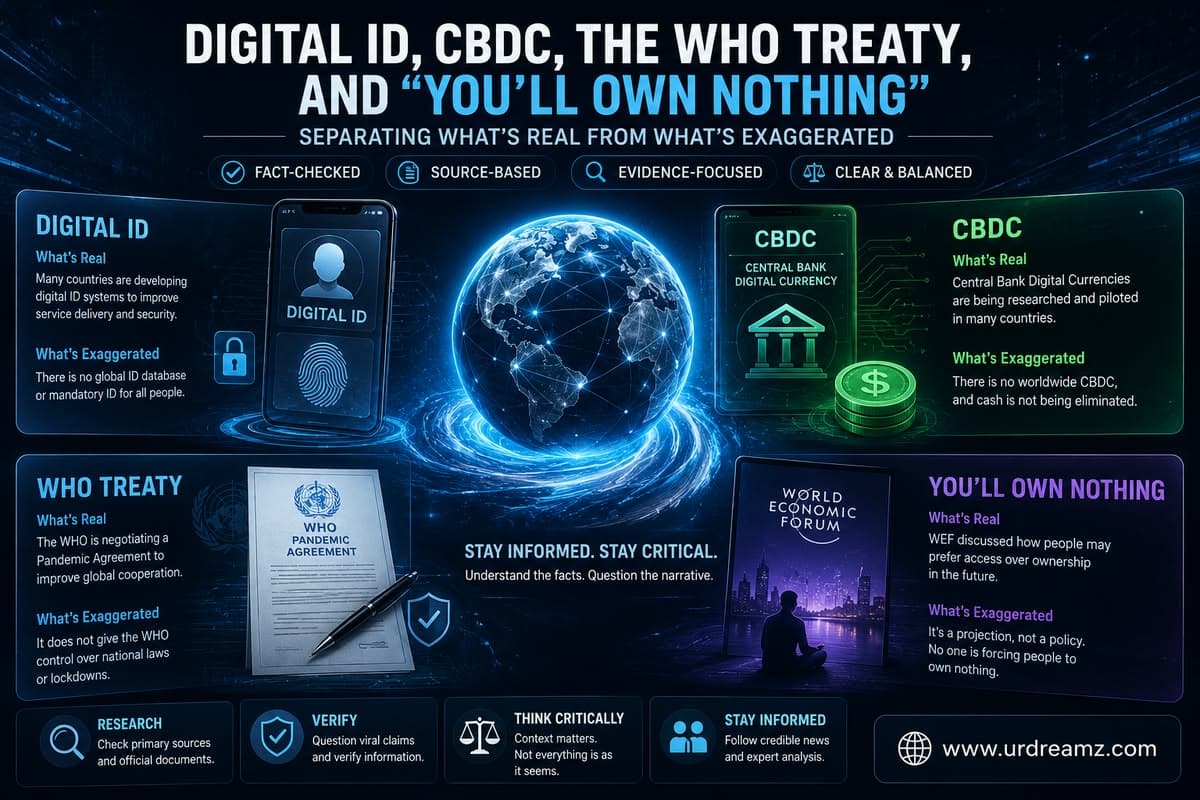
Digital ID, CBDC, the WHO Treaty, and "You'll Own Nothing": Separating What's Real From What's Exaggerated
Every so often, a message circulates online tying together four separate developments, Digital ID systems, Central Bank Digital Currencies, a World Health Organization treaty, and a World Economic Forum quote about ownership, into a single, alarming narrative: that by 2030, the entire world will be converted into one controlled, trackable system, and that every human being's life will effectively be reduced to something a government or global institution can switch off with a button. This is a serious claim, and it deserves a serious, careful look. So let's actually go through each of these four things individually, using what has actually been published, reported, and verified, rather than relying on how the claim has been summarized secondhand.
This isn't about dismissing genuine concerns. Some of the underlying issues here, privacy, financial surveillance, and the pace of technological change, are legitimate topics that deserve real scrutiny. But there's an important difference between a real, documented policy trend and a claim about a coordinated, secret plan to strip away individual freedom by a specific date. Let's separate the two, piece by piece, starting from the very first claim: that digital identity systems are quietly converting entire populations into something that can be controlled at will.
Digital ID: What It Actually Is, and Where It Actually Came From
Digital identity systems are real, and they are indeed spreading across much of the world. But it's worth understanding what these systems actually are, and just as importantly, how long they've already existed, before assuming this is some brand-new, sudden global rollout tied to a 2030 deadline.
Take Pakistan as a specific example, since it was mentioned directly. Pakistan's Computerized National Identity Card system is not new at all. It traces back to 2000, when the National Database and Registration Authority, better known as NADRA, was established, with the first computerized ID cards issued starting in 2001. For close to twenty-five years now, Pakistani citizens have needed this ID to open a bank account, get a passport, register to vote, get a SIM card, or access many government services. What has changed recently is not the existence of digital identity in Pakistan, but its format: in 2025 and 2026, NADRA began rolling out a fully "dematerialized" digital ID, accessible through a smartphone app called Pak Identity, along with a new chip-less card using a QR code instead of a physical chip. This is a modernization of a system that has existed for a quarter of a century, not the sudden introduction of a new form of control.
Globally, the push toward digital ID is driven largely by a very different motivation than population control: financial and civic inclusion. The World Bank has repeatedly highlighted that roughly one billion people worldwide lack any form of officially recognized identification, which locks them out of banking, healthcare, education, and legal protections entirely. Programs like the World Bank's Identification for Development initiative specifically aim to help countries build digital ID systems so that undocumented citizens, often the poorest and most marginalized, can finally access services that already require identification in paper form. In Pakistan specifically, human rights organizations have actually raised the opposite concern from what circulates online: that people without a CNIC are excluded from banking, education, and social protection, not that having one is itself the danger.
The European Union's Digital Identity Wallet: What the Regulation Actually Says
The European Union's Digital Identity Wallet is real, and it is a genuinely significant piece of regulation, formally known as the updated eIDAS framework, or eIDAS 2.0. It requires all EU member states to offer citizens a digital identity wallet by the end of 2026, allowing people to store things like their driver's license, medical prescriptions, diplomas, and banking credentials in one secure digital app.
However, the framing that circulates online, that without this wallet you will not be able to open a bank account, visit a hospital, or enroll in school, is not accurate. The EU regulation is explicit that use of the digital wallet is voluntary for citizens. Member states are required to offer it as an option, but individuals are not legally required to adopt it in place of existing documents and identification methods. The wallet is designed to make certain interactions more convenient, verifying your age at a shop, signing a document, proving a qualification, without needing to hand over multiple physical documents, but it exists alongside, not instead of, traditional forms of identification.
Central Bank Digital Currency: What's Actually Being Tested
The claim that roughly 130-plus countries are exploring central bank digital currencies is broadly accurate. Trackers maintained by organizations like the Atlantic Council do show that the vast majority of the world's central banks are at some stage of researching, piloting, or in a small number of cases, actually launching a digital version of their national currency. This is a real, well-documented global trend, not a fringe theory. It is one of the more accurate individual pieces of the broader claim being examined here, which is exactly why it's worth understanding precisely, rather than dismissing outright simply because it appears alongside less accurate claims in the same message.
It's worth understanding why central banks are interested in this at all. The stated motivations generally include modernizing payment infrastructure, reducing the cost of managing physical cash, improving financial inclusion for people without bank accounts, and maintaining monetary sovereignty as private cryptocurrencies and stablecoins grow in popularity. None of that is inherently sinister, and in many pilot programs, CBDCs have been designed to function very similarly to existing digital payment systems people already use every day, like mobile banking apps.
That said, there is a genuinely serious, widely discussed concern among economists, privacy advocates, and even some central bankers themselves: the technical possibility that a retail CBDC could be built with "programmable" features, meaning a government could, in theory, restrict what a specific unit of currency could be spent on, or when it expires, in ways that traditional bank deposits cannot easily replicate. This concern is real and worth taking seriously, and it is one of the main reasons several countries, including the United States under recent executive action, have explicitly ruled out or paused development of a retail CBDC specifically over surveillance and financial freedom concerns. It's also worth remembering, though, that governments and courts in most countries already have the legal authority to freeze bank accounts under existing banking law, through court orders, sanctions enforcement, or anti-money-laundering rules. A CBDC doesn't necessarily invent an entirely new power that didn't exist before; the more precise concern raised by experts is that it could make exercising that power faster, more granular, and easier to apply at scale, which is a meaningfully different, more specific worry than the idea that account freezing itself is a brand-new capability.
The WHO Pandemic Agreement: What the Actual Text Says
This is the claim that deserves the most direct, careful correction, because it has been extensively, repeatedly fact-checked against the treaty's actual published text, and the claim that circulates online does not hold up.
After more than three years of negotiation, the World Health Organization's Pandemic Agreement was formally adopted by consensus at the World Health Assembly on May 20, 2025. The core purpose of the agreement is to improve international cooperation for future pandemics, things like equitable vaccine distribution, faster information sharing between countries, and stronger health system resilience, based on lessons learned from the failures and inequities exposed during COVID-19.
The claim that WHO would gain the authority to unilaterally decide which countries go into lockdown is directly contradicted by the agreement's own text. The final agreement includes an explicit sovereignty clause, stating plainly that nothing in the agreement gives the WHO Secretariat or its Director-General any authority to direct, order, alter, or prescribe the national laws or policies of any member country, or to mandate actions such as banning travelers, imposing vaccine mandates, or implementing lockdowns. This isn't a minor technicality buried in a footnote. It is a central, repeatedly emphasized provision that was specifically added because negotiators were aware of exactly this kind of concern circulating publicly during the drafting process. Multiple independent fact-checking organizations, along with legal analysts who were part of the negotiating body itself, have confirmed that no version of the treaty, from the earliest drafts to the final adopted text, contains any provision transferring sovereign public health decision-making power to the WHO.
It's also worth noting the agreement has not entered into force yet even for the countries that adopted it. It still requires a specific number of formal ratifications by individual national governments, along with the finalization of a separate technical annex, before it becomes legally binding anywhere. Notably, the United States did not participate in the final negotiations at all, having already announced its withdrawal from the WHO, and several other countries, including Russia, Italy, Poland, and Slovakia, abstained from adopting it, some citing sovereignty concerns of their own during the vote, which is itself proof that countries retained the sovereign right to simply not join if they disagreed with it.
"You Will Own Nothing": Where That Phrase Actually Came From
This is probably the single most widely misunderstood piece of the entire narrative, so it's worth tracing its origin carefully. The phrase "You'll own nothing and be happy" did not originate as a formal policy declaration from the World Economic Forum. It originated from a 2016 opinion essay written by Ida Auken, a Danish member of parliament, titled "Welcome to 2030: I own nothing, have no privacy, and life has never been better." The essay was a speculative, first-person thought experiment imagining what daily life in a city might feel like in 2030 if trends like the sharing economy, subscription services, and rental-based living continued to grow, similar in spirit to speculative fiction used to spark discussion about where current trends might lead.
The World Economic Forum did host this essay on its website and later summarized it, along with several other speculative predictions, in a short social media video titled "8 Predictions for the World in 2030." That video is where the phrase gained its viral visibility. But hosting a speculative essay and turning it into a highlighted line in a predictions video is meaningfully different from what the claim suggests, that this represents an officially adopted WEF goal or policy platform with a hard 2030 deadline. Multiple fact-checking organizations, including Reuters and PolitiFact, have specifically investigated this claim and found no evidence that the World Economic Forum has ever stated an actual policy objective to eliminate private property ownership by 2030. Auken herself later added a note to her essay clarifying that it was meant to spark discussion about the pros and cons of emerging technological and economic trends, not to describe a personal utopia or an organizational mandate she was pushing for.
It is true that ownership patterns have genuinely been shifting in parts of the world, more people renting rather than buying homes, subscription models replacing outright purchases for software and even some consumer goods, and corporate ownership of rental housing increasing in some markets. Those are real, observable economic trends worth discussing on their own merits. But the specific claim that this shift represents an official, published World Economic Forum policy platform, distinct from broader, real conversations happening across the economics world about ownership, access, and the sharing economy, is not accurate.
A Closer Look at How Digital ID Has Spread Worldwide
The claim that roughly 161 countries have adopted some form of digital identity system is not far from documented reality, though it's worth being precise about what "adopted" actually means in practice. The World Bank's Identification for Development initiative tracks this closely, and its data shows that the overwhelming majority of countries worldwide have moved, or are actively moving, toward some form of digitized civil registration and identity verification, ranging from fully biometric national ID cards to simpler digitized birth and death registries. This range matters, because "digital ID" covers a very wide spectrum, from a country like Estonia, which has built one of the most comprehensive digital governance systems in the world, allowing citizens to vote, file taxes, and access nearly all government services online through a single digital identity, to countries that have simply digitized their existing paper-based civil registries without introducing any biometric or centralized tracking components at all.
What ties most of these programs together in official development literature is not a stated goal of control, but a stated goal of inclusion and efficiency. The World Bank has specifically highlighted that people without any form of legal identity, disproportionately women, rural populations, and refugees, are effectively locked out of formal banking, healthcare enrollment, property ownership, and voting in many parts of the world. Digital ID programs, in the language used by the institutions actually building them, are framed primarily as a tool to close that gap, not to create a new form of restriction for people who already have documentation. Whether every country implements these systems well, with strong privacy protections and genuine accessibility, is a separate and completely valid question, and it's one where real documented problems do exist in specific countries, including gaps and exclusion issues that have been reported in Pakistan's own system. But that is a different critique than the claim that digital ID itself represents a secret, coordinated mechanism for global population control.
What "Control" Actually Looks Like in Existing Digital ID Systems
It's worth being specific about what digital ID systems can and cannot currently do, since vague claims about "control" tend to blur together several very different technical capabilities. A digital ID system, in its most common form, verifies that a person is who they claim to be, replacing the need to physically carry and present a paper document. This is functionally similar to what a passport or driver's license has done for decades, just delivered through a smartphone app or QR code instead of a physical card.
What digital ID systems do not automatically do, without additional, separately built infrastructure and legal authority, is track a person's real-time location, monitor their private communications, or automatically restrict their access to services based on their behavior. Those capabilities would require entirely separate systems, deliberately built and legally authorized for those specific purposes, layered on top of a basic identity verification tool. Conflating identity verification with real-time behavioral tracking is one of the more common ways this topic gets exaggerated online. That said, the theoretical risk that a centralized identity database could eventually be linked to other tracking systems is a real, legitimate subject of ongoing debate among privacy law experts, which is exactly why regulations like the EU's eIDAS framework include specific legal provisions around data minimization, requiring services to request only the specific piece of information they actually need to verify, rather than full access to a person's entire identity record.
Understanding CBDC Pilots Already Underway
To make the CBDC discussion more concrete, it helps to look at what a few of the furthest-along pilot programs actually involve. Nigeria's eNaira, launched in 2021, was one of the first live retail CBDCs in the world, designed primarily to improve financial inclusion in a country where a large share of the population remains unbanked. China's digital yuan, or e-CNY, has been piloted extensively across major cities since 2020, functioning largely as a digital cash equivalent usable for everyday retail purchases, integrated alongside, not replacing, existing private payment platforms.
The European Central Bank has spent several years researching a potential digital euro, and it's worth noting that European officials have specifically and repeatedly stated, in public documentation, that any digital euro would be designed with strict privacy protections, would not replace physical cash, and would not allow the central bank to see individual transaction details in the way some viral claims suggest. Whether those design commitments will be fully honored once a system is actually deployed at scale remains, fairly, an open question that deserves continued public scrutiny, but it's worth distinguishing between the stated design intentions currently on record and a claim that surveillance is the explicit, acknowledged purpose of these programs.
The Actual Text of the WHO Sovereignty Clause
Given how central this specific claim is to the broader narrative, it's worth quoting the relevant provision directly rather than simply summarizing it, since the precise wording matters here. The final adopted text of the WHO Pandemic Agreement states plainly that nothing in the agreement shall be interpreted as providing the WHO Secretariat, including the Director-General, "any authority to direct, order, alter or otherwise prescribe the national and/or domestic law, as appropriate, or policies of any Party, or to mandate or otherwise impose any requirements that Parties take specific actions, such as ban or accept travelers, impose vaccination mandates or therapeutic or diagnostic measures or implement lockdowns."
This exact clause exists specifically because the drafting process, which took more than three years and involved public negotiation sessions, was closely watched by exactly the kind of sovereignty concerns being raised in the viral claim. Negotiators from multiple countries, including ones generally skeptical of expanding international institutional authority, pushed for this language to be added explicitly, and it was. This is a case where the public concern genuinely shaped the final legal text, which is a meaningfully different outcome than a secret plan being pushed through despite public objection.
How This Compares to the 2005 International Health Regulations
Some of the confusion around WHO's authority actually stems from a separate, earlier legal instrument: the International Health Regulations, first adopted in 2005 and amended in 2024. These regulations, distinct from the 2025 Pandemic Agreement, do grant WHO's Director-General the authority to formally declare a "public health emergency of international concern," a designation that has been used during outbreaks like Ebola, COVID-19, and mpox. This declaration authority is real and predates the more recent Pandemic Agreement by two decades.
However, even this declaration authority is fundamentally different from the power to mandate specific domestic policy. A declaration of a public health emergency functions primarily as an alert mechanism, prompting international information sharing, coordinated research, and recommended (not mandatory) guidance. Individual countries retain full legal authority to decide their own domestic response, whether that means implementing travel restrictions, business closures, or nothing at all. The 2024 amendments to these regulations did adjust some procedural elements, including how WHO can respond to regional emergencies, but multiple parliamentary and legal reviews, including one conducted by the UK's House of Commons Library, concluded that neither the amended regulations nor the newer Pandemic Agreement transfer sovereign decision-making authority to WHO.
Tracing the "Great Reset" Label Back to Its Source
Part of why these four topics get bundled together so persistently traces back to a specific term: "The Great Reset." This phrase originated from a genuine World Economic Forum initiative launched in 2020, in the early months of the COVID-19 pandemic, calling for governments and businesses to use the disruption of the pandemic as an opportunity to rebuild economies with more focus on sustainability and reduced inequality. Klaus Schwab, the WEF's founder, wrote a book on the subject and discussed it at WEF's annual meetings.
The Great Reset, as actually published and described by the WEF, was a broad, largely aspirational policy framework encouraging governments to consider environmental and social factors alongside economic growth when planning post-pandemic recovery, the kind of language commonly found in international economic policy discussions. It did not include a specific operational plan to abolish private property, control global food supplies, or eliminate national sovereignty. However, the phrase became a magnet for a wide range of separate claims, including the ownership essay discussed earlier, largely because it offered a convenient, singular label under which many previously unrelated concerns and conspiracy narratives could be grouped together and cross-referenced, even when the original source material didn't actually connect them the way later retellings suggested.
So Why Do These Four Things Get Bundled Together?
It's worth pausing to understand why these four separate, quite different developments, an identity document modernization program, a monetary policy research trend, a public health treaty, and a decade-old opinion essay, keep getting woven into a single unified narrative about a coordinated 2030 takeover. Part of the answer is that each of these topics, taken individually, touches on something people are genuinely, reasonably anxious about: how much of daily life increasingly runs through digital systems, how much personal data is being collected by institutions we don't fully understand or control, and how quickly technology seems to be reshaping economic and social life without much public input into the process.
When several separate institutions, a national identity authority, a group of central banks, a UN health body, and an economic forum, are all independently exploring digital tools, subscription-based economics, or international cooperation frameworks around the same general period, roughly the late 2020s, it can feel, from the outside, like evidence of coordination, especially when the year 2030 shows up repeatedly across unrelated organizations' planning documents. Part of this is simply because 2030 is the target date attached to the United Nations' Sustainable Development Goals, an internationally agreed framework from 2015 covering things like poverty reduction, education access, and health outcomes, which many governments and institutions reference when setting their own long-term planning targets, not because there is a secret, unified plan being executed by all of them together.
What Legitimate Concerns Actually Exist Here
None of this fact-checking is meant to suggest there's nothing worth being cautious about. There are real, serious, widely discussed concerns among privacy researchers, economists, and civil liberties organizations about several of these trends, and it's worth naming them clearly, separate from the exaggerated versions.
On digital ID, genuine concerns exist about data centralization, the risk of large-scale data breaches, and the exclusion of vulnerable populations who struggle to access the documentation needed to register in the first place, concerns that human rights organizations working directly with Pakistan's NADRA system have specifically raised. On CBDCs, the programmability question is real and worth continued public scrutiny and legal safeguards, which is exactly why some governments have chosen to build in explicit privacy protections or avoid retail CBDCs altogether. On international health cooperation, reasonable people can disagree about how much authority any international body should hold, even when that authority is explicitly limited by treaty text, and ongoing public oversight of how such agreements are implemented is a healthy, normal part of democratic accountability. And on ownership and the broader economy, it's entirely fair to have a real debate about whether subscription-based, rental-heavy economic models genuinely benefit ordinary consumers or primarily benefit large corporations and asset holders.
The difference between these legitimate concerns and the viral narrative isn't that one says "everything is fine" and the other says "be worried." It's that legitimate concern engages with what's actually written in the relevant laws, treaties, and regulations, while the viral version tends to skip that step entirely, relying instead on a chain of loosely connected facts stitched together into a much more dramatic, and much less accurate, conclusion.
What Media Literacy Researchers Say About Claims Like This
Researchers who study how misinformation spreads online have identified a recurring structural pattern in narratives like this one, sometimes referred to as "connect the dots" content. Rather than fabricating facts outright, this style of content takes several individually real, verifiable developments and connects them with speculative, unverified links, phrases like "this means," "this leads to," or "this is really about," that carry the narrative from documented fact to unsupported conclusion without clearly marking where that transition happens. This is part of what makes this kind of content so difficult to counter with a simple yes-or-no fact-check: most of the individual building blocks are accurate, which lends borrowed credibility to the speculative conclusion built on top of them.
This pattern shows up clearly across all four topics discussed here. Digital ID systems are real. CBDC research is real. The WHO Pandemic Agreement is real. Ida Auken's essay and the WEF video referencing it are real. Each individual fact checks out. What doesn't check out is the specific causal chain connecting them, the claim that these separately developed, independently governed initiatives, run by different institutions with different legal mandates in different countries, amount to a single coordinated system designed to eliminate personal autonomy by a specific calendar date. Recognizing this pattern, real building blocks assembled into an unsupported structure, is often more useful than trying to fact-check every individual sentence in isolation.
What Happens When These Systems Are Implemented Poorly
It would be dishonest to end this discussion by suggesting these technologies carry no real risk at all. Digital identity systems, CBDCs, and international regulatory frameworks are all, in practice, only as trustworthy as the institutions implementing them and the legal safeguards built around them. There are documented, real-world cases worth taking seriously: India's Aadhaar biometric identity system has faced legitimate criticism over data security incidents and instances where service denial occurred due to biometric authentication failures, particularly affecting elderly citizens and manual laborers whose fingerprints can be harder to scan reliably. Pakistan's own NADRA system has faced scrutiny over CNIC suspensions affecting vulnerable communities and reported data security incidents, exactly the kind of accountability gap that deserves sustained public attention and independent oversight.
These are the kinds of concerns worth channeling energy toward: pushing for strong data protection laws, independent oversight bodies, clear legal limits on how identity and financial data can be shared between government agencies and private companies, and transparent, publicly accountable processes when these systems are designed and implemented. That kind of engaged, specific scrutiny tends to produce far more meaningful protection for ordinary people than a broader claim about a secret, unified global plan, precisely because it targets the real, fixable gaps in how these systems are actually built and governed, rather than a conspiracy that the available evidence doesn't support.
A Few Things Worth Checking Before Sharing a Claim Like This
If you come across a claim like this one in the future, a few simple checks can go a long way. First, look for the actual source document, the treaty text, the regulation, the original essay or video, rather than relying on a summary of a summary. In this case, the WHO Pandemic Agreement's sovereignty clause is publicly available and takes less than a minute to find and read directly. Second, check whether major, independent fact-checking organizations across different countries and political leanings have already investigated the specific claim; when outlets as different as Reuters, PolitiFact, FactCheck.org, and Pakistan's own NADRA documentation all converge on the same basic correction, that convergence itself is meaningful evidence. Third, be skeptical of any claim that ties together several unrelated institutions into a single, secret, coordinated plan, real global policy coordination, when it happens, tends to be publicly negotiated, documented, and often quite messy and contested, not seamless or secret.
Final Thoughts
Digital identity systems, central bank digital currencies, international pandemic cooperation, and shifting patterns of ownership in the economy are all real, legitimate topics that deserve genuine public attention, debate, and, where appropriate, real skepticism about how they're implemented. But the specific claim that these four separate developments represent a coordinated, secret plan to convert the entire world into a single controlled system by 2030, complete with a WHO with the power to unilaterally declare lockdowns and a formal WEF policy to abolish private property, does not hold up against the actual, publicly available source material.
That doesn't mean healthy questions should stop. It means the questions are better asked with the real documents in hand: what does the actual treaty text say, what does the actual regulation require, who actually wrote the original essay and in what context, and what do independent, cross-checking sources actually find when they investigate the claim directly. Fear spreads fastest when it skips that step. Understanding tends to follow when we don't. And in an environment where headlines move faster than verification, that extra step, reading the actual document instead of the summary of the summary, remains one of the simplest, most reliable tools any of us have.
Frequently Asked Questions
Is Digital ID a new system being introduced for the first time? No, in most countries with active digital ID programs, including Pakistan, the underlying identity system has existed for decades. What is changing recently is the format, moving from physical cards to smartphone-based digital verification, not the introduction of identity registration itself.
Does the WHO Pandemic Agreement give WHO the power to order lockdowns in member countries? No. The agreement's text explicitly states that nothing in it gives the WHO Secretariat or Director-General authority to direct, mandate, or prescribe national laws or policies, including lockdowns, travel bans, or vaccine mandates. This has been confirmed by multiple independent fact-checking organizations and the treaty's own negotiators.
Did the World Economic Forum officially adopt a policy to make people "own nothing" by 2030? No. The phrase originated from a 2016 speculative essay by Danish politician Ida Auken, which the WEF hosted and later referenced in a predictions video. Fact-checkers including Reuters and PolitiFact have found no evidence of an official WEF policy goal to eliminate private property ownership.
Are governments actually developing digital currencies? Yes, this part of the claim is broadly accurate. Well over a hundred countries are researching, piloting, or in limited cases launching central bank digital currencies, primarily citing goals like payment modernization and financial inclusion, though genuine privacy and "programmability" concerns are actively debated by economists and policymakers.
Is the EU Digital Identity Wallet mandatory for citizens to use? No, the regulation requires EU member states to offer citizens the option of a digital identity wallet by the end of 2026, but its use by individuals remains voluntary rather than legally required in place of existing identification methods.
Why do these four separate topics keep getting grouped together online? Largely because each touches on real, understandable anxieties about digital surveillance and rapid technological change, and because many institutions independently reference the year 2030 due to its association with the United Nations' Sustainable Development Goals, which can create an appearance of coordination that isn't supported by the underlying documents.
Is it wrong to be cautious about these technologies even if the conspiracy version is inaccurate? No, healthy skepticism about data privacy, financial surveillance, and institutional accountability is reasonable and valuable regardless of whether the specific 2030 takeover narrative holds up. The most effective form of that skepticism engages directly with the actual laws, regulations, and design choices being made, rather than relying on an unverified, unified conspiracy narrative.