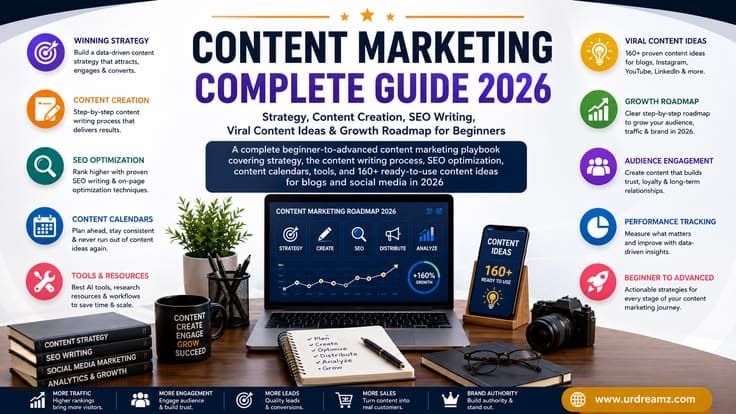
Content Marketing Complete Guide 2026: Strategy, Content Creation, SEO Writing, Viral Content Ideas & Growth Roadmap for Beginners
Content marketing is the single most reliable way to build an audience, earn trust, and turn strangers into customers without paying for every single click. This guide walks you through the entire journey - from understanding what content marketing actually is, to building a strategy, writing SEO-friendly content, planning a calendar, choosing the right tools, and never running out of content ideas again. Whether you are a complete beginner or you already run a blog or a business page, this roadmap is designed to be the only resource you need to bookmark for 2026.
Every section below is written to stand on its own, so feel free to jump straight to the part that matches where you are right now. If you're still deciding what your content is even about, start with the strategy and audience sections. If you already have a content engine running but feel like you're running out of ideas, skip ahead to the content idea libraries later in this guide, which include more than one hundred and sixty ready-to-use prompts across blogs, Reels, carousels, and stories.
1. What Is Content Marketing and Why It Matters
Content marketing is the practice of creating and sharing valuable, relevant material - blog posts, videos, podcasts, social posts, newsletters - with the goal of attracting and keeping a clearly defined audience. Instead of interrupting people with ads, content marketing earns attention by being genuinely useful. Over time, this builds brand recognition, trust, and authority, which eventually leads to more inquiries, more sales, and more repeat customers.
The reason content marketing matters so much in 2026 is simple: buyers research before they buy. People search Google, scroll Pinterest, and watch short videos long before they ever speak to a salesperson. If your brand shows up consistently with helpful answers, you become the obvious choice by the time they are ready to purchase. Content marketing is also compounding - a well-optimized blog post can keep bringing in traffic and leads for years, unlike a paid ad that stops working the moment you stop paying for it.
Think about the last time you bought something new - a phone, a course, or even a pair of shoes. There is a very good chance you searched for reviews, watched a comparison video, or read a "best of" list before you ever clicked "buy." That entire research phase is where content marketing lives. Brands that show up during this phase with genuinely useful information don't just get more traffic, they get warmer, more informed leads who trust them before the first conversation even happens.
Another reason content marketing has become non-negotiable is the shift in how people search. Voice search, AI chat assistants, and visual search on platforms like Pinterest have all changed the way information is discovered. This means a modern content strategy has to think beyond a single blog post ranking on Google - it needs to consider how the same information will be found through a voice assistant, summarized by an AI answer engine, or discovered as a short video on a social feed. The brands that win in 2026 are the ones creating one strong piece of core content and adapting it across every format their audience actually uses.
Below is a quick snapshot comparing content marketing with traditional advertising, so you can see why so many brands are shifting their budgets.
| Factor | Content Marketing | Traditional Advertising |
|---|---|---|
| Cost over time | Decreases as content compounds | Stays constant or increases |
| Trust built | High - educates first | Low - interrupts and sells |
| Longevity | Can drive traffic for years | Stops the moment budget ends |
| Audience relationship | Long-term, loyal | Transactional |
| Best for | Brand authority and organic growth | Quick, short-term spikes |
2. The 5 Pillars of a Winning Content Marketing Strategy
Every successful content marketing strategy is built on five pillars. Skip any one of them and your results will plateau no matter how much you post.
| Pillar | What It Means | Action Step |
|---|---|---|
| Audience Insight | Deeply understanding your ideal reader - their needs, problems, and questions | Build a simple customer persona document |
| Valuable Content | Creating original, high-quality material that actually solves a problem | Answer one real question per piece of content |
| Effective Distribution | Publishing on the channels your audience already uses | Pick 2-3 channels and go deep instead of spreading thin |
| Content Strategy | Planning ahead with a calendar mapped to the buyer journey | Build a monthly content calendar |
| Consistency & Results | Publishing on a schedule and measuring what works | Review analytics every month and adjust |
Notice that audience insight comes first. Most beginners jump straight to "what should I post" without ever writing down who they are posting for. Spend a single afternoon mapping out your reader's biggest frustrations, their goals, and the questions they type into Google - everything else in this guide becomes ten times easier once that groundwork is done.
It also helps to think of these five pillars as a cycle rather than a one-time checklist. You research your audience, create content for them, distribute it, plan the next round based on what you learned, and then measure results before starting the cycle again. Brands that treat content marketing as a straight line - research once, then create forever - eventually drift away from what their audience actually wants. Revisiting your audience insight every few months, especially as your business or niche evolves, keeps every other pillar sharp and relevant.
3. The 8-Step Content Writing Process
Professional writers don't just open a blank document and start typing. They follow a repeatable process that takes an idea from research to a published, optimized, and analyzed piece of content.
| Step | Stage | What Happens |
|---|---|---|
| 1 | Research | Pick the topic, gather information from credible sources, take notes |
| 2 | Planning | Define the audience, choose the format, build an outline |
| 3 | Writing | Draft the content following the outline, focus on clarity and flow |
| 4 | Editing | Review for accuracy, improve flow, keep tone consistent |
| 5 | Optimization | Add keywords, headings, meta description, alt text |
| 6 | Proofreading | Final check for grammar, spelling, and formatting |
| 7 | Publishing | Publish and promote across channels |
| 8 | Analysis | Track performance and use insights for the next piece |
The mistake most beginners make is skipping straight from Step 1 to Step 3 - jumping into writing without an outline. This is why so many blog posts feel unfocused. Spend a little extra time on planning and your writing speed will actually go up, because you are no longer figuring out structure while also trying to write sentences.
Step 8, analysis, is the step most people skip entirely, and it's arguably the most valuable one. Every piece of content you publish is a small experiment. Which headline got clicked more? Which section made people leave the page? Which call to action actually converted? Answering these questions turns your next piece of content into an improvement on the last one instead of a completely fresh guess. Over a year of consistent publishing, this compounding feedback loop is often the real difference between a blog that plateaus at a few hundred visitors a month and one that grows into a five- or six-figure traffic source.
4. Content Writing vs Copywriting: Key Differences
These two terms get mixed up constantly, but they serve very different purposes. Understanding the difference will help you use the right tone for the right piece of content.
| Aspect | Copywriting | Content Writing |
|---|---|---|
| Goal | Sell and convert leads | Educate, engage, and build authority |
| Tone | Catchy, conversational, persuasive | Informative, often more formal |
| Length | Short-form | Long-form |
| Examples | Ads, landing pages, social captions | Blogs, articles, newsletters, ebooks |
| Timeframe | Focused on immediate action | Part of a long-term strategy |
| Call to Action | Direct and strong | Subtle and secondary |
5. Article vs Blog Post: What Is the Difference
Not every piece of long-form writing is a "blog post," and not every blog post qualifies as a formal "article." Knowing the difference helps you choose the right structure and tone for each piece you publish.
| Feature | Article | Blog Post |
|---|---|---|
| SEO optimization | Not always optimized | Usually SEO optimized |
| Writing style | Formal, third person | Casual, often first person |
| Personal opinion | Avoided | Often included |
| Typical length | Usually longer, fact-based | Can be shorter, opinion-based |
| Organization | Arranged by category | Arranged chronologically |
| Updates | Infrequent | Frequent |
| Verification | Fact-checked before publishing | Doesn't always require verification |
6. 10 Beginner Content Marketing Mistakes to Avoid
Before we get into content ideas, it's worth pausing on what NOT to do. Most creators don't fail because they lack ideas - they fail because of a handful of repeated mistakes that quietly kill momentum. These mistakes rarely show up as a single dramatic failure; instead, they show up as slow, invisible drag that makes months of effort feel like they produced almost nothing.
| # | Mistake | Why It Hurts You |
|---|---|---|
| 1 | No clear niche | Trying to talk to everyone means your message reaches no one |
| 2 | Ignoring your audience | Not understanding their problems means creating content that never connects |
| 3 | Copying instead of creating value | Inspiration is healthy, imitation without added value is not |
| 4 | Inconsistent posting | Posting randomly never builds trust or keeps an audience engaged |
| 5 | Focusing on vanity metrics | Likes and followers look nice but don't always pay the bills |
| 6 | Poor content quality | Bad visuals, audio, or editing make people scroll straight past |
| 7 | No clear call to action | If you never tell people what to do next, you lose the opportunity |
| 8 | Not providing real value | Content that doesn't help, teach, or entertain simply won't grow |
| 9 | Not analyzing your content | If you never track what works, you keep repeating what doesn't |
| 10 | Quitting too soon | Growth takes time - consistency today becomes results tomorrow |
Print this list out if you have to. Almost every stalled blog or abandoned Instagram page can trace its problem back to two or three items on this table.
If you had to pick just one mistake to fix first, make it consistency. A mediocre piece of content published every week will almost always outperform a perfect piece of content published once a quarter, simply because algorithms and search engines both reward accounts and websites that show a reliable pattern of activity. Perfectionism disguised as "I'm still researching" or "I need better equipment first" is one of the most common reasons promising creators never build momentum. Publish something useful on a schedule you can actually sustain, then improve the quality as you go.
7. Content Ideas for Every Format: Reels, Stories, Carousels & Single Posts
Different formats work best for different goals. A quick idea that flops as a static post might explode as a Reel. Use this table to match your idea to the right format.
| Reels / Short Video | Stories | Carousels | Single Post |
|---|---|---|---|
| Short tutorials | Behind-the-scenes | In-depth tips | Infographics |
| "How to" videos | Polls and quizzes | Toolkits and checklists | Case studies |
| Before and after | Live updates | Blueprints | Quotes |
| Behind-the-scenes footage | Wins and fails | Cheatsheets | Testimonials |
| Mistakes and myth-busting | Milestones | Mindmaps | Industry news |
| Day-in-the-life | Ask-me-anything | Useful lists | Product spotlights |
| Timelapse builds | Product teasers | Tips and tricks | Storytelling posts |
8. 33 Viral Content Hook Ideas You Can Copy Today
A hook is the first line that stops someone from scrolling. Below are thirty-three proven hook formats, rewritten so you can plug your own topic straight into the brackets.
- Here's exactly how I reached [desired outcome]
- It took me years to learn this - here it is in under ten seconds
- The ultimate guide to [result] in 2026
- If I were starting in [niche] again, here's exactly what I'd do
- Nine tools I swear by whenever I need [result]
- Five habits quietly stopping you from reaching [goal]
- Nobody talks about what it actually takes to achieve [X]
- If you're in [niche], you need to hear this
- Five books so good I'd gift them to any [expert]
- Newbie vs pro: how [industry] approaches change over time
- How to become a [expert] without spending a fortune
- I've used [tool] for years and just discovered this feature
- This one simple trick changed everything
- This might be a little controversial, but here goes
- Have you heard about this completely free [niche] tool?
- The iceberg of what really goes on in [niche]
- I'd bet you don't know all three of these [niche] tips
- What I wish clients would say - but almost never do
- How to fix this common issue during [typical task]
- Is this something only the pros know about?
- A realistic look at my morning as a [industry expert]
- Stop scrolling if this describes you
- This single feature is why I switched to [tool]
- The biggest time-saver for [industry] professionals
- Every [industry expert]'s dream tool, explained
- The best [niche] books released this year
- [Niche] tips that genuinely improve daily life
- How I solved my biggest struggle as a [expert]
- The trends shaping [industry] this year
- The single biggest mistake I keep seeing in [niche]
- What nobody warns you about before you start in [niche]
- I tried [strategy] for thirty days straight - here's what happened
- Save this post if you're serious about [goal]
9. 77 High-Engagement Content Ideas for Social Media
Whenever you're stuck, come back to this master list. It's organized loosely from educational to personal to promotional, so you can build a balanced content mix instead of posting the same type of content every day.
- Answer a frequently asked question
- Share your origin story
- Show a behind-the-scenes moment
- Reveal a common mistake in your niche
- Post a quick, actionable tip
- Share a client success story
- Create a downloadable checklist
- Explain your process step by step
- Share a personal lesson you learned the hard way
- Show a day in your life
- Share a customer review
- Post a before-and-after result
- Share an emerging industry trend
- Create a beginner-friendly guide
- Post an inspirational quote
- Share your favorite business tool
- Bust a common myth in your field
- Celebrate a recent win
- Highlight a product feature
- Post a mini tutorial
- Share a surprising fact
- Ask your audience a direct question
- Create a quick poll
- Share a productivity tip
- Show your workspace or setup
- Talk about a recent challenge you faced
- Explain a key concept in simple terms
- Share a book recommendation
- Create a resource roundup list
- Post a motivational story
- Share your goals for the week
- Reveal your daily routine
- Show a project while it's still in progress
- Share a customer transformation story
- Celebrate a milestone with your audience
- Share an unpopular opinion, respectfully
- Post a quick-win strategy
- Show exactly how your product works
- Share relevant industry news
- Tell a memorable client story
- Highlight a team member
- Share a lesson learned from failure
- Post a relevant business statistic
- Share a detailed case study
- Create a side-by-side comparison post
- Share your favorite app or software
- Answer a common objection people have
- Post a roundup of your best content
- Share a recent breakthrough moment
- Teach one useful thing in under sixty seconds
- Reveal an AI tool you genuinely love
- Share your single best piece of advice
- Post a step-by-step guide
- Showcase content created by your audience
- Share a small daily business habit
- Feature a happy customer
- Explain an industry term in plain English
- Share your biggest takeaway from this month
- Create a myth-versus-fact post
- Post a short product demo
- Share a framework behind your success
- Comment on a trending topic in your space
- Share a networking tip
- Reveal your favorite shortcut or hack
- Share a bold prediction for the future
- Challenge your followers to try something
- Highlight a genuinely free resource
- Break down your current content strategy
- Tell the story behind your brand name
- Ask your audience how they discovered you
- Host a quick live question-and-answer session
- Post a "swipe to save" style carousel
- Tease an upcoming seasonal campaign
- Give a shoutout to your community
- Run an open ask-me-anything session
- Compare two popular tools in your niche
- Share a year-in-review recap
10. 57 Clever Social Media Content Ideas by Category
This list is grouped by purpose so you can pick the right idea depending on whether you want to build connection, teach something, or promote an offer.
| Category | Ideas |
|---|---|
| Behind the Scenes | A day-in-the-life video; your creative process; a workspace tour; what's inside your work bag; how you plan your week; a moodboard of current inspiration; a blooper reel; a time-lapse of a project being built |
| Educational / Tips & Tricks | Three things you wish you knew when starting; a mini how-to; your favorite productivity hack; common myths and the truth behind them; a swipeable quick-tips carousel; a "did you know" fact; one mistake to avoid; breaking down a trending topic |
| Personal & Relatable | Your biggest mistake and what it taught you; then versus now; a day you almost quit but didn't; a respectfully unpopular opinion; a meme that matches your current mood; a "this or that" poll about daily habits; three things that bring instant joy; a funny but insightful rant |
| Trendy / Evergreen Fun | Jumping on a trending audio or format; using a viral meme template to describe your niche or your day |
| Engagement Boosters | Caption-this photo challenge; an ask-me-anything session; a guessing quiz; a slider poll in stories; a "would you rather" prompt; asking people to comment their favorite item; a two-truths-and-a-lie game; a fill-in-the-blank prompt |
| Product / Offer Focused | Before-and-after using your product; a customer review with your own reaction added; a trending sound paired with your offer; packaging your product on camera; explaining what makes your offer different; three creative ways to use your product; a launch countdown; a flashback to your very first sale |
| Growth / Motivation | A Monday mantra; a quote that changed your perspective; a journal prompt for your audience; a mindset shift you went through; something you recently unlearned; reacting to your very first piece of content; motivation for when things feel stuck; "this is your sign" style post |
| Collaboration & AI-Powered Ideas | Duet or collaborate with another creator in your niche; co-host a live session with a peer; use an AI tool to remix an old post into a new format; ask an AI assistant to summarize your top posts of the month; run an AI-generated quiz for your audience; repurpose a long article into an AI-assisted carousel; share how you personally use AI in your workflow |
11. AI-Powered Content Prompts to Beat the Blank Page
Artificial intelligence tools have become one of the biggest time-savers for creators and marketers. Instead of staring at a blank page, you can ask an AI assistant to generate a first draft, brainstorm angles, or repurpose one piece of content into ten smaller ones. Here are some of the most useful AI-assisted content formats worth experimenting with in 2026:
- AI-assisted carousel scripts for LinkedIn or Instagram
- Faceless YouTube channel scripts and outlines
- Evergreen content refresh prompts for old blog posts
- Before-and-after transformation post scripts
- Comparison posts contrasting AI-written and human-written content
- Email subject line variations for A/B testing
- Blog post outlines generated in minutes, then edited by a human
- Thumbnail text variation testing
- FAQ page drafts based on real customer questions
- Product description variations for different audiences
- Webinar titles and agenda combinations
- Lead magnet headline testing
- Interactive quiz question generation
- Data visualization prompt ideas for reports
- Weekly newsletter theme brainstorming
The important rule with AI content is the same rule that applies to any tool: it should speed up your process, not replace your judgment. Always edit AI-generated drafts to match your own voice, verify any facts or statistics, and add real examples from your own experience before publishing.
There is also an ongoing conversation about whether search engines penalize AI-generated content. The honest answer is that search engines don't penalize content for being written with AI assistance - they penalize content that is low-quality, unoriginal, or unhelpful, regardless of who or what wrote it. A thin, generic article produced entirely by AI with no editing will struggle to rank, but so will a poorly written article produced entirely by a human. The winning approach in 2026 is a hybrid workflow: use AI to speed up research, outlining, and first drafts, then apply real expertise, personal examples, and a genuine edit pass before anything gets published. That combination of speed and authenticity is what both readers and search engines are increasingly rewarding.
Beyond writing, AI tools are also useful for the less glamorous parts of content marketing - summarizing long customer feedback threads into a handful of content ideas, turning a webinar transcript into a blog post outline, or generating alt text suggestions for a batch of images. Treating AI as a research and production assistant, rather than the final voice of your brand, is the safest and most effective way to use it.
12. SEO Content Writing: On-Page Optimization Checklist
Great writing alone isn't enough if search engines can't understand what your page is about. On-page SEO is how you translate valuable content into content that actually ranks.
| Element | Best Practice |
|---|---|
| Primary keyword | Place naturally in the title, first paragraph, and at least one heading |
| Meta title | Keep it descriptive, concise, and include the main keyword near the front |
| Meta description | Summarize the value of the page in one or two compelling sentences |
| Headings (H2, H3) | Break content into scannable sections that match search intent |
| Internal links | Link to related articles to build topical authority and reduce bounce rate |
| Image alt text | Describe the image accurately while including relevant keywords naturally |
| URL slug | Keep it short, readable, and keyword-focused |
| Schema markup | Help search engines understand the page type, such as Article or FAQ |
| Search intent | Match the content format to what the searcher actually wants - a guide, a list, a comparison, or a definition |
A common beginner mistake is optimizing for a keyword without checking search intent. If people searching your target keyword mostly want a quick definition, but your page is a five-thousand-word deep dive, you may struggle to rank even with perfect keyword placement. Always check what already ranks for your target term before you start writing.
It's also worth understanding the difference between primary and secondary keywords. Your primary keyword is the main phrase you want the page to rank for - it usually appears in the title, the URL, and the opening paragraph. Secondary and long-tail keywords are the related phrases and questions real people search around that same topic, and weaving them naturally throughout your subheadings and body text helps search engines understand the full scope of what your page covers. This is often called semantic SEO, and it matters more today than simply repeating one exact phrase over and over, a tactic search engines now recognize as keyword stuffing and actively penalize.
Finally, don't underestimate readability. Short paragraphs, simple sentences, and clear transition words make content easier to scan on a phone screen, where the majority of readers will actually find you. A technically perfect, keyword-optimized article that nobody wants to finish reading will still underperform a slightly less optimized article that keeps people engaged until the end, because engagement signals - time on page, scroll depth, and return visits - increasingly factor into how search engines rank content over time.
13. Content Distribution: Where and How to Promote Your Content
Publishing is only half the job. Distribution is what actually gets your content in front of the right eyes. Many beginners spend ninety percent of their time writing and ten percent promoting, when a healthier split is closer to fifty-fifty. A brilliant article that nobody sees performs exactly the same as an article that was never written at all, at least in terms of business results.
| Channel | Best For | Tip |
|---|---|---|
| SEO / Organic Search | Long-term, compounding traffic | Target search intent, not just keyword volume |
| Visual, evergreen discovery traffic | Design multiple pin variations per post | |
| Email Newsletter | Owned audience and repeat visits | Send a short summary with a link, not the whole article |
| Instagram / TikTok | Fast, top-of-funnel awareness | Turn one blog post into three to five short videos |
| B2B authority building | Share a personal take, not just a link | |
| YouTube | Long-form trust building | Optimize titles and descriptions like blog posts |
| Content syndication | Extra reach on established platforms | Always link back to your original source |
A helpful way to think about distribution is the "one piece, many formats" rule. Instead of creating brand-new content for every single channel, treat your best-performing blog post as raw material. A two-thousand-word guide can become a five-slide carousel, a sixty-second video script, three separate email newsletter sections, and a handful of standalone social posts quoting the most useful tips. This approach not only saves enormous amounts of time, it also reinforces the same core message across multiple touchpoints, which is usually what it takes before a new visitor actually remembers your brand.
Timing also matters more than most beginners realize. Publishing a blog post and sharing it once on social media the same day is rarely enough. Successful creators often re-share the same piece of content multiple times over several weeks, rewriting the caption or hook each time, because most of their audience simply wasn't online the first time it was posted. Distribution is not a single action - it's an ongoing process that continues well after the initial publish date.
14. Building a Content Calendar That Works
A content calendar turns "I'll post when I feel inspired" into a system. Consistency, not intensity, is what compounds over time.
| Day | Content Type | Goal |
|---|---|---|
| Monday | Educational tip or how-to | Attract new followers through value |
| Tuesday | Behind-the-scenes post | Build relatability and trust |
| Wednesday | Long-form blog article | Drive organic search traffic |
| Thursday | Customer story or case study | Build social proof |
| Friday | Engagement post or poll | Boost comments and shares |
| Weekend | Repurposed or evergreen content | Stay visible with less effort |
Notice this calendar mixes formats intentionally instead of repeating the same content type every day. A healthy content mix keeps your existing audience engaged while still attracting new people through search and discovery.
When building your own calendar, work backward from your business goals rather than forward from a blank grid. If lead generation is your priority this quarter, make sure at least one piece of content each week has a clear conversion path - a lead magnet, a newsletter signup, or a direct call to action. If brand awareness is the priority, weight your calendar more heavily toward shareable, top-of-funnel content like behind-the-scenes posts and educational tips. A calendar without a goal behind it tends to produce content that is technically consistent but strategically directionless.
It's also worth building in flex days. Trying to plan every single post three months in advance leaves no room for timely, trend-jacking content or for responding to a question your audience asks in real time. A good rule of thumb is to plan roughly seventy percent of your calendar in advance and leave the remaining thirty percent open for real-time opportunities.
15. Best Content Marketing Tools Compared
The right tool saves hours every week. Here is a quick reference of popular categories and what each one is generally used for.
| Tool Category | Example Tools | Main Use Case |
|---|---|---|
| AI writing assistants | ChatGPT, Claude | Drafting, brainstorming, and editing content |
| Grammar and proofreading | Grammarly | Catching grammar, spelling, and tone issues |
| Design | Canva | Creating graphics, pins, and social media visuals |
| Planning and organization | Notion, Google Sheets | Content calendars and editorial planning |
| Content optimization | Surfer SEO | Scoring content against top-ranking competitors |
| Keyword research | Ahrefs, Semrush | Finding keyword volume, difficulty, and competitors |
| Question and topic research | AnswerThePublic, Google Trends | Discovering what people are actually searching for |
| Analytics | Google Analytics, Search Console | Measuring traffic, rankings, and technical errors |
You do not need every tool in this table to get started. In fact, trying to learn five new platforms in your first month is one of the fastest ways to burn out before you've published a single piece of content. A realistic starter stack looks like this: one AI writing assistant to speed up drafting, one free analytics tool to see what's working, one design tool for visuals, and a simple spreadsheet or notebook app for planning. Everything else on this list becomes useful later, once you have enough content and traffic to justify the learning curve and, in many cases, the subscription cost.
When you do outgrow the free tier of a tool, evaluate the paid upgrade against a simple question: will this save me more time or generate more revenue than it costs? A keyword research tool that helps you avoid wasting a week writing an article that was never going to rank easily pays for itself. A design tool upgrade that saves you two hours a week creating graphics is worth it if your time is genuinely better spent writing or strategizing. Treat every tool purchase as an investment decision, not a shortcut to success on its own - no tool will substitute for genuinely useful content and a clear understanding of your audience.
16. SEO Tasks Checklist: Daily, Weekly, Monthly & Periodic
SEO isn't a one-time setup - it's an ongoing habit. Breaking tasks into a rhythm keeps your site healthy without becoming overwhelming.
| Frequency | Tasks |
|---|---|
| Daily / Weekly | Check Search Console for new errors; scan for broken links; review analytics; check competitor rankings; monitor brand mentions |
| Monthly | Conduct keyword research; publish new quality content; identify pages to refresh; monitor organic traffic; check indexing issues; review backlinks |
| Periodic | Add internal links from high-authority pages; optimize videos; clean up slugs; add missing alt text; align content with search intent; build infographics |
| One-time setup | Install analytics tools; improve page speed; fix site structure; optimize landing pages; prepare for voice search; set up rank tracking |
17. 9 Actionable Tips to Increase Blog Traffic
If your blog traffic has plateaued, work through this checklist in order. Each tip builds on the one before it.
| # | Tip | How to Apply It |
|---|---|---|
| 1 | Write about what your audience actually cares about | Study common questions and analyze competitor content |
| 2 | Build topical authority | Cover related subtopics and connect them with internal links |
| 3 | Make content genuinely helpful | Add images, video, and clear, actionable steps |
| 4 | Target realistic keywords | Check keyword difficulty and favor long-tail terms early on |
| 5 | Publish consistently | Follow a schedule and refresh old content quarterly |
| 6 | Build quality backlinks | Find sites linking to competitors and pitch them your content |
| 7 | Write enticing meta titles | Lead with the main keyword and keep it concise |
| 8 | Add schema markup | Help search engines understand and display your pages correctly |
| 9 | Write compelling headlines | Promise a clear, specific benefit the reader can picture |
18. 30+ Micro-Niche Blog Ideas for Faster Ranking
Broad niches are crowded. Micro-niches let you rank faster because there is far less competition. Here are proven examples across different industries you can adapt to your own space:
- Sustainable living for apartment dwellers
- Dog-friendly travel destinations
- Indoor gardening for small spaces
- DIY natural beauty products for sensitive skin
- Simple vegan desserts with minimal ingredients
- Budget home workouts for busy parents
- Gluten-free camping meals
- Freelancer tips for digital nomads
- Mindfulness exercises for daily commuters
- Paleo lunchbox ideas for kids
- Upcycled fashion on a thrift-store budget
- Slow cooker recipes for one-person households
- Urban beekeeping for beginners
- Affordable sustainable fashion
- Home decor made from recycled materials
- Zero-waste products for travelers
- Low-impact fitness for seniors
- Local microbreweries and craft beer guides
- Fitness routines for desk-job workers
- Keto recipes for college students on a budget
- Natural pest control for urban gardens
- High-intensity workouts for tiny apartments
- Suburban homesteading tips
- Vintage thrifting and fashion finds
- Gluten-free travel planning
- Mindful eating for sustainable weight loss
- Sustainable and budget-friendly wedding ideas
- Beginner yoga for limited mobility
- Minimalist living in a tiny house
- Fitness for time-poor entrepreneurs
- Natural hair care for curly hair types
- Plant-based meal prep for athletes
- Natural cleaning products for pet owners
19. Using AI Assistants for Lead Generation
AI tools like ChatGPT can dramatically speed up the lead generation process when you use them for the right tasks. Here's how each stage of the funnel can be supported by AI.
| Stage | How AI Helps | Example Prompt Idea |
|---|---|---|
| Prospect research | Identify ideal customers and their pain points | List businesses in a given industry that likely need a specific service |
| Outreach copy | Draft cold emails and follow-up sequences | Write a three-email sequence solving one clear problem |
| Lead qualification | Create qualifying questions and scoring criteria | Generate ten questions to qualify buyers for a specific product |
| Value propositions | Craft hooks and address objections | Write five value propositions targeting one specific pain point |
| Lead magnets | Brainstorm freebies and outline landing pages | Create ten lead magnet ideas that solve a niche problem |
| Follow-up strategy | Design a multi-touch nurture sequence | Build a thirty-day plan for leads who didn't convert yet |
| List segmentation | Group contacts by behavior for tailored messaging | Segment an email list by engagement level for better conversion |
20. Content Performance Metrics and KPIs to Track
You can't improve what you don't measure. These are the metrics that actually matter for content marketers, as opposed to vanity numbers that look good but don't move the business forward.
| Metric | What It Tells You |
|---|---|
| Organic traffic | How many people find you through search engines |
| Bounce rate | Whether visitors find the page relevant enough to stay |
| Click-through rate (CTR) | How compelling your titles and meta descriptions are in search results |
| Average engagement time | How much of your content people actually consume |
| Conversion rate | How many readers take the action you want, such as subscribing |
| Backlinks | How much authority other sites are passing to your content |
| Keyword rankings | Where your pages sit in search results over time |
| Content ROI | Whether the traffic and leads justify the time invested |
Review these numbers monthly rather than daily. Content marketing is a compounding game, and daily fluctuations rarely tell you anything useful. What matters is the trend line over eight to twelve weeks.
When you do sit down to review performance, resist the urge to only celebrate your best-performing post and ignore the rest. The most valuable insights often come from your worst-performing content. Did a topic simply not resonate with your audience, or was the content itself weak? Did the title undersell genuinely useful information? Was the piece published on a day with historically low engagement? Answering these questions consistently, even for content that "failed," is what separates creators who improve steadily from those who keep guessing.
It also helps to separate vanity metrics from business metrics early on. Likes, views, and follower counts feel rewarding, but they don't directly pay bills. Metrics like email signups, qualified leads, and actual sales attributed to content are the numbers that justify the time and budget you're investing. A post with modest likes but a strong conversion rate is usually more valuable to a business than a viral post that generates no measurable action at all.
21. B2B vs B2C Content Marketing: What Changes
Content marketing principles stay the same whether you sell to businesses or to individual consumers, but the details of tone, format, and buying cycle shift quite a bit. Understanding these differences prevents you from copying a strategy that simply doesn't fit your audience.
| Factor | B2B Content Marketing | B2C Content Marketing |
|---|---|---|
| Buying cycle | Longer, involves multiple decision-makers | Shorter, often a single decision-maker |
| Tone | Professional, data-driven, ROI focused | Emotional, relatable, entertainment-friendly |
| Preferred formats | Whitepapers, case studies, webinars, LinkedIn posts | Short videos, social posts, reviews, influencer content |
| Key metric | Lead quality and sales-cycle influence | Engagement and conversion volume |
| Content depth | Long-form, detailed, technical | Snackable, quick, visually driven |
A B2B software company, for example, will usually get more value from a detailed comparison guide or an in-depth case study that a buying committee can pass around internally. A B2C skincare brand, on the other hand, will usually get more value from a fifteen-second video showing a visible result, because the decision is emotional and immediate. Neither approach is "better" - they simply serve different buying psychology, and mixing them up is a common reason content underperforms even when the quality is high.
Many brands actually sit somewhere in between, selling to small business owners who are making a personal decision but still evaluating it with a business mindset. In that middle ground, a blended approach often works best: lead with an emotional, relatable hook to earn attention, then back it up with the kind of data, proof, and detail a B2B buyer would expect before trusting a purchase decision. Testing both styles with your specific audience, rather than assuming one universally correct approach, is the fastest way to find what actually converts for your niche.
22. A Simple Case Study Walkthrough: From Zero to Ranking
To make this guide practical, here is a simplified example of how these pillars come together in real life. Imagine a new blog in the home organization niche.
Month 1 - Research and Foundation. The creator writes down exactly who they are talking to: busy parents in small apartments who feel overwhelmed by clutter. They research the questions this audience actually types into Google and build a list of thirty realistic, low-competition topics instead of chasing broad, crowded keywords like "home organization."
Month 2 - Consistent Publishing. They publish two well-researched articles a week, each one following the eight-step writing process from Section 3. Every article includes at least one table or checklist, because scannable content keeps readers on the page longer, which signals quality to search engines.
Month 3 - Distribution. Each article gets turned into three Pinterest pins, one short video, and one email newsletter segment. The creator stops treating each platform as a separate content calendar and instead treats every blog post as the source material for a week's worth of smaller content pieces.
Month 4 to 6 - Compounding. Internal links start connecting related articles into a small topic cluster around "small space organization." Search rankings for individual long-tail keywords begin to climb. Traffic that used to require constant promotion starts arriving on its own, because the content itself is now doing the marketing.
This is the pattern behind almost every successful content-driven brand: a clear audience, consistent publishing, smart repurposing across channels, and patience while the compounding effect takes hold. There is no shortcut around the first three to six months, but the payoff is a traffic and lead source that keeps working long after the initial effort was put in.
23. Final Roadmap: How to Build Topical Authority in Content Marketing
If you take one thing away from this guide, let it be this: topical authority beats random, scattered posting every time. Instead of publishing whatever comes to mind, choose a handful of core categories - content strategy, content writing, blogging, SEO, AI content, and content distribution are strong starting points - and commit to covering each one thoroughly before moving to the next.
Start with a pillar page like this one that gives a broad overview, then branch out into supporting articles that go deep on each subtopic: a dedicated SEO content writing guide, a copywriting-for-beginners piece, an evergreen content guide, a pillar-pages explainer, and a content calendar tutorial. Link them all back to this guide, and link this guide out to them. That internal linking structure is exactly what search engines look for when deciding whether a website deserves to be treated as an authority on a subject.
Combine that structure with the content ideas, tables, and checklists above, publish consistently, and revisit your analytics every month to double down on what's working. That is the entire game of content marketing - understand your audience, publish valuable content consistently, distribute it intelligently, and measure your way to better decisions over time.
If this guide feels overwhelming, remember that nobody implements all twenty-three sections in their first week. Pick one pillar to strengthen this month - maybe it's finally writing down your audience persona, maybe it's building your first real content calendar, maybe it's simply fixing the ten SEO mistakes from Section 12. Small, consistent improvements compound the same way content itself compounds. A year from now, the brands and creators who are still standing won't necessarily be the ones with the flashiest single viral post - they'll be the ones who kept showing up, kept refining their process, and kept treating their audience's problems as more important than their own promotional goals.
Bookmark this guide, come back to the tables whenever you're planning your next batch of content, and use the 160-plus ideas above whenever you feel stuck. Content marketing rewards patience and consistency far more than it rewards talent alone, which means anyone willing to follow this roadmap has a genuine shot at building an audience in 2026 and beyond.
Frequently Asked Questions
What is content marketing?
Content marketing is the strategy of creating and distributing valuable, relevant content to attract and retain a clearly defined audience, with the ultimate goal of driving profitable customer action.
Why is content marketing important?
It builds trust before a sale ever happens, drives compounding organic traffic, and positions a brand as an authority rather than just another advertiser.
How do beginners start content marketing?
Start by defining your audience, picking one or two content formats, publishing consistently, and reviewing performance data every month to refine your approach.
What is the difference between SEO and content marketing?
SEO is the technical and strategic practice of helping content get found in search engines, while content marketing is the broader discipline of creating and distributing that content in the first place. SEO is essentially one channel within content marketing.
How long does content marketing take to show results?
Most brands begin to see meaningful organic traction after three to six months of consistent publishing, with compounding results building further over the following year.
What are the best content marketing tools for beginners?
A free analytics tool, a design tool like Canva, a writing assistant, and a simple keyword research tool are enough to get started before investing in premium software.