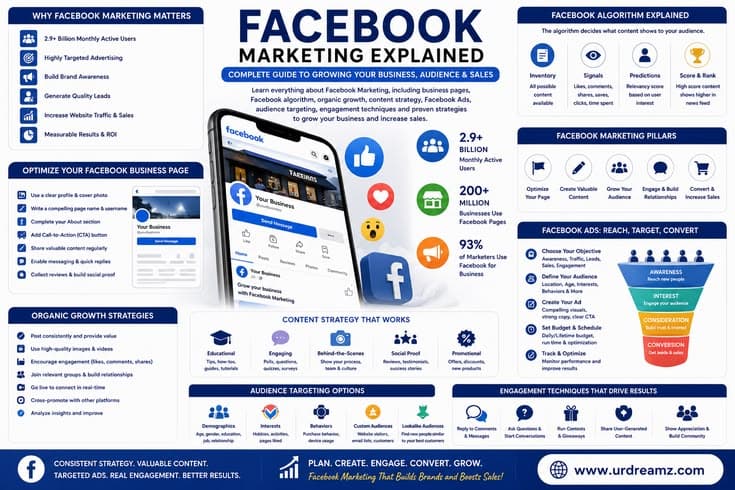
Facebook Marketing Explained: Complete Guide to Growing Your Business, Audience and Sales
With billions of active users, Facebook remains one of the most powerful platforms for reaching customers, whether you're a local business, a blogger, an ecommerce brand, or an affiliate marketer. Facebook marketing covers everything from setting up and optimizing a business page, to posting content the algorithm actually rewards, to running Meta Ads that turn a small budget into real leads and sales. This guide walks through the entire process step by step.
What makes Facebook uniquely valuable compared to newer platforms is simply the breadth of its audience. While TikTok and Instagram skew younger, Facebook still holds strong engagement across a much wider age range, which means it remains one of the best places to reach parents, professionals, local shoppers, and older demographics who may not spend much time on newer apps at all. For local businesses in particular - restaurants, clinics, service providers, retail shops - Facebook often produces the highest return of any single platform, simply because it's where their exact customer base already spends time daily.
This guide is organized to be used two ways: read it start to finish for a complete strategy, or jump straight to the section relevant to whatever stage you're at right now - whether that's setting up your very first business page or refining an existing ad account that's already spending real money. Along the way, you'll see how each piece connects: a well-optimized page makes your organic content perform better, strong organic content makes your paid ads more credible when people click through to check you out, and clean tracking through the Pixel and Conversions API makes every dollar of ad spend go further by feeding better data back into Meta's optimization systems. None of these pieces work in isolation nearly as well as they work together.
This guide continues the Digital Marketing Learning Center and builds directly on the Social Media Marketing foundation already covered. It connects naturally with: Blogger vs WordPress, Amazon Associates: Complete Guide to Affiliate Marketing, SEO for Beginners, Digital Marketing Explained, Content Marketing Complete Guide, Email Marketing Explained, and Social Media Marketing Explained.
1. What Is Facebook Marketing?
Facebook marketing is the practice of using a Facebook business page, groups, content, and paid ads to build brand awareness, engage an audience, and generate leads and sales. Despite newer platforms competing for attention, Facebook still holds one of the largest and most diverse user bases of any social network, which makes it especially valuable for local businesses, ecommerce brands, and any business targeting an audience broader than just teenagers and young adults.
Facebook marketing works best as a combination of three things: a fully optimized business page, a consistent organic content strategy, and targeted paid advertising through Meta Ads Manager. Trying to rely on just one of these three usually produces weaker results than combining all three together.
2. How to Create and Optimize a Facebook Business Page
A properly optimized business page is the foundation everything else builds on. Skipping steps here quietly limits how much your content and ads can perform later.
| Step | What to Do |
|---|---|
| 1. Choose the right category | Select the most accurate business category so people can find you through search |
| 2. Create a custom username | Use a clean, easy-to-remember username (your page's unique @handle) |
| 3. Design a professional profile and cover photo | Use a high-quality logo and a cover image that represents your brand; check Meta's current help center for the latest recommended cover photo dimensions before uploading, since exact size guidance can change |
| 4. Optimize your About section | Write a clear, keyword-rich description of what your business does |
| 5. Add a call-to-action button | Choose the CTA that matches your main goal - messages, calls, sign-ups, or shop now |
| 6. Use keywords throughout your page | Include relevant keywords in your page name, About section, and posts to improve discoverability |
| 7. Post engaging, consistent content | Share valuable, on-brand content on a predictable schedule |
| 8. Enable reviews and social proof | Encourage happy customers to leave reviews and recommendations |
| 9. Set up Messenger and auto-reply | Respond instantly to new messages to build trust and save time |
| 10. Track Insights and improve | Use Facebook Insights regularly to see what's working and adjust |
A few extra setup details worth handling early: adding additional page admins under your Page Settings so more than one person can manage the account, and verifying your business page once it's established, which can add a small credibility boost to your profile.
Adding an admin is straightforward once you're inside your page's settings: navigate to the "Page Access" or "People with Facebook Access" section, choose to add a new person, and assign them the appropriate role - full control, content management, or a more limited role depending on how much access they genuinely need. Keeping admin access tidy matters more than it sounds; pages with too many forgotten admins, including old employees or contractors, are a common and avoidable security risk.
Verification, meanwhile, isn't strictly required to run a successful page, but the small blue or grey badge it adds does measurably increase trust for visitors who are seeing your business for the first time. Meta periodically changes exactly which businesses qualify and what documentation is required, so it's worth checking the current requirements directly inside Meta Business Suite rather than relying on older instructions, since this is one of the areas that shifts most often.
Two details that are easy to overlook but genuinely matter for discoverability: your page's custom username becomes part of your public Facebook URL, so a clean, on-brand username helps people find and remember you outside of search; and your profile picture, since it appears next to every comment and share, should be simple and recognizable even at the small size it usually displays at, which typically rules out busy, text-heavy designs.
3. Facebook Business Page Do's and Don'ts
| Do | Don't |
|---|---|
| Post timely, relevant, high-quality content | Post low-quality images, memes, or content you wouldn't want in your own feed |
| Post consistently at strategic times based on your Insights data | Post sporadically or disappear for long stretches |
| Use hashtags to help new people discover your content | Overuse hashtags on every single post |
| Include links that genuinely drive value to your website | Constantly promote your business with nothing but sales pitches |
| Respond to and like comments from people who engage with you | Ignore or delete negative comments instead of addressing them |
| Keep captions reasonably short - shorter posts tend to earn more likes, comments, and shares | Tag people in photos or graphics they aren't actually in |
| Use your cover photo strategically, such as linking to your site or an email signup | Ask people directly to like or follow your posts, which goes against current platform guidelines |
| Remember your page exists to engage your audience, not just sell to them | Flood the news feed - space posts out instead of publishing everything at once |
Most of these guidelines boil down to a single underlying principle: treat your page the way you'd want a business to treat you if you followed them. Nobody enjoys being asked to like a post, being tagged in something they weren't part of, or scrolling past five promotional posts in a row from the same account. The pages that build genuine long-term followings are almost always the ones that would pass this simple test consistently, month after month, not just on their best day.
4. How the Facebook Algorithm Works in 2026
Understanding how Facebook decides what to show people is the difference between content that reaches thousands and content that reaches almost no one. The algorithm generally works through a four-step ranking process.
| Stage | What Happens |
|---|---|
| 1. Inventory | Facebook gathers every possible post that could be shown to a specific user |
| 2. Signals | Each post is evaluated on engagement, watch time, and the relationship between the poster and viewer |
| 3. Predictions | The system predicts how likely that specific person is to engage with that specific post |
| 4. Relevance score | Posts are ranked and mixed into a person's feed based on that predicted relevance |
A large share of what people see in their feed today comes from recommended content rather than only friends and pages they follow directly, and the first hour after publishing a post is generally the most important window for testing how well it will perform.
What the algorithm tends to reward
- Comments and shares carry more weight than simple likes
- Reels and other short-form video are generally prioritized
- Authentic, original content outperforms reposted or recycled material
- Posts that spark genuine conversation in the comments
- Group posts often rank higher in relevant feeds than standard Page posts
- Replying quickly to comments appears to function as a positive ranking signal
What tends to hurt your reach
- Posts with external links, which can reduce distribution compared to native content
- Obvious engagement bait, such as "like if you agree"
- Low-quality or generic, clearly automated content
- An inconsistent posting schedule
- Ignoring comments and direct messages
- Clickbait titles that don't deliver on their promise
Formats that tend to perform best
- Reels, which generally see the highest reach and engagement right now
- Carousels and photo albums
- Live video, which often receives a temporary visibility boost
- Native video that isn't linked out to another site
- Polls and questions, which are specifically designed to drive comments
It's worth internalizing why this ranking system exists in the first place: Facebook's core goal is keeping people on the platform longer by showing them content they're statistically likely to actually engage with. Every signal the algorithm rewards - comments, shares, watch time, fast replies - is really just a proxy for "this content kept someone interested." Once you view the algorithm through that lens, most of its preferences stop feeling arbitrary and start feeling like straightforward incentives: make things people want to react to, respond quickly when they do, and avoid anything that reads as a dead end (like a post that simply links away from the platform with nothing else to engage with first).
It's also worth noting that Facebook periodically adjusts these weightings, sometimes significantly, in response to broader platform priorities like reducing misinformation or promoting video formats it wants to grow. Because of this, the smartest long-term approach isn't to memorize this exact rule set and never revisit it, but to build a habit of checking your own Insights data every month or two, since your own performance trends will usually reveal an algorithm shift well before it's officially announced anywhere.
5. Facebook Organic Growth Strategies
Growing a page organically comes down to a handful of habits repeated consistently rather than any single trick. Reviewing your Facebook Insights regularly tells you exactly which posts are working, which post formats tend to go semi-viral for your specific audience, and what time of day your fans are most active - all of which should directly shape your future posting schedule.
- Identify your best-performing post type and deliberately repeat or adapt that format
- Use photos and simple, easy prompts to make engaging with your content effortless
- Mix genuinely fun content with informative, value-driven content rather than leaning entirely on one type
- Schedule key posts around when your audience is most active, often evenings and weekends for many consumer audiences
- Pin your best or most important post to the top of your page for maximum visibility
- Use Facebook Groups, either by joining relevant ones or building your own, to create a more intimate space for community and trust
- Go live occasionally - live video still tends to receive a visibility boost compared to pre-recorded content
One habit that separates pages that grow steadily from pages that stall out is treating organic growth as a monthly experiment rather than a fixed routine. Pick one variable to test each month - posting time, content format, caption length, or CTA style - and compare the results against your baseline. Over a year, twelve small, deliberate tests will teach you far more about your specific audience than a full year of posting on autopilot ever could.
6. Facebook Groups Marketing
Facebook Groups often get overlooked in favor of the main business page, but they can be one of the most effective tools for building a genuinely engaged community rather than just a passive following. Groups create a more intimate, conversation-first environment where members expect to interact with each other and with you directly, which naturally produces higher engagement rates than a typical page feed.
There are two main approaches: joining existing groups where your target audience already gathers, or building your own branded group from scratch. Joining existing groups works well for direct audience research and light, value-first participation - answering questions, sharing genuine advice, and only mentioning your own business when it's truly relevant rather than as a constant plug. Building your own group takes longer to grow but gives you full control over the community, the content, and the direction of conversation, which makes it a strong long-term asset for any business serious about building loyalty rather than just reach.
A few practices consistently separate active, valuable groups from ones that quietly go quiet: setting clear group rules and pinning them at the top, asking a short set of questions when new members request to join to filter out spam, posting a regular discussion prompt on a predictable schedule, and personally welcoming new members so the group feels moderated by real people rather than left on autopilot. Groups also tend to reward businesses that resist the urge to constantly sell - members join expecting community and value, and a group that turns into a stream of promotions will lose engagement quickly.
7. Facebook Live and Video Marketing (Reels and Stories)
Video has become the format Facebook's algorithm favors most heavily, and understanding the different video formats available helps you choose the right one for each specific goal.
| Video Format | Best Use Case |
|---|---|
| Facebook Reels | Short, punchy, entertainment-first or quick-tip content aimed at reach and discovery |
| Facebook Stories | Casual, temporary updates, behind-the-scenes moments, and quick polls |
| Facebook Live | Real-time engagement, Q&A sessions, product launches, and events |
| Native uploaded video | Longer-form tutorials, testimonials, and brand storytelling |
Facebook Live deserves special attention because it consistently receives a temporary algorithmic boost while the broadcast is active, and it can be started from virtually any device without any editing or complex uploading required. Effective live sessions tend to share a few traits: a clear, promoted starting time so people know when to show up, an interactive element such as answering questions live or taking requests, and a specific, singular purpose - a product launch, an AMA, a tutorial - rather than an unfocused, open-ended broadcast.
For Reels specifically, the same principles from short-form video marketing generally apply: the first few seconds need a strong hook, captions should be included since a large share of viewers watch without sound, and a single Reel can often be repurposed with only minor edits into an Instagram Reel or a YouTube Short, stretching the value of one piece of content across multiple platforms.
8. Facebook Content Ideas and Posting Best Practices
A strong Facebook content mix blends educational posts, behind-the-scenes content, customer stories, polls, and the occasional promotion. A few specific, proven formats include asking a direct question to your audience, sharing a person's photo alongside a story, running a fill-in-the-blank post, and pairing photos with a clear, simple call to action.
Keep captions relatively short and to the point where possible, since more concise posts often earn stronger engagement than long blocks of text. It's also worth experimenting across formats - Reels, Stories, carousel posts, and traditional image posts - since each tends to reach a slightly different segment of your audience.
A practical way to keep ideas flowing without reinventing your content strategy every week is to build a small rotation of recurring themes - a weekly tip, a monthly customer spotlight, a recurring Q&A session - so your audience learns to expect and look forward to specific content on specific days. This kind of light structure also makes planning dramatically easier, since you're filling in a known template each week rather than starting from a blank page every single time.
9. Words That Quietly Hurt Your Facebook Reach
Certain overtly salesy words and phrases are treated by Facebook's systems as signals of low-quality, spammy content, which can quietly reduce how far a post travels even if the offer itself is genuinely good. Being aware of this lets you keep a strong call to action while avoiding unnecessary reach penalties.
| Category to Avoid | Softer Alternative Phrasing |
|---|---|
| Direct selling language ("buy," "sale," "% off," "discount," "coupon") | "Grab it," "pick it up," "get it," "gift idea" |
| Contest and giveaway language ("giveaway," "win," "free," "enter") | "Come and get it," "snag it," "this one's on us" |
| Artificial urgency ("limited time," "today only," "doors close") | "Don't wait on this one," "hurry over," "the lowest I've seen" |
The goal isn't to remove all urgency or calls to action from your posts - it's to phrase them more naturally, the way a person would talk rather than the way a traditional ad reads.
It's worth being realistic about how much weight to give this: word choice alone won't rescue a genuinely weak post, and it won't sink a genuinely strong one either. Treat this less as a strict rulebook and more as a tiebreaker - when you're deciding between two similar ways to phrase a caption, lean toward the version that sounds like a recommendation from a friend rather than a retail flyer, and your reach will generally benefit at the margins over time.
10. How to Set Up and Run Facebook Ads: Step-by-Step Walkthrough
Facebook advertising runs through Meta Ads Manager, which sits inside the broader Meta Business Suite. Here's the full path from a brand-new account to a live, published ad.
| Step | What to Do |
|---|---|
| 1. Go to Meta Business Suite | Visit business.facebook.com and log in with your Facebook account |
| 2. Create a business portfolio | Open the menu, go to Business Settings, then Add - Create a Business, and enter your business name, your name, and business email |
| 3. Create an ad account | Under Accounts - Ad Accounts, click Add - Create a New Ad Account, then set the account name, time zone, and currency |
| 4. Fund your ad account | Go to Billing and Payments, add a payment method, and enter your payment details |
| 5. Create your campaign | Open Ads Manager and choose a campaign objective, such as traffic, leads, sales, or conversions |
| 6. Set up your ad set | Define your audience by location, age, and interests, choose placements, and set your budget and schedule |
| 7. Create your ad | Choose your page, add your creative (image, video, or carousel), write your primary text, headline, and description, and add a CTA button |
| 8. Review and publish | Double-check your campaign, ad set, and ad details, then publish and begin monitoring performance |
Once your ad is live, the real work is just beginning: test, learn, optimize, and scale is the ongoing cycle that separates profitable campaigns from ones that quietly burn through budget with no clear direction.
A few practical notes that make this walkthrough easier the first time through: choose your campaign objective carefully at step five, since Meta's delivery system optimizes everything downstream around that specific goal - a campaign objective set to "traffic" will not optimize for the same outcomes as one set to "conversions," even if the ad creative itself is identical. At step six, resist the temptation to narrow your audience too aggressively on your very first campaign; a broader starting audience combined with Meta's automated targeting tools usually outperforms a hand-picked, heavily restricted audience, especially before you have enough data for the system to learn from. Finally, expect a short learning phase after publishing - typically a handful of days - during which performance can look inconsistent as the algorithm calibrates; avoid the common beginner mistake of pausing or heavily editing a campaign within the first 24 to 48 hours, since that resets the learning process and often makes results look worse than they actually are.
11. Facebook Ads Creative and Audience Strategy
Strong creative is consistently one of the biggest performance levers in modern Facebook advertising. A healthy monthly rotation typically includes three to five distinct creative angles, expressed across six to ten different styles, adding up to somewhere between ten and twenty total variations to test.
| Creative Type | Example Format |
|---|---|
| Hook-first short video | A six-to-ten-second video that leads immediately with the most compelling detail |
| User-generated testimonial | A real customer describing their experience in their own words |
| Problem-solution video | Clearly frames a pain point before showing your product as the fix |
| Before-and-after | Visual proof of a transformation or result |
| Quick product demo | A short, practical look at the product in action |
| Clean product image | A simple, well-lit shot of the product on its own |
| Lifestyle image | The product shown in a real-world context or setting |
| Offer-led image | A clear visual built specifically around a promotion or bundle |
On the audience side, broader targeting generally performs better on modern Meta ad systems than heavily narrowed targeting. Favor Meta's automated broad or "Advantage+" audience options, use a large geographic area where relevant, and keep lookalike audiences fairly light, around one percent, rather than layering in dozens of narrow interest groups. Over-segmenting into many small ad sets tends to slow down the algorithm's ability to learn and optimize efficiently.
Refresh underperforming creative every seven to ten days rather than letting a tired ad run indefinitely. Clear signals that it's time to swap something out include a cost per thousand impressions climbing above roughly ten dollars, a click-through rate dropping below about 0.8 percent, or a cost per acquisition that's simply become too high to justify.
Creative fatigue is one of the most underestimated reasons a previously profitable campaign suddenly stops performing. The same audience seeing the same ad repeatedly naturally becomes less responsive over time, even if nothing about the offer itself has changed - which is exactly why maintaining a steady pipeline of new creative variations matters as much as the targeting and budget decisions around it. A simple, sustainable system is to batch-produce a month's worth of creative variations in one sitting, rather than scrambling to produce something new every time an ad starts to slow down.
12. Facebook Pixel and Retargeting Explained
The Facebook Pixel is a small piece of tracking code installed on your website that reports back key actions - page views, add-to-carts, checkouts - to Meta's ad systems. Alongside the Pixel, the Conversions API sends this same data more reliably and directly from your server, which has become increasingly important as browser privacy changes have made pure browser-based tracking less complete on its own.
Once tracking is properly installed, retargeting becomes one of the highest-return tactics available. A simple, effective retargeting setup usually includes: an audience of website visitors from the last thirty days, a separate audience specifically for people who added a product to their cart in the last thirty days, and a shorter fourteen-day window for anyone who simply viewed a product. Creative for these retargeting audiences typically performs best when it leans on product benefits, a specific offer such as free delivery or a discount, testimonials, and strong hooks - with a reasonable retargeting budget sitting around twenty to thirty percent of your total ad spend.
Retargeting tends to produce a noticeably better cost per result than cold, top-of-funnel campaigns, simply because you're speaking to people who have already shown real interest rather than introducing your brand for the first time. Because of this, many advertisers structure their overall Facebook Ads budget with the majority allocated toward broader, cold-audience awareness campaigns, and a smaller but highly efficient slice reserved specifically for retargeting - letting the top of the funnel keep feeding fresh, warm traffic into the retargeting pool below it.
13. Facebook Ads vs Instagram Ads: Which Delivers Better ROI?
Since both platforms run through the same Meta Ads Manager, it's worth understanding how they differ so you can choose the right one - or use both together.
| Factor | Facebook Ads | Instagram Ads |
|---|---|---|
| Audience | Broader, strong across ages 25-55+ | Younger, concentrated around 18-34 |
| Typical ad costs | Generally lower CPC and CPM | Slightly higher CPC and CPM, improving over time |
| Engagement style | Strong on links, offers, and direct content | Higher visual engagement - likes, saves, comments, shares |
| Ad formats | Image, video, carousel, collection, lead ads, Stories | Visual-first: Stories, Reels, Feed, Explore |
| Best for | Lead generation, remarketing, local business, direct conversions | Brand awareness, product discovery, lifestyle and ecommerce brands |
| Bottom line | Better for lower costs and direct conversions | Better for brand awareness and visual, top-of-funnel impact |
Rather than treating this as an either-or decision, most experienced advertisers run campaigns across both placements simultaneously, letting Meta's delivery system find the best-performing mix of Facebook and Instagram placements automatically.
14. How AI Is Changing Facebook Ads
Meta has built increasingly capable AI directly into its ad platform, and understanding these features can meaningfully improve results without requiring deep technical expertise.
- Advantage+ campaign budget automatically shifts spend toward the best-performing ad sets in real time
- Advantage+ audience finds new, high-quality potential customers beyond your original targeting inputs
- Advantage+ placements automatically choose the best-performing spots - Feed, Stories, Reels, in-stream - for your specific ad
- Dynamic creative automation tests different combinations of images, headlines, and formats, then scales whichever combination performs best
- The Conversions API feeds more accurate, server-side data back into the system to improve optimization
- Automated rules and alerts monitor performance continuously and flag opportunities or problems
Getting real value from these AI features depends on a few basics: define clear campaign goals and key metrics upfront, feed the system clean and accurate conversion data, give campaigns enough time and budget to properly exit the learning phase, and avoid making constant manual changes that reset that learning process. AI in advertising works best as a force multiplier for a solid strategy, not a replacement for having one in the first place.
15. Facebook Insights, Analytics and Key Metrics
Facebook Insights (accessible through Meta Business Suite) is where you turn a gut feeling about your content into an actual, evidence-based strategy.
| Metric | What It Tells You |
|---|---|
| Reach | How many unique people saw your content |
| Impressions | Total times your content was displayed, including repeat views |
| Engagement rate | Likes, comments, and shares relative to your reach |
| Click-through rate (CTR) | How many people clicked through to your link or CTA |
| Conversion tracking | Whether clicks are translating into real leads or sales |
| Page performance | Overall page growth, activity, and response rate over time |
Beyond the raw numbers, Insights can also show you which specific tab or section of your page gets the most views, which lets you prioritize your best content in the places people are actually looking, and which times of day consistently produce your strongest reach.
A practical habit worth building is setting aside fifteen minutes at the same point every week - a Monday morning review, for example - purely to scan your Insights dashboard. Look specifically for your single best-performing post of the week and ask what made it work: was it the format, the topic, the time it was posted, or the caption style? Then deliberately try to repeat that specific element in your next few posts. This turns analytics from a passive report you glance at occasionally into an active feedback loop that steadily improves your content over time.
16. Essential Facebook Marketing Tools
| Tool | What It's Used For |
|---|---|
| Meta Business Suite | Central hub for managing pages, posts, ads, and messages |
| Ads Manager | Building, running, and analyzing Facebook and Instagram ad campaigns |
| Facebook Pixel | Tracking website actions to power retargeting and conversion optimization |
| Audience Insights | Understanding audience demographics and interests |
| Facebook Creator Studio | Scheduling and managing video and post content |
| Canva | Designing on-brand graphics, carousels, and cover photos |
| Buffer / Hootsuite / Metricool | Scheduling posts and tracking analytics across platforms |
| CapCut | Editing Reels and short-form video content on mobile |
| ChatGPT | Brainstorming captions, hooks, and content ideas |
| Notion / Trello | Planning a content calendar and managing team workflow |
As with any marketing stack, more tools isn't automatically better. A solo creator or small business typically only needs Meta Business Suite for scheduling and messaging, Canva for design, and one AI writing assistant for caption ideas - the rest of this list becomes genuinely useful only once posting volume, ad spend, or team size grows large enough to justify the extra complexity and, often, the added subscription cost.
17. Common Facebook Marketing Mistakes to Avoid
| Mistake | Why It Hurts You |
|---|---|
| Buying followers or likes | Inflates vanity metrics while actively hurting genuine engagement rate |
| Inconsistent posting | Resets algorithmic momentum and makes your page feel abandoned |
| Poor branding | A generic or low-quality profile makes visitors distrust the page instantly |
| No clear call to action | Leaves engaged viewers with no next step to take |
| Ignoring analytics | Means repeating the same underperforming approach indefinitely |
| Poor audience targeting | Wastes ad budget reaching people unlikely to ever convert |
| Clickbait content | Damages trust and can actively suppress future reach |
| Overposting | Overwhelms your audience and can reduce engagement per post |
| Always selling, never engaging | Turns your page into a one-way broadcast instead of a real community |
Notice how many of these mistakes trace back to a single root cause: treating Facebook as a billboard rather than a conversation. Buying followers, overposting, ignoring comments, and constant selling are all variations of the same error - optimizing for the appearance of activity instead of genuine connection with real people. Fixing even two or three of these on this list is often enough to noticeably shift a stagnant page's trajectory within a single month.
18. Facebook Marketing for Bloggers, Affiliates and Ecommerce
Bloggers can use Facebook to drive traffic back to their site by sharing valuable excerpts of posts along with a link, and by participating actively in niche Facebook Groups where their target audience already gathers. Affiliate marketers should focus on value-first content and genuine recommendations rather than direct, repetitive promotional links, since heavily promotional posts tend to underperform on the platform's current algorithm. Ecommerce brands benefit most from combining a well-optimized Facebook Shop, retargeting ads aimed at cart abandoners, and consistent organic content that builds trust ahead of the sale.
For bloggers specifically, one effective pattern is sharing only the most compelling insight or statistic from a post directly in the caption, rather than a generic "new post is up" announcement, since the specific hook is what actually earns the click. For affiliate marketers, disclosing affiliate relationships clearly and framing content around genuine personal experience with a product tends to outperform generic promotional copy, both for trust reasons and because audiences have become highly skilled at recognizing and scrolling past obvious ads. For ecommerce brands running both organic content and paid ads simultaneously, keeping the two aligned matters more than most realize - an ad promoting a product that hasn't been mentioned anywhere in recent organic posts can feel disconnected from the brand a visitor thought they were engaging with, while a cohesive presence across both channels reinforces the same message and builds more consistent trust.
19. Complete Facebook Marketing Checklist
Use this checklist as a periodic audit of your Facebook presence - most pages benefit from running through it once a quarter.
| Checklist Item | Why It Matters |
|---|---|
| Profile and cover photo are current and on-brand | First impressions form within seconds of landing on your page |
| About section includes clear, keyword-rich business details | Improves discoverability in both Facebook and general web search |
| CTA button is set and points to the right destination | Removes friction between interest and action |
| At least two admins have access to the page | Prevents losing access to the account if one person leaves or is locked out |
| Posting schedule has been consistent for the last 30 days | Consistency is one of the clearest signals rewarded by the algorithm |
| Facebook Pixel and Conversions API are installed and verified | Without accurate tracking, ad optimization is working with incomplete data |
| At least one retargeting audience is active | Captures warm traffic that would otherwise be lost after a single visit |
| Insights have been reviewed in the last 30 days | Prevents repeating the same underperforming approach indefinitely |
| Ad creative has been refreshed in the last 7-10 days (if running ads) | Prevents creative fatigue from quietly raising your costs |
| At least one Group or community touchpoint is active | Builds deeper loyalty than page content alone typically can |
20. Final Roadmap: Where Facebook Fits in Your Marketing Stack
Facebook marketing rewards the same fundamentals as everything else in this Digital Marketing Learning Center: a solid foundation (an optimized page), consistent value (organic content the algorithm actually rewards), and smart, tested paid amplification (Meta Ads) layered on top once the organic side is working. Start with your page setup and a simple weekly posting rhythm, add Insights review as a habit, and only move into paid ads once you have a clear goal and at least one Pixel properly installed.
If you take away only one idea from this entire guide, let it be this: Facebook rewards patience and consistency far more than it rewards any single clever trick or growth hack. A modest, well-optimized page that posts consistently, engages genuinely, and slowly layers in tested paid advertising will, almost without exception, outperform a page that chases every new algorithm hack while neglecting the fundamentals covered in the sections above.
This guide sits inside a larger Digital Marketing Learning Center that will continue expanding into Instagram Marketing, Pinterest Marketing, LinkedIn Marketing, YouTube Marketing, TikTok Marketing, X Marketing, and WhatsApp Marketing - each one building on the Facebook and Social Media Marketing foundations covered here.
Frequently Asked Questions
What is Facebook marketing?
Facebook marketing is the use of a Facebook business page, organic content, groups, and paid advertising through Meta Ads Manager to build brand awareness, engage an audience, and generate leads and sales.
Is Facebook marketing still effective in 2026?
Yes. Despite competition from newer platforms, Facebook still reaches an extremely broad and diverse audience, making it especially valuable for local businesses, ecommerce brands, and audiences beyond the youngest demographics.
How much do Facebook Ads cost?
Costs vary widely by industry, audience, and competition, and are best judged against your own cost-per-result over time rather than a single universal benchmark.
What is Facebook Pixel used for?
The Facebook Pixel is a tracking snippet installed on your website that reports key actions back to Meta, enabling retargeting and more accurate conversion optimization for your ad campaigns.
How often should I post on my Facebook business page?
Consistency matters more than raw frequency - a predictable, sustainable schedule that avoids long gaps will generally outperform sporadic bursts of daily posting.
What is a good Facebook engagement rate?
Benchmarks vary by industry and page size, so it's more useful to track your own account's engagement rate trend over time than to chase one universal number.
Should I use Facebook Groups or just my business page?
Ideally both - a business page is best for broadcasting updates and running ads, while a Group builds a more intimate, engaged community that a standard page feed typically can't replicate.
How do I know if my Facebook Ads are actually profitable?
Compare your cost per result (cost per lead, cost per purchase) against your actual profit margin per customer, rather than judging a campaign purely on cost per click or reach alone.
Is organic Facebook marketing still worth doing if I run ads?
Yes - organic content builds the trust and brand familiarity that make paid ads convert better, and a page with an active, engaged organic presence generally sees stronger ad performance than one that only ever appears through paid placements.