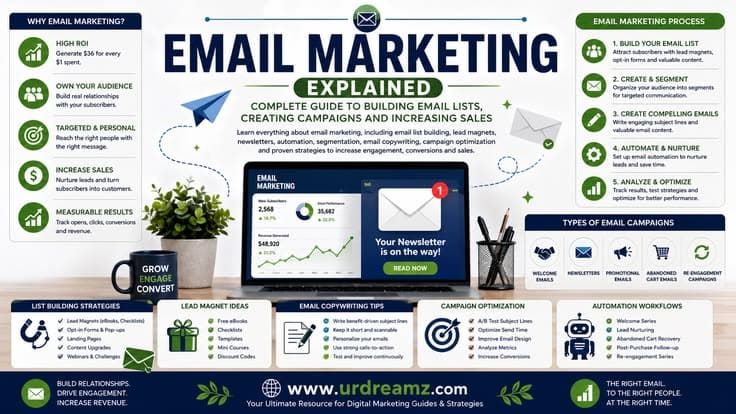
Email Marketing Explained: Complete Guide to Building Email Lists, Creating Campaigns and Increasing Sales
Email marketing is still, dollar for dollar, one of the highest-return channels in digital marketing. Unlike social media, where an algorithm decides who sees your content, email lands directly in someone's inbox - a space they check every single day. This guide covers the entire email marketing journey: what it is, how to build a list from scratch, how to write copy that gets opened and clicked, how to automate the boring parts, which tools to use, and how to avoid the mistakes that quietly kill most campaigns.
This article is part of a growing Digital Marketing Learning Center. If you're building your foundation, it naturally connects with a few guides already covered: Blogger vs WordPress, Amazon Associates: Complete Guide to Affiliate Marketing, SEO for Beginners, Digital Marketing Explained, and Content Marketing Complete Guide. Reading those alongside this one will give you the full picture of how email fits into a modern marketing stack.
1. What Is Email Marketing and Is It Still Worth It?
Email marketing is the practice of sending targeted messages - newsletters, promotions, updates, or automated sequences - to a list of people who have given you permission to contact them. It's used for everything from business email marketing and ecommerce marketing to blogging email marketing and affiliate email marketing.
Despite predictions over the years that email would be replaced by social media, it remains one of the most profitable digital marketing tools available in 2026. The reason is simple: you own your email list. A social platform can change its algorithm overnight and cut your reach in half, but nobody can take your subscriber list away from you. For beginners wondering whether email marketing is still worth learning, the honest answer is yes - it consistently produces some of the highest return on investment of any online business marketing channel, especially once automation is set up.
2. Email Marketing Vocabulary Every Beginner Should Know
Before diving into strategy, it helps to understand the core terms you'll see inside every email marketing software dashboard. This glossary covers the vocabulary that shows up constantly in email KPIs, email analytics, and email reporting.
| Term | What It Means |
|---|---|
| Open rate | The percentage of recipients who opened your email. Treat this as directional rather than exact, since privacy features on some devices can inflate the number automatically. |
| Click-through rate (CTR) | The percentage of recipients who clicked a link inside your email - a more reliable signal of real engagement than opens. |
| Conversion rate | The percentage of people who completed the actual goal after clicking, such as making a purchase or booking a call. This is the metric that ties directly to revenue. |
| Bounce rate | The percentage of emails that failed to deliver. A hard bounce means the address no longer exists; a soft bounce is usually a temporary delivery issue. |
| Unsubscribe rate | The percentage of people who opted out after an email. A steady trickle of unsubscribes is healthy - it's better than being marked as spam. |
| Deliverability | Whether your email actually lands in the inbox instead of the spam folder. This underpins every other metric on this list. |
| Sender reputation | A trust score mailbox providers assign to your sending domain based on past behavior. A strong reputation keeps you out of the spam folder. |
| CTA (call to action) | The specific action you want the reader to take, usually a button or link such as "Shop Now" or "Start Your Trial." |
| Segmentation | Splitting your list into smaller groups based on behavior, interests, or lifecycle stage so each group receives more relevant messages. |
| Automation / drip campaign | A pre-built sequence of emails that triggers automatically based on an action, such as a signup or a purchase, and then runs without manual effort. |
| Transactional email | Emails triggered by a direct user action, like password resets or order receipts, generally held to different sending rules than marketing emails. |
| ESP (email service provider) | The dedicated platform used to send marketing emails at scale, rather than a personal inbox like Gmail. |
3. How to Build an Email List From Scratch
Every successful email strategy starts with list building. You cannot run campaigns, automation, or segmentation without subscribers to send to, so this step comes before anything else.
The fastest way to grow subscribers is to place an email opt-in or signup form everywhere your audience already spends time - a homepage popup, an embedded blog form, a sidebar widget, or a dedicated landing page. Most beginners find that combining two or three of these placements, rather than relying on just one, produces noticeably faster subscriber growth. A double opt-in, where a new subscriber confirms their email address before being added to your list, keeps your list clean and improves long-term deliverability, even though it can slightly slow down initial growth.
Buying an email list is one shortcut you should avoid entirely. Purchased contacts haven't agreed to hear from you, which tanks your engagement rates, damages sender reputation, and can violate anti-spam laws. Organic list building - through your blog, SEO for email lists, Pinterest, YouTube, or Instagram - takes longer but produces subscribers who actually want to hear from you and convert at a much higher rate.
| List Building Channel | How It Works |
|---|---|
| Blog opt-in forms | Embed a signup form inside or below blog content related to your lead magnet |
| Exit-intent popups | Trigger an offer right as a visitor is about to leave the page |
| Landing pages | A dedicated, distraction-free page built purely to convert visitors into subscribers |
| Social media bios and posts | Direct followers from Pinterest, Instagram, or YouTube toward your signup link |
| Webinars and events | Collect emails during registration in exchange for live or recorded access |
| Content upgrades | Offer a bonus resource tied directly to the blog post someone is already reading |
4. Lead Magnet Ideas That Actually Convert
A lead magnet is the free resource you offer in exchange for someone's email address. The best lead magnets solve one specific, narrow problem instantly - broad, vague freebies tend to convert poorly because they don't feel urgent or useful enough to trade an email address for.
- A short, focused free ebook or downloadable guide
- A one-page checklist or cheat sheet
- A free short email course delivered over several days
- Printable templates or a swipe file
- A downloadable PDF resource or workbook
- A resource library bundling several small tools together
- A short quiz that delivers a personalized result by email
- A free mini video training
Checklists and short PDFs tend to convert faster than full ebooks because they promise a quicker win. That said, a well-written ebook still works extremely well for topics that need more depth, so the right format depends entirely on how complex the problem is that you're solving.
5. Email Copywriting: Subject Lines, Body Copy and CTAs
Email copywriting is a specific skill that blends persuasive writing with a very tight space to work in. Every element - the subject line, the opening line, the body, and the CTA - has one job: move the reader to the next step.
Subject lines decide whether an email gets opened at all. Data on welcome emails specifically shows that including the word "welcome" in a subject line significantly increases both open rate and click-through rate compared to subject lines without it, which tells you how much a single well-chosen word can matter.
| Subject Line Style | Why It Works |
|---|---|
| A clear reward upfront ("Here's your 20% off code") | Promises an immediate, tangible benefit |
| A personalized recommendation | Feels tailored instead of mass-sent |
| A simple numbered promise ("3 simple steps to get started") | Makes the next action feel easy and quick |
| A curiosity hook | Creates a small, satisfying gap the reader wants closed |
| A community or belonging angle | Connects the subscriber to something bigger than a transaction |
| A transparent preview of what's inside | Reduces uncertainty and lowers the chance of an unsubscribe |
Beyond subject lines, a few copywriting principles consistently separate emails that convert from emails that get ignored. Build every email around one clear idea instead of several competing messages - trying to sell three different things in one email usually sells none of them. Write the way you naturally speak, since overly formal or stiff language creates distance between you and the reader. Focus relentlessly on what's in it for the reader rather than what's impressive about your product, and always sell the benefit, not the feature - people don't buy a camera, they buy better pictures. Finally, every promotional email needs a single, clear call to action; scattering five different links across one email usually reduces clicks on all of them rather than increasing total clicks.
6. Welcome Emails: The Highest-Converting Email You'll Ever Send
A welcome email is the very first message a new subscriber receives immediately after signing up. Because subscribers are actively expecting it, welcome emails consistently earn far higher open and click rates than regular marketing emails, and they generate significantly more revenue on average than standard promotional sends. This makes the welcome email one of the highest-leverage pieces of copy you will ever write for your business.
A strong welcome email usually accomplishes several things at once: it thanks the subscriber personally, briefly introduces the brand's story or mission, sets clear expectations for what kind of emails will follow and how often, and includes one focused call to action - whether that's browsing best-sellers, following on social media, watching a short demo video, or redeeming a welcome discount. Some brands stretch this into a full welcome sequence of three to five emails instead of a single message, using the extra emails to deliver a lead magnet, share more brand story, and gently guide the subscriber toward their first purchase.
| Welcome Email Type | Best For |
|---|---|
| Discount/offer welcome | Ecommerce brands wanting a fast first purchase |
| Brand story welcome | Brands built around a mission, values, or founder story |
| Onboarding welcome | Apps and services guiding users through setup |
| Newsletter welcome | Bloggers and creators setting expectations for content frequency |
| Product demo welcome | SaaS products that benefit from a quick visual walkthrough |
| Free trial welcome | Subscription products guiding someone toward becoming a paying customer |
Whichever type you build, a handful of elements consistently show up in every high-performing welcome email: a clear, benefit-driven subject line, a personalized greeting, a genuine thank-you, an incentive or reason to stay subscribed, a short piece of brand storytelling, a couple of useful resource links, and exactly one strong call to action. Once your single welcome email is working well, the natural next step is expanding it into a full automated welcome sequence that nurtures new subscribers over their first one to two weeks.
7. Email Automation and Drip Campaigns Explained
Email automation is what turns email marketing from a manual chore into a system that works while you sleep. Instead of writing and sending every message by hand, you build a workflow once, and it triggers automatically whenever a subscriber takes a specific action.
| Automation Type | What Triggers It | Goal |
|---|---|---|
| Welcome sequence | A new signup | Introduce the brand and build early trust |
| Abandoned cart emails | A shopper leaves items in their cart without checking out | Recover lost ecommerce sales |
| Onboarding emails | A new user or customer account is created | Guide them to their first success with the product |
| Lead nurturing sequence | A lead magnet download or webinar signup | Warm up a cold lead toward a sale |
| Re-engagement / win-back emails | A subscriber goes quiet for a set period | Bring inactive subscribers back or clean the list |
| Lifecycle emails | A subscriber moves between stages, such as trial to paid | Match messaging to where the customer actually is |
| Product launch sequence | A scheduled launch date | Build anticipation and drive first-week sales |
For beginners wondering which automation to build first, the welcome sequence is almost always the right starting point, since it's the easiest to set up and already has the highest natural engagement of any email type. From there, abandoned cart automation is the next highest priority for any ecommerce store, since it recovers sales that would otherwise be lost entirely.
8. Email Performance: Metrics, KPIs and A/B Testing
You cannot improve an email strategy you never measure. Reviewing your email analytics regularly - rather than obsessing over a single campaign - is what turns guesswork into a repeatable system.
A/B testing is the most reliable way to improve performance over time. The rule that matters most here is testing only one variable at a time - the subject line, the CTA button color, or the send time - so you know exactly what caused the change in results. Testing five things at once tells you that something worked, but not which part actually mattered.
| Metric | What a Healthy Trend Looks Like |
|---|---|
| Open rate | Steady or improving, viewed as a directional signal rather than an exact number |
| Click-through rate | Consistent or rising month over month |
| Conversion rate | The number that should ultimately justify your time and budget |
| Bounce rate | As close to zero as possible, especially hard bounces |
| Unsubscribe rate | Low and stable; small spikes after big sends are normal |
| Spam complaint rate | Near zero - this is the number that most damages deliverability |
9. Best Email Marketing Tools and Software Compared
Choosing an email marketing platform is one of the first real decisions a beginner has to make. Most tools do the same core job - sending emails and building automations - but they differ in ease of use, pricing, and how deep their automation and segmentation features go.
| Tool | Best Known For |
|---|---|
| Mailchimp | Beginner-friendly interface with a large template library |
| ConvertKit (Kit) | Popular with creators and bloggers for its simple tagging and automation |
| Brevo | Affordable all-in-one email, SMS, and automation platform |
| ActiveCampaign | Advanced automation and segmentation for scaling businesses |
| MailerLite | Clean, modern editor with strong automation at a low price |
| GetResponse | Built-in funnels and landing pages alongside email |
| Beehiiv | Purpose-built for newsletter creators and monetization |
| HubSpot Email Marketing | Deep CRM integration for sales and marketing alignment |
| AWeber | A long-trusted, beginner-friendly classic platform |
| Klaviyo | Ecommerce-focused automation and customer data |
If you plan to promote affiliate links inside your emails, it's worth knowing that not every platform treats affiliate marketing the same way. Tools like GetResponse, AWeber, ConvertKit, systeme.io, MailerLite, and ActiveCampaign are generally considered affiliate-friendly, each offering solid autoresponders, funnels, and segmentation, while some other platforms restrict affiliate links more heavily. Always check a platform's current terms of service before building your list around affiliate promotions, since policies can change.
10. Email Sales Funnels and Conversion Strategy
An email sales funnel guides a subscriber from "just signed up" to "paying customer" through a deliberate sequence of messages rather than one big pitch. The strongest funnels combine education, trust-building, and a clear offer, delivered in that order.
- Welcome and orientation emails that build initial trust
- Value-driven emails that teach something useful before ever selling
- Social proof emails featuring testimonials or case studies
- A direct offer email with a clear, time-bound CTA
- A follow-up or objection-handling email for anyone who didn't convert
- A win-back or retention email for existing customers
Retention deserves just as much attention as acquisition. Keeping an existing customer engaged through consistent value - not just promotional emails - is often more profitable than constantly chasing new subscribers, since repeat customers already trust your brand and convert faster on future offers.
11. 18 Email Marketing Best Practices to Increase Revenue
These practices come up again and again across successful email programs, regardless of industry or list size.
| # | Best Practice |
|---|---|
| 1 | Always preview emails on mobile before sending - most people skip this step |
| 2 | Avoid spam trigger words that can hurt deliverability |
| 3 | Check every link in a campaign before it goes out |
| 4 | Set up an automated welcome series for new subscribers |
| 5 | Use emojis sparingly rather than overwhelming the inbox |
| 6 | Segment your audience for stronger CTR and conversions |
| 7 | Use storytelling to build a real connection with subscribers |
| 8 | Build drip campaigns that sell for you on autopilot |
| 9 | Use visuals like images, GIFs, or infographics where relevant |
| 10 | Craft compelling, specific subject lines |
| 11 | Keep calls to action clear and concise |
| 12 | Make sure every email provides real value, not just a pitch |
| 13 | Ask subscribers for feedback through short surveys |
| 14 | Add interactive elements like quizzes or polls when possible |
| 15 | Build re-engagement campaigns for inactive subscribers |
| 16 | Plan seasonal campaigns and sales well in advance |
| 17 | Offer subscribers exclusive content or discounts |
| 18 | Personalize every email with the recipient's name and relevant details |
12. 10 Email Marketing Mistakes That Kill Campaigns
Just as important as knowing best practices is knowing exactly what to avoid. These ten mistakes are responsible for the majority of underperforming campaigns.
| # | Mistake | Example |
|---|---|---|
| 1 | Lack of personalization | Addressing everyone as "Dear Subscriber" instead of by name |
| 2 | Overloading with content | Cramming too many topics and links into a single email |
| 3 | Ignoring mobile optimization | Emails that look broken or use tiny text on smaller screens |
| 4 | Neglecting segmentation | Sending the same offer to an entire list regardless of relevance |
| 5 | Poor subject lines | Using a vague label like "Newsletter #17" instead of a specific hook |
| 6 | Ignoring A/B testing | Sending the same layout to everyone with no experimentation |
| 7 | Irrelevant content | Promoting products that don't match subscriber interests |
| 8 | Inconsistent branding | Switching tone, colors, or style between emails |
| 9 | Neglecting the CTA | Sending an email with no clear next step for the reader |
| 10 | Ignoring preview text | Leaving preview text blank instead of using it to add extra context |
13. Email Marketing Across the Full Marketing Stack
Email marketing performs best when it isn't treated as a separate silo. Combining it with other channels compounds the results of every message you send.
- Encourage subscribers to follow your social accounts, and share social proof back inside your emails
- Feature blog content inside newsletters to drive traffic back to your site, and use reply feedback to shape future content marketing
- Use retargeting ads for people who click specific links inside your emails
- Coordinate promotions to launch on email, social, and your website at the same time, with consistent messaging across all three
- Combine data from email, social, and website analytics into one view of the customer for more personalized targeting
- Track how each channel contributes to your overall funnel so you can double down on what's actually driving results
14. 8 Types of Emails Every List Should Receive
Beyond promotions, a healthy sending calendar mixes several distinct email types to keep subscribers engaged between sales pitches.
| Email Type | Purpose |
|---|---|
| Welcome email | First impression and expectation-setting for new subscribers |
| Tools-you-use email | Share the tools behind your business - useful, and sometimes affiliate-friendly |
| Quick win or tip | Deliver a small, exclusive piece of value that lowers unsubscribe rates |
| Freebie giveaway | Surprise subscribers with an unannounced bonus resource |
| Repurposed blog post | Turn an existing article into a value-packed email with or without links |
| Behind-the-scenes update | Share news, pivots, or projects to keep subscribers invested in your journey |
| Product or sale announcement | Unveil a new offer to your warmest audience with an exclusive discount |
| Feedback or survey email | Ask subscribers directly what they want more of |
15. Professional Email Templates for Business Communication
Not every email you send is a marketing campaign - plenty of day-to-day business communication follows its own templates. Having a go-to structure for common situations saves time and keeps your tone consistent.
| Situation | What the Email Should Do |
|---|---|
| Making a new connection | Introduce yourself briefly and propose a specific next step, like a short call |
| Requesting a meeting | Offer a few concrete time options so the recipient can choose quickly |
| Requesting approval or information | Summarize impact, timeline, and what you need, with a clear deadline |
| Following up | Reference the original ask, restate the benefit, and give a simple deadline |
| Owning a mistake | State exactly what went wrong, what you fixed, and confirm everything is resolved |
| Saying no politely | Decline clearly, give a brief reason, and offer an alternative if possible |
| Apologizing for a delay | Give a new deadline, a short reason, and what you're doing to make it right |
| Setting a boundary | Decline taking something on while redirecting the person to the right resource |
| Giving feedback | Lead with a genuine strength, then name one clear area to improve |
16. Copywriting Principles That Apply to Every Marketing Email
A handful of copywriting principles show up across almost every high-converting email, regardless of industry.
- Build each email around one big, exciting idea rather than several small ones
- Spend disproportionate effort on the headline and opening line, since they decide whether the rest gets read
- Write the way you naturally talk, then read it out loud to check it still sounds like you
- Constantly answer the reader's unspoken question: "what's in it for me?"
- Highlight your unique selling point instead of blending in with every competitor
- Make the perceived value of your offer clearly outweigh the price being asked
- Focus copy on a big, real problem - bigger problems create stronger motivation to act
- Sell benefits, not features - better pictures, not a camera; a stylish way to tell time, not a watch
- Write a messy first draft, then edit multiple times to cut filler words and repetition
- Use "you" language and speak to one specific person, not a faceless crowd
- Remember that one email sent to many people should still feel like it's speaking to just one of them
- Position the customer as the hero of the story and your brand as the guide helping them win
17. Email Marketing by Business Type: Ecommerce, SaaS, B2B, B2C and Affiliate
The core principles of email marketing stay constant, but the details shift depending on what you're selling.
| Business Type | What Matters Most |
|---|---|
| Ecommerce | Abandoned cart recovery, product recommendations, and seasonal promotional emails |
| SaaS | Onboarding sequences that drive product activation and reduce churn |
| B2B | Longer nurture sequences aimed at multiple decision-makers, with a focus on ROI |
| B2C | Shorter, emotionally driven campaigns aimed at a single decision-maker |
| Affiliate marketing | Value-first content emails that build enough trust to support a recommendation |
| Blogging / creators | Consistent newsletters that repurpose content and build a loyal reader relationship |
18. Deliverability, GDPR and CAN-SPAM Compliance
None of the strategy above matters if your emails never reach the inbox. Deliverability depends on sender reputation, list hygiene, and following the basic legal rules that govern commercial email.
- Always use permission-based list building - never add contacts without explicit consent
- Include a visible, working unsubscribe link in every commercial email
- Clearly identify who the email is from, including a real physical business address where required
- Regularly clean your list of inactive or invalid addresses to protect your sender reputation
- Avoid spam trigger words and excessive punctuation or all-caps subject lines
- Honor unsubscribe requests promptly, since delays can trigger spam complaints and legal issues
GDPR (for contacts in the EU) and CAN-SPAM (for the US) are the two compliance frameworks beginners run into most often. Neither is meant to make email marketing harder - they simply formalize the same permission-based approach that produces better engagement anyway.
19. Building an Email Marketing Career or Freelance Business
Email marketing isn't only a skill for business owners - it's also a genuine career path. Email copywriters, email marketing specialists, and freelance consultants are in steady demand because good email performance directly affects revenue.
If you're exploring email marketing as a career, start by building a small portfolio using mock campaigns or work for a friend's business, then look for freelance email copywriting jobs on general freelance platforms. Over time, a strong portfolio, a few case studies showing real performance improvements, and a clear specialty - ecommerce, SaaS, or a specific industry - are what set experienced email marketers apart from beginners still building a reputation.
20. Complete Email Marketing Checklist Before You Hit Send
| Checklist Item | Why It Matters |
|---|---|
| Preview on mobile and desktop | Most subscribers read email on their phone first |
| Test every link | Broken links quietly kill conversions |
| Double-check the subject line and preview text | Both directly affect open rate |
| Confirm the CTA is clear and singular | Multiple competing CTAs reduce total clicks |
| Check personalization tags | A broken merge tag looks unprofessional instantly |
| Verify the unsubscribe link works | Required for compliance and protects sender reputation |
| Send a test email to yourself | Catches formatting issues before subscribers ever see them |
| Schedule around your audience's time zone | Send time noticeably affects open rates |
21. Final Roadmap: Where Email Marketing Fits in Your Growth
Email marketing rewards patience in the same way blogging and SEO do. The first hundred subscribers feel slow, but a clean list, a solid welcome sequence, and a few well-placed automations compound quietly in the background long after you've stopped actively thinking about them. Start with one lead magnet, one welcome sequence, and one consistent newsletter rhythm - master those three things before adding more complexity.
This guide sits inside a larger Digital Marketing Learning Center that will keep expanding. Upcoming guides will cover Social Media Marketing, Pinterest Marketing, Google Ads, Marketing Analytics, Google Analytics (GA4), Google Search Console, and AI in Digital Marketing - each one designed to connect back to the email marketing, content marketing, SEO, affiliate marketing, and blogging foundations you've already built.
Frequently Asked Questions
What is email marketing?
Email marketing is the practice of sending targeted, permission-based messages to a list of subscribers in order to build relationships, promote products, and drive sales.
Is email marketing still effective in 2026?
Yes. Because you own your subscriber list and aren't dependent on a social platform's algorithm, email consistently delivers one of the strongest returns of any digital marketing channel.
How do beginners start email marketing?
Choose a beginner-friendly platform, create one focused lead magnet, set up a simple welcome sequence, and commit to a consistent newsletter schedule before adding advanced automation.
What is a good email open rate?
Averages vary widely by industry, but treat open rate as a directional trend rather than an exact number, and pair it with click-through rate and conversions for a fuller picture.
How often should you send marketing emails?
Consistency matters more than frequency. A predictable weekly or biweekly rhythm generally outperforms sporadic bursts of sending.
What is the difference between email marketing and email automation?
Email marketing broadly covers all email communication with subscribers, while automation refers specifically to pre-built sequences that trigger automatically based on subscriber behavior.