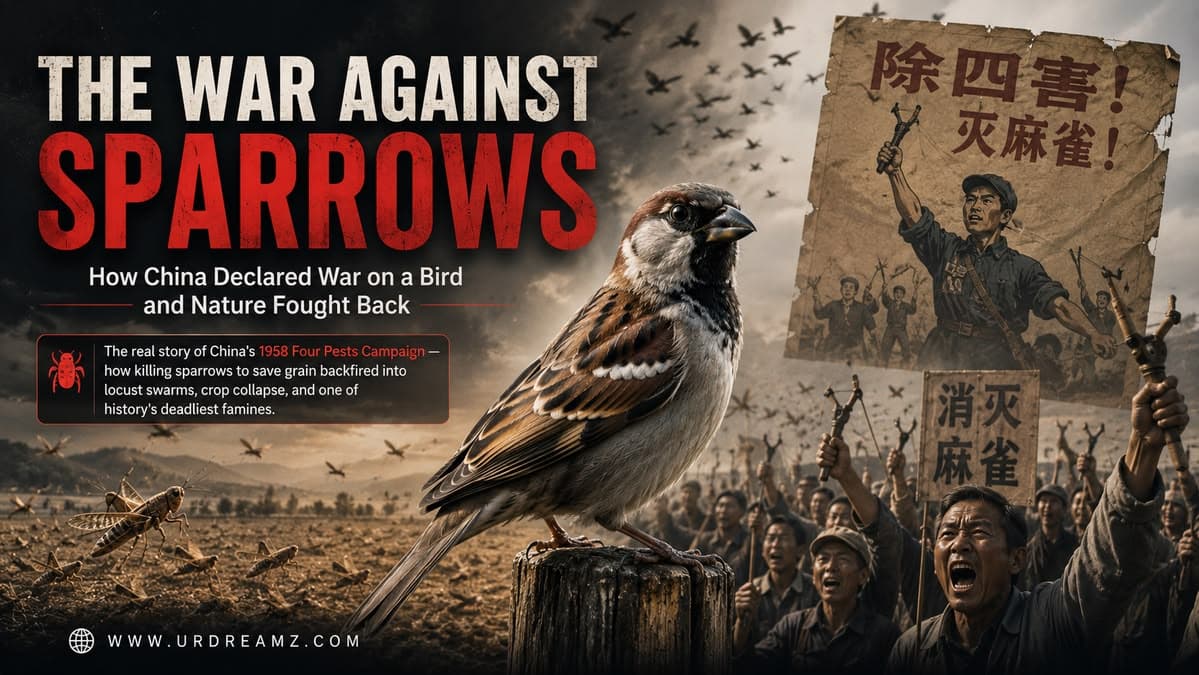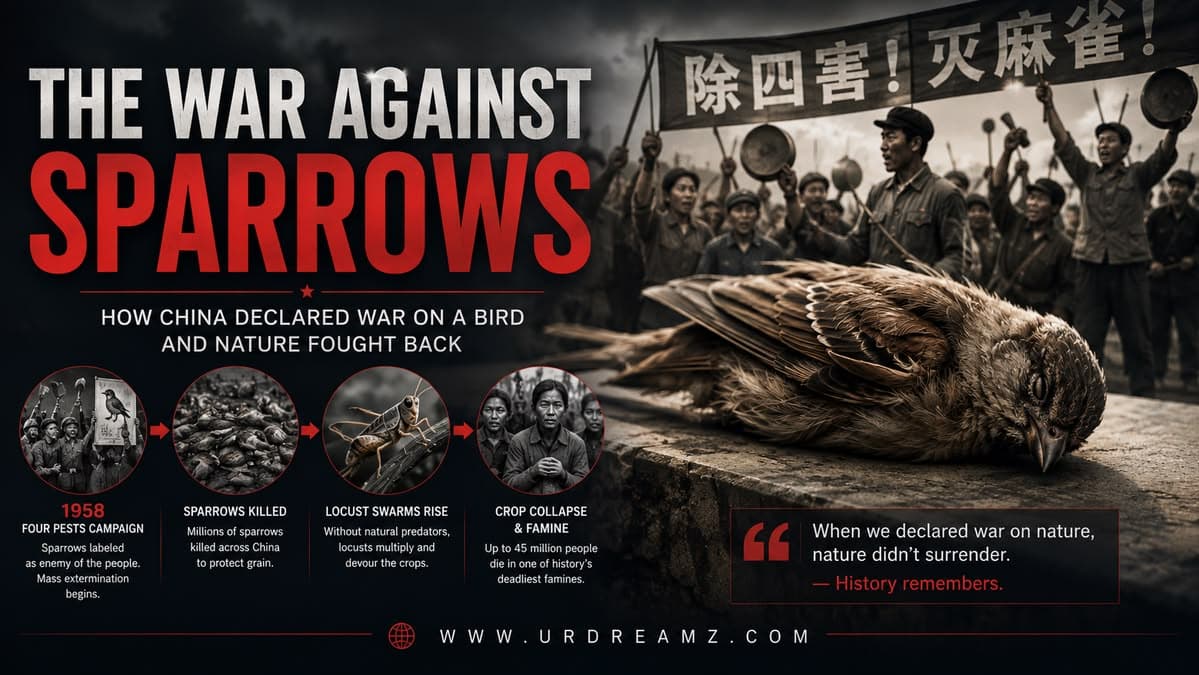
The War Against Sparrows: How China Declared War on a Bird and Nature Fought Back
In 1958, the Chinese government looked out across its farmland and decided it had found the enemy responsible for the country's food shortages. It wasn't drought, it wasn't poor infrastructure, and it wasn't mismanagement. According to the thinking of the time, the real culprit was a small, unassuming bird sitting quietly on telephone wires and rooftops across the countryside: the sparrow. What followed was one of the strangest, most consequential campaigns in modern history, a nationwide war against a single species that would end up reshaping the fate of hundreds of millions of people. This is the real story of what happened, why it happened, and what it still teaches us today about the risks of underestimating nature, and about how quickly confidence, unchecked by careful evidence, can turn a well-intentioned plan into one of the deadliest self-inflicted disasters of the twentieth century.
The Backdrop: China's Great Leap Forward
To understand why this campaign happened at all, you have to understand the moment China was living through. In 1958, Chairman Mao Zedong launched a sweeping national program known as the Great Leap Forward, an ambitious attempt to rapidly transform China from a largely agricultural society into a modern industrial powerhouse in just a few short years. The plan touched nearly every part of daily life, from how farms were organized to how steel was produced, and it demanded enormous sacrifices from ordinary citizens in the name of rapid national progress.
As part of this broader push, the government also launched a public health and hygiene initiative known as the Four Pests Campaign. The idea, on paper, seemed simple and reasonable enough: identify the pests responsible for spreading disease and destroying food supplies, then mobilize the entire population to eliminate them. Three of the four targets were relatively uncontroversial. Rats spread the plague. Flies and mosquitoes spread malaria and other diseases. Eliminating them, or at least reducing their numbers dramatically, was seen as a straightforward win for public health, and in fact, this part of the campaign is often credited with genuinely improving hygiene and reducing disease transmission across the country.
The fourth target, though, was the one that would end up defining the entire campaign in the history books, and not for a good reason: the humble sparrow.
Why Sparrows Were Put on the List
The inclusion of sparrows on this list traces back to complaints from farmers, who had noticed sparrows feeding on grain seeds in the fields and concluded that these small birds were directly responsible for reducing the nation's harvests. When these complaints reached Mao Zedong, he reportedly accepted the logic without much hesitation: sparrows were eating the nation's food, and a nation struggling to feed itself could not afford to keep sharing its harvest with birds.
Chinese officials at the time even ran the numbers to make the campaign feel scientifically justified. Calculations circulated suggesting that each sparrow consumed several kilograms of grain every year, and that for every million sparrows eliminated, enough grain would be saved to feed tens of thousands of additional people. On paper, it looked like simple, elegant arithmetic: fewer birds, more food, happier population. It was the kind of reasoning that feels airtight until you actually test it against the messy complexity of a real ecosystem, which is exactly what nobody involved in designing this campaign had properly done.
It's worth noting that not everyone accepted this logic quietly. Some scientists at the time did raise concerns, pointing to historical precedent, including a similar attempt to eliminate sparrows in Prussia back in the eighteenth century, which had also backfired badly due to the very same ecological blind spot. Their warnings, unfortunately, were largely ignored in the rush to demonstrate visible, dramatic results.
"Kill All the Sparrows": How the Campaign Was Actually Carried Out
What made this campaign so remarkable, beyond its underlying reasoning, was the sheer scale of public mobilization behind it. This wasn't a quiet government pest-control initiative handled by a small team of specialists. It became a mass, nationwide movement, with citizens of nearly every age called upon to participate directly in the extermination effort. Colorful propaganda posters and slogans encouraged people to hunt down and kill sparrows using whatever methods were available to them.
The method that became most iconic, and honestly, most bizarre when you actually picture it happening at national scale, involved exploiting a specific weakness in sparrow biology: these birds cannot survive being kept in continuous flight for extended periods of time. So citizens across the country were mobilized to bang pots, pans, drums, gongs, and any other noise-making object they could find, all at once, across entire neighborhoods and villages, specifically to keep sparrows from ever landing to rest. Exhausted, with nowhere safe to perch, many sparrows eventually died mid-flight from sheer physical exhaustion, falling from the sky after hours of forced, continuous movement.
Beyond the noise campaigns, people also destroyed sparrow nests wherever they could find them, smashed eggs, shot birds directly out of the sky, and used poison in some areas to accelerate the extermination effort. Schools even distributed pest-control equipment to children, turning the campaign into something that touched nearly every household and every generation simultaneously. Within a remarkably short period, this mobilization proved almost frighteningly effective. Estimates of how many sparrows were killed vary depending on the source, with some accounts citing at least two hundred million birds eliminated in 1958 alone, while other estimates, factoring in the campaign's full duration, suggest the total death toll among sparrows may have reached somewhere in the neighborhood of two billion birds nationwide.
A Premature Victory Celebration
For a brief period, it genuinely looked like the campaign had worked exactly as intended. Sparrow populations across large parts of the country collapsed dramatically, in some regions coming perilously close to complete local extinction. Officials pointed to the results as proof that the mobilization strategy behind the Great Leap Forward was working, that ordinary citizens, organized and directed with enough enthusiasm, could reshape their environment according to the state's vision, solving problems that had plagued Chinese agriculture for generations.
What nobody fully understood at the time, or at least what nobody in a position of power was willing to seriously act on, was that the entire premise behind the campaign rested on a fundamentally incomplete understanding of what sparrows actually ate. The assumption driving the entire operation was that sparrows were, overwhelmingly, grain thieves, small but persistent enemies of the harvest. The reality, as later research would confirm, was considerably more complicated, and that gap between assumption and reality would soon prove catastrophic.
The Discovery That Came Too Late
In 1959, researchers connected to China's Academy of Sciences performed autopsies on a number of sparrow carcasses, hoping presumably to confirm what everyone already assumed about the birds' diet. What they found instead upended the entire justification for the campaign. The majority of the contents found in these birds' stomachs was not grain at all. It was insects, particularly during the warmer months, when sparrows rely heavily on insects like locusts and other crop-damaging pests as their primary food source rather than seeds and grain.
In other words, sparrows were not simply stealing food from Chinese farmers. For a significant portion of the year, they were actively working as a natural, free pest-control system, keeping insect populations, especially locusts, in check before those insects could multiply and devastate crops on a much larger scale than sparrows ever could by eating seeds directly. By systematically wiping out sparrows across enormous stretches of the country, China had not removed a competitor for its grain supply. It had removed one of its most important natural defenses against a far more destructive threat.
When the Locusts Came
The consequences of this miscalculation did not take long to appear. With their primary natural predator gone across huge swaths of the countryside, insect populations, and locusts in particular, began to explode without any meaningful check on their growth. Locust swarms descended on fields in numbers that had rarely been seen before, moving largely unimpeded across regions where sparrows had once kept their numbers under control.
The damage was severe and widespread. Crop yields, already under pressure from other elements of the Great Leap Forward's chaotic agricultural reforms, including forced collectivization and the diversion of rural labor toward often ineffective industrial projects like backyard steel furnaces, collapsed even further under the weight of these unchecked insect infestations. Some estimates suggest crop production fell by as much as seventy percent in certain areas during the worst periods of this ecological unraveling, a staggering decline that no country, let alone one already straining under the pressures of rapid, poorly managed industrialization, could easily absorb.
The Great Chinese Famine
What followed has since been recognized as one of the deadliest famines in recorded human history: the Great Chinese Famine, which unfolded primarily between 1959 and 1961, though its effects lingered into 1962 in some regions. The exact death toll remains genuinely difficult to pin down with precision, partly because of the chaotic record-keeping of the era and partly because of how politically sensitive the topic remained within China for decades afterward. Different historians and researchers have arrived at estimates ranging anywhere from around fifteen million to as high as fifty-five million deaths, with many serious historical accounts converging somewhere in the range of thirty to forty million people who died from starvation and related causes during this period.
It is important to be honest and precise about one thing here: the elimination of sparrows was not the sole cause of this famine. The Great Leap Forward as a whole was a deeply flawed, often catastrophically mismanaged set of policies, involving forced agricultural collectivization, wildly unrealistic grain production quotas that local officials felt pressured to falsely report as met, a disastrous diversion of farm labor into inefficient small-scale steel production, and a series of unfavorable weather events including droughts and flooding. All of these factors combined to create the conditions for a famine of historic scale.
That said, careful modern research has specifically quantified just how significant a contributor the sparrow eradication campaign was on its own. A rigorous economic study conducted by researchers including scholars from the University of Chicago examined the connection between areas where sparrows were most heavily targeted and subsequent agricultural outcomes. Their findings suggested that the loss of sparrows accounted for close to twenty percent of the overall decline in crop production during the famine years in the areas most affected, and that this specific effect, the sparrow eradication itself, separate from the famine's many other causes, likely contributed to the deaths of close to two million people directly, along with hundreds of thousands of births that never occurred due to the resulting food shortages. In some of the hardest-hit rural regions, close to twenty percent of the local population reportedly died during this period, an almost incomprehensible scale of loss concentrated within just a few short years.
China Eventually Admits the Mistake
To its credit, and this is genuinely worth acknowledging, the Chinese government did not simply continue the sparrow extermination campaign indefinitely once the consequences became undeniable. By April 1960, as reports of collapsing crop yields and worsening food shortages accumulated, and as advisory ornithologists and scientists pressed the point that sparrows played an essential, beneficial role in natural pest control, the leadership formally reversed course. Sparrows were officially removed from the list of the "Four Pests," and in a move that today reads as almost darkly ironic, bed bugs were named as the new fourth target in their place.
But removing sparrows from the pest list did not undo the ecological damage that had already been done. Sparrow populations across large parts of the country had been decimated so thoroughly that natural recovery on its own would have taken far too long to meaningfully address the ongoing agricultural crisis. Faced with this reality, China made a decision that stands as one of history's more striking examples of a government publicly reversing its own environmental policy: it began importing sparrows from the Soviet Union, bringing in roughly two hundred and fifty thousand birds in an effort to help restore the natural balance that its own citizens had spent the previous two years working so hard to destroy.
The Deeper Lesson: Ecosystems Don't Forgive Easily
What makes the story of the Four Pests Campaign so enduringly powerful, even decades later, is not simply the scale of the tragedy, though that scale alone is almost impossible to fully comprehend. It's the clarity of the underlying lesson. This wasn't a natural disaster that struck without warning. It was a self-inflicted catastrophe, born directly from a government's confident decision to treat an entire ecosystem as something simple enough to be understood, and controlled, through a single, oversimplified calculation: fewer birds equals more grain.
Nature, as this story demonstrates so starkly, rarely operates according to such neat, linear logic. Every species within an ecosystem tends to occupy a specific role, often several roles simultaneously, and removing even one piece from that intricate web can trigger consequences that ripple outward in ways that are extraordinarily difficult to predict in advance, especially when decisions are made quickly, driven by political urgency rather than careful, patient scientific study. The sparrow was never simply a competitor stealing grain from Chinese farmers. It was, simultaneously, one of the country's most effective natural defenses against the very insects that would go on to devastate its harvests once that defense was removed.
A Pattern That Keeps Repeating Itself
Perhaps the most sobering part of this entire story is that it is far from the only example of humans dramatically underestimating the consequences of tampering with a natural ecosystem. History offers several other cautionary tales that echo this same basic pattern, a species targeted for elimination based on an incomplete understanding of its actual ecological role, followed by unintended consequences that end up far worse than the original problem the intervention was meant to solve.
Even within China's own more recent history, similar patterns have occasionally resurfaced. During the SARS outbreak in the early 2000s, for example, authorities ordered the mass culling of thousands of civet cats, animals that were suspected of playing a role in transmitting the virus to humans, based on incomplete scientific understanding at the time. These recurring patterns suggest that the lesson from the Four Pests Campaign, however painfully learned, has not always been fully internalized in the decades since, and that the temptation to solve complex ecological problems through swift, decisive, large-scale intervention remains a recurring instinct, even when history has already shown how dangerous that instinct can be when it outpaces genuine scientific understanding.
What This Story Still Asks Us to Consider Today
Reading through the full arc of this story today, from the initial complaints of farmers watching sparrows feed on their grain, to the nationwide mobilization involving millions of citizens banging pots and pans, to the devastating famine that followed, to the eventual, almost absurd irony of importing sparrows back into the country after spending years trying to eliminate them, it becomes clear that this is about far more than a single failed policy from a specific era in Chinese history. It's a broader warning about the risks that come with acting decisively on incomplete information, particularly when that action involves something as complex and interconnected as a natural ecosystem.
Every living creature within an ecosystem tends to exist in relationship with countless others, forming a web of dependencies that is rarely as simple as it first appears from the outside. A bird that looks, on the surface, like a nuisance competing with humans for food may simultaneously be performing an essential service that humans depend on just as much, if not more, than the resource it appears to be consuming. Understanding those relationships requires patience, humility, and a genuine willingness to study a system carefully before intervening in it dramatically, qualities that were, unfortunately, in short supply during the intense political pressure and urgency that defined the Great Leap Forward era. That gap between confidence and actual understanding is, in many ways, the single most important thread running through this entire story, and it is exactly the gap that continues to make this decades-old event feel so relevant to conversations about environmental policy, unintended consequences, and human hubris today.
Respecting the Balance Nature Has Already Built
There is something genuinely worth sitting with in this story, beyond the historical facts and statistics. It offers a powerful reminder that the natural world, for all its apparent chaos and unpredictability, tends to operate according to a kind of balance that has developed and refined itself over an immense span of time, far longer than any single human government or generation has existed to observe it. When that balance gets disrupted suddenly and dramatically, whether by eliminating a single species considered inconvenient or undesirable, the consequences rarely stay confined to the area anyone originally intended to affect.
The sparrows of 1958 were never simply pests competing with humans for grain. They were part of a much larger, carefully balanced system, one that had been quietly protecting China's harvests from locust infestations long before anyone thought to measure exactly how much grain a single sparrow actually consumed each year. Removing them didn't solve a problem. It removed a solution to a much bigger problem that nobody had fully appreciated existed until it was already too late to prevent the consequences. Every part of a functioning ecosystem, however small or seemingly insignificant, tends to serve some purpose within that larger balance, whether or not humans have taken the time to fully understand what that purpose actually is before deciding to interfere with it. It is, in many ways, one of the clearest historical arguments for treating every living creature, no matter how small or seemingly disposable, with a degree of caution and respect before deciding it no longer has a place in the world around us.
The Propaganda Machine Behind the Campaign
It's worth spending a little more time on just how thoroughly this campaign was woven into the broader propaganda apparatus of the era, because understanding that context helps explain why so few people questioned the underlying logic before it was too late. The Great Leap Forward relied heavily on mass mobilization campaigns designed to demonstrate the power of collective action under socialism, and the Four Pests Campaign fit perfectly into that broader narrative. Vivid, colorful posters depicted sparrows as enemies of the people, sometimes drawn alongside rats, flies, and mosquitoes in dramatic illustrations meant to stir a sense of urgency and collective purpose.
This kind of propaganda did more than simply inform citizens about a public health initiative. It transformed an ecological question, one that genuinely required careful scientific study, into a moral and political one, where killing sparrows became a patriotic duty rather than a decision that deserved careful scrutiny. In an environment where questioning official policy could carry serious personal and professional risk, even those who may have had doubts about the wisdom of eliminating an entire species were given little practical space to voice those concerns publicly. The campaign's success, in terms of sheer participation and enthusiasm, was itself a product of this broader political climate, one where visible, dramatic action was often rewarded far more than cautious, evidence-based restraint.
A Closer Look at the Numbers Behind the Famine
Given how significant the death toll from the Great Chinese Famine was, it's worth taking a slightly closer look at why historians and researchers still disagree so much about the exact figures involved. Unlike more recent historical events, where detailed record-keeping, satellite data, and independent verification are widely available, China during this period operated under a highly centralized, tightly controlled information system, where local officials often felt significant pressure to report inflated harvest numbers to their superiors, fearing punishment if they reported shortfalls honestly.
This created a deeply dangerous feedback loop. As local officials reported artificially high grain production figures to please central authorities, the government continued to requisition grain from rural areas based on those inflated numbers, even as actual harvests were collapsing due to the ecological disruption caused by the sparrow campaign, combined with poor weather and disastrous collectivized farming practices. Villages were sometimes left with far less grain than they needed to survive the winter, precisely because official records suggested they had produced a surplus. This administrative failure, layered on top of the ecological catastrophe, is part of why so many historians view the famine as a uniquely man-made disaster, one where policy failures compounded natural and ecological ones at nearly every stage.
Voices From the Ground: What Survivors Remembered
Beyond the statistics and policy analysis, some of the most striking accounts of this period come from personal diaries, memoirs, and oral histories collected from people who actually lived through the campaign and its aftermath. Descriptions from the time paint a vivid, almost surreal picture: entire neighborhoods erupting into coordinated noise at specific hours, banging gongs, drums, pots, pans, and washbasins in a deliberate, sustained effort to keep sparrows airborne until exhaustion set in. Some accounts describe children being given specific roles in the campaign, positioned on rooftops or in open fields to help spot and scare away any sparrows attempting to land and rest.
What comes through clearly in many of these firsthand accounts is a genuine sense of collective enthusiasm at the time, at least initially. Many participants appear to have believed sincerely that they were contributing to something important, a national effort to solve a real problem affecting their communities. This makes the eventual outcome all the more tragic. The people banging pots and pans in their villages were not acting out of malice or carelessness. They were responding, often with genuine sincerity and civic pride, to a message from their government that turned out to be built on a fundamentally flawed understanding of the natural world around them.
How Long It Took Nature to Recover
Even after China formally reversed its policy in 1960 and began importing sparrows from the Soviet Union, ecological recovery was neither immediate nor simple. Rebuilding a stable, self-sustaining sparrow population across a country as vast as China took considerably longer than the original extermination effort, partly because natural bird populations tend to grow gradually through breeding cycles rather than being restored quickly through importation alone. The imported sparrows needed suitable habitat, adequate food sources, and time to establish breeding populations large enough to meaningfully affect insect control across the country's vast agricultural regions.
In the meantime, Chinese agriculture had to rely on other, far less efficient methods to manage the locust and insect infestations that had developed in the sparrows' absence, including expanded pesticide use, which itself introduced new environmental complications over time. This period stands as a clear illustration of an uncomfortable ecological truth: while an ecosystem can be disrupted or destroyed with remarkable speed, often within just a few short years or even months, restoring that same balance tends to take considerably longer, sometimes spanning multiple years or even decades, and full recovery is never entirely guaranteed.
Why This Story Still Gets Told Today
More than sixty years after the events themselves, the story of China's sparrow extermination campaign continues to circulate widely, appearing in environmental science courses, economics research papers, journalism, and casual online discussions alike. Part of its enduring appeal lies in just how clearly it illustrates cause and effect, a rare case where a policy's consequences can be traced back to a specific, identifiable ecological mechanism with relative clarity, rather than getting lost in a tangle of competing, harder-to-isolate factors. Few historical events offer such a clean, traceable line between a single decision and the catastrophe that followed, which is exactly why teachers, researchers, and writers keep returning to it decades later.
It has become something of a go-to example for economists, ecologists, and historians alike whenever they want to illustrate the broader concept of unintended consequences, the idea that even well-intentioned interventions in complex systems can produce outcomes that are not just unhelpful, but actively catastrophic, precisely because those systems are more interconnected and less predictable than they initially appear. Whether the conversation is about agricultural policy, environmental conservation, public health interventions, or even unrelated fields like economics and technology, the sparrow campaign keeps resurfacing as a powerful, almost universally recognizable cautionary tale about the dangers of confident, large-scale action taken without sufficiently understanding the full system being disrupted.
How This Compares to Other Famous Ecological Missteps
Placing China's sparrow campaign alongside other historical examples of ecological mismanagement helps put the scale of the miscalculation into sharper perspective. In the eighteenth century, Prussia attempted a strikingly similar sparrow extermination effort, motivated by nearly identical concerns about birds eating agricultural grain. That earlier campaign also triggered a surge in crop-damaging insects once the birds were removed, forcing Prussian authorities to reverse course and even offer rewards for people who helped restore local sparrow populations. This historical precedent existed and was even referenced by at least one biologist who tried to warn Chinese officials before the 1958 campaign began, which makes the eventual outcome all the more difficult to fully excuse as an unforeseeable accident.
Other ecological missteps throughout history follow similarly recognizable patterns, even when the specific species and circumstances differ. Attempts to introduce or eliminate specific animal populations without fully understanding their role within a broader food web have repeatedly produced outcomes strikingly similar to what happened in China: an initial, seemingly successful intervention, followed by a delayed but severe unraveling once the true ecological function of the targeted species becomes apparent, usually only after significant, sometimes irreversible damage has already occurred. What sets the Chinese sparrow campaign apart from many of these other examples is simply the scale involved, both in terms of the sheer number of birds killed and, tragically, the number of human lives ultimately affected by the resulting agricultural collapse.
The Role of Speed and Political Pressure
One element of this story that deserves particular attention is the role that speed and political urgency played in preventing a more careful, evidence-based approach from taking hold before the campaign caused irreversible damage. The Great Leap Forward, as a broader political project, was built around the idea of rapid, dramatic transformation, achieving in a few short years what might otherwise take decades of gradual development. This created enormous pressure at every level of government to produce fast, visible results, and a campaign that could show dramatic numbers of eliminated pests within months offered exactly the kind of tangible, easily measurable success that officials under pressure to demonstrate progress were eager to report upward through the political hierarchy.
This dynamic, where political incentives reward speed and visible results over caution and thorough scientific verification, is not unique to 1950s China. It represents a recurring tension that shows up across many different political and organizational systems throughout history, wherever leaders face pressure to demonstrate rapid results on complex, slow-moving problems. The sparrow campaign stands as a particularly stark illustration of what can happen when that pressure for speed overrides the kind of patient, careful analysis that ecological interventions of this scale genuinely require, especially when the people best positioned to raise concerns, scientists and researchers with direct expertise in the relevant fields, find themselves operating in a political environment where dissent carries real personal risk.
What Modern Conservation Science Has Learned Since
In the decades since this campaign unfolded, the field of ecology and conservation science has developed considerably more sophisticated tools and frameworks specifically designed to avoid repeating this kind of mistake. Modern environmental policy, at least in principle, now places far greater emphasis on studying the full web of interactions a species participates in before making decisions about population control, introduction, or elimination, rather than focusing narrowly on a single, isolated behavior like grain consumption in the case of the sparrows.
Concepts like food web analysis, trophic cascades, and ecosystem services have become standard parts of how scientists evaluate the potential consequences of environmental interventions today. A trophic cascade, in particular, describes exactly the kind of chain reaction that unfolded in China: the removal of one species triggering a cascading series of effects throughout the rest of the ecosystem, often in ways that are counterintuitive or difficult to predict without careful modeling beforehand. Modern conservation efforts increasingly rely on pilot programs, controlled studies, and gradual implementation specifically to catch these kinds of unintended consequences early, on a smaller, more manageable scale, before committing to the kind of nationwide, irreversible action that defined China's approach back in 1958. Whether these more careful modern approaches are consistently followed in practice, of course, remains an open question, but the theoretical framework for avoiding disasters like the sparrow campaign is, at the very least, far more developed today than it was during the Great Leap Forward.
Final Thoughts
The story of the Four Pests Campaign remains one of history's clearest, most dramatic illustrations of how quickly good intentions, combined with incomplete understanding and unchecked confidence, can spiral into genuine catastrophe. It stands as a permanent reminder that nature is rarely as simple as it appears from a distance, and that even the smallest, most overlooked creatures can play roles far more important than anyone initially realizes. Millions of lives were ultimately affected by a decision that, in hindsight, traced back to a fundamental misunderstanding of what a small bird actually ate for a living.
More than sixty years later, the lesson still holds real weight, well beyond the specific historical context in which it originally unfolded. Whenever humans consider intervening dramatically in a natural system, whether through large-scale extermination campaigns, aggressive environmental engineering, or any other sweeping attempt to reshape the natural world according to a simplified human plan, the story of China's sparrows stands as a quiet, persistent warning: understand the full system before you act, because nature has connections running far deeper than any single, isolated calculation can fully capture, and disrupting even one small thread within that web can unravel far more than anyone ever intended.
Frequently Asked Questions
What was the Four Pests Campaign? The Four Pests Campaign was a nationwide public health and agricultural initiative launched in China in 1958, as part of the broader Great Leap Forward, targeting rats, flies, mosquitoes, and sparrows for mass elimination in an effort to improve hygiene and increase grain production.
Why were sparrows specifically targeted? Sparrows were included after farmers complained that the birds were eating grain seeds from fields, leading officials, including Mao Zedong, to conclude that eliminating sparrows would significantly increase the country's available food supply.
How many sparrows were killed during the campaign? Estimates vary, with some sources citing at least two hundred million sparrows killed in 1958 alone, while broader estimates covering the full campaign suggest the total may have reached close to two billion birds nationwide.
What went wrong after the sparrows were eliminated? With sparrows gone, locust and other insect populations, which sparrows had previously helped keep in check as a major part of their diet, surged dramatically and devastated crops across large parts of the country, significantly worsening food shortages.
Did the sparrow campaign cause the Great Chinese Famine? The sparrow eradication campaign was one of several contributing factors to the Great Chinese Famine, alongside forced agricultural collectivization, unrealistic production quotas, and unfavorable weather conditions. Research specifically attributes close to two million deaths directly to the agricultural losses caused by the sparrow eradication effort.
Did China try to fix the mistake? Yes, in April 1960, China officially removed sparrows from the list of targeted pests, replacing them with bed bugs, and later imported roughly two hundred and fifty thousand sparrows from the Soviet Union to help restore the country's decimated sparrow population.
Is the sparrow eradication campaign still studied today? Yes, it remains a widely cited example in ecology, economics, and public policy discussions, used to illustrate how removing a single species from an ecosystem can trigger unforeseen, cascading consequences far beyond what was originally intended.