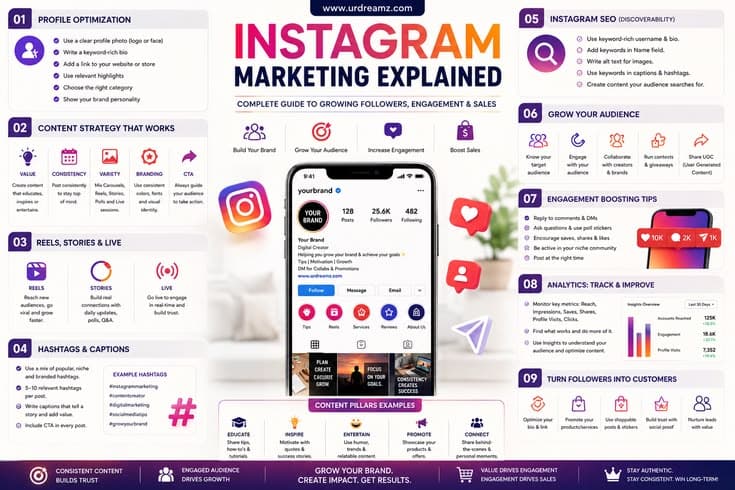
Instagram Marketing Explained: Complete Guide to Growing Followers, Engagement and Sales
Instagram has grown from a simple photo-sharing app into one of the most powerful marketing platforms in the world, used by creators, bloggers, small businesses, and major brands alike to build an audience and drive real revenue. Instagram marketing today means far more than posting pretty pictures - it covers profile optimization, a deliberate content strategy across Reels, Stories, and carousels, Instagram SEO, hashtag strategy, paid advertising, and ongoing analytics. This guide walks through every part of that system, from your very first profile setup to running a full content and ad strategy.
What sets Instagram apart from most other platforms is how naturally it blends discovery with commerce. A single Reel can reach thousands of people who have never heard of your brand, while shopping tags, a well-placed link in bio, and Instagram Shop turn that same moment of discovery into an actual purchase without ever forcing someone to leave the app. Few platforms make the journey from "never seen this brand before" to "just bought something from them" feel as short or as frictionless.
This guide is built to be useful whether you're launching your very first business profile or trying to squeeze more consistent results out of an account you've already been running for months. Read it start to finish for the complete picture, or jump to whichever section matches the stage you're at right now - profile setup, content strategy, Reels and Stories tactics, SEO and hashtags, paid ads, or analytics all stand on their own while still building toward the same overall system.
This guide continues the Digital Marketing Learning Center and builds directly on the Social Media Marketing and Facebook Marketing foundations already covered. It connects naturally with: Blogger vs WordPress, Amazon Associates: Complete Guide to Affiliate Marketing, SEO for Beginners, Digital Marketing Explained, Content Marketing Complete Guide, Email Marketing Explained, Social Media Marketing Explained, and Facebook Marketing Explained. Since Instagram runs on the same Meta advertising infrastructure as Facebook, many of the ad concepts from that guide apply here directly.
1. What Is Instagram Marketing?
Instagram marketing is the practice of using an Instagram profile, content, and paid ads to build brand awareness, grow an engaged audience, and convert followers into leads or customers. Unlike a purely personal account, Instagram marketing treats every post, Reel, and Story as a deliberate step toward a business goal, whether that goal is brand awareness, community building, website traffic, or direct sales. It is, in short, the discipline of turning attention into a genuine, ongoing business asset rather than a fleeting stream of likes.
What makes Instagram especially valuable is that it combines discovery and connection in one place. The Explore page and Reels feed constantly introduce your content to people who have never followed you before, while Stories, DMs, and comments give you a direct, personal channel to nurture the people who already have. Few platforms combine cold discovery and warm relationship-building as effectively in a single app, and that combination is exactly why Instagram continues to punch above its weight for brands willing to invest real time into both sides of that equation rather than only one.
2. Instagram Business vs Creator Account: Which Should You Use?
Before posting a single piece of content, it's worth choosing the right account type, since each unlocks slightly different features.
| Account Type | Best For | Key Features |
|---|---|---|
| Business account | Brands, ecommerce stores, local businesses | Shopping tags, detailed Insights, contact buttons, ad campaign creation |
| Creator account | Influencers, bloggers, coaches, personal brands | Creator-specific Insights, branded content tools, more flexible category labels |
Both account types give you access to Instagram Insights and Meta Business Suite, so the decision usually comes down to how you present yourself: a business account signals "this is a company," while a creator account signals "this is a person building a personal brand." Many solo entrepreneurs actually benefit from a creator account even while running a real business, since it lets their personality lead while still keeping access to business-grade analytics and tools.
It's also worth knowing that switching between account types later is simple and doesn't require starting over - your followers, posts, and history stay intact either way. Because of this, don't overthink the initial choice too much; pick whichever type matches how you plan to present yourself today, and revisit the decision in a few months once you have a clearer sense of whether your audience responds more to "brand" framing or "person" framing.
3. Instagram Profile Optimization Checklist
Your profile is effectively your homepage on Instagram - it's what every new visitor sees within the first few seconds of finding you, whether through a Reel, a hashtag, or a friend's tag. A weak profile can undo the work of a genuinely great piece of content.
| Element | Best Practice |
|---|---|
| Username | Keep it short, searchable, and as close to your brand name as possible |
| Profile picture | Use a clear logo or face shot that stays recognizable at a small size |
| Name field | Include a searchable keyword alongside your brand name, since this field is indexed by Instagram search |
| Bio | Clearly state who you help and how, in a scannable, benefit-driven format |
| Link in bio | Point to a single, clear destination - your website, a link-in-bio tool, or your most important offer |
| Category label | Choose the most accurate category so your profile surfaces correctly in relevant searches |
| Highlights | Organize key information - FAQs, testimonials, products - into labeled, on-brand highlight covers |
| Contact options | Enable relevant contact buttons (email, call, or directions) for business accounts |
A bio worth writing twice is worth the effort - it's essentially unpaid, permanent ad space that every single visitor reads. A strong structure to follow is: a line stating who you help, a line stating how you help them, and a final line or emoji-separated detail pointing toward your link in bio. Avoid vague, generic phrases like "passionate about life" that say nothing distinct about your value, and instead be specific enough that a stranger understands your entire value proposition in under five seconds.
Highlights deserve more strategic thought than most accounts give them. Rather than randomly saving whatever Stories happen to still be relevant, treat your Highlights row as a mini table of contents for your profile: a highlight introducing who you are, one showing product or service details, one collecting testimonials or reviews, and one answering common questions all give a first-time visitor a self-guided tour without you needing to say anything new. Custom highlight covers that match your brand colors also reinforce the same visual consistency that makes an account feel professional at a glance.
Your link in bio deserves the same level of care as your homepage, since for many visitors it functions exactly like one. If you're promoting more than one destination - a shop, a blog, a lead magnet - a simple link-in-bio tool that houses multiple buttons behind one link is usually a better choice than repeatedly editing your bio link every time your priority changes.
4. The 5-Step Instagram Content Strategy Framework
A content strategy turns Instagram from a place where you post whenever inspiration strikes into a repeatable system that consistently attracts, engages, and converts your audience.
| Step | What Happens |
|---|---|
| 1. Know your audience | Understand their needs, pain points, interests, and everyday behaviors |
| 2. Set clear goals | Define what success actually looks like - more reach, more engagement, or more sales |
| 3. Plan your content | Choose content themes, formats, and build out a content calendar |
| 4. Create and deliver value | Produce high-quality content that genuinely solves a problem or entertains |
| 5. Analyze and improve | Track performance, learn what's actually working, and refine continuously |
Most accounts that struggle with growth have skipped straight to step four without ever completing steps one and two. Posting good-looking content without a clear sense of who it's for or what it's meant to achieve produces likes without direction - engagement that never actually turns into business results.
Step five - analyzing and improving - is where this framework becomes a genuine system rather than a one-time exercise. Treat each month as a small experiment: pick one variable to test, whether that's Reel length, posting time, hook style, or caption format, and compare the results against the previous month's baseline. Over the course of a year, twelve deliberate tests like this will teach you far more about what your specific audience responds to than a year of posting on instinct alone ever could.
5. Instagram Content Types and Posting Frequency
A healthy Instagram presence rotates through several distinct content types rather than repeating the same format endlessly.
| Content Type | Purpose | Examples |
|---|---|---|
| Educational | Teach something useful | How-to guides, tips and tricks, tutorials |
| Entertaining | Keep your audience amused and engaged | Trend-based Reels, memes, relatable humor |
| Inspirational | Motivate action or belief in a possibility | Quotes, success stories, before-and-after transformations |
| Behind-the-scenes | Build trust through authenticity | Process videos, day-in-the-life content |
| Promotional | Drive a specific action or sale | Product launches, offers, testimonials |
Format also matters as much as topic. As a general guide: feed posts work well three to five times a week for brand-building and value content; Reels perform best posted two to four times a week, since they're the format most likely to reach non-followers; Stories can be posted daily, often five to ten per day, for engagement, updates, and behind-the-scenes moments; and Live sessions work well once or twice a month to build real-time trust and connection.
Rather than treating these five content types as a strict rotation to follow in order, think of them as a toolbox to pull from based on what a given week actually calls for. A product launch week might lean heavily on promotional and inspirational content, while a quieter week might lean more on educational and behind-the-scenes posts. The goal isn't perfect balance in every single week - it's making sure that, looked at over a full month, your feed doesn't lean so heavily on any one type that your audience starts to see your account as purely promotional, purely entertainment, or purely educational when it's meant to be a genuine mix of all three.
6. How the Instagram Algorithm Works
Instagram doesn't use one single algorithm - it uses several, each tailored to a specific part of the app: Feed, Stories, Reels, and Explore each rank content slightly differently, though they share some common signals.
- Watch time and completion rate carry significant weight, especially for Reels
- Shares and saves are treated as strong positive signals, often more valuable than a simple like
- Comments, especially longer, thoughtful ones, boost a post's perceived relevance
- How quickly a post earns engagement after publishing affects how widely it's then distributed
- Consistency in posting and genuine engagement with your own audience both factor into how much reach your account earns over time
- Original content is generally favored over reposted or recycled material from elsewhere
Because Reels are currently the format Instagram most actively promotes to non-followers, an account trying to grow its audience should generally weight its content mix more heavily toward Reels than static posts, while using Stories and feed posts more for nurturing the audience it already has.
It's worth remembering that Instagram, like every major platform, adjusts its ranking systems periodically in response to broader company priorities - sometimes favoring video more heavily, sometimes shifting weight toward Stories or DMs, sometimes changing how heavily Explore leans on a viewer's past behavior versus trending content overall. Rather than treating any specific rule as permanent, build a habit of checking your own Insights every few weeks; a sudden, unexplained shift in your own reach or engagement is often the earliest and most reliable signal that something in the underlying algorithm has changed, well before it's ever formally announced.
7. Instagram Reels Strategy: Hooks, Ideas and Best Practices
Reels remain the single best tool for reaching people who don't already follow you, which makes them the backbone of most modern Instagram growth strategies.
Strong hook formats to open a Reel
- Naming the pain point: "Why you're stuck with [problem]"
- Calling out a mistake directly: "Stop doing [X]"
- Sparking curiosity: "Nobody tells you this about [topic]"
- Sharing proof: "I tried [thing] - here's what happened"
Reel formats worth rotating through
- Listicle-style Reels ("5 tools I use every week")
- Step-by-step how-to guides
- "Versus" comparison videos
- Reaction videos to trends or news in your niche
- Live streams repurposed into short clips
- Transformation or before-and-after Reels
Beyond the hook and format, a few technical habits consistently improve Reels performance: use trending audio when it genuinely fits the content rather than forcing it, add on-screen captions since a large share of viewers watch without sound, keep the pacing tight with no dead space in the first three seconds, and post consistently rather than in occasional bursts, since Reels reward accounts that show up reliably over ones that post rarely but "go big."
It's worth setting realistic expectations about virality specifically. Most Reels, even well-made ones, will perform modestly rather than explosively, and that's completely normal - the accounts that grow steadily over time are almost always the ones that treat every Reel as a small, repeatable bet rather than pinning their entire strategy on one video "blowing up." A consistent stream of solid, on-brand Reels reliably outperforms an inconsistent chase for a single viral hit, both because it compounds over time and because it keeps building the same audience relationship a lucky viral moment often fails to convert into loyal followers anyway.
Length also matters more than beginners often assume. Very short Reels, in the range of seven to fifteen seconds, tend to maximize completion rate and are ideal for a single punchy idea, while longer Reels in the thirty-to-ninety-second range work better for genuine tutorials or storytelling, where the value justifies the extra watch time. Matching the length to the actual content, rather than defaulting to one fixed length for everything, keeps completion rates - one of the algorithm's most heavily weighted signals - consistently healthy.
8. Instagram Stories Strategy
Stories serve a different purpose than Reels - where Reels are built for discovery, Stories are built for connection and daily engagement with people who already follow you. Because Stories disappear after 24 hours, they're a lower-pressure format that's ideal for behind-the-scenes moments, quick polls, and daily updates that don't need to be permanent.
- Use poll and question stickers to invite direct interaction
- Share behind-the-scenes moments that feel more casual than your main feed
- Post quick tips, checklists, or countdowns tied to an upcoming launch
- Use the "swipe up" or link sticker to drive traffic when you have something specific to promote
- Repost user-generated content and tag the original creator to build social proof
Because Stories are consumed quickly and often in a sequence, keeping each individual Story simple - one idea per frame - tends to keep viewers watching through to the end rather than tapping away partway through.
Stories also serve a purpose that's easy to underrate: they're often the first place a highly interested follower will interact with you directly, since replying to a Story feels far more casual and low-pressure than commenting publicly on a feed post. Treat every Story reply as a genuine conversation starter rather than a quick auto-response - the followers who engage this way are typically among your most invested, and a real, personal reply can turn a casual follower into a genuine customer or advocate over time.
9. Instagram Carousel Strategy
Carousels - multi-image or multi-slide posts - are especially effective for educational content, since they encourage people to swipe through multiple slides, which increases time spent on the post and signals strong engagement to the algorithm. A carousel built around a single, clear structure - a countdown list, a step-by-step process, or a myth-versus-fact format - tends to perform more consistently than one that jumps between unrelated ideas.
The first slide carries the most weight, since it functions as the hook the same way a Reel's opening seconds do. A strong first slide states the value proposition immediately - what the reader will learn or gain by swiping - rather than a vague title that requires several slides before the payoff becomes clear.
Design consistency across slides matters more in carousels than in almost any other format, since viewers are comparing each slide to the one before it in rapid succession. Using the same font, color palette, and layout template throughout a carousel - varying only the specific content on each slide - creates a polished, cohesive feel that a mismatched, ad-hoc design simply can't match. The final slide is also worth planning deliberately, since it's the natural place for a clear call to action, whether that's "save this for later," "follow for more," or a direct link to learn more.
10. Instagram SEO: Keywords, Captions and Alt Text
Instagram has increasingly become a search engine in its own right, particularly for younger users who search directly within the app rather than using Google. Instagram SEO means optimizing your profile and content so it surfaces in these searches.
| SEO Element | Best Practice |
|---|---|
| Name field | Include a relevant keyword, since this field is searchable |
| Bio | Naturally include the terms your ideal audience would search for |
| Captions | Write naturally while including relevant keywords early in the text |
| Alt text | Add a clear, descriptive alt text to images rather than leaving it blank |
| Hashtags | Use hashtags as an additional discovery layer, not a replacement for genuine keyword use in captions |
Searchable captions matter more than most creators realize - writing "5 budgeting tips for beginners" instead of a vague "swipe for more" gives Instagram's search and recommendation systems something concrete to match against a user's actual search intent.
Alt text is one of the most overlooked Instagram SEO tools available, largely because it's hidden behind an extra tap when uploading a post. Instagram automatically generates a basic alt text description, but writing your own - specific, descriptive, and naturally including a relevant keyword - gives you far more control over how your image is categorized and surfaced in both accessibility tools and search. This takes only a few extra seconds per post but compounds meaningfully across hundreds of posts over time.
11. Instagram Hashtag Strategy
Hashtags still help with discoverability, though their impact has become more nuanced than simply adding as many as possible. A balanced approach mixes three types: a few broad, high-volume hashtags for maximum reach, several niche-specific hashtags where competition is lower and your ideal audience is more concentrated, and one or two branded hashtags unique to your business that you use consistently.
Rather than maxing out at thirty hashtags on every post, most creators now see better results from a smaller, more relevant set placed either in the caption or the first comment. Researching which hashtags your specific target audience actually follows and engages with matters far more than chasing generic, oversaturated tags that are unlikely to surface your content to anyone genuinely interested.
A practical way to build your hashtag list is to look at what similar, successful accounts in your niche are already using, then cross-reference those tags against how many posts currently use them - extremely high-volume tags with millions of posts tend to bury your content within minutes, while moderately sized, niche-specific tags give a post a longer realistic window to be discovered. Rotating a handful of different hashtag sets across your posts, rather than pasting the exact same block onto every single one, also helps avoid your account being flagged for repetitive, spammy-looking behavior.
12. A Proven Viral Content Framework for Instagram
Beyond individual post ideas, having a repeatable content formula removes the guesswork from planning an entire month. One framework that's worked well across many accounts splits content into three format types, roughly equally, until real performance data suggests otherwise.
| Format | Purpose | Starting Split |
|---|---|---|
| Carousels | Teach, explain, and get saved | Roughly one-third of content |
| Reels | Reach, personality, and discovery | Roughly one-third of content |
| Single image posts | Punchy ideas, beliefs, and reminders | Roughly one-third of content |
After around a hundred posts, shift the split toward whichever format has genuinely earned the strongest results for your specific account - a common adjustment is roughly sixty percent toward your best-performing format, thirty percent toward your second-best, and ten percent toward experiments.
It also helps to think about the purpose behind each individual post using three broad categories: attraction content built around pain points, hot takes, and common beginner mistakes designed to reach new people; nurture content built around behind-the-scenes moments, proof, and lessons learned designed to deepen trust with existing followers; and sales content built around offers, FAQs, and results designed to directly convert warm followers into customers. A rough starting split of seventy percent attraction, twenty percent nurture, and ten percent sales keeps the account growth-focused while still making room for genuine conversion moments.
Underneath individual posts, four recurring content pillars keep a feed feeling cohesive rather than random: process content showing exactly how to get a result, perspective content sharing what you genuinely believe, pain content addressing what your audience struggles with, and proof content demonstrating why they should trust you. Rotating consistently through these four pillars, combined with the format and purpose splits above, is enough to fill an entire month of content without ever feeling like you're starting from a blank page.
Finally, a short weekly review keeps this system honest: check views, interactions, profile visits, your reach-to-engagement ratio, and your profile-visit-to-follow ratio, then deliberately repeat whichever post from that week performed in roughly the top twenty percent of your content.
What makes this particular framework valuable isn't any single number in it - it's the discipline of having a starting structure at all. Most accounts that feel stuck aren't lacking creativity; they're lacking a system that turns creativity into a repeatable weekly output. Starting with an even split across formats, purposes, and pillars, then adjusting based on real performance rather than guesswork, removes the two biggest obstacles to consistent posting: decision fatigue over what to post next, and the temptation to abandon a format after just one or two lukewarm results before it's had a real chance to prove itself.
13. Instagram Marketing for Ecommerce and Fashion Brands
Instagram remains one of the strongest discovery platforms for fashion and lifestyle brands specifically, since the format is inherently visual and shopping-friendly. A few strategies consistently drive results for clothing and product-based brands:
- Use Reels to showcase new arrivals, styling tips, and trending audio-led outfit content
- Set up Instagram Shop and tag products directly inside posts and Reels so browsing leads straight to checkout
- Collaborate with niche-relevant influencers and actively encourage user-generated content, then repost customer photos and reviews as social proof
- Run targeted Meta ads for specific collections, and retarget people who have already visited your website or added an item to their cart
- Maintain a consistent visual theme across the entire feed, since a cohesive aesthetic builds brand recognition faster than an inconsistent mix of styles
Strong content ideas for this kind of brand include new collection reveals, styling and outfit-pairing tips, seasonal or festive campaigns, customer reviews and testimonials, sales and promotional announcements, and behind-the-scenes glimpses of the design or packing process. Posting consistently three to five times a week, replying to comments and DMs daily, and reviewing Instagram Insights regularly are the baseline habits that separate steadily growing brand accounts from stagnant ones.
A cohesive visual theme deserves particular emphasis for product-based brands, since Instagram is fundamentally a visual-first discovery platform - a shopper deciding whether to follow a fashion account is often making that decision based on the overall feel of the grid within a few seconds, before reading a single caption. Committing to a consistent color palette, a repeatable photo style, and a predictable Reel intro or outro format all contribute to that instantly recognizable feel, and this consistency becomes an asset that compounds as the account grows, since returning visitors begin to recognize the brand at a glance even in a crowded Explore page.
14. Instagram Ads and Meta Advertising
Since Instagram runs through the same Meta Ads Manager used for Facebook, the underlying setup process, targeting tools, and optimization principles are largely shared between the two platforms. The main difference lies in placement and creative style: Instagram ads tend to perform best with polished, visually strong creative suited to Feed, Stories, Reels, and Explore placements, while Facebook ads can perform well with a slightly broader range of formats, including more text-heavy or link-driven content.
A few Instagram-specific ad considerations worth keeping in mind: Reels ad placements typically need vertical, full-screen creative designed specifically for that format rather than a repurposed square feed image, and Stories ads should be designed to feel native to the surrounding organic Stories rather than obviously separate from them. As with Facebook, retargeting website visitors and cart abandoners tends to produce a stronger return than cold, top-of-funnel campaigns alone, so a healthy Instagram ad strategy usually combines both.
Budget allocation between Instagram and Facebook placements is usually best left to Meta's automatic placement optimization rather than manually restricting a campaign to Instagram only. The delivery system tends to find the most cost-efficient mix across both platforms in real time, and manually narrowing placements - much like manually narrowing audiences - often reduces the amount of data the algorithm has to learn from, which can quietly raise your cost per result even when the intention was to focus spend more precisely.
15. Influencer Marketing and User-Generated Content
Influencer and creator partnerships remain one of the fastest ways to borrow trust and reach a new, relevant audience on Instagram. Micro-influencers - accounts with smaller but highly engaged, niche-specific audiences - often produce a stronger return than a single large influencer deal, both because they're more affordable and because their audiences tend to trust their recommendations more personally.
User-generated content works alongside influencer marketing as a lower-cost, highly authentic alternative. Actively encouraging customers to tag your brand, then reposting their photos and reviews with credit, builds the same kind of social proof as an influencer partnership while costing nothing beyond the time it takes to ask and repost.
When evaluating a potential influencer partnership, engagement rate and audience relevance matter far more than raw follower count. An influencer with fifteen thousand highly engaged, niche-relevant followers will typically drive more meaningful sales for a small business than one with two hundred thousand broad, disengaged followers who have no particular reason to trust their recommendations in your specific category. Reviewing an influencer's past sponsored content - specifically how their audience responded in the comments - is usually a far better predictor of results than their follower count alone.
16. Instagram Insights and Analytics
Instagram Insights, available through the app or Meta Business Suite, is where content decisions stop being guesses and start being backed by real data.
| Metric | What It Tells You |
|---|---|
| Reach | How many unique accounts saw your content |
| Impressions | Total times your content was displayed, including repeat views |
| Engagement rate | Likes, comments, shares, and saves relative to your reach |
| Saves | How many people bookmarked your post to revisit later - a strong signal of real value |
| Shares | How many people sent your content to someone else directly |
| Profile visits | How many people clicked through to your profile after seeing your content |
| Website clicks | How much traffic your content is actually sending outside the app |
Saves and shares deserve special attention, since they're widely considered stronger signals of genuine value than likes - a post that gets saved is being treated as a resource worth returning to, while a post that gets shared is actively expanding your reach through someone else's network at no cost to you.
A simple weekly habit worth adopting is setting aside fifteen minutes to review your Insights at the same time each week. Identify your single best-performing post from that week and ask specifically what made it work - was it the hook, the topic, the format, or the time it was posted? Then deliberately try to repeat that specific element in the following week's content. Over time, this turns analytics from a number you glance at occasionally into an active feedback loop that steadily sharpens your content strategy.
17. Best Instagram Marketing Tools
| Tool | Main Use Case |
|---|---|
| Meta Business Suite | Scheduling posts, managing messages, and tracking Insights |
| Canva | Designing carousels, Story templates, and branded graphics |
| CapCut | Editing Reels and short-form video on mobile |
| Buffer / Later / Metricool | Scheduling content and analyzing performance across platforms |
| Adobe Express | Quick, templated design work for social graphics |
| Notion | Planning a content calendar and organizing content pillars |
| ChatGPT | Brainstorming captions, hooks, and content ideas |
A realistic starter stack for most beginners is Meta Business Suite for scheduling and Insights, Canva for design, and CapCut for video editing - everything else becomes useful once content volume and team size grow large enough to justify the added complexity.
Before adding a new tool to your workflow, it's worth asking a simple question: does this genuinely save meaningful time, or does it just add another dashboard to check? A scheduling tool that lets you batch a week's worth of posts in one sitting is a clear win. A fourth analytics tool that duplicates data you can already see natively in Instagram Insights usually isn't worth the added subscription cost or mental overhead, at least not until your account has grown well beyond the beginner stage.
18. Common Instagram Marketing Mistakes to Avoid
| Mistake | Why It Hurts You |
|---|---|
| Buying followers or fake engagement | Inflates vanity metrics while damaging your genuine engagement rate |
| Inconsistent posting | Resets algorithmic momentum and makes an account feel abandoned |
| Weak or generic captions | Misses the opportunity to add context, keywords, and a clear CTA |
| Ignoring analytics | Means repeating the same underperforming content indefinitely |
| Inconsistent niche or messaging | Confuses both the algorithm and potential followers about what your account is about |
| Overusing hashtags | Can look spammy and rarely outperforms a smaller, more relevant hashtag set |
| Low-quality visuals | Undermines trust before your caption is even read |
| No clear call to action | Leaves engaged viewers unsure what to do next |
Most of these mistakes share a common root: optimizing for the appearance of growth rather than the substance of it. Bought followers, inflated hashtag lists, and inconsistent niche-hopping might occasionally produce a short-term bump in a vanity metric, but they all work against the same underlying goal - building a genuinely engaged audience that actually converts into business results. Fixing even two or three items from this list is often enough to shift a stagnant account's trajectory within a single month.
19. Instagram Marketing for Bloggers and Affiliate Marketers
Bloggers can use Instagram to drive traffic back to their site by sharing the single most compelling insight from a post directly in a Reel or carousel, then directing interested viewers to the full article through their link in bio. Affiliate marketers should lean on genuine, experience-based recommendations rather than repetitive promotional posts, clearly disclosing affiliate relationships to maintain trust. For both, Reels and carousels tend to outperform static single images for driving new traffic, since they're the formats Instagram's discovery systems currently favor most.
One pattern worth borrowing directly from full-time content creators is treating every blog post or affiliate recommendation as raw material for several pieces of Instagram content rather than a single announcement post. A single in-depth article can realistically become a hook-driven Reel highlighting the most surprising finding, a carousel breaking the full argument into swipeable steps, and a Story series walking followers through a shorter, more casual version of the same idea. This kind of repurposing multiplies the return on the original research or writing effort without requiring an entirely new piece of content for each format.
20. Complete Instagram Marketing Checklist
| Checklist Item | Why It Matters |
|---|---|
| Profile picture, bio, and link in bio are current | First impressions form within seconds of a profile visit |
| Highlights are organized and labeled clearly | Gives new visitors an easy way to explore your best content |
| Content calendar covers the next two to four weeks | Prevents last-minute scrambling and inconsistent posting |
| Content mix includes Reels, Stories, and carousels | Balances discovery, engagement, and depth |
| Captions include relevant keywords naturally | Improves Instagram SEO and search visibility |
| Insights have been reviewed in the last two weeks | Keeps content decisions grounded in real performance data |
| At least one retargeting or engagement-based ad audience is active (if running ads) | Captures warm traffic more efficiently than cold campaigns alone |
21. Final Roadmap: Where Instagram Fits in Your Marketing Stack
Instagram marketing rewards the same fundamentals as every other channel in this Digital Marketing Learning Center: a clear, optimized profile, a genuine content strategy built around your specific audience, and consistent, patient effort over months rather than days. Start with your profile optimization and a simple weekly content mix of Reels, Stories, and carousels, build the habit of reviewing Insights regularly, and only layer in paid ads once your organic content is already earning genuine engagement.
If there's one idea worth carrying forward from this entire guide, it's that Instagram rewards consistency and genuine value far more than it rewards any single viral moment or growth hack. An account that shows up reliably, engages honestly, and steadily refines its approach based on real Insights data will, almost without exception, outgrow an account chasing every new trend while ignoring the fundamentals covered above.
This guide sits inside a larger Digital Marketing Learning Center that will continue expanding into Pinterest Marketing, LinkedIn Marketing, YouTube Marketing, TikTok Marketing, X Marketing, WhatsApp Marketing, and Influencer Marketing - each one building on the Instagram and Facebook foundations covered here.
Frequently Asked Questions
What is Instagram marketing?
Instagram marketing is the use of an Instagram profile, organic content, and paid ads to build brand awareness, grow an engaged audience, and generate leads and sales. It combines profile optimization, a consistent content strategy across Reels, Stories, and carousels, Instagram SEO, and, when the budget allows, paid advertising through Meta Ads Manager.
How do beginners grow Instagram followers organically?
Focus on a clear niche, post consistently across Reels, Stories, and carousels, optimize your profile and captions for Instagram SEO, and genuinely engage with your audience rather than posting and disappearing.
How often should I post on Instagram?
A common, sustainable rhythm is three to five feed posts and two to four Reels per week, alongside daily Stories - though consistency matters more than hitting an exact number.
Do Reels really help you gain followers?
Yes. Reels are currently the format most actively shown to people who don't already follow you, making them one of the most effective tools for reaching new audiences.
How many hashtags should I use on Instagram?
A smaller, carefully researched mix of broad, niche, and branded hashtags generally performs better than maxing out at the platform's hashtag limit on every post.
Is Instagram marketing worth it for small businesses?
Yes, especially for visual products and local or lifestyle brands - Instagram combines strong organic discovery through Reels and Explore with detailed ad targeting through Meta Ads Manager.
What is the difference between Instagram reach and impressions?
Reach counts the number of unique accounts that saw your content, while impressions count the total number of times it was displayed, including repeat views from the same account - a post can have far more impressions than reach if the same people see it multiple times.
Should I focus on Reels or feed posts first?
If growth is your main goal, prioritize Reels, since they're currently shown more widely to non-followers. If you already have an engaged audience and want to deepen that relationship, feed posts and carousels tend to earn stronger engagement from people who already follow you.