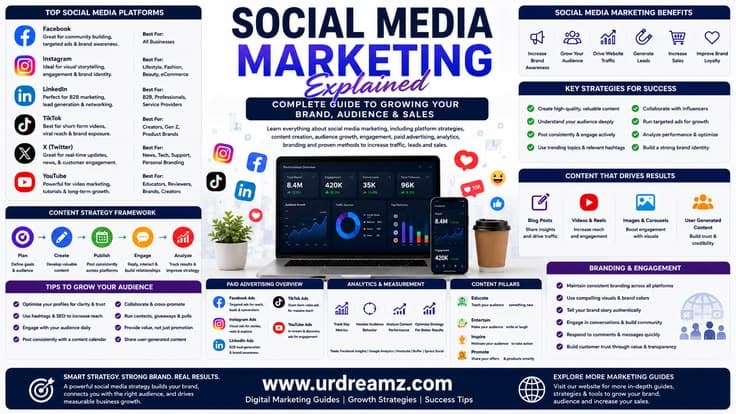
Social Media Marketing Explained: Complete Guide to Growing Your Brand, Audience and Sales
Social media marketing is the practice of using platforms like Facebook, Instagram, Pinterest, LinkedIn, X, TikTok, and YouTube to connect with an audience, build brand awareness, spark engagement, and ultimately drive traffic and sales. Unlike a single tactic, it's really a full discipline that blends content creation, community building, paid advertising, analytics, and branding into one ongoing system. This guide walks through every major piece of that system, from picking the right platform to turning followers into paying customers.
This article continues the Digital Marketing Learning Center and follows naturally after email marketing. It connects with the guides already published: Blogger vs WordPress, Amazon Associates: Complete Guide to Affiliate Marketing, SEO for Beginners, Digital Marketing Explained, Content Marketing Complete Guide, and Email Marketing Explained. Together, these guides form one connected roadmap for anyone building an online business from scratch.

1. What Is Social Media Marketing and Why It Matters
At its core, social media marketing is about using social platforms to engage audiences, build community, and grow a brand. Instead of shouting a message at people, the best social media marketing invites a conversation - replying to comments, answering DMs, and showing up consistently enough that your brand becomes a familiar, trusted presence rather than just another account in someone's feed.
It matters for three main reasons. First, it increases brand awareness by putting your business in front of a much wider audience than word of mouth alone ever could. Second, it builds real relationships through direct engagement - comments, shares, and conversations that a billboard or a traditional ad could never create. Third, it drives measurable traffic, leads, and sales, sending visitors directly to your website, landing pages, or online store.
| Benefit | What It Looks Like in Practice |
|---|---|
| Brand awareness | More people recognize your name, logo, and voice over time |
| Audience engagement | Comments, shares, and DMs build a genuine relationship with followers |
| Traffic generation | Posts and bio links send visitors directly to your website or store |
| Lead generation | Content and ads capture interested prospects for future nurturing |
| Sales growth | Engagement and trust convert into actual purchases over time |
2. The Real Impact of Social Media Marketing
It's easy to underestimate just how much social media has reshaped modern business. A few realities are worth keeping in mind as you build your own strategy: social platforms let businesses reach far larger audiences than traditional advertising ever allowed, and they let brands grow internationally without the overhead of a physical presence in every market. Genuinely well-made content - especially short videos and reels - tends to earn noticeably higher engagement than static posts, and consistent posting is what actually builds long-term trust with an audience, rather than any single viral moment.
Hashtags help new audiences discover content they wouldn't have found otherwise, and creator or influencer partnerships can introduce a brand to entirely new communities. Compared to traditional advertising, social media marketing is also remarkably cost-efficient, since organic reach and modest ad budgets can still produce meaningful results. On top of that, built-in analytics let marketers understand audience behavior in a level of detail that simply wasn't possible with older forms of marketing, and direct replies or DMs let businesses talk to customers one-on-one at scale. Altogether, brands that track trends and adapt their approach over time tend to build the kind of long-term, compounding success that a single lucky viral post never could on its own.
3. The 6-Step Social Media Marketing Strategy Framework
A strategy turns random posting into a repeatable system. These six steps form the backbone of almost every successful social media plan, regardless of the platform or industry.
| Step | Stage | What Happens |
|---|---|---|
| 1 | Set goals | Decide whether you're chasing awareness, leads, traffic, or direct sales |
| 2 | Know your audience | Understand their interests, habits, and where they actually spend time online |
| 3 | Create valuable content | Share posts that educate, entertain, or genuinely solve a problem |
| 4 | Plan and publish | Build a content calendar and post on a consistent schedule |
| 5 | Engage and build community | Reply to comments and messages, and spark real conversation |
| 6 | Analyze and optimize | Track performance data and refine the strategy based on what the numbers show |
Most beginners skip straight to step three - posting content - without ever defining a goal or truly understanding their audience. That's exactly why so many accounts post consistently for months without seeing real business results: they're technically active, but strategically directionless.
4. Best Social Media Platforms for Business and How They Differ
Every major platform has its own audience, content style, and strengths. Choosing where to focus your energy should depend on where your specific audience actually spends time, not on which platform is trendiest.
| Platform | Typical Audience | Best Content Types | Main Strength | Watch Out For |
|---|---|---|---|---|
| Boomers, Gen X, broad 25-34 | Photos, links, live video | Local marketing, community groups, advertising | Organic reach has weakened significantly | |
| Millennials, 18-34 | Reels, carousels, inspiration-led visuals | Ecommerce, influencer marketing, brand storytelling | Ad costs can run high in competitive niches | |
| TikTok | Mostly female, 18-34 | Short entertaining or educational videos, series content | Direct sales, viral discovery, relationship building | Fast-moving trends require constant adaptation |
| X (Twitter) | Educated, 18-34 | News, discussion, humor | Customer service, real-time updates, industry conversation | Smaller, more niche ad audience |
| Working professionals, 25-34 | Long-form posts, thought leadership | B2B marketing, international reach, professional networking | Requires more polished, credibility-driven content | |
| YouTube | Broad, all ages, 18-35 core | How-tos, webinars, explainers, long-form video | SEO-driven organic discovery, in-depth education | Video production is more resource-heavy than other formats |
| Snapchat | Teens, 13-17 core | Casual, feel-good, trend-driven content | App marketing, location-based promotion | Skews very young for many B2B or professional brands |
Rather than trying to be active everywhere at once, most beginners get far better results by choosing one or two platforms where their specific audience already spends time, mastering the content style that works there, and only expanding once that first platform is genuinely working.
5. Content Creation Ideas That Actually Get Engagement
Content is the fuel behind every social media strategy. The accounts that never run out of ideas usually rotate through a handful of proven content types instead of trying to invent something new every single day.
| Content Type | Why It Works |
|---|---|
| Educational content (tips, how-tos, tutorials) | Provides genuine value that earns saves and shares |
| Behind-the-scenes content | Builds relatability by showing your real process and team |
| Customer stories and testimonials | Uses social proof to build trust with new visitors |
| Polls and Q&A | Invites direct interaction and signals to the algorithm that people are engaging |
| Promotions and offers | Gives your audience a clear, timely reason to act |
| Short-form video and Reels | Currently the highest-reach format on most major platforms |
| Carousel posts | Encourages longer time-on-post, which many algorithms reward |
| User-generated content | Builds community while requiring less original production effort |
A content calendar is what turns these ideas into a repeatable system instead of a one-off burst of inspiration. Planning a month of content in advance - mixing educational posts, behind-the-scenes moments, customer stories, and the occasional promotion - keeps your feed varied while still following a clear, intentional structure your audience learns to expect.
6. Video Marketing: Reels, Shorts and Short-Form Video
Short-form video - whether it's an Instagram Reel, a YouTube Short, or a TikTok video - currently earns some of the highest organic reach on nearly every major platform. That reach comes with a catch: the first two seconds of a video decide whether someone keeps watching or scrolls past, so a strong hook matters more than almost any other single element of the content.
Beyond hooks, a few practices consistently separate video content that performs from video content that gets ignored: keep the pacing tight and avoid dead space, add captions since a large share of viewers watch with sound off, and repurpose one strong idea across multiple formats - the same tip can become a Reel, a YouTube Short, and a carousel post without much extra effort.
7. Branding and Visual Consistency on Social Media
Branding is what makes your content recognizable even before someone reads a single word. Visual consistency - the same colors, fonts, and overall style across every post - trains your audience to recognize your content instantly while scrolling, which builds familiarity and, eventually, trust.
- Pick two to three brand colors and a consistent font pairing, then use them everywhere
- Keep a consistent tone of voice across captions, whether it's playful, professional, or somewhere in between
- Write a clear, keyword-rich bio that tells a new visitor exactly what your account is about within seconds
- Use a consistent profile photo and cover image across every platform so your brand is instantly recognizable
- Give your content a repeatable visual structure, such as consistent carousel layouts or intro frames for video
Personal branding follows the same principles as business branding, just centered on an individual rather than a company. Both rely on consistency, authenticity, and a clear point of view rather than trying to appeal to absolutely everyone.
8. Audience Growth and Organic Community Building
Growing followers organically comes down to a small set of repeatable habits rather than any single hack. Posting consistently, engaging genuinely with comments and DMs, using relevant hashtags for discoverability, and collaborating with other accounts in your niche all compound together over time far more reliably than chasing a single viral post.
Community building goes a step further than growth alone. It means actively replying to comments instead of just posting and disappearing, asking questions that invite real conversation, celebrating user-generated content when your audience creates it, and treating negative feedback as a customer service opportunity rather than something to ignore. Accounts with a smaller, genuinely engaged following consistently outperform accounts with a much larger but passive one, because engagement quality - not raw follower count - is what platforms reward and what actually converts into sales.
9. Turning Followers Into Paying Customers
Followers don't pay bills - customers do. Converting attention into actual revenue follows a fairly predictable path, even though it's easy to skip steps in the excitement of growing a following.
| Step | What to Do |
|---|---|
| 1. Build trust first | Share content that solves real problems, consistently and authentically |
| 2. Create value every day | Educate, entertain, or inspire rather than only promoting |
| 3. Engage and build relationships | Reply to comments and DMs so followers feel genuinely seen |
| 4. Grow your email list | Offer a lead magnet and capture emails through your bio link or landing page |
| 5. Nurture and warm your audience | Send helpful emails, share stories and behind-the-scenes updates |
| 6. Make your offer irresistible | Solve a specific problem and highlight clear, tangible results |
| 7. Show proof and build confidence | Share testimonials, reviews, and case studies |
| 8. Make it easy to buy | Simplify the buying process with clear CTAs and minimal friction |
| 9. Delight and get referrals | Overdeliver on service so happy customers refer others |
Notice how closely this mirrors the earlier lesson on email marketing - social media builds the initial attention and trust, while your email list is often what actually nurtures that relationship into a sale. The two channels work best together, not in isolation.
10. Paid Advertising: Facebook, Instagram, Pinterest, LinkedIn, TikTok and YouTube Ads
Organic content builds trust, but paid advertising lets you scale reach on your own timeline instead of waiting for the algorithm to notice you. Each major ad platform has its own strengths depending on your goal and audience.
| Ad Platform | Best For |
|---|---|
| Facebook Ads | Broad targeting, local businesses, retargeting website visitors |
| Instagram Ads | Visual products, ecommerce, and younger, discovery-driven audiences |
| Pinterest Ads | Bloggers and ecommerce brands with strong visual or inspirational content |
| LinkedIn Ads | B2B lead generation and professional services |
| TikTok Ads | Younger audiences and entertainment-first, trend-driven campaigns |
| YouTube Ads | Longer-form storytelling and demonstrating a product in action |
Beyond simply choosing a platform, effective ad campaigns rely on a handful of optimization techniques: audience segmentation to reach the right group instead of everyone, custom audiences built from your existing customers or website visitors, lookalike audiences that find new people similar to your best customers, and retargeting ads aimed specifically at people who already showed interest but didn't convert. A/B testing different creative, headlines, and targeting options is what turns a mediocre campaign into a genuinely profitable one over time.
11. 10 PPC and Paid Campaign Management Strategies
Whether you're running ads on a social platform or a search engine, the underlying discipline of managing pay-per-click campaigns stays largely the same.
| # | Strategy | Why It Matters |
|---|---|---|
| 1 | Define your goals | Know upfront whether you're chasing leads, sales, or awareness |
| 2 | Research ad formats | Understand the options - text, image, video, rich media - before you build anything |
| 3 | Write compelling ad copy | Persuasive copy is what actually earns the click |
| 4 | Target your audience precisely | Wasted spend usually comes from targeting the wrong people |
| 5 | Choose the right keywords or interests | These determine exactly who sees your ad |
| 6 | Set a clear budget | A defined daily or monthly cap prevents overspending |
| 7 | Monitor campaigns closely | Track CTR, conversion rate, and cost per conversion regularly |
| 8 | Test constantly | Try different copy, images, and targeting to see what actually performs |
| 9 | Optimize over time | Add negative keywords and refine based on real performance data |
| 10 | Bring in an expert if needed | A PPC specialist can accelerate results once budgets grow larger |
12. Social Media Analytics, Engagement Rate and Key Metrics
You cannot improve a strategy you never measure. Understanding a handful of core metrics turns vague impressions like "this post did well" into an actual, repeatable system for improvement.
| Metric | What It Tells You |
|---|---|
| Reach | How many unique people saw your content |
| Impressions | The total number of times your content was displayed, including repeat views |
| Engagement rate | Likes, comments, and shares divided by reach - a strong signal of real interest |
| Click-through rate (CTR) | How many people clicked your link or call to action |
| Conversion rate | How many clicks turned into leads, sign-ups, or sales |
| ROI (return on investment) | Whether the revenue generated justifies the time and money spent |
| Follower growth | How steadily your audience is expanding over time |
Reach and impressions often get confused, but the difference matters: reach counts unique viewers, while impressions count total views, including the same person seeing a post multiple times. A campaign can have huge impressions but weak reach if it's being repeatedly shown to a small, narrow audience - which is exactly the kind of insight that raw follower counts alone would never reveal.
13. Best Social Media Marketing Tools Compared
The right tools save hours every week and keep a growing content calendar from becoming unmanageable.
| Tool | Main Use Case |
|---|---|
| Buffer | Simple, beginner-friendly post scheduling across multiple platforms |
| Hootsuite | A broader management dashboard for larger teams and multiple accounts |
| Later | Visual content planning, especially strong for Instagram grids |
| Canva | Designing graphics, carousels, and branded templates without a design background |
| Meta Business Suite | Free, native scheduling and insights for Facebook and Instagram |
| Metricool | Cross-platform analytics and scheduling in one dashboard |
| Sprout Social | Advanced analytics and team collaboration for larger businesses |
| Notion | Building a flexible content calendar and collaborative workflow |
| CapCut | Mobile-friendly video editing for Reels, Shorts, and TikTok content |
Beginners don't need every tool on this list at once. A realistic starter stack looks like one scheduling tool, Canva for design, and the platform's own native analytics - everything else can wait until your content volume genuinely requires more advanced collaboration or reporting features.
14. Social Media Do's and Don'ts
| Do | Don't |
|---|---|
| Create genuinely valuable, high-quality content | Over-promote with constant hard selling |
| Reply to comments and DMs promptly | Ignore negative feedback or customer complaints |
| Post consistently using a content calendar | Post sporadically with long, unexplained gaps |
| Track key metrics and refine your strategy | Chase vanity metrics like follower count alone |
| Optimize your bio, CTA, and hashtags | Buy followers, spam hashtags, or copy content without credit |
15. 10 Social Media Marketing Mistakes Beginners Make
Beyond the basic do's and don'ts, a handful of strategic mistakes quietly hold back beginner accounts even when their individual posts look fine.
| # | Mistake | Why It Hurts Growth |
|---|---|---|
| 1 | Posting without a goal | Content earns likes but produces no real business outcome |
| 2 | Chasing every platform at once | Effort gets scattered instead of compounding on one platform |
| 3 | Obsessing over follower count | A smaller, engaged audience usually outperforms a large, passive one |
| 4 | Posting random content types | Inconsistent structure confuses both the algorithm and the audience |
| 5 | Ignoring content hooks | Weak openings cause high drop-off in the first two seconds |
| 6 | Selling too early | Pitching before trust is built leads to low clicks and muted reach |
| 7 | Not studying analytics | Without feedback, the same mistakes repeat indefinitely |
| 8 | Copying viral content blindly | What works for a large creator often fails for a smaller, different audience |
| 9 | Inconsistent posting gaps | Disappearing for weeks resets the momentum algorithms reward |
| 10 | Unclear profile positioning | A vague bio makes visitors leave within seconds instead of following |
16. Social Media Marketing for Small Business, Startups and Ecommerce
The core strategy stays the same across business types, but the emphasis shifts depending on what you're trying to grow.
| Business Type | What to Prioritize |
|---|---|
| Local small business | Facebook and Instagram for local visibility, reviews, and community engagement |
| Startup | One focused platform, clear positioning, and rapid testing of messaging |
| Ecommerce store | Instagram and TikTok for product discovery, paired with retargeting ads |
| B2B company | LinkedIn for thought leadership and direct professional networking |
| Bloggers and affiliates | Pinterest and YouTube for long-term, evergreen discovery traffic |
For anyone building an affiliate or content-driven website, Pinterest deserves special attention. Unlike most social platforms where posts fade from visibility within days, pins can continue driving traffic for months or even years after being published, making it one of the most efficient platforms for compounding, evergreen organic traffic.
17. Latest Social Media Marketing Trends
- Short-form video continues to dominate reach across nearly every platform
- Authentic, less polished content increasingly outperforms overly produced posts
- AI tools are speeding up content creation, captioning, and basic editing
- Social search behavior is growing, with more users searching platforms directly instead of Google for certain queries
- Community-driven, niche accounts are outperforming broad, generic ones
- Creator collaborations and micro-influencer partnerships are becoming more cost-effective than large influencer deals
18. Final Roadmap: Where Social Media Fits in Your Marketing Stack
Social media marketing rewards the same patience that content marketing, SEO, and email marketing do. Pick one platform where your audience genuinely spends time, commit to the six-step strategy framework, and give it several consistent months before judging results. Chasing every platform and every trend at once is the single fastest way to burn out without building anything durable.
This guide sits inside a larger Digital Marketing Learning Center that will keep expanding with dedicated platform guides - Facebook Marketing, Instagram Marketing, Pinterest Marketing, LinkedIn Marketing, TikTok Marketing, and YouTube Marketing - each one building on the strategy foundation covered here. Given how well Pinterest compounds evergreen traffic for blogs and affiliate sites, Pinterest Marketing and Pinterest SEO are natural next stops on this roadmap.
Frequently Asked Questions
What is social media marketing?
Social media marketing is the use of social platforms to build brand awareness, engage an audience, and drive traffic and sales through a mix of organic content and paid advertising.
Which social media platform is best for business?
It depends entirely on where your specific audience spends time - Instagram and TikTok suit visual and younger audiences, LinkedIn suits B2B, Facebook suits local business and community groups, and Pinterest and YouTube suit long-term, evergreen content discovery.
How often should businesses post on social media?
Consistency matters more than frequency. A predictable schedule you can sustain long-term will outperform sporadic bursts of daily posting followed by long silences.
Is social media marketing free?
Organic social media marketing costs time rather than money, while paid advertising adds a direct cost. Most successful strategies combine both.
What is a good engagement rate?
Engagement rate benchmarks vary by platform and industry, so it's most useful to track your own account's trend over time rather than chasing a single universal number.
How do I turn followers into paying customers?
Build trust through consistent value, move your audience onto an email list, nurture that relationship, and then present a clear, low-friction offer backed by social proof.