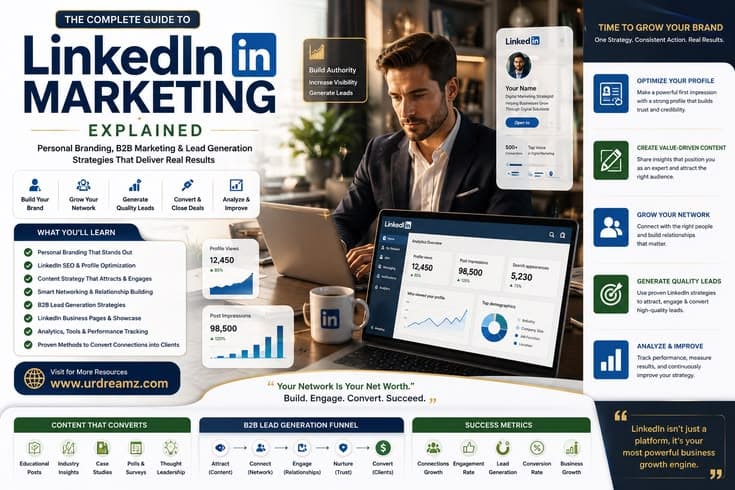
LinkedIn Marketing Explained: Complete Guide to Personal Branding, B2B Marketing and Lead Generation
LinkedIn is the one platform in this entire Digital Marketing Learning Center built specifically for professional trust rather than entertainment. Every other channel covered so far competes for attention; LinkedIn competes for credibility. That single difference changes everything about how content, branding, and lead generation should work here. This guide goes far beyond the generic "post consistently and optimize your profile" advice already sitting on page one of Google - it breaks down exactly what changed in LinkedIn's 2026 algorithm, why most personal branding advice is incomplete, and how real B2B marketers turn a profile into a genuine lead-generation engine.
Most of what circulates about LinkedIn online is a shallow checklist: "post consistently," "optimize your headline," "use hashtags." All true, none of it explains why. This guide is written differently on purpose - every principle below is paired with the actual reasoning behind it, so instead of memorizing seventy isolated tips, you walk away understanding the underlying logic of how professional trust actually gets built on this specific platform, in this specific year, and can keep applying that logic long after any individual tactic stops working.
This guide continues the Digital Marketing Learning Center and builds on everything already covered: Blogger vs WordPress, Amazon Associates: Complete Guide to Affiliate Marketing, SEO for Beginners, Digital Marketing Explained, Content Marketing Complete Guide, Email Marketing Explained, Social Media Marketing Explained, Facebook Marketing Explained, Instagram Marketing Explained, and Pinterest Marketing Explained.
1. Why LinkedIn Marketing Deserves Its Own Playbook
Most advice about LinkedIn floating around online is simply repackaged advice from Instagram or Twitter with the word "professional" sprinkled on top. That's exactly why so many accounts feel stuck: they're applying the wrong platform's playbook. LinkedIn rewards depth, identity, and genuine professional value over speed, virality, and constant novelty - and the businesses and individuals who understand that distinction consistently outperform the ones chasing generic engagement tactics borrowed from elsewhere.
The practical consequence of this difference shows up everywhere: a hook that works beautifully on TikTok can read as tone-deaf on LinkedIn, and a posting frequency that keeps an Instagram account relevant can feel like spam to a LinkedIn network. Recognizing LinkedIn as its own distinct ecosystem, with its own norms and its own definition of what "good content" means, is the single mental shift that makes everything else in this guide click into place.
2. What Is LinkedIn Marketing?
LinkedIn marketing is the practice of using a personal profile, company page, content, and paid advertising on LinkedIn to build professional credibility, grow a relevant network, and generate business leads. Unlike consumer-facing platforms, LinkedIn's entire audience is there in a professional mindset, actively open to learning, hiring, buying, and partnering - which makes it uniquely suited to B2B marketing, freelancing, consulting, recruitment, and personal brand building for anyone whose career or business depends on being known and trusted within a specific industry.
This also explains why LinkedIn marketing tends to move on a longer timeline than Instagram or TikTok. A viral Reel can produce an instant spike in followers; a strong LinkedIn presence tends to produce a slower, steadier accumulation of trust that eventually converts into an inbound message, a job offer, or a client inquiry - often weeks or months after someone first noticed your name. Understanding that timeline upfront prevents the common mistake of abandoning LinkedIn too early simply because it doesn't reward the same fast feedback loop other platforms do.
3. LinkedIn Is Not Instagram or Facebook
A recurring mistake is treating LinkedIn like a personal social feed. LinkedIn is built for professional growth, networking, learning, and opportunity - not for the same content that thrives on Instagram or Facebook. Posting like it's a casual social space dilutes the exact credibility that makes LinkedIn valuable in the first place. Your LinkedIn profile functions as a living, public resume and reputation document, and every post either reinforces or quietly undermines that reputation.
4. What NOT to Post on LinkedIn
A handful of habits consistently damage professional credibility on this platform: posting personal life updates unrelated to your work (vacations, parties, unrelated selfies), posting purely for attention or validation, sharing irrelevant trending content like memes or unrelated viral videos, overposting or spamming your network with excessive promotion, and writing in an overly casual tone loaded with slang or excessive emojis. None of these are "wrong" as human behavior - they're simply mismatched to what this specific audience showed up expecting.
5. What to Post Instead
The alternative isn't to be boring - it's to be professionally genuine. Share real insights, lessons, and achievements; focus on adding value by educating, inspiring, or informing your network; keep content relevant and industry-specific through case studies and best practices; post with intention rather than volume, favoring quality over frequency; and maintain a respectful, clear communication style. Done well, this approach builds credibility, expands your network, and unlocks opportunities that a purely personal-style feed simply won't generate on this platform.
6. The LinkedIn Algorithm in 2026: What Actually Changed
LinkedIn's algorithm has shifted meaningfully, and understanding the shift explains why tactics that worked two or three years ago have quietly stopped scaling.
| What Used to Work (Fading) | What Works Now (2026) |
|---|---|
| Random motivational quotes | Depth over virality |
| Generic "Good morning LinkedIn family" posts | Dwell time - people staying, scrolling, re-reading |
| Copy-paste AI-generated content with no editing | Original thinking combined with real experience |
| Mass-tagging people purely for reach | Specific niche positioning - micro-audiences win |
| Viral one-liners with no real depth | Story-based professional content |
| Broad, vague positioning ("I help everyone") | Comments carrying more weight than likes |
| Chasing likes as the success metric | Replies in the comments acting as a strong algorithm signal |
| Posting without engaging back afterward | DM conversations contributing to overall reach |
| Resume-style, credential-first personal branding | Consistency valued over occasional perfection |
| Chasing followers as the end goal | Real relationships valued over raw follower counts |
The underlying theme across every one of these shifts is the same: LinkedIn increasingly rewards identity-driven profiles people follow as a person, not a list of credentials or tips scraped from somewhere else.
It's worth understanding why LinkedIn made this shift in the first place. As AI writing tools made generic, competent-sounding content trivially easy to produce, the platform's own feed risked becoming flooded with interchangeable posts saying roughly the same thing in roughly the same voice. Rewarding depth, original experience, and genuine two-way conversation is LinkedIn's way of protecting what actually makes the platform valuable: real professional insight from real, identifiable people, rather than an endless scroll of polished but hollow content that could have come from anyone.
7. LinkedIn SEO and Discoverability
LinkedIn SEO determines whether you show up when someone searches your industry, role, or expertise, either inside LinkedIn's own search or through Google. Your headline, About section, job titles, and skills are all indexed and searchable, which means the specific words you choose directly affect who finds you. A profile that simply says "Marketing Professional" is invisible next to one that says "B2B Content Strategist Helping SaaS Founders Turn LinkedIn Into a Lead Channel" - the second version contains the actual keywords a prospective client or employer would type into a search bar.
Keyword placement matters most in three specific places: the headline, since it's the single most heavily weighted field in LinkedIn's own search; the About section, where natural, spread-out keyword usage across a few paragraphs outperforms a single dense, unnatural cluster; and the skills section, since recruiters and LinkedIn's search both filter directly by these listed terms. Unlike Google SEO, where backlinks and technical factors dominate, LinkedIn SEO is comparatively simple - it rewards specific, honest, keyword-aligned language over vague, generic self-description.
8. LinkedIn Profile Optimization Checklist
Before any content strategy matters, the profile itself needs to function as a landing page rather than a static résumé.
| Element | What It Should Do |
|---|---|
| Headline | State who you help and how, not just your job title |
| Profile photo | Clear, current, and professionally appropriate for your industry |
| Banner image | Reinforce your niche or value proposition visually |
| About section | Answer who you help, how, and why you specifically, in a genuine voice |
| Featured section | Showcase your best content, case studies, or offers front and center |
| Skills and endorsements | Reflect the specific, searchable terms relevant to your niche |
| Recommendations | Provide third-party social proof that a resume alone can't |
9. Personal Branding Principle 1: Your Brand Is What Others Say
Your personal brand isn't what you say about yourself - it's what people say about you when you're not in the room. This reframes the entire goal of LinkedIn content: instead of writing to describe how good you are, write in a way that earns other people's genuine description of you as knowledgeable, generous, or trustworthy after they've engaged with your work.
10. Personal Branding Principle 2: Share Perspective, Not Just Information
Anyone can share an article or repost someone else's insight. Only you can share your specific opinion on it. That opinion, shaped by your own experience, is what actually earns a genuine follow - information alone is a commodity, but a real point of view is not.
11. Personal Branding Principle 3: Talk About Failures as Much as Wins
Vulnerability builds trust, trust builds an audience, and an audience eventually builds real opportunity. A feed that only ever celebrates wins reads as a highlight reel, and highlight reels create distance rather than connection. Sharing a genuine mistake or setback, along with what it taught you, does more to build credibility than another polished success story.
12. Personal Branding Principle 4: Niche Down Your Content
You cannot be known for everything. Picking two or three topics and genuinely owning them is what allows LinkedIn's algorithm, and human memory, to associate your name with a specific area of expertise. A broad, unfocused profile forces every new visitor to work harder to understand what you actually do - a cost most visitors simply won't pay.
13. Personal Branding Principle 5: Engage Before You Post
Commenting thoughtfully on a handful of other posts before publishing your own signals genuine activity to the algorithm and warms up your own visibility ahead of a new post. Creators who only ever show up to broadcast, never to participate, tend to see slower, shallower growth than ones who treat LinkedIn as a two-way conversation.
14. Personal Branding Principle 6: Post Consistently, Not Perfectly
Showing up three times a week reliably beats disappearing for a month after one lucky viral post. Consistency compounds in a way that sporadic brilliance never does, because the algorithm and your audience both reward a predictable, recurring presence far more than an occasional spike.
15. Personal Branding Principle 7: Optimize Your Profile Like a Landing Page
Your headline, banner, and About section should collectively answer three questions within seconds: who do you help, how do you help them, and why should it be you specifically. A profile that fails to answer all three loses a visitor's attention before they ever scroll to your actual content.
16. Personal Branding Principle 8: Build in Public
Sharing your actual journey - the process, the lessons, the pivots, even the messy middle - creates far more investment from an audience than a polished resume ever could. People invest emotionally in stories, not credentials, which is exactly why "building in public" has become one of the most effective personal branding approaches on the platform.
17. Personal Branding Principle 9: Make Your Profile a Trust Machine, Not a Resume
A resume exists to prove you're qualified for one role. A LinkedIn profile, done well, exists to make dozens of future opportunities - clients, collaborators, employers - trust you before you ever speak to them directly. That shift in purpose changes what belongs on the page: proof of impact and genuine perspective matter more than an exhaustive list of past job duties.
18. Personal Branding Principle 10: Let Identity Drive the Content, Not Just Expertise
People ultimately follow people, not a rotating feed of unattributed tips. Two creators can share the exact same piece of advice, and the one whose identity, voice, and consistent point of view is already established will earn dramatically more engagement and trust than the one who is, functionally, still anonymous. Expertise gets you noticed once; identity is what gets you followed long-term.
19. Content Type 1: Educational Posts
Purpose: teach something genuinely valuable within your niche. Benefit: builds authority and positions you as a credible expert. Example angle: "5 LinkedIn mistakes killing your reach." This remains the single most reliable content type for establishing expertise, since it gives every reader a concrete reason to save or share the post.
20. Content Type 2: Personal Stories
Purpose: share a real experience and the lesson behind it. Benefit: builds trust and emotional connection far faster than a purely informational post. Example angle: "Three years ago I had 700 followers..." - a simple before-and-after framing that naturally invites people to keep reading to see how the story resolves.
21. Content Type 3: Step-by-Step Carousels
Purpose: break a process down into clear, swipeable slides. Benefit: strong saves and dwell time, both of which the algorithm rewards heavily. Example angle: "How to write a post in 15 minutes" - a practical, structured walkthrough that performs especially well as a carousel format.
22. Content Type 4: Contrarian Takes
Purpose: challenge a popular, widely accepted opinion in your field. Benefit: sparks debate and makes your perspective memorable. Example angle: "Unpopular opinion: hashtags are dead." A well-argued contrarian post tends to generate significantly more comments than a safe, agreeable one, simply because it gives people something to actually respond to.
23. Content Type 5: Behind-the-Scenes Content
Purpose: show the real, unpolished side of your process. Benefit: humanizes your brand and builds relatability. Example angle: "My actual content process - messy notes and cold coffee included." This content type works because it lowers the guard between creator and audience, making the account feel approachable rather than curated.
24. Content Type 6: Listicles
Purpose: deliver quick, scannable value in a compact format. Benefit: easy to consume and highly shareable. Example angle: "7 AI tools I use daily." Listicles work especially well for readers skimming their feed quickly, since the format itself signals a fast, digestible read before they even open it.
25. Content Type 7: Social Proof Posts
Purpose: showcase real wins, results, and testimonials. Benefit: builds credibility and establishes trust with a colder audience. Example angle: "This post generated 42 inbound leads." Numbers and specific, verifiable outcomes carry far more persuasive weight than a vague claim of success.
26. Content Type 8: Engagement Posts
Purpose: directly invite audience participation. Benefit: boosts comments and strengthens community. Example angle: polls, "this or that" prompts, or a genuine hot take that invites a reaction. These posts trade some depth for a deliberate spike in interaction, which can be a useful, occasional addition to an otherwise educational feed.
27. Content Type 9: Repurposed Content
Purpose: maximize the return on content you've already created elsewhere. Benefit: saves significant time while reaching a new segment of your audience. Example angle: turning a newsletter into a carousel, or a tweet into a standalone post. Treating every piece of original content as the seed for two or three additional formats multiplies its value without multiplying your workload.
28. The Teach-Guide-Story Content Framework
Three simple shifts consistently separate content that builds authority from content that gets scrolled past. First, teach what you know rather than trying to go viral - you don't need a breakout hit, you need to become reliably valuable. Second, position yourself as the guide rather than the hero: instead of "look how amazing my business is," post "here's how I can help," a small reframe that changes how a reader receives the message entirely. Third, use LinkedIn to start conversations rather than simply broadcasting - reply to comments, start conversations, and send thoughtful messages, since LinkedIn functions fundamentally as a relationship platform, and that's where real opportunities actually originate.
These three shifts work together rather than independently. Teaching without positioning yourself as the guide can come across as lecturing; positioning yourself as the guide without genuinely teaching anything reads as empty self-promotion; and either one without follow-up conversation stops at a single impression instead of turning into an actual relationship. The strongest LinkedIn presences apply all three simultaneously - a genuinely useful post, framed around how you help, followed by real engagement in the comments once people respond.
29. Client-Finding Method 1: Study Competitor Audiences
Find a viral post from a competitor in your niche, then click through the list of people who liked or commented on it. These are people already interested in exactly what you offer. Reaching out with a connection request that references the specific post gives your outreach immediate, genuine context instead of feeling like a cold, generic pitch.
30. Client-Finding Method 2: Mine LinkedIn Events
Search for events your ideal client would realistically attend, then check the attendee list - a genuinely underused source of warm leads. A simple, honest opener like "saw you're attending [event]" gives you a natural, low-pressure reason to start a conversation with someone who has already signaled relevant interest.
31. Client-Finding Method 3: Boolean Search Operators
LinkedIn's free search bar supports AND, OR, and NOT operators, letting you build precise searches like "VP Marketing" AND SaaS NOT Intern. This turns LinkedIn's basic, free search into a surprisingly capable prospecting tool without needing to pay for a premium subscription right away.
32. Client-Finding Method 4: The People Also Viewed Snowball
Find one genuinely ideal client profile, then check the "People Also Viewed" suggestions in the sidebar. Because LinkedIn's own recommendation engine tends to surface similar profiles, this creates a snowball effect where one great lead reliably points you toward several more just like them.
33. Client-Finding Method 5: LinkedIn Groups
Join three to five active groups where your ideal client base genuinely spends time, engage first, and avoid pitching directly. Building visibility through consistent, helpful participation, then connecting with the most active members afterward, produces far warmer leads than joining purely to broadcast a sales message.
34. Client-Finding Method 6: Comment Section Mining
Follow the most influential voices in your industry and watch who consistently comments on their posts. People actively engaging with industry leaders are, by definition, already warm, engaged prospects worth reaching out to directly.
35. Client-Finding Method 7: Sales Navigator Spotlights
LinkedIn's paid Sales Navigator tool includes "spotlight" filters that surface people who recently changed jobs, posted recently, or work at a company with growing headcount - all strong signals of a warmer, more receptive lead than a cold, random search would produce.
36. Client-Finding Method 8: Reverse-Engineer Your Best Clients
Look closely at your ten best past or current clients: what groups do they belong to, what skills do they list, what job titles and industries do they share? Once that pattern is clear, searching for lookalike profiles becomes a far more targeted exercise than guessing at a broad, generic audience.
37. B2B Principle 1: Know Your Market's Readiness to Buy
At any given time, most of your total target market isn't ready to buy - some are still unaware of the problem, some are problem-aware but not solution-aware, and only a small slice is actually ready to purchase right now. Content and outreach need to account for all three groups rather than assuming everyone you reach is in immediate buying mode. Educational content earns the unaware and problem-aware segments; case studies and direct offers convert the smaller, ready-to-buy segment - and confusing which content serves which group is a common reason B2B campaigns underperform.
38. B2B Principle 2: Build Around the Audience, Not the Product
The right question isn't "what should we create?" - it's "what does our audience actually need to see?" Reframing content planning around the audience's needs, rather than your own product list, consistently produces more resonant, higher-performing B2B content.
39. B2B Principle 3: Dig Into the Real Problem
Buyers have both surface-level and deep underlying reasons for seeking a solution. Repeatedly asking "why" during audience research - moving from the surface problem to the intermediary problem to the real, root problem - uncovers the messaging that actually resonates, rather than settling for the first, most obvious answer.
40. B2B Principle 4: Own a Clear Market Position
Positioning is what shows how and why your offer is the best fit compared to competitors. Finding one clear positioning angle and consistently sticking to it, rather than trying to be everything to everyone, is what actually earns a distinct place in a crowded market.
41. B2B Principle 5: Turn Pain Points Into Messaging
Effective messaging takes the audience's pain points and current limitations and directly reframes them as the specific solution your offer provides. Messaging built this way feels immediately relevant, because it mirrors language the buyer already uses to describe their own problem.
42. B2B Principle 6: Take a Strong Point of View
Avoid being perceived as an interchangeable commodity by developing a genuine, defensible point of view on your broader market and industry. A strong point of view differentiates you from competitors offering a nearly identical product or service far more effectively than a feature comparison ever could.
43. B2B Principle 7: Define Your Value Proposition
Clearly outline the unique value your company provides, framed around the gap between a customer's current limitation and their dream outcome. A sharp value proposition makes the benefit of working with you immediately obvious, rather than requiring a prospect to piece it together themselves.
44. B2B Principle 8: Repeat Your Positioning Consistently
Decide how you want to be perceived, then repeat the same consistent actions and messaging over time to actually become "top of mind." Repetition, not novelty, is what earns a lasting position in a buyer's memory - switching your message every few weeks resets that progress each time.
45. B2B Principle 9: Build a Feedback Loop
Create a continuous feedback system between your stakeholders, customers, and your own business so that market insight keeps flowing back into your strategy. B2B marketing that never incorporates real feedback tends to drift further from the market's actual needs over time, even if the original strategy was sound.
46. LinkedIn Ad Campaign Types Explained
LinkedIn Ads offer distinct campaign types matched to different stages of the funnel, and choosing the wrong one for your actual goal is one of the most common reasons paid campaigns underperform.
| Campaign Type | Best For |
|---|---|
| Brand Awareness | Increasing visibility and reach among the right professional audience |
| Website Visits | Driving qualified traffic to a website or landing page |
| Engagement | Growing post engagement, video views, and meaningful interactions |
| Lead Generation | Capturing high-intent leads directly through native Lead Gen Forms |
| Website Conversions | Driving specific actions like sign-ups, purchases, or bookings |
| Talent Branding | Showcasing company culture to attract and recruit top talent |
Matching the campaign type to your actual funnel stage - awareness, traffic, engagement, leads, conversions, or talent branding - is what determines whether a campaign is even structurally capable of hitting your real goal, regardless of how strong the creative is.
47. LinkedIn Business Pages and Employer Branding
A LinkedIn company page functions as the organizational counterpart to a personal profile, and it matters for two distinct audiences at once: potential customers evaluating your business, and potential employees evaluating you as a place to work. Consistent posting, showcase pages for specific products or divisions, and genuine employee engagement with company content all strengthen both the commercial and recruitment sides of a business page simultaneously.
48. LinkedIn Analytics: Metrics That Matter
Profile views, post impressions, and engagement rate are the core metrics worth tracking regularly, but they matter most in relation to each other rather than in isolation. A post with modest impressions but a high comment-to-view ratio is often more valuable than one with huge reach and almost no genuine interaction, since comments carry more algorithmic and relationship-building weight than passive views.
49. Essential LinkedIn Marketing Tools
A practical starter toolkit includes Canva for designing carousels and banners, an AI writing assistant like ChatGPT for brainstorming angles and first drafts, LinkedIn's native Creator Mode and analytics for tracking performance, and Sales Navigator once B2B lead generation becomes a serious, ongoing priority rather than an occasional activity.
50. Common LinkedIn Marketing Mistakes
The most damaging habits include leaving a profile incomplete, writing a vague or generic headline, keyword-stuffing the About section unnaturally, posting inconsistently, networking passively without real engagement, publishing generic content indistinguishable from a thousand other posts, and ignoring analytics entirely rather than letting real performance data shape future content decisions.
Nearly every one of these mistakes traces back to treating LinkedIn as a box to check rather than a relationship to build. A profile filled out once and never revisited, content posted without any real point of view, connections added without any intention of ever engaging with them - all of these produce the appearance of activity without the substance that actually earns trust, which is exactly why they consistently underperform even accounts that post far less frequently but far more genuinely.
51. Beginner Tip 1: Use a Professional Profile Photo
A clear, appropriately professional photo immediately makes a profile look more trustworthy, since it's the very first visual signal anyone sees before reading a single word you've written.
52. Beginner Tip 2: Write a Simple, Clear Headline
A headline like "Finance Student | Interested in Financial Analysis and Digital Marketing" immediately communicates direction, even for someone still early in their career, rather than defaulting to a generic job title alone.
53. Beginner Tip 3: Complete Every Section of Your Profile
Add education, skills, certifications, and achievements in full. An incomplete profile reads as unfinished or inactive, which quietly undermines credibility before a visitor even reaches your content.
54. Beginner Tip 4: Connect With People in Your Field
Start with classmates, professors, alumni, and working professionals in your target industry. A network built from genuinely relevant people is far more valuable long-term than one built purely for a higher connection count.
55. Beginner Tip 5: Post Occasionally to Build Visibility
Share what you're learning, recent certificates, projects, or career insights. Even infrequent posting is far better than none at all, since it signals to your growing network that you're active and engaged in your field.
56. Beginner Tip 6: Add Relevant Skills
Include skills tied directly to your studies and career interests. These skills are searchable, meaning the right ones can genuinely help you surface in recruiter and industry searches.
57. Beginner Tip 7: Follow Companies You Care About
Following target employers or industry leaders keeps you updated on internships, job openings, and company news, often before it's widely advertised elsewhere.
58. Beginner Tip 8: Be Professional in Every Message
Keep networking messages polite, clear, and concise. A rushed or overly casual message is one of the fastest ways to lose a promising professional connection before it even begins.
59. Beginner Tip 9: Keep Learning and Adding Certifications
Regularly add new courses and certifications as you complete them. A profile that visibly grows over time signals ongoing initiative far more convincingly than one that's been static for years.
60. Beginner Tip 10: Stay Active Even in Small Bursts
Even ten to fifteen minutes a week - liking, commenting, checking messages - is enough to keep a network warm and steadily growing, without requiring a large time investment every single day.
61. Beginner Tip 11: Ask for Recommendations Early
A handful of genuine, specific recommendations from professors, managers, or collaborators add third-party credibility that no amount of self-written profile copy can replicate on its own.
62. Beginner Tip 12: Engage Before You Publish
Spend a few minutes commenting thoughtfully on others' posts before sharing your own. This single habit warms up your visibility and builds genuine goodwill within your growing professional circle.
63. Beginner Tip 13: Join a Few Relevant Groups
Rather than joining dozens of groups passively, pick a handful of genuinely active ones in your field and participate consistently - a smaller, engaged presence beats a large, silent membership list.
64. Beginner Tip 14: Track What Actually Resonates
Pay attention to which posts genuinely earn comments and shares versus which ones get ignored. Even beginners benefit from this simple feedback loop, since it prevents repeating content that quietly isn't working.
65. Beginner Tip 15: Treat Your Profile as a Living Document
Revisit your headline, About section, and featured content every few months as your goals and experience evolve. A profile written once and never revisited slowly drifts out of alignment with where you actually are in your career.
66. Complete LinkedIn Marketing Checklist
| Category | Checklist Items |
|---|---|
| Profile | Professional photo, clear headline, complete About section, featured content, endorsed skills, recommendations |
| Content | Niche defined, consistent posting rhythm, mix of educational, story, and engagement content |
| Networking | Relevant connections, active group participation, genuine engagement before posting |
| Lead Generation | Clear positioning, warm outreach methods, tracked follow-up process |
| Analytics | Regular review of engagement rate, profile views, and top-performing content |
67. Final Roadmap: Where LinkedIn Fits in Your Marketing Stack
LinkedIn rewards exactly the same fundamentals as every other channel in this Digital Marketing Learning Center - genuine value, consistency, and patience - but it uniquely rewards depth and identity over speed and virality. Start with a fully optimized profile, commit to a niche, post consistently using a genuine mix of the content types covered above, and layer in deliberate networking and lead-generation habits once that foundation is solid. This guide sits inside a larger Digital Marketing Learning Center that will continue expanding into YouTube Marketing, X (Twitter) Marketing, TikTok Marketing, Reddit Marketing, Quora Marketing, WhatsApp Marketing, Influencer Marketing, AI Marketing, Marketing Automation, and Conversion Rate Optimization.
If there's one idea worth carrying forward from everything covered above, it's that LinkedIn rewards the same person showing up consistently far more than it rewards any single perfectly optimized post. The seventy-plus principles, content types, and tips in this guide are meant to be applied gradually, not all at once - pick one section, put it into practice this week, and let the compounding effect of consistent, identity-driven presence do what no single tactic ever could on its own.
68. Frequently Asked Questions
What is LinkedIn marketing?
LinkedIn marketing is the use of a personal profile, company page, content, and paid ads on LinkedIn to build professional credibility, grow a relevant network, and generate business leads.
How do I grow on LinkedIn organically?
Niche down your content, post consistently, engage genuinely before and after publishing, and prioritize depth and real perspective over chasing viral, generic content.
How is the 2026 LinkedIn algorithm different from before?
It now favors depth, dwell time, original thinking, and genuine comments and DM conversations over likes, mass tagging, and generic motivational content.
How do I get clients from LinkedIn?
Combine consistent, valuable content with active prospecting methods like studying competitor audiences, mining events and comment sections, and using Boolean search or Sales Navigator to find warm leads.
Is LinkedIn good for freelancers and consultants?
Yes - LinkedIn's professional, high-intent audience makes it especially effective for freelancers and consultants building authority and generating direct client inquiries.
What's the biggest mistake beginners make on LinkedIn?
Treating it like a casual social feed rather than a professional trust-building platform, which dilutes credibility rather than building it.