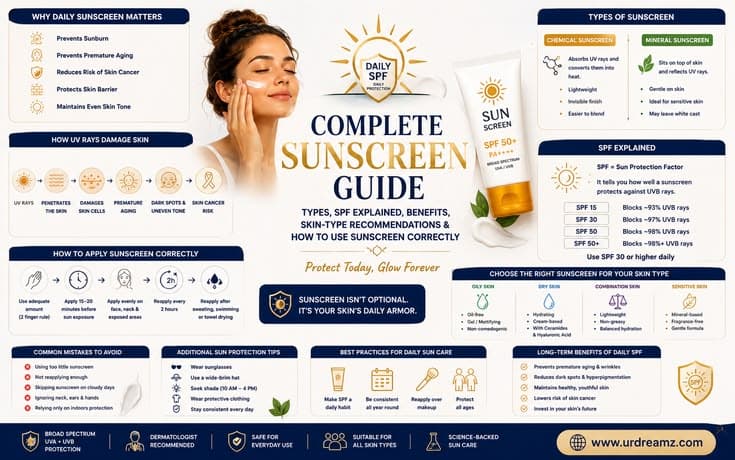
Complete Sunscreen Guide: Types, SPF Explained, Benefits, Skin-Type Recommendations and How to Use Sunscreen Correctly
Sunscreen is the most consistently recommended product across dermatology, and yet the gap between knowing it matters and actually understanding why, which one to use, and how to apply it correctly is enormous for most people. This guide covers everything — from how UV radiation damages the skin to what SPF numbers actually mean, how chemical and mineral formulas differ, which textures suit which skin types, how to apply correctly, and the connection between consistent daily sun protection and almost every other skincare goal, from anti-aging to brightening. It connects naturally with several other guides in this series including our articles on anti-aging skincare, skin brightening, acne treatment and the daily skincare routine.
1. What UV Radiation Actually Is and Why It Damages Skin
Ultraviolet radiation is a form of electromagnetic energy emitted by the sun that reaches the earth at two biologically significant wavelengths. Understanding both is important because they cause different types of damage and require protection against both to be meaningful.
UVB rays are the higher-energy, shorter-wavelength form that penetrates only the skin's outermost layer. They're responsible for sunburn, and their intensity varies significantly by season, time of day, latitude and altitude — they're strongest in summer, at midday, at higher altitudes and closer to the equator. UVB rays are also the primary driver of the cellular mutations that can eventually lead to certain types of skin cancer.
UVA rays are lower-energy but longer-wavelength, which means they penetrate far more deeply into the skin than UVB, reaching the dermis where collagen, elastin and other structural proteins live. UVA intensity remains relatively constant throughout the year and throughout the day, and crucially, it passes through clouds and glass. This means indoor UV exposure from windows contributes meaningfully to cumulative photoaging even for people who never deliberately sunbathe. UVA is the primary driver of premature aging — wrinkles, sagging, loss of firmness and uneven pigmentation — rather than sunburn specifically.
2. What Broad Spectrum Means and Why It Matters
A sunscreen labeled "broad spectrum" offers protection against both UVA and UVB radiation. A product that specifies only an SPF number without the "broad spectrum" label provides meaningful UVB protection but may offer far less UVA coverage, which is why it's the first thing worth checking on any sunscreen label. The PA rating system, used widely in Asian skincare markets, also indicates UVA protection specifically — PA+ indicates some protection, going up to PA++++ for the highest level of UVA defense currently used on product labels.
| UV Type | Penetration Depth | Main Damage | Varies By Season? |
|---|---|---|---|
| UVB | Epidermis (outer layer) | Sunburn, DNA damage, skin cancer risk | Yes — much stronger in summer |
| UVA | Dermis (deeper layer) | Collagen breakdown, wrinkles, pigmentation | No — relatively consistent year-round |
3. What SPF Actually Means
Sun Protection Factor measures how much longer protected skin takes to develop a sunburn compared to unprotected skin when exposed to the same UV source under controlled conditions. An SPF 30 sunscreen theoretically allows someone to stay in the sun thirty times longer than they would without protection before experiencing the same degree of UVB-triggered redness. In practical terms, the more meaningful number is the percentage of UVB rays blocked by each level.
| SPF Rating | Approximate UVB Protection |
|---|---|
| SPF 15 | 93% |
| SPF 30 | 97% |
| SPF 40 | 97.5% |
| SPF 50 | 98% |
| SPF 50+ | 98% or slightly above |
| SPF 100 | Approximately 99% |
The practical difference between SPF 30 and SPF 50 is about one percentage point of additional UVB protection, which is meaningful in extended outdoor exposure or for very sensitive skin, but less consequential for typical daily indoor-to-outdoor use. What matters far more than choosing between SPF 30 and SPF 50 is whether the sunscreen is actually applied in sufficient quantity and reapplied when needed — poor application at SPF 50 delivers less real-world protection than proper application at SPF 30.
4. The Six Core Benefits of Daily Sunscreen Use
| Benefit | Mechanism |
|---|---|
| Prevents sunburn | Absorbs or reflects UVB rays before they reach and damage skin cells |
| Prevents premature aging | Blocks UVA rays that break down collagen and elastin, causing wrinkles and sagging |
| Prevents dark spots and uneven tone | Stops UV-triggered melanin overproduction that causes pigmentation and tanning |
| Reduces skin cancer risk | Limits cumulative DNA damage in skin cells that can lead to malignant changes over time |
| Maintains even, healthy skin tone | Prevents the ongoing pigmentation that disrupts color uniformity across the face |
| Protects active skincare investments | Prevents UV from undoing the effects of retinol, vitamin C and brightening ingredients applied beneath it |
5. Why Sunscreen Works Outdoors AND Indoors
One of the most underappreciated aspects of daily sunscreen use is that UVA rays — the ones responsible for photoaging rather than sunburn — penetrate glass. Someone sitting near a window in an office, in a car, or at home is receiving UVA exposure even though no sunburn results. Over years, this cumulative exposure adds meaningfully to the structural aging of the skin. This is the reason dermatologists recommend daily sunscreen as a year-round, all-weather habit rather than a beach-day or sunny-day-only step.
6. Chemical Sunscreen: How It Works
Chemical sunscreens, also called organic sunscreens in some labeling systems, work by absorbing UV radiation and converting it into heat, which then dissipates from the skin. Common active ingredients in this category include avobenzone, oxybenzone, octinoxate, homosalate and octisalate, and most modern sunscreens use a combination of these rather than a single agent, since no single compound covers the full UV spectrum alone.
Chemical sunscreens tend to be lighter in texture, more cosmetically elegant and less likely to leave a white cast on the skin compared to mineral alternatives, which makes them more popular for everyday use under makeup and across a wider range of skin tones. They do require ten to fifteen minutes after application before they're fully effective, since they need to interact with the skin's surface before UV exposure begins. Some people with sensitive or reactive skin find certain chemical UV filters irritating, particularly oxybenzone, which has a history of sensitization in some individuals.
7. Mineral Sunscreen: How It Works
Mineral sunscreens, also called physical or inorganic sunscreens, use zinc oxide, titanium dioxide or a combination of both as active ingredients. Unlike chemical filters, they work by sitting on the skin's surface and physically reflecting UV rays away rather than absorbing them. They become effective immediately on application and are generally considered gentler and less irritating than chemical alternatives, which is why mineral formulas are the standard recommendation for babies, pregnant women, people with rosacea and those with very sensitive or reactive skin types.
The historical downside of mineral sunscreens was the white cast — zinc oxide and titanium dioxide are naturally white, and older formulations left a clearly visible film that was unflattering and difficult to blend particularly on medium to deeper skin tones. Modern mineral formulas have significantly improved with micronized particles and tinted options that reduce this effect considerably, though some degree of white cast remains more likely with mineral formulas than with chemical ones.
8. Chemical vs Mineral Sunscreen: A Direct Comparison
| Feature | Chemical Sunscreen | Mineral Sunscreen |
|---|---|---|
| How it works | Absorbs UV and converts to heat | Reflects UV rays off the skin surface |
| Texture | Usually lighter, more invisible | Historically thicker; modern options improved |
| White cast | Typically none or minimal | Can be present, especially on darker skin |
| Time before effective | 15-20 minutes after application | Immediately effective |
| Skin sensitivity suitability | Some filters irritate sensitive skin | Generally gentler and better tolerated |
| Best suited for | Everyday wear, darker skin tones, under makeup | Sensitive, reactive skin; babies; pregnancy |
9. Sunscreen Textures and What They Mean
Beyond the chemical-versus-mineral distinction, sunscreen formulas also vary enormously in texture, and choosing a texture that actually suits your skin type is often the difference between a product that becomes a daily habit and one that stays in the drawer.
| Texture | Feel on Skin | Best Suited For |
|---|---|---|
| Gel or aqua gel | Lightweight, watery, quick-absorbing | Oily and acne-prone skin |
| Fluid or lightweight lotion | Thin consistency, blends easily | Normal to combination skin |
| Cream | Richer, more emollient | Dry and mature skin |
| Jello or watery essence | Transparent, very light, refreshing | Oily skin in hot and humid conditions |
| Stick | Solid, easy to carry and reapply | On-the-go reapplication, targeted spots |
| Spray | Fine mist, convenient but harder to cover evenly | Reapplication over makeup, body use |
10. Sunscreen for Oily and Acne-Prone Skin
Oily and acne-prone skin types historically avoided sunscreen or wore it reluctantly because heavier, poorly formulated sunscreens genuinely did worsen congestion and shine. Modern gel, aqua gel and fluid formulations designed for oily skin are both non-comedogenic and mattifying, providing full protection without adding to shine, clogging pores or triggering breakouts. Key things to look for on a sunscreen label when shopping for oily or acne-prone skin include oil-free formulation, non-comedogenic certification, matte or dry-touch finish, and lightweight gel or aqua texture. Niacinamide as an added ingredient is a particularly useful bonus in sunscreens for this skin type, since it simultaneously helps regulate oil production.
| What to Look For | What to Avoid |
|---|---|
| Oil-free and non-comedogenic | Heavy creams and lotions |
| Matte or dry-touch finish | Oils or occlusive ingredients in the formula |
| Gel or aqua gel texture | Thick, white-cast mineral formulas |
| SPF 50 broad spectrum PA++++ | Low-SPF products that need excessive layering |
11. Sunscreen for Dry Skin
Dry skin benefits from sunscreens that combine UV protection with meaningful hydration rather than a separate moisturizer and sunscreen applied in sequence. Ingredients like hyaluronic acid, glycerin, squalane, ceramides and panthenol in a sunscreen formula provide the moisture that dry skin needs throughout the day without requiring additional product layering. Cream textures with a dewy rather than matte finish tend to suit dry skin, as matte formulas can exaggerate the look of dry patches and make the skin appear dull. A slightly richer formula also tends to feel more comfortable on skin that already tends toward tightness.
12. Sunscreen for Combination Skin
Combination skin — typically oilier in the T-zone and drier on the cheeks and around the eyes — benefits from a balanced, medium-weight formulation that doesn't under-moisturize the drier areas while still avoiding congestion in the oilier areas. A light lotion or cream-gel hybrid tends to hit this balance well. Some people with combination skin use a gel sunscreen on the T-zone and a slightly richer formula on drier cheeks, which takes a little more effort but produces a more comfortable result throughout the day.
13. Sunscreen for Sensitive Skin
Sensitive skin has a relatively simple guiding principle for sunscreen selection: mineral over chemical, and fragrance-free over scented. Zinc oxide and titanium dioxide are inherently gentler than chemical UV filters, and fragrances are one of the most common causes of contact sensitization in skincare products generally. Alcohol-free formulas are also preferable since alcohol can be drying and irritating for reactive skin. Centella asiatica, aloe vera and allantoin are commonly added to sunscreens targeting sensitive skin for their calming, barrier-supporting properties. A tinted mineral sunscreen that addresses white cast concerns while remaining gentle is often the ideal choice for this skin type.
14. Sunscreen for Darker Skin Tones
A persistent misconception is that darker skin tones don't need sunscreen, sometimes supported by the logic that higher melanin content provides more natural UV protection. While darker skin does have a higher natural SPF equivalent due to melanin, it still sustains significant UV damage including photoaging, hyperpigmentation and skin cancer risk, even if sunburn happens less easily. Post-inflammatory hyperpigmentation — the darkening that follows almost any skin trauma including acne — is also particularly pronounced in darker skin tones, and UV exposure significantly worsens and prolongs this discoloration.
White cast has historically been the practical barrier to sunscreen use for deeper skin tones, since many mineral formulas left a clearly visible greyish or white film. Modern chemical formulas, tinted mineral options, and improved micronized zinc formulations have significantly reduced this problem, making daily sunscreen use more accessible across all skin tones than it was even a decade ago.
15. Understanding PA Ratings
The PA rating system, developed in Japan and widely used across Asian sunscreen markets, specifically measures UVA protection strength. While SPF measures only UVB protection, the PA system fills this gap with a clear rating scale. PA+ indicates some UVA protection, PA++ indicates moderate, PA+++ indicates high, and PA++++ the highest currently in use on commercial products. For daily wear in most conditions, PA+++ or PA++++ combined with SPF 30 or above provides comprehensive broad-spectrum protection. For extended outdoor exposure, PA++++ with SPF 50+ is the more robust choice.
16. Sunscreen as the Most Important Anti-Aging Product
Research into what causes the majority of visible skin aging consistently points toward UV exposure — not genetics or time alone — as the largest single external contributor to wrinkles, loss of firmness, uneven pigmentation and textural change. One often-cited study following identical twins over decades found that the twin who used sun protection consistently showed significantly less visible aging than the sibling who didn't, even when all other lifestyle factors were similar. This positions sunscreen not just as a cancer-prevention tool but as the cornerstone of any anti-aging routine, more effective at preventing photoaging than any serum or treatment applied beneath it. The related anti-aging guide covers collagen-supporting ingredients and routines that complement this UV protection foundation.
17. Sunscreen and Brightening: Protecting Your Investment
Every brightening ingredient — vitamin C, alpha arbutin, kojic acid, niacinamide, azelaic acid — works by either reducing existing pigmentation or preventing new melanin production. But UV exposure continuously triggers new melanin production at a pace that outstrips what any of these ingredients can address. A brightening routine without daily sunscreen is essentially a routine that spends its effort on existing marks while new ones continuously form in the same place. Sunscreen is what allows brightening ingredients to make lasting progress rather than simply maintaining a status quo against ongoing UV-driven darkening. The full brightening approach is covered in the skin brightening guide.
18. Sunscreen and Acne-Prone Skin: Completing the Routine
Several of the most effective acne-fighting ingredients, including retinol, adapalene, AHAs and BHAs, increase the skin's photosensitivity and make it more vulnerable to UV damage. Wearing sunscreen over these actives is not optional — it's what makes it safe to use them consistently without incurring additional sun damage alongside any acne benefit. Acne-prone skin choosing non-comedogenic sunscreen and completing its full routine with SPF is a significantly more complete approach than using actives without it. The acne treatment guide covers this and other aspects of a complete acne care routine.
19. Sunscreen and Hair: Protecting Scalp and Hairline
The scalp and hairline are sun-exposed areas that frequently go unprotected, and scalp skin cancers, though less discussed, are a genuine concern. Hair provides some protection for the scalp in areas of decent coverage, but the parting and hairline receive direct UV exposure. A UV-protecting hair spray or scalp mist, a wide-brimmed hat, or careful application of sunscreen along the parting and hairline are all practical approaches for people who spend significant time outdoors. This connects to the broader hair care advice in the hair growth guide and hair fall treatment guide, where scalp health is also discussed.
20. How to Apply Sunscreen Correctly: The Details That Actually Matter
The application amount used by most people is dramatically less than the amount used in the controlled conditions that determine SPF ratings. Testing for SPF certification applies 2 milligrams of product per square centimeter of skin, which translates to approximately half a teaspoon for the face and neck combined — substantially more than the thin film most people actually apply. A practical shorthand that many dermatologists use is the "two-finger rule": sunscreen applied along the length of the index and middle fingers together provides roughly the right amount for the face and neck.
| Application Step | Correct Practice |
|---|---|
| Amount | Two fingers' worth for face and neck combined — more than most people use |
| Timing (chemical sunscreen) | Apply 15-20 minutes before sun exposure to allow the filters to activate |
| Timing (mineral sunscreen) | Effective immediately upon application |
| Coverage | Face, ears, neck, back of hands, any exposed skin |
| Layering | Final step in skincare routine, before makeup if worn |
| Reapplication | Every two to three hours during outdoor exposure; after swimming or sweating |
21. Reapplying Sunscreen Over Makeup
Reapplication is where many people's sun protection effectively ends, because reapplying a liquid sunscreen over a full face of makeup simply isn't practical without disturbing it. Several options exist for this scenario: setting sprays with SPF, powder sunscreens that can be applied over makeup with a brush, sunscreen cushion compacts designed for reapplication, and sunscreen sticks that can be pressed rather than rubbed. None of these are as reliable as a complete fresh application of full sunscreen, but they provide meaningfully more protection than no reapplication at all.
22. Does Sunscreen in Moisturizer or Makeup Replace a Dedicated Sunscreen?
Moisturizers and foundations with SPF labeling provide some UV protection but generally don't deliver the same coverage as a dedicated sunscreen applied in the correct amount and technique. The amount of moisturizer or foundation used on the face in typical makeup application is far less than the amount needed to achieve the stated SPF rating. This doesn't make them useless — an SPF 15 in a daily moisturizer adds some defense — but counting them as a replacement for dedicated sunscreen tends to leave UV protection significantly below where the SPF number on the label implies.
23. Common Sunscreen Mistakes That Reduce Its Effectiveness
- Using too little: The most common error; most people apply less than half the amount needed to achieve the labeled SPF.
- Not reapplying: No sunscreen lasts indefinitely; two to three hours is the practical maximum for full effectiveness, shorter if sweating or swimming.
- Skipping cloudy days: UVA rays penetrate clouds; a cloudy day provides almost no additional UV protection.
- Skipping indoors: UVA passes through windows; significant indoor time near glass warrants sunscreen.
- Missing the ears, neck and hands: All three are high sun-exposure areas where skin aging and skin cancer are common, and all are frequently overlooked in application.
- Applying over makeup without checking compatibility: Some sunscreens pill or disturb certain foundations; testing before full application saves frustration.
- Assuming higher SPF numbers make infrequent application acceptable: Correct application amount and reapplication timing matter more than choosing between SPF 50 and SPF 100.
24. Sunscreen in Different Environments and Situations
| Environment or Situation | Recommendation |
|---|---|
| Everyday indoor-outdoor mix | SPF 30-50 broad spectrum applied every morning |
| Extended outdoor activities | SPF 50 broad spectrum, water-resistant, reapplied every 2 hours |
| Swimming or water sports | Water-resistant sunscreen, reapplied immediately after towel-drying |
| High altitude (skiing, mountains) | UV intensity increases significantly; SPF 50+ recommended even in cold conditions |
| Driving | UVA through the car window warrants sunscreen on exposed left or right arm and face |
| Overcast or winter days | UVA is present regardless of visible sun; daily application still recommended |
25. Sunscreen for Children
Children's skin is more sensitive and thinner than adult skin, making UV protection particularly important from an early age, both to prevent sunburn and to limit the cumulative UV exposure that contributes to skin cancer risk decades later. Mineral formulas with zinc oxide are the standard recommendation for children due to their gentler profile. Babies under six months old should ideally avoid direct sun altogether and rely on protective clothing, shade and hats rather than sunscreen, since their skin is too sensitive and porous for even mineral formulas to be used without guidance. Above six months, mineral sunscreen on exposed skin is appropriate and recommended.
26. Sunscreen and Vitamin D: Understanding the Balance
A common concern about daily sunscreen use is that it will block vitamin D synthesis, since UV radiation on the skin is the primary natural trigger for vitamin D production. In practice, the amount of unprotected sun exposure typical in daily life — hands, face and neck exposed even on a shaded walk — usually provides sufficient UV stimulus for vitamin D synthesis without deliberate unprotected sun bathing. People at genuine risk of vitamin D deficiency can address it through diet or supplementation under a doctor's guidance rather than by skipping sunscreen, which prevents a much more preventable and serious range of UV-driven harm.
27. Additional Sun Protection Beyond Sunscreen
Sunscreen is the cornerstone of UV protection but works best as part of a broader approach that makes practical sun avoidance easier and more comprehensive.
- Wide-brimmed hats: Provide shade to the face, ears, neck and scalp simultaneously without any reapplication needed.
- UV-protective sunglasses: Protect the delicate skin around the eyes from UV exposure and reduce the risk of UV-related eye conditions.
- Protective clothing: UPF-rated clothing provides consistent, non-depleting protection for covered areas that is independent of reapplication.
- Seeking shade: The most effective single avoidance measure, particularly between 10 a.m. and 4 p.m. when UV intensity is at its daily peak.
- Antioxidant-rich diet: Internal antioxidants from food provide some systemic support against oxidative damage from UV exposure alongside external protection.
28. Choosing a Sunscreen Formula: A Practical Framework
| Priority | What to Look For |
|---|---|
| Minimum protection level | SPF 30 broad spectrum PA+++ for everyday use; SPF 50 PA++++ for extended outdoor |
| Skin type fit | Gel for oily; cream for dry; light lotion or cream-gel for combination; mineral for sensitive |
| White cast tolerance | Chemical formula or modern tinted mineral if white cast is a concern |
| Wear under makeup | Fluid or primer-like finish formulas; allow full dry time before foundation |
| Value and consistency | The best sunscreen is the one used every day — texture and feel matter for adherence |
29. Sunscreen and Other Skincare Actives: Layering Correctly
Sunscreen sits as the final step in any morning skincare routine because it's designed to function at the skin's surface rather than penetrate it, and applying anything on top of it after the fact reduces its effectiveness. The standard morning layering order is cleanser, toner if used, vitamin C or other morning serum, eye cream, moisturizer, and sunscreen last. Makeup, if worn, goes over sunscreen, not between skincare steps and sunscreen. The daily skincare routine guide covers the full morning and night sequence in more detail.
30. Sunscreen Myths Worth Addressing Directly
| Myth | More Accurate Reality |
|---|---|
| Sunscreen is only for the beach or summer | UVA is present year-round and passes through clouds and glass regardless of season |
| Darker skin tones don't need sunscreen | All skin tones sustain UV damage including photoaging, pigmentation and cancer risk |
| One application in the morning is sufficient all day | UV protection depletes with time and exposure; reapplication every two to three hours is needed |
| Sunscreen clogs pores and causes breakouts | Non-comedogenic formulas for oily and acne-prone skin exist and don't worsen breakouts |
| SPF in makeup is enough on its own | Application amounts for makeup rarely match what's needed to achieve labeled SPF |
| Sunscreen blocks vitamin D production entirely | Incidental daily UV exposure plus diet or supplementation addresses vitamin D needs without sacrificing sun protection |
31. Sunscreen as a Habit, Not a Chore
The main practical obstacle to consistent sunscreen use isn't knowledge — most people know sunscreen matters — it's finding a formula that feels genuinely comfortable to use every day. A sunscreen that feels greasy, leaves a white cast, stings the eyes or pills under makeup will reliably be skipped. Trying several formulas to find one that fits the individual's skin type, finish preference and makeup compatibility is time well spent, because the best sunscreen is simply the one that actually gets applied every morning rather than the one with the theoretically ideal formulation sitting unused in a cabinet.
32. Frequently Asked Questions
Is SPF 30 or SPF 50 better for daily use?
For most daily indoor-to-outdoor routines, SPF 30 provides excellent protection when applied correctly. SPF 50 adds a small additional margin that becomes more meaningful for extended outdoor exposure, very fair skin, or people using photosensitizing active ingredients. Both are appropriate daily choices; correct application amount and regular reapplication matter more than choosing between them.
Can I use sunscreen alone without moisturizer?
Many modern sunscreens are sufficiently hydrating to function as a moisturizer replacement in warmer months or for oilier skin types. Dry skin usually benefits from a dedicated moisturizer underneath. Checking whether a sunscreen's formula meets individual hydration needs prevents dryness that can result from relying on a non-moisturizing formula as the sole hydrating step.
Does sunscreen cause vitamin D deficiency?
Not in the way most people assume. Casual daily outdoor exposure provides some UV contact regardless of sunscreen; combined with a diet that includes vitamin D sources or supplementation when genuinely deficient, the overall need is typically met without deliberately skipping sun protection.
When should sunscreen be reapplied?
Every two to three hours during active outdoor exposure, and immediately after swimming, sweating heavily or towel-drying. For primarily indoor days with limited sun exposure, a morning application typically covers the day adequately.
Is mineral or chemical sunscreen safer?
Both are considered safe for the vast majority of people. Mineral formulas are gentler and better tolerated for sensitive skin, pregnancy, babies and those with chemical filter sensitivities. Chemical formulas are more cosmetically wearable for most daily use cases. Neither category is inherently dangerous for healthy adults.
33. Final Thoughts
Sunscreen is genuinely the most impactful single skincare step for long-term skin health — not because it's the most exciting product or because the skincare industry recommends it most loudly, but because the data on UV damage as the primary driver of visible skin aging, hyperpigmentation and skin cancer risk is overwhelming and consistent. Every other skincare effort, from retinol to vitamin C to professional treatments, works better and lasts longer with consistent daily sun protection underneath it. Finding the right formula for your skin type, applying it in the correct amount, and making reapplication practical rather than inconvenient are the three practical keys that make the difference between sunscreen that theoretically protects and sunscreen that actually does.