Acne Treatment Guide: Causes, Prevention, Skincare Routine and Best Solutions for Clear Skin
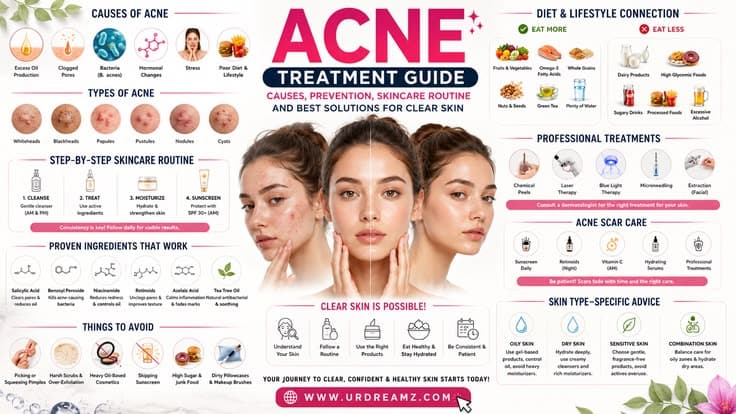
Acne is one of the most common skin concerns in the world, affecting teenagers and adults alike, and it's also one of the most over-explained yet under-understood topics in skincare. This guide breaks down what actually causes breakouts, the different forms acne can take, how to build a sensible daily routine, which ingredients genuinely earn their reputation, how diet and lifestyle connect to skin health, and what's worth knowing about scars, professional treatments and skin-type-specific care.
Almost everyone deals with some form of acne at some point, whether that means a handful of occasional breakouts or a more persistent, ongoing pattern that lasts years. The amount of conflicting advice available online — some of it genuinely useful, some of it outdated or simply wrong — makes it easy to bounce between products without ever building a routine that's actually working. This guide aims to cut through that noise with practical, evidence-grounded explanations rather than promises of an instant cure.
1. What Acne Actually Is
Acne is a skin condition that develops when hair follicles become clogged with a combination of excess oil, dead skin cells and sometimes bacteria. While the word "acne" often gets used loosely to describe any pimple, it technically refers to this broader, ongoing pattern of clogged follicles and inflammation rather than a single isolated spot.
Acne can range from a few occasional blemishes to a persistent, widespread condition affecting large areas of the face, chest or back. Severity matters quite a lot when deciding on a treatment approach, since mild, occasional breakouts often respond well to simple over-the-counter care, while more severe, inflamed or scarring-prone acne usually benefits from a more structured, sometimes medically supervised plan.
2. How a Pimple Actually Forms
Skin naturally sheds dead cells and produces oil (sebum) to keep itself moisturized. When that oil and dead skin build up faster than the pore can clear them, a plug forms inside the follicle. Bacteria that live naturally on the skin can then multiply inside that clogged space, triggering inflammation, which is what shows up on the surface as redness, swelling and the various bumps associated with acne.
3. The Main Causes of Acne at a Glance
| Cause | How It Contributes |
|---|---|
| Hormonal fluctuation | Increases oil gland activity, especially around puberty, menstruation and pregnancy |
| Excess oil production | Provides more material to clog pores |
| Dead skin cell buildup | Physically blocks the follicle opening |
| Bacterial overgrowth | Triggers inflammation inside a clogged pore |
| Genetics | Influences oil production and inflammatory tendency |
| Diet | High-glycemic and certain dairy intake may worsen breakouts in some people |
| Stress | Raises cortisol, which can increase oil production |
| Skincare or cosmetic products | Heavy, pore-clogging formulas can contribute directly |
4. Hormonal Acne Explained
Hormonal acne tends to show up around the jawline, chin and lower face, often deeper and more painful than typical surface breakouts. It's commonly linked to natural hormone shifts during the menstrual cycle, puberty, pregnancy, or conditions like polycystic ovary syndrome, all of which can increase androgen activity and, in turn, oil production. Because the root cause sits below the skin's surface, hormonal acne often responds more slowly to topical treatment alone and sometimes benefits from a combined approach involving a doctor's input.
5. Diet-Related Acne Triggers
Diet doesn't cause acne on its own for everyone, but for some people, certain foods do appear to make breakouts more frequent or severe. High-glycemic foods that spike blood sugar quickly, and dairy in some sensitive individuals, are the two most consistently discussed dietary triggers in research and clinical observation, though the effect varies considerably from person to person.
6. Stress and Breakouts
Stress doesn't directly clog pores, but it raises cortisol levels, and elevated cortisol is associated with increased oil gland activity. This is part of why breakouts often cluster around particularly demanding or anxious periods, even when skincare habits haven't changed at all.
7. The Role of Genetics
A family history of acne meaningfully raises the likelihood of experiencing it personally, largely because genetics influence both how much oil the skin produces and how the immune system responds to the bacteria involved in breakouts. This doesn't mean genetically prone skin can't improve significantly with the right routine, but it does mean some people will need to be more consistent and patient than others to see comparable results.
8. Oily Skin and Clogged Pores
Naturally oilier skin types tend to experience more frequent clogged pores simply because there's more sebum available to mix with dead skin cells inside the follicle. This doesn't mean oily skin should be aggressively stripped of oil — overly harsh cleansing often backfires by triggering even more oil production as the skin tries to compensate for what was stripped away.
9. The Main Types of Acne at a Glance
| Acne Type | What It Looks Like |
|---|---|
| Blackheads | Open clogged pores that darken from exposure to air |
| Whiteheads | Closed clogged pores that stay covered by skin |
| Papules | Small, firm, often tender red bumps without visible pus |
| Pustules | Inflamed bumps with a visible white or yellow pus center |
| Cystic acne | Deep, painful, pus-filled lumps under the skin |
| Nodular acne | Large, hard, painful lumps without a pus-filled center |
| Fungal acne | Small, itchy, uniform bumps caused by yeast rather than bacteria |
10. Blackheads in Detail
Blackheads form when a clogged pore stays open at the surface, allowing the trapped oil and dead skin to oxidize on contact with air, which is what turns the plug dark rather than skin-colored. They're generally non-inflammatory and respond well to consistent use of gentle exfoliating ingredients over time rather than physical squeezing, which often pushes material deeper instead of removing it cleanly.
11. Whiteheads in Detail
Whiteheads are essentially the closed version of the same clogged-pore process, where a thin layer of skin covers the trapped material rather than exposing it to air. Because the surface stays intact, whiteheads don't darken the way blackheads do, but they share the same underlying treatment approach: regular gentle exfoliation and pore-clearing ingredients rather than picking.
12. Papules and Pustules Compared
Papules and pustules both represent a step up in inflammation compared to blackheads and whiteheads. A papule is a small, firm, often tender bump without a visible pus center, while a pustule has progressed to the point of a clearly visible white or yellow center. Both generally respond to anti-inflammatory and antibacterial ingredients, and both are best left alone rather than squeezed, since manual pressure tends to spread inflammation into surrounding skin.
13. Cystic Acne Explained
Cystic acne develops deep beneath the skin's surface, forming large, painful, pus-filled lumps that often don't come to a visible head the way a typical pimple does. It's considered one of the more severe forms of acne, carries a higher risk of scarring, and frequently requires a dermatologist's involvement, sometimes including prescription-strength topical treatment or oral medication, rather than responding fully to over-the-counter products alone.
14. Nodular Acne Explained
Nodular acne resembles cystic acne in its depth and discomfort but tends to feel more solid and hard rather than fluid-filled. Like cystic acne, it generally benefits from professional evaluation, since the inflammation runs deep enough that surface-level treatment alone often isn't sufficient to resolve it fully or prevent scarring.
15. Fungal Acne: Not Quite the Same Condition
Fungal acne, technically a form of folliculitis caused by an overgrowth of yeast rather than the bacteria typically associated with standard acne, tends to produce small, uniform, sometimes itchy bumps, often across the forehead, chest or back. Because it has a different root cause, standard acne treatments like benzoyl peroxide often do little for it, while anti-fungal ingredients tend to work far more effectively, which is why correctly identifying which condition is present matters before choosing a treatment direction.
16. Hormonal vs Bacterial vs Inflammatory Acne
| Acne Pattern | Typical Location | Primary Driver |
|---|---|---|
| Hormonal acne | Jawline, chin, lower cheeks | Hormone-driven oil production |
| Bacterial/regular acne | Forehead, nose, upper cheeks | Excess oil and bacterial overgrowth |
| Inflammatory acne | Varies, often more widespread | Irritation and immune response within clogged pores |
17. Building a Skincare Routine That Actually Helps
A workable acne skincare routine doesn't need to be elaborate to be effective — in fact, overly complicated routines with too many active ingredients often do more harm than good by irritating the skin barrier. A simple, consistent structure repeated daily tends to outperform an inconsistent, ever-changing one almost every time.
18. A Simple Morning Routine
| Step | Purpose |
|---|---|
| Gentle cleanser | Removes overnight oil buildup without stripping the skin |
| Treatment serum (if used) | Targets active concerns like oil control or redness |
| Lightweight, oil-free moisturizer | Maintains hydration without clogging pores |
| Broad-spectrum sunscreen | Protects against UV damage and helps prevent dark marks from worsening |
19. A Simple Night Routine
| Step | Purpose |
|---|---|
| Cleanser (or double cleanse if wearing makeup/sunscreen) | Removes the day's buildup thoroughly |
| Acne treatment ingredient | Targets clogged pores, oil or bacteria overnight |
| Moisturizer | Supports the skin barrier while active ingredients work |
20. Why Double Cleansing Helps Some People
Double cleansing involves an oil-based cleanser first to dissolve sunscreen, makeup and excess sebum, followed by a water-based cleanser to remove any remaining residue and impurities. For people who wear heavier makeup or sunscreen daily, this two-step approach tends to leave skin genuinely cleaner than a single quick wash, which can translate into fewer clogged pores over time.
21. Protecting the Skin Barrier While Treating Acne
It's a common and understandable instinct to treat acne aggressively, but a damaged skin barrier — often caused by over-cleansing, over-exfoliating, or stacking too many active ingredients at once — frequently makes acne worse rather than better. Signs of barrier damage include persistent tightness, stinging after applying products, increased sensitivity, and skin that takes longer than usual to heal. Scaling back to a simpler routine and reintroducing actives slowly tends to resolve this far more effectively than pushing through.
22. The Acne-Fighting Ingredients Worth Knowing
| Ingredient | Main Benefit | Best Suited For |
|---|---|---|
| Salicylic acid | Exfoliates inside the pore, reduces blackheads | Oily, blackhead-prone skin |
| Benzoyl peroxide | Targets acne-causing bacteria | Active, inflamed breakouts |
| Niacinamide | Calms redness, regulates oil, supports the barrier | Most skin types, including sensitive |
| Retinoids (retinol/adapalene) | Speeds cell turnover, prevents clogged pores | General acne prevention and texture |
| Azelaic acid | Reduces inflammation and fades post-acne marks | Sensitive or reactive skin |
| Tea tree oil | Natural antibacterial properties | Mild, occasional breakouts |
| Hyaluronic acid | Hydrates without adding oil | All skin types needing moisture |
| Ceramides | Rebuilds and supports the skin barrier | Irritated or barrier-compromised skin |
23. Salicylic Acid in Practice
Salicylic acid is oil-soluble, which allows it to penetrate into the pore itself rather than just sitting on the surface, making it particularly effective against blackheads and oily-skin congestion. It's commonly found in cleansers, toners and spot treatments, and starting with a lower concentration a few times a week, rather than daily from the outset, helps the skin adjust without excessive dryness.
24. Benzoyl Peroxide in Practice
Benzoyl peroxide works by directly reducing the bacteria associated with acne, making it especially useful for active, inflamed breakouts rather than purely blackhead-type congestion. It can be drying and occasionally bleaches fabric, so applying it carefully and pairing it with a good moisturizer tends to make it far more tolerable over the long run.
25. Niacinamide in Practice
Niacinamide has earned a broad reputation in skincare because it's genuinely gentle enough for most skin types while still meaningfully calming redness and helping regulate excess oil. It pairs well with most other acne-fighting ingredients and is often a sensible starting point for anyone newer to active ingredients in general.
26. Retinol and Adapalene in Practice
Retinoids speed up skin cell turnover, which helps prevent dead cells from building up and clogging pores in the first place, making them more of a long-term prevention tool than a fast spot treatment. Adapalene, available over the counter in many regions, is a gentler entry point into this ingredient family, while prescription-strength retinoids offer a stronger effect under medical guidance. Both typically require several weeks of consistent use before meaningful improvement appears.
27. Azelaic Acid in Practice
Azelaic acid offers a milder alternative to some other actives, with the added benefit of fading post-acne dark marks alongside its anti-inflammatory effect, which makes it a popular choice for people dealing with both active breakouts and lingering discoloration at the same time.
28. Tea Tree Oil in Practice
Tea tree oil has a long history of use as a natural antiseptic, and some research supports a modest antibacterial effect against acne-causing bacteria specifically. It's generally best diluted before applying directly to skin, since the undiluted oil can be irritating, and it tends to work best for milder, more occasional breakouts rather than as a primary treatment for more severe acne.
29. Hyaluronic Acid and Ceramides: The Hydration Side of Acne Care
It's a persistent myth that acne-prone skin doesn't need moisturizer — in reality, skipping hydration often backfires by signaling the skin to produce even more oil to compensate. Hyaluronic acid draws water into the skin without adding oil, while ceramides help reinforce the skin's natural barrier, and both pair well with active acne ingredients rather than working against them.
30. Diet and Clear Skin: What Tends to Help
| Food Category | Why It's Often Recommended |
|---|---|
| Leafy greens | Provide vitamins linked to skin repair and reduced inflammation |
| Berries | High in antioxidants that may help counter oxidative skin stress |
| Fatty fish (salmon, sardines) | Omega-3 content associated with reduced inflammation |
| Nuts and seeds | Provide zinc and healthy fats relevant to skin health |
| Probiotic foods (yogurt, kefir) | Support gut health, which has some connection to skin condition |
| Water-rich foods and adequate hydration | Support overall skin function and resilience |
31. Foods Often Linked to More Frequent Breakouts
Highly processed, high-sugar foods, sugary drinks, and in some people dairy, particularly skim milk, show up repeatedly in research and clinical observation as potential acne triggers. None of these need to be eliminated entirely for everyone, but noticing whether breakouts cluster around periods of higher intake of these foods can be a useful, low-cost piece of personal data.
32. Hydration, Sleep and Lifestyle Factors
Beyond specific foods, broader lifestyle patterns play a meaningful supporting role in skin health. Adequate hydration supports normal skin barrier function, consistent sleep supports the body's overnight repair processes, and regular movement supports circulation and stress regulation, all of which indirectly influence how skin behaves over time even though none of them act as a direct acne treatment on their own.
33. Habits That Quietly Make Acne Worse
- Popping or picking pimples: Often pushes bacteria deeper and increases the likelihood of lasting marks or scars.
- Over-washing or harsh scrubbing: Strips natural oils and can trigger a rebound increase in oil production.
- Sleeping in makeup: Leaves pore-clogging residue on the skin overnight.
- Touching the face frequently: Transfers bacteria and oil from hands directly onto skin.
- Dirty pillowcases and phone screens: Accumulate oil and bacteria that transfer back onto the face repeatedly.
- Stacking too many active ingredients at once: Often irritates the skin barrier rather than accelerating results.
34. Over-the-Counter vs Prescription Treatment
Mild to moderate acne often responds well to consistent over-the-counter products containing salicylic acid, benzoyl peroxide or adapalene. More persistent, painful or scarring-prone acne, particularly cystic or nodular types, often calls for a dermatologist's involvement, which might include prescription-strength topical retinoids, oral antibiotics, hormonal treatment, or in more severe cases isotretinoin, taken under close medical supervision due to its potential side effects.
| Severity Level | Common First-Line Approach |
|---|---|
| Mild | Consistent gentle skincare with salicylic acid or benzoyl peroxide |
| Moderate | Adding a retinoid or seeking a dermatologist consult if not improving |
| Severe, cystic or scarring | Dermatologist-guided prescription treatment, sometimes including oral medication |
35. Professional and In-Clinic Treatments
For acne that doesn't respond sufficiently to home care, dermatologists and skin clinics offer several in-office options. Chemical peels use acids to encourage faster skin turnover and reduce both active breakouts and surface discoloration. Microneedling creates controlled micro-injuries that stimulate collagen production, often used for textural scarring. Laser treatments target either inflammation or scarring depending on the specific device and settings used. These procedures generally work best as a complement to a solid home routine rather than a replacement for one.
36. Acne Marks vs Acne Scars
Acne marks, often a flat, discolored patch left behind after a pimple heals, tend to fade gradually on their own over weeks to months, sometimes helped along by ingredients like azelaic acid or vitamin C. Acne scars, by contrast, involve actual changes to the skin's texture — depressed, pitted or raised areas — caused by damage to the deeper collagen structure, and these typically require more active intervention like microneedling, certain lasers, or other dermatological procedures to meaningfully improve.
37. Skin-Type Specific Acne Care
| Skin Type | Care Priority |
|---|---|
| Oily skin | Lightweight, oil-free products; salicylic acid or niacinamide |
| Dry skin | Gentle cleansing, richer moisturizer, milder actives introduced slowly |
| Combination skin | Targeted treatment on oilier areas, lighter hydration elsewhere |
| Sensitive skin | Fragrance-free, minimal-ingredient products, patch testing before new actives |
38. Acne Across Different Life Stages
Teenage acne is often closely tied to puberty-driven hormone surges and tends to respond well to a consistent basic routine alongside patience, since hormone-driven oil production naturally settles somewhat with age. Adult acne, increasingly common particularly among women, often clusters around the jawline and is more frequently linked to ongoing hormonal patterns, stress, or specific skincare and cosmetic choices. Pregnancy acne deserves particular caution, since several common acne ingredients, including retinoids and certain oral medications, aren't considered safe during pregnancy, making it especially important to consult a doctor before starting or continuing any treatment during this time. Men's skin tends to be somewhat oilier on average due to testosterone's effect on oil glands, which can mean slightly more emphasis on oil control within an otherwise similar routine.
39a. Natural and Home Remedies Worth Knowing About
Alongside formal skincare ingredients, several home-based approaches have a long tradition of use for mild acne, though they generally work best as gentle supporting measures rather than primary treatment for more serious breakouts. Honey has natural antibacterial properties and is sometimes used in homemade cleansers. Diluted apple cider vinegar is occasionally used as a toner, though it should be used cautiously given its acidity and potential to irritate sensitive skin. Aloe vera is widely used to soothe inflamed, irritated skin alongside other treatments. Oatmeal-based masks can help calm redness and gently absorb excess oil without being overly drying.
One often-overlooked home remedy is simply consistent gentle care rather than any single special ingredient: a basic cleanse, tone and moisturize routine performed reliably twice a day tends to outperform sporadic use of even the most highly recommended natural ingredient. Patience also plays a bigger role with natural remedies than with pharmaceutical-grade ingredients, since their effects tend to be milder and slower to show results.
| Natural Remedy | Traditional Use | Best Suited For |
|---|---|---|
| Honey | Mild antibacterial cleansing | Gentle daily cleansing routines |
| Diluted apple cider vinegar | Toning, pH balancing | Occasional use, patch-tested first |
| Aloe vera | Soothing irritated or inflamed skin | Calming redness alongside other treatment |
| Oatmeal mask | Gentle exfoliation and oil absorption | Sensitive or easily irritated skin |
| Tea tree oil (diluted) | Mild antibacterial spot treatment | Occasional, milder breakouts |
39b. A Practical Daily Acne Prevention Checklist
Pulling together the various pieces of advice throughout this guide into a single daily checklist tends to make the overall approach easier to actually follow, rather than treating each tip as a separate, disconnected rule.
- Cleanse gently twice a day rather than scrubbing aggressively or washing excessively.
- Use non-comedogenic, oil-free products for moisturizer, sunscreen and makeup.
- Apply sunscreen every single morning, regardless of weather or season.
- Avoid touching the face throughout the day and resist the urge to pick at blemishes.
- Change pillowcases regularly and keep phone screens reasonably clean.
- Stay hydrated and aim for consistent, adequate sleep most nights.
- Pay attention to how skin responds to specific foods, without assuming any single food is universally problematic.
- Introduce new active ingredients one at a time, giving each several weeks before judging its effect.
- Myth: Washing your face more often clears acne faster. Over-washing typically irritates skin and can worsen breakouts rather than help.
- Myth: Acne only affects oily skin. Dry and sensitive skin types can experience breakouts too, often related to barrier issues rather than excess oil.
- Myth: Popping a pimple helps it heal faster. It typically increases inflammation and the risk of lasting marks or scars.
- Myth: Expensive products always work better. Ingredient choice and consistency matter far more than price point.
- Myth: Sun exposure clears up acne. Any short-term drying effect is often outweighed by long-term sun damage and worsened post-acne discoloration.
- Myth: Acne is purely a teenage problem. Adult acne is genuinely common and often has different underlying drivers than teenage breakouts.
40. Frequently Asked Questions
What is generally considered the main cause of acne?
Acne develops from a combination of excess oil, dead skin cell buildup and bacterial activity inside clogged pores, often influenced further by hormones, genetics, diet and stress.
How can I prevent acne naturally?
Gentle, consistent cleansing, non-comedogenic products, daily sunscreen, adequate hydration, reasonable sleep, and avoiding habits like face-touching and pimple-popping all support fewer breakouts over time.
Which acne treatment tends to work fastest?
Benzoyl peroxide often produces the quickest visible reduction in active, inflamed breakouts, though long-term prevention usually benefits more from consistent use of ingredients like salicylic acid or retinoids over weeks.
Is acne caused by dirty skin?
Not directly — acne is primarily driven by oil, dead skin cells and hormonal factors rather than simple dirtiness, although good hygiene habits like clean pillowcases and avoiding face-touching still help.
Can acne scars be removed completely?
Significant improvement is often achievable with treatments like microneedling, chemical peels or laser therapy, though complete, scar-free results aren't guaranteed and depend heavily on scar depth and skin type.
When should I see a dermatologist for acne?
If breakouts are painful, cystic, leaving noticeable scarring, or simply not responding to a consistent over-the-counter routine after a couple of months, a dermatologist consultation is generally worthwhile.
41. Final Thoughts
Clearer skin almost never comes from a single miracle ingredient or an overnight fix — it tends to come from a simple, consistent routine built around genuinely effective ingredients, reasonable attention to diet and lifestyle, and the patience to give any new approach several weeks before judging whether it's working. Acne is also, for most people, a manageable condition rather than a permanent state, and what works well during one life stage may need adjusting during another as hormones, stress levels and skin needs shift over time. Whatever combination of products, habits and professional support ends up working for your particular skin, treating it with patience and consistency tends to matter more than any single product choice ever could.