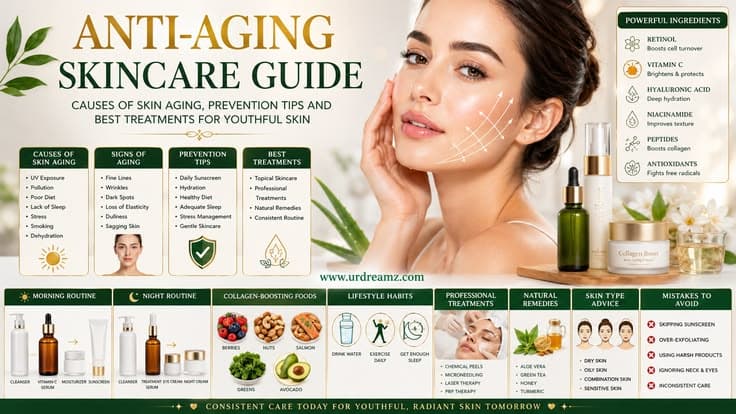
Anti-Aging Skincare Guide: Causes of Skin Aging, Prevention Tips and Best Treatments for Youthful Skin
Skin aging is inevitable in the biological sense, but how quickly or noticeably it shows up is influenced enormously by the choices made day to day — the sunscreen worn or skipped, the sleep prioritized or ignored, the skincare ingredients used consistently or changed every week. This guide covers everything from the science behind why skin ages to the practical ingredients, routines, foods and lifestyle habits that genuinely help, alongside a clear-eyed look at professional treatments and the mistakes worth avoiding.
1. What Skin Aging Actually Is
Skin aging is a gradual process driven by two broad categories of influence: intrinsic aging, which is the natural biological clock — the steady decline in collagen production, slower cell turnover, and reduced oil gland activity that happens regardless of how well a person takes care of their skin — and extrinsic aging, which is caused by everything from outside the body, primarily ultraviolet radiation, pollution, smoking, poor diet, and chronic stress. Understanding both categories matters because while intrinsic aging can be slowed and supported but not stopped, extrinsic aging is far more controllable and often accounts for a significant share of what most people think of as "looking older than they should."
2. What Collagen Has to Do With It
Collagen is the structural protein that gives skin its firmness, plumpness and ability to spring back when pressed. The body produces it naturally and continuously, but at somewhere around the late twenties that production rate begins declining — roughly one percent per year in most people — and continues declining throughout life. Less collagen means thinner, less firm skin that creases more easily and takes longer to recover its shape. Supporting collagen production, through both skincare ingredients and diet, is one of the most direct ways to slow the visible effects of this decline.
3. Elastin: The Other Structural Protein That Matters
Elastin works alongside collagen to give skin its bounce and resilience. When elastin is abundant and functioning well, skin snaps back after being stretched or pressed. When it degrades — accelerated significantly by UV exposure — skin stays creased longer and begins to sag rather than holding its position. Unlike collagen, which can be somewhat supported through diet and certain skincare ingredients, elastin is more difficult to rebuild once it's been significantly degraded, which is part of why consistent sun protection from an early age makes such a meaningful long-term difference.
4. The Main Visible Signs of Aging Skin
| Sign | What Causes It |
|---|---|
| Fine lines and wrinkles | Collagen and elastin decline combined with repeated facial expressions |
| Crow's feet | Expression lines around the eyes, thin skin, and UV exposure |
| Forehead wrinkles | Repeated movement and gradual loss of skin volume |
| Smile lines (nasolabial folds) | Volume loss and skin loosening around the cheeks |
| Sagging skin | Loss of collagen, fat and bone density beneath the skin |
| Age spots | Cumulative UV exposure triggering excess pigment production |
| Dull, uneven skin tone | Slower cell turnover, reduced circulation, and sun damage |
| Loss of firmness | Declining collagen and elastin alongside reduced skin thickness |
5. Sun Damage: The Single Biggest External Cause of Aging
Ultraviolet radiation is responsible for a disproportionate share of visible skin aging, a process called photoaging, and it accumulates over a lifetime rather than in single dramatic events. Both UVB rays, which cause sunburn, and UVA rays, which penetrate more deeply and cause structural damage to collagen and elastin, contribute to photoaging. Daily broad-spectrum sunscreen use, even on cloudy days and even when most of the day is spent indoors near windows, is consistently the most cost-effective single anti-aging step available.
6. How Smoking Accelerates Skin Aging
Smoking restricts blood flow to the skin's surface, reduces the delivery of oxygen and nutrients, generates free radicals that damage collagen directly, and depletes vitamin C — a nutrient critical to the body's collagen production process. The result tends to show up as noticeably duller, more leathery skin with deeper wrinkles, particularly around the mouth, often appearing significantly earlier than in non-smokers with otherwise similar genetics and lifestyle habits.
7. Stress and Cortisol's Effect on Skin
Chronic stress keeps cortisol levels elevated for extended periods, and prolonged high cortisol breaks down collagen, impairs the skin barrier, increases inflammation, and can disrupt sleep quality — all of which accelerate visible aging. Managing stress isn't just good for mental wellbeing; it has a measurable, if indirect, effect on how quickly the skin ages at the structural level.
8. Poor Sleep and Skin Aging
The skin carries out its most intensive repair and regeneration work during sleep, including collagen synthesis and cell turnover. Consistently poor or insufficient sleep interrupts this process, contributing to a duller complexion, more visible dark circles, and over time a reduced ability to repair daily damage effectively. The phrase "beauty sleep" reflects something genuinely biological rather than merely a pleasantry.
9. Dehydration and Skin Appearance
Chronically dehydrated skin looks more creased and dull than well-hydrated skin, partly because water plumps individual skin cells and supports the naturally occurring cushioning between skin layers. While drinking more water alone won't erase wrinkles, consistent hydration supports the basic function of every skin cell and makes the skin more resilient and smoother in texture over time, particularly when paired with appropriate topical hydration.
10. Pollution and Environmental Damage
Airborne pollutants, particularly particulate matter and ozone, generate oxidative stress in the skin on contact, triggering inflammation and accelerating collagen breakdown in exposed areas over years of cumulative exposure. Antioxidant-rich serums applied before daily outdoor exposure provide a meaningful layer of defense against this environmental damage.
11. Diet's Connection to Skin Aging
Excess sugar in the diet contributes to a process called glycation, where sugar molecules attach to collagen fibers and make them stiffer and less functional — a process that effectively accelerates the structural aging of skin from the inside. A diet heavy in processed foods, refined carbohydrates and added sugars consistently appears in research as an aggravating factor for visible aging, while diets rich in antioxidants, healthy fats and lean protein tend to be associated with better skin resilience.
12. The Five Most Proven Anti-Aging Skincare Ingredients
| Ingredient | Primary Benefit | Key Usage Notes |
|---|---|---|
| Retinol | Speeds cell turnover, stimulates collagen, reduces fine lines | Start low and slow; apply at night; always pair with SPF |
| Vitamin C | Antioxidant protection, collagen synthesis, brightening | Use in the morning before SPF; store carefully as it oxidizes |
| Hyaluronic acid | Deep hydration, plumping effect on fine lines | Apply to damp skin; layer moisturizer on top to seal it in |
| Peptides | Signal skin to produce more collagen; improve firmness | Gentle enough for daily use; pairs well with other ingredients |
| Niacinamide | Strengthens barrier, evens tone, minimizes pores | Broadly compatible with most ingredients; suits all skin types |
13. Retinol Explained in Detail
Retinol is a form of vitamin A that works by increasing the speed at which skin cells cycle through from deep layers to the surface, which over time smooths texture, reduces fine lines and stimulates deeper collagen production. It's one of the most researched and consistently validated anti-aging ingredients available without a prescription. The main reason it's not universally loved from day one is that introducing it too quickly tends to cause redness, flaking and sensitivity, which is why dermatologists almost universally recommend starting with a lower concentration a few times a week and building gradually over months rather than using it nightly from the start.
14. Retinal vs Retinol
Retinal, also called retinaldehyde, sits one conversion step closer to the biologically active form of vitamin A than retinol does, which means it tends to work more efficiently and at lower concentrations while generally causing less irritation than retinol at equivalent percentages. It remains a slightly less commonly discussed ingredient simply because it's less widely available than retinol, but it deserves consideration as an option, particularly for people who found retinol too irritating even at lower starting doses.
15. Vitamin C Serum Explained
Vitamin C is an essential cofactor in the body's collagen production process, and applied topically it also functions as an antioxidant that neutralizes free radicals generated by UV exposure before they can damage skin cells and break down collagen. Ascorbic acid is the most potent and researched form, though it's also the least stable and most likely to oxidize quickly if stored in warm or light-exposed conditions. Derivative forms like sodium ascorbyl phosphate or ascorbyl glucoside are more stable and milder, though generally less potent in equivalent concentrations.
16. Hyaluronic Acid: Hydration vs Anti-Aging
Hyaluronic acid is naturally present in the skin and can hold many times its weight in water, making it highly effective at drawing moisture into the skin and plumping the appearance of fine lines that are partly caused by dehydration. Its anti-aging effect is largely hydration-based rather than structural, meaning it makes skin look and feel more supple and reduces the appearance of surface lines without directly rebuilding collagen, which is why it works best alongside structurally active ingredients like retinol or peptides rather than as a replacement for them.
17. Peptides and Ceramides for Mature Skin
Peptides are short chains of amino acids that function partly as signaling molecules, communicating with the skin to produce more collagen or improve its structural repair processes. Ceramides, meanwhile, are lipid molecules that form a significant part of the skin's barrier layer, helping retain moisture and keep irritants out. As skin ages, ceramide levels naturally decline, making the barrier more porous and the skin more susceptible to moisture loss and environmental damage — which is why ceramide-rich moisturizers feature prominently in routines for mature or dry skin.
18. Bakuchiol: A Plant-Based Retinol Alternative
Bakuchiol is a plant-derived compound that has attracted genuine research interest for producing some retinol-like benefits — improved skin texture, fine line reduction, and some collagen-stimulating effect — without the irritation commonly associated with retinol, particularly during the early adjustment period. It's a reasonable option for people with sensitive skin or those who want to introduce retinol-adjacent benefits gradually, though it's generally considered to be milder in overall effect than well-tolerated retinol used consistently over time.
19. Coenzyme Q10 and Azelaic Acid for Aging Skin
Coenzyme Q10, sometimes listed as ubiquinone, is an antioxidant that the body produces naturally but in declining quantities with age, and when applied topically it may provide modest protection against oxidative damage in the skin. Azelaic acid, while primarily known for its role in treating acne and rosacea, also offers brightening and anti-inflammatory benefits that make it useful in anti-aging routines, particularly for managing post-inflammatory marks and uneven tone alongside other active ingredients.
20. A Step-by-Step Morning Anti-Aging Routine
| Step | Product | Purpose |
|---|---|---|
| 1 | Gentle cleanser | Remove overnight oil and any residue without stripping |
| 2 | Vitamin C serum | Antioxidant protection and collagen support ahead of UV exposure |
| 3 | Niacinamide or peptide serum | Strengthen barrier, firm and even tone |
| 4 | Eye cream | Targeted hydration for the thin, delicate eye area |
| 5 | Lightweight moisturizer | Lock in the layers below and support barrier function |
| 6 | Broad-spectrum sunscreen SPF 30 or higher | Protection against the single biggest external cause of aging |
21. A Step-by-Step Night Anti-Aging Routine
| Step | Product | Purpose |
|---|---|---|
| 1 | Oil cleanser (if wearing makeup or sunscreen) | Dissolve surface products before water-based cleansing |
| 2 | Gentle cleanser | Remove remaining impurities |
| 3 | Retinol or retinal (on appropriate nights) | Cell turnover, collagen stimulation, texture improvement |
| 4 | Hydrating serum or essence | Replenish moisture before the treatment is sealed in |
| 5 | Ceramide or peptide moisturizer | Support repair overnight, reinforce barrier |
| 6 | Neck cream or extension of face products to the neck | The neck and décolletage show aging quickly and are often overlooked |
22. Why Sunscreen Is the Cornerstone of Any Anti-Aging Routine
If there is a single product that consistently comes top in dermatologist recommendations for preventing premature aging, it's broad-spectrum sunscreen applied every morning, year-round, regardless of weather or season. UVA radiation penetrates clouds and glass and causes the deep structural damage to collagen and elastin that shows up as wrinkles and sagging over time. No combination of active ingredients, treatments or lifestyle habits is as cost-effective at preventing this damage as the consistent daily application of an SPF 30 or higher before going outdoors.
23. Eye Cream: Is It Necessary or Optional?
The skin around the eye area is thinner and more delicate than facial skin elsewhere, produces less oil, and is subject to constant movement from blinking and expression. A dedicated eye cream typically offers a lighter, more carefully formulated texture appropriate for this sensitive zone, often incorporating ingredients like peptides, caffeine or hyaluronic acid to address the particular concerns of the area — fine lines, dark circles and puffiness. It isn't strictly irreplaceable if a lightweight face moisturizer is applied carefully around the orbital bone, but a well-chosen eye product does make the routine more targeted.
24. Neck and Décolletage: The Area Most Commonly Neglected
The neck and décolletage tend to show signs of aging particularly visibly because the skin in these areas is thinner than on the face, receives significant UV exposure, and is rarely given the same skincare attention as the face. Extending whatever is applied to the face — cleanser, serum, moisturizer and sunscreen — down to the neck and upper chest as a matter of daily habit costs nothing extra and can meaningfully reduce the contrast between a well-treated face and an undertreated neck over time.
25. Double Cleansing for Anti-Aging Skin
Double cleansing, using an oil-based product first to break down sunscreen and makeup, followed by a gentle water-based cleanser, ensures that active ingredients applied afterward can properly penetrate the skin rather than sitting on a layer of residue. For people wearing SPF and makeup daily, this two-step approach tends to produce noticeably cleaner skin and is widely credited with helping active ingredients work more effectively over time.
26. Foods That Naturally Support Collagen Production
| Food | Why It's Useful |
|---|---|
| Citrus fruits and kiwi | Vitamin C, a required cofactor in the body's collagen synthesis process |
| Bone broth | Contains collagen peptides and amino acids that support structural proteins |
| Salmon and fatty fish | Omega-3 fatty acids reduce inflammation and support skin barrier integrity |
| Berries (blueberries, strawberries) | Rich in antioxidants that protect collagen from oxidative damage |
| Leafy greens (spinach, kale) | Provide vitamins A and C alongside antioxidants relevant to skin repair |
| Nuts and seeds (especially walnuts) | Zinc, vitamin E and omega-3s supporting skin resilience |
| Eggs | Provide proline and glycine, two amino acids specifically needed for collagen synthesis |
27. Antioxidant Foods and Their Role in Skin Aging
Free radicals — unstable molecules generated by UV exposure, pollution, stress and metabolic processes — damage skin cells and break down collagen when left unchecked. Antioxidants neutralize free radicals before they complete this damage, and a diet consistently rich in antioxidant-dense foods like berries, leafy greens, colourful vegetables, green tea and dark chocolate provides the body with a steady supply of this protective capacity. Topical antioxidants like vitamin C add an extra layer of defense at the surface specifically, but dietary antioxidants support the body's protection from the inside out.
28. Omega-3 Fatty Acids and Skin Health
Omega-3 fatty acids found in fatty fish, flaxseeds, walnuts and chia seeds help regulate inflammation throughout the body, including in the skin, and contribute to the structural integrity of cell membranes, which in turn supports skin plumpness and barrier function. Chronically inflamed skin ages faster at the cellular level, which makes adequate omega-3 intake one of the more meaningful dietary anti-aging strategies available.
29. Hydration, Sleep and Exercise as Anti-Aging Habits
Daily hydration supports basic skin cell function and helps maintain the skin's natural moisture balance. Consistent quality sleep, ideally seven to eight hours in most adults, allows the body's overnight repair processes to run fully, including collagen production and cellular damage repair. Regular physical exercise improves circulation, delivers more oxygen and nutrients to skin cells, and reduces the chronic stress that accelerates aging — effectively functioning as a systemic anti-aging intervention that complements any topical routine.
30. Foods and Habits That Accelerate Aging
- Excess sugar: Drives glycation, stiffening and damaging collagen fibers over time.
- Highly processed and fried foods: Promote inflammation that degrades skin structure gradually.
- Excess alcohol: Dehydrates the body, depletes antioxidants and can disrupt sleep quality.
- Smoking: Restricts circulation, damages collagen and generates excess free radicals in the skin.
- Chronic stress without management: Keeps cortisol elevated, directly impairing collagen production.
- Inconsistent or inadequate sleep: Interrupts the overnight repair cycle the skin depends on.
31. Anti-Aging Medical and Professional Treatments
For people seeking more significant or faster results than topical products and lifestyle habits can deliver alone, a range of professional treatments are available. None of these are one-size-fits-all, and outcomes depend significantly on individual skin characteristics, the skill of the practitioner, and the consistency of maintenance afterward. They work best as a complement to solid home care rather than as replacements for it.
| Treatment | Main Benefit | Best Suited For |
|---|---|---|
| Chemical peel | Removes outer skin layers to reveal fresher skin beneath | Texture, tone, surface lines |
| Microneedling | Creates controlled micro-injuries to stimulate collagen | Texture, scars, overall firmness |
| Laser resurfacing | Removes damaged outer layers and stimulates collagen via heat | Deep lines, significant sun damage |
| Radiofrequency treatment | Heats deeper skin layers to tighten tissue and stimulate collagen | Mild to moderate sagging |
| Collagen induction therapy | Encourages the body's own collagen rebuilding response | Volume loss, texture, early sagging |
| Dermal fillers | Restore lost volume in areas like cheeks and lips | Volume loss, deep lines |
32. Botox Alternatives Worth Knowing About
For those interested in reducing the appearance of expression-related wrinkles without injections, several alternatives carry a degree of evidence or growing clinical interest. Argireline, a peptide sometimes called "topical Botox" in marketing, shows modest effects on expression lines in some studies, though far milder than the injectable version. Facial exercise techniques, massage, gua sha and other physical approaches may support circulation and muscle tone over time, though results are subtle and depend heavily on consistency. Some people find that combining these approaches alongside a strong retinol routine and consistent SPF delivers results they're satisfied with as a non-injection path.
33. Natural Remedies for Aging Skin
Several plant-based ingredients have a long history of use for skin aging and varying degrees of research support. Rosehip oil is rich in essential fatty acids and natural beta-carotene, widely used for improving skin texture and tone. Aloe vera provides hydration and soothing anti-inflammatory effects, useful for calming irritation around active ingredient use. Turmeric contains curcumin with anti-inflammatory properties, sometimes used in face masks. Green tea extract is one of the better-researched topical antioxidants beyond vitamin C. Honey offers mild antibacterial properties and acts as a humectant, drawing moisture to the skin in mask applications.
34. Facial Massage, Gua Sha and Jade Roller
Regular facial massage supports lymphatic drainage, which can reduce puffiness and give the face a more defined appearance. It also improves circulation, delivering more oxygen and nutrients to skin cells. Gua sha, a traditional technique using a smooth-edged stone tool, is often used to relieve facial tension and may temporarily improve the appearance of contour and circulation. A jade roller offers a gentler, less technique-dependent way to improve product absorption and provide a cooling, de-puffing effect, particularly when kept in the refrigerator. None of these approaches repair collagen structurally, but they add meaningful supporting benefits to an overall skincare routine.
35. Anti-Aging Skincare in Your Thirties
The thirties tend to be when the early signs of intrinsic aging begin appearing — typically a slight loss of the natural glow of youth, early fine lines around the eyes, and the first hints of textural change. The most impactful additions at this stage are a consistent broad-spectrum SPF every morning, a vitamin C serum to complement that UV protection, and the gradual introduction of a retinoid, even at a low concentration, to start supporting cell turnover before the pace of collagen decline becomes more pronounced. Prevention does significantly more at this stage than trying to reverse changes that have already become established.
36. Anti-Aging Skincare in Your Forties
The forties often bring more noticeable changes — deeper expression lines, more visible skin laxity, increased dryness as oil production declines, and more pronounced loss of volume in the cheeks and temples. Routines typically benefit from more emphasis on richly hydrating moisturizers, a well-tolerated retinoid used consistently, peptide serums to support collagen signaling, and eye creams targeting both fine lines and the emerging darkness or puffiness that often increases with age. Professional treatments become a more common complement to home care at this stage for those who want to address more pronounced concerns.
37. Anti-Aging Skincare in Your Fifties and Beyond
Skin in the fifties and beyond tends to be noticeably drier, thinner and more fragile than in younger decades, with more significant collagen and volume loss, deeper wrinkles and more prominent skin laxity. Routines generally shift toward richer, more nourishing formulas, heavier emphasis on ceramides and barrier-supporting ingredients, and products specifically formulated for mature skin rather than routines designed for oily or younger skin types. Professional treatment interest often increases at this stage, particularly for volume restoration and more significant lifting effects. The SPF habit remains just as important — ongoing UV damage is cumulative and worth preventing even when other aging changes are already visible.
38. Men's Anti-Aging Skincare
Men's skin tends to be somewhat thicker and oilier than women's due to testosterone's influence on sebaceous gland activity, which often means slightly slower visible aging in earlier decades — but this difference narrows significantly from the fifties onward. Men also tend to spend less time in established skincare routines, which means starting a few core habits early goes a long way. A cleanser suited to skin type, a moisturizer with SPF, and a retinol product introduced gradually cover the most important bases without requiring an elaborate multi-step routine.
39. Skin Type Considerations in Anti-Aging
| Skin Type | Anti-Aging Priority | Common Product Consideration |
|---|---|---|
| Oily skin | Antioxidant and SPF protection; lighter moisture layers | Gel-based or water-based moisturizers with SPF |
| Dry skin | Richer hydration, barrier support, careful active ingredient introduction | Ceramide-heavy creams; lower-concentration retinol to start |
| Combination skin | Balancing hydration across zones without over-loading oilier areas | Lightweight serum layers with a moderately rich moisturizer |
| Sensitive skin | Gentle actives, minimum ingredient lists, patch testing new additions | Bakuchiol as a retinol alternative; fragrance-free formulas |
40. Common Anti-Aging Skincare Mistakes Worth Avoiding
- Skipping sunscreen: The single most common and most consequential anti-aging mistake, given UV damage's contribution to photoaging.
- Over-exfoliating: Too-frequent exfoliation damages the skin barrier, causing inflammation that accelerates aging rather than preventing it.
- Sleeping with makeup on: Leaves pore-clogging residue on the skin overnight and prevents the natural repair cycle from running cleanly.
- Rubbing the eye area aggressively: The delicate skin around the eyes is prone to mechanical damage from repeated pulling or rubbing.
- Ignoring the neck and décolletage: These areas age visibly and are often left out of daily routines despite being just as exposed to UV and environmental damage as the face.
- Changing products too frequently: Most anti-aging ingredients need several weeks to months of consistent use before results become visible; switching before that window closes is one of the most common reasons people conclude that a product "doesn't work."
- Using too many active ingredients at once: Stacking retinol, AHAs, vitamin C and acids simultaneously often causes barrier damage rather than accelerating benefits.
- Layering products in the wrong order: Applying heavier formulas before lighter ones prevents thinner serums from absorbing properly; general order is thinnest to thickest, with SPF always last in the morning.
41. Anti-Aging Myths vs Facts
| Myth | More Accurate Reality |
|---|---|
| Expensive creams work better than affordable ones | Ingredient choice and formulation quality matter far more than price |
| You only need anti-aging products once wrinkles appear | Prevention begun earlier is meaningfully more effective than reversal later |
| Oily skin doesn't age or doesn't need moisturizer | Oily skin can absolutely develop wrinkles; hydration supports all skin types |
| Collagen creams rebuild collagen in the skin | Topical collagen molecules are generally too large to penetrate the skin; peptides, vitamin C and retinol are more effective at supporting collagen production |
| Natural and DIY products are always safe | Some natural ingredients cause irritation or photosensitivity; all skincare warrants patch testing |
| Anti-aging skincare is only for women | Skin aging affects everyone; gender is not a determining factor for whether care is worthwhile |
42. Frequently Asked Questions
At what age should I start an anti-aging skincare routine?
SPF and antioxidant protection benefit skin at any age, and a basic moisturizing routine is useful from early adulthood. The mid-to-late twenties is a reasonable time to begin incorporating more targeted anti-aging ingredients like vitamin C and a low-strength retinoid.
Does retinol work better than natural alternatives like bakuchiol?
Retinol has significantly more long-term clinical evidence behind it, but bakuchiol is a genuinely reasonable option for sensitive skin or as a gentler starting point. For most people who can tolerate it, well-managed retinol tends to produce more pronounced results over time.
Can sunscreen alone significantly slow skin aging?
Yes. Consistent daily broad-spectrum sunscreen use is among the most evidence-backed single anti-aging habits available, given how much of visible aging is attributable to cumulative UV exposure over time.
Are collagen supplements effective?
Hydrolyzed collagen peptide supplements have some emerging research suggesting modest benefits to skin hydration and elasticity, though the evidence is not yet as robust as for topical retinoids or vitamin C. They're considered low-risk for most people and a reasonable complement to a broader anti-aging approach.
What is the most common mistake in anti-aging skincare?
Skipping daily sunscreen is the most impactful and widespread mistake, followed closely by changing products before giving them enough time to show results and using too many active ingredients simultaneously rather than building a routine incrementally.
43. Final Thoughts
Youthful, healthy skin is less the product of any single miracle ingredient than it is of a consistently applied set of sensible habits: daily sunscreen, adequate hydration, meaningful active ingredients introduced at a pace the skin can tolerate, reasonable attention to diet and sleep, and the patience to let a routine work over weeks and months rather than expecting overnight transformation. The earlier these habits are established the more they protect, but starting them at any age tends to slow the pace of visible aging more than not starting them at all. For concerns that go beyond what a home routine can reasonably address, a dermatologist's input adds a layer of personalized precision that no general guide can fully replicate.