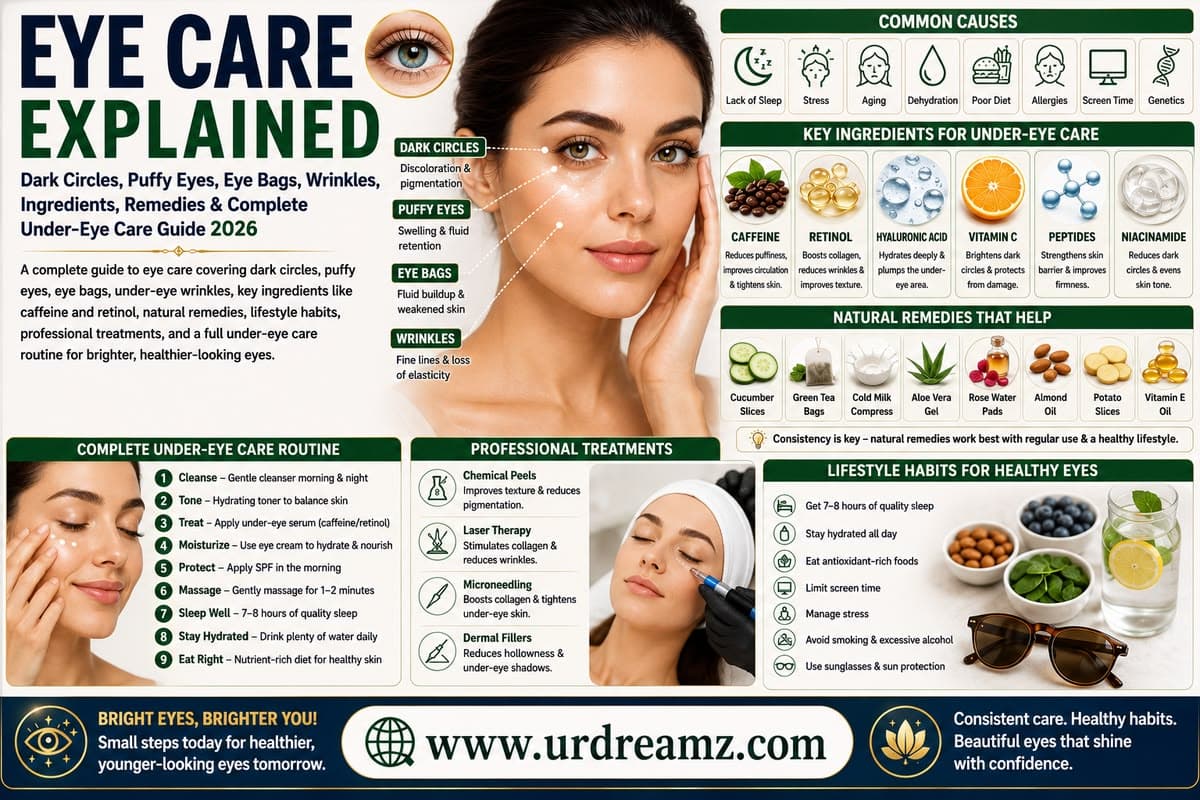
Eye Care Explained: Dark Circles, Puffy Eyes, Eye Bags, Wrinkles, Ingredients, Remedies & Complete Under-Eye Care Guide 2026
The skin around the eyes is often the first place where tiredness, stress, and age become visible, long before they show up anywhere else on the face. Dark circles, puffiness, and fine lines around the eyes can make even a well-rested person look exhausted, which is exactly why under-eye care has become one of the most searched topics in modern skincare. This guide brings together everything worth knowing about the eye area — what causes these common concerns, which ingredients genuinely help, how to build a realistic routine, and when a home remedy is enough versus when it may be time to see a professional.
Whether you are dealing with stubborn dark circles that do not seem to improve no matter how much sleep you get, morning puffiness that takes hours to settle, or the first fine lines appearing at the corners of your eyes, this guide is designed to walk through the causes and solutions in plain, practical language. We will look at the unique anatomy of the eye area, the different types and causes of dark circles, the ingredients backed by the most consistent evidence, natural remedies worth trying, and the daily habits that quietly make the biggest difference over time.
It helps to approach eye care with realistic expectations from the start. Some under-eye concerns, particularly those rooted in genetics or the natural loss of volume that comes with aging, cannot be fully reversed with a jar of cream, no matter how well formulated. Others, like temporary puffiness from a poor night's sleep or mild dullness from dehydration, respond remarkably well to simple, consistent care. Knowing which category your concern falls into is often the single most useful piece of information in this entire guide.
1. Why the Eye Area Needs Its Own Care Routine
The skin surrounding the eyes is structurally different from the rest of the face. It is significantly thinner, contains fewer oil glands, and has less underlying fat and collagen support, which makes it more prone to dryness, visible blood vessels, and the earliest signs of fine lines. This same thinness is also why the under-eye area reacts so quickly and so visibly to fatigue, dehydration, and stress, often before any other part of the face shows a change.
Because of these differences, products formulated for the rest of the face are not always ideal for the eye area. Regular facial moisturizers can be too heavy or contain ingredients that are more likely to irritate the sensitive skin near the eyes, or migrate into the eyes themselves during the day. This is the main reason dedicated eye creams, gels, and serums exist — they are generally formulated with gentler concentrations of active ingredients and lighter textures designed specifically for this delicate area.
It is also worth remembering that the eye area is one of the most expressive parts of the face. Between blinking roughly fifteen to twenty times a minute and the countless small expressions we make throughout the day, the skin here undergoes far more repetitive movement than almost anywhere else on the body. Over years, this constant motion combined with naturally thinner, less elastic skin is part of why fine lines tend to appear here before they show up elsewhere, making early, consistent care especially worthwhile.
2. Understanding the Anatomy of the Under-Eye Area
A closer look at what makes this part of the face structurally unique helps explain nearly every concern covered later in this guide, from why dark circles form to why fine lines tend to appear here first.
| Feature | Why It Matters |
|---|---|
| Thinner Skin | Makes underlying blood vessels and muscle more visible, contributing to a darker appearance |
| Fewer Oil Glands | The area dries out more easily and shows fine lines sooner than oilier parts of the face |
| Less Collagen and Fat Support | Leads to earlier sagging, hollowing, and the appearance of shadows as we age |
| Constant Movement | Blinking thousands of times a day accelerates the formation of fine lines around the eyes |
| Close Proximity to Muscle | Underlying orbicularis oculi muscle activity contributes to expression lines like crow's feet |
Taken together, these structural traits explain why the eye area often ages differently, and sometimes faster, than the rest of the face, and why a one-size-fits-all approach to skincare rarely serves this region as well as a dedicated, gentler routine.
3. What Are Dark Circles? Understanding the Different Types
Dark circles refer to the darkened appearance of the skin beneath the eyes, which can range from a bluish or purplish tint to a brown or black discoloration depending on skin tone and underlying cause. While they are rarely a sign of a serious health issue, dark circles are one of the most common cosmetic concerns people search for solutions to, since they can make even a healthy, well-rested face look tired or older.
Dark circles can affect people of every age, skin tone, and background, though certain groups tend to notice them more prominently. People with naturally thinner under-eye skin, a family history of pigmentation in this area, or deeper skin tones that are more prone to visible post-inflammatory pigmentation may find that dark circles appear earlier or more persistently than they do for others. This is one of the reasons a single product rarely works identically for everyone — the underlying cause behind the same visual concern can vary significantly from person to person.
Not all dark circles are the same, and understanding which type you are dealing with makes a significant difference in choosing an effective approach.
| Type | Appearance | Underlying Cause |
|---|---|---|
| Pigmented | Brownish discoloration | Excess melanin production, often from sun exposure or genetics |
| Vascular | Bluish or purplish tint | Visible blood vessels showing through thin under-eye skin |
| Structural | Shadowing rather than true discoloration | Volume loss or hollowing that creates a shadow effect |
| Mixed | A combination of the above | Most people experience some blend of pigmentation, visible vessels, and structural shadowing |
4. Common Causes of Dark Circles
Dark circles rarely have a single cause — they are usually the result of several overlapping factors working together. Identifying which of these applies most to your situation can help you choose a more targeted approach rather than relying on a single generic solution.
It is also worth noting that dark circles are not limited to adults. Children and even babies can sometimes show mild under-eye darkening, most often linked to allergies, fatigue, or simply having naturally thinner, more translucent skin at a young age, which allows underlying blood vessels to show through more easily. In most cases, this is not a cause for concern, though persistent or worsening dark circles in a child, especially alongside other symptoms like frequent congestion or poor sleep, are worth mentioning to a pediatrician.
| Cause | How It Contributes |
|---|---|
| Genetics | Some people naturally have thinner under-eye skin or a family tendency toward pigmentation in this area |
| Aging | Skin thins and loses collagen over time, making blood vessels more visible and hollows more pronounced |
| Lack of Sleep | Poor sleep can make skin appear paler, allowing underlying blood vessels to show through more clearly |
| Dehydration | Under-hydrated skin looks duller and can accentuate hollowness and shadowing |
| Sun Exposure | Long-term UV exposure increases melanin production, contributing to pigmented dark circles |
| Allergies and Rubbing | Rubbing the eyes due to allergies or fatigue can cause blood vessels to dilate or break, darkening the area |
| Lifestyle Factors | Smoking, excessive alcohol use, and chronic stress can all contribute to a duller, more shadowed under-eye appearance |
5. Puffy Eyes and Eye Bags Explained
Puffy eyes and eye bags are related concerns but are not exactly the same thing. Puffiness usually refers to temporary swelling caused by fluid retention, most often noticeable first thing in the morning, while eye bags typically describe a more persistent, structural change caused by weakened tissue and fat displacement that develops gradually with age. Confusing the two can lead to frustration, since a product designed to address temporary swelling will do very little for a bag that has been present, largely unchanged, for years.
| Concern | Typical Cause | Usual Pattern |
|---|---|---|
| Puffy Eyes | Fluid retention, allergies, high salt intake, lack of sleep | Often temporary, more noticeable in the morning and improves throughout the day |
| Eye Bags | Weakened muscle and connective tissue, fat displacement, aging | Generally persistent and gradually more noticeable over time |
5.1 Common Causes of Puffy Eyes and Eye Bags
| Cause | Explanation |
|---|---|
| Fluid Retention | Lying flat overnight allows fluid to pool under the eyes, most noticeable upon waking |
| Allergies | Inflammation and histamine release can cause visible swelling around the eyes |
| High Sodium Intake | Excess salt can encourage the body to retain more water, worsening puffiness |
| Lack of Sleep | Poor sleep quality is one of the most consistently reported triggers for morning puffiness |
| Aging | As supportive tissue weakens over time, fat can shift forward, creating a persistent bag-like appearance |
| Genetics | Some people are simply more prone to under-eye puffiness or bags at a younger age due to family traits |
Best Practices: Since morning puffiness is so often linked to fluid retention overnight, small adjustments like sleeping with an extra pillow, reducing salty foods in the evening, and applying a cold compress right after waking tend to make a noticeable difference within minutes. Persistent eye bags that do not improve with these habits are more likely structural and may benefit more from firming ingredients or, in more pronounced cases, a conversation with a dermatologist.
6. Dark Circles vs Puffy Eyes vs Eye Bags: Key Differences
Because these three concerns are so often mentioned together, it helps to see them laid out side by side. This comparison is a useful quick reference when trying to decide which section of this guide is most relevant to what you are currently experiencing.
| Feature | Dark Circles | Puffy Eyes | Eye Bags |
|---|---|---|---|
| Main Issue | Discoloration | Temporary swelling | Persistent structural bulge |
| Usually Worse When | Consistently visible, may worsen with fatigue | First thing in the morning | Gradually worsens with age |
| Primary Approach | Brightening ingredients, sun protection, sleep | Cold compress, reduced sodium, adequate sleep | Firming ingredients, sometimes professional treatment |
7. Under-Eye Wrinkles and Fine Lines
Because the skin around the eyes is thinner and moves constantly through blinking and facial expression, it is often one of the first areas to show fine lines, commonly known as crow's feet when they appear at the outer corners of the eyes. These lines are a natural part of aging but can be influenced significantly by lifestyle factors, and their rate of progression varies considerably from person to person based on genetics, sun habits, and skincare consistency.
| Contributing Factor | Why It Matters |
|---|---|
| Repeated Facial Expressions | Squinting and smiling repeatedly over years gradually etches lines into thin skin |
| Sun Exposure | UV damage breaks down collagen and accelerates the appearance of fine lines |
| Natural Collagen Loss | Collagen production slows with age, reducing skin's elasticity and bounce |
| Dehydration | Dry skin tends to show fine lines more prominently than well-hydrated skin |
| Smoking | Accelerates the breakdown of collagen and elastin, speeding up visible aging |
Best Practices: Since fine lines around the eyes are influenced heavily by repeated movement and cumulative sun exposure, prevention tends to be more effective than correction. Wearing sunglasses regularly, applying sunscreen around the orbital bone daily, and introducing a gentle retinol or peptide product in your late twenties or early thirties, before deep lines have formed, generally produces better long-term results than waiting until wrinkles are already well established.
8. Key Eye Care Ingredients Explained
A handful of well-studied ingredients show up repeatedly in effective eye care products, each targeting a slightly different concern. Understanding what each one actually does makes it much easier to choose a product suited to your specific needs rather than picking based on packaging alone.
Because the eye area is more sensitive than the rest of the face, ingredient concentrations here are often lower than in equivalent facial products, even when the active ingredient itself is the same. This is a deliberate formulation choice rather than a sign of a weaker product — it reflects the fact that thinner skin generally needs a gentler introduction to strong actives to avoid irritation, dryness, or a stinging sensation.
| Ingredient | Primary Function | Best For |
|---|---|---|
| Caffeine | Temporarily constricts blood vessels and reduces fluid buildup | Puffiness and morning swelling |
| Retinol | Encourages cell turnover and supports collagen production | Fine lines, crow's feet, and early aging signs |
| Vitamin C | Antioxidant that supports brightness and collagen synthesis | Dullness and pigmented dark circles |
| Hyaluronic Acid | Draws and holds moisture, plumping the skin surface | Dehydrated, hollow-looking under-eye skin |
| Peptides | Support collagen and elastin production for firmer skin | Loss of firmness and early sagging |
| Niacinamide | Helps even tone and supports the skin barrier | Pigmentation and general skin resilience |
| Ceramides | Reinforce the skin's natural protective barrier | Dryness and barrier support around the eyes |
| Vitamin K | Traditionally associated with supporting circulation under the skin | Vascular-type dark circles |
| Green Tea Extract | Antioxidant with mild soothing and circulation-supporting properties | General puffiness and dullness |
| Vitamin E | Antioxidant that supports skin softness and repair | Dry, rough under-eye texture |
8.1 Ingredient Quick-Match Guide by Concern
| If Your Main Concern Is... | Look For |
|---|---|
| Puffiness and morning swelling | Caffeine, green tea extract |
| Fine lines and crow's feet | Retinol, peptides |
| Dark, pigmented circles | Vitamin C, niacinamide, kojic acid |
| Hollow, dehydrated appearance | Hyaluronic acid, peptides |
| Sensitive, easily irritated skin | Ceramides, aloe vera, fragrance-free formulas |
8.2 Patch Testing New Eye Products
Because the eye area is more prone to irritation than most other parts of the face, patch testing any new product before applying it near the eyes is a sensible habit, particularly for stronger actives like retinol or high-concentration vitamin C. A simple approach is to apply a small amount of the new product to the inner forearm or just below the ear for two to three days, watching for redness, itching, or stinging before introducing it to the more delicate under-eye skin.
9. Eye Cream vs Eye Serum vs Eye Gel: What's the Difference?
Walking down a skincare aisle or browsing online, it is easy to feel overwhelmed by the number of eye product formats available. Each of the three main formats is built around a slightly different texture and delivery approach, and knowing the distinction helps you pick a starting point rather than choosing based on packaging alone.
| Format | Texture | Best Time to Use | Best For |
|---|---|---|---|
| Eye Cream | Rich, more emollient | Night, or daytime for very dry skin | Dryness, fine lines, nourishment |
| Eye Serum | Lightweight, fast-absorbing | Morning, under makeup | Targeted concerns like brightening or puffiness |
| Eye Gel | Very light, often cooling | Morning, especially for puffiness | Quick de-puffing and a refreshed feel |
None of these formats is strictly better than the others — many people actually use more than one, layering a lightweight serum for targeted active ingredients under a richer cream for extra nourishment, particularly as part of a nighttime routine.
10. How to Apply Eye Products Correctly
How you apply an eye product matters almost as much as which product you choose. Even the most well-formulated cream can underperform, or contribute to irritation, if it is applied too aggressively or in the wrong location relative to the eye itself.
| Step | Action | Purpose |
|---|---|---|
| 1 | Cleanse the face gently first | Removes dirt and makeup so the product can absorb properly |
| 2 | Take a small, rice-grain sized amount of product | The eye area needs far less product than the rest of the face |
| 3 | Warm the product slightly between fingertips | Makes application smoother and gentler on delicate skin |
| 4 | Use your ring finger to apply | The ring finger naturally applies the lightest pressure of all fingers |
| 5 | Gently tap or pat along the orbital bone | Avoids stretching or dragging the thin under-eye skin |
| 6 | Avoid applying too close to the lash line | Reduces the risk of product migrating into the eyes |
| 7 | Allow the product to fully absorb before applying makeup or SPF | Prevents pilling and helps the active ingredients work properly |
Rubbing or dragging the skin around the eyes, even gently, adds unnecessary mechanical stress to an area that is already thinner and less elastic than the rest of the face, which is why the tapping technique is consistently recommended over rubbing.
11. Daily Eye Care Routine: Morning and Night
A realistic eye care routine does not need to be complicated to be effective. In fact, a routine that is too elaborate is often the first thing to be abandoned after a busy week, which defeats the purpose entirely. The table below outlines a simple, sustainable structure that covers the essentials without adding unnecessary steps.
| Time | Recommended Steps |
|---|---|
| Morning | Gentle cleanse, lightweight caffeine or vitamin C eye serum, sunscreen (including the orbital area), sunglasses if going outdoors |
| Night | Gentle cleanse to remove makeup, hydrating or retinol-based eye cream, allow to absorb before sleep |
Consistency tends to matter more than product complexity — a simple two-step morning and night routine followed daily will generally outperform an elaborate routine that is only followed occasionally. If you only have time for one step a day, a well-chosen daytime product that combines hydration with sun protection is usually the most efficient single choice, since it addresses two of the most impactful factors — dehydration and UV exposure — at once.
12. Eye Care by Age and Life Stage
Under-eye concerns evolve over the years, and what works well in your twenties is not necessarily the most efficient focus in your forties. Adjusting your routine's priorities as you move through different life stages tends to produce better long-term results than sticking rigidly to the same approach indefinitely.
| Age Range | Common Concerns | Suggested Focus |
|---|---|---|
| Late Teens to Mid-20s | Occasional puffiness, mild dark circles from lifestyle factors | Gentle hydration, sun protection as a preventive habit |
| Late 20s to 30s | Early fine lines, more persistent dark circles | Hydrating serums, introduction of antioxidants like vitamin C |
| 40s and Beyond | Deeper wrinkles, volume loss, more visible eye bags | Retinol, peptides, and consideration of professional treatments if desired |
| Men's Eye Care | Often overlooked, but faces the same structural aging as women's skin | Simple, fragrance-free formulas focused on hydration and firmness |
13. Natural and Home Remedies for the Eye Area
Many people reach for simple, low-cost home remedies before trying dedicated eye care products, and several of these do have a genuine, if often temporary, effect — particularly for puffiness rather than deeper pigmentation. Part of their enduring popularity comes from accessibility: most of these remedies use items already found in a typical kitchen or refrigerator, making them an easy first step before investing in specialized products.
| Remedy | How It Helps | How to Use |
|---|---|---|
| Cold Compress | Constricts blood vessels and reduces fluid buildup | Apply a cool, damp cloth or chilled spoon for a few minutes |
| Cucumber Slices | Cooling and mildly hydrating, temporarily reduces puffiness | Chill slices and place over closed eyes for about ten minutes |
| Cold Tea Bags | Caffeine and antioxidants may help tighten the area temporarily | Chill used tea bags and apply for five to ten minutes |
| Aloe Vera Gel | Soothing and lightly hydrating | Apply a small amount gently around the orbital bone |
| Rose Water | Refreshing, mildly soothing for tired-looking eyes | Soak cotton pads and apply for a few minutes |
| Almond Oil | Nourishing for dry under-eye skin | Massage a small amount in gently before bed |
These remedies are best viewed as a supportive, low-risk addition to a routine rather than a guaranteed fix, particularly for dark circles caused by genetics or deeper structural changes, which tend to respond better to consistent product use or professional treatment.
14. Lifestyle and Prevention Habits
Some of the most meaningful improvements to the appearance of the eye area come not from products at all, but from everyday habits that support the body's overall health and circulation. These habits tend to work quietly in the background, and their effects are often most noticeable only after several weeks of consistency, which is part of why they are so easy to underestimate compared to a new product with an appealing before-and-after photo.
| Habit | Why It Helps |
|---|---|
| Getting Consistent, Adequate Sleep | Reduces pale, dull skin tone that makes blood vessels more visible |
| Staying Hydrated | Supports overall skin plumpness and reduces the appearance of hollowness |
| Elevating Your Head While Sleeping | Helps prevent fluid from pooling under the eyes overnight |
| Reducing Sodium Intake | Lowers the likelihood of fluid retention contributing to puffiness |
| Wearing Sunscreen and Sunglasses | Protects against UV-driven pigmentation and collagen breakdown |
| Managing Screen Time | Reduces eye strain, which can contribute to a tired appearance |
| Limiting Alcohol and Avoiding Smoking | Both can dehydrate skin and accelerate visible aging over time |
14.1 Screen Time, Blue Light, and the Eye Area
Extended screen use does not directly cause dark circles, but it contributes to the problem indirectly in several ways. Staring at a screen for long periods reduces blink rate, which can lead to eye strain, squinting, and fatigue, all of which make the eye area look more tired by the end of the day. Poor posture during screen use, often involving leaning the head forward, can also mildly affect circulation around the face and neck over time. While the direct skin impact of blue light itself is still debated among researchers, taking regular breaks, adjusting screen brightness, and maintaining good posture are sensible habits that support a more rested-looking eye area regardless.
14.2 Diet and Under-Eye Skin Health
What you eat has an indirect but meaningful influence on how the eye area looks. A diet consistently low in key nutrients, or one that includes excessive salt and processed foods, can contribute to both dullness and puffiness. Foods rich in antioxidants, such as berries, leafy greens, and citrus fruits, support the skin's ability to manage everyday oxidative stress, while adequate intake of iron and vitamin B12 has been associated in some research with reduced under-eye discoloration, since deficiencies in these nutrients can contribute to a paler, more shadowed appearance. As with most areas of skincare, diet works best as a supporting habit alongside topical care rather than as a stand-alone fix.
14.3 Eye Massage Techniques
Gentle massage around the eye area is often recommended to support circulation and encourage lymphatic drainage, which can help reduce the appearance of both puffiness and, to a lesser extent, dark circles. A simple technique involves using the ring finger to gently tap along the orbital bone in a light, circular motion, starting from the inner corner near the nose and moving outward toward the temple. This can be done with or without a product, though adding a cooling eye gel or a chilled metal roller often enhances the immediate de-puffing effect. As with any technique applied to this delicate area, the pressure used should always be extremely light.
14.4 DIY Eye Masks
| DIY Mask | Ingredients | Best For |
|---|---|---|
| Cooling Cucumber Mask | Chilled, thinly sliced cucumber | Puffiness and a quick refreshed feeling |
| Green Tea Mask | Cooled, brewed green tea bags | Mild antioxidant support and de-puffing |
| Aloe and Rose Water Mask | Aloe vera gel mixed with a few drops of rose water, applied on cotton pads | Soothing tired, irritated-feeling eyes |
| Potato Slice Mask | Thin, chilled raw potato slices | Traditionally used for mild brightening, though evidence is limited |
As with any homemade remedy, these should be patch tested first, kept away from direct contact with the eyes themselves, and used gently, since even natural ingredients can occasionally cause irritation on such delicate skin.
13.1 Eye Patches Explained
Eye patches, sometimes called under-eye masks, are pre-soaked pads designed to sit on the skin for a set period, delivering a concentrated dose of hydrating or brightening ingredients in a short amount of time. They have become especially popular as a quick, visible pick-me-up before events or in the morning after a poor night's sleep, largely because the cooling, occlusive effect of the patch itself can produce an immediate, if temporary, improvement in puffiness and tightness.
| Feature | Details |
|---|---|
| Typical Wear Time | 10 to 20 minutes |
| Best Frequency | 2 to 3 times per week, or occasionally before special occasions |
| Common Ingredients | Hyaluronic acid, caffeine, collagen, botanical extracts |
| Immediate Effect | Cooling, temporary tightening, and a hydration boost |
| Long-Term Effect | Best used alongside a daily eye cream rather than as a replacement for one |
While eye patches can deliver a satisfying short-term result, they are generally better suited to occasional or event-based use rather than being relied upon as the sole method of long-term under-eye care, since a daily cream or serum tends to provide more consistent, cumulative benefits.
15. Common Eye Care Mistakes
Many under-eye concerns are made worse not by a lack of good products, but by small habits that quietly undermine the effort being put into a routine. Recognizing these patterns is often the fastest way to see improvement, sometimes even before introducing a single new product.
| Mistake | Why It's a Problem | Fix |
|---|---|---|
| Rubbing the eyes vigorously | Can break tiny blood vessels and worsen both puffiness and discoloration | Use gentle tapping instead of rubbing when applying products or removing makeup |
| Using too much product | Excess product can migrate into the eyes and cause irritation | Stick to a small, rice-grain sized amount |
| Applying eye cream too close to the lash line | Increases the risk of product entering the eyes | Apply along the orbital bone, not directly on the lash line |
| Skipping sunscreen around the eyes | Leaves the area vulnerable to UV-driven pigmentation and aging | Use an eye-safe sunscreen or wear sunglasses daily |
| Expecting overnight results | Most active ingredients need weeks of consistent use to show visible change | Commit to a routine for at least six to eight weeks before judging results |
| Using harsh anti-aging actives too aggressively | Can cause irritation on the already delicate eye area | Introduce retinol and other actives slowly, starting with a lower frequency |
16. Professional and Medical Treatments
For deeper or more persistent concerns that do not respond well to home care, several professional treatments are available through dermatologists or licensed aesthetic practitioners. These are generally reserved for more stubborn cases and should always be discussed with a qualified provider. Unlike most over-the-counter products, these treatments can address structural causes, such as significant volume loss, that topical skincare alone is simply not designed to fix.
| Treatment | How It Works | Best For |
|---|---|---|
| Chemical Peels | Uses acids to lighten pigmentation and improve texture | Pigmented dark circles |
| Laser Therapy | Targets pigment and can stimulate new collagen formation | Pigmented and mixed-type dark circles |
| Dermal Fillers | Restores lost volume to reduce shadowing | Structural dark circles and hollowing |
| Platelet-Rich Plasma (PRP) | Uses the person's own plasma to support tissue repair and collagen growth | General rejuvenation of the under-eye area |
| Blepharoplasty | Surgical removal of excess skin or fat | Significant, persistent eye bags |
16.1 Dark Circles and Different Skin Tones
The way dark circles appear can vary noticeably depending on natural skin tone, and this affects both how they are perceived and which treatments tend to work best. On lighter skin tones, dark circles often present as a bluish or purplish tint, since visible blood vessels show through more easily. On deeper skin tones, dark circles are more likely to appear as a brownish discoloration linked to pigmentation, and this skin type can also be more prone to post-inflammatory hyperpigmentation, meaning that rubbing or irritation in the area can leave a lasting mark more easily. Because of this, ingredients like niacinamide and vitamin C, which target pigmentation, are often especially relevant for deeper skin tones, while vascular-focused ingredients like caffeine and vitamin K may be more relevant for lighter skin tones where visible blood vessels are the primary concern.
16.2 Layering Eye Products with Makeup
Many people wear concealer or foundation over the eye area to further disguise dark circles or puffiness, and how eye products are layered underneath makeup affects both comfort and how well makeup applies. Allowing an eye cream or serum a few minutes to fully absorb before applying concealer helps prevent the product from pilling or causing makeup to crease throughout the day. Lightweight gels and serums tend to work better under makeup than very rich, heavy creams, which are often better reserved for nighttime use when no makeup will be applied on top. Color-correcting concealers in a peach or orange tone are also commonly used to counteract the bluish tint of vascular dark circles, while a standard concealer shade works well for general brightening.
16.3 Cold Compress vs Warm Compress
| Compress Type | Best For | How It Works |
|---|---|---|
| Cold Compress | Puffiness, morning swelling, tired-looking eyes | Constricts blood vessels and reduces fluid buildup |
| Warm Compress | Tension around the eyes, tired eye muscles from screen strain | Relaxes surrounding muscles and can ease general eye fatigue |
For most common under-eye concerns like puffiness and dark circles, a cold compress is generally the more useful option, while a brief warm compress can be a pleasant addition for general relaxation, particularly after long periods of screen use.
17. When Should You See a Doctor?
Dark circles and mild puffiness are usually cosmetic rather than medical concerns, but certain signs are worth discussing with a healthcare provider rather than treating at home. Knowing where this line sits can prevent unnecessary worry over normal variation while still catching the rarer cases that do need professional attention.
| Sign | Why It's Worth Checking |
|---|---|
| Swelling or discoloration in only one eye | May indicate an underlying issue rather than a general cosmetic pattern |
| Sudden, significant swelling | Could be related to an allergic reaction or other medical cause |
| Persistent pain around the eyes | Warrants a medical evaluation rather than home treatment |
| Dark circles appearing alongside other new symptoms | Worth ruling out underlying causes such as thyroid or nutritional issues |
17.1 The Role of Sleep Position and Habits
Beyond simply getting enough hours of sleep, how you sleep can also influence how the eye area looks in the morning. Sleeping flat on your back with the head level allows fluid to settle evenly around the face overnight, which is part of why many people wake up with more noticeable puffiness than they had the evening before. Elevating the head slightly with an extra pillow helps gravity work in your favor, encouraging fluid to drain away from the under-eye area rather than pooling there. Side sleeping, particularly consistently on the same side, has also been anecdotally linked by some dermatologists to slightly more pronounced puffiness or even mild asymmetry on the side that spends more time pressed against a pillow, since prolonged pressure and reduced circulation on one side may contribute to localized fluid retention.
17.2 How Eye Care Products Are Typically Formulated
Understanding a little about how eye care products are put together can help explain why certain textures and packaging choices exist. Because the eye area does not tolerate heavy fragrance, alcohol, or harsh preservatives as well as the rest of the face, most reputable eye products are formulated to be fragrance-free or very lightly scented, with a shorter, more conservative ingredient list than a typical face cream or serum. Packaging also tends to favor tubes, pumps, or rollerball applicators over open jars, partly for hygiene reasons, since repeated finger contact with a jar increases the risk of introducing bacteria to a product that will be applied so close to the eyes.
4.1 Hormonal and Medical Factors Behind Dark Circles
Beyond the everyday lifestyle causes already covered, certain hormonal and medical factors can also play a role in under-eye discoloration, even though these are less commonly discussed. Thyroid imbalances, for instance, can sometimes contribute to a paler, more shadowed under-eye appearance, since thyroid function affects circulation and overall skin tone. Hormonal fluctuations related to menstrual cycles, pregnancy, or menopause can also temporarily affect fluid retention and skin appearance around the eyes for some people. Certain medications, particularly those that cause blood vessels to dilate, may also make under-eye blood vessels more visible as a side effect. None of these causes are common enough to assume without other symptoms, but they are worth keeping in mind if dark circles appear suddenly, worsen significantly, or do not respond to any of the more typical lifestyle and skincare approaches covered in this guide.
18. Eye Care Myths vs Facts
| Myth | Fact |
|---|---|
| Eye cream can completely erase dark circles overnight | Most ingredients need weeks of consistent use, and some causes, like genetics or structural volume loss, cannot be fully reversed with topical products alone |
| You only need eye cream once you have wrinkles | Preventive use from the mid-20s onward, focused on hydration and sun protection, can help slow visible changes |
| Any face moisturizer works fine around the eyes | The eye area benefits from gentler, specifically formulated products due to its thinner, more sensitive skin |
| Dark circles are always caused by lack of sleep | Sleep is only one of several contributing factors, alongside genetics, pigmentation, and structural changes |
| Expensive eye creams always work better | Effectiveness depends on the ingredients and their concentration, not the price of the product |
| Rubbing helps eye cream absorb faster | Rubbing adds unnecessary stress to delicate skin; gentle tapping is the recommended technique |
18.1 Natural vs Synthetic Eye Care Ingredients
| Aspect | Natural Ingredients | Synthetic / Lab-Formulated Ingredients |
|---|---|---|
| Examples | Cucumber extract, aloe vera, green tea, rose water | Caffeine, retinol, hyaluronic acid, peptides |
| Typical Strength | Generally mild, soothing effects | Often more concentrated and targeted |
| Best Use | Everyday soothing and light hydration | Addressing specific concerns like pigmentation or fine lines |
18.2 Budget vs Luxury Eye Creams
As with most skincare categories, a higher price tag does not automatically translate into better results for the eye area. Many affordable eye creams and serums contain the same core active ingredients, such as caffeine or hyaluronic acid, found in significantly more expensive alternatives. What matters most is the concentration of the active ingredient and how consistently the product is used, rather than the brand name on the packaging.
18.3 Quick Glossary of Eye Care Terms
| Term | Meaning |
|---|---|
| Periorbital | Referring to the area surrounding the eye socket |
| Orbital Bone | The bony ridge surrounding the eye socket, used as a guide for applying eye products |
| Tear Trough | A hollow groove that can form between the lower eyelid and cheek, often contributing to shadowing |
| Vasoconstriction | The narrowing of blood vessels, which can temporarily reduce puffiness and redness |
| Hyperpigmentation | Darkening of the skin caused by excess melanin production |
| Blepharoplasty | A surgical procedure to remove excess skin or fat around the eyes |
18.4 Sample Under-Eye Routine by Concern
| Main Concern | Morning | Night |
|---|---|---|
| Dark Circles (Pigmented) | Vitamin C eye serum, sunscreen | Niacinamide or brightening eye cream |
| Puffiness | Caffeine eye gel, cold roller if available | Lightweight hydrating gel, avoid heavy creams |
| Fine Lines / Crow's Feet | Peptide eye serum, sunscreen | Retinol-based eye cream (start slowly) |
| Dryness / Hollowing | Hyaluronic acid eye serum | Rich, ceramide-based eye cream |
These are general starting points rather than fixed rules — the most effective routine is the one that matches your specific combination of concerns and that you can realistically stick with over several weeks.
19. Frequently Asked Questions (FAQs)
What causes dark circles under the eyes?
Dark circles are usually caused by a combination of factors, including genetics, thinning skin with age, visible blood vessels, pigmentation from sun exposure, dehydration, and lack of sleep. Most people experience more than one of these factors at once, which is why a combined approach often works better than targeting just one cause.
Can dark circles be removed permanently?
Some dark circles improve significantly with consistent skincare and lifestyle changes, while others caused by genetics or structural volume loss may require professional treatment for more lasting results. Setting realistic expectations based on the underlying cause tends to lead to more satisfying outcomes than expecting a universal fix.
Does lack of sleep really cause dark circles?
Yes, poor sleep can make skin appear paler, which allows underlying blood vessels to become more visible and can worsen the appearance of existing dark circles. Consistently getting enough quality sleep is one of the simplest, most effective habits for this concern.
Is under-eye cream really necessary?
While not strictly mandatory, a dedicated eye product is often more suitable than a regular face moisturizer, since the eye area has thinner, more sensitive skin with different needs. Many people find that switching to a proper eye cream reduces irritation compared to using a heavier facial product in this area.
When should I start using eye cream?
Many people begin using a light, hydrating eye cream in their mid-20s as a preventive habit, though it is never too late to start if dark circles or fine lines are already visible. Starting early with sun protection is often more impactful than the specific age you begin using an eye cream.
How do I apply eye cream correctly?
Use a small, rice-grain amount and gently tap it along the orbital bone with your ring finger, avoiding direct contact with the lash line or rubbing the delicate skin. This technique minimizes unnecessary stretching of skin that is already thinner and less elastic than the rest of the face.
Which ingredient is best for puffy eyes?
Caffeine is one of the most well-known ingredients for temporarily reducing puffiness, since it can help constrict blood vessels and reduce fluid buildup. Cooling application tools like rollers or chilled gel formulas often enhance this effect further.
Which ingredient is best for dark circles?
Vitamin C and niacinamide are commonly recommended for pigmented dark circles, while caffeine and vitamin K are more associated with the vascular type. Identifying which type of dark circle you have makes it easier to choose the most relevant ingredient.
Can retinol be used around the eyes?
Yes, but it should be introduced gradually and used in a formula specifically designed for the eye area, since standard facial retinol products can be too strong for this delicate skin. Starting with two or three uses a week is a common, cautious approach.
Does cucumber really help dark circles?
Cucumber slices can provide temporary cooling and mild hydration that reduces puffiness, though the effect on true pigmentation is limited and mostly temporary. It works best as a quick refresh rather than a long-term treatment.
Are tea bags effective for puffy eyes?
Cold tea bags may offer a mild, temporary tightening effect due to their caffeine and antioxidant content, making them a popular low-cost home remedy. Using caffeinated tea rather than herbal varieties tends to give a slightly stronger effect.
Can drinking more water reduce eye bags?
Staying well hydrated supports overall skin plumpness and can help reduce the appearance of hollowness, though it will not resolve structural eye bags caused by aging. It is still one of the simplest, most accessible habits for overall skin health.
Does sunscreen matter around the eyes?
Yes, UV exposure is a significant contributor to pigmented dark circles and premature fine lines, so sun protection, including sunglasses, is an important preventive step. Many people overlook this area when applying facial sunscreen, which can leave it more exposed than the rest of the face.
Can allergies cause dark circles or puffy eyes?
Yes, allergy-related inflammation and eye rubbing can both contribute to visible discoloration and swelling around the eyes. Managing the underlying allergy, where possible, often improves the appearance of the eye area as a side benefit.
Is it normal for one eye to look different from the other?
Minor asymmetry is common, but noticeable swelling or discoloration in only one eye is worth having checked by a healthcare provider, since it may point to a specific, treatable cause rather than a general pattern.
Can men use eye cream too?
Yes, the skin around men's eyes experiences the same structural aging and can benefit equally from a simple, consistent eye care routine. Men's skin is often slightly thicker overall, but the eye area itself follows the same delicate pattern regardless of gender.
How long does it take to see results from an eye cream?
Puffiness-related improvements can sometimes be noticed within a few weeks, while changes to pigmentation or fine lines typically take six to eight weeks or longer of consistent use. Photographing the area under similar lighting every few weeks can make gradual progress easier to notice.
What is the difference between eye cream and eye serum?
Eye serums are usually lighter and better suited for daytime or targeted concerns, while eye creams tend to be richer and more nourishing, often used at night. Some routines use both, layering a serum first and a cream on top for extra hydration.
Can I use my regular face moisturizer around my eyes?
It is possible, but the eye area generally benefits more from a dedicated product formulated with gentler, more appropriate ingredients for its thinner skin. Using a facial product with strong actives near the eyes increases the risk of irritation or stinging.
Does stress contribute to dark circles?
Chronic stress can affect sleep quality and overall skin appearance, indirectly contributing to a more tired, shadowed look around the eyes. Managing stress through regular routines, exercise, or relaxation techniques can support better sleep and, indirectly, a fresher-looking eye area.
Can under-eye wrinkles be prevented?
While some fine lines are a natural part of aging, consistent sun protection, hydration, and gentle handling of the eye area can help slow their visible progression. Starting these habits earlier rather than later tends to produce the most noticeable long-term benefit.
What foods might support healthier-looking under-eye skin?
A generally balanced diet with adequate hydration, along with foods rich in antioxidants and healthy fats, supports overall skin health, including the delicate eye area. Foods containing iron and vitamin B12 may be particularly relevant for people whose dark circles are linked to paleness.
Is it safe to use eye patches regularly?
Most eye patches are safe for regular use a few times a week and can provide a quick, temporary boost of hydration or a cooling, de-puffing effect. They work well as an occasional treat rather than a full replacement for a daily eye cream routine.
Can I wear makeup over eye cream?
Yes, but allow the eye cream a few minutes to fully absorb first to prevent makeup from creasing or sitting unevenly on top of the product. Lighter formulas like gels and serums tend to layer more smoothly under makeup than very rich creams.
Why do children sometimes have dark circles?
Children can develop mild under-eye darkening for similar reasons as adults, including allergies, fatigue, and naturally thin, translucent skin, though persistent or worsening circles alongside other symptoms are worth discussing with a pediatrician.
Does sleeping position affect puffiness?
Yes, sleeping flat allows fluid to settle evenly around the face overnight, while elevating the head slightly with an extra pillow can help reduce morning puffiness by encouraging fluid to drain away from the area.
Can genetics really determine whether I get dark circles?
Yes, some people are simply predisposed to thinner under-eye skin or a family tendency toward pigmentation in this area, which means dark circles may appear even with excellent sleep and skincare habits.
Is it better to use eye cream in a jar or a tube?
Tubes, pumps, and rollerball applicators are generally considered more hygienic than open jars, since they reduce repeated finger contact with the product, which matters more for an area as close to the eyes as this one.
Can color-correcting concealer help with dark circles?
Yes, a peach or orange-toned color corrector can help neutralize the bluish tint common in vascular dark circles before applying a regular concealer on top, giving a more even finished look.
Conclusion
The eye area tells a story that the rest of the face often does not — how well you slept, how hydrated you are, and, over time, how your skin has aged. Because the skin here is thinner, more delicate, and structurally different from the rest of the face, it responds to both neglect and care more visibly and more quickly, which is exactly why a dedicated eye care routine is worth building, regardless of your age.
There is no single ingredient or product that resolves every under-eye concern, since dark circles, puffiness, and fine lines often stem from different underlying causes and sometimes overlap. Understanding which of these you are actually dealing with — pigmentation, visible blood vessels, fluid retention, or structural volume loss — makes it far easier to choose ingredients and habits that genuinely address the problem rather than guessing based on marketing claims.
It also helps to remember that the eye area does not exist in isolation from the rest of your health and daily habits. Sleep quality, hydration, diet, stress levels, and sun exposure all leave their mark here before almost anywhere else on the face, which means that even the most carefully chosen eye cream will only go so far without some attention to these underlying factors. Small, sustainable changes — an extra glass of water, a slightly earlier bedtime, a habit of wearing sunglasses on sunny days — often add up to more visible improvement over a few months than any single product used in isolation.
Consistency, gentle handling, and realistic expectations matter more than any single miracle product. A simple routine built around sun protection, adequate sleep, proper hydration, and a well-chosen eye cream or serum, followed patiently over several weeks, will typically deliver more meaningful improvement than an expensive product used only occasionally. And for concerns that do not respond well to consistent home care, particularly structural changes like significant hollowing or persistent eye bags, a conversation with a dermatologist can help clarify which professional treatments, if any, might be worth considering.