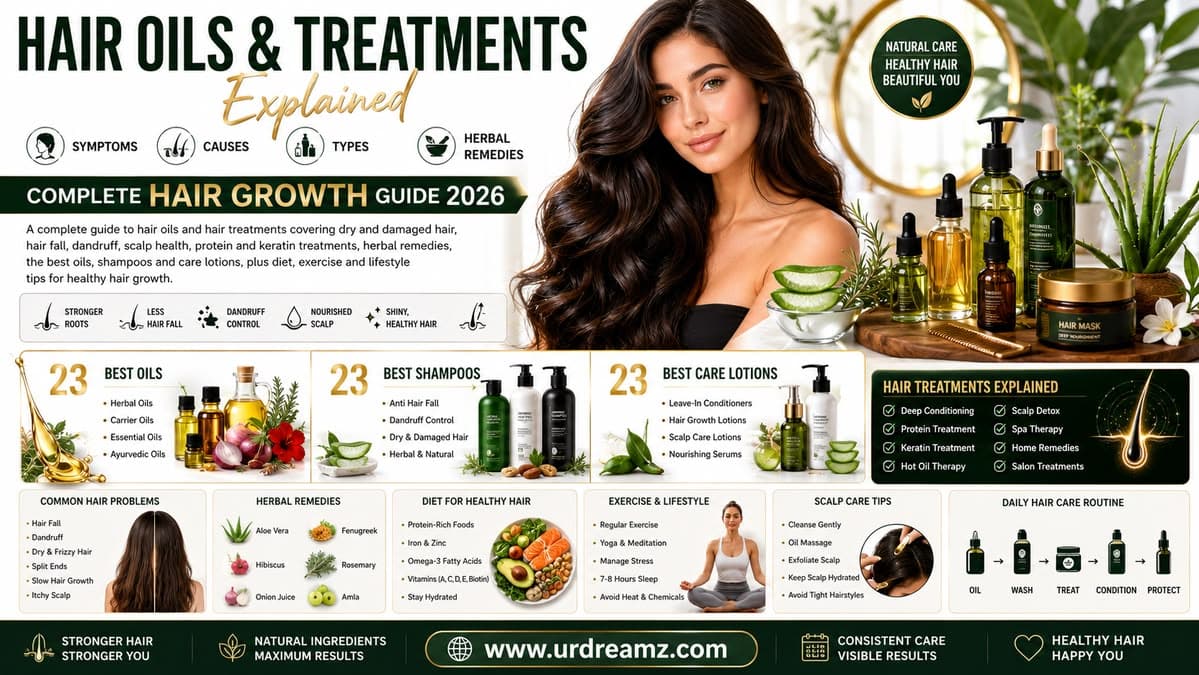
Hair Oils & Treatments Explained: Symptoms, Causes, Types, Herbal Remedies, 23 Best Oils, 23 Best Shampoos, 23 Best Care Lotions & Complete Hair Growth Guide 2026
Hair oiling is one of the oldest beauty rituals in the world, yet modern hair problems — pollution, hard water, heat styling, chemical processing, and constant stress — mean that a simple bottle of oil is rarely enough on its own anymore. This guide brings together everything worth knowing about hair oils and hair treatments in one place: the science of how hair actually grows and breaks down, every major hair and scalp problem broken into symptoms, causes, signs, and treatment, the full range of natural and modern treatment options, and practical, everyday habits — diet, exercise, and routine — that quietly determine how healthy your hair looks over time.
Whether you have been oiling your hair the same way for years without seeing the results you expect, or you are just starting to build a proper hair care routine from scratch, this guide is designed to give you a complete, practical reference. Rather than repeating generic advice like "oil your hair regularly," it walks through exactly which oil suits which hair type and concern, how each major treatment method actually works beneath the surface, and how to build a realistic weekly routine you can actually stick to.
1. What Are Hair Oils and Hair Treatments?
Hair oils are lipid-based products applied to the scalp, the hair strand, or both, designed to nourish, protect, and improve the look and feel of hair. Hair treatments are a broader category that includes oils but also covers protein treatments, keratin smoothing, deep conditioning masks, and scalp-focused therapies, all aimed at repairing or maintaining healthy hair. Together, oils and treatments form the backbone of most traditional and modern hair care routines, working at either the strand level, the scalp level, or both simultaneously.
2. Why Hair Needs Oiling and Treatment
Hair itself is made of dead protein cells with no ability to repair itself once damage occurs, which is why prevention and consistent nourishment matter so much more than trying to fix hair after the fact. Oiling helps reduce friction between strands, slows water loss from the hair shaft, and can help protect against the everyday stress of combing, styling, sun exposure, and pollution. Treatments go a step further, replenishing lost protein, restoring moisture balance, and supporting the scalp environment where new, healthy growth actually begins.
It also helps to think of oiling and treatment as two related but distinct jobs. Oiling is largely preventive and maintenance-focused, working continuously to reduce the small, everyday sources of wear that add up over months. Treatments, on the other hand, are often more corrective, stepping in to actively rebuild strength or moisture once damage has already occurred. A well-rounded hair care approach uses both together rather than relying on just one.
3. Understanding Hair Structure: Shaft, Cuticle, Follicle
| Part | Description | Why It Matters |
|---|---|---|
| Follicle | The structure beneath the scalp where each hair strand originates | Follicle health determines whether hair grows thick, thin, or not at all |
| Shaft | The visible part of the hair extending from the scalp | Made of dead cells, so any damage here cannot self-repair |
| Cuticle | The outermost protective layer of overlapping scale-like cells | A smooth, closed cuticle reflects light well and looks shiny; a raised, damaged cuticle looks dull and frizzy |
| Cortex | The inner layer containing most of the hair's protein and pigment | Cortex damage from heat or chemicals leads to weakness and breakage |
4. The Hair Growth Cycle Explained
| Phase | What Happens | Typical Duration |
|---|---|---|
| Anagen (Growth) | Active hair growth from the follicle | Several years |
| Catagen (Transition) | Growth slows and the follicle shrinks | A few weeks |
| Telogen (Resting) | The hair rests before eventually shedding | A few months |
| Exogen (Shedding) | Old hair sheds to make way for new growth | Ongoing, blends into the next anagen phase |
Shedding fifty to one hundred hairs a day is considered normal, since each follicle cycles through these phases independently rather than all at once, which is why healthy heads of hair never go fully bald from normal daily shedding.
5. Overview of Common Hair Problems
Most hair concerns fall into a handful of overlapping categories: dryness, structural damage, breakage, hair fall, and scalp-level issues like dandruff or excess oil. The sections below break each of these down individually into symptoms, causes, warning signs, and treatment, since identifying the right category is the first step toward choosing an oil or treatment that actually addresses the problem rather than masking it temporarily.
6. Dry Hair: Symptoms
Dry hair typically feels rough or straw-like to the touch, looks dull rather than glossy, tangles easily, and may show visible flyaways or static, particularly in low humidity. The ends are often the driest part, since they are the oldest and most exposed section of the hair strand. In more advanced cases, dry hair may also lose its natural bounce and feel thin or fragile even when it is not.
7. Dry Hair: Causes
Common causes include frequent heat styling, over-washing with harsh sulfate shampoos, hard water mineral buildup, prolonged sun exposure, chemical treatments like coloring or straightening, and simply not using enough moisturizing or sealing products in a routine. Living in a dry or high-altitude climate, along with indoor heating or air conditioning, can also accelerate moisture loss from the hair shaft over time.
8. Dry Hair: Warning Signs
Persistent roughness that does not improve with conditioner, hair that feels the same texture wet or dry, an audible "crunchy" sound when running fingers through strands, and rapidly increasing breakage are all signs that dryness has progressed beyond a surface-level issue. At this stage, a single conditioning session is unlikely to be enough, and a more structured, repeated treatment plan becomes necessary.
9. Dry Hair: Treatment
Deep conditioning masks, leave-in conditioners, and rich sealing oils like coconut or olive oil applied to the mid-lengths and ends generally offer the most noticeable improvement. Reducing wash frequency slightly, switching to a sulfate-free shampoo, and using lukewarm rather than hot water also help preserve natural moisture. Consistency over several weeks, rather than a single intensive treatment, tends to produce the most lasting results.
10. Damaged Hair: Symptoms
Damaged hair often shows a rough, uneven cuticle under close inspection, reduced elasticity when gently stretched, a straw-like texture, visible split ends, and hair that tangles into knots more easily than it used to. It may also appear thinner overall, not because fewer strands are growing, but because weakened strands are more prone to snapping partway along their length.
11. Damaged Hair: Causes
The most common causes are repeated heat styling without protection, chemical processes such as bleaching, perming, or relaxing, over-brushing when wet, harsh mechanical friction from towel-drying, and cumulative sun and environmental exposure over months or years. Combining several of these stressors at once, such as frequent heat styling on already color-treated hair, tends to accelerate damage considerably faster than any single factor alone.
12. Damaged Hair: Warning Signs
Hair that snaps rather than stretches when gently pulled, noticeable thinning along the mid-lengths, a gummy or mushy texture when wet, and strands that no longer hold curl or style are all signs of significant structural damage that needs a repair-focused routine. These signs typically indicate that damage has moved beyond the outer cuticle and into the inner cortex of the hair.
13. Damaged Hair: Treatment
Protein treatments to rebuild strength, deep conditioning to restore moisture balance, trimming away severely damaged ends, and reducing or pausing heat styling and chemical processing are the core steps to recovering damaged hair. Recovery is gradual and often requires several weeks of consistent care, and in more severe cases, a gradual trimming schedule alongside treatment may be necessary to fully remove the most compromised sections.
14. Hair Breakage: Causes and Treatment
Breakage happens when the hair shaft becomes too weak to withstand normal handling, often from a combination of dryness, protein loss, and mechanical stress like tight hairstyles or aggressive brushing. Treatment involves alternating gentle protein and moisture treatments, switching to wide-tooth combs, and avoiding tight ponytails or braids pulled directly on dry hair. Detangling from the ends upward, rather than starting at the roots, also significantly reduces the amount of breakage caused during everyday brushing.
15. Split Ends: Causes and Treatment
Split ends form when the protective cuticle at the tip of the hair wears away, usually from age, heat, and friction, causing the strand to fray. Once formed, split ends cannot be repaired and must be trimmed away; regular trims every eight to twelve weeks, along with sealing oils on the ends, help prevent new splits from forming as quickly. Products marketed as "split end menders" can temporarily smooth the appearance of a split but do not permanently fuse the hair back together.
16. Frizzy Hair: Causes and Treatment
Frizz occurs when the cuticle lifts and moisture from the air enters the hair shaft unevenly, causing strands to swell and lose a smooth appearance. Humidity, dryness, and rough towel-drying all contribute. Smoothing oils like argan or almond oil, anti-frizz serums, and microfiber towels or cotton t-shirts instead of regular towels can noticeably reduce frizz. Air-drying with minimal disturbance, rather than rough towel-scrunching, also helps keep the cuticle lying flat as hair dries.
17. Dull Hair: Causes and Treatment
Dullness is usually caused by product buildup, mineral deposits from hard water, or a raised, damaged cuticle that scatters light instead of reflecting it. Clarifying washes every few weeks, glossing treatments, and a final cool-water rinse after conditioning can restore noticeable shine. Reducing the number of layered styling products used at once can also prevent the gradual buildup that often causes dullness in the first place.
18. Hair Fall and Thinning: Symptoms
Noticeably more hair on the pillow, in the shower drain, or in a hairbrush than usual, a widening part line, and visibly reduced density at the crown or temples are common early symptoms of hair fall or thinning. Some people also notice individual strands appearing finer or more fragile before overall density visibly decreases.
19. Hair Fall: Causes
Hair fall can be triggered by genetics, hormonal changes, nutritional deficiencies, chronic stress, certain medications, tight hairstyles, postpartum shifts, and scalp conditions like dandruff or inflammation that weaken the follicle environment over time. In many cases, more than one of these factors overlaps, which is why a single cause is not always easy to identify without professional evaluation.
20. Hair Fall: Warning Signs
Sudden, dramatic shedding rather than gradual thinning, visible bald patches, or hair loss accompanied by scalp pain, redness, or scaling are signs that go beyond typical hair fall and are worth discussing with a professional rather than treating with oils alone. Hair loss that follows a clearly defined pattern, such as a receding hairline or a specific bald spot, also often points to a more specific underlying cause.
21. Hair Fall: Treatment
Scalp-focused oils containing castor, onion, or rosemary extract, regular scalp massage to support circulation, addressing any underlying nutritional gaps, and reducing tension-based styling all support healthier regrowth. Persistent or severe hair fall benefits from a professional evaluation to rule out underlying medical causes, since some forms of hair loss respond far better to prescription treatment than to any topical oil alone.
22. Dandruff and Scalp Buildup: Causes and Treatment
Dandruff is commonly linked to an overgrowth of a yeast-like organism naturally present on the scalp, combined with excess oil production and skin cell turnover. Anti-fungal ingredients like tea tree oil, along with regular gentle cleansing to remove buildup, are the most effective everyday approach. Persistent dandruff that does not respond to over-the-counter anti-dandruff shampoos after several weeks may benefit from a dermatologist's evaluation, since it can sometimes overlap with other scalp conditions.
23. Oily Scalp: Causes and Treatment
An oily scalp results from overactive sebaceous glands, often influenced by genetics, hormones, humidity, or over-washing, which can trigger a rebound increase in oil production. Lightweight, oil-free scalp serums, clarifying shampoo used sparingly, and avoiding heavy oils directly on the roots all help manage this. Washing too frequently in an attempt to control oil can sometimes backfire, so finding a balanced, sustainable frequency tends to work better than daily washing.
24. Dry and Itchy Scalp: Causes and Treatment
A dry, itchy scalp can result from harsh shampoos, cold weather, dehydration, or mild dermatitis. Gentle, sulfate-free cleansers, scalp oils with soothing ingredients like aloe vera, and avoiding excessive hot water during washing generally bring relief within a few weeks. Scratching the scalp aggressively, even when itchy, should be avoided, since it can create small abrasions that make irritation worse rather than better.
25. Chemically Damaged Hair: Repair Approach
Bleaching, perming, and chemical straightening all break down the internal protein bonds of hair, leaving it more porous and fragile. Repair focuses on regular protein treatments to rebuild strength, deep moisture masks to offset the resulting dryness, and patience, since chemically damaged hair often needs months of consistent care alongside eventual trimming. Avoiding further chemical processing until the hair has had time to recover significantly improves the odds of a successful repair.
26. Heat-Damaged Hair: Repair Approach
Repeated exposure to blow dryers, straighteners, and curling tools without heat protection gradually weakens the cuticle and cortex. Reducing heat tool frequency, always using a heat protectant spray or oil beforehand, and incorporating weekly deep conditioning are the most effective ways to reverse and prevent further heat damage. Lowering the temperature setting on styling tools, even slightly, can also make a meaningful difference over months of regular use.
27. Types of Hair Oils Overview
| Type | Primary Function | Best For |
|---|---|---|
| Sealing Oils | Coat the hair shaft to lock in existing moisture | Dry, frizzy, or porous hair |
| Penetrating Oils | Absorb into the hair shaft to reduce protein loss | Damaged or chemically treated hair |
| Scalp/Growth Oils | Support circulation and follicle health when massaged in | Hair fall, thinning, and slow growth |
| Lightweight Finishing Oils | Add shine without weighing hair down | Fine or oily hair used only on the ends |
28. Types of Hair Treatments Overview
| Treatment | Main Purpose |
|---|---|
| Protein Treatment | Rebuilds internal strength lost from damage |
| Keratin Treatment | Smooths the cuticle and reduces frizz for weeks at a time |
| Deep Conditioning | Restores moisture balance |
| Hot Oil Treatment | Combines heat and oil for deeper penetration |
| Scalp Treatment | Targets dandruff, oiliness, or circulation at the root level |
29. Protein Treatment Explained
Protein treatments temporarily fill in gaps along the damaged hair shaft with hydrolyzed proteins, giving hair a firmer, stronger feel and reducing breakage. They are especially useful for chemically treated or heat-damaged hair but should not be overused, since too much protein without enough moisture can make hair feel stiff and brittle. Most hair types benefit from a protein treatment every four to six weeks, though this can be adjusted based on how the hair responds.
30. Keratin Treatment Explained
Keratin treatments coat and smooth the hair cuticle, significantly reducing frizz and cutting down on styling time for weeks at a time. They are typically performed in a salon setting and work best on coarse, frizzy, or unruly hair textures, though results and longevity vary based on the specific formula used. Because some keratin treatments involve heat and formaldehyde-releasing ingredients, it is worth discussing the specific formula and any sensitivities with a stylist beforehand.
31. Deep Conditioning Explained
Deep conditioning masks are left on for longer than a regular conditioner, allowing moisturizing and strengthening ingredients more time to penetrate the hair shaft. Used weekly or biweekly, they are one of the most reliable ways to maintain softness, elasticity, and shine over time.
32. Hot Oil Treatment Explained
A hot oil treatment involves gently warming a carrier oil and applying it to dry or damp hair, often followed by covering the hair with a shower cap or warm towel to help the cuticle open and absorb more of the oil's benefits. This method is particularly popular for very dry or brittle hair.
33. Scalp Treatment Explained
Scalp treatments are formulated specifically to address the skin beneath the hair rather than the strands themselves, targeting concerns like dandruff, excess oil, or poor circulation. Since healthy growth begins at the follicle, scalp treatments are often just as important as hair-focused products, especially for anyone dealing with thinning or hair fall.
34. Pre-Wash Oiling vs Post-Wash Care
| Approach | Purpose | Typical Products |
|---|---|---|
| Pre-Wash Oiling | Protects hair from the drying effects of shampoo and reduces protein loss during washing | Coconut oil, olive oil, castor oil blends |
| Post-Wash Care | Seals in moisture and smooths the cuticle after cleansing | Leave-in conditioners, lightweight serums, finishing oils |
35. How to Oil Your Hair Correctly
| Step | Action |
|---|---|
| 1 | Choose an oil suited to your hair type and main concern |
| 2 | Part hair into sections for even application |
| 3 | Apply directly to the scalp for growth-focused oils, or mid-lengths to ends for sealing oils |
| 4 | Massage gently into the scalp for several minutes if targeting growth or circulation |
| 5 | Leave on for at least thirty minutes, or overnight for deeper treatment |
| 6 | Wash out thoroughly with a gentle shampoo, shampooing twice if needed to fully remove oil |
36. How Often You Should Oil Your Hair
Two to three times a week is a reasonable starting point for most hair types, though very dry or damaged hair may benefit from slightly more frequent oiling, while naturally oily scalps often do better with once-weekly, scalp-light application focused mainly on the ends.
37. Scalp Massage Technique and Benefits
Using the fingertips rather than nails, gentle circular motions across the entire scalp for five to ten minutes can help improve blood flow to the follicles, ease tension, and enhance the absorption of any oil or treatment applied beforehand. Consistency over several weeks tends to matter more than the pressure or duration of any single session.
38. Modern Salon and Clinical Treatments
Beyond home-based oils and masks, salon and clinical options include keratin smoothing treatments, professional deep-conditioning hair spa sessions, scalp micro-needling, PRP (platelet-rich plasma) injections for hair fall, and low-level laser therapy devices designed to stimulate follicle activity. These are generally reserved for more persistent or severe concerns and should be discussed with a qualified professional beforehand.
39. Herbal and Ayurvedic Hair Treatments
Traditional herbal hair care, particularly rooted in South Asian Ayurvedic practice, relies on ingredients like amla, hibiscus, fenugreek, bhringraj, and neem, often infused into a carrier oil and massaged into the scalp. These ingredients are generally valued for their gentle, cumulative nourishing effect rather than dramatic, fast results, and many modern formulations now combine several of these herbs into a single blended oil. This approach has been used for generations precisely because it addresses the scalp, the strand, and overall hair resilience simultaneously, rather than targeting just one narrow concern.
40. Key Hair Care Ingredients Explained
Beyond whole oils, a number of specific compounds show up repeatedly across both natural and modern hair care formulas. Understanding what each one does helps explain why certain products are recommended for certain concerns rather than being interchangeable with one another.
| Ingredient | Function | Best For |
|---|---|---|
| Biotin (Vitamin B7) | Supports keratin production within the hair | General hair health and strength |
| Keratin | The main structural protein of hair; topical keratin can temporarily patch damage | Damaged, chemically treated hair |
| Collagen | Supports the connective tissue that surrounds hair follicles | Overall scalp and hair resilience |
| Vitamin E | Antioxidant that supports scalp health and shine | Dry, dull hair |
| Caffeine | May help stimulate circulation at the follicle when applied topically | Thinning hair and slow growth |
| Aloe Vera | Soothes the scalp and provides light hydration | Itchy or irritated scalp |
| Fenugreek | Traditionally used to reduce hair fall and add shine | Weak, shedding hair |
| Hibiscus | Traditionally valued for supporting thickness and shine | Dull, thinning hair |
| Amla (Indian Gooseberry) | Rich in vitamin C, traditionally used to strengthen hair and support natural color | Weak, brittle hair |
41. 23 Best Hair Oils for Every Concern
With so many oils available, it helps to have a single reference table covering the most well-regarded options across every major hair concern, from growth and hair fall to shine and scalp health. The list below is organized by which specific issue each oil is most commonly used to address.
| # | Oil | Best For |
|---|---|---|
| 1 | Coconut Oil | Deep nourishment, reducing protein loss |
| 2 | Castor Oil | Scalp circulation, hair fall support |
| 3 | Rosemary Oil (diluted) | Supporting hair growth and reducing shedding |
| 4 | Argan Oil | Frizz control and shine |
| 5 | Onion Oil | Hair fall and follicle strength |
| 6 | Almond Oil | Softening dry, dull hair |
| 7 | Olive Oil | Deep moisture for very dry hair |
| 8 | Jojoba Oil | Balancing oily scalps, reducing protein loss |
| 9 | Tea Tree Oil (diluted) | Dandruff and scalp buildup |
| 10 | Black Seed Oil | Scalp nourishment and strengthening |
| 11 | Amla Oil | Strengthening brittle hair |
| 12 | Hibiscus Oil | Thickness and shine |
| 13 | Fenugreek-Infused Oil | Reducing hair fall |
| 14 | Grapeseed Oil | Lightweight shine for fine hair |
| 15 | Avocado Oil | Sealing and smoothing the cuticle |
| 16 | Sesame Oil | Traditional scalp nourishment |
| 17 | Neem Oil | Scalp cleansing and dandruff support |
| 18 | Clove Oil (diluted) | Stimulating scalp massage |
| 19 | Peppermint Oil (diluted) | Cooling scalp stimulation |
| 20 | Bhringraj Oil | Traditional hair fall and growth support |
| 21 | Mustard Oil | Traditional deep scalp nourishment |
| 22 | Macadamia Oil | Thick, coarse, curly hair |
| 23 | Baobab Oil | Elasticity and non-greasy shine |
42. 23 Best Shampoos for Every Hair Type
Shampoo choice matters just as much as oiling, since the wrong cleanser can strip away the very benefits a good oiling routine provides. The table below breaks down the most common shampoo formulations by the specific hair or scalp concern each one is best suited to address.
| # | Shampoo Type | Best For |
|---|---|---|
| 1 | Sulfate-Free Daily Shampoo | General use, all hair types |
| 2 | Moisturizing Shampoo | Dry, brittle hair |
| 3 | Clarifying Shampoo | Product and mineral buildup |
| 4 | Anti-Dandruff Shampoo | Flaking and scalp fungus concerns |
| 5 | Onion Extract Shampoo | Hair fall support |
| 6 | Keratin-Infused Shampoo | Smoothing damaged, frizzy hair |
| 7 | Protein-Enriched Shampoo | Weak, breakage-prone hair |
| 8 | Tea Tree Shampoo | Oily, dandruff-prone scalp |
| 9 | Argan Oil Shampoo | Frizz and heat-damaged hair |
| 10 | Herbal Multi-Herb Shampoo | General scalp repair and hard water buildup |
| 11 | Color-Safe Shampoo | Chemically colored hair |
| 12 | Volumizing Shampoo | Fine, flat hair |
| 13 | Curl-Defining Shampoo | Curly and coily hair textures |
| 14 | Scalp Balancing Shampoo | Combination oily-roots, dry-ends hair |
| 15 | Baby / Ultra-Gentle Shampoo | Very sensitive scalps |
| 16 | Biotin Shampoo | Supporting overall hair strength |
| 17 | Aloe Vera Shampoo | Soothing an irritated scalp |
| 18 | Charcoal Detox Shampoo | Deep cleansing oily scalps |
| 19 | Anti-Hair Fall Shampoo | Reducing shedding alongside oiling |
| 20 | Coconut Milk Shampoo | Nourishing dry, coarse hair |
| 21 | Rosemary Shampoo | Supporting scalp circulation |
| 22 | Anti-Frizz Smoothing Shampoo | Humidity-prone, frizzy hair |
| 23 | Fragrance-Free Shampoo | Sensitive skin or scalp allergies |
43. 23 Best Hair Care Lotions and Leave-In Creams
Beyond oils and shampoos, leave-in lotions and creams round out a complete hair care routine, offering targeted, lightweight support that can be layered into both daily and weekly care without needing to be rinsed out. The following list covers the most common formulations and the specific concern each one is generally chosen to address.
| # | Product Type | Best For |
|---|---|---|
| 1 | Leave-In Conditioner Lotion | Daily detangling and softness |
| 2 | Curl Defining Cream | Curly and coily textures |
| 3 | Heat Protectant Lotion | Before blow-drying or straightening |
| 4 | Deep Repair Cream Mask | Severely damaged hair |
| 5 | Anti-Frizz Smoothing Lotion | Humid climates |
| 6 | Scalp Soothing Lotion | Itchy, irritated scalp |
| 7 | Hair Growth Tonic Lotion | Thinning hair, applied to scalp |
| 8 | Protein Repair Cream | Chemically treated hair |
| 9 | Overnight Hair Mask Cream | Deep, extended treatment |
| 10 | Anti-Dandruff Lotion | Flaking, fungal scalp concerns |
| 11 | Volumizing Root Lotion | Fine, flat hair |
| 12 | Shine-Enhancing Serum Cream | Dull hair |
| 13 | Split-End Repair Cream | Damaged ends |
| 14 | Color-Protecting Lotion | Colored or highlighted hair |
| 15 | Keratin Smoothing Lotion | Frizzy, unruly hair |
| 16 | Cooling Scalp Gel Lotion | Oily, heat-irritated scalp |
| 17 | Herbal Hair Fall Lotion | Shedding, weak roots |
| 18 | Detangling Spray Lotion | Knot-prone, textured hair |
| 19 | Night Repair Cream | Overnight recovery routines |
| 20 | UV Protection Hair Lotion | Sun-exposed hair |
| 21 | Post-Chemical Treatment Cream | Post-bleach or perm recovery |
| 22 | Root Strengthening Lotion | General preventive hair fall care |
| 23 | Fragrance-Free Sensitive Scalp Lotion | Highly reactive or allergy-prone scalps |
44. Choosing Hair Oil by Hair Type
| Hair Type | Recommended Oil Weight | Example Oils |
|---|---|---|
| Fine / Thin | Very lightweight | Grapeseed, jojoba, argan |
| Normal | Medium | Almond, sesame, light coconut blends |
| Thick / Coarse | Rich, heavier | Castor, olive, avocado, macadamia |
| Curly / Coily | Rich, penetrating | Coconut, castor, avocado |
45. Choosing Hair Oil by Main Concern
| Concern | Recommended Oil |
|---|---|
| Hair Fall | Castor, onion, rosemary, bhringraj |
| Dryness | Coconut, olive, almond |
| Dandruff | Tea tree, neem |
| Frizz | Argan, almond, avocado |
| Dullness | Amla, hibiscus, argan |
| Oily Scalp | Jojoba, grapeseed (light application) |
46. Understanding Hair Porosity
Porosity describes how easily hair absorbs and retains moisture, determined by how tightly the cuticle layer sits. Low porosity hair has a tightly closed cuticle that resists moisture absorption and benefits most from lightweight, penetrating oils like jojoba or argan. High porosity hair has a more open, often damaged cuticle that absorbs moisture quickly but loses it just as fast, and generally benefits from heavier sealing oils like castor or shea-based products to help lock hydration in.
47. Common Hair Oiling Mistakes
| Mistake | Why It's a Problem | Fix |
|---|---|---|
| Applying oil to soaking wet hair | Water creates a barrier that reduces oil absorption | Apply to dry hair before washing |
| Using heavy oil directly on an oily scalp | Can worsen greasiness and clog follicles | Focus heavier oils on the lengths and ends instead |
| Leaving oil in for days without washing | Can lead to buildup and scalp irritation | Wash out within 24 to 48 hours |
| Using the same oil regardless of concern | Different problems need different formulations | Match the oil to your specific hair type and concern |
48. Common Hair Treatment Mistakes
| Mistake | Why It's a Problem | Fix |
|---|---|---|
| Overusing protein treatments | Can make hair stiff and more prone to snapping | Alternate protein treatments with moisture-focused ones |
| Skipping heat protection before styling | Accelerates cuticle damage | Always apply a heat protectant before hot tools |
| Combining multiple strong chemical treatments too close together | Increases the risk of severe breakage | Space out chemical processes and consult a professional |
| Expecting one treatment to fix months of damage | Repair is usually gradual, not instant | Commit to a consistent routine over several weeks |
49. Sample Weekly Hair Care Routine
| Day | Suggested Step |
|---|---|
| Day 1 | Pre-wash oil treatment, scalp massage, wash out |
| Day 2 | Regular shampoo and conditioner |
| Day 3 | Light leave-in styling routine |
| Day 4 | Deep conditioning mask |
| Day 5 | Regular wash day |
| Day 6 | Rest day, minimal product |
| Day 7 | Scalp treatment or protein treatment (alternating weekly) |
50. Sample Daily Hair Care Routine
On non-wash days, a simple routine of gentle detangling, a small amount of leave-in product on the ends, and protecting hair with a silk or satin pillowcase or scarf overnight helps maintain moisture and reduce unnecessary friction damage between wash days.
51. Hair Care Routine by Hair Type
| Hair Type | Wash Frequency | Key Routine Focus |
|---|---|---|
| Oily | Every 1–2 days | Lightweight, scalp-focused products |
| Dry | Every 3–4 days | Rich oils and deep conditioning |
| Curly/Coily | Every 5–7 days | Moisture retention, minimal manipulation |
| Fine | Every 1–2 days | Volumizing, lightweight formulas |
52. What Actually Stimulates Hair Growth
Genuine hair growth support comes from a combination of a healthy scalp environment, adequate nutrition, good circulation, and avoiding unnecessary breakage that makes hair appear like it is not growing when it actually is. Ingredients like caffeine and rosemary oil have shown some evidence of supporting circulation at the follicle, but no topical product can override genetics or an underlying medical cause entirely. In many cases, what looks like "slow growth" is actually normal growth undermined by ongoing breakage at the ends, which is why length retention through gentle handling matters just as much as anything applied to stimulate the scalp itself.
53. Hair Growth Myths vs Facts
| Myth | Fact |
|---|---|
| Cutting hair often makes it grow faster | Trimming only removes damaged ends; growth happens at the scalp, unrelated to the ends |
| Oiling daily guarantees faster growth | Consistency and scalp health matter more than frequency alone |
| Hair growth oils work overnight | Most genuine improvements take eight to twelve weeks of consistent use to become visible |
| Thicker-looking hair always means healthier hair | Thickness and actual hair health are related but not identical |
54. 17 Healthy Foods for Hair Growth
Topical oils and treatments work on the hair you already have, but genuine long-term hair health also depends heavily on what your body is being fed. The following foods are commonly associated with stronger, healthier-looking hair when eaten as part of a regular, balanced diet.
| # | Food | Hair Benefit |
|---|---|---|
| 1 | Eggs | Rich in protein and biotin, key building blocks for hair |
| 2 | Spinach | Provides iron and vitamins that support follicle health |
| 3 | Salmon or Fish | Omega-3 fatty acids support scalp health |
| 4 | Walnuts | Healthy fats and biotin for hair strength |
| 5 | Sweet Potatoes | Beta-carotene supports scalp cell health |
| 6 | Greek Yogurt | Protein and probiotics for overall health |
| 7 | Lentils | Plant-based protein and iron |
| 8 | Avocados | Healthy fats supporting scalp moisture |
| 9 | Almonds | Vitamin E for scalp circulation |
| 10 | Chickpeas | Zinc and protein for hair structure |
| 11 | Citrus Fruits | Vitamin C supports collagen production |
| 12 | Pumpkin Seeds | Zinc supports follicle health |
| 13 | Oats | Fiber, zinc, and iron for overall nourishment |
| 14 | Berries | Antioxidants that protect follicles from damage |
| 15 | Chicken | Lean protein source supporting keratin production |
| 16 | Bell Peppers | High vitamin C for collagen support |
| 17 | Milk or Dairy | Calcium and protein for hair structure |
55. 17 Foods to Avoid for Healthier Hair
Just as certain foods support hair health, others may work against it when eaten frequently or in excess. None of these need to be eliminated entirely, but being mindful of how often they appear in your diet can make a meaningful difference over time.
| # | Food | Why It May Affect Hair |
|---|---|---|
| 1 | Sugary sodas | May contribute to inflammation affecting the scalp |
| 2 | Deep-fried foods | Excess oil intake linked to scalp oiliness in some people |
| 3 | Excess alcohol | Can interfere with nutrient absorption over time |
| 4 | Highly processed snacks | Low nutrient value offers little support for growth |
| 5 | Excess sugar | May contribute to hormonal imbalances affecting hair cycles |
| 6 | Crash diet meal replacements | Severe calorie restriction is linked to increased shedding |
| 7 | Excess caffeine without hydration | Can contribute to dehydration affecting scalp health |
| 8 | High-sodium packaged foods | Can contribute to water retention and scalp discomfort |
| 9 | Refined white bread | Low nutrient density compared to whole grains |
| 10 | Excess red meat without balance | May contribute to inflammation in excess |
| 11 | Artificial trans fats | Linked to overall inflammation |
| 12 | Energy drinks | High sugar and caffeine combination can dehydrate the body |
| 13 | Instant noodles | Low in the protein and nutrients hair needs |
| 14 | Excess dairy in sensitive individuals | May trigger inflammation in some people |
| 15 | Very low-protein diets | Hair is largely made of protein and needs adequate intake |
| 16 | Excess salty snacks | Can contribute to dehydration |
| 17 | Sugary breakfast cereals | Low nutrient value to start the day |
56. 17-Point Healthy Diet Plan for Hair
Rather than following a strict or extreme diet, most of the benefit for hair health comes from consistently applying a set of simple, sustainable habits over time. The following points can be introduced gradually into a daily routine rather than adopted all at once.
| # | Habit | Benefit |
|---|---|---|
| 1 | Eat adequate protein at each meal | Supports the protein-based structure of hair |
| 2 | Drink at least 8 glasses of water daily | Supports scalp and follicle hydration |
| 3 | Include iron-rich foods weekly | Iron deficiency is a known contributor to hair fall |
| 4 | Add omega-3 sources regularly | Supports scalp health and reduces inflammation |
| 5 | Include zinc-rich foods | Supports follicle repair and growth |
| 6 | Eat vitamin C rich foods daily | Supports collagen production around follicles |
| 7 | Limit added sugar | May help reduce inflammation-related hair issues |
| 8 | Include biotin-rich foods | Supports keratin production |
| 9 | Avoid extreme calorie restriction | Prevents diet-related shedding |
| 10 | Eat a variety of colorful vegetables | Broad range of antioxidants and micronutrients |
| 11 | Moderate caffeine intake | Prevents excess dehydration |
| 12 | Include healthy fats like nuts and seeds | Supports scalp moisture |
| 13 | Maintain consistent meal timing | Supports hormonal balance affecting hair cycles |
| 14 | Reduce ultra-processed food intake | Improves overall nutrient density of the diet |
| 15 | Include probiotic foods | Supports gut health linked to nutrient absorption |
| 16 | Get enough vitamin D through diet or sunlight | Vitamin D deficiency has been linked to hair thinning |
| 17 | Eat regular balanced meals rather than skipping | Supports steady nutrient delivery for growth |
57. 17 Exercises That Support Hair Health
Physical activity benefits hair primarily through improved circulation, which helps deliver oxygen and nutrients to the scalp, and through stress reduction, since chronic stress is a well-documented trigger for hair shedding. The exercises below are all accessible, low-cost ways to support both general health and, indirectly, healthier-looking hair.
| # | Exercise | Hair-Related Benefit |
|---|---|---|
| 1 | Brisk walking | Improves overall circulation, including to the scalp |
| 2 | Jogging | Boosts oxygen delivery throughout the body |
| 3 | Yoga | Reduces stress hormones linked to hair shedding |
| 4 | Inverted yoga poses | May temporarily increase blood flow to the scalp |
| 5 | Cycling | Supports cardiovascular health and circulation |
| 6 | Swimming | Full-body circulation benefit (rinse hair after chlorine exposure) |
| 7 | Strength training | Supports healthy metabolism and hormone balance |
| 8 | Deep breathing exercises | Lowers cortisol, which can affect the hair growth cycle |
| 9 | Stretching routines | Reduces physical tension linked to stress |
| 10 | Scalp massage as exercise | Directly supports follicle circulation |
| 11 | Meditation | Reduces chronic stress, a known hair fall trigger |
| 12 | Dancing | Cardio benefit that also boosts mood |
| 13 | Pilates | Improves posture and circulation |
| 14 | Hiking | Combines cardio with stress-reducing time outdoors |
| 15 | Skipping rope | Quick cardio boost for circulation |
| 16 | Neck and shoulder stretches | May ease tension that affects scalp circulation |
| 17 | Stair climbing | Simple daily cardio supporting overall blood flow |
58. Sleep, Stress and Hydration for Hair
Chronic stress is one of the most well-documented triggers for temporary hair shedding, since prolonged high cortisol levels can push more follicles into the resting phase than usual. Adequate sleep supports the body's natural repair processes, while consistent hydration keeps both the scalp and hair shaft in better condition. None of these factors work in isolation — they support each other, which is why lifestyle habits are just as central to hair health as any product applied topically.
59. Vitamins and Supplements for Hair
| Nutrient | Role in Hair Health |
|---|---|
| Biotin | Supports keratin production |
| Iron | Deficiency is strongly linked to increased shedding |
| Zinc | Supports follicle repair and growth |
| Vitamin D | Linked to follicle cycling and thinning when deficient |
| Omega-3 Fatty Acids | Support scalp health and reduce inflammation |
| Vitamin C | Supports collagen and iron absorption |
Supplements are most useful for correcting an identified deficiency rather than being taken indiscriminately, so a simple blood test can help clarify whether supplementation is actually necessary before starting one.
60. Hair Care for Men
Men's hair care often overlaps significantly with general hair health principles, though pattern hair loss driven by genetics and hormones is a more common concern. A simple routine combining a gentle shampoo, scalp-focused oiling, and early attention to thinning, if it begins, tends to produce the best long-term results.
61. Hair Care for Women
Women's hair concerns often shift with hormonal changes such as pregnancy, postpartum shifts, and menopause, all of which can temporarily affect shedding patterns. A consistent, gentle routine combined with attention to nutrition during these life stages helps manage the natural fluctuations that occur.
62. Hair Care for Children and Teenagers
Children and teenagers generally need much gentler formulations, focused on mild cleansing and light conditioning rather than intensive treatments or strong active ingredients, since their scalp and hair are still developing and are more sensitive to harsh products.
63. Seasonal Hair Care: Summer, Winter and Humidity
| Season | Main Challenge | Suggested Approach |
|---|---|---|
| Summer / Intense Heat | UV damage, sweat, increased oil production | UV-protective products, lighter oils, more frequent gentle cleansing |
| Winter / Dry Climate | Static, dryness, breakage | Richer oils, deep conditioning, reduced wash frequency |
| Humid / Monsoon Climate | Frizz, scalp fungal issues | Anti-frizz serums, antifungal scalp care, lightweight styling products |
64. Hard Water and Hair: The Problem and the Fix
Hard water, common in many regions, deposits calcium and magnesium minerals onto the scalp and hair shaft with every wash, leading to a rough, dull feel and reduced product effectiveness over time. Using a clarifying or chelating shampoo every few weeks, along with a final rinse using filtered or slightly acidic water when possible, can help reduce this mineral buildup. Over time, this buildup can also make hair feel increasingly resistant to conditioning products, since minerals coating the shaft prevent moisturizing ingredients from properly absorbing, which is why people in hard water areas often notice their hair feels progressively less manageable even when using the same products that once worked well.
65. Natural vs Synthetic Hair Care Ingredients
| Aspect | Natural Ingredients | Synthetic / Lab-Formulated Ingredients |
|---|---|---|
| Examples | Coconut oil, amla, hibiscus, aloe vera | Silicones, hydrolyzed proteins, synthetic peptides |
| Consistency | Can vary by source and preparation | Precisely formulated and consistent |
| Typical Effect | Gentle, cumulative nourishment | Often faster, more targeted results |
Both categories have a place in a well-rounded hair care routine, and combining traditional oils with modern, evidence-based treatments often produces better results than relying exclusively on either approach.
66. Budget vs Luxury Hair Products
As with skincare, a higher price does not automatically mean better performance for hair products. Many affordable oils and shampoos contain the same core beneficial ingredients as expensive alternatives, with price differences often reflecting packaging, branding, and added fragrance rather than a meaningful difference in effectiveness. Choosing based on ingredient list and suitability for your specific hair type and concern tends to matter far more than the price tag.
67. When to See a Dermatologist or Trichologist
| Sign | Why It's Worth Checking |
|---|---|
| Sudden, dramatic hair loss | May indicate an underlying medical or hormonal cause |
| Visible bald patches | Could point to a specific treatable condition |
| Persistent scalp pain, redness, or scaling | Warrants professional evaluation rather than home treatment alone |
| No improvement after several months of consistent care | A professional can help identify an underlying cause home care cannot address |
68. Quick Glossary of Hair Care Terms
| Term | Meaning |
|---|---|
| Porosity | How easily hair absorbs and retains moisture |
| Cuticle | The outer protective layer of the hair shaft |
| Sebum | The natural oil produced by the scalp |
| Anagen Phase | The active growth stage of the hair cycle |
| Protein Overload | A stiff, brittle feel from using too many protein treatments without enough moisture |
| Clarifying Shampoo | A deeper-cleansing shampoo designed to remove buildup |
69. Hair Oil and Treatment Myths vs Facts
| Myth | Fact |
|---|---|
| Oiling the scalp always causes more hair fall | Gentle oiling and massage generally support scalp health; visible shedding during oiling is often just loosened resting-phase hairs |
| All oils work the same way | Sealing, penetrating, and scalp-focused oils each work differently and suit different concerns |
| More oil means better results | Excess oil can weigh hair down and is often harder to wash out completely |
| Natural oils never cause reactions | Natural ingredients can still trigger irritation or allergic reactions in some people |
70. Frequently Asked Questions
What is the best hair oil for hair growth?
Castor oil, rosemary oil, and onion oil are among the most commonly recommended options for supporting scalp circulation and reducing shedding, though results depend on consistent use over several weeks.
How often should I oil my hair?
Two to three times a week works well for most hair types, adjusted based on how oily or dry your scalp naturally is.
Should I apply oil to wet or dry hair?
Dry hair is generally recommended, since water can create a barrier that reduces how well the oil penetrates the hair shaft and scalp.
Can hair oil stop hair fall completely?
Oiling can support scalp health and reduce breakage-related shedding, but it cannot address hair fall caused by genetics, hormones, or underlying medical conditions on its own.
How long should I leave oil in my hair?
At least thirty minutes is generally enough for most oils, though leaving it on overnight can provide deeper nourishment for very dry or damaged hair.
Is daily hair oiling good for the scalp?
Daily oiling is not necessary for most people and can lead to buildup; two to three times a week is usually sufficient.
What is the difference between a protein treatment and deep conditioning?
Protein treatments rebuild internal strength in damaged hair, while deep conditioning primarily restores moisture and softness.
Can rosemary oil really help hair grow?
Some studies suggest rosemary oil may support hair density comparably to certain growth treatments, though it should always be diluted in a carrier oil before scalp application.
Does dandruff always mean a dry scalp?
No, dandruff is often linked to excess oil and yeast overgrowth rather than dryness alone, which is why anti-fungal ingredients like tea tree oil are commonly recommended.
Can diet really affect hair health?
Yes, hair is largely made of protein, and deficiencies in iron, zinc, biotin, or overall protein intake are well-documented contributors to hair thinning and shedding.
Is it necessary to wash out hair oil, or can I leave it in?
Most hair oils are meant to be washed out within a day or two to prevent buildup, though very lightweight finishing oils applied to the ends can sometimes be left in as part of a styling routine.
Can I mix different hair oils together?
Yes, combining oils, such as a lighter carrier oil with a stronger essential oil, is common practice and can allow you to target more than one concern at once.
Why does my hair still feel dry even though I oil it regularly?
This can happen if the oil being used is too heavy for your hair's porosity, if it is applied to already dry, unconditioned hair, or if underlying factors like hard water or excessive heat styling are undoing the benefit of oiling.
Is it bad to oil an oily scalp?
Not necessarily, but lighter oils applied sparingly, or focused mainly on the ends rather than the roots, tend to work better for oily scalps than heavy, rich oils applied all over.
Can hair treatments reverse gray hair?
No topical hair oil or treatment can reverse graying, since it is caused by reduced pigment production within the follicle rather than anything happening on the surface of the strand.
How long does it take to see results from a new hair care routine?
Most people notice improvements in texture and manageability within two to four weeks, while changes related to hair fall or growth typically take eight to twelve weeks of consistent care to become clearly visible.
Can stress really cause visible hair fall?
Yes, significant or prolonged stress can push more hair follicles than usual into the resting phase, leading to noticeable shedding a few months later, a pattern often referred to as stress-related telogen effluvium.
71. Conclusion
Healthy hair is rarely the result of a single miracle oil or treatment — it is built gradually through understanding your specific hair type, recognizing the difference between a surface-level styling problem and a deeper structural or scalp issue, and choosing oils, treatments, and habits that actually match what your hair needs. Dry hair needs different care than damaged, chemically processed hair; a shedding scalp needs a different approach than a simply oily one, and no single product line can address every one of these concerns equally well.
What ties all of this together is consistency. A simple, well-matched routine followed patiently over several weeks will almost always outperform an expensive, elaborate one used only occasionally. Pairing the right oils and treatments with genuine attention to diet, hydration, stress, and sleep gives hair the best possible environment to grow and repair itself over time. And for hair fall, scalp conditions, or damage that does not respond to consistent home care, a dermatologist or trichologist can help identify causes that no amount of oiling alone can fully resolve.
Perhaps the most useful takeaway from this entire guide is that hair care is not a single decision but a series of small, ongoing ones — which oil to reach for this week, whether to reach for a protein treatment or a moisture mask, how often to wash based on the season, and how to protect hair from unnecessary friction and heat on an average day. None of these choices need to be perfect every time. What matters far more is building a routine flexible enough to adjust as your hair's needs change, and consistent enough that your scalp and strands have the steady support they need to stay genuinely healthy over the long term.