Skin Brightening Guide: Causes of Dull Skin, Daily Routine and Best Ingredients for Naturally Radiant Skin
Bright, even, healthy-looking skin is one of the most searched-for goals in skincare, and also one of the most misunderstood. Products labeled "brightening" or "whitening" sit side by side on shelves, the advice online often contradicts itself, and ingredient lists read like chemistry textbooks. This guide cuts through all of that with clear, practical explanations of why skin looks dull or uneven in the first place, which ingredients genuinely make a difference, how to build a daily routine around them, what diet and lifestyle add to the picture, and which common habits quietly cancel out every product you apply.
1. Skin Brightening vs Skin Lightening vs Skin Whitening: The Difference Matters
These three terms are often used interchangeably but refer to meaningfully different goals. Skin brightening focuses on restoring the natural radiance the skin already has by removing dullness, dead cell buildup and surface-level discoloration — it doesn't change the skin's natural complexion, it just helps it look cleaner and more alive. Skin lightening focuses more specifically on reducing pigmentation from sun damage, post-acne marks or melasma by interfering with melanin production at a more targeted level. Skin whitening goes further still, aiming to significantly lighten the overall complexion beyond its natural baseline, often using stronger or more aggressive agents that carry a greater risk of side effects. This guide focuses primarily on brightening and safe pigmentation management rather than aggressive lightening approaches.
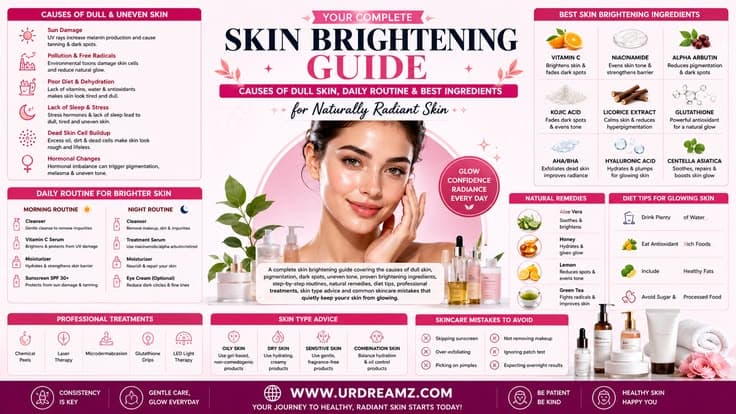
2. What Causes Dull, Uneven Skin in the First Place
Dullness isn't a single condition with a single cause — it's the end result of one or several overlapping factors, which is why the same routine won't fix every type of dullness equally well. Understanding which factor or combination of factors applies to your own skin makes it much easier to choose the right response rather than buying products based on packaging alone.
| Cause | How It Makes Skin Look Dull or Uneven |
|---|---|
| Dead skin cell buildup | A layer of accumulated dead cells on the surface scatters light unevenly and makes skin look rough and flat |
| UV damage and sun exposure | Stimulates irregular melanin production, causing dark spots, sunspots and uneven tone over time |
| Dehydration | Skin without adequate water plumps poorly and appears creased, tired and lacking in natural bounce |
| Poor circulation | Reduces the healthy flush that gives well-oxygenated skin its natural color |
| Pollution and environmental stress | Free radicals from pollution degrade the skin's surface and dull its texture |
| Lack of sleep | Interrupts overnight skin repair, leading to tiredness reflected visibly in the skin's appearance |
| Stress and hormonal shifts | Raise cortisol levels and can trigger pigmentation or inflammation that disrupts even skin tone |
| Post-acne marks and inflammation | Leave behind temporary or longer-lasting patches of discoloration |
3. Understanding Hyperpigmentation
Hyperpigmentation is a broad term for any area of skin that appears darker than the surrounding skin, caused by localized overproduction of melanin — the pigment that determines skin color. Several distinct types of hyperpigmentation behave differently and respond to slightly different treatments, which is worth knowing before choosing between products.
4. Types of Hyperpigmentation at a Glance
| Type | Common Cause | Typical Location |
|---|---|---|
| Post-inflammatory hyperpigmentation (PIH) | Left behind by healed pimples, rashes or minor injuries | Wherever breakouts occurred |
| Melasma | Hormonal changes, including pregnancy and oral contraceptives, amplified by UV | Typically cheeks, forehead, upper lip |
| Sunspots (solar lentigines) | Cumulative UV exposure over years | Cheeks, nose, hands, exposed areas |
| Freckles | Genetic tendency amplified by sun exposure | Nose, cheeks, shoulders |
| Acne marks (not true scars) | Inflammation from active acne triggering temporary melanin increase | Where active acne appeared |
5. The Role of Melanin in Skin Color and Pigmentation
Melanin is produced by cells called melanocytes and distributed into surrounding skin cells to provide color and a degree of natural UV protection. When these cells are triggered by UV light, inflammation, or hormonal signals, they produce melanin in greater quantities than the surrounding skin, resulting in a patch that appears darker. Most skin brightening ingredients work specifically by interrupting or slowing this process at one step or another in the melanin production pathway.
6. The Most Proven Skin Brightening Ingredients
| Ingredient | How It Works | Best Suited For |
|---|---|---|
| Vitamin C | Antioxidant protection + inhibits a key enzyme in melanin production + supports collagen | Overall glow, dark spots, sun damage |
| Niacinamide | Interrupts the transfer of melanin to skin cells + calms inflammation | Uneven tone, redness, PIH |
| Alpha arbutin | Slow-release inhibitor of the melanin-producing enzyme tyrosinase | Targeted dark spots, melasma |
| Kojic acid | Directly inhibits tyrosinase to reduce pigment production | Stubborn spots, uneven tone |
| Azelaic acid | Reduces melanin production and calms the inflammation that triggers it | Melasma, PIH, rosacea-related redness |
| Tranexamic acid | Disrupts the UV-triggered signals that drive excess melanin production | Melasma, stubborn pigmentation |
| Licorice extract | Contains glabridin, which inhibits tyrosinase activity gently | Sensitive skin, mild brightening |
| Retinol | Speeds cell turnover, carrying pigmented cells to the surface to shed faster | PIH, uneven texture, overall dullness |
7. Vitamin C Serum: Why It Earns Its Reputation
Vitamin C works through two distinct mechanisms that make it genuinely valuable for skin brightening: it intercepts free radicals generated by UV exposure before they can trigger melanin production, and it directly inhibits tyrosinase, the enzyme responsible for converting precursors into melanin. The result, used consistently over several weeks, tends to be a more even tone, reduced appearance of dark spots and an improved overall luminosity rather than a lightened complexion.
Pure ascorbic acid is the most potent and researched form but also the most unstable — it oxidizes relatively quickly when exposed to air, light or heat, turning orange-brown when degraded. Storage in an airtight, opaque container kept away from heat or sunlight meaningfully extends its useful life. Derivative forms such as ascorbyl glucoside and sodium ascorbyl phosphate are more stable and less irritating, a reasonable trade for slightly reduced potency, particularly for sensitive skin types.
8. Niacinamide: The Versatile Team Player
Niacinamide, a form of vitamin B3, stands out because it addresses multiple causes of uneven skin tone simultaneously. It reduces the transfer of melanin from the cells that make it to the skin cells that display it, calms the inflammatory signals that often trigger overproduction, and strengthens the skin barrier — all without causing irritation in most people, which makes it one of the most broadly compatible brightening ingredients in regular use. It pairs well with almost every other skincare ingredient, making it a sensible addition to most routines regardless of skin type.
9. Alpha Arbutin vs Kojic Acid: Which One to Choose
Both alpha arbutin and kojic acid inhibit the same enzyme in the melanin production process, but they differ in strength and gentleness. Alpha arbutin releases its active compound slowly and steadily, which tends to produce a more tolerable effect on sensitive skin with a lower risk of irritation, making it the more frequently recommended starting point for people new to brightening ingredients. Kojic acid acts more directly and tends to be more potent, but can cause irritation or even contact dermatitis in some people, particularly at higher concentrations or with frequent use. Starting with alpha arbutin and switching to or layering kojic acid if more effect is wanted tends to be a sensible approach.
10. Azelaic Acid and Tranexamic Acid for Pigmentation
Azelaic acid occupies a useful dual role in brightening routines because it both reduces melanin production and calms the inflammation that often drives it, making it particularly effective for post-acne marks and rosacea-associated redness. It's generally well tolerated by sensitive skin and available both over the counter at lower concentrations and by prescription at higher ones for more stubborn pigmentation. Tranexamic acid, originally a medical drug used to control bleeding, was observed to significantly reduce melasma in patients and has since been incorporated into topical skincare products, where it works through a different pathway than most other brightening ingredients and tends to complement rather than duplicate them.
11. Licorice Extract and Hyaluronic Acid for Sensitive Skin
Licorice root extract contains glabridin, a compound that gently inhibits tyrosinase activity with a lower risk of the irritation that some stronger brightening ingredients can cause. It's particularly useful for people with reactive or sensitive skin who want some brightening benefit without the risk of a flare. Hyaluronic acid doesn't directly affect pigmentation, but it contributes to overall brightness by deeply hydrating the skin — well-plumped, well-hydrated skin catches and reflects light more evenly, which has a visible brightening effect that works alongside any active brightening ingredient in the routine.
12. Skincare Ingredients That Should Not Be Used Together
| Combination | Why to Avoid | Better Approach |
|---|---|---|
| Retinol + AHA or BHA on the same application | Both increase cell turnover; using them together often causes irritation and barrier damage | Use retinol on separate nights from exfoliating acids |
| Vitamin C + Benzoyl Peroxide together | They can cancel each other's effectiveness | Vitamin C in the morning, benzoyl peroxide at night |
| Multiple exfoliating acids layered together | Over-exfoliation damages the skin barrier | Use one acid at a time, two or three times a week |
| Vitamin C and Retinol on the same occasion | Can be too irritating, particularly for newer users | Vitamin C in the morning, retinol at night |
13. Ingredients That Work Well Together
- Niacinamide and Hyaluronic Acid: Together they hydrate, strengthen the skin barrier and calm redness without any conflict.
- Vitamin C and Sunscreen: Vitamin C in the morning amplifies UV protection when paired with sunscreen, making both more effective at preventing new pigmentation.
- Ceramides and Hyaluronic Acid: Hyaluronic acid draws water into the skin; ceramides seal it in. Together they maintain the hydration that keeps skin plump and radiant.
- Alpha Arbutin and Niacinamide: Work through different pathways in the same overall direction, producing a more comprehensive brightening effect without irritation.
14. Building a Morning Skincare Routine for Brighter Skin
| Step | Product | Purpose |
|---|---|---|
| 1 | Gentle cleanser | Remove overnight oil and prep skin for actives |
| 2 | Face toner | Balance pH and provide an initial layer of hydration |
| 3 | Vitamin C serum | Antioxidant protection and melanin inhibition before UV exposure |
| 4 | Niacinamide serum (if used separately) | Calm redness, reduce melanin transfer, strengthen barrier |
| 5 | Lightweight moisturizer | Hydrate and seal in the layers below |
| 6 | Broad-spectrum sunscreen SPF 30 or higher | Prevent new UV-triggered pigmentation — the most critical step |
15. Building a Night Skincare Routine for Brighter Skin
| Step | Product | Purpose |
|---|---|---|
| 1 | Oil-based cleanser or micellar water | Remove sunscreen, makeup and surface impurities |
| 2 | Water-based cleanser | Thoroughly clean the skin before treatment |
| 3 | Toner | Balance skin and prep for better serum absorption |
| 4 | Active treatment serum (retinol, alpha arbutin or azelaic acid) | Target pigmentation and accelerate cell turnover overnight |
| 5 | Hydrating serum or hyaluronic acid | Replenish moisture alongside active treatment |
| 6 | Ceramide or peptide moisturizer | Support the skin barrier while it repairs through the night |
16. The Non-Negotiable Role of Sunscreen in Any Brightening Routine
Sunscreen isn't just a last step in a morning routine — it's the single product most responsible for determining whether any brightening routine actually makes lasting progress or spins its wheels. Every brightening ingredient in this guide works to reduce or fade existing pigmentation, but UV exposure continuously creates new pigmentation at a pace that easily outstrips what any serum can address. Daily broad-spectrum sunscreen, worn every morning regardless of season, weather or how much time is planned outdoors, is what allows everything else in the routine to actually gain ground rather than simply maintaining the status quo against ongoing UV-triggered darkening.
17. Exfoliation's Role in Brightening
Regular, gentle exfoliation removes the buildup of dead skin cells that physically dims the skin's surface, allowing it to reflect light more evenly and allowing serums applied afterward to penetrate more effectively. Chemical exfoliants — alpha hydroxy acids like glycolic and lactic acid for surface brightening, or beta hydroxy acids like salicylic acid for oilier or more congested skin — tend to produce more even, controlled results than physical scrubs, which can cause micro-tears and inconsistent abrasion. Once or twice a week is generally sufficient for most skin types; more frequent exfoliation tends to damage the skin barrier rather than accelerate results.
18. How to Layer Skincare Products in the Right Order
The general principle for layering skincare is thinnest to thickest — watery, lightweight products penetrate best when applied to clean skin before heavier formulas seal over them. A toner goes before a serum because it's lighter. A serum goes before a moisturizer because moisturizer creates a sealing layer that would block anything applied over it from reaching the skin properly. Sunscreen goes last in the morning because it's designed to sit on the skin's surface rather than penetrate it. Applying products out of this order doesn't necessarily ruin a routine, but it does reduce how efficiently each product reaches the skin.
19. Gel Moisturizer vs Cream Moisturizer for Brightening Skin
The moisturizer in a brightening routine doesn't need to be a brightening product itself — its job is to support the skin barrier, lock in hydration from the steps before it, and keep the skin comfortable enough to tolerate active ingredients consistently. Gel moisturizers tend to suit oilier skin types and warmer climates, providing hydration without adding weight or shine. Cream moisturizers suit drier skin or cooler climates, providing a richer, more occlusive layer that helps prevent moisture loss overnight. Neither is inherently superior for brightening; the right choice depends on skin type and personal comfort.
20. Natural Remedies With Some Basis for Brightening
| Natural Ingredient | Traditional Use and Evidence |
|---|---|
| Aloe vera | Soothes inflamed skin and provides hydration; contains aloesin, which shows some mild tyrosinase-inhibiting activity |
| Turmeric | Curcumin has anti-inflammatory and antioxidant properties; traditionally used in face masks for evening skin tone |
| Honey | Acts as a humectant, drawing moisture to the skin; has mild antibacterial properties useful for acne-related pigmentation |
| Yogurt | Contains lactic acid, a mild AHA that gently exfoliates the skin surface |
| Green tea extract | Rich in polyphenols that provide antioxidant protection; shows some evidence of reducing UV-induced pigmentation |
| Rose water | Mildly toning and soothing; provides hydration and a calming effect on irritated skin |
| Cucumber | High water content hydrates and soothes; cooling effect temporarily reduces puffiness |
A common caution worth raising: lemon juice is frequently suggested as a brightening home remedy due to its vitamin C content, but the pH of undiluted lemon juice is too acidic for direct skin application and frequently causes irritation, burns and, paradoxically, post-inflammatory hyperpigmentation — the opposite of what's intended. Vitamin C serum formulated for the skin is a more reliable, safer, and better-absorbed option.
21. DIY Face Masks Worth Trying
- Honey and Yogurt: Combine a spoon of plain yogurt with a spoon of honey for a hydrating and gently exfoliating mask that suits most skin types.
- Turmeric and Yogurt: A small amount of turmeric powder mixed into yogurt creates a traditional brightening mask, though turmeric can temporarily stain fair skin yellow.
- Oat and Milk: Ground oats combined with milk or yogurt soothes and very gently exfoliates, good for calming irritated or sensitive skin.
- Aloe Vera and Green Tea: Cooled brewed green tea mixed with aloe vera gel provides hydration, antioxidants and a cooling, calming effect after sun exposure.
22. Foods That Support Naturally Brighter Skin
| Food Group | Examples | Skin Benefit |
|---|---|---|
| Vitamin C sources | Citrus fruits, kiwi, strawberries, bell peppers | Support collagen synthesis and natural brightening |
| Antioxidant-rich foods | Berries, dark leafy greens, green tea, nuts | Protect skin cells from the oxidative damage that causes dullness |
| Omega-3 sources | Fatty fish, walnuts, flaxseeds, chia seeds | Reduce inflammation that can trigger pigmentation and dullness |
| Zinc-rich foods | Pumpkin seeds, lentils, chickpeas | Support skin repair and help regulate oil production |
| Collagen-supporting foods | Bone broth, eggs, citrus fruits | Provide amino acids and vitamin C needed for structural skin protein |
| Water-rich foods | Cucumber, watermelon, tomatoes, celery | Support hydration from the inside out alongside fluid intake |
23. A Sample Seven-Day Skin-Friendly Diet Plan
No specific meal plan can substitute for an overall varied diet, but the following week of examples illustrates the general principle of eating for skin health: plenty of antioxidants, vitamin C, omega-3 fats and staying well hydrated throughout.
| Day | Focus | Example Meals |
|---|---|---|
| Day 1 | Hydration and vitamin C | Oatmeal with orange slices, grilled chicken salad, watermelon snack |
| Day 2 | Omega-3 boost | Avocado toast with egg, salmon with greens, walnuts as snack |
| Day 3 | Gut and skin health | Plain yogurt with berries, quinoa salad, lentil soup |
| Day 4 | Beta-carotene and brightening | Mango smoothie, carrot and chickpea bowl, papaya as snack |
| Day 5 | Collagen support | Egg and spinach, sweet potato with chicken, kiwi snack |
| Day 6 | Skin barrier and repair | Greek yogurt, bean salad, grilled fish with steamed vegetables |
| Day 7 | Antioxidant protection | Spinach smoothie with berries, lentil soup, pomegranate for dessert |
24. Hydration, Sleep and Lifestyle Habits for Glowing Skin
Consistent water intake supports skin cell function and plumpness; a general guideline of eight to ten glasses daily is a reasonable target for most adults, adjusted upward in hotter conditions or with more physical activity. Sleep allows the skin to run its overnight repair cycle, including the cell turnover that carries pigmented or damaged cells to the surface to shed. Seven to eight hours of quality sleep consistently is one of the least expensive, most impactful "treatments" available for skin appearance. Regular movement improves blood circulation and reduces chronic stress — both of which influence how evenly and radiantly the skin looks over time.
25. Professional Treatments for More Significant Brightening
| Treatment | Main Effect | Best Suited For |
|---|---|---|
| Chemical peel | Removes outer skin layers with acid solutions to reveal fresher skin | Surface pigmentation, uneven texture, dull tone |
| Laser skin treatment | Targets melanin directly to break up pigment clusters | Sunspots, more stubborn pigmentation |
| Microdermabrasion | Physical exfoliation to remove dead surface layers | Superficial dullness, mild uneven texture |
| Microneedling | Creates micro-channels that stimulate collagen and improve product absorption | Acne marks, uneven texture, general radiance |
| HydraFacial | Combines cleansing, exfoliation and hydration in one treatment | Overall glow, dehydration, gentle congestion |
26. Skin Type Considerations for Brightening
A brightening routine built for oily skin focuses on oil-free, non-comedogenic product textures with ingredients like niacinamide that also help regulate excess oil production. Dry skin needs the same brightening actives but paired with richer, more hydrating formulas and careful introduction of exfoliating ingredients that can tip an already-dry skin into excessive dryness. Combination skin often benefits from balancing — lighter product textures in oilier zones while slightly richer formulas in drier areas. Sensitive skin benefits most from starting with the mildest brightening options (niacinamide, alpha arbutin, azelaic acid) at low concentrations, patch testing everything, and avoiding the more aggressive brightening ingredients until tolerance is established.
27. Korean Glass Skin Routine for Brightening
The Korean "glass skin" concept describes a layered approach to achieving a clear, reflective, almost translucent skin appearance through multiple lightweight hydrating steps rather than a single heavy product. The approach typically involves thorough double cleansing, a watery essence applied in thin layers multiple times to build hydration gradually, a brightening serum, a lightweight moisturizer, and a very high SPF for daytime. What makes this approach effective for brightening isn't any single K-beauty product but rather the philosophy of sustained, consistent hydration paired with diligent sun protection — the same underlying principles as the broader approach described throughout this guide.
28. Signs Your Skin Barrier Is Damaged and Needs Repair Before Anything Else
A damaged skin barrier almost always needs to be repaired before a brightening routine can function effectively, because a compromised barrier causes active ingredients to irritate rather than help and reduces the skin's ability to retain moisture that makes it look healthy. Signs of a damaged barrier include persistent tightness after cleansing, stinging or burning when gentle products are applied, redness that doesn't come from anything specific, increased breakouts, and skin that looks dry and dull regardless of how many products are applied. Repairing the barrier usually means stripping back to basics — a gentle cleanser, a ceramide-heavy moisturizer, and sunscreen — and allowing it to recover before reintroducing any active ingredients.
29. Brightening by Skin Concern: Quick Reference
| Skin Concern | Most Useful Ingredients |
|---|---|
| Overall dullness | Vitamin C, niacinamide, gentle exfoliation, hydration |
| Post-acne dark marks | Niacinamide, azelaic acid, alpha arbutin, retinol |
| Melasma | Tranexamic acid, azelaic acid, strict sun protection |
| Sun spots | Vitamin C, alpha arbutin, kojic acid, laser for stubborn cases |
| Uneven skin tone | AHA exfoliation, niacinamide, retinol |
| Dehydrated, tired-looking skin | Hyaluronic acid, ceramides, sleep, hydration |
30. Brightening for Teenage Skin
Teenage skin is often dealing with the aftermath of acne — primarily post-inflammatory hyperpigmentation rather than sun damage or melasma — making a gentle, PIH-focused approach the most relevant starting point. Niacinamide, azelaic acid and consistent sunscreen are well-tolerated by most teenage skin and effective against the type of discoloration most common at this age. Stronger ingredients like retinol can be introduced carefully at low concentrations for more persistent marks, ideally with guidance rather than self-directed escalation.
31. Brightening for Mature Skin
In mature skin, brightening concerns often combine several types simultaneously — sunspots from decades of UV exposure, general dullness from slowed cell turnover, and uneven texture from reduced collagen. A comprehensive approach addressing several of these at once tends to work better than targeting one alone, typically combining a retinoid for cell turnover, a vitamin C serum for antioxidant and brightening effect, careful exfoliation, rich moisturizing, and meticulous sun protection to prevent further damage.
32. Men's Skin Brightening
Men's skin tends to be somewhat thicker and oilier than women's, which can mean slightly slower surface brightening results from the same ingredients, simply because the active compound has slightly more to work through. The principles are identical — sunscreen, vitamin C, niacinamide, consistent exfoliation and hydration — and the most common gap is sunscreen, which tends to be the step most frequently skipped by men despite being the most important single product for preventing new pigmentation from forming.
33. How Long Does Skin Brightening Actually Take
This is one of the most commonly asked questions and one that genuinely varies based on the type and depth of pigmentation being addressed. Post-acne marks that are still relatively fresh tend to fade within four to eight weeks of consistent treatment. More established hyperpigmentation, including longer-standing dark spots and melasma, often takes three to six months of consistent use before meaningful improvement is visible. Sun damage accumulated over years takes longer still and sometimes requires a combination of topical care and professional treatment to see significant change. The common factor across all of these timelines is consistency — most brightening ingredients produce no meaningful overnight result, but over weeks they compound into visible improvement.
34. Skincare Mistakes That Keep Skin From Brightening
- Skipping sunscreen: Creates new pigmentation faster than most products can address existing marks, effectively keeping any brightening routine locked in a holding pattern.
- Over-exfoliating: Damages the skin barrier, causes inflammation, and can actually darken PIH by triggering more inflammation around existing marks.
- Sleeping with makeup on: Traps residue in pores overnight, contributing to congestion and dullness.
- Using too many active products simultaneously: Irritation from stacking incompatible actives causes inflammation, which ironically can worsen pigmentation over time.
- Touching the face frequently: Spreads bacteria, irritants and oil from hands onto the skin, contributing to breakouts that leave additional marks.
- Popping pimples: Increases inflammation and spreads bacteria, dramatically worsening the post-inflammatory pigmentation that follows.
- Switching products too quickly: Brightening ingredients typically require several weeks of consistent use before visible improvement appears; changing products before that window closes is the most common reason people feel a product "doesn't work."
- Using unsafe or unregulated whitening products: Some products marketed for skin whitening contain unlisted ingredients like hydroquinone at illegal concentrations, mercury, or steroids, which can cause serious skin and health damage over time.
35. Skin Brightening Myths Worth Knowing About
| Myth | More Accurate Reality |
|---|---|
| Lemon juice brightens skin safely | It's too acidic for direct skin contact and frequently causes irritation and rebound pigmentation |
| Sunscreen only matters on sunny days | UVA radiation penetrates clouds and glass; daily application is needed regardless of weather |
| More expensive brightening products work better | Ingredient percentage and formulation quality matter more than price |
| Results should be visible within a week | Most brightening ingredients need consistent use over weeks to months to produce visible change |
| Natural and DIY always means safe | Some natural ingredients cause irritation or photosensitivity; all skincare warrants patch testing |
| Darker skin tones don't need sun protection | All skin tones are susceptible to UV-induced pigmentation and skin damage |
36. Building a Weekly Brightening Routine
Beyond the daily morning and night routine, a weekly layer of care can meaningfully support brightening progress without requiring daily use of every step. Once or twice a week, incorporating a gentle chemical exfoliant removes the dead cell layer that dulls the surface. A weekly brightening mask — whether a product-based sheet mask or a simple home version like the yogurt and honey combination mentioned earlier — adds an extra targeted session. A regular facial oil massage, either with rosehip oil or another skin-compatible oil, improves circulation and temporarily gives the skin a more luminous appearance while supporting overall skin health.
37. Vitamin C Serum Application Guide
- Apply to clean, dry skin in the morning before any other serum or product.
- Use two to three drops for the face and a little more if extending to the neck.
- Press gently into the skin rather than rubbing, and allow it to fully absorb before the next step.
- Always follow with sunscreen in the morning, since vitamin C's antioxidant protection amplifies UV defense when the two are combined.
- Store in a cool, dark place, and replace the bottle if it turns significantly orange or brown, which indicates the active compound has oxidized and lost potency.
- If starting for the first time, begin with two to three times per week to allow the skin to adjust before moving to daily use.
38. Brightening Ingredient Comparison at a Glance
| Comparison Pair | Key Difference |
|---|---|
| Vitamin C vs Niacinamide | Vitamin C directly inhibits melanin production; niacinamide interrupts its transfer. Both useful together in a routine |
| Alpha arbutin vs Kojic acid | Alpha arbutin is gentler and more stable; kojic acid is stronger but more irritating for some people |
| Azelaic acid vs Tranexamic acid | Azelaic targets production and inflammation; tranexamic disrupts the UV signaling process. Both particularly effective for melasma |
| Retinol vs Vitamin C | Retinol accelerates cell turnover to shed pigmented cells; vitamin C prevents new pigment from forming. Work well as morning-night pairing |
| Chemical peel vs Laser treatment | Chemical peel addresses surface-level dullness and mild pigmentation; laser can target deeper or more stubborn pigment clusters |
39. A Beginner's Week-One Brightening Routine
For anyone starting completely fresh, simplicity is the most reliable approach in the first week. A gentle face wash morning and night, a single brightening ingredient introduced every other day to allow tolerance to build, a basic moisturizer and daily sunscreen covers all the important bases without overwhelming new skin with multiple actives at once. Niacinamide or a vitamin C serum used every other morning to start, building to daily once the skin shows it's tolerating well, is a practical first-week plan. Adding a second active ingredient is then reasonable in week three or four, once the first is established and the skin's response is known.
40. Frequently Asked Questions
What is the single most effective thing I can do for brighter skin?
Consistent daily sunscreen use. It prevents the constant creation of new pigmentation that outpaces what any brightening serum can address.
Can I use vitamin C and niacinamide together?
Yes. The older concern about these two canceling each other out has been largely addressed by modern formulations, and they work well together in most current routines, complementing each other's different mechanisms.
How long does it take for dark spots to fade?
Recent PIH may begin visibly fading within four to eight weeks of consistent treatment. More established spots typically take three to six months or longer, and melasma often requires professional input alongside home care for meaningful improvement.
Is lemon juice a good home remedy for brightening?
No. Despite its vitamin C content, undiluted lemon juice is too acidic for direct skin application and frequently causes irritation or worsening pigmentation. A formulated vitamin C serum is a safer, more reliable option.
Which brightening ingredient is safest for sensitive skin?
Niacinamide is generally considered the most broadly gentle and compatible brightening ingredient for sensitive skin types, followed by azelaic acid and licorice extract at lower concentrations.
Does brightening skincare make skin sensitive to the sun?
Some brightening ingredients, particularly retinol and certain exfoliating acids, do increase sun sensitivity during use, which is exactly why sunscreen in any brightening routine isn't optional — it's what makes the entire approach safe and effective simultaneously.
41. Final Thoughts
Naturally brighter, more even skin is a realistic goal for almost anyone, but it's a patient, consistent process rather than a quick fix. The core framework is simple: daily sunscreen to prevent new pigmentation, one or two well-chosen brightening ingredients used consistently to address existing unevenness, gentle exfoliation once or twice a week to keep the surface clear, and enough hydration to keep the skin functioning well. Everything else — diet, sleep, stress management — adds meaningful supporting benefit to that foundation. The most common reason brightening routines don't produce results isn't that the products don't work; it's that they weren't given enough consistent time, or that skipping sunscreen made every session of progress temporary. Build the foundation, stay consistent, and give it real time.