Skin Barrier Explained: Signs of a Damaged Skin Barrier, Causes, Repair Methods and Complete Skincare Guide
The skin barrier is the most important concept in modern skincare, and yet most people only discover it exists when it stops working properly — when a routine that seemed fine suddenly causes burning, when skin that was manageable becomes sensitive to everything, or when a cycle of persistent dryness, breakouts and irritation won't resolve no matter how many products are added. Understanding the skin barrier from the beginning changes how every other skincare decision is made. This guide covers the full picture from structure to repair, including the best ingredients, routines, foods, lifestyle habits and the recovery timeline to set realistic expectations. It builds naturally on the face cleansing guide, skin exfoliation guide, sunscreen guide, acne treatment guide, anti-aging guide and skin brightening guide.
1. What the Skin Barrier Actually Is
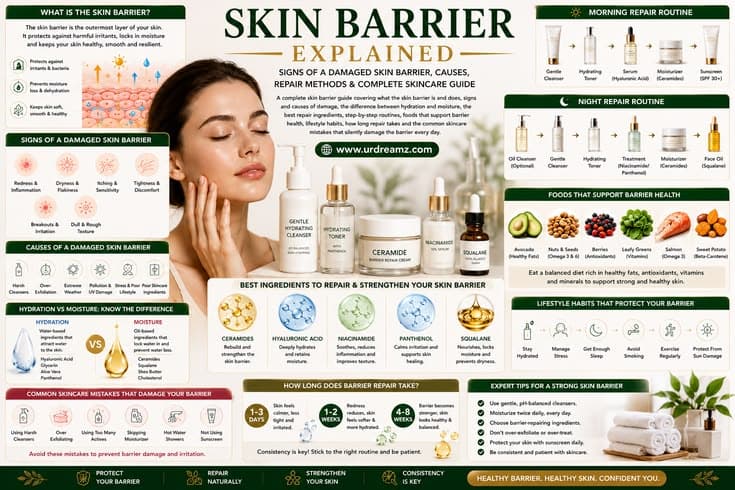
The skin barrier, also called the moisture barrier or epidermal barrier, is the outermost functional layer of the skin — specifically the stratum corneum, the topmost part of the epidermis. Its job is to act simultaneously as an exit gate that keeps moisture inside the skin and an entry gate that prevents harmful substances from getting in. It performs both functions continuously, without any conscious effort — until something disrupts it.
The most commonly used analogy for the skin barrier is a brick wall. The "bricks" are mature skin cells called corneocytes — flattened, protein-rich cells that have completed their lifecycle and migrated to the surface to form a protective physical layer. The "mortar" holding them together is a mixture of lipids: ceramides (roughly 50 percent of the lipid composition), cholesterol and free fatty acids. When both the bricks and the mortar are intact and in appropriate proportions, the barrier is strong, hydrated and resilient. When cells are damaged or the lipid mortar is depleted, the structure becomes porous — water escapes where it should be retained, and irritants, bacteria and allergens enter where they should be blocked.
2. The Five Core Functions of a Healthy Skin Barrier
| Function | When It Works | When It Fails |
|---|---|---|
| Prevents water loss | Skin stays plump, hydrated and soft | Skin becomes dry and tight despite moisturizer |
| Blocks pathogens | Harmful bacteria, viruses and fungi stay outside | Higher risk of infections and persistent breakouts |
| Filters allergens and irritants | Fragrance, dust and chemicals stay on the surface | Increased sensitivity to previously tolerated substances |
| Maintains skin balance | pH, oil production and microbiome stay regulated | pH imbalance; microbiome disruption increases inflammation |
| Supports healthy aging | Skin retains elasticity; fine lines develop slowly | Accelerated visible aging from chronic moisture loss |
3. Skin Barrier vs Moisture Barrier: Is There a Difference
The two terms are used interchangeably in most skincare contexts. The "skin barrier" refers to the full stratum corneum including its physical cell structure, while "moisture barrier" emphasizes specifically the lipid-based function of preventing water loss. When someone says their moisture barrier is damaged, they mean the lipid layer has been depleted enough that transepidermal water loss has increased — the skin is losing moisture faster than it can retain it. Both terms point to the same underlying reality: the outermost skin layer is not functioning optimally and needs support to restore its structural integrity.
4. Hydration vs Moisture: Two Different Concepts That Both Matter
Hydration refers to the water content within skin cells. When the skin is dehydrated, it appears dull, feels tight, shows surface creases more prominently and may look simultaneously dry and oily as it overproduces oil to compensate. Hydration is delivered by humectant ingredients: hyaluronic acid, glycerin, aloe vera and panthenol, which attract water molecules to the skin cells.
Moisture refers to the oil content and lipid structure on and within the skin surface. When skin is under-moisturized, water evaporates too readily even when water content initially exists. Moisture is delivered and retained by emollients and occlusives: ceramides, fatty acids, shea butter, squalane and petrolatum. For genuinely healthy skin, both are needed — hydration quenches the skin from within, and moisture seals it in so it cannot escape.
5. Transepidermal Water Loss: The Science Behind Barrier Health
Transepidermal water loss (TEWL) is the amount of water that passively evaporates through the skin surface into the surrounding environment. A healthy intact barrier keeps TEWL low. When the barrier is damaged, TEWL increases and the skin loses water faster than the body can replenish it. This is what creates the characteristic tight, dry, dull appearance of a compromised barrier — the skin is physically losing its water content through a barrier too porous to hold it in, regardless of how much moisturizer is applied on top. The practical at-home indicator is noticing whether the skin feels dry and tight within minutes of cleansing even after moisturizer is applied.
6. Signs of a Damaged Skin Barrier
The challenge with identifying barrier damage is that many of its symptoms overlap with other skin conditions. The distinguishing factor is that several symptoms appear together, often with a clear connection to recent skincare changes or habits known to affect the barrier.
| Sign | What It Indicates |
|---|---|
| Skin feels tight after cleansing | Cleanser has stripped natural lipids; barrier cannot hold moisture |
| Persistent redness | Inflammation from a compromised barrier allowing irritants in |
| Burning or stinging after applying skincare | Products penetrating a damaged barrier and reaching nerve endings |
| Dry, flaky or rough patches | Insufficient lipid layer allowing moisture to escape |
| Skin looks dull despite hydration | A damaged surface layer scatters light rather than reflecting it evenly |
| Previously tolerated products now cause irritation | Increased barrier permeability; ingredients penetrate too deeply |
| Increased breakouts without obvious cause | Compromised barrier allows bacteria to penetrate; inflammation drives congestion |
| Skin feels dehydrated despite moisturizing | Moisturizer is not retained because the barrier cannot seal it in |
| Makeup sits poorly or looks patchy | Uneven surface texture and dehydration cause poor product adhesion |
| Itching without visible rash | Sensitized nerve endings in skin with an insufficient protective layer |
7. What Causes Skin Barrier Damage
Barrier damage almost never comes from a single cause in isolation. More commonly it results from a combination of factors — several individually minor stressors accumulating over time until the barrier's capacity to repair itself is outpaced by the rate at which it's being compromised. Identifying and addressing the combination is more effective than fixing one thing while the others continue.
8. Over-Exfoliation: The Most Common Cause
Over-exfoliation is the single most common cause of barrier damage in people who follow active skincare routines. AHAs, BHAs and physical scrubs work partly by disrupting the bonds holding surface skin cells together. At appropriate frequency this is beneficial. At too high a frequency or concentration, the same mechanism removes healthy skin cells alongside dead ones, depletes the lipid mortar holding the barrier together, and leaves skin increasingly raw and porous.
Recovery requires completely stopping all exfoliating products for several weeks — not reducing frequency, but stopping entirely — until the barrier has rebuilt itself sufficiently. Trying to continue at a reduced frequency while the barrier is actively damaged almost always extends recovery rather than shortening it. The full timeline is covered in the skin exfoliation guide.
9. Harsh Cleansers and the pH Connection
A healthy skin barrier has a mildly acidic surface pH of between 4.5 and 5.5. This slightly acidic environment supports the natural skin microbiome and allows the enzymes that regulate normal skin shedding to function properly. Highly alkaline cleansers — traditional bar soaps typically have a pH of 9 to 10 — disrupt this balance and weaken the environment the barrier depends on. High-foaming cleansers using aggressive sulfates like sodium lauryl sulfate remove surface lipids alongside dirt. A cleanser that leaves skin squeaky clean, very tight or dry immediately after rinsing is almost certainly damaging the barrier with every use. More detail on choosing appropriate cleansers is in the face cleansing guide.
10. Too Many Active Ingredients Used Simultaneously
Retinoids, high-percentage vitamin C, glycolic acid, salicylic acid and benzoyl peroxide are all individually effective, but all carry potential to cause significant irritation and barrier disruption when layered together before tolerance to each is established. The concept of skin cycling — alternating active ingredients across different nights rather than using them all nightly — directly acknowledges that the skin needs recovery time between applications of aggressive actives. Introducing one active ingredient at a time, confirming tolerance over several weeks, and only then considering whether to add a second one is consistently more effective than building an elaborate multi-active routine from the start that overwhelms the barrier before any individual product has had a fair assessment.
11. Hot Water, Overwashing and Environmental Stressors
Hot water dissolves the lipid mortar holding the barrier together far more aggressively than lukewarm water. Long hot showers remove natural oils the skin produces to protect its own surface. Over time this depletes the barrier's lipid layer as effectively as over-exfoliation. Washing the face more than twice daily has a similar accumulative effect — the skin simply cannot produce protective lipids fast enough to replace what frequent washing removes.
Environmental factors compound this: cold dry air in winter increases transepidermal water loss. Air conditioning indoors creates similarly low humidity year-round. Pollution generates oxidative stress that damages skin cells and weakens barrier structural proteins. UV radiation, covered in the sunscreen guide, damages skin cells directly and impairs the barrier's ability to repair itself over time.
12. Who Is Most Vulnerable to Barrier Damage
| Risk Factor | Why It Increases Vulnerability |
|---|---|
| Naturally dry skin | Produces fewer lipids to begin with; less reserve before the barrier becomes insufficient |
| Sensitive or reactive skin | Inherently lower tolerance threshold for external stressors |
| Eczema or atopic dermatitis | Genetic mutation in filaggrin — a protein crucial to barrier structure — creates structural weakness |
| Rosacea | Barrier is inherently more permeable; triggers cause flushing and inflammation more easily |
| Active skincare users using multiple actives | Retinoids, benzoyl peroxide and acids all have barrier-depleting potential when overused |
| Mature skin | Lipid production declines with age; barrier naturally becomes thinner and less resilient |
| Swimmers | Repeated chlorine exposure strips surface lipids from the skin |
| Cold climate residents | Low-humidity cold air draws moisture from the skin constantly |
13. The Ten Best Ingredients for Skin Barrier Repair
Not all moisturizing or hydrating ingredients work in the same way for the skin barrier. Ingredients fall into three functional categories — humectants that draw water in, emollients and barrier lipids that reinforce the lipid structure, and occlusives that seal moisture in — and an effective repair routine ideally includes ingredients from all three categories.
14. Ceramides: The Most Important Barrier Ingredient
Ceramides are lipid molecules that occur naturally in the skin and make up approximately half of the lipid composition of the skin barrier. When the barrier is damaged, ceramide levels in the skin drop. Replenishing them topically is one of the most direct approaches to structural barrier repair. Products labeled with ceramide NP, AP, EOP or by number (ceramide 1, 2, 3) are the ones to look for. Ceramides work best in combination with cholesterol and fatty acids, which is why products formulated to mimic the skin's natural lipid ratio produce better barrier repair results than those containing ceramides alone.
15. Hyaluronic Acid: Deep Hydration for Recovery
Hyaluronic acid is a naturally occurring substance in skin tissue that can bind many times its weight in water. During barrier repair it draws water into skin cells and, when layered beneath an occlusive or ceramide moisturizer, helps maintain the water content rather than allowing it to evaporate. An important nuance: hyaluronic acid applied in very dry environments without an occlusive product on top can draw moisture from the deeper skin layers, potentially worsening dryness. This is why applying it to damp skin and following immediately with a moisturizer is practically significant. During barrier repair this layering sequence is especially important.
16. Niacinamide: Barrier-Strengthening from Within
Niacinamide, a form of vitamin B3, stimulates the skin's own production of ceramides and fatty acids, meaning it supports the barrier from inside rather than simply adding a topical layer. Over consistent use it measurably increases the skin's native lipid production, which strengthens barrier function rather than just compensating temporarily. Its additional benefits — calming redness, regulating oil production, improving texture — make it one of the most broadly useful ingredients in any barrier-focused routine. It is gentle enough to use daily during the repair phase when most other actives should be paused.
17. Glycerin, Squalane, Panthenol and Occlusive Ingredients
Glycerin is one of the most consistently effective humectant ingredients in skincare — it draws water from the environment and deeper skin layers to maintain surface hydration, is non-irritating, and is compatible with almost every other ingredient. Squalane, a plant-derived oil structurally similar to the skin's own sebum, functions as an emollient and mild occlusive that reinforces the outer lipid layer without clogging pores or causing reactions even in oily skin types.
Panthenol, which converts to vitamin B5 in the skin, supports the natural repair process at a cellular level — it reduces the burning and stinging associated with a compromised barrier, promotes faster resolution of inflammation, and contributes humectant hydration alongside its reparative role. Petrolatum, the active in Vaseline, is one of the most effective occlusives available, forming a physical film that significantly reduces water evaporation from the skin surface. "Slugging" — applying a thin layer of petrolatum as the final step of the night routine — traps the barrier repair products applied beneath it overnight. Shea butter provides similar occlusive benefit with additional emollient fatty acids for people who find petrolatum too heavy in texture.
18. Centella Asiatica and Colloidal Oatmeal for Reactive Skin
Centella asiatica, known in Korean skincare as Cica, contains compounds with meaningful anti-inflammatory and wound-healing activity in the skin. It reduces redness, calms the irritation cycle that damaged skin tends to be trapped in, and supports collagen synthesis during repair. It has become one of the most prominent ingredients in barrier repair products and sensitive skin formulations over the past decade, and the evidence behind its skin-calming properties is relatively strong compared to many botanical ingredients.
Colloidal oatmeal is finely milled oat with a long history in dermatology for eczema and sensitive skin care. It forms a protective film on the skin surface, provides anti-inflammatory activity, and is specifically recognized as a skin protectant by regulatory authorities in several countries — a distinction few cosmetic ingredients achieve. It is particularly useful for the most reactive and itchy stage of barrier damage, including eczema flares.
19. Ingredients Comparison: What to Use and Why
| Ingredient | Category | Primary Benefit | Best For |
|---|---|---|---|
| Ceramides | Barrier lipid | Directly replenishes barrier lipid structure | All damaged skin types |
| Hyaluronic acid | Humectant | Draws and holds water in skin cells | Dehydrated and dry skin |
| Glycerin | Humectant | Attracts water from environment and deeper skin | All skin types, daily use |
| Niacinamide | Active repair | Stimulates natural ceramide production | All skin types including oily |
| Panthenol | Healing agent | Soothes, repairs, reduces inflammation | Irritated and reactive skin |
| Squalane | Emollient oil | Reinforces lipid layer, reduces moisture loss | All skin types including oily |
| Centella asiatica | Anti-inflammatory | Calms inflammation, supports repair | Sensitive, rosacea, post-procedure |
| Colloidal oatmeal | Skin protectant | Forms protective film, soothes itching | Eczema, severely reactive skin |
| Shea butter | Occlusive/emollient | Softens and seals moisture into the skin | Dry and very dry skin |
| Petrolatum | Occlusive | Most effective moisture-sealing ingredient available | Very damaged, extremely dry or healing skin |
20. Ingredients to Temporarily Avoid During Repair
| Ingredient or Product | Why to Avoid During Repair |
|---|---|
| AHAs and BHAs | Continue the exfoliation that likely contributed to the damage |
| Physical scrubs | Mechanical abrasion on compromised skin causes further irritation |
| Retinoids (if causing irritation) | Speed cell turnover at a rate the damaged barrier cannot keep up with |
| High-percentage vitamin C | Low-pH formulas sting irritated skin and can slow recovery |
| Fragrances and essential oils | Common sensitizers that penetrate more deeply through a damaged barrier |
| Alcohol-based toners | Drying and barrier-depleting |
| Benzoyl peroxide (if drying) | Can increase barrier permeability and irritation during repair phase |
21. Morning Skin Barrier Repair Routine
| Step | Product Type | What to Look For |
|---|---|---|
| 1. Cleanse | Gentle, pH-balanced, non-foaming cleanser | Ceramides, glycerin; free of sulfates and fragrance |
| 2. Hydrate | Hydrating serum on damp skin | Hyaluronic acid, glycerin, panthenol |
| 3. Repair serum | Niacinamide serum | Supports ceramide production; calms redness gently |
| 4. Moisturize | Ceramide moisturizer | Ceramides, cholesterol, fatty acids, shea butter |
| 5. Protect | Mineral sunscreen SPF 30 or higher | Zinc oxide or titanium dioxide; fragrance-free |
Keep the morning routine to these five steps maximum during active repair. Adding more products introduces more variables and potential irritants at the moment when simplicity is most important. A minimal but well-chosen routine consistently outperforms an elaborate one during barrier repair.
22. Evening Skin Barrier Repair Routine
| Step | Product Type | What to Look For |
|---|---|---|
| 1. Remove makeup | Gentle oil cleanser or micellar water | Non-stripping; no fragrance; rinses cleanly |
| 2. Cleanse | Same gentle pH-balanced cleanser as morning | Consistency — no switching cleansers during repair |
| 3. Hydrate | Hydrating toner or essence on damp skin | Hyaluronic acid, panthenol, centella asiatica |
| 4. Repair moisturizer | Ceramide or barrier repair cream | Richer formula for overnight; ceramides, fatty acids |
| 5. Occlusive seal | Thin layer of petrolatum or balm (for very dry/damaged skin) | Locks everything in overnight; use sparingly |
23. The Barrier Repair Timeline: What to Expect
One of the most important pieces of information for anyone repairing a damaged skin barrier is a realistic timeline. The skin heals according to biological processes that cannot be significantly accelerated by adding more products — only by stopping what's disrupting the process and providing appropriate support. The timeline below reflects generally consistent observations but individual variation exists based on severity and skin type.
| Timeline | What Typically Improves |
|---|---|
| Days 1-3 | Reduced tightness and burning as the most acute inflammation begins to settle |
| Days 3-7 | Less stinging when applying products; redness begins to decrease; skin feels slightly less reactive |
| Weeks 1-2 | Improved hydration and comfort; fewer products cause irritation; skin feels calmer overall |
| Weeks 2-4 | Noticeable improvement in texture; dry patches resolve; skin begins to look healthier |
| Weeks 4-8 | Barrier function becomes significantly stronger; actives can begin to be reintroduced very slowly |
| Months 2-3 | Most mild to moderate damage is largely repaired with consistent gentle care |
Severe barrier damage — from extended periods of over-exfoliation, prescription retinoid overuse or a significant reaction to a product — may take longer than three months to fully resolve. Consulting a dermatologist is appropriate when the timeline extends beyond what consistent home care can reasonably be expected to address.
24. Skin Barrier Care for Sensitive Skin
Sensitive skin and a damaged skin barrier share many symptoms, which creates genuine confusion about which is which. The practical distinction is that sensitive skin is an inherent skin type — it tends to react to a wide range of inputs even when the barrier is intact — while a damaged barrier is an acquired condition that can improve with appropriate care and will eventually allow some of the same products that were previously tolerated to be used again. Genuinely sensitive skin, by contrast, will continue to require careful product selection indefinitely.
For both sensitive skin and damaged barrier skin, the approach is essentially the same: fragrance-free, alcohol-free, minimal-ingredient products; mineral rather than chemical sunscreen; patch testing any new product before full-face application; no more than two or three product steps in the routine at a time; and consistent use of ceramide-based moisturizer rather than changing products frequently. Aloe vera, oat extract and centella asiatica are particularly useful soothing additions for skin that remains reactive even when the basic barrier routine is in place.
25. Skin Barrier Health at Different Life Stages
| Life Stage | Barrier Characteristics | Key Care Priorities |
|---|---|---|
| Teenagers | Active oil production; acne-prone; potential over-treatment with drying products | Gentle cleanser; avoid stripping actives; non-comedogenic moisturizer |
| Early 20s | Barrier generally robust but often disrupted by first-time active use | Introduce actives slowly; don't over-exfoliate; build a consistent basic routine |
| Late 20s to 30s | Lipid production beginning to slow slightly; fine lines beginning to appear | Ceramide moisturizer; retinol introduced carefully; consistent sunscreen |
| 40s and 50s | Measurable decline in lipid production; barrier thins; more susceptible to dryness | Richer ceramide formulas; occlusive steps at night; more conservative exfoliation |
| 60s and beyond | Significantly thinner skin barrier; much lower lipid production; slower repair | Maximum hydration and occlusive sealing; very gentle exfoliation only occasionally |
26. Skin Barrier Health for Acne-Prone Skin
Acne-prone skin presents a particular challenge for barrier health because many of the most effective acne treatments — retinoids, benzoyl peroxide, salicylic acid, adapalene — are also barrier-disrupting at higher frequencies or concentrations. The temptation to use all of these simultaneously and aggressively is understandable given how distressing active breakouts are, but the resulting barrier damage often worsens inflammation and increases breakout frequency rather than reducing it.
The most effective approach is choosing one or two primary actives, introducing them slowly, and maintaining a robust barrier-supporting base of a gentle cleanser, hydrating serum and non-comedogenic ceramide moisturizer beneath and between active applications. A healthy barrier actually reduces acne susceptibility in the long run, because intact skin is better able to regulate bacterial populations and resist the inflammation that drives breakout cycles. The full acne treatment approach is covered in the acne treatment guide.
27. Skin Barrier Repair After Retinol
Retinoids are among the most evidence-backed skincare ingredients available, but they also carry one of the most consistent patterns of initial barrier disruption, often described as the "retinization period" — several weeks of increased dryness, flaking and sensitivity while the skin adjusts to the ingredient's acceleration of cell turnover.
If the barrier has already been damaged before retinol is introduced, the two problems compound each other significantly. The standard recommendation is to repair the barrier first, then introduce retinol at the lowest available concentration on alternate nights (or even less frequently initially), always paired with a ceramide moisturizer applied immediately afterward. "Buffering" — applying a small amount of moisturizer before the retinol rather than after — dilutes the retinol slightly and is a recognized technique for reducing initial irritation in those who find even low concentrations uncomfortable.
28. Foods That Support Skin Barrier Health
The lipid composition of the skin barrier is influenced partly by the dietary fats consumed. Diets consistently low in essential fatty acids produce a barrier that's structurally less capable of retaining moisture. Eating for skin barrier health doesn't require supplements or exotic foods — it primarily means ensuring adequate intake of the nutrient categories listed below through a reasonably varied diet.
| Food Category | Examples | Benefit to the Skin Barrier |
|---|---|---|
| Omega-3 fatty acids | Salmon, sardines, walnuts, flaxseeds, chia seeds | Support the lipid composition of the barrier; reduce inflammation that disrupts it |
| Healthy fats | Avocado, olive oil, nuts | Provide essential fatty acids that contribute to barrier lipid structure |
| Vitamin C sources | Citrus, kiwi, bell peppers, berries | Support collagen production; antioxidant protection of barrier cells |
| Zinc-rich foods | Pumpkin seeds, lentils, chickpeas, eggs | Support the cellular repair processes that maintain barrier integrity |
| Antioxidant-rich vegetables | Spinach, kale, sweet potatoes, carrots | Protect barrier cells from oxidative damage from pollution and UV |
| Probiotic foods | Yogurt, kefir, fermented foods | Support gut health, which has an emerging connection to skin inflammation and barrier function |
| Water and hydrating foods | Cucumber, watermelon, tomatoes, herbal tea | Maintain the hydration within skin cells that the barrier is designed to preserve |
29. Lifestyle Habits That Protect the Skin Barrier
- Sleep seven to nine hours consistently: The skin's repair cycle runs most intensively during sleep; chronic sleep deprivation directly impairs the skin's overnight barrier maintenance processes.
- Manage stress actively: Chronic stress raises cortisol, which both impairs the skin barrier's lipid production and increases inflammation that disrupts it. Any sustainable stress reduction — movement, sleep, time outdoors, whatever works individually — has measurable downstream benefits for the skin barrier.
- Use a humidifier in dry environments: Air conditioning and winter heating both create low-humidity indoor environments that draw moisture from the skin continuously. A humidifier in the bedroom particularly, where most hours of low activity are spent, significantly reduces the atmospheric moisture gradient that drives transepidermal water loss during rest.
- Take lukewarm rather than hot showers: Hot water is one of the most consistent barrier disruptors across all skin types; simply lowering shower temperature removes one of the more significant daily barrier stressors without any product change required.
- Avoid smoking: Smoking restricts blood flow to the skin, depletes vitamin C essential to skin repair, and generates free radicals that directly damage barrier cell structure.
- Wear sunscreen daily: UV damage to skin cells accumulates over time and directly impairs the barrier's ability to maintain itself. Daily SPF is a barrier protection habit as much as an anti-aging one. See the sunscreen guide for formulation and application details.
- Eat adequate protein: Skin cells are protein-rich; dietary protein provides the amino acid building blocks for cellular repair throughout the body including the skin.
30. Healthy vs Damaged Skin Barrier: A Direct Comparison
| Feature | Healthy Skin Barrier | Damaged Skin Barrier |
|---|---|---|
| Lipid structure | Intact; ceramide, cholesterol and fatty acid levels adequate | Depleted; gaps in lipid mortar allow water to escape |
| Moisture retention | Water stays in; skin plump and hydrated | High TEWL; skin loses water continuously |
| Microbiome balance | Good bacteria thrive; supports skin defense and pH | Disrupted; harmful bacteria penetrate more easily |
| Sensitivity | Calm and resilient; tolerates most products well | Reactive; products and environmental factors trigger irritation |
| Appearance | Even, smooth, naturally radiant | Rough, flaky, dull, sometimes oily and dehydrated simultaneously |
| Repair capacity | Minor daily damage repairs overnight | Overwhelmed; daily damage accumulates faster than repair can occur |
31. Common Mistakes That Damage the Skin Barrier Silently
- Washing the face more than twice daily unless exercise creates a specific need for a third cleanse.
- Using a harsh cleanser with the logic that cleaner equals better — a cleanser that strips the barrier is counterproductive regardless of how clean it feels immediately after.
- Exfoliating too frequently without adequate recovery days between sessions.
- Layering multiple strong actives in the same routine without spacing them across different nights.
- Skipping moisturizer on oily skin days — oily skin can absolutely have a dehydrated and damaged barrier.
- Not wearing sunscreen on cloudy or indoor-only days — UV exposure through windows is a real barrier stressor.
- Picking at acne or skin — mechanical disruption of the skin surface directly damages barrier integrity locally.
- Switching skincare products very frequently — the skin needs time to adjust to any product; constant switching prevents accurate assessment of what's helping and keeps the barrier in a permanent state of adjustment.
- Ignoring early warning signs of irritation with the assumption they'll resolve on their own — early irritation usually indicates a product or frequency adjustment is needed before more serious damage develops.
32. Skin Barrier Myths Worth Addressing
| Myth | More Accurate Reality |
|---|---|
| Oily skin cannot have a damaged barrier | Oily skin and a compromised moisture barrier are completely compatible conditions; over-cleansing and over-exfoliation damage the barrier regardless of oil production |
| A damaged barrier can be permanently fixed quickly by the right product | Barrier repair is a biological process that takes weeks to months and requires stopping what caused the damage as much as adding what supports repair |
| More products mean better skin barrier support | During repair especially, fewer products reduce the chance of introducing additional irritants; simplicity is more effective than complexity |
| The "purging" from a new product is normal and should be pushed through | True purging from actives that speed cell turnover is short-lived and location-specific; widespread or prolonged irritation is more likely barrier damage that warrants stopping the product |
| Natural and organic products are always gentler on the barrier | Fragrances and essential oils in natural products are among the most common causes of contact sensitization and barrier disruption in skincare |
33. Skin Barrier Repair for Teenagers
Teenage skin is often genuinely oilier and more acne-prone than adult skin, which creates a common pattern: the skin is over-treated with drying, stripping products in an attempt to control oil and clear breakouts, and the barrier becomes damaged in the process. This paradoxically increases oiliness, inflammation and breakout frequency rather than reducing them, because a stripped barrier triggers compensatory oil production and loses its ability to regulate the bacterial populations that drive acne inflammation.
For teenage skin specifically, a minimal routine — gentle cleanser suited to skin type, lightweight non-comedogenic moisturizer, daily SPF — with one targeted active ingredient introduced slowly if acne is significant, is both more effective and less damaging than an aggressive multi-step approach. The connection between acne and barrier health is covered in more depth in the acne treatment guide.
34. Skin Barrier and Anti-Aging: The Connection
A strong, intact skin barrier and the appearance of younger skin are closely connected for reasons beyond the obvious. A healthy barrier retains moisture effectively, which keeps skin plump and reduces the visibility of fine lines. Chronic moisture loss through a compromised barrier gradually depletes the collagen support structure beneath the skin over time, accelerating the structural changes associated with aging. The inflammation associated with a persistently damaged barrier also drives collagen breakdown, which is one of the mechanisms through which habitual over-exfoliation can paradoxically accelerate visible aging rather than preventing it.
Maintaining barrier health is therefore one of the most genuinely anti-aging habits available — not through any specific miracle ingredient but through the consistent support of the skin's natural protective and repair capacity. The anti-aging guide covers the broader aging prevention picture including collagen-supporting ingredients and routines.
35. Frequently Asked Questions
How do I know if my skin barrier is damaged rather than just dry?
The presence of multiple symptoms together — redness, burning, stinging from products, tightness after cleansing, increased breakouts and skin that feels dry despite moisturizer — points more toward barrier damage than simple dryness. Truly dry skin tends to feel dry but doesn't typically cause burning or stinging from ordinary skincare products.
Can oily skin have a damaged skin barrier?
Yes. Oily skin and barrier damage are not mutually exclusive. Oily skin that is over-cleansed or over-exfoliated can become dehydrated and barrier-compromised while still producing excess oil — sometimes more excess oil than before, as the damaged barrier triggers compensatory sebum production.
How long does skin barrier repair take?
Minor damage from a few sessions of over-exfoliation may improve within two to four weeks. More established damage from months of aggressive routines may take two to three months or longer. Consistent gentle care without setbacks produces more reliable recovery than an impatient approach that reintroduces actives before the barrier is ready.
Should I stop using retinol if my skin barrier is damaged?
If retinol is actively causing irritation or the skin barrier is clearly compromised, pausing it temporarily and focusing on barrier repair before reintroducing it at a lower frequency and concentration is the standard recommendation. Pushing through barrier damage with retinol typically extends the damaged period rather than resolving it.
Does sunscreen help protect the skin barrier?
Yes. UV radiation directly damages skin cells and impairs their ability to repair themselves. Daily sunscreen prevents this cumulative UV-driven damage and is therefore a genuine barrier health habit alongside its cancer and photoaging prevention roles.
Is the skin barrier the same as the moisture barrier?
The terms are used interchangeably in almost all skincare contexts. Technically the skin barrier includes both the physical cell structure and the lipid function, while the moisture barrier refers more specifically to the lipid layer that prevents water loss. In practice, when either is damaged, the same repair approach applies.
36. Final Thoughts
The skin barrier is not a topic to learn about only after something goes wrong — it's the fundamental framework that every other skincare decision builds on. Understanding it from the beginning explains why some routines fail despite good products, why some skin types seem to tolerate anything and others react to everything, and why "more" in skincare very consistently produces worse outcomes than the right amount of the right things applied consistently over time.
Repairing a damaged barrier requires patience that runs counter to most skincare marketing, which promises quick visible results. The biology of repair is slower than the biology of damage, and there is no product that shortcuts this timeline. What can be done is creating the best possible conditions — stop the stressors, provide ceramides and hydration, add gentle anti-inflammatory support, protect with sunscreen, eat well and sleep enough — and then give the skin the time it needs to do the work it's biologically equipped to do. When it does, the results tend to be more stable and satisfying than anything achieved by an aggressive high-active routine that was working against the barrier rather than with it.