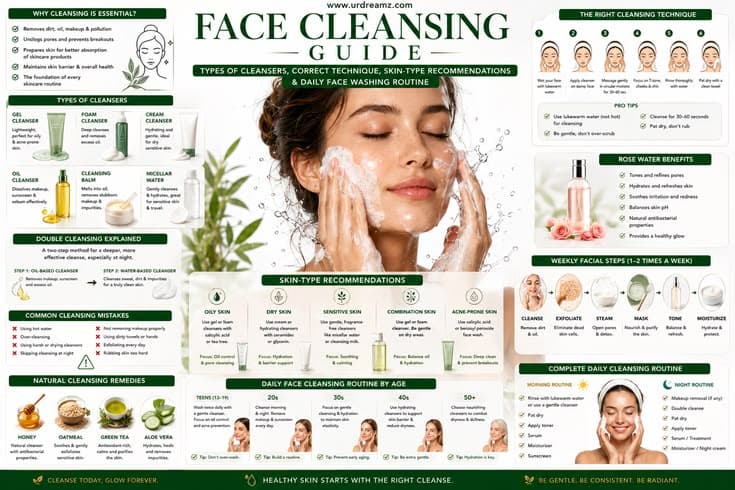
Face Cleansing Guide: Types of Cleansers, Correct Technique, Skin-Type Recommendations and Daily Face Washing Routine
Cleansing is the first step of every skincare routine, and the one most people get wrong in at least one significant way — whether that's using the wrong formula for their skin type, washing with water that's too hot, over-cleansing until the barrier is damaged, or under-cleansing and leaving a layer of sunscreen and makeup in place for active ingredients to sit on rather than reach the skin. This guide covers every aspect of effective face cleansing from scratch: why it matters, which types of cleanser suit which skin types, the correct application technique, double cleansing explained, common mistakes and fixes, natural remedies, and a full breakdown of daily and weekly routines for every age and skin concern. This guide connects naturally with several others in this series — the daily skincare routine, the acne treatment guide, the anti-aging guide, the skin brightening guide, the dark circles guide and the sunscreen guide.
1. Why Cleansing Is the Foundation of Healthy Skin
The skin's surface accumulates a mixture of things throughout the day and overnight that don't belong there: environmental pollution, excess sebum, dead skin cells, makeup, sunscreen residue, bacteria from touching the face, and fine particles from the air. Left in place, this buildup clogs follicles, dull the skin's natural reflectivity, and forms a physical barrier that prevents any serum or moisturizer applied over it from actually reaching the skin it's meant to treat.
Cleansing twice daily — once in the morning to remove what accumulated overnight, and once at night to remove the full day's buildup including sunscreen and any makeup — creates the clean base that every other skincare step depends on. It's not glamorous and it rarely gets the attention that serums and treatments do, but it has a more direct impact on how well everything that follows actually works than almost any other step in the routine.
2. What a Good Cleanser Actually Does
A well-formulated cleanser removes surface impurities without stripping the skin of the natural oils and moisture it needs to maintain a healthy barrier. The distinction between "removes impurities" and "strips the skin" matters enormously in practice. A cleanser that leaves the face feeling tight, dry or squeaky-clean after rinsing is almost always stripping the barrier, which then triggers compensatory oil production in oilier skin types and leads to irritation and sensitivity in drier ones. A cleanser that leaves skin feeling clean but comfortable has done its job correctly.
3. The Main Types of Cleansers and When to Use Each
| Cleanser Type | Texture and Feel | Best Suited For |
|---|---|---|
| Gel cleanser | Transparent, lightweight, often cooling | Oily and acne-prone skin |
| Foaming cleanser | Creates lather that lifts oil and impurities effectively | Oily to combination skin |
| Cream cleanser | Rich, milky, often no-lather | Dry, sensitive and mature skin |
| Cleansing oil | Liquid oil that emulsifies with water | All types as first step in double cleansing; particularly good for makeup removal |
| Cleansing balm | Solid to soft balm that melts on contact | Dry and normal skin; first step in double cleanse |
| Micellar water | Water-like liquid with micellar clusters that attract impurities | Gentle removal without rinsing; sensitive skin; travel or quick cleanse |
| Exfoliating cleanser | Contains chemical acids or mild physical exfoliant | Most skin types 2-3 times weekly for cell turnover |
4. Gel Cleansers in Detail
Gel cleansers are water-based formulas with a transparent or translucent appearance that clean effectively without the heaviness of a cream. They're typically the best match for oily and acne-prone skin because they cut through excess sebum without leaving any residue behind, and many formulations for this skin type include ingredients like salicylic acid or niacinamide that provide additional benefit alongside the basic cleaning function. A good gel cleanser for oily skin should leave the face feeling clean and fresh without tightness — if tightness is present, the formula may be too stripping and worth swapping for something gentler.
5. Foaming Cleansers in Detail
Foaming cleansers, which create a lather either during dispensing or when worked between wet hands, are effective at removing excess oil and surface-level impurities. They tend to suit oily to normal skin types well but can be too drying for dry or sensitive skin if the formula relies on harsh surfactants like sodium lauryl sulfate to create the foam. Gentler foaming formulas using mild surfactants like sodium cocoamphoacetate or disodium lauryl sulfosuccinate can produce the satisfying foam experience without stripping the barrier.
6. Cream Cleansers in Detail
Cream cleansers have a milky, lotion-like consistency that cleanses gently while adding a layer of nourishment rather than stripping moisture. They rarely produce significant lather and often don't remove heavy makeup fully on their own, making them most suited to routine morning cleansing for dry and sensitive skin, or as the second step in a double cleanse rather than the first. Key ingredients to look for in cream cleansers include ceramides for barrier support, glycerin for humectant hydration, and panthenol for skin soothing — all of which add a functional benefit beyond basic cleansing.
7. Cleansing Oils in Detail
Cleansing oils work on the principle that oil dissolves oil — specifically, the oil-based formula dissolves makeup, sunscreen and excess sebum on the skin's surface, which then emulsifies when water is added so that everything rinses away cleanly. Despite seeming counterintuitive to apply oil to oily skin, properly formulated cleansing oils rinse fully without leaving residue and are effective for removing sunscreen — among the most stubborn products to fully clear with a water-based cleanser alone. They form the first step in a double cleanse for most skin types and are particularly useful on days when sunscreen, long-wearing makeup or both have been worn.
8. Cleansing Balms in Detail
Cleansing balms start as a solid or semi-solid texture that melts to an oil-like consistency when massaged across the skin, working on the same dissolving principle as cleansing oils but often offering a slightly richer, more emollient experience on application. They tend to be particularly nourishing for dry skin and are one of the gentler ways to remove heavier makeup. As with cleansing oils, they're most effective when used as the first step in a double cleanse and followed by a water-based cleanser to remove the emulsified residue fully.
9. Micellar Water in Detail
Micellar water contains microscopic structures called micelles — tiny spherical clusters of cleansing molecules that act like magnets for oil and dirt. When micellar water is applied to the skin on a cotton pad and wiped across the face, the micelles attract and lift surface impurities away without requiring water or rinsing. This makes it convenient and very gentle, which is why it's commonly recommended for sensitive skin and for travel when a full sink-based routine isn't practical. Its limitations are that it struggles with heavier formulations like waterproof mascara or highly pigmented makeup, and that it's not effective enough to replace a full rinse-off cleanse as the sole cleansing step on days when significant product has been worn.
10. Exfoliating Cleansers in Detail
Exfoliating cleansers either contain chemical exfoliants like glycolic acid, lactic acid or salicylic acid, or physical exfoliants in the form of fine particles that physically buff away surface dead cells as the product is massaged across the skin. Chemical exfoliating cleansers are generally gentler than their physical counterparts because the active time on the skin before rinsing is brief, limiting potential over-exfoliation. Physical scrubs in cleansers can be harsh if the particle size is irregular — walnut shells and apricot kernels, which have jagged edges at a microscopic level, are worth avoiding in favor of finely milled sugar or round synthetic particles that are less likely to cause micro-damage. Exfoliating cleansers in any form are best used two to three times a week rather than daily.
11. What Double Cleansing Is and Why It Matters
Double cleansing is the practice of using two different cleansers in sequence, typically an oil-based product first followed by a water-based cleanser second. The logic is straightforward: the first oil-based cleanse dissolves oil-soluble impurities — makeup, sunscreen and excess sebum — while the second water-based cleanse then removes the remaining water-soluble impurities like sweat, pollution particles and the residue from the first cleanse.
Double cleansing is most relevant at night, since the daytime buildup that includes sunscreen and makeup is significantly harder to remove than overnight sebum and sweat. In the morning, a single gentle water-based cleanser is usually sufficient. It's worth noting that double cleansing isn't necessary on days when no sunscreen or makeup was worn — for minimal skin contact days, a single gentle cleanse is perfectly adequate.
| Step | Product Type | What It Removes |
|---|---|---|
| Step 1 (First cleanse) | Oil, balm, or cleansing water | Makeup, sunscreen, excess sebum |
| Step 2 (Second cleanse) | Gel, foam, or cream cleanser | Residual impurities, sweat, remaining residue from step 1 |
12. The Correct Cleansing Technique Step by Step
The technique used to apply and rinse a cleanser affects how well it works and whether it accidentally causes irritation in the process. Most people rush this step, which reduces effectiveness and often increases the chance of inadvertent friction damage to the delicate skin on the face.
- Begin with clean, dry hands — any bacteria or residue on the hands transfers directly to the face during application.
- Wet the face with lukewarm water before applying cleanser. Water that is too hot strips natural oils and disrupts the barrier; water that is too cold doesn't emulsify product effectively.
- Dispense the appropriate amount of cleanser — typically a coin-sized amount for the face and neck.
- Massage gently across the face in slow, circular motions with the fingertips for a full thirty to sixty seconds, giving the cleanser time to break down impurities rather than just sitting briefly on the surface.
- Rinse thoroughly with lukewarm water until all product residue is gone — remaining cleanser on the skin can cause dryness or breakouts.
- Pat the face dry gently with a soft, clean towel. Rubbing, pulling or harsh patting causes unnecessary friction and can contribute to irritation over time.
13. Choosing the Right Cleanser for Oily Skin
| What to Look For | What to Avoid |
|---|---|
| Oil-free, non-comedogenic formula | Heavy cream cleansers that leave residue |
| Gel or gentle foaming texture | Harsh stripping cleansers that cause rebound oiliness |
| Niacinamide, salicylic acid or tea tree as bonus actives | Alcohol-heavy formulas that over-dry |
| pH-balanced formulation | "Instant brightening" or bleaching cleansers with harsh agents |
One common mistake with oily skin is choosing the harshest available cleanser with the logic that more stripping equals cleaner skin. In reality, over-stripping triggers the sebaceous glands to produce more oil in compensation, creating a cycle of ever-increasing oiliness. A gentle but effective cleanser used twice daily produces steadier results than an aggressive formula used desperately.
14. Choosing the Right Cleanser for Dry Skin
Dry skin loses moisture easily and benefits from a cleanser that removes surface impurities without taking the skin's remaining natural oils along with them. Cream, milk or hydrating gel formulas with ceramides, glycerin, hyaluronic acid or panthenol as key ingredients clean effectively while contributing a layer of hydration rather than depleting it. Foaming cleansers that produce heavy lather tend to be too stripping for consistently dry skin. After cleansing, dry skin should feel clean and comfortable rather than tight, and following with a moisturizer promptly while the skin is still slightly damp helps lock in hydration before it evaporates.
15. Choosing the Right Cleanser for Combination Skin
Combination skin presents a practical challenge because the T-zone — forehead, nose and chin — behaves like oily skin while the cheeks and areas around the eyes behave more like normal to dry skin. A gentle gel or cream-gel hybrid cleanser usually hits the best balance, providing enough cleansing power for oilier areas without stripping the drier zones. Some people with combination skin use two different cleansers, applying a gel or salicylic acid-based formula only along the T-zone and a gentler cream cleanser on the cheeks, which takes more effort but produces more balanced results.
16. Choosing the Right Cleanser for Sensitive Skin
Sensitive skin reacts easily to ingredients, temperature changes and friction, which means the cleanser it needs is probably the gentlest product on any store shelf: fragrance-free, sulfate-free, alcohol-free, and formulated with soothing ingredients like centella asiatica, oat extract, aloe vera or allantoin. The physical act of cleansing should involve as little friction as possible — fingers rather than cloths or brushes, gentle strokes rather than vigorous scrubbing. Patch testing any new cleanser on a small area of the neck or jaw before committing to full-face use is a good habit for sensitive skin types that react unpredictably to new formulations.
17. Choosing the Right Cleanser for Normal Skin
Normal skin, where oil production is reasonably balanced and the skin rarely feels either tight or excessively oily, has the most flexibility in cleanser choice. Almost any well-formulated cleanser works well for this skin type. The main guiding principle is choosing a formula that the skin responds well to and feels comfortable using daily — whether that's a gel, cream-gel or mild foam is largely a matter of personal preference rather than specific necessity.
18. Common Cleansing Mistakes and How to Correct Each One
| Mistake | Why It Matters | The Fix |
|---|---|---|
| Washing with hot water | Hot water strips natural oils and disrupts the skin barrier | Switch to lukewarm water for both wetting and rinsing |
| Not removing makeup and sunscreen before bed | Residue left overnight clogs pores and prevents skin repair | Double cleanse at night when wearing sunscreen or makeup |
| Rubbing the face dry with a rough towel | Friction causes micro-irritation and accelerates sensitivity over time | Pat dry gently with a soft, clean towel |
| Over-cleansing three or more times daily | Strips the natural oil barrier, triggering compensatory oil production or dryness | Cleanse exactly twice daily: morning and night |
| Using a cleanser that leaves tightness | A tight sensation after cleansing signals barrier disruption | Switch to a gentler, more hydrating formula |
| Spending less than thirty seconds on application | Brief application doesn't give the cleanser enough contact time to break down impurities | Massage gently for thirty to sixty seconds before rinsing |
| Skipping the neck and jawline | These areas accumulate the same day's impurities as the face and are often neglected | Extend cleansing down the neck and along the jaw |
19. Why pH Balance Matters in a Cleanser
Healthy skin has a mildly acidic surface pH, typically somewhere between 4.5 and 5.5, which supports the natural microbiome and helps the barrier function properly. Many traditional bar soaps have an alkaline pH of around 9 to 10, which disrupts this balance and leaves the skin more vulnerable to bacteria, irritation and dryness until the pH rebalances naturally over a period of hours. pH-balanced cleansers formulated closer to the skin's natural acidity are gentler on the barrier and increasingly easy to find in modern skincare formulations, though the exact pH isn't usually disclosed on packaging. A useful proxy is that a cleanser leaving no tightness or irritation is likely maintaining a reasonably appropriate pH.
20. Rose Water as a Natural Cleansing and Toning Step
Rose water has a long history of use in skincare across many cultures, and its appeal goes beyond tradition. It has a naturally slightly acidic pH that makes it compatible with the skin's own surface chemistry, mild astringent properties that help tighten the appearance of pores temporarily, and a gentle anti-inflammatory effect that soothes redness and irritation. Used on a cotton pad after cleansing as a natural toner, rose water helps remove any remaining cleanser residue, restores some of the moisture lost during cleansing, and prepares the skin to absorb serums and moisturizers more readily.
| Rose Water Benefit | Mechanism |
|---|---|
| Hydration | Acts as a light humectant that draws moisture to the skin surface |
| Pore appearance | Mild astringency temporarily reduces the visible size of pores |
| pH balance | Slightly acidic pH supports the skin's natural surface chemistry |
| Antibacterial | Gentle antibacterial properties help keep the cleansed surface clean |
| Anti-inflammatory | Soothes minor redness and irritation after cleansing |
| Skin tone | Natural astringency smooths texture for a more uniform appearance |
| Anti-aging support | Antioxidants in rose water help protect against environmental stressors |
21. A Step-by-Step Home Facial Routine
A proper at-home facial once a week provides a deeper level of cleansing and skin care than a standard daily routine, addressing buildup, improving circulation and leaving the skin noticeably smoother and more radiant without requiring a salon visit.
| Step | What to Do | How Long |
|---|---|---|
| 1. Cleansing | Wash with a gentle cleanser or use raw milk on a cotton pad for a natural alternative | 1-2 minutes |
| 2. Steaming | Steam the face over a bowl of hot water or with a warm damp towel; optionally add rose water or a drop of lemon for freshness | 5-10 minutes |
| 3. Scrubbing | Apply a mild scrub or DIY sugar-honey mix and massage gently in circular motions to remove loosened dead skin | 2-3 minutes |
| 4. Face pack | Apply a mask suited to the skin type, leave to set, then rinse | 15-20 minutes |
| 5. Massage | Massage aloe vera gel or a light oil into the face in upward circular motions to improve circulation | 5-10 minutes |
| 6. Toning | Apply rose water on a cotton pad to tighten pores and restore pH balance | 1 minute |
| 7. Moisturizing | Seal everything in with a suitable moisturizer for the skin type | 1 minute |
22. Face Masks Suited to Different Skin Types
| Skin Type | Recommended Mask | Effect |
|---|---|---|
| Oily skin | Multani mitti (fuller's earth) with rose water | Absorbs excess oil, tightens pores |
| Dry skin | Honey with milk or cream | Nourishes, softens and retains moisture |
| Normal skin | Yogurt with a pinch of turmeric | Brightens gently, soothes and hydrates |
| Combination skin | Clay on T-zone, hydrating mask on cheeks | Balances oil and moisture across different zones |
| Sensitive skin | Plain oat paste or aloe vera gel alone | Soothes, calms redness and reduces irritation |
23. Natural Cleansing Remedies Worth Knowing
- Raw milk on cotton: Lactic acid in raw milk gently removes surface impurities while leaving behind a thin film of natural moisturizing factors. Well tolerated by most skin types and particularly kind to dry or sensitive skin.
- Aloe vera gel: Used as a light-touch cleanser for minimalist routines, aloe vera soothes and hydrates while providing mild cleansing of very light surface impurities.
- Honey: Naturally antibacterial and humectant, pure honey can be gently massaged across the face and rinsed away for mild cleansing with a moisturizing effect, suited to dry or combination skin.
- Cucumber juice: Applied on cotton pads, cucumber's high water content and mild astringency makes it a refreshing, cooling cleansing step particularly useful for puffy or irritated skin.
- Besan (gram flour) paste: A traditional paste made with besan and water or yogurt acts as a gentle, mildly exfoliating cleanser that removes surface impurities and leaves skin feeling smooth.
24. The Morning Cleansing Routine
The morning cleanse serves a simpler purpose than the night cleanse: removing the oil and sweat that accumulated overnight while the skin was in repair mode. In the morning a single, gentle, appropriately matched cleanser is usually entirely sufficient — there's no sunscreen or heavy makeup to cut through, so a lighter approach works well. For people with very dry or sensitive skin, some dermatologists even suggest a water-only rinse in the morning with cleanser used only at night, preserving the additional moisture the skin produced overnight.
| Step | Product |
|---|---|
| 1 | Gentle cleanser suited to skin type |
| 2 | Toner or rose water to balance |
| 3 | Serum (vitamin C or niacinamide) |
| 4 | Eye cream if used |
| 5 | Moisturizer |
| 6 | Sunscreen as the final step |
25. The Night Cleansing Routine
The night cleanse is the most important cleansing of the day because it removes everything accumulated through active hours — sunscreen, makeup, pollution, sweat and excess oil — clearing the way for overnight repair and for any treatment products applied afterward to work on clean skin rather than through a layer of residue. For anyone wearing SPF and makeup, double cleansing at night is strongly recommended.
| Step | Product |
|---|---|
| 1 | Oil cleanser or cleansing balm (first cleanse) |
| 2 | Gentle water-based cleanser (second cleanse) |
| 3 | Toner |
| 4 | Treatment serum (retinol, niacinamide or other actives) |
| 5 | Eye cream |
| 6 | Moisturizer |
26. A Weekly Skincare and Cleansing Schedule
| Day | Special Addition |
|---|---|
| Monday | Exfoliating step added to the night routine (max twice a week) |
| Wednesday | Weekly face mask appropriate to skin type |
| Friday | Facial oil massage for improved circulation and glow |
| Sunday | Glow day — sheet mask, lip scrub, under-eye patches for an intensive weekly reset |
27. Skincare and Cleansing Routine by Age Group
| Age Group | Focus | Essential Additions |
|---|---|---|
| Teens (13-19) | Gentle daily cleansing, acne prevention, basic hydration | Gentle cleanser, light moisturizer, SPF 30+ |
| Early 20s (20-24) | Hydration, oil control, early brightening | Vitamin C serum, SPF 50, weekly clay mask for oily skin |
| Late 20s (25-29) | Prevention of early fine lines, sustained hydration | Double cleanse, hyaluronic acid, retinol introduction, eye cream |
| 30s (30-39) | Collagen support, brightening, firmness | Vitamin C, peptides, retinol, richer moisturizer, SPF 50 |
| 40s (40-49) | Firmness, elasticity, deeper hydration | Ceramide moisturizer, retinoid, antioxidant serum, eye cream |
| 50s and beyond | Skin barrier repair, deep nourishment | Cream cleanser, rich moisturizer, peptides, facial oil, daily SPF |
28. Sensitive Skin Cleansing: A Gentler Approach
Sensitive skin requires both the mildest cleanser available and the most careful application technique. Fragrance, alcohol and harsh surfactants are the most common sensitizing ingredients in cleansers and worth actively avoiding. The physical routine should involve the softest possible touch — no cloths, no brushes, no scrubbing — and rinsing with water at a comfortable, moderately cool-to-lukewarm temperature. Any new cleanser should be patch-tested on a small area, particularly the jaw or inner arm, for twenty-four hours before being used across the full face. When the skin barrier is already compromised and reactive, reducing active ingredients and simplifying the routine to a gentle cleanser, a calming moisturizer and sunscreen is often more effective than adding products intended to address the symptoms.
29. Cleansing Tools: Are They Worth Using?
Cleansing brushes and electronic devices that vibrate or spin during cleansing can improve the thoroughness of a cleanse and temporarily improve circulation and product penetration. They also carry a meaningful risk of over-exfoliation and barrier damage if used too frequently or with too much pressure, particularly on thinner or more sensitive skin. If a cleansing device is used, limiting sessions to once or twice a week rather than daily, using the softest available brush head, and pairing it with a gentle rather than active cleanser reduces the risk of irritation. For the vast majority of people, clean fingertips used with correct technique produce excellent results without any device at all.
30. Signs That Your Current Cleanser Isn't Working for Your Skin
- A tight, dry or uncomfortable feeling immediately after rinsing, which indicates over-stripping.
- A persistent greasy feel or breakouts in areas that weren't previously congested, which may indicate the cleanser is too heavy or leaving residue.
- Increased redness or irritation that appears specifically around cleansing time and settles afterward — often a sign of a sensitizing ingredient.
- Dull skin despite other skincare steps working well, which may indicate inadequate cleansing is leaving a surface layer that dulls reflectivity.
- Pilling of the products applied after cleansing, which often indicates residue from an incompletely rinsed cleanser creating a barrier between layers.
31. Do's and Don'ts of Face Cleansing
| Do | Don't |
|---|---|
| Cleanse twice daily — morning and night | Cleanse more than twice unless post-workout sweating warrants it |
| Use lukewarm water | Use hot water, which strips natural oils |
| Massage for 30-60 seconds | Rush the application and rinse immediately |
| Pat dry with a soft towel | Rub or drag the towel across the face |
| Double cleanse at night when wearing SPF and makeup | Sleep in makeup or sunscreen residue |
| Patch test new cleansers | Switch cleansers frequently before giving each one time to work |
| Extend cleansing to the neck and jawline | Stop at the chin and ignore the neck |
| Follow with moisturizer while slightly damp | Leave skin bare after cleansing for extended periods |
32. Beauty Habits That Amplify Good Cleansing Results
- Changing pillowcases at least once a week — pillowcase fabric accumulates bacteria, skin cells and hair product residue that transfers back to the freshly cleansed face overnight.
- Keeping phone screens clean — the face presses against the phone screen repeatedly during calls, and phone screens carry significant bacterial contamination.
- Using separate towels for the face and body, and laundering face towels frequently.
- Drinking adequate water throughout the day — well-hydrated skin responds more positively to cleansing and stays more resilient after it.
- Not touching the face with unwashed hands during the day — hands carry bacteria and oil from every surface touched, and touching the face repeatedly undermines any cleansing routine.
33. A Complete 30-Tip Skin Care Reference
Building on everything covered in this guide, the following quick-reference list synthesizes the daily habits that collectively produce consistently healthy, cleaner skin over time:
- Cleanse the face twice daily with a gentle, appropriate formula.
- Use lukewarm water for both wetting and rinsing.
- Avoid harsh scrubbing — fingertips and gentle circular motions are enough.
- Exfoliate one to two times per week rather than daily.
- Moisturize every time after cleansing, even for oily skin.
- Apply broad-spectrum sunscreen every morning as the final skincare step.
- Drink adequate water for overall health, which reflects in skin hydration.
- Prioritize seven to eight hours of sleep nightly.
- Eat a varied diet that includes fruits, vegetables, healthy fats and protein.
- Avoid touching the face during the day.
- Remove all makeup before sleeping without exception.
- Use a toner after cleansing to restore pH balance.
- Choose products appropriate to the specific skin type rather than generic "normal" formulas.
- Patch test before introducing any new product to the full routine.
- Keep the skin consistently hydrated with a suitable moisturizer.
- Use a face mask once a week tailored to the skin's current needs.
- Keep phone screens clean and change pillowcases regularly.
- Manage stress through movement, sleep or whatever approach works personally.
- Avoid smoking and limit alcohol consumption.
- Protect skin from pollution by cleansing thoroughly at the end of the day.
- Include more antioxidant-rich foods — berries, leafy greens, nuts — in daily eating.
- Apply eye cream consistently rather than occasionally.
- Resist popping pimples, which spreads bacteria and worsens pigmentation.
- Keep hands clean to reduce bacterial transfer to the face.
- Avoid harsh scrubs that cause microscopic surface damage.
- Keep the routine simple and consistent rather than constantly complex and changing.
- Extend skincare to the neck — it accumulates the same impurities and shows aging just as visibly.
- Be consistent with the routine over weeks, since most skincare results take time.
- Approach skincare with patience — healthy skin is a habit built over time, not an overnight result.
- Appreciate and care for the skin rather than criticizing it — consistency and kindness produce more results than anxiety and over-intervention.
34. Frequently Asked Questions
How many times should I wash my face each day?
Twice daily is the general recommendation for most skin types — once in the morning and once at night. After heavy exercise that produces significant sweating, a third gentle rinse is reasonable. More frequent cleansing than this tends to strip the barrier rather than improve cleanliness.
Is double cleansing necessary for everyone?
It's most necessary for anyone wearing sunscreen and makeup regularly, since these products are difficult to fully remove with a single water-based cleanse. On minimal-product days or for people who don't wear makeup, a single gentle cleanser is usually sufficient.
Can I use face wipes as a substitute for cleansing?
Face wipes remove surface-level makeup but don't provide the thorough cleansing of a properly applied and rinsed cleanser. They're a useful emergency fallback when nothing else is available, but not a reliable daily substitute for a full cleanse, since residue from the wipe itself often remains on the skin.
What's the difference between face wash and facial cleanser?
The terms are often used interchangeably in product marketing. In practice, "face wash" tends to refer to rinse-off foaming or gel formulas, while "facial cleanser" is broader and includes creams, oils and micellar formulas. The distinction matters less than whether the specific formula suits the individual's skin type.
Should I use a different cleanser in summer and winter?
Many people benefit from switching to a more hydrating formula in winter when environmental conditions are drier, and back to a lighter gel or foam in summer when humidity and heat increase oil production. Skin isn't a fixed condition and adjusting to seasonal changes makes practical sense.
35. Final Thoughts
Face cleansing is the simplest step in any skincare routine in concept and one of the most consequential in practice. Getting it right — correct formula for the skin type, correct technique, correct frequency, and the right follow-through — doesn't require expensive products or elaborate rituals. It requires understanding what the skin needs, choosing a formula that genuinely fits those needs, and applying it consistently with enough care that it actually does the job it's designed to do. Everything covered in this guide — from the daily skincare routine to the anti-aging steps, acne treatment, skin brightening, dark circle reduction and sun protection — starts with clean skin. The cleanser step doesn't need to be complex, but it does need to be done right.