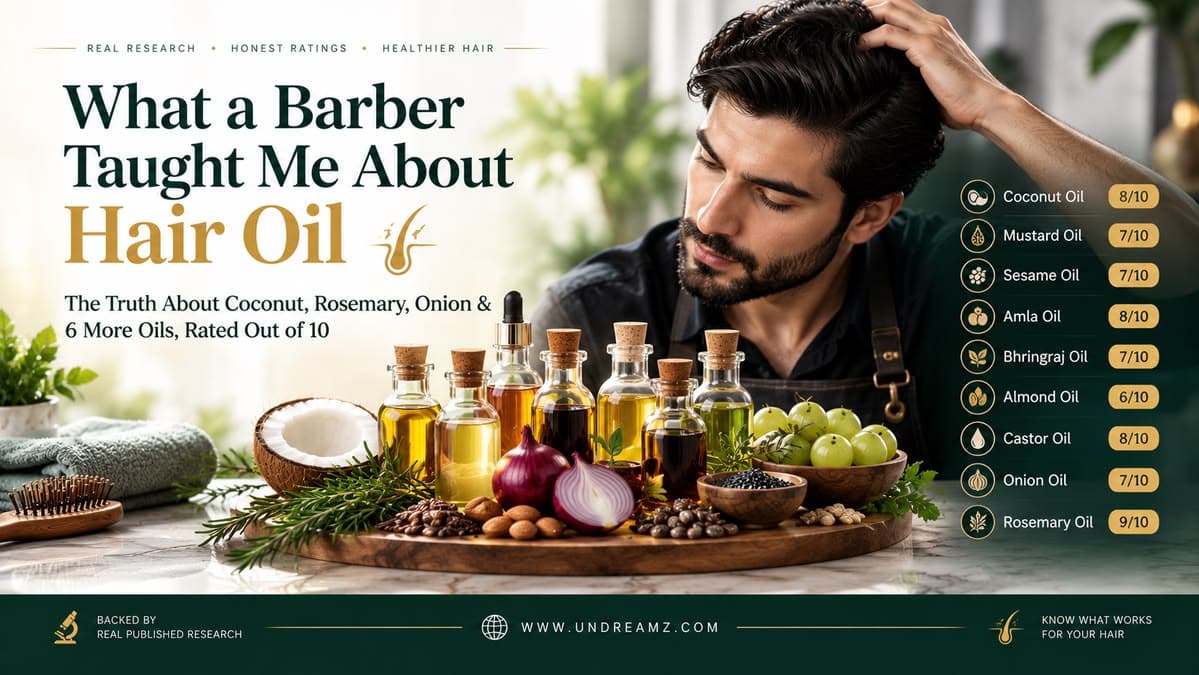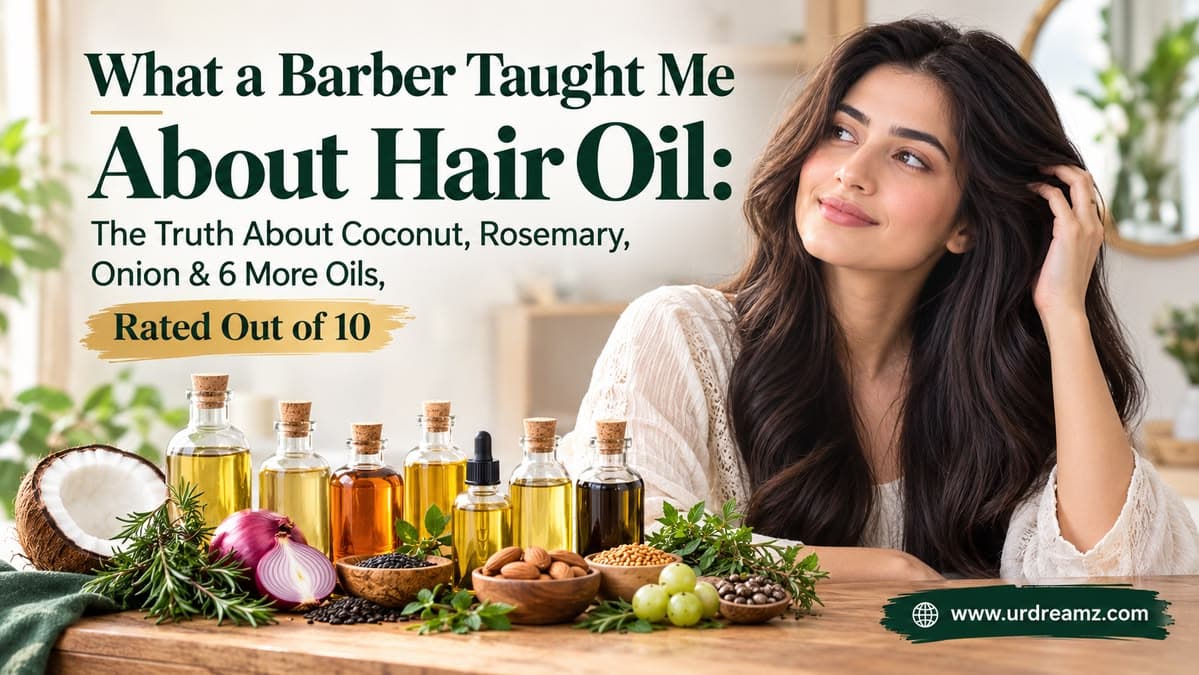
What a Barber Taught Me About Hair Oil: The Truth About Coconut, Rosemary, Onion & 6 More Oils, Rated Out of 10
Every hair oil advertisement makes the same quiet promise: use this, and your hair will come back thicker, longer, fuller than ever. Buy enough bottles over enough years, though, and a strange pattern emerges — the shelves keep filling up, but the mirror rarely changes. That contradiction is exactly what sent me down this research rabbit hole in the first place. I was sitting in a barber shop when a new customer walked in and asked, half-joking, half-desperate: "Bhai, which oil should I use so my hair grows back?" The barber, without even looking up from his scissors, said something that stuck with me: "Oil never grew a single hair on anyone's head in the history of the world. It only protects what you already have. If oil could actually grow hair, we barbers would all be selling bottles instead of running this shop."
That one sentence became the starting point for this entire article — a genuinely honest, slightly humbling moment that made it clear how much of what we believe about hair oil comes from repetition and hopeful marketing rather than anything anyone had actually bothered to verify. So we did the actual homework — pulling published dermatology and cosmetic science research rather than repeating marketing claims — and rated nine of the most talked-about hair oils honestly, out of 10, based on what the evidence genuinely supports and what it doesn't.
Quick Answer
Last updated: September 2026
No hair oil can "grow" brand-new hair on a scalp affected by genetic (androgenetic) baldness — that requires medical treatment, not a bottle. What oil genuinely does well is reduce breakage, lock in moisture, calm scalp irritation, and protect hair that's still growing from further damage. Based on published research: coconut oil (9/10) is the strongest all-round protector, proven to reduce protein loss during washing far better than mineral or sunflower oil. Rosemary oil (8/10) showed hair-count results comparable to 2% minoxidil in a 6-month clinical trial. Bhringraj oil (8/10) is Ayurveda's traditional favorite. Onion oil (5/10) has real clinical evidence — but specifically for alopecia areata (an autoimmune patchy hair-loss condition), not ordinary thinning. Mustard, sesame, amla, almond, and castor oils each offer real scalp and strand benefits, without direct evidence of regrowing hair.
1. Setting Expectations: Can Any Oil Actually "Grow" New Hair?
Let's answer the barber's blunt claim directly and honestly, because it deserves a proper explanation rather than just a punchline. No topical oil — however expensive, however "ancient" its formula claims to be — has been shown in credible research to create brand-new hair follicles where none exist, or to reverse genetic pattern baldness on its own. What oils genuinely can do, and this is not a small thing, is protect the hair that is already growing: reducing breakage along the strand, moisturizing a dry scalp, calming irritation, and creating the healthiest possible environment for hair that's already in its natural growth cycle. Understanding this distinction — protection versus creation — is the single most important thing to take away before spending money on any bottle on a shelf.
2. Genetics and Baldness: Why Family History Beats Any Bottle
If a close male relative on both sides of the family — a father and a grandfather, for instance — experienced significant hereditary hair loss, no oil in the world can reverse that specific pattern. This type of hair loss, known clinically as androgenetic alopecia, is driven by genetics and hormone sensitivity at the follicle level, a mechanism entirely outside what any topical oil can influence. This isn't meant to be discouraging — it's meant to redirect expectations toward what's actually achievable. Oil can meaningfully protect and strengthen hair that remains, and support scalp health throughout that process, but it cannot override a genetic blueprint. Anyone dealing with clear hereditary pattern loss is better served consulting a dermatologist about clinically proven treatments than pinning hope on any single oil.
2b. The Role of Genetics vs. Hormones: DHT Explained Simply
To understand why genetics wins out over any oil in cases of hereditary hair loss, it helps to understand what's actually happening at the follicle level. Androgenetic alopecia is driven primarily by a hormone called dihydrotestosterone, or DHT, which is produced when an enzyme converts testosterone into this more potent form. In people genetically predisposed to hair loss, hair follicles are unusually sensitive to DHT, and repeated exposure over years gradually shrinks these follicles in a process called miniaturization — each growth cycle produces a slightly thinner, shorter strand than the one before, until eventually the follicle stops producing visible hair altogether. This is a hormonal and genetic process happening beneath the scalp's surface, entirely separate from surface-level hydration, protein loss, or scalp circulation — which is exactly why oil, working only at the surface and shaft level, simply doesn't have access to the specific biological mechanism responsible for this type of hair loss, no matter how consistently or generously it's applied.
3. What Oil Actually Does For Your Hair and Scalp
Even setting aside the myth of "growth," oil plays a genuinely useful role for hair health. It coats and, in some cases, penetrates the hair shaft, reducing friction between strands and lowering the amount of protein lost every time hair is washed, combed, or exposed to heat and styling. It can moisturize a dry, flaking scalp, which reduces itching and the kind of scratching that can damage follicles over time. Massaging oil into the scalp also temporarily boosts local blood circulation, and for many people, this makes a real, tangible difference in reducing breakage and keeping existing hair looking fuller and healthier for longer — exactly the kind of realistic benefit that gets lost in flashy marketing promises.
3b. Scalp Massage: The Real Hero Ingredient in Every Oil
Here's something worth sitting with: a meaningful portion of the benefit people attribute to hair oil may actually come from the act of massaging it in, rather than the oil itself. Several small studies on scalp massage alone — without any oil at all — have found measurable increases in hair thickness over time, likely through mechanically stretching the cells within hair follicles, which is thought to encourage the follicle to produce thicker strands. This doesn't mean oil is pointless; oil genuinely improves the massage experience, reduces friction on the scalp, and adds its own separate moisturizing and protective benefits. But it does help explain why people so often report feeling like "something is working" regardless of which specific oil they choose — a five-minute daily scalp massage, oil or no oil, is doing real, measurable work of its own.
4. Our Rating System: How We Scored Each Oil Out of 10
Each oil below is scored out of 10 based on a combination of factors: the strength and quality of published research behind it (not brand-funded marketing claims alone), how genuinely useful it is for common everyday concerns like breakage, dryness, and scalp health, practical considerations like smell, texture, and ease of use, and any real safety caveats worth knowing before using it. A high score does not mean "this oil regrows hair" — as established above, no oil does that. It means the oil delivers strong, evidence-supported value for what oil can realistically do.
4b. A Brief History: How Different Cultures Turned to Oil for Hair Care
The instinct to oil hair regularly isn't a modern marketing invention — it stretches back thousands of years across multiple cultures independently. Ayurvedic texts from ancient India describe scalp oiling, particularly with sesame and bhringraj, as a core part of daily self-care routines meant to balance the body as a whole, not just condition hair. Ancient Egyptian records describe the use of castor and moringa oils for scalp and hair maintenance in a climate that made hair extremely prone to dryness. Mediterranean cultures have used olive oil for hair and skin for millennia. What's notable is that nearly every one of these traditions converged on the same basic idea — that oil supports and protects hair — without any of them claiming, historically, that oil alone could regenerate hair from a bald scalp. That specific claim is largely a modern marketing addition, layered on top of genuinely old and reasonable traditional wisdom about protection and nourishment.
5. Coconut Oil — 9/10: The Undisputed All-Rounder
Coconut oil consistently sits at the very top of nearly every credible comparison, and for good reason. Its molecular structure is smaller than most other common oils, allowing it to actually penetrate into the hair shaft rather than just sitting on the surface. A well-cited 2003 study published in the Journal of Cosmetic Science compared coconut oil, mineral oil, and sunflower oil, and found that coconut oil was the only one of the three that meaningfully reduced protein loss from hair — both before and after washing — for both damaged and undamaged hair, while mineral and sunflower oil showed little to no measurable protective effect.
Worth noting honestly: that specific study was conducted at the research division of a major hair-oil manufacturer, which is a detail transparency-minded readers deserve to know, even though the finding itself has since been widely cited and referenced across independent cosmetic science literature. A simple way to check if a coconut oil is genuinely pure: real, unrefined coconut oil solidifies into a solid white mass in cold winter temperatures and melts back to liquid in warmth — an oil that stays liquid through cold winter conditions is very likely adulterated or heavily processed. For best results, research suggests applying it specifically before washing rather than only after, since the pre-wash application appears to allow deeper penetration into the hair shaft before the swelling and stripping effects of shampoo take place.
6. Mustard Oil — 6/10: Asia's Powerful but Polarizing Oil
Mustard oil (sarson ka tel) has been a staple of South Asian winter hair care for generations, prized for the way it warms the scalp and is widely believed to stimulate local blood circulation. Its strong, pungent smell and heavier texture, however, make it genuinely unsuitable for many people, particularly those with naturally oily scalps or acne-prone skin — since its warming, heavy nature can worsen oiliness and clog pores if used excessively, especially during hot weather. It earns a solid but middling score because its benefits are real specifically in cold weather and for dry scalp conditions, while its drawbacks in warmer climates and for oilier scalp types are equally real. Those who do use it are generally better off limiting it to the colder months, using a modest amount rather than saturating the scalp, and washing it out thoroughly rather than leaving it in for extended periods.
7. Sesame Oil — 7/10: The Balanced Ayurvedic Classic
Sesame oil (til ka tel) doesn't have the same star power as coconut oil, but it holds a genuinely respected place in traditional Ayurvedic scalp massage, considered neither too heavy nor too light — a balanced middle ground suitable across seasons and climates. It carries a pleasant, nutty aroma and has been used for centuries as an all-purpose scalp oil. It doesn't have direct clinical evidence specifically for reducing hair fall, which is part of why it doesn't score higher, but as an overall nourishing, well-tolerated oil for regular use, it remains a genuinely solid, underrated choice, particularly for anyone who finds coconut oil too light or mustard oil too heavy and pungent for daily use.
8. Amla Oil — 7/10: The Vitamin C Vault
Amla (Indian gooseberry) oil is rich in vitamin C and antioxidants, and has been used across generations specifically to help delay premature greying and support overall hair strength. Like several other traditional oils on this list, its role is primarily supportive rather than corrective — it doesn't have direct clinical evidence for reversing hair fall, but its antioxidant profile makes it a genuinely useful addition to a broader hair care routine, particularly for anyone concerned about early greying alongside general hair health. It's often used in combination with a base carrier oil rather than applied entirely on its own, and its tart, slightly sharp scent is one worth being prepared for before first use.
9. Bhringraj Oil — 8/10: The "King of Hair"
Bhringraj oil carries a name that literally translates to something like "ruler of hair" in traditional Ayurvedic texts, and it has been used for centuries specifically for hair and scalp health. It's a favorite in traditional Ayurvedic hair care formulations, often blended with other base oils, and is widely regarded for its calming effect on an irritated or inflamed scalp. While large-scale modern clinical trials specifically isolating bhringraj's effect are limited compared to something like rosemary oil, its long, consistent traditional use and generally excellent tolerability earn it a strong score among the oils on this list. It's frequently sold pre-blended with a lighter carrier oil like sesame or coconut, which makes it easier to apply and reduces the risk of it feeling overly heavy on finer hair types.
10. Almond Oil — 7/10: The Gentle All-Rounder
Almond oil is prized for being lightweight, rich in vitamin E, and genuinely gentle even on sensitive scalps, making it a good entry-level option for people newer to oiling their hair regularly. It moisturizes effectively without feeling heavy, and its mild, pleasant scent makes it easy to incorporate into a regular routine. Like several oils on this list, its strength lies in consistent, gentle nourishment rather than any dramatic, clinically proven effect on hair fall specifically. It also blends well with other, heavier oils, making it a useful lightening agent when someone wants to dilute a thicker oil like castor or bhringraj without losing the overall nourishing effect.
11. Castor Oil — 6/10: Thick, Powerful, and Genuinely Risky If Misused
Castor oil is notably thick and viscous compared to nearly every other oil on this list, rich in ricinoleic acid and believed to support scalp circulation. But its extreme thickness comes with real, well-documented practical risks that deserve honest mention rather than being glossed over. Used in excess or left in for extended periods, castor oil's sheer stickiness can cause strands to tangle and mat together severely — in more extreme documented cases, hair has become so matted from heavy castor oil use that portions had to be cut out entirely, since the tangles couldn't be safely combed through. It also poses a genuine irritation risk if it gets into the eyes, given its thick, hard-to-rinse consistency, which can cause temporary blurred vision and discomfort. For these reasons, castor oil is best used sparingly and ideally blended with a lighter carrier oil like coconut or almond oil, rather than applied on its own in large amounts.
12. Onion Oil — 5/10: Weakest Score, Strongest (and Most Misunderstood) Research
Onion oil has become hugely popular in recent years, and it genuinely does have real, published clinical research behind it — more rigorous, in fact, than most other oils on this list. A well-known 2002 study tested crude onion juice, applied directly to the scalp twice daily, against a plain tap-water control group in patients with patchy hair loss on the scalp. The results were striking: 20 out of 23 patients using onion juice showed hair regrowth, compared to only 2 out of 15 patients in the water-only control group — a genuinely significant difference.
Here's the crucial detail that gets lost in nearly every viral post about this study: the participants in that research had alopecia areata specifically — an autoimmune condition that causes sudden, patchy hair loss, entirely different from ordinary hair thinning, hereditary pattern baldness, or general hair fall from breakage. The study also used raw, crude onion juice applied at near-full strength, not the diluted, processed "onion oil" typically sold in commercial bottles. This is exactly why onion oil earns a comparatively modest score here, despite having some of the strongest clinical evidence on this list: the evidence is real, but it applies to a specific autoimmune condition, using a specific raw preparation — not a general, proven promise for everyday hair fall or thinning, which is how it's most often marketed.
12b. Onion Oil Side Effects and Managing the Smell
Beyond the important context about what onion oil's research actually covers, it's worth addressing its most commonly reported practical downsides directly. The lingering smell is the most frequently mentioned complaint — raw onion juice carries a strong, persistent odor that can remain noticeable on the scalp and pillow even after washing, which is a major reason commercial "onion oil" products dilute and mask the raw juice with other carrier oils and fragrances, even though this dilution likely reduces the concentration of active compounds compared to what was used in the original research. Skin irritation, including redness and a mild burning sensation, has also been reported by some users, particularly with more concentrated or homemade preparations, so a small patch test on the inner arm before full scalp application is a sensible precaution. For those wanting to try it while minimizing the odor issue, mixing a small amount of onion juice or oil into a carrier oil along with a few drops of a pleasantly scented essential oil, and washing thoroughly with a fragranced shampoo afterward, tends to make the experience considerably more manageable for daily life.
13. Rosemary Oil — 8/10: The Natural Challenger to Minoxidil
Rosemary oil, often called the "foreign" or Western oil in South Asian hair care conversations, has genuinely strong clinical evidence behind it. A well-designed 2015 randomized comparative trial followed 100 patients with androgenetic alopecia over six months, comparing rosemary oil directly against 2% minoxidil solution, applied to the scalp. By the six-month mark, both groups showed a statistically significant increase in hair count from baseline, with no meaningful difference between rosemary oil and minoxidil — and the rosemary group reported notably less scalp itching, one of minoxidil's more common side effects.
An important caveat worth being transparent about: the comparison was specifically against 2% minoxidil, while many men in real-world use apply the stronger 5% concentration, which has separately been shown to outperform the 2% version. Rosemary oil hasn't yet been tested head-to-head against 5% minoxidil in published research. Even accounting for that, this remains one of the most credible, well-designed studies behind any natural hair oil on this list, which is precisely why it earns one of the highest scores here.
13b. Essential Oils vs. Carrier Oils: An Important Distinction
Rosemary oil sits in a slightly different category from most of the other oils on this list, and understanding that distinction matters for safe use. Coconut, mustard, sesame, almond, and castor oil are all carrier oils — meaning they're generally safe to apply directly and generously to the scalp on their own. Rosemary oil, in its pure essential oil form, is far more concentrated and potent, and applying it undiluted directly onto the scalp can cause irritation, redness, or a burning sensation for many people. In the clinical trial discussed above, rosemary oil was used in a formulated preparation rather than at full essential-oil strength applied raw. For safe home use, rosemary essential oil should generally be diluted into a carrier oil like coconut, almond, or jojoba oil — typically just a few drops mixed into a tablespoon or two of carrier oil — rather than applied directly at full concentration.
13c. Spotting Genuine Rosemary Oil vs. Diluted or Synthetic Versions
Given rosemary oil's growing popularity following its clinical research, the market has also seen a rise in low-quality or synthetically fragranced versions marketed under the same name. Genuine rosemary essential oil typically carries a sharp, distinctly herbal, almost medicinal scent — closer to the fresh plant itself than to a sweetened or overly perfumed version. It's generally sold in small, dark glass bottles (to protect the oil from light degradation) rather than large plastic containers, and a genuine product will typically list "Rosmarinus officinalis" as an ingredient, reflecting the plant's scientific name, rather than only a vague "fragrance" or "rosemary extract" listing further down an ingredient list. As with several other oils discussed in this article, checking the ingredient list carefully, rather than relying on branding or a pleasant-sounding name alone, remains one of the most reliable ways to avoid disappointment.
14. All Nine Oils, Side by Side
| Oil | Score (out of 10) | Best Known For | Key Caution |
|---|---|---|---|
| Coconut Oil | 9 | Reducing protein loss, strengthening strands | None significant |
| Rosemary Oil | 8 | Clinically comparable to 2% minoxidil | Only tested against 2%, not 5% minoxidil |
| Bhringraj Oil | 8 | Traditional scalp calming, ayurvedic staple | Limited large-scale modern trials |
| Sesame Oil | 7 | Balanced, all-season nourishment | No direct hair-fall evidence |
| Amla Oil | 7 | Antioxidants, delaying premature greying | No direct hair-fall evidence |
| Almond Oil | 7 | Lightweight, gentle moisture | No direct hair-fall evidence |
| Mustard Oil | 6 | Winter warmth, scalp circulation | Can worsen oily/acne-prone scalps |
| Castor Oil | 6 | Thick nourishment, scalp support | Can mat hair severely; eye irritation risk |
| Onion Oil | 5 | Strong evidence — but specific to alopecia areata | Marketed for general hair fall it wasn't tested for |
14b. Oil, Hair Porosity, and Why the Same Oil Doesn't Work for Everyone
One factor that explains why the same oil can feel wonderful on one person's hair and heavy or greasy on another's is hair porosity — essentially, how easily the outer layer (cuticle) of a hair strand allows moisture and oil to pass in and out. Low porosity hair has a tightly packed cuticle that resists absorbing moisture and oil easily, meaning heavier oils like castor or bhringraj can sit on top of the strand rather than absorbing in, leading to a greasy, weighed-down feeling even with a small amount. High porosity hair, by contrast, has a more open cuticle structure that absorbs moisture and oil quickly, but can also lose it just as quickly, often benefiting from heavier, richer oils that help seal that moisture in for longer. For low porosity hair specifically, lighter oils like sesame, almond, or a small amount of coconut oil applied to damp (not dry) hair tend to absorb more effectively than heavier options, and gentle heat — such as wrapping hair in a warm towel after oiling — can help the cuticle open slightly, allowing better absorption. A simple way to get a general sense of your own hair's porosity is to drop a clean strand of hair into a glass of water: hair that floats for a while tends to be lower porosity, while hair that sinks quickly tends to be higher porosity, though this simple test isn't a substitute for a professional stylist's assessment for anyone seeking precise guidance.
14c. Beyond Hair: Coconut and Castor Oil for Skin and Face
Since coconut oil and castor oil are also widely searched for skin and face use, it's worth a brief, honest note on that separate topic. Coconut oil is a popular natural moisturizer for dry skin on the body, though it's comedogenic (pore-clogging) for many people, meaning it can worsen acne or clogged pores when used directly on the face, particularly for those with oily or acne-prone skin — it tends to work far better as a body moisturizer than a facial one for most skin types. Castor oil is sometimes used in small amounts around the skin for its moisturizing, thick occlusive properties, and is a common ingredient in oil-cleansing routines when blended with lighter oils, though, as with hair, its thickness means a little goes a long way, and it should always be kept well away from direct contact with the eyes given its irritation potential discussed earlier.
15. Meaning and Local Names: What These Oils Are Called in Urdu
| English Name | Common Urdu / Local Name |
|---|---|
| Coconut Oil | Nariyal ka tel (ناریل کا تیل) |
| Mustard Oil | Sarson ka tel (سرسوں کا تیل) |
| Sesame Oil | Til ka tel (تل کا تیل) |
| Amla Oil | Aanwla ka tel (آنولہ کا تیل) |
| Bhringraj Oil | Bhringraj / Kesharaj tel |
| Almond Oil | Badam ka tel (بادام کا تیل) |
| Castor Oil | Arandi ka tel (اروندی کا تیل) |
| Onion Oil | Pyaz ka tel (پیاز کا تیل) |
| Rosemary Oil | Often simply called "Rosemary oil"; sometimes referred to as the "foreign" or vidasi oil |
Several traditional herbal oils, including onion and bhringraj-based formulations, are also widely available in Pakistan through well-known local herbal and Ayurvedic retailers, with Saeed Ghani being one of the most recognized names in this space for locally sourced natural oils.
16. Why Is Gen Z Losing Hair Earlier Than Ever?
It's a genuinely fair question, and one increasingly asked online: why are people in their late teens and twenties dealing with noticeable hair thinning far earlier than previous generations typically did? Several overlapping factors are commonly pointed to. Chronic stress and irregular sleep, both strongly linked to disrupted hair growth cycles, have become far more common among younger adults navigating academic pressure, social media comparison, and demanding early careers. Diets heavier in ultra-processed food and lighter in the protein, iron, and key vitamins hair actually needs to grow have also become more widespread. Frequent heat styling, chemical treatments, and tight hairstyles add cumulative mechanical stress. And increased awareness itself plays a role too — younger generations are simply more likely to notice, discuss, and search for information about hair thinning openly, rather than quietly accepting it the way older generations often did.
16b. Diet and Hair: What You Put In Matters As Much As What You Put On
No conversation about hair oil is complete without acknowledging what's happening on the inside, because hair is, quite literally, built from the nutrients circulating in the body. Protein deficiency directly limits the raw material hair needs to grow, since hair strands are made almost entirely of a protein called keratin. Iron deficiency, particularly common among menstruating women, has been consistently linked to increased hair shedding, since iron plays a role in delivering oxygen to actively growing follicles. Deficiencies in vitamin D, zinc, and B-vitamins like biotin have similarly been associated with hair thinning in various studies. This is precisely why someone can use the most expensive, research-backed oil available and still see disappointing results — if the underlying nutritional building blocks aren't present in adequate amounts, no amount of external oiling can fully compensate for what the body isn't getting internally.
17. How to Actually Apply Hair Oil the Right Way
(3–5 minutes)
(30 min – overnight)
Gently warming the oil slightly before application helps it spread more evenly and can make the massage itself more relaxing and effective at boosting local circulation. Section the hair so the oil reaches the scalp directly rather than just coating the surface of already-covered strands. A gentle, circular-motion massage for three to five minutes is generally recommended, followed by leaving the oil on for at least 30 minutes — or, for deeper absorption, overnight — before washing thoroughly with a mild shampoo. Two to three applications a week is a commonly recommended, sustainable frequency for most hair and scalp types.
18. Common Mistakes People Make With Hair Oil
| Mistake | Why It's a Problem |
|---|---|
| Expecting oil alone to regrow hair on a genetically bald scalp | No oil can override genetics; leads to wasted money and disappointment |
| Leaving heavy oils like castor oil on for days at a time | Can cause severe tangling and matting, sometimes requiring hair to be cut |
| Using mustard oil generously on an already oily, acne-prone scalp | Can worsen oiliness and clog follicles |
| Applying oil only to the ends and skipping the scalp | Misses the area where circulation-boosting massage benefits happen |
| Never washing oil out properly | Residue buildup can attract dirt and worsen scalp conditions over time |
19. Oil Mixing: Which Combinations Work Well
| Combination | Why It Works |
|---|---|
| Castor oil + Coconut oil | Coconut oil's lighter texture offsets castor oil's thickness, reducing tangling risk |
| Amla oil + Bhringraj oil | A classic Ayurvedic pairing combining antioxidant support with traditional scalp calming |
| Rosemary oil + Coconut or Almond oil (carrier) | Rosemary is a potent essential oil best diluted in a gentler carrier oil before scalp application |
| Sesame oil + Almond oil | A lightweight, balanced blend suitable for most scalp types year-round |
20. Reading Labels: Real Research vs. Marketing Hype
When shopping for hair oil, a few label-reading habits go a long way. Words like "clinically proven" should prompt a closer look at what was actually tested — was it protein loss reduction (a real, measurable outcome, as with coconut oil), or a vague, unspecified claim about "growth" with no cited study at all? Ingredient lists matter more than front-of-bottle branding — a product labeled "onion oil" with onion extract listed far down the ingredient list, diluted among several other filler oils, is a very different product from the concentrated raw onion juice used in actual published research. As with food labels, the real information is almost always on the back of the bottle, not the front.
20b. The Business of Hair Oil: Why Marketing Works So Well
It's worth understanding, honestly, why hair oil marketing is so persuasive, because recognizing the pattern makes it much easier to resist. Hair loss is deeply tied to self-image and confidence, which makes people, understandably, willing to try almost anything that offers hope. Advertisements frequently show dramatic before-and-after transformations without disclosing whether those results came primarily from oiling, from an entirely separate medical treatment used alongside it, from careful lighting and styling for the photo, or simply from natural month-to-month variation in shedding that everyone experiences regardless of any product. Testimonials, while emotionally persuasive, are not controlled evidence — a person who happened to also improve their diet, reduce stress, or start a completely different treatment around the same time as trying a new oil may credit the oil alone, even when several other factors were likely involved. None of this means every hair oil brand is dishonest — many products genuinely do what oil can realistically do. It simply means a healthy dose of skepticism toward dramatic "growth" claims, and a habit of asking "what does the actual published research say?" rather than "what does the advertisement promise?", serves consumers far better in the long run.
21. Best Oil by Specific Hair Concern
| Concern | Best-Suited Oil(s) |
|---|---|
| General breakage and protein loss | Coconut oil |
| Androgenetic (pattern) thinning support | Rosemary oil (alongside dermatologist-guided treatment) |
| Dry, flaky scalp | Almond oil, Sesame oil |
| Cold-weather scalp warmth | Mustard oil |
| Premature greying support | Amla oil |
| Deep traditional scalp nourishment | Bhringraj oil |
| Alopecia areata (patchy autoimmune hair loss) | Onion oil/juice — under dermatologist guidance |
22. When Hair Fall Signals Something Beyond What Oil Can Fix
Some patterns of hair loss are worth taking to a dermatologist rather than managing with oil alone. Sudden, patchy bald spots — as opposed to gradual, all-over thinning — can indicate alopecia areata, an autoimmune condition that benefits from proper diagnosis and, in many cases, medical treatment. Hair loss accompanied by scalp pain, scarring, or unusual redness deserves prompt medical attention. And significant, rapid hair shedding following illness, major stress, childbirth, or a new medication can sometimes point to an underlying nutritional deficiency (commonly iron or vitamin D) or thyroid issue — conditions that a simple blood test can identify, and that no amount of oiling will resolve on its own.
22b. Debunking Specific Hair Oil Myths
A few specific claims deserve direct debunking, since they circulate so widely. "Oiling more often makes hair grow faster" — there's no credible evidence that increasing oil frequency beyond a few times a week accelerates hair's natural growth rate, which is largely determined by genetics and biology rather than topical product frequency. "Thicker, heavier oils always work better" — thickness relates to texture and how an oil feels, not necessarily its effectiveness; as discussed with castor oil, excessive thickness can actually cause damage through matting if misused. "Natural oils have no side effects because they're natural" — this is a common but risky assumption; several oils on this list, including mustard and rosemary, can cause irritation, allergic reactions, or worsened oiliness in certain skin and scalp types, and "natural" does not automatically mean universally safe for every person. Approaching each of these claims with a bit of healthy skepticism, rather than accepting them simply because they've been repeated often, leads to far better outcomes and far less wasted money.
23. Building a Realistic Hair Care Routine
Pulling everything together, a realistic, sustainable routine might look like this: oiling the scalp two to three times a week with a well-suited oil or blend, left on for at least 30 minutes before a gentle wash; a diet genuinely rich in protein, iron, and key vitamins, since hair is literally built from the nutrients available in the body; minimizing excessive heat styling and tight hairstyles that place ongoing mechanical stress on strands; and, for anyone dealing with visible thinning or bald patches beyond normal shedding, a proper dermatologist consultation rather than relying on oil alone. None of this requires expensive products or dramatic overnight change — just realistic expectations and consistent, evidence-informed habits.
23b. A Final Word: Realistic Hope, Not False Promises
That barber's blunt comment — "oil never grew a single hair on anyone's head" — turned out to be almost, but not entirely, right. Oil genuinely cannot create new follicles or reverse a genetically written destiny, and no amount of hopeful marketing changes that basic biology. But it can do something quietly valuable that gets lost in the search for a miracle cure: it can protect the hair a person already has, support a healthier scalp environment, and, through the simple, ancient ritual of a scalp massage, offer a few minutes of genuine calm in an otherwise rushed day. Perhaps the healthiest way to approach hair oil isn't as a magic bottle to be disappointed by, but as one small, evidence-informed piece of a much larger picture — alongside good nutrition, manageable stress, and, when genuinely needed, an honest conversation with a dermatologist rather than another product on the shelf.
23c. Seasonal Hair Care: Adjusting Your Oil Routine Through the Year
A single "best oil" rarely stays best across every season, and adjusting a routine seasonally tends to work far better than sticking rigidly to one oil year-round. In colder winter months, when scalps tend to dry out and hair can feel brittle from indoor heating, heavier, warming oils like mustard or a coconut-castor blend tend to feel genuinely more suited to the weather, offering deeper moisture and a comforting warmth during application. In hot, humid summer months, lighter oils like sesame or almond tend to feel far more comfortable, reducing the risk of a greasy, weighed-down scalp that can worsen sweat-related irritation and dandruff. Monsoon or high-humidity periods, common across much of South Asia, often call for particular attention to scalp cleanliness, since excess moisture combined with oil residue can create a more favorable environment for fungal or bacterial scalp issues if hair isn't washed thoroughly and regularly enough during these months.
24. Frequently Asked Questions
Can hair oil actually make new hair grow?
No oil has been shown to create new hair follicles or reverse genetic pattern baldness. Oil primarily protects existing hair from breakage and supports scalp health.
Which oil has the strongest scientific evidence?
Coconut oil has strong evidence for reducing hair protein loss, and rosemary oil has clinical trial evidence comparable to 2% minoxidil for androgenetic alopecia specifically.
Does onion oil really regrow hair?
The well-known research behind onion oil's reputation involved raw onion juice and specifically alopecia areata, an autoimmune patchy hair-loss condition — not general hair thinning, which is how it's often marketed.
Is castor oil safe for hair?
Yes, in moderation, but its thick consistency can cause severe tangling or matting if overused or left on too long, and it should be kept away from the eyes due to irritation risk.
Why does coconut oil solidify in winter — does that mean it's fake?
The opposite: pure, unrefined coconut oil naturally solidifies in cold temperatures. An oil that stays liquid through cold winter weather is more likely to be adulterated or heavily processed.
Is mustard oil good for hair?
It can be beneficial in cold weather for scalp warmth and circulation, but it's often unsuitable for oily or acne-prone scalps, especially in hot weather.
What is the difference between amla oil and bhringraj oil?
Amla oil is prized primarily for its vitamin C and antioxidant content, often used to help delay premature greying, while bhringraj oil is traditionally used more broadly for overall scalp calming and hair strength.
How often should I oil my hair?
Two to three times a week is a commonly recommended, sustainable frequency for most hair and scalp types, with the oil left on for at least 30 minutes before washing.
If my father and grandfather are bald, will any oil help me?
Oil can help protect and strengthen your existing hair, but it cannot reverse hereditary, genetically driven pattern baldness. A dermatologist can discuss medically proven options for that specific situation.
Why is rosemary oil compared to minoxidil?
A 2015 clinical trial found rosemary oil produced hair count increases comparable to 2% minoxidil over six months, with less scalp itching, though it hasn't been tested against the stronger 5% minoxidil.
What is hair porosity and why does it matter for choosing an oil?
Hair porosity refers to how easily the hair's outer cuticle absorbs and retains moisture. Low porosity hair generally does better with lighter oils applied to damp hair, while high porosity hair often benefits from heavier, richer oils that help seal moisture in.
Is coconut oil good for the face?
Not always. Coconut oil is comedogenic for many people, meaning it can clog pores and worsen acne when used on the face, even though it works well as a body moisturizer for many skin types.
Should rosemary oil be applied directly to the scalp undiluted?
No. Pure rosemary essential oil is highly concentrated and can irritate the scalp if applied undiluted. It should be mixed into a carrier oil like coconut or almond oil before use.
What is DHT and why can't oil stop it?
DHT (dihydrotestosterone) is a hormone that shrinks genetically sensitive hair follicles over time, causing hereditary pattern baldness. This process happens beneath the scalp surface and is unaffected by topical oils, which only act at the hair shaft and scalp surface level.