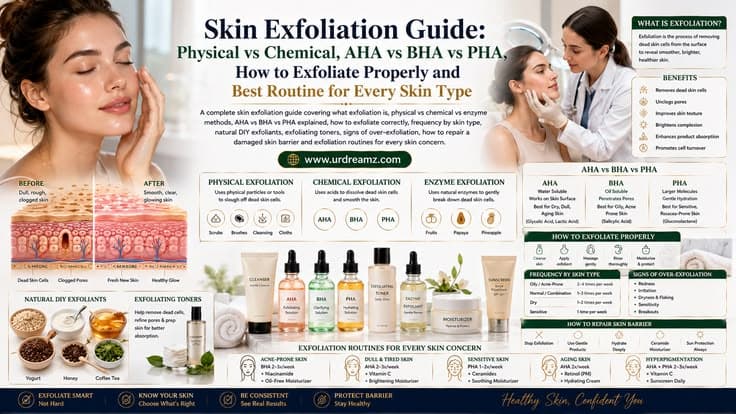
Skin Exfoliation Guide: Physical vs Chemical, AHA vs BHA vs PHA, How to Exfoliate Properly and Best Routine for Every Skin Type
Exfoliation is one of the most transformative steps in any skincare routine — and also one of the most misunderstood. Done correctly and at the right frequency, it removes the buildup of dead skin cells that makes complexions look dull and flat, unclogs pores before they become breakouts, and allows every product applied afterward to actually reach the skin rather than sitting on top of a surface layer. Done too aggressively or too often, it strips the skin barrier, causes redness, sensitivity and increased breakouts, and turns a beneficial step into a genuinely damaging one. This guide covers everything needed to exfoliate effectively: types, acids, frequencies, DIY options, tools, common mistakes, signs of overdoing it, and how to recover a damaged skin barrier. This guide connects naturally with our face cleansing guide, daily skincare routine, acne treatment guide, skin brightening guide and sunscreen guide.
1. What Skin Exfoliation Actually Is
The outermost layer of the skin is made up of dead skin cells that the body sheds naturally through a process called desquamation, which typically takes around twenty-eight days in younger skin and slows progressively with age. When this natural shedding process falls behind, dead cells accumulate on the surface, making the skin appear dull, rough and uneven in texture. Exfoliation deliberately speeds this cell removal process, either by physically dislodging the dead cells or by dissolving the bonds that hold them together so they shed more efficiently. The result is a fresher surface layer, improved light reflectivity and better penetration of any skincare applied afterward.
2. The Six Core Benefits of Regular Exfoliation
| Benefit | How It Happens |
|---|---|
| Removes dead skin cell buildup | Clears the dull, accumulated surface layer to reveal fresher skin beneath |
| Unclogs pores | Removes the material inside follicles before it oxidizes or inflames |
| Improves skin texture | Smooths rough patches and uneven surface for a more refined feel |
| Boosts natural radiance | Fresh skin reflects light more evenly than a built-up dead cell layer |
| Improves product absorption | Removes the surface barrier that prevents serums and moisturizers from penetrating |
| Prevents dullness over time | Maintains consistent cell turnover as natural shedding slows with age |
3. The Three Types of Exfoliation
Exfoliation methods fall into three broad categories, each working through a different mechanism and suited to different skin needs and tolerances. Understanding the difference between them is the starting point for choosing an approach that produces improvement rather than irritation.
4. Physical Exfoliation Explained
Physical exfoliation uses particles, surfaces or tools to manually dislodge dead skin cells from the surface through friction. This includes face scrubs with granular particles, cleansing brushes, rough cloths, loofah sponges and microdermabrasion tools. The immediate result is noticeably smoother skin because the dead cells are physically removed in the session, which is why physical exfoliation is appealing for its instant gratification.
The risk with physical exfoliation is that the technique and the quality of the exfoliant matter enormously. Irregular, jagged particles — most notoriously walnut shell powder or apricot kernel fragments common in inexpensive scrubs — create microscopic tears in the skin surface that damage the barrier and cause low-level inflammation even when the skin looks fine immediately after use. Finely milled, smooth particles like sugar, jojoba beads or round synthetic beads are meaningfully gentler. Technique matters equally: pressing hard or scrubbing vigorously negates whatever gentleness the particle choice provides.
5. Chemical Exfoliation Explained
Chemical exfoliants use acids or other compounds that dissolve the bonds holding dead skin cells together, allowing them to shed from the surface more completely and efficiently than physical methods can achieve. Rather than physically scrubbing cells off, chemical exfoliants work invisibly at the cellular level, producing results that develop over hours after the product is applied and rinsed or left on the skin.
Chemical exfoliation is generally considered gentler than physical exfoliation when used at appropriate concentrations and frequencies, because it doesn't create friction and can penetrate more evenly across the surface. It's also far more targeted — different chemical exfoliants work at different depths and on different types of skin concerns, which makes choosing the right one genuinely meaningful rather than simply a matter of preference. Dermatologists consistently recommend chemical over physical exfoliation for most skin types, particularly for people with sensitivity, acne or significant pigmentation concerns.
6. Enzyme Exfoliation Explained
Enzyme exfoliants use natural proteolytic enzymes — most commonly derived from papaya (papain), pineapple (bromelain) or pumpkin — that break down the keratin proteins in dead skin cells, dissolving them gently without the pH-dependent mechanism that acids use. Enzyme exfoliants are often described as the gentlest category of exfoliation, because they work at a surface level rather than penetrating into the pore, and they don't typically increase sun sensitivity the way AHAs can.
This gentleness also means enzyme exfoliants tend to be less dramatically effective than well-formulated acids at addressing deeper concerns like significant pigmentation or congested pores. They're an excellent option for sensitive skin types that react to acids, for people new to chemical exfoliation who want to start with something low-risk, and for maintaining the benefits of exfoliation during seasons when skin is particularly reactive.
7. Physical vs Chemical vs Enzyme: A Direct Comparison
| Feature | Physical | Chemical | Enzyme |
|---|---|---|---|
| Mechanism | Manual friction removes dead cells | Acids dissolve cell bonds | Enzymes digest keratin proteins |
| Immediacy of results | Instant — smooth skin right after | Gradual — develops over hours | Gentle and gradual |
| Precision | Variable — depends heavily on technique | High — targeted to specific concerns | Moderate — surface-level only |
| Risk of over-doing | Higher — friction causes damage easily | Moderate — concentration and pH matter | Lower — very surface-level |
| Best for | Normal skin, body use, occasional brightness | Most skin concerns with correct choice | Sensitive skin, beginners |
| Increases sun sensitivity | Minimally | Yes (especially AHAs) — SPF essential | Minimally |
8. AHA: Alpha Hydroxy Acid Explained
Alpha hydroxy acids are water-soluble acids that work primarily on the skin's surface, loosening the bonds between dead skin cells and the layer of healthy cells beneath them. Because they're water-soluble, they don't penetrate into the oil-filled pore, which means they excel at surface concerns — dullness, uneven texture, sun damage, fine lines and mild pigmentation — rather than active breakouts or deep congestion.
The most studied and widely used AHAs are glycolic acid, derived from sugar cane and notable for having the smallest molecular weight in the AHA family (which means it penetrates most efficiently), and lactic acid, derived from milk and slightly larger in molecular size, which makes it gentler than glycolic while still effectively improving texture and tone. Mandelic acid, from bitter almonds, is the gentlest common AHA with the largest molecule size, suitable for sensitive or reactive skin types and those dealing with hormonal pigmentation. All AHAs increase photosensitivity, making daily sunscreen not just recommended but genuinely necessary.
9. BHA: Beta Hydroxy Acid Explained
Salicylic acid is the primary beta hydroxy acid used in skincare, and it differs from AHAs in one critically important way: it's oil-soluble rather than water-soluble. This means it can penetrate into the oily environment inside the pore itself, dissolving the sebum and dead cell mixture that creates blackheads and congested skin from the inside out, rather than just working at the surface level. This pore-penetrating ability is what makes salicylic acid the most effective exfoliant available for oily, acne-prone and congested skin types.
Salicylic acid also has anti-inflammatory properties, which adds an additional benefit for inflamed breakouts beyond its exfoliating effect. It's generally available over the counter in concentrations from 0.5% to 2%, with 2% being the most commonly used and researched concentration for acne-related concerns. Because it's oil-soluble, it's better tolerated by oilier skin types than AHAs, which can feel slightly drying when the skin doesn't have excess oil to compensate.
10. PHA: Polyhydroxy Acid Explained
Polyhydroxy acids are a newer generation of chemical exfoliants that work similarly to AHAs but with significantly larger molecular sizes, which means they penetrate the skin more slowly and at a shallower depth. The most common PHAs are gluconolactone and lactobionic acid. Because their action is so much more surface-level than AHAs or BHAs, PHAs are considerably less irritating and far better tolerated by reactive, rosacea-prone or very sensitive skin types that can't handle standard exfoliating acids without flaring.
PHAs also have the added benefit of being humectants — they draw moisture to the skin as they work, which distinguishes them from most other exfoliants that can feel drying during the initial adjustment period. They're an excellent starting point for anyone new to chemical exfoliation or anyone recovering from a damaged skin barrier who wants to reintroduce exfoliation gradually and safely.
11. AHA vs BHA vs PHA at a Glance
| Exfoliant | Solubility | Depth of Action | Best Skin Concerns | Best Skin Type |
|---|---|---|---|---|
| AHA (glycolic, lactic, mandelic) | Water-soluble | Surface level | Dullness, sun damage, fine lines, mild pigmentation | Normal, dry, mature |
| BHA (salicylic acid) | Oil-soluble | Inside the pore | Blackheads, whiteheads, active acne, clogged pores | Oily, acne-prone, combination |
| PHA (gluconolactone, lactobionic acid) | Water-soluble | Very surface level | Gentle brightening, first-time exfoliation, barrier support | Sensitive, reactive, rosacea |
12. Glycolic Acid vs Lactic Acid vs Mandelic Acid
Within the AHA family, the three most commonly used acids differ in how quickly and deeply they work, which determines how effective and how irritating they are at equivalent concentrations.
| AHA Type | Molecular Size | Penetration | Gentleness | Best Used For |
|---|---|---|---|---|
| Glycolic acid | Smallest | Deepest and fastest | Least gentle | Most effective for texture, fine lines, sun damage — experienced users |
| Lactic acid | Medium | Moderate | Moderately gentle | Good balance of effectiveness and tolerability; suitable for most skin types |
| Mandelic acid | Largest | Slowest and shallowest | Gentlest AHA | Sensitive skin, darker skin tones with pigmentation, hormonal acne |
13. Exfoliating Toners: What They Are and How to Use Them
Exfoliating toners are liquid products applied after cleansing that contain chemical exfoliants at concentrations lower than dedicated treatment serums, making them a gentler way to incorporate regular exfoliation into a daily or near-daily routine. They're applied to a cotton pad and swept across the face, or pressed in with the palms, and they typically dry down quickly without requiring rinsing.
They're distinct from regular hydrating toners, which contain no exfoliating acids. An exfoliating toner containing 5-7% glycolic acid provides a meaningful exfoliating effect that accumulates with consistent use, removing the dead cell layer and improving radiance without the more intensive result of a dedicated peel or leave-on serum. For people new to chemical exfoliation, an exfoliating toner used two to three times a week is often an easier entry point than a more concentrated leave-on product used nightly. Key things to look for: acid type suited to the skin concern, alcohol-free formula where possible to avoid unnecessary drying, and hydrating supporting ingredients like hyaluronic acid or glycerin that counterbalance any potential dryness.
14. How to Exfoliate Your Face Correctly: Step by Step
| Step | Action |
|---|---|
| 1. Cleanse | Start with a gentle cleanser to remove makeup, sunscreen and surface impurities before applying any exfoliant |
| 2. Choose exfoliant | Select a physical scrub, chemical acid or enzyme product appropriate for the skin type and concern |
| 3. Apply gently | For physical: use fingertips in slow, gentle circular motions with light pressure. For chemical: apply as directed — many are cotton-pad toners or leave-on serums |
| 4. Rinse well (if applicable) | Rinse physical scrubs and some chemical products with lukewarm water — leave-on acids stay on the skin |
| 5. Tone | Apply a hydrating toner or rose water to soothe and restore pH balance |
| 6. Hydrate | Apply a hydrating serum — hyaluronic acid or a calming essence — before the moisturizer |
| 7. Moisturize | Always follow exfoliation with a good moisturizer to support the barrier |
| 8. Sunscreen (morning) | If exfoliating in the morning or using AHAs that increase UV sensitivity, SPF is non-negotiable |
15. How Often Should You Exfoliate by Skin Type
| Skin Type | Recommended Frequency |
|---|---|
| Normal or combination skin | 2-3 times a week |
| Oily or acne-prone skin | 2-4 times a week depending on tolerance and product strength |
| Dry skin | 1-2 times a week — prioritize gentle exfoliants |
| Sensitive or reactive skin | 1-2 times a week maximum, starting with enzyme or PHA |
| Mature skin | 2-3 times a week, focusing on AHAs for surface renewal and collagen support |
These are starting points rather than fixed rules. The most reliable feedback mechanism is the skin itself — if increased redness, tightness or breakouts appear after a new exfoliation schedule, the frequency is too high and should be reduced. Skin that seems unbothered and shows progressive improvement is at an appropriate frequency.
16. Best Time to Exfoliate: Morning or Evening
The evening is generally the better time to exfoliate, for two reasons. First, many exfoliating acids increase photosensitivity, making them safer when applied at night when there's no subsequent UV exposure. Second, the skin's repair and renewal processes are more active overnight, which means exfoliation that facilitates cell turnover has more biological support when done before sleep. If morning exfoliation is preferred — some people use a very gentle AHA toner in the morning for a pre-makeup smoothing effect — ensuring SPF50 is applied immediately afterward is critical. AHAs in particular significantly increase the risk of sun damage when the skin isn't protected immediately after use.
17. Should You Exfoliate Before or After Cleansing
Exfoliation always comes after cleansing, never before. The cleansing step removes surface makeup, sunscreen and impurities that would otherwise be pushed around by an exfoliant rather than addressed by it. A chemical exfoliant applied to dirty skin has less contact with the actual skin surface and less consistent effect. Cleanse first, then apply the exfoliant once the skin is clean and dry.
18. Natural and DIY Exfoliants Worth Knowing
| Natural Ingredient | Exfoliation Type | Best Used For |
|---|---|---|
| Fine sugar | Physical (gentle) | Face and body scrub; smoother than salt and dissolves quickly |
| Ground oats | Physical (very gentle) + mild enzyme | Sensitive skin; simultaneously soothes and removes surface dullness |
| Coffee grounds | Physical | Body scrub; improves circulation and temporarily reduces surface roughness |
| Honey with papaya | Enzyme (papain) | Natural enzyme peel; dissolves dead surface cells gently |
| Yogurt | Chemical (lactic acid) | Very mild AHA effect; suitable for sensitive skin and brightening |
| Besan (gram flour) with milk | Physical + mild chemical | Traditional South Asian gentle exfoliation and brightening |
| Lemon juice — with caution | Chemical (citric acid) | Generally not recommended for direct application due to low pH causing irritation |
19. DIY Exfoliant Recipes for Home Use
- Sugar Scrub (Body and Normal Skin Face): Combine one part fine sugar with one part carrier oil such as coconut or jojoba oil. A few drops of lavender essential oil can be added for fragrance if skin isn't sensitive. Massage gently and rinse with lukewarm water.
- Oatmeal Gentle Face Paste (Sensitive Skin): Grind rolled oats into a fine powder in a blender. Mix with enough warm water or plain milk to form a paste. Apply to the face, leave for five to ten minutes, then rinse with gentle circular motions. Suitable for very reactive skin.
- Honey and Papaya Enzyme Mask: Mash ripe papaya and combine with a spoon of raw honey. Apply to the face and leave for ten to fifteen minutes for the papain enzyme to work on the skin surface. Rinse with cool water. Brightening and very gentle.
- Coffee Scrub (Body): Combine fresh or used coffee grounds with enough coconut oil to hold them together. Massage onto arms, legs and elbows in circular motions before rinsing. Improves circulation and surface texture on the body.
- Besan and Yogurt Paste (Traditional): Combine two spoons of besan (gram flour) with enough plain yogurt to make a paste. Apply to the face and leave until dry, then rinse while gently massaging in circular motions. Good for brightening and removing surface dullness.
20. Exfoliation for Oily and Acne-Prone Skin
Oily and acne-prone skin types tend to benefit most from BHA exfoliation specifically, because salicylic acid's oil solubility allows it to enter the pore environment where sebum and dead cells accumulate, rather than working only at the surface. Using a salicylic acid toner or cleanser two to four times a week helps prevent the buildup that leads to blackheads and inflammatory breakouts. An important caution: over-exfoliating oily skin triggers compensatory oil production rather than reducing it, creating a cycle of increasingly congested skin. The response to any worsening of oil production during a new exfoliation routine is almost always to reduce frequency, not increase it. For more on treating acne comprehensively, see our acne treatment guide.
21. Exfoliation for Dry Skin
Dry skin genuinely benefits from exfoliation because accumulated dead cells on dry skin sit more visibly and feel rougher than they would on oilier skin, and they also create a physical barrier to moisturizer absorption. Lactic acid is the most frequently recommended AHA for dry skin because it has a gentle exfoliating effect combined with a humectant property that draws moisture into the skin as it works. One to two exfoliation sessions per week is appropriate rather than more frequent use, always paired with an immediately applied moisturizer afterward to prevent the freshly revealed skin from feeling stripped. The daily skincare routine covered in our skincare routine guide provides the full context for where exfoliation fits within a complete approach.
22. Exfoliation for Sensitive and Reactive Skin
Sensitive skin needs the gentlest possible introduction to exfoliation. PHAs, enzyme exfoliants and very low concentrations of lactic or mandelic acid are the appropriate starting points, used only once a week initially before gradually increasing frequency if tolerance is confirmed. Patch testing any new exfoliant on a small area — the inner arm or jaw — for twenty-four hours before full-face application is worth the extra step for reactive skin types. Any stinging, redness or swelling that doesn't settle within a few minutes of rinsing indicates the product is too strong or the skin is currently too reactive for chemical exfoliation, and a period of barrier repair should come first before retrying.
23. Exfoliation for Pigmentation and Dark Spots
Chemical exfoliation is one of the most effective approaches for improving post-acne marks and other surface pigmentation, because the increased cell turnover it drives carries pigmented cells to the surface more quickly than natural shedding alone would. AHAs are particularly relevant here — glycolic and mandelic acid both have evidence for improving surface pigmentation over consistent use. AHAs also combine well with other brightening ingredients like vitamin C and niacinamide, addressed more fully in the skin brightening guide. One critical rule: any exfoliation routine targeting pigmentation requires strict daily sunscreen, since UV exposure continuously creates new pigmentation that easily outpaces the clearing effect of any exfoliant.
24. Exfoliation for Body Skin
Body skin tends to be thicker and less reactive than facial skin, which means it can tolerate more vigorous physical exfoliation without the same risks that apply to the face. A body scrub used in the shower one to two times per week effectively removes the dead cell layer from arms, legs, elbows and feet, keeping skin soft and allowing body moisturizer to absorb more effectively afterward. Chemical exfoliants in body lotion form, containing lactic acid or glycolic acid, work well for people with keratosis pilaris — the rough, bumpy texture commonly found on the upper arms and thighs — where physical scrubbing alone doesn't address the underlying cause effectively.
25. Signs You Are Over-Exfoliating
Over-exfoliation is more common than under-exfoliation, particularly among people following aggressive skincare advice online. Recognizing the signs early prevents the weeks of recovery time that full barrier damage requires.
| Sign | What It Indicates |
|---|---|
| Persistent redness | Skin barrier is compromised and inflamed |
| Tightness after cleansing | Moisture is escaping through a damaged barrier |
| Dehydrated yet oily-looking skin | Barrier damage causes compensatory oil production over dehydrated skin |
| Stinging or burning from previously tolerated products | Barrier is broken down; products are penetrating where they shouldn't |
| Flaky patches despite regular moisturizing | Barrier is too compromised to retain moisture regardless of what's applied |
| Sudden increased breakouts | Compromised barrier allows bacteria to penetrate more easily |
| Sensitivity to water temperature or light touch | Skin is raw and reactive at the barrier level |
26. How to Repair a Damaged Skin Barrier
Recovering a damaged skin barrier from over-exfoliation requires stopping all exfoliation completely and resisting the temptation to add more products to compensate. The skin needs simplicity and specific barrier-supporting ingredients rather than more intervention.
| Phase | Timing | Focus |
|---|---|---|
| Calm and protect | Days 1-2 | Stop all exfoliants; switch to a gentle cleanser; apply a ceramide moisturizer; use SPF |
| Hydrate and repair | Days 3-5 | Add hydrating serums with hyaluronic acid, panthenol or centella; keep the routine minimal |
| Rebalance | Week 2 | Continue simple routine; skin should feel calmer and more resilient |
| Reintroduce gradually | Weeks 3-4 | If skin feels recovered, reintroduce one gentle exfoliant at reduced frequency |
27. Key Ingredients for Skin Barrier Repair After Over-Exfoliation
- Ceramides: Lipid molecules that form a structural part of the skin barrier, directly replenishing what exfoliation has stripped.
- Hyaluronic acid: Draws water into the skin and helps maintain hydration while the barrier recovers.
- Niacinamide: Supports ceramide synthesis within the skin and helps calm inflammation.
- Panthenol (vitamin B5): Soothing and hydrating; accelerates the skin's surface healing process.
- Centella asiatica: Strongly anti-inflammatory and wound-healing; widely used in Korean skincare for barrier repair.
- Glycerin: Humectant that draws moisture to the skin and helps maintain surface hydration.
- Allantoin: Soothing and healing ingredient that calms irritation and supports skin recovery.
28. Exfoliation Dos and Don'ts
| Do | Don't |
|---|---|
| Exfoliate on clean skin after cleansing | Exfoliate on irritated, sunburned or broken skin |
| Use light, gentle pressure for physical exfoliation | Scrub hard or press aggressively |
| Moisturize after every exfoliation session | Leave skin bare after exfoliating |
| Use sunscreen daily when using AHAs | Skip SPF after using photosensitizing acids |
| Start at lower concentrations and frequencies | Begin at maximum strength or daily use |
| Patch test new exfoliants | Apply a new strong acid to the full face without testing |
| Listen to the skin and reduce if irritation appears | Push through irritation assuming it's normal |
| Introduce one new exfoliant at a time | Layer multiple acids in the same routine simultaneously |
29. Can You Mix AHA and BHA Together
Some products combine AHA and BHA in a single formula at lower concentrations, and these can work well for combination skin that needs both surface brightening and pore-clearing effects. However, layering a separate high-concentration AHA product and a high-concentration BHA product in the same session is more likely to cause irritation than to produce better results — both exfoliate simultaneously and the combined effect on the barrier is additive. If both acid types are part of a routine, alternating them on separate nights or using a single low-dose combination product is generally a more balanced approach than using both in full strength at the same time.
30. Exfoliation Myths Worth Addressing
| Myth | More Accurate Reality |
|---|---|
| Daily exfoliation produces better results than weekly | Over-exfoliation damages the barrier; consistent but appropriately spaced exfoliation produces better cumulative results |
| Stronger acids always work faster | Higher concentrations cause more irritation and aren't tolerated consistently; moderate concentrations used regularly outperform intense concentrations used sporadically |
| Tingling means the product is working | Tingling means irritation; a gentle, tolerated exfoliant working consistently produces results without discomfort |
| Physical scrubs are better because results are instant | Chemical exfoliation produces more consistent, targeted and ultimately more significant results over time |
| Exfoliation alone solves acne | Exfoliation is one useful component of an acne routine alongside targeted actives and lifestyle factors |
| You need to exfoliate every day to prevent acne | Over-exfoliation worsens acne by damaging the barrier; appropriate frequency is the goal, not maximum frequency |
31. A Weekly Exfoliation Schedule Example
| Day | Evening Routine Addition |
|---|---|
| Monday | Exfoliating toner or gentle AHA serum |
| Wednesday | Exfoliating session; face mask suited to skin type afterward |
| Friday | Third exfoliation session if skin type calls for it (oily or normal) |
| Saturday/Sunday | Rest from actives; focus on hydration, barrier support and a nourishing mask |
32. Exfoliation in a Glow-Up Routine
For a comprehensive 30-day skin improvement routine, exfoliation sits alongside cleansing, hydration, masking and targeted serums as one of the weekly habits that produces the most visible change over time. Once or twice weekly exfoliation combined with consistent double cleansing at night, a vitamin C serum in the morning, daily sunscreen, adequate hydration and a calming mask once a week represents a genuinely complete approach to improving skin texture, radiance and clarity over weeks rather than overnight. The full cleansing foundation for this kind of routine is covered in the face cleansing guide.
33. Frequently Asked Questions
Is it better to exfoliate at night or in the morning?
Evening is generally preferable — it avoids increased UV exposure on freshly exfoliated skin, and the skin's overnight repair mode supports the cell turnover that exfoliation encourages. Morning exfoliation works if a gentle product is used and SPF is applied immediately afterward.
Can exfoliation remove pimples?
Not directly, but regular exfoliation prevents the dead cell and sebum buildup that creates the conditions for pimples to form. BHA exfoliation is particularly relevant for acne because salicylic acid enters the pore and reduces congestion before it becomes inflamed.
How do I exfoliate without products?
A warm, damp, soft washcloth used with very gentle pressure during cleansing provides mild physical exfoliation. Natural enzyme options like mashed papaya or ground oatmeal provide very gentle exfoliation without manufactured products. These options are less consistent than formulated exfoliants but a reasonable starting point.
Is it okay to exfoliate every day?
For the vast majority of people, no. Daily exfoliation almost always leads to barrier damage over time, even with gentle products. Most skin types do well with one to four sessions a week depending on the product strength and skin tolerance. If a gentle exfoliating toner with a low acid concentration is used, some people incorporate it daily in small amounts, but this should be built to gradually rather than started immediately.
Which exfoliant do dermatologists typically recommend?
Chemical exfoliants, particularly AHAs and BHAs, are more consistently recommended than physical scrubs by most dermatologists because they produce more predictable results without the risk of mechanical barrier damage. BHA at 2% for oily and acne-prone skin, and AHA for surface concerns in dry or mature skin, are among the most frequently recommended starting points.
34. Final Thoughts
Skin exfoliation, when done correctly, is one of the most visibly impactful steps anyone can add to a skincare routine. The key words are "done correctly" — choosing the right type for the specific skin concern, at the appropriate concentration and frequency, with sufficient hydration and sun protection built around it. The temptation to exfoliate more aggressively or more often when results feel slow is one of the most common skincare mistakes, and it consistently produces the opposite of what's intended. More exfoliation produces a damaged barrier, more irritation and more breakouts. The right amount of exfoliation, applied consistently over weeks, produces smoother texture, cleared pores and genuinely brighter skin that doesn't require explanation. Combined with a solid cleansing routine from our face cleansing guide, thoughtful brightening from the brightening guide, and daily sunscreen from the sunscreen guide, regular exfoliation becomes the engine of a genuinely effective skincare routine.