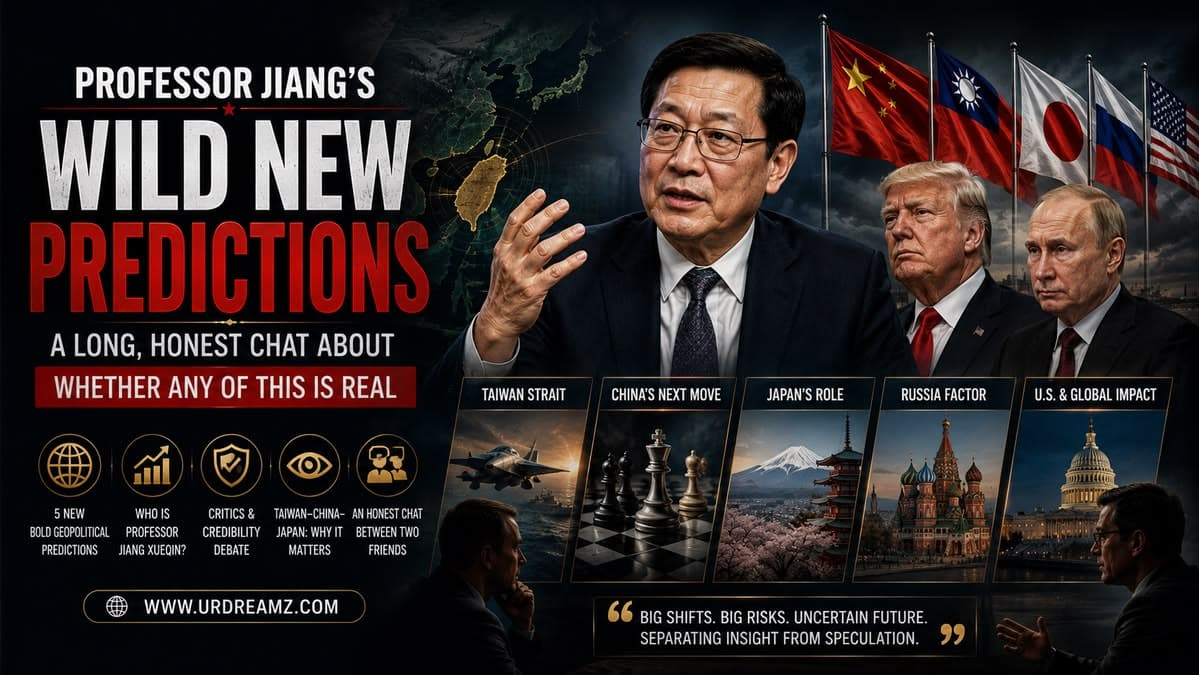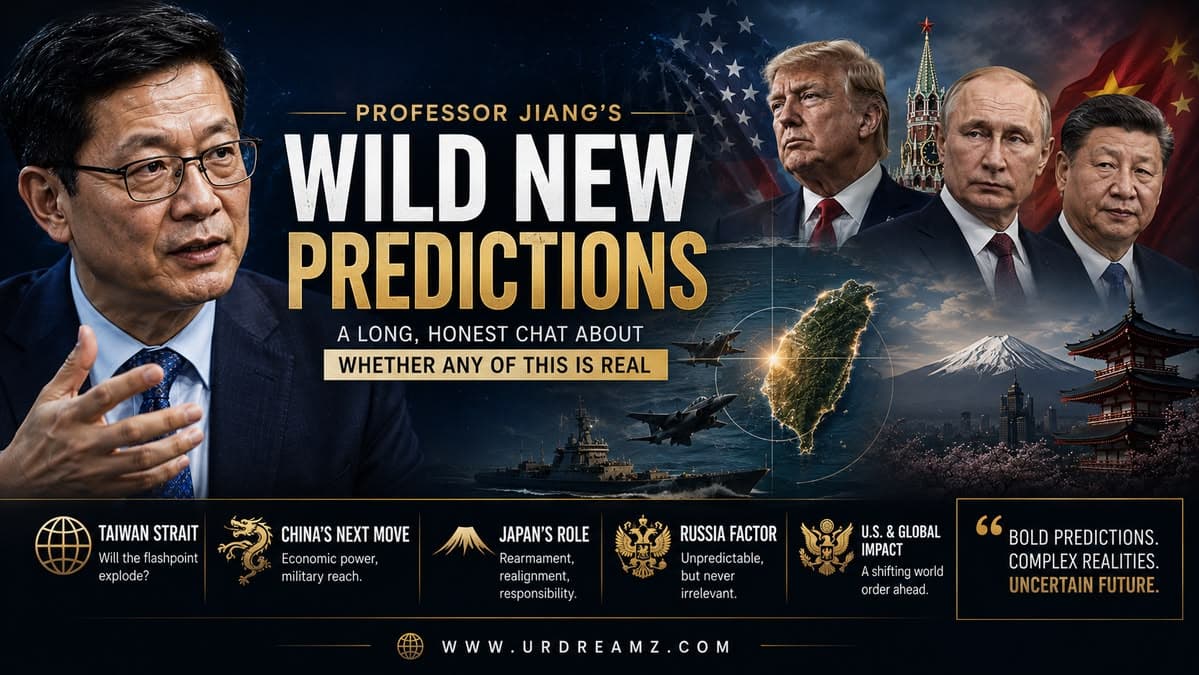
Professor Jiang's Wild New Predictions: A Long, Honest Chat About Whether Any of This Is Real
So my friend calls me up the other night, sounding way more worked up than usual, and the first thing out of his mouth is, "Have you heard the new Professor Jiang podcast yet?" I hadn't, not yet, so he basically talked my ear off for the next hour explaining everything this man had just said. And honestly, by the time he was done, my head was spinning too. So I figured, instead of just keeping this conversation between the two of us, let's actually sit down, go through everything point by point, and talk it out properly, the way we always do when something sounds too big to just accept at face value.
Before we even get into the five new predictions themselves, though, I want to back up and talk about who this guy actually is, because that part matters more than people give it credit for. A prediction is only as strong as the person making it, and Professor Jiang's story is a lot more complicated than the clips floating around online make it seem.
Okay, But Who Actually Is Professor Jiang?
Here's the thing that surprised me most when I actually looked into this. Professor Jiang, whose real name is Jiang Xueqin, is not some retired intelligence officer or a career diplomat sitting on decades of classified briefings. He is a Chinese-born, Canadian-raised educator who currently works as a history and philosophy teacher at a private high school in Beijing. That's it. That's the day job. On the side, he runs a YouTube channel called Predictive History, where he goes by the title "Professor Jiang," and where he talks about something he calls psychohistory, basically the idea that if you study historical patterns closely enough, you can start forecasting where the world is headed next.
Now, I want to be fair here, because plenty of people online genuinely find his content fascinating. He has built a following in the millions, and he gets invited onto major podcasts specifically because he speaks with so much confidence and clarity about incredibly complicated global issues. He was even featured on a well-known podcast where he was framed almost like a modern-day prophet, someone whose predictions about Trump's return to power and the Iran conflict had already come true, which is exactly the reputation you mentioned when you first brought this up to me.
But Here's Where It Gets a Little More Complicated
This is the part that I think genuinely deserves more attention before anyone takes his newest predictions as gospel. When you actually dig into how people who study geopolitics for a living view him, the picture is a lot messier than "he's always right." A well-known online science communicator, who runs a channel dedicated to fact-checking pseudo-intellectual content, did an entire reaction video specifically about Professor Jiang, and did not hold back, essentially arguing that Jiang dresses up vague, unfalsifiable claims in academic-sounding language without actually having the credentials or rigorous methodology that real historians and political scientists use.
And it's not just one critic either. On forums where people who actually study international relations hang out, opinions on him are genuinely split down the middle. Some people find his big-picture thinking refreshing, a way of questioning the usual mainstream narratives we're fed. Other people flat out call him a conspiracy theorist, pointing out that he doesn't hold formal academic credentials in history or political science, and that a lot of his forecasts lean on dramatic, sweeping claims that are almost impossible to verify or falsify until years after the fact, if ever.
So I told my friend, look, this doesn't mean everything the man says is nonsense. But it does mean we shouldn't walk into this conversation assuming he has some kind of perfect track record or secret insider access. He's a high school teacher with a very popular YouTube channel and a talent for sounding extremely certain about things nobody can actually be certain about. Keep that in mind as we go through what he's now claiming.
Let's Talk About the Predictions That Made Him Famous First
To be fair to the guy, and to you, since this is exactly what got you excited about him in the first place, let's walk through the predictions that built his reputation before we get into the new ones. The first big one everyone points to is his call that Donald Trump would win a second term as president. That did happen, and it happened around the time he was making a lot of noise about it, so credit where it's due.
The second one people bring up constantly is his claim that Iran and the United States would end up in a direct war shortly after Trump returned to office. Depending on how you define "war," there has indeed been serious, direct military confrontation between the two sides during this period, so again, on the surface, this lines up with what he said.
And the third claim, the one that really seems to have cemented his reputation in your eyes, is that he predicted the United States would ultimately lose that conflict and suffer a real decline as a result. Now, whether that has actually, fully played out yet is genuinely debatable and depends a lot on how you're reading the current situation, but I understand why, if you're watching tensions escalate the way they have been, it feels like his prediction is coming true in real time.
Here's my honest pushback though, and I say this as your friend, not as someone trying to argue for the sake of arguing: predicting that two countries already locked in decades of hostility might go to war, or predicting that the frontrunner in a presidential race that was genuinely close and getting closer might win, is not exactly the same as reading tea leaves nobody else could read. These were widely discussed, widely debated possibilities among all kinds of commentators, journalists, and analysts well before Jiang said anything. He just said it with a lot more confidence and theatrical flair than most people, and confidence, especially delivered in a slow, deliberate, professor-like tone, tends to feel a lot more convincing than it should.
Alright, Now Let's Actually Get Into the Five New Predictions
Okay, so with all of that context sitting in the back of our minds, let's go through what he's now claiming in this new podcast, one at a time, the same way you laid them out for me on the phone.
Prediction One: The Trump Family Succession Plan
This is the one that genuinely made my jaw drop when you first explained it to me, and I get why it rattled you too. According to what he's saying, in about two years, Donald Trump is going to somehow return to the presidency again. Now, right off the bat, we both know this runs directly into a constitutional wall. The Twenty-Second Amendment to the United States Constitution is about as clear as constitutional language gets: no person shall be elected to the office of president more than twice. Trump has already served two terms. Under the plain reading of that amendment, running for and being elected president a third time is simply not allowed.
But apparently, Jiang's actual claim is more elaborate than "Trump runs again directly." What he's suggesting, from what you described, is a kind of succession chain: Eric Trump becomes president first, Donald Trump becomes his vice president, and then, at some point after that, either the running mate steps aside or some other maneuver happens that allows Donald Trump to move from vice president into the presidency through succession rather than through a direct third election. You mentioned this ties into speculation involving JD Vance as well.
I'll be straight with you: this kind of scenario has floated around in political commentary circles before, usually as a hypothetical "loophole" discussion rather than a confirmed plan, and it remains hotly contested among constitutional scholars whether someone barred from being elected a third time could still legally ascend to the presidency through the vice-presidential succession route. It's the kind of legal gray area people love to argue about precisely because it has never actually been tested in real life. So when Jiang presents this as something that's simply going to happen, treating a contested legal theory as a settled outcome, that's a pretty big leap. It's a fascinating hypothetical to think about, sure, but it is nowhere close to a guaranteed inevitability, and honestly, layering a whole family succession plan involving a specific son on top of an already disputed legal theory is where this starts to feel more like speculative storytelling than serious forecasting.
Prediction Two: The Iran Conflict Just Keeps Going
The second prediction is a lot less dramatic on the surface: Jiang is saying Iran simply won't be able to extract itself from this ongoing conflict with the United States, and that the fighting, or at least the underlying tension, is going to continue rather than reach any kind of resolution. Honestly, out of all five predictions, this is the one that feels the most grounded, mainly because it doesn't require anything particularly surprising to come true. Long, unresolved conflicts between powerful nations and regional actors have been the norm throughout modern history far more often than clean, decisive endings. Saying a conflict like this "continues" is a pretty safe bet almost by default, which is worth keeping in mind before we're too impressed by it.
Prediction Three: The "Greater Israel" Claim
This next one is heavier, and I want to be careful about how we talk about it, because it touches on real, deeply sensitive territorial and political questions that affect millions of actual people. According to what you described, Jiang is predicting that Israel will move to acquire additional territory in pursuit of what's sometimes referred to as a "Greater Israel" concept, essentially expanding beyond its current recognized borders into areas he specifically identified.
I think the most responsible way for us to talk about this is to acknowledge that questions of territorial expansion, borders, and regional conflict in that part of the world are among the most contested, sensitive, and consequential issues in modern geopolitics, and different people, governments, and communities hold very different views on what has happened, what is happening, and what should happen. A single commentator on a podcast predicting a specific territorial outcome is not the same as that outcome being confirmed, planned, or inevitable. This is exactly the kind of claim where I'd want us to be especially careful about spreading it further without treating it as clearly speculative, because of how much real weight these topics carry for real people.
Prediction Four: Russia, NATO, and an "Unhinged" Trump
This fourth prediction has two parts, and honestly, both parts deserve their own conversation. The first part is that tensions between Russia and NATO are going to keep deteriorating, potentially into a broader, more direct conflict beyond what's already happening in Ukraine, where Russian forces have been engaged for years now. Given how strained that relationship already is, this again isn't the wildest prediction in the world. Escalation remains a real, openly discussed risk among actual foreign policy analysts, not just YouTube commentators.
The second part of this prediction is where things get a lot more dramatic and, frankly, a lot more speculative. Jiang is apparently claiming that Donald Trump currently holds something like ninety percent of total available presidential power, and that this will soon become effectively one hundred percent, unchecked and unrestrained. From there, he suggests this concentration of power will lead to increasingly erratic, even "unhinged" decision-making, and he even references some kind of "capture group," implying a small circle of people positioned to manipulate decisions made from that position of near-total power.
I told my friend straight up, this is where I get the most skeptical. Measuring presidential "power" as a clean percentage that can somehow jump to one hundred is not really how constitutional systems of checks and balances work, even under significant strain. It's an evocative, dramatic way of framing things for a podcast audience, but it's not a measurable, falsifiable claim in any meaningful sense. It sounds specific and confident, which is exactly what makes content like this so shareable, but there's no real methodology behind assigning a number like ninety percent to something as abstract as institutional power.
Prediction Five: Taiwan, China, and Japan Getting Pulled In
The last prediction is the one that honestly worried me the most, not because I think it's guaranteed to happen, but because the underlying tension it's describing is very real and already being discussed seriously by actual policy experts, not just Professor Jiang. He's predicting that a war over Taiwan is coming, and that Japan will be directly pulled into it.
Now, I actually think this is the one prediction worth unpacking properly, with real context, rather than just reacting to the headline version of it. And that's exactly why I want to share something with you here, an article that lays out the entire Taiwan-China-United States dynamic in a lot more depth than either of us could summarize on a phone call.
You can read the full breakdown here: Taiwan, China, and the Semiconductor Flashpoint Explained. It goes deep into exactly why Taiwan sits at the center of so much global anxiety, and honestly, once you understand the semiconductor angle, the Japan connection stops feeling like a random detail Jiang threw in and starts making a lot more logical sense.
Here's the short version, though, for anyone who wants the quick explanation before clicking through. Taiwan is not just some contested island with symbolic political weight. It happens to be home to the most advanced semiconductor manufacturing capability on the entire planet, producing the majority of the world's most sophisticated computer chips, the kind that power everything from smartphones to military systems to artificial intelligence infrastructure. China views Taiwan as a breakaway province that should ultimately be reunified with the mainland, while Taiwan operates as a self-governing entity with its own government, and the United States maintains a deliberately ambiguous but historically supportive relationship with Taiwan, partly out of strategic interest in preventing China from controlling that chip supply.
Japan's connection to all of this is almost entirely economic and industrial rather than purely political. Japanese technology companies, automakers, and electronics manufacturers are enormously dependent on a steady supply of the advanced chips that Taiwan produces. If that supply were ever disrupted by a military conflict, Japan's entire economy would be hit incredibly hard almost overnight, which gives Japan a very direct, very concrete incentive to be deeply invested in whatever happens to Taiwan, diplomatically, economically, and potentially, in a worst-case scenario, militarily as well.
So when Jiang says Japan would be "directly involved," it's not some wild, unsupported leap. It actually lines up with something real analysts, economists, and defense strategists have been discussing seriously for years now. The real question isn't whether Japan has a stake in what happens to Taiwan, because it clearly does. The real question is whether an actual armed conflict is truly imminent, and that's a much harder, much more uncertain question that depends on political decisions still being made in real time by real governments, not something any single commentator can responsibly claim to know for certain in advance.
And that's really the core of why this particular prediction matters more than the others, at least to me. If two nuclear-capable superpowers, or their allies, were ever to face off directly over something like Taiwan, we are not talking about a regional skirmish that stays contained. We are talking about the kind of confrontation that could reshape global trade, global technology, and global security all at once. Just sit with that for a second. Imagine the ripple effects across every industry that depends on those chips, across every economy connected to global trade, across every country that suddenly has to pick a side or scramble to protect itself. That's the scale we're talking about if this ever actually escalated the way Jiang is suggesting.
Why Do Predictions Like This Spread So Fast in the First Place?
Before we even get to the five new claims themselves, I think it's worth pausing on something my friend and I ended up circling back to more than once during our conversation: why does content like this spread so quickly in the first place? It's not really a mystery once you break it down. A confident voice, a slow and deliberate speaking style, and a willingness to say things nobody else is willing to say out loud on camera is an extremely powerful combination online. Most mainstream analysts hedge their language constantly, saying things like "it's possible" or "under certain conditions" or "we can't rule out." Professor Jiang doesn't really do that. He states things directly, almost like they've already happened, and that kind of certainty is deeply appealing to an audience that's tired of vague, wishy-washy commentary.
There's also something almost cinematic about the way his content is framed. Calling something "psychohistory" instantly makes it sound like a hidden, almost mystical field of knowledge, something only a select few people have access to. It taps into a very old, very human fascination with prophecy and hidden knowledge, the idea that somewhere out there, someone has figured out the pattern the rest of us are too blind to see. That framing alone does a huge amount of work in making his claims feel more credible than they might otherwise be if delivered in a dry, academic tone.
The Danger of Only Remembering the Hits
Here's something else my friend and I talked about that I think deserves its own space in this conversation. When someone makes dozens, maybe even hundreds, of predictions over the course of years of content, of course some of them are going to end up being roughly correct, purely by the law of averages. The problem is, we almost never hear about the predictions that didn't pan out. Nobody makes viral clips out of "Professor Jiang predicted this and it didn't happen." Those moments quietly disappear, while the hits get clipped, reposted, and turned into headline material again and again.
This is actually a well-documented pattern in how any kind of forecasting personality builds a reputation, whether we're talking about financial market pundits, sports commentators, or geopolitical analysts. If you make enough predictions, confidently and often enough, some of them are statistically guaranteed to land close to reality, especially vague or broad ones. The trick, intentional or not, is that only the hits get remembered and amplified, while the misses fade into the background noise of everything else that was said and quietly forgotten. I'm not saying this is necessarily happening deliberately here, but it is worth keeping in mind any time someone's reputation rests heavily on a handful of specific successful predictions rather than a transparent, complete track record.
How Should We Actually Approach Content Like This?
So where does that leave two friends trying to make sense of a podcast that's got half the internet talking? I think the healthiest approach isn't to dismiss it outright, and it's also not to accept it uncritically just because it sounds compelling. Somewhere in the middle is probably right. It's absolutely fine, even valuable, to listen to voices like Professor Jiang's as a way of thinking through possible scenarios, especially when they touch on real, ongoing tensions like the Taiwan situation or the Russia-NATO relationship. Thinking through worst-case scenarios isn't inherently unhealthy. It can actually be a useful exercise, as long as we remember it's an exercise in imagination and pattern recognition, not a confirmed roadmap of what's definitely coming.
Where it becomes a problem is when people start treating a single commentator's timeline as though it's already locked in, planning their emotional state, their financial decisions, or their worldview entirely around one person's specific, dramatic predictions. That's where healthy curiosity crosses over into something a lot less healthy, a kind of low-grade anxiety fed by content that's specifically designed, whether intentionally or not, to feel urgent and inevitable.
A Bit More on the Israel-Related Claim
Going back to the third prediction for a moment, because I think it deserves a little more room than we initially gave it. Claims about territorial expansion tied to historical or religious concepts are among the most emotionally charged topics in modern geopolitics, and for good reason, given how much real history, real suffering, and real ongoing conflict is tied up in that region. When a commentator states, with total confidence, that a specific territorial outcome is coming, it's worth remembering that actual foreign policy, actual military decisions, and actual diplomatic negotiations involve an enormous number of moving parts: domestic politics within multiple countries, international law, economic pressures, alliances, and public opinion, among many other factors.
None of that complexity fits neatly into a five-minute segment of a podcast, no matter how confidently it's delivered. That doesn't mean the topic isn't worth discussing seriously, because it absolutely is, and there are extremely well-informed analysts, historians, and regional experts who spend their entire careers studying exactly these dynamics. It just means a single online commentator's prediction shouldn't be mistaken for the kind of deep, nuanced expertise that this topic genuinely requires and deserves.
Thinking a Little More About the "Power Grows to One Hundred Percent" Idea
I want to circle back to prediction four for a second, because the more my friend and I talked about it, the more it bothered me, not because it's necessarily wrong, but because of how it's framed. The idea that a leader's power could somehow climb from ninety percent to a full one hundred percent implies there's some kind of measurable ceiling, some final threshold where all remaining checks simply dissolve. In reality, political power in any large modern country is diffused across courts, legislatures, media, public opinion, allied nations, financial markets, and countless other pressure points, all pulling in different directions at once. It doesn't behave like a single dial that gets turned up gradually until it hits maximum.
That doesn't mean concentration of power isn't a real, legitimate concern in modern politics, because history has plenty of examples of institutions weakening over time and leaders accumulating more practical influence than the system originally intended. But framing it as a clean numerical progression makes for a much more dramatic, quotable soundbite than it does an accurate description of how institutional erosion, if it happens at all, actually tends to unfold in the real world, usually messily, unevenly, and with plenty of pushback along the way rather than a smooth, uncontested climb to total control.
What About the Idea of a "Capture Group"?
The other piece of that same prediction that stuck with me was this mention of some kind of "capture group," a circle of people supposedly positioned to manipulate decisions once power becomes concentrated enough. This is a really common structure in this genre of content, the idea that some smaller, less visible group is quietly steering events from behind the scenes. It's a compelling narrative device, no doubt, because it offers a tidy explanation for chaotic, unpredictable events, but it's also incredibly hard to verify or disprove, which is exactly what makes it so appealing to include in this kind of forecasting. Claims about hidden groups pulling strings behind the scenes have existed in political commentary for centuries, long before Professor Jiang or YouTube even existed, and they tend to resurface in slightly different forms every generation. That alone doesn't make the specific claim automatically false, but it should make us a little more careful before treating it as an established fact rather than an unverified assertion layered on top of an already speculative prediction.
One More Thing Worth Remembering About Long-Term Predictions
Something else worth sitting with, especially since Jiang himself is talking about outcomes stretching fifteen to twenty years into the future, is just how difficult it genuinely is for anyone, credentialed expert or confident podcaster alike, to accurately forecast that far ahead. Go back twenty years and try to find serious, mainstream predictions about exactly where global politics, technology, and power dynamics would sit today. Most of them, even from well-respected institutions with huge research budgets and teams of specialists, missed major turning points entirely, simply because the world is shaped by an enormous number of unpredictable variables interacting in ways nobody can fully model in advance.
This isn't a knock specifically against Professor Jiang. It's just a reminder that long-range forecasting, in general, is an inherently uncertain exercise, no matter who's doing it or how confidently they present it. The further out a prediction reaches, the more room there is for unexpected events, technological shifts, leadership changes, and countless other factors to completely reshape the picture in ways nobody currently anticipates. That uncertainty isn't a flaw in the process. It's simply the nature of trying to predict something as complex and unpredictable as the future of global politics.
What My Friend and I Actually Agreed On By the End
After going back and forth for what felt like way too long for a phone call, here's roughly where we landed together. Some of what Jiang talks about touches on real, legitimate areas of global concern that serious people are genuinely worried about, particularly around Taiwan, semiconductor dependency, and rising tension between major powers. Those threads are worth paying attention to, not because Professor Jiang said them, but because they show up consistently across serious, credentialed sources as well.
But the specific, dramatic framing, the exact percentages, the detailed family succession scenarios, the confident timelines measured in exact years, those are the parts that deserve real skepticism. They make for gripping podcast content, but gripping content and reliable forecasting are simply not the same thing, no matter how good someone is at making the two feel identical while you're listening.
After going through all five of these one by one with my friend, here's roughly where we landed, and I think it's a fair place for you to land too. Some of what Jiang is saying touches on genuinely real, well-documented tensions that serious policy experts are already watching closely, especially around Taiwan and the broader Russia-NATO relationship. Those parts of his predictions aren't him inventing something out of thin air; they're him picking up on real, existing anxieties and packaging them into a confident, dramatic narrative.
But other parts, especially the very specific claims like a father-son-vice-president succession chain, or a precise percentage tied to presidential power, feel a lot more like speculative storytelling dressed up in the language of forecasting. They're the kind of claims that sound incredibly specific and authoritative in the moment, but fall apart a little when you actually try to trace the logic or the evidence behind them.
Whatever ends up actually happening over the next couple of years, I think the real value of a conversation like the one my friend and I had isn't in predicting the outcome ourselves either. It's in slowing down enough to actually examine a claim before passing it along, in separating what's genuinely well-supported from what's simply dramatic and confidently delivered, and in remembering that even the most engaging voice on the internet is still just one voice among billions of people trying to make sense of an uncertain world. And honestly, that might be the most useful takeaway from this entire conversation, more useful, in the end, than any of the five predictions themselves.
Now Here's the Part I Actually Wanted to Say All Along
After we went back and forth on all of this for a while, my friend got quiet for a second, and then he said something that honestly stuck with me more than any of Jiang's five predictions combined. He said, at the end of the day, no prediction, no matter how confident or detailed, sits above the will of the One who actually decides what happens. That belief, that ultimate control over events doesn't rest with any analyst, politician, or commentator, but with God alone, is something a lot of us carry quietly in the back of our minds, even when we're busy debating geopolitics on a phone call at eleven at night.
And honestly, there's real wisdom in that perspective, regardless of what you personally believe. So many things appear right in front of us, seeming certain, seeming inevitable, and then simply don't happen the way anyone expected. Plans fall apart. Timelines shift. People who seemed unstoppable one year are gone from the picture the next. Jiang himself is talking about outcomes he expects over the next fifteen to twenty years, which is an enormous stretch of time for absolutely anything to change in ways nobody currently sees coming.
And here's the thing that really puts it all in perspective. Plenty of powerful people have walked around convinced they had decades left to shape the world exactly the way they wanted. Joe Biden reportedly carried that same mindset for a long time, genuinely believing he had time on his side. Lindsey Graham has spoken with that same kind of long-term certainty about his own political future. Donald Trump, Benjamin Netanyahu, and so many others operate the same way, as though the next fifteen or twenty years are simply theirs to plan around. But realistically, none of these people, no matter how powerful or convinced they are, can guarantee themselves more than another decade or so of active influence, if that. Time has a way of humbling absolutely everyone eventually, no matter how certain they feel about tomorrow.
So maybe that's really the honest note to end this conversation on, more than any verdict on whether Professor Jiang turns out to be right or wrong about any of these five predictions. Pay attention to the world, stay informed, take serious analysis seriously. But hold every prediction, especially the dramatic ones delivered with total confidence, a little loosely, because certainty about the future has never actually belonged to any one of us.
My friend and I ended the call laughing a little, honestly, not because any of this is actually funny, given how heavy some of these topics are, but because of how normal it felt to spend an hour going deep into geopolitics, constitutional law, and quiet reflections on mortality, all sparked by one YouTube podcast. That's really the whole point of writing this down the way we talked about it, instead of just reacting to a headline or a short clip. Slow down, ask questions, check the background of the person speaking, separate the parts grounded in real, ongoing tension from the parts that sound dramatic simply because drama sells, and remember that no single voice, however confident, has ever actually held the future in their hands.
Frequently Asked Questions
Who is Professor Jiang Xueqin? He is a Chinese-born, Canadian-raised educator who currently teaches history and philosophy at a private high school in Beijing, and who runs a popular YouTube channel called Predictive History, where he discusses geopolitics and historical patterns under the name Professor Jiang.
Does Professor Jiang have formal credentials in geopolitics or history? He does not hold widely recognized formal academic credentials specifically in geopolitics or professional historical research, and critics have pointed this out as a reason to view his sweeping predictions with caution, even as his content remains popular online.
Did Professor Jiang really predict Donald Trump's return to the presidency? He is widely credited with predicting Trump's return to office, along with claims about an Iran-US conflict following that return, though these were also widely discussed possibilities among many other commentators and analysts at the time.
Is it constitutional for Donald Trump to serve a third term as president? No, the Twenty-Second Amendment to the United States Constitution limits any individual to being elected president twice, making a direct third election unconstitutional, though hypothetical succession-based scenarios remain a subject of legal debate rather than settled precedent.
Why would Japan be involved in a potential Taiwan conflict? Japan relies heavily on Taiwan's advanced semiconductor manufacturing industry, which supplies critical chips used across global technology and industry, meaning any disruption to Taiwan could severely impact Japan's economy and give it a strong incentive to be involved diplomatically or otherwise.
Should predictions like these be taken as guaranteed future events? No, predictions from any single commentator, regardless of past accuracy on certain claims, should be treated as speculative rather than guaranteed, especially when they involve long timeframes, complex political systems, and highly sensitive international relationships.
Is Professor Jiang the same person as Professor Jian Zhang from UNSW Sydney? No, these are two entirely different people who are sometimes confused because of similar names. Professor Jian Zhang is an academic at UNSW Canberra specializing in international and political studies, while Professor Jiang Xueqin is the Beijing-based high school teacher and YouTube commentator behind Predictive History.