Why Taiwan Is Called the World's Most Dangerous Place: Semiconductors, China, and the Cross-Strait Standoff Explained
An island roughly the size of the Netherlands, sitting a little over a hundred miles off the coast of southeastern China, has become one of the single most closely watched pieces of territory on Earth. Not because of oil, not because of a religious dispute, not because of a trade route dispute in the traditional sense — but because of what happens inside a small number of factories clustered around the cities of Hsinchu and Tainan. That island is Taiwan, and those factories produce the advanced computer chips that quietly run almost everything modern life depends on.
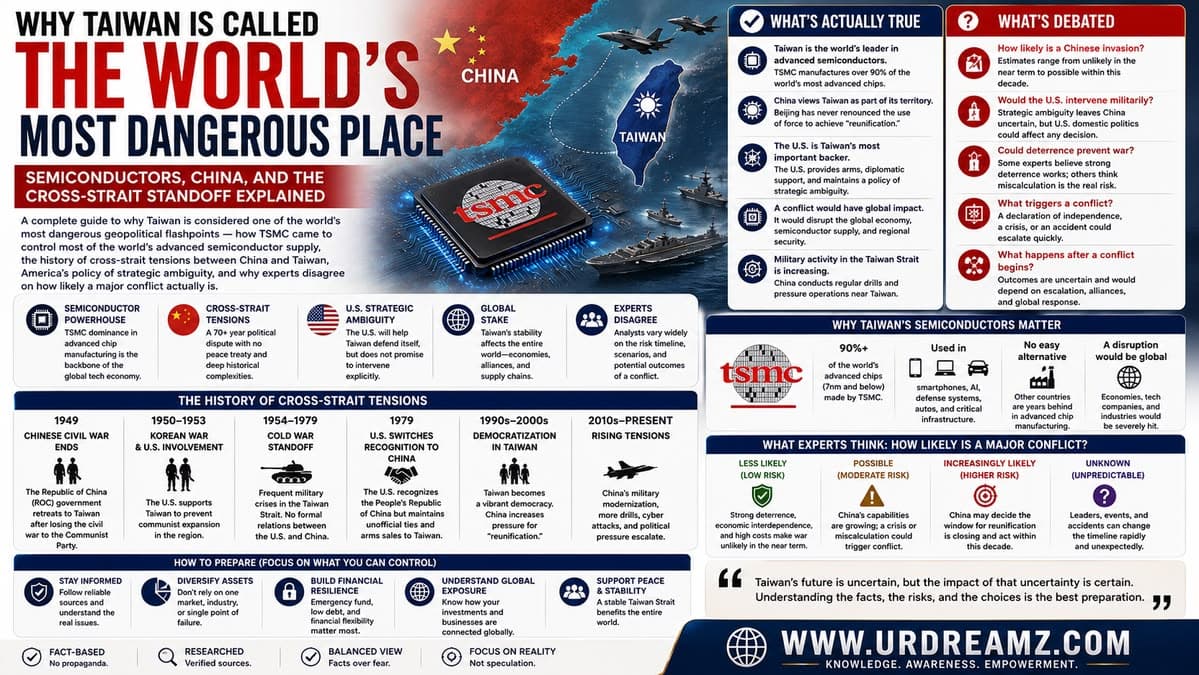
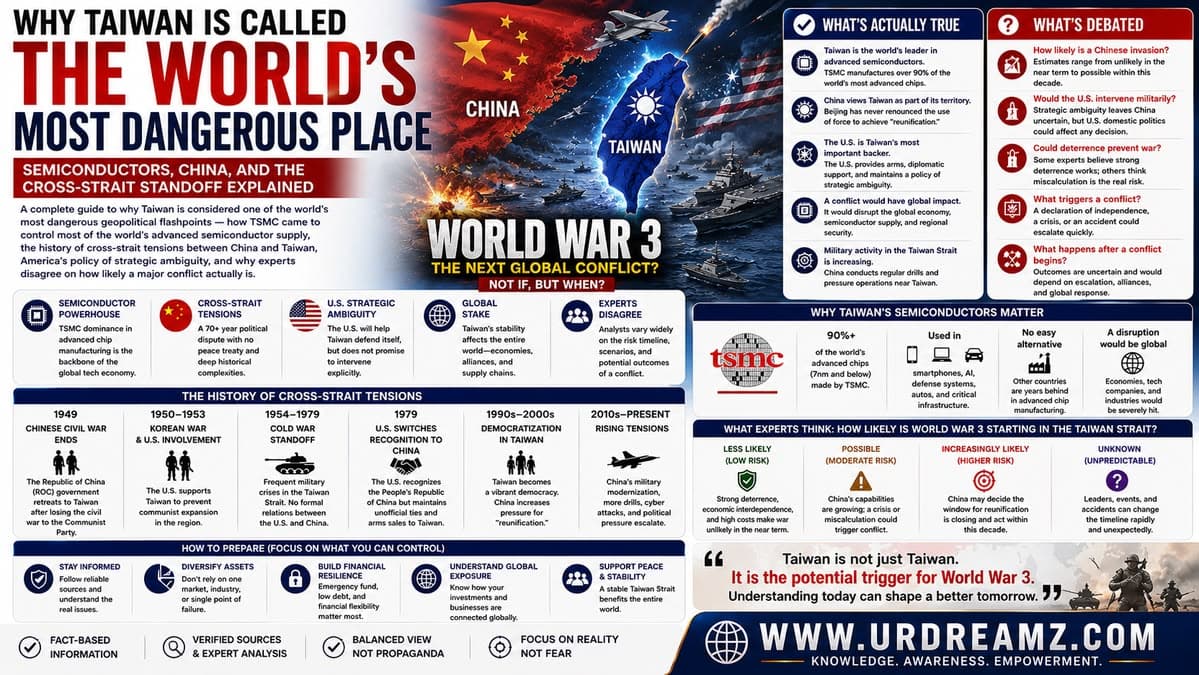
This guide explains why serious foreign policy analysts and outlets like The Economist have described Taiwan as "the most dangerous place on Earth," what actually makes it so strategically important, the long and complicated history behind the tension between China and Taiwan, how the United States fits into the picture, and why experts genuinely disagree about how likely a major conflict actually is. This is analysis of a real, ongoing geopolitical situation — not a prediction of a certain future, since no government, intelligence agency, or analyst can honestly claim to know exactly what will happen or when.
1. Why Taiwan Keeps Coming Up in Global Security Discussions
If you follow international news even loosely, Taiwan comes up constantly — in discussions about technology, trade, military strategy, and diplomacy, often in the same breath as far larger and more traditionally "newsworthy" powers like the United States and China. That's not an accident or media exaggeration; Taiwan sits at the intersection of several of the most consequential forces shaping the current global order at once.
2. Taiwan: A Quick Geographic Overview
Taiwan is an island of roughly 23 million people located in East Asia, separated from mainland China by the Taiwan Strait, a body of water that at its narrowest point is only about 130 kilometers (roughly 80 miles) wide. Despite its relatively small size, Taiwan has developed into one of the world's most technologically advanced economies.
3. Why Such a Small Place Draws This Much Attention
Taiwan's outsized global importance comes down to a combination of factors rarely found together in one place: an advanced, globally essential technology industry, a politically unresolved status that both China and Taiwan's government treat as fundamentally important, and a location sitting directly along critical shipping and military routes in the Indo-Pacific region.
4. The Semiconductor Connection: Why Chips Matter So Much
At the center of Taiwan's global significance is its semiconductor industry — the factories that manufacture the microchips powering virtually every piece of modern electronics. This single industry has transformed Taiwan from a regional economic story into a matter of direct concern for governments and companies worldwide.
5. What a Semiconductor Actually Is
A semiconductor, commonly called a chip, is a small electronic component made primarily from silicon that controls the flow of electrical signals, forming the fundamental building block of virtually all modern electronic devices. Chips range enormously in complexity, from simple components in basic appliances to the extraordinarily advanced processors that power smartphones, artificial intelligence systems, and military equipment.
6. TSMC Explained
Taiwan Semiconductor Manufacturing Company, known as TSMC, is the company primarily responsible for Taiwan's outsized role in global chip production. Founded in 1987, TSMC pioneered a business model in which it manufactures chips designed by other companies rather than designing and selling its own — a model that made it the trusted manufacturing partner for major technology firms worldwide, including Apple, Nvidia, and AMD.
7. How Much of the World's Chip Supply Comes From Taiwan
| Metric | Taiwan's Share |
|---|---|
| Global dedicated (foundry) chip manufacturing market | Roughly 60% to 70%, and rising |
| World's most advanced logic chips (leading-edge nodes) | More than 90% |
| Taiwan's total semiconductor industry revenue (2024) | Over $165 billion |
These figures come from industry trade data and research groups tracking the global semiconductor market, and they've generally continued climbing in recent years as demand for AI and advanced computing chips has surged.
8. Why the Most Advanced Chips Specifically Matter
The most advanced chips — those built on the smallest, most precise manufacturing processes — are what power cutting-edge artificial intelligence systems, high-performance computing, and modern military technology. Taiwan's near-total dominance in this specific advanced category, rather than chip manufacturing broadly, is what makes its role genuinely difficult for any single alternative location to replace in the near term.
9. What Actually Runs on These Chips
| Category | Examples |
|---|---|
| Consumer Electronics | Smartphones, laptops, gaming consoles |
| Transportation | Modern cars, particularly electric and driver-assist systems |
| Infrastructure | Data centers, cloud computing, telecommunications networks |
| Artificial Intelligence | AI training and inference hardware |
| Defense and Aerospace | Satellites, guided systems, and advanced military hardware |
10. The "Silicon Shield" Theory
Some analysts describe Taiwan's chip dominance as a "silicon shield" — the theory that because so many countries, including major powers, depend so heavily on Taiwan's semiconductor output, there's a strong practical incentive for the international community to prevent any disruption to Taiwan's stability. Critics of this theory point out that dependency can cut both ways, and it's far from a guaranteed protection on its own.
11. A Brief History of Cross-Strait Relations
The relationship between China and Taiwan, often called "cross-strait relations," traces back to the Chinese Civil War of the 1940s, and understanding that history is essential to understanding why the current situation exists at all.
12. The Chinese Civil War and Taiwan's Modern Origins
Following the Chinese Civil War, the Nationalist government, having lost control of mainland China to Communist forces in 1949, retreated to Taiwan and continued governing there, while the Communist Party established the People's Republic of China on the mainland. Both sides, for decades afterward, claimed to be the legitimate government of all of China, a dispute whose legacy still shapes the current standoff.
13. What "One China" Actually Means
The "One China" principle refers to the position, held by the government in Beijing, that there is only one sovereign China, and that Taiwan is a part of it, not a separate, independent country. Most countries around the world, including the United States, formally acknowledge this "One China" position in their diplomatic relations with Beijing, even while maintaining unofficial or informal relationships with Taiwan.
14. Taiwan's De Facto Self-Governance
In practice, Taiwan has operated as a self-governing entity for over seven decades, with its own democratically elected government, military, currency, and independent foreign relations with many countries, even though it lacks widespread formal diplomatic recognition as an independent state. This gap between practical self-governance and formal international recognition is a central source of the ongoing tension.
15. Why Beijing Considers Taiwan Part of China
The Chinese government maintains that Taiwan is an inseparable part of Chinese territory, framing eventual reunification — by peaceful means if possible, but not ruling out force — as a core national goal tied closely to Chinese sovereignty and historical unity. This position remains consistent across Chinese leadership and is treated as a fundamental, non-negotiable matter of national policy.
16. Why Taiwan's Government and People See It Differently
Within Taiwan, public opinion varies, but a significant and growing share of the population identifies primarily as Taiwanese rather than Chinese, and most polling shows strong support for maintaining Taiwan's current de facto autonomy, whether or not that comes with formal independence. Taiwan's democratic political system, developed since the late 1980s, is itself a significant point of contrast with mainland China's governance model, and one that many in Taiwan see as central to their identity.
17. The United States' Role: Strategic Ambiguity Explained
The United States maintains a long-standing policy commonly known as "strategic ambiguity" regarding Taiwan — officially acknowledging China's "One China" position while deliberately avoiding a clear, explicit commitment about whether it would militarily intervene if China attempted to take Taiwan by force. The intent behind this ambiguity is to discourage both Chinese military action and any move by Taiwan toward a formal declaration of independence, without fully committing the US to a specific course of action either way.
18. The Taiwan Relations Act
Passed in 1979 after the US formally switched diplomatic recognition from Taiwan to mainland China, the Taiwan Relations Act is US domestic legislation that commits the United States to providing Taiwan with the means to maintain a sufficient self-defense capability, without constituting a formal mutual defense treaty. It remains the primary legal foundation for the ongoing, unofficial US-Taiwan relationship, including continued US arms sales to Taiwan.
19. Why the US Maintains a Presence in the Region
The United States maintains a significant naval and military presence throughout the broader Indo-Pacific region, partly to preserve freedom of navigation through key waterways, partly to reassure regional allies like Japan and South Korea, and partly as part of its broader strategic posture toward China. US naval vessels periodically conduct transits through the Taiwan Strait, a practice China regularly criticizes as provocative.
20. China's Military Activity Near Taiwan
In recent years, China has significantly increased military activity near Taiwan, including more frequent air incursions into Taiwan's air defense identification zone and large-scale military exercises surrounding the island. Analysts widely interpret this pattern as a combination of military pressure, political signaling, and preparation, though there's ongoing debate about how directly it should be read as a sign of imminent action.
21. Why Analysts Call This a "Flashpoint"
A "flashpoint" in geopolitical terms refers to a location or situation where a relatively small incident could rapidly escalate into a much larger conflict, given the underlying tensions and stakes already in place. Taiwan is widely described this way because it combines unresolved sovereignty disputes, major military powers with direct interests, and immense global economic stakes all in one contained, physically small area.
22. The Economic Stakes of a Potential Conflict
Given Taiwan's outsized role in global chip production, most economic analyses suggest that any serious, sustained disruption to Taiwan's semiconductor industry — whether from conflict, blockade, or another major disruption — would have significant, rapid ripple effects across global technology, automotive, and defense industries worldwide, given how deeply integrated Taiwanese-made chips are into global supply chains.
23. Global Supply Chain Vulnerability Explained
Modern global supply chains are built around the assumption of continuous, predictable production from key manufacturing hubs, and Taiwan's concentration of advanced chip manufacturing represents a genuine single point of vulnerability in this system — there is currently no comparable alternative source capable of replacing Taiwan's advanced chip output at scale in a short timeframe.
24. Why This Differs From an Oil-Style Crisis
Unlike oil, which can be sourced from a relatively wide range of countries even if prices and logistics shift during a disruption, the most advanced semiconductor manufacturing is concentrated in an extremely narrow set of facilities that took decades and hundreds of billions of dollars in specialized investment to develop. This narrower concentration is part of why some analysts consider a serious disruption to Taiwan's chip production potentially more difficult to absorb than a typical energy market disruption.
25. Comparing Taiwan to Other Global Flashpoints
| Flashpoint | Primary Stakes |
|---|---|
| Taiwan Strait | Sovereignty dispute, global semiconductor supply, major power rivalry |
| Strait of Hormuz | Global oil and gas shipping routes |
| South China Sea | Territorial disputes, shipping lanes, resource claims |
| Korean Peninsula | Long-standing armistice, nuclear proliferation concerns |
What sets Taiwan apart from several of these other flashpoints is the specific combination of a major-power sovereignty dispute directly overlapping with an irreplaceable global technology chokepoint.
26. Why Experts Are Divided on Timing and Likelihood
Foreign policy analysts, intelligence assessments, and academic experts genuinely disagree on how likely a major conflict over Taiwan actually is, and on what timeline, if any. This isn't a sign that the topic is being ignored — it reflects real uncertainty about the intentions, internal politics, and long-term calculations of the key parties involved, none of which can be predicted with confidence from the outside.
27. Arguments Suggesting Higher Risk
| Factor | Why It's Cited as a Risk Indicator |
|---|---|
| Increased Chinese military activity near Taiwan | Seen by some analysts as preparation or pressure escalation |
| Beijing's stated long-term reunification goals | Framed as a core, unchanging national priority |
| Growing Chinese military capability | Narrowing the gap with US regional military presence over time |
| Rising nationalist sentiment on multiple sides | Can reduce political space for compromise |
28. Arguments Suggesting Lower Risk
| Factor | Why It's Cited as a Restraining Factor |
|---|---|
| Deep economic interdependence between China and the rest of the world | A major conflict would carry severe costs for China's own economy |
| Global dependency on Taiwan's chip production | Creates strong international incentive to avoid disruption |
| Historical precedent of decades without major escalation | Despite periodic tensions, direct conflict has been avoided since 1949 |
| Significant military, logistical, and political difficulty of any invasion scenario | An amphibious operation of this scale would be enormously complex and costly |
29. Deterrence and Why It Matters
Deterrence refers to the strategy of preventing an adversary from taking a specific action by ensuring the costs and risks of doing so clearly outweigh any potential benefit. Much of the current stability around Taiwan rests on multiple layers of deterrence — military, economic, and diplomatic — all operating simultaneously, which is part of why the situation has remained largely stable for decades despite persistent underlying tension.
30. The Role of Regional Alliances
Countries including Japan, South Korea, Australia, and the Philippines maintain their own strategic interests and, in some cases, formal defense arrangements with the United States that would likely factor into how any regional crisis unfolds. This web of regional alliances is part of why analysts generally view a potential Taiwan crisis as a matter with implications well beyond just China, Taiwan, and the United States alone.
31. What a "World War" Would Actually Require
Historically, a global-scale war has required not just conflict between two major powers, but a broader cascade of alliance commitments, economic collapse, and political escalation pulling in a large number of additional countries, as happened in both World War I and World War II. A regional conflict, even a serious one involving major powers, does not automatically or necessarily escalate to that scale, and predicting such an outcome with confidence goes well beyond what current analysis can responsibly claim.
32. Why Regional Conflict and Global War Are Different Things
It's worth being precise about terminology here: a serious regional conflict over Taiwan, while it would carry major global economic and political consequences, is not automatically the same thing as a third world war in the historical sense of that term. Conflating the two can lead to both unnecessary alarm and, paradoxically, to underestimating just how serious a regional crisis alone would already be without needing to escalate that far.
33. What Countries Are Doing to Reduce Chip Dependency
Recognizing the risk of concentrating so much critical technology production in one geographically vulnerable location, multiple governments — including the United States, Japan, and countries within the European Union — have launched major initiatives to build domestic semiconductor manufacturing capacity, aiming to reduce reliance on any single source.
34. The US CHIPS Act and Reshoring Efforts
The United States passed the CHIPS and Science Act to provide substantial funding and incentives for domestic semiconductor manufacturing, and TSMC itself has committed to a major, multi-billion-dollar expansion of manufacturing facilities in Arizona as part of this broader diversification trend. Japan and various European countries have pursued similar domestic investment strategies of their own.
35. Why Diversifying Chip Production Takes Years, Not Months
Building advanced semiconductor manufacturing capacity from scratch requires enormous capital investment, highly specialized equipment, and years of engineering expertise that took Taiwan decades to develop — meaning that even well-funded efforts elsewhere are expected to take many years before meaningfully reducing global dependence on Taiwan's existing, highly refined manufacturing base.
36. How This Tension Already Affects Everyday Life
Even without any major escalation, ongoing uncertainty around Taiwan has already influenced global technology company strategy, supply chain planning, and government policy for years, contributing to decisions like companies diversifying suppliers and governments subsidizing domestic chip production as a precaution.
37. What This Means for Ordinary People
For most people, the practical takeaway isn't a need for alarm, but rather an understanding of why global technology prices, supply chains, and even some government policies are shaped by a situation most people rarely think about directly. Staying informed through credible, balanced sources — rather than sensationalized predictions — is generally the most useful way to follow a situation this complex and consequential.
38. Myths vs Facts
| Myth | Fact |
|---|---|
| A conflict over Taiwan is guaranteed to happen soon | Experts genuinely disagree on likelihood and timing; no credible source can predict this with certainty |
| Taiwan produces all the world's semiconductors | Taiwan produces the majority of advanced chips specifically, not all chips globally; countries like South Korea and the US also manufacture chips |
| A regional conflict would automatically become a world war | A serious regional conflict and a global world war are historically different in scale and required conditions |
| The US has a clear, public commitment to defend Taiwan militarily | US policy is deliberately ambiguous on this specific point, by design |
| Taiwan and China have always been in open conflict | Despite ongoing tension, no direct large-scale military conflict has occurred between them since 1949 |
39. Quick Glossary
| Term | Meaning |
|---|---|
| Cross-Strait Relations | The relationship and interactions between mainland China and Taiwan |
| One China Policy | The position that there is only one sovereign China, which Taiwan is considered part of |
| Strategic Ambiguity | The US policy of not explicitly stating whether it would militarily defend Taiwan |
| Foundry | A company that manufactures chips designed by other companies |
| Flashpoint | A location or situation where a small incident could rapidly escalate into major conflict |
| Deterrence | A strategy of preventing an action by making its costs clearly outweigh its benefits |
40. Frequently Asked Questions
Why is Taiwan considered so strategically important?
Taiwan produces the large majority of the world's most advanced semiconductor chips, sits at a geopolitically sensitive location in the Indo-Pacific, and is at the center of an unresolved sovereignty dispute involving major world powers.
What percentage of the world's chips does Taiwan produce?
Taiwan accounts for roughly 60 to 70 percent of the global foundry chip market and more than 90 percent of the most advanced semiconductor chips specifically.
What is the "One China" policy?
It's the position, held by the Chinese government and formally acknowledged by most countries including the US, that there is only one sovereign China and that Taiwan is part of it, rather than a separate independent country.
Does the United States have a formal treaty to defend Taiwan?
No, the US follows a policy of strategic ambiguity, deliberately avoiding an explicit public commitment on whether it would militarily intervene if China attempted to take Taiwan by force.
Is a war over Taiwan definitely going to happen?
No credible source can predict this with certainty; experts are genuinely divided on both the likelihood and potential timing of any major escalation.
Would a Taiwan conflict automatically become World War 3?
Not automatically — a serious regional conflict and a global-scale world war are historically different in scale, required alliance dynamics, and escalation patterns.
What are countries doing to reduce dependence on Taiwan's chip production?
The US, Japan, and European countries have launched major initiatives, including the US CHIPS Act, to build domestic semiconductor manufacturing capacity, though this is expected to take many years to meaningfully shift global dependence.
41. Conclusion
Taiwan's outsized place in global affairs isn't the product of exaggeration or media hype — it genuinely sits at the overlap of an unresolved, decades-old sovereignty dispute between major world powers and an irreplaceable global technology chokepoint that touches nearly every piece of modern electronics. That combination is exactly why serious analysts use words like "flashpoint" to describe it, and why governments around the world have started investing heavily in reducing their own dependence on a single geographic source for the chips their economies now run on.
What this situation does not deserve is confident, sensationalized predictions about an inevitable global war. The honest answer is that experts genuinely disagree, the relevant decision-makers keep their own calculations largely private, and history shows that serious tension can persist for decades without escalating into open conflict, just as it can also shift quickly when least expected. Understanding why Taiwan matters — the chips, the history, the competing claims, and the layers of deterrence currently holding the situation in place — is far more useful than trying to guess a date on a calendar no one can actually see.