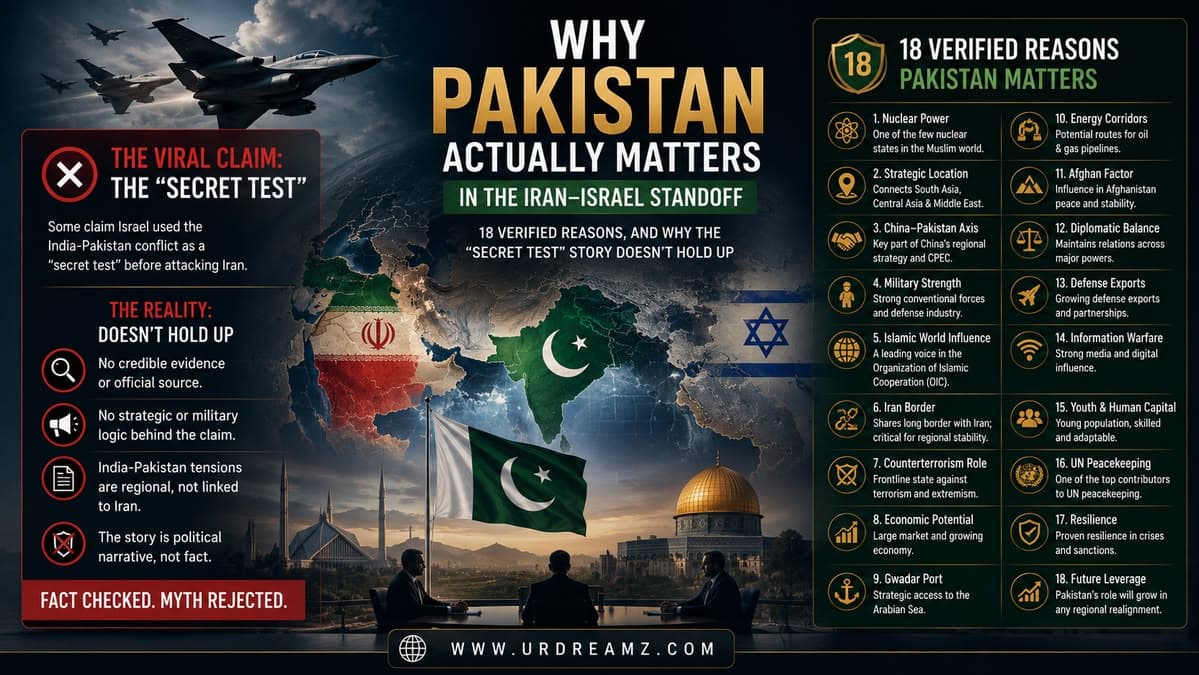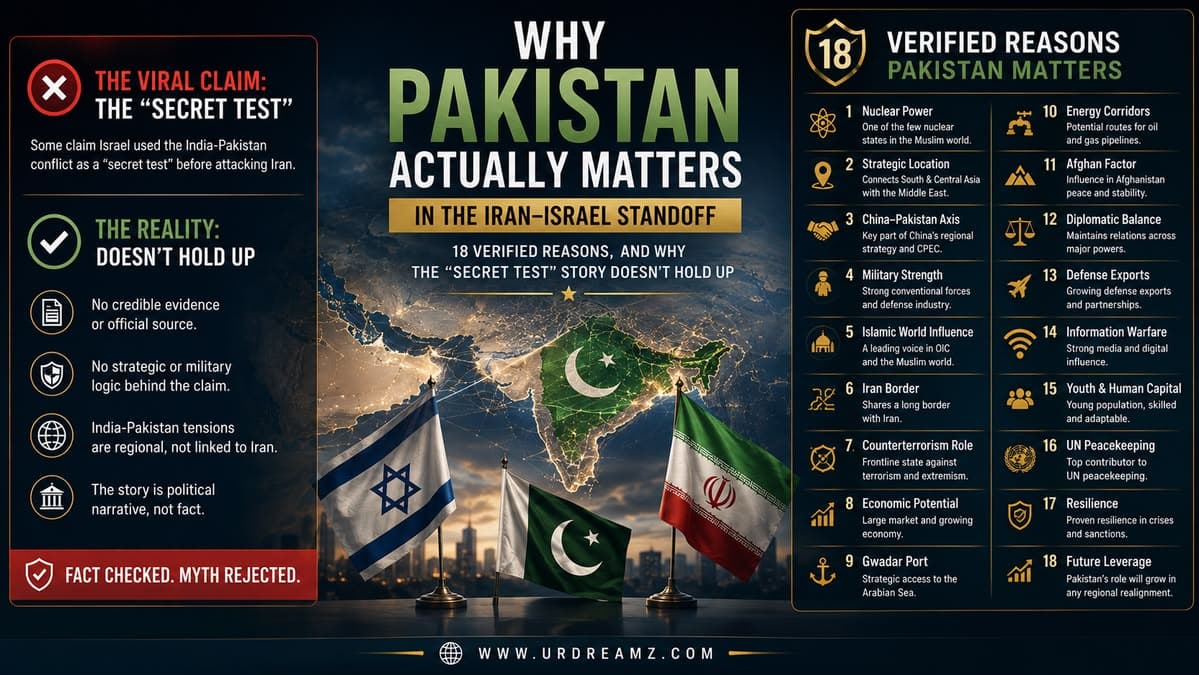
Why Pakistan Actually Matters in the Iran-Israel Standoff: 18 Verified Reasons, and Why the "Secret Test" Story Doesn't Hold Up
A story has been circulating claiming that the May 2025 India-Pakistan conflict wasn't really about India and Pakistan at all, that it was secretly orchestrated by Israel to test Pakistan's military capability ahead of a planned attack on Iran, complete with claims about Israeli intelligence intercepting radio frequencies from Kashmir military bases, Pakistan moving nuclear weapons toward its border in response, Iran requesting Pakistani air force officers, and an unidentified aircraft that flew near Israel being secretly Pakistani. It's a dramatic, cinematic version of events, tying together several genuinely tense regional conflicts into one unified, secret storyline.
These are serious, specific claims involving nuclear-armed states in active conflict, and they deserve to be checked carefully against real, verifiable sources before being repeated further, because getting this kind of claim wrong doesn't just spread a rumor, it can genuinely distort how people understand a live, dangerous geopolitical situation. So let's do exactly that: separate what's actually documented and verifiable from what appears to be unsupported speculation, and then look at the real, well-documented reasons why Pakistan genuinely does occupy an important, unusual position in the current Middle East balance of power, reasons that don't require any unverified claims to be compelling on their own.
What Actually Happened: Operation Sindoor, May 2025
On April 22, 2025, gunmen killed 26 civilians in a terrorist attack in Pahalgam, in Indian-administered Kashmir. India blamed Pakistan-based militant groups, an accusation Islamabad denied while calling for a neutral investigation. On the night of May 6 to 7, India launched what it called Operation Sindoor, a series of missile strikes on nine sites in Pakistan and Pakistan-administered Kashmir, describing the action as "focused, measured, and non-escalatory" and aimed only at militant infrastructure, not military targets.
What followed was the most serious aerial confrontation between the two nuclear-armed neighbors in decades, involving what multiple reports describe as well over a hundred combat aircraft from both sides engaged in beyond-visual-range combat. Fighting continued over several days, from roughly May 7 to May 10, before a ceasefire was reached.
The Rafale Controversy: What's Verified and What Isn't
This is one of the most contested parts of the entire episode, and it's important to be precise about what is actually confirmed versus what remains disputed. Pakistan's government, including Prime Minister Shehbaz Sharif and Defense Minister Khawaja Asif, publicly claimed that the Pakistan Air Force shot down five Indian aircraft, described as three Rafale jets, one MiG-29, and one Su-30, using J-10C fighters armed with PL-15 long-range air-to-air missiles. Pakistani officials also stated that as many as eighty Indian fighter jets were airborne during the initial exchange, though Pakistani forces reportedly "chased them away" rather than engaging all of them directly.
India's government did not confirm the specific aircraft types lost in the immediate aftermath, and India's Press Information Bureau specifically debunked some viral images being shared as proof, identifying at least one circulated photo as an unrelated 2021 crash. However, in June 2025, India's Chief of Defence Staff, General Anil Chauhan, publicly acknowledged for the first time that India did lose some jets during the initial phase of fighting, without specifying which types, while noting that India adapted its tactics in the days that followed and struck more effectively afterward. Separately, a senior French intelligence official reportedly confirmed to CNN that at least one Indian Rafale had been shot down, which, if accurate, would mark the Rafale's first-ever combat loss in twenty years of service. The French Ministry of Armed Forces itself said only that it would represent a historic first "if confirmed," stopping short of confirming it outright.
Operation Sindoor: Claim vs. Confirmation
What was claimed publicly, and what has actually been confirmed by each side (as of the most recent reporting)
This is a genuinely disputed part of the conflict. No claim of "6 jets" downed appears in any government or verified defense-industry source reviewed for this article; the consistent figure across Pakistani statements is five.
Why the "Secret Israeli Test" Claim Doesn't Hold Up
Now to the central viral claim: that this entire conflict was actually orchestrated or exploited by Israel to test Pakistan's capabilities before an Iran strike, complete with intercepted radio frequencies from Kashmir bases, Pakistan moving nuclear weapons toward the border, Iran requesting Pakistani officers, and a mystery aircraft over Israel being Pakistani. After reviewing defense reporting, fact-checking organizations, and official statements from India, Pakistan, Iran, and international bodies, none of these specific claims appear in any verifiable, credible source.
What is verifiably documented is the opposite of a nuclear escalation: the International Atomic Energy Agency explicitly stated there was no radiation leak or release from any nuclear facility in Pakistan during the conflict, directly contradicting circulating claims that Pakistani nuclear sites were struck or that nuclear assets were being moved and activated. India's own Air Marshal publicly denied targeting Pakistan's Kirana Hills facility, a site linked to Pakistan's nuclear program, stating plainly, "We have not hit Kirana Hills, whatever is there." This is a case where the verified, official record runs directly against the version of events being shared virally, and no credible defense journalist, fact-checking body, or government statement supports the claim that Israel was secretly directing or observing the conflict as cover for testing Pakistan ahead of striking Iran.
The Real Iran-Israel War of 2025
Separately from the India-Pakistan conflict, a genuine, major war did break out between Israel and Iran in 2025. Israel launched strikes against Iranian nuclear and military sites, and the United States later conducted its own strikes on Iranian nuclear facilities using B-2 bombers, drawing Iranian retaliation against American bases in the region. This conflict caused serious global concern, including disruption to shipping through the Strait of Hormuz, and remains one of the most significant Middle East escalations in recent years. This is genuinely one of the most consequential conflicts shaping the region, entirely independent of anything happening between India and Pakistan.
So Why Does Pakistan Actually Matter Here? 18 Verified Reasons
Even without any of the unverified viral claims, there is a substantial, well-documented, entirely real case for why Pakistan occupies an unusually significant position in how the current Iran-Israel-Middle East balance of power is being discussed by real analysts, officials, and defense researchers. Here are eighteen of them, each grounded in verifiable reporting, presented in the order that best builds the full picture rather than any particular ranking of importance.
1. Pakistan Is the Only Nuclear-Armed Muslim-Majority Country
This is a simple, undisputed fact, and it alone gives Pakistan a unique status in any conversation about regional deterrence involving Israel, which is itself a widely presumed but officially undeclared nuclear power. No other Muslim-majority nation in the world possesses nuclear weapons, which places Pakistan in an entirely different category from every Arab state and from Iran, whose nuclear program remains a matter of international dispute and inspection rather than a confirmed arsenal.
2. The Pakistan-Saudi Strategic Mutual Defense Agreement
On September 17, 2025, Pakistan and Saudi Arabia signed a Strategic Mutual Defense Agreement in Riyadh, formally committing both countries to treat any attack on one as an attack on both. This is real, officially confirmed, and considered one of the most significant defense developments in the region in years, explicitly described by analysts as reshaping Gulf security away from sole reliance on the United States. Dr. F. Gregory Gause, a noted Gulf security scholar, has specifically argued that the pact functioned partly as a diplomatic signal from Saudi Arabia toward Washington, an attempt to extract stronger security commitments from the United States by visibly diversifying its alliances, rather than being aimed purely at any single named adversary.
3. The Nuclear Umbrella Ambiguity
Following the pact's signing, a Saudi official was asked directly whether it extended Pakistan's nuclear protection to Saudi Arabia, and responded that it was "a comprehensive defensive agreement that encompasses all military means." Pakistan's own Defense Minister, Khawaja Asif, initially suggested Saudi Arabia would benefit from Pakistan's nuclear umbrella, before later walking the comment back. Pakistan has not officially confirmed extending nuclear protection, and its stated doctrine remains India-specific, but the ambiguity itself has become a significant talking point among arms control experts precisely because of what it could signal for the broader region.
4. A Defense Relationship Going Back Decades
The 2025 pact didn't emerge from nothing. Pakistan and Saudi Arabia have maintained a formal defense relationship since a 1967 protocol, under which Pakistan has stationed between 1,500 and 2,000 troops in the kingdom and trained an estimated 8,000 to 10,000 Saudi military personnel over the decades. This long history is part of why the 2025 agreement is widely described as a formalization of an existing deep alliance rather than something built from scratch.
5. Pakistan's Support for Saudi Arabia After Its 1998 Nuclear Test
When Pakistan faced international isolation after its first nuclear tests in 1998, Saudi Arabia's King Fahd reportedly pledged to "support you more than you expect," reportedly followed by an oil supply arrangement worth billions of dollars annually. This history of Saudi support during Pakistan's most diplomatically isolated moment is frequently cited as part of the foundation for the depth of trust behind the more recent formal defense pact.
Timeline: How We Got Here
Key verified events connecting South Asia and the Middle East, 2024–2025
This timeline reflects publicly reported, verifiable events. It does not include the unverified "secret test" claims discussed earlier, since no credible source connects these events in that specific way.
6. Pakistan's Historical Combat Record Against Israeli Aircraft
This one surprises a lot of people: during the 1967 Six-Day War, Pakistani pilots served as advisors and trainers with the Jordanian and Iraqi air forces. One of them, Flight Lieutenant Saiful Azam, is widely credited by Pakistani, Jordanian, Iraqi, and Bangladeshi accounts with shooting down four Israeli aircraft over three days of fighting, downing Israel's Mystère fighter-bomber over Jordan and two more aircraft, a Mirage III and a Vautour, after being transferred to an Iraqi airbase. It's worth noting, in the interest of full accuracy, that Israeli historical accounts confirm losing aircraft at the same times and locations but generally attribute them to Jordanian or Iraqi pilots rather than specifically naming a Pakistani aviator, a genuine historical dispute that remains unresolved between the two sides even today. Regardless of that specific attribution dispute, it's a well-documented historical fact that Pakistani-trained or Pakistani pilots were directly involved in air combat against Israel during that war.
7. Pakistan Has Never Recognized Israel
Unlike several Arab and Muslim-majority nations that have normalized relations with Israel in recent years through the Abraham Accords and similar agreements, Pakistan has consistently maintained no formal diplomatic relationship with Israel since its founding, a position tied closely to its long-standing support for Palestinian statehood. This diplomatic stance places Pakistan in a smaller, and increasingly distinct, group of nations still formally withholding recognition.
8. Reported (and Unconfirmed) Missile Cooperation with Iran
During the height of the June 2025 Iran-Israel war, some media reports, including one citing intelligence sources speaking to CNN-News18, suggested Pakistan had signaled willingness to supply Iran with Shaheen-III medium-range ballistic missiles if the conflict escalated further. It's important to flag this claim's actual status: it was not officially confirmed by the Pakistani government, and no independent verification of an actual transfer has been documented. It's included here specifically as an example of the kind of unconfirmed but seriously reported claim that deserves careful labeling, rather than being treated with the same confidence as the verified events described elsewhere in this article.
9. Pakistan's Deep Defense Relationship with China
Pakistan's air force performance during Operation Sindoor drew global attention specifically because it operates the Chinese-made J-10C fighter jet, reportedly used to fire the PL-15 missile said to have downed Indian aircraft. This showcased, in a real combat setting, the capability of a major Chinese weapons export, and it deepened existing conversations about how China-Pakistan defense cooperation factors into the broader regional balance involving Iran, Israel, India, and the Gulf states.
10. Demonstrated Combat Capability in a Real, Recent Conflict
Whatever the exact, disputed numbers, Operation Sindoor was a real combat event involving well over a hundred aircraft, extensive beyond-visual-range engagements, and internationally reported claims of the first-ever Rafale combat loss. This demonstrated, in practice rather than theory, that Pakistan's air force possesses genuine modern combat capability, a fact regional and international defense analysts have discussed extensively since May 2025, independent of any claims about a secret Israeli connection.
11. Geographic Position Directly Bordering Iran
Pakistan shares a long, sensitive border with Iran through its Balochistan province, a region that has already seen direct, if brief, military friction between the two countries, including the January 2024 exchange of strikes. This geography means Pakistan cannot avoid being strategically relevant to any escalation involving Iran, regardless of whether it chooses to become actively involved.
12. Deliberate Nuclear Ambiguity as a Deterrence Strategy
Pakistan has historically maintained a policy of deliberate ambiguity around the exact size, deployment, and doctrine governing its nuclear arsenal, a strategy shared by other nuclear powers, including Israel itself, which has never officially confirmed or denied possessing nuclear weapons despite widespread international assessment that it does. This shared reliance on strategic ambiguity is itself part of why regional nuclear dynamics are so difficult to fully verify from outside sources, and why unverified viral claims can spread so easily into a genuine information vacuum.
Estimated Nuclear Arsenals in the Region
Publicly available independent estimates (SIPRI / Federation of American Scientists); no country in this comparison publishes official confirmed figures
These figures are independent estimates from arms-control research organizations, not official government disclosures, and should be read as approximate ranges rather than precise counts.
13. One of the World's Largest Standing Militaries
Pakistan maintains one of the largest active militaries in the world by personnel count, a scale that, combined with its nuclear status, gives it meaningful conventional deterrence capacity well beyond what most Middle Eastern states, apart from Iran itself, can independently field.
14. Deep Economic Ties to the Gulf
Roughly 2.7 million Pakistani nationals live and work in Saudi Arabia alone, contributing more than six billion dollars annually in remittances back to Pakistan's economy. This economic interdependence adds a powerful, practical layer to the security relationship, giving both countries strong incentives to maintain and deepen cooperation beyond formal defense agreements.
15. Pakistan Stayed Officially Neutral in the Iran-Israel War
Despite bordering Iran and maintaining friendly relations with Tehran, Pakistan did not join the 2025 Iran-Israel conflict militarily. This official neutrality, while still maintaining defense ties with Saudi Arabia, China, and historically the United States, illustrates the genuinely careful balancing act Pakistan performs across multiple, sometimes competing regional relationships, rather than aligning firmly with any single bloc.
16. Integration into Saudi Vision 2030 Economic Plans
Beyond pure defense cooperation, Pakistan has increasingly been folded into Saudi Arabia's Vision 2030 economic diversification strategy, reflecting a relationship that spans military, economic, and labor cooperation simultaneously, rather than defense ties existing in isolation from the broader bilateral relationship.
17. A Genuinely Contested, Complicated Relationship with Iran
It would be inaccurate to describe Pakistan-Iran relations as simply close or simply hostile. The January 2024 cross-border strikes over alleged militant camps show real friction exists alongside cooperation, and Pakistan's calculations regarding Iran are shaped by this complicated, sometimes tense history, not a simple, uncomplicated alliance, which is part of why sweeping claims about Pakistan definitively "siding" with any one party in the Iran-Israel conflict tend to oversimplify a genuinely complex picture.
18. A Uniquely Watched Wildcard in Regional Calculations
Taken together, these seventeen preceding, verifiable points explain why serious defense analysts, arms control researchers, and regional diplomats do genuinely watch Pakistan closely when assessing how a broader Middle East conflict involving Israel and Iran might evolve, not because of any confirmed secret operation, but because of Pakistan's unique, real combination of nuclear capability, a brand-new formal defense pact with a major Gulf power, deep economic ties across the region, unresolved historical friction with Iran, a historical but disputed combat record against Israel, and a consistent policy of not recognizing Israel diplomatically. That combination of real factors is significant enough on its own, without needing any unverified claims about secret intelligence tests or intercepted radio frequencies to make Pakistan's regional position genuinely worth paying attention to.
It's worth emphasizing again just how unusual this combination actually is on the world stage. Very few countries anywhere combine confirmed nuclear weapons capability, a brand-new mutual defense treaty with a major regional power, a long, complicated border with an active regional flashpoint, and a large diaspora deeply embedded in that same region's economy, all at the same time. This is precisely why Pakistan keeps appearing in serious geopolitical analysis of the Iran-Israel-Gulf dynamic, entirely apart from anything involving unverified claims about secret operations.
What This Means for How We Should Read Viral Claims Like This
The unverified claims that started this conversation, secret Israeli testing, radio frequency leaks from Kashmir bases, nuclear weapons movement, Iranian requests for Pakistani officers, a mystery aircraft over Israel, share a common structure worth recognizing: they take a real, complex, genuinely significant set of regional relationships and dramatize them into a single, secret, cinematic narrative that no verified source actually supports. This doesn't mean Pakistan's regional role isn't significant. It clearly, verifiably is, as the eighteen points above demonstrate using nothing but publicly documented, attributable information. It simply means that significance doesn't require, and isn't strengthened by, claims that can't be traced to any credible defense reporting, government statement, or international body.
When claims involve nuclear-armed states in active or recent conflict, this distinction matters enormously. Genuine regional analysis, the kind found in outlets like the Bulletin of the Atomic Scientists, the Arms Control Association, and established defense journalism, already provides a substantial, fascinating, and entirely real picture of why Pakistan matters in this moment. That real picture doesn't need embellishment, and repeating unverified claims about nuclear weapons movements or secret intelligence operations involving live conflicts risks spreading exactly the kind of misinformation that can make an already tense regional situation harder for ordinary people to understand accurately, particularly for readers trying to make sense of these events from outside the region, who may have no easy way to independently check a specific, dramatic claim against the underlying source material themselves.
A Closer Look at the Radio Frequency Claim
It's worth addressing the radio frequency claim specifically, since it's one of the more technically specific pieces of the viral story. Real Indian intelligence agencies have, in the past, publicly discussed intercepting coded FM transmissions used by Pakistan-based militant groups operating in Kashmir, a documented practice going back years and tied specifically to counter-terrorism operations, not to any Israeli involvement. This is a real, publicly reported phenomenon, but it describes India intercepting militant communications, not Israel intercepting or controlling Indian military base frequencies, which is a completely different claim with no corresponding documentation in any verified source reviewed for this piece. It's a good example of how a real, verifiable fact, communications interception happens in this region, can get quietly swapped out for a different, unverified actor and purpose as a story spreads and gets retold, gradually drifting further from its original, documented source with each retelling.
Understanding Why This Kind of Claim Spreads So Easily
Claims like the ones in this story tend to spread quickly precisely because the underlying region is already so genuinely complex and high-stakes that almost any dramatic addition feels plausible to someone following the news casually rather than tracking primary sources directly. India and Pakistan are both nuclear-armed. Iran and Israel are in active, serious conflict. Pakistan and Saudi Arabia just signed a genuinely significant, still-debated defense pact with unresolved nuclear implications. In an environment this genuinely tense and fast-moving, a claim connecting several real elements, Kashmir, radio interception, nuclear weapons, Israeli intelligence, Iran, feels like it could plausibly be one more real thread in an already tangled situation, even when no actual reporting supports the specific connections being drawn.
This is precisely why it matters to trace claims back to actual named sources rather than accepting a compelling narrative simply because it fits neatly into an already tense news environment. A claim can feel plausible, fit the general mood of a moment, and still not be supported by anything a journalist, government, or international body has actually verified. This is also why cross-referencing multiple independent, differently-motivated sources, Pakistani, Indian, French, and international, tends to produce a far more reliable picture than relying on any single account, especially one shared without attribution to a specific named official, outlet, or document.
What Regional Experts Are Actually Saying
It's worth contrasting the unverified viral narrative with what genuine regional security analysts have actually published since these events unfolded. Organizations like the Bulletin of the Atomic Scientists, the Arms Control Association, and Georgetown University's Journal of International Affairs have all published detailed, on-the-record analysis of the Pakistan-Saudi defense pact specifically, discussing its implications for nuclear ambiguity, its signal to Washington about Gulf security preferences, and its potential to reshape regional deterrence calculations involving Israel.
None of these serious, named analysts, writing under their own credentials for established institutions, have connected the India-Pakistan conflict to a secret Israeli testing operation, nor have they cited intercepted Kashmir radio frequencies or Iranian requests for Pakistani officers as part of their analysis. This absence is itself meaningful. If credible evidence existed for these specific claims, it is exactly the kind of detail serious defense researchers, who actively look for connections between regional conflicts, would have picked up and analyzed by now, particularly given how closely they've already scrutinized the Pakistan-Saudi pact's every nuance.
The Difference Between "Plausible" and "Verified"
It's worth drawing out this distinction clearly, because it applies well beyond this specific story. Something can sound plausible, even genuinely clever as a piece of geopolitical analysis, without being verified or true. It is plausible, in the abstract, that intelligence services monitor foreign military conflicts for lessons about weapons performance; this is, in fact, a normal, well-documented practice that defense analysts openly discuss regarding how militaries around the world studied Operation Sindoor for exactly this reason, including examining how Chinese-made jets and missiles performed against French and Russian-made aircraft.
But there is a significant difference between "many countries likely studied this conflict's lessons from a distance, as is completely normal" and the much more specific, dramatic claim that "Israel secretly orchestrated or directly infiltrated this conflict as cover for testing Pakistan before attacking Iran." The first statement is almost certainly true and unremarkable. The second is a specific, serious, unverified accusation that would require real evidence, not general plausibility, before being treated as established fact.
Pakistan's Own Official Position
It's also worth noting what Pakistan's own government and military have actually said publicly throughout this period, since their own statements provide direct insight into how they characterize these events. Pakistani officials have consistently framed Operation Sindoor as a bilateral conflict with India, tied specifically to the Pahalgam attack accusations, and have not publicly referenced any Israeli involvement, testing, or intelligence-gathering operation connected to the conflict in any official statement, press briefing, or parliamentary address reviewed for this article. Similarly, Pakistan's public statements regarding the Iran-Israel war have emphasized neutrality and diplomatic concern rather than any coordination with Israel. If Pakistan's own government believed it had been secretly used as a testing ground by Israel, this would represent an extraordinarily serious diplomatic and security matter, one that would be difficult to imagine remaining entirely unaddressed in any public forum, given how vocally Pakistan has otherwise discussed regional security concerns involving Iran, India, and its own sovereignty.
Why This Shift Matters Even Without Any Secret Operation
One point worth adding here, drawn from independent, non-Pakistani academic sources rather than either government's own messaging: some regional commentary has specifically framed the new Saudi-Pakistani pact as a response to Israel's long-standing regional dominance as the presumed sole nuclear power in the wider region. One academic analysis put it plainly, describing the pact as likely to "alter the strategic balance, particularly with regard to Israel, a previously undeclared nuclear power that has been dominant in the region." This is a genuinely significant, independently published observation, and it captures something real about why Pakistan's role matters here, without needing to invent any secret operation to make the point. The shift being described is about publicly known alliances and openly declared defense commitments, not covert intelligence games playing out behind the scenes.
This distinction matters enormously for how we should think about the entire topic. A formal, publicly signed defense treaty between two sovereign governments, debated openly by parliaments, arms control think tanks, and international journalists, is a fundamentally different kind of event than a secret intelligence operation that supposedly leaves no trace in any credible source. The first kind of event, publicly documented and analyzed, is exactly the kind of development that genuinely reshapes regional power balances over time. The second kind, if it existed, would represent an extraordinary intelligence failure across multiple countries' journalism and oversight institutions simultaneously, which is precisely why claims of that nature require an unusually high bar of evidence before being accepted.
A Note on Responsible Reporting During Active Conflicts
Finally, it's worth reflecting briefly on why standards of verification matter especially during and immediately after active military conflicts between nuclear-armed states, where the temptation to fill information gaps with confident-sounding claims tends to be at its highest. The fog of war, a well-documented phenomenon where accurate information becomes genuinely difficult to obtain in the immediate aftermath of fighting, was explicitly cited by defense journalists covering Operation Sindoor itself, who noted "nebulous imagery swamping social media" and reports that "emerged suspiciously quickly" with "uncanny detail" in the days immediately following the conflict.
This is precisely the environment in which unverified, dramatic claims tend to proliferate fastest, not because people are necessarily acting in bad faith, but because genuine uncertainty creates space for confident-sounding claims to fill the gap before verified information catches up. The responsible approach, for anyone genuinely trying to understand what happened and what it means, is to keep tracking claims back to named, credible sources, and to hold conclusions loosely until verification actually catches up with the initial, dramatic version of events.
Final Thoughts
Pakistan's position in the current Middle East and South Asian security landscape is genuinely fascinating, and genuinely significant, built on real events: a brand-new, formal defense pact with Saudi Arabia, a decades-long military relationship predating that pact, a historical, if disputed, combat record against Israeli aircraft, a consistent policy of non-recognition toward Israel, deep economic integration with the Gulf, and a demonstrated, real combat capability shown during Operation Sindoor. None of that requires inventing a secret Israeli operation to be interesting. The real, documented story is compelling enough on its own, and it deserves to be told accurately, especially in an information environment where dramatic, unverified claims about nuclear-armed states can travel faster than the careful, sourced reporting needed to properly evaluate them.
The next time a similarly dramatic claim about this region crosses your feed, framed as a hidden truth that mainstream sources supposedly missed, it's worth pausing to ask a simple question: which named source, government statement, or independent institution actually verifies this specific detail? If the answer is unclear, that uncertainty itself is worth taking seriously, just as seriously as the claim being made.
Frequently Asked Questions
Did Israel secretly orchestrate the India-Pakistan conflict to test Pakistan before attacking Iran? No credible evidence supports this claim. It does not appear in any verified defense reporting, government statement, or international body's findings, and the International Atomic Energy Agency specifically confirmed no nuclear facility in Pakistan was struck or compromised during the conflict.
How many Indian jets did Pakistan actually shoot down during Operation Sindoor? Pakistan's government consistently claimed five aircraft, three Rafales, one MiG-29, and one Su-30. India acknowledged some losses months later without specifying aircraft types, and a French intelligence official reportedly confirmed one Rafale loss, though full independent verification of the exact count remains unavailable.
Is there real evidence that Pakistan moved nuclear weapons toward its border during the conflict? No verified evidence supports this claim. The IAEA confirmed no radiation leak or nuclear facility strike occurred, and no credible government or independent monitoring body has reported nuclear weapons movement during the conflict.
Does Pakistan actually have a defense pact with Saudi Arabia? Yes, this part is fully verified. Pakistan and Saudi Arabia signed a Strategic Mutual Defense Agreement on September 17, 2025, committing both nations to treat an attack on one as an attack on both, building on a defense relationship dating back to 1967.
Did a Pakistani pilot really shoot down Israeli jets in the past? Pakistani, Jordanian, Iraqi, and Bangladeshi accounts credit Pakistani pilot Saiful Azam with shooting down four Israeli aircraft during the 1967 Six-Day War while serving as an advisor to Jordan and Iraq. Israeli historical records confirm the aircraft losses but generally attribute them to Jordanian or Iraqi pilots rather than specifically to a Pakistani aviator, making this a genuine, unresolved historical dispute.
Did Pakistan officially join the 2025 Iran-Israel war? No, Pakistan maintained official neutrality and did not join the conflict militarily, despite sharing a border with Iran and maintaining diplomatic and economic ties across the region.