World Top 10 Billionaires 2026: From Elon Musk's Trillion-Dollar Empire to the Tech Giants Who Built the Future
June 14, 2026 — History was made just two days ago when Elon Musk officially became the world's first and only trillionaire, crossing the $1.1 trillion mark following SpaceX's landmark public debut on the Nasdaq. While the headlines focused on the historic number, the real story runs much deeper: behind every billion on these lists is a startup that almost failed, a bet that seemed crazy, a decade of relentless work, and a vision that most people didn't believe.
This is not just a list of numbers. This is the story of ten people who fundamentally changed how the world works — through search engines, electric cars, social networks, AI chips, cloud databases, retail supply chains, and luxury empires. In this comprehensive guide, we bring you the World Top 10 Billionaires as of June 14, 2026 — their net worth, wealth sources, startup journeys, companies, and the business lessons every entrepreneur can learn from their lives.
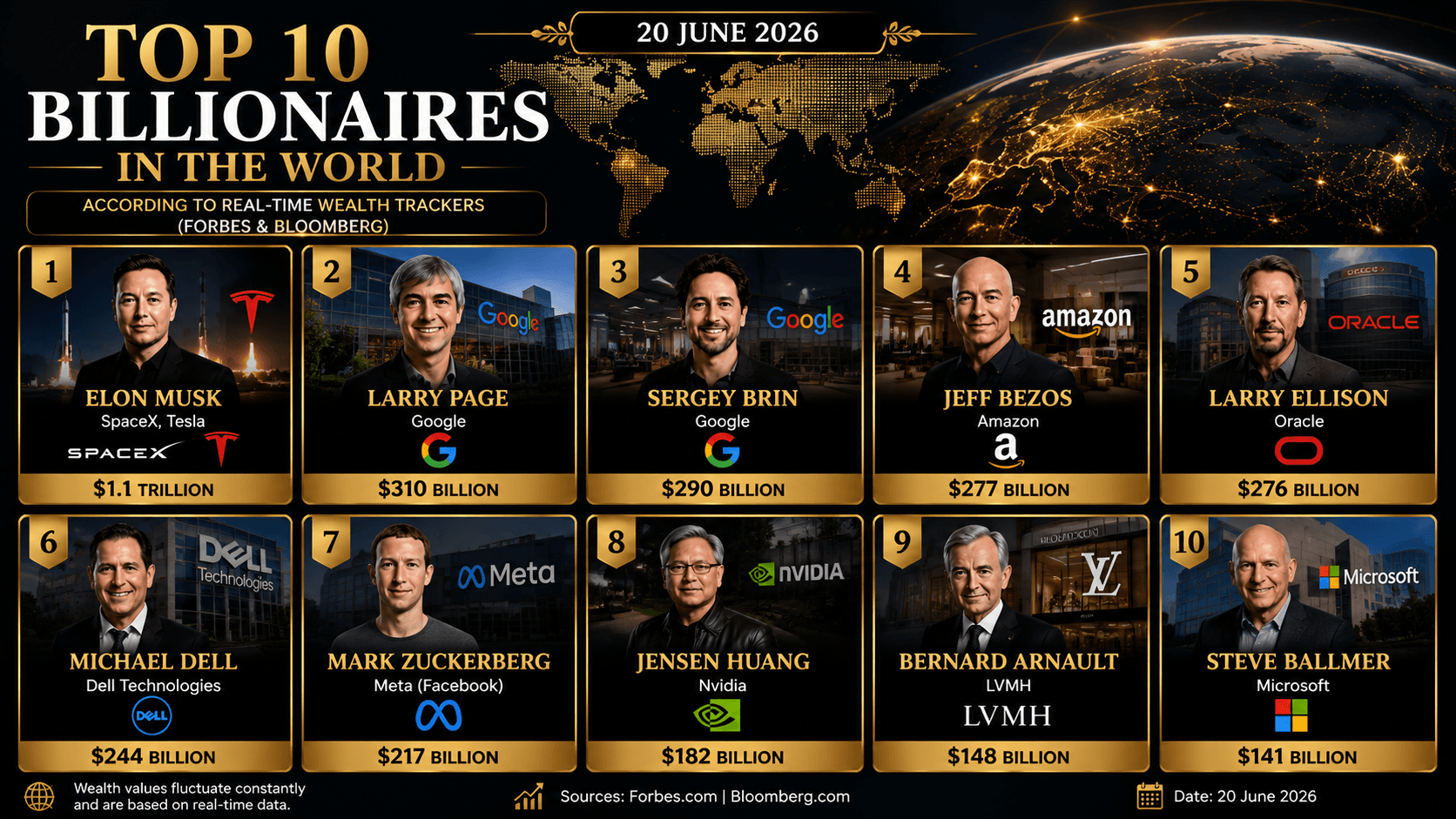
World Top 10 Richest People — June 14, 2026 (Master Rankings Table)
| Rank | Name | Net Worth (USD) | Primary Company | Country | Industry |
|---|---|---|---|---|---|
| #1 👑 | Elon Musk | $1.11 Trillion | Tesla / SpaceX / xAI | USA | EV, Space, AI |
| #2 | Larry Page | $294–306 Billion | Alphabet / Google | USA | Tech / AI |
| #3 | Sergey Brin | $271–285 Billion | Alphabet / Google | USA | Tech / AI |
| #4 | Jeff Bezos | $223–284 Billion | Amazon / Blue Origin | USA | E-Commerce / Space |
| #5 | Larry Ellison | $231 Billion | Oracle Corporation | USA | Enterprise Software / AI Cloud |
| #6 | Michael Dell | $213–246 Billion | Dell Technologies | USA | Computing / AI Infrastructure |
| #7 | Mark Zuckerberg | $217 Billion | Meta Platforms | USA | Social Media / AI / Metaverse |
| #8 | Jensen Huang | $170–202 Billion | NVIDIA Corporation | USA / Taiwan | AI Chips / Semiconductors |
| #9 | Bernard Arnault | $171 Billion | LVMH | France | Luxury Goods / Fashion |
| #10 | Jim Walton | $137–147 Billion | Walmart | USA | Retail / Supply Chain |
Note: Net worth figures are based on Bloomberg Billionaires Index and Forbes Real-Time Billionaires List as of June 14, 2026. Values fluctuate daily with stock market movements.
#1 — Elon Musk: The World's First and Only Trillionaire ($1.11 Trillion)
On June 12, 2026, history changed forever. When SpaceX began trading publicly on the Nasdaq — opening at $135 per share and closing up 20% at $161.11 — Elon Musk's net worth surged past $1.1 trillion, making him not just the richest person in the world, but the first human being in recorded history to accumulate a trillion-dollar personal fortune.
The milestone was covered by Forbes, Bloomberg, the BBC, Reuters, and The New York Times simultaneously. Forbes officially declared him the world's first trillionaire on June 12, 2026.
Who Is Elon Musk?
Born June 28, 1971, in Pretoria, South Africa, Elon Reeve Musk taught himself to code as a child and sold his first video game — Blastar — at just 12 years old. He left South Africa at 17 to avoid compulsory military service, moved to Canada through his mother's citizenship, and eventually earned dual bachelor's degrees in physics and economics from the University of Pennsylvania. He enrolled in a Stanford PhD program in physics but dropped out after two days to pursue the emerging internet gold rush of the 1990s.
The Startup Journey: From Zip2 to a Trillion Dollars
Musk's first company, Zip2, co-founded with his brother Kimbal, provided online city guide software to newspapers. In 1999, Compaq acquired it for $307 million — Musk's first major exit. He immediately plowed his earnings into his next idea: an online financial services company called X.com, which merged with Confinity to become PayPal. When eBay acquired PayPal in 2002 for $1.5 billion, Musk walked away with approximately $180 million after taxes — and used nearly every dollar to fund his next two ventures simultaneously.
Most people thought he was insane. He put $100 million into SpaceX, a rocket company he knew nothing about, and $70 million into Tesla, an electric car startup that most analysts considered a doomed idea. By 2008, both companies were days from bankruptcy. Musk later recalled that he had to borrow money from friends for personal living expenses during this period. But he refused to give up — and both companies survived, went on to change their respective industries forever, and made him the richest person in human history.
Elon Musk's Companies — The Empire
Tesla transformed the global automotive industry by proving that electric vehicles could be desirable, fast, and commercially viable. Under Musk's leadership as CEO and product architect, Tesla became the most valuable car company in the world and pioneered full self-driving AI technology and the Tesla Optimus humanoid robot.
SpaceX — which now holds the title of Musk's most valuable asset — revolutionized the aerospace industry by developing reusable rocket technology, dramatically slashing the cost of space access. Its Falcon 9 and Falcon Heavy rockets are now the most reliable and cost-effective launch vehicles in history. Starlink, SpaceX's satellite internet division, serves millions of users globally. The company's IPO debut valued it at over $2 trillion — more than the GDP of most countries on Earth.
xAI, founded in 2023, is Musk's artificial intelligence company developing the Grok AI model, positioned to compete directly with OpenAI and Google DeepMind in the race to build artificial general intelligence.
Neuralink is developing brain-computer interface implants that have already been tested in human clinical trials, with early results showing paralyzed patients able to control computers with their thoughts.
X (formerly Twitter), acquired in late 2022, is being transformed into an everything app combining social media, payments, and communications.
| Company | Founded | Musk's Stake | Estimated Value | Industry | Key Achievement |
|---|---|---|---|---|---|
| SpaceX | 2002 | ~42% | $2+ Trillion (post-IPO) | Aerospace / Satellite | Reusable rockets, Mars mission, Starlink |
| Tesla | 2003 (joined 2004) | ~11-12% | ~$800 Billion market cap | Electric Vehicles / AI | EV revolution, Autopilot, Optimus robot |
| xAI | 2023 | Majority | $50+ Billion (private) | Artificial Intelligence | Grok AI, competing with OpenAI |
| X (Twitter) | Acquired 2022 | Majority | $20-40 Billion | Social Media / Payments | Everything app transformation |
| Neuralink | 2016 | Majority | Multi-Billion (private) | Brain-Computer Interface | Human clinical trials in progress |
| The Boring Company | 2016 | Majority | ~$5 Billion (private) | Infrastructure / Tunneling | Underground transit solutions |
Net Worth Timeline — From $2 Billion to $1.1 Trillion
Musk's wealth journey is the fastest personal wealth expansion in modern economic history. In 2012, he first appeared on the Forbes Billionaires list with a net worth of $2 billion. He crossed $100 billion in August 2020, became the world's richest person in January 2021, hit $300 billion by late 2021, dipped in the 2022 tech downturn, recovered to $400 billion by December 2024, crossed $700 billion in 2025, and then smashed the $1 trillion barrier on June 12, 2026, with the SpaceX IPO.
Business Lesson from Elon Musk: Risk everything on ideas that sound impossible. Build for civilizational scale, not quarterly earnings. Hire the best people, set impossibly high standards, and never accept \"that's just how things are done\" as a reason not to try something different.
#2 — Larry Page: The Search Engine Billionaire ($294–306 Billion)
Born March 26, 1973, in East Lansing, Michigan, Lawrence Edward Page grew up in a household where computers were everywhere — his father, Carl Page Sr., was a pioneer computer science professor at Michigan State University. By the time Larry was a child, he had already absorbed a deep passion for technology and its power to change human knowledge.
The Stanford Research Project That Became Google
In 1996, while pursuing his computer science PhD at Stanford University, Larry Page met a fellow student named Sergey Brin. The two initially clashed intellectually before finding common ground in a research project analyzing the link structure of the World Wide Web. Their insight was revolutionary: a webpage's importance could be measured by how many other important pages linked to it — a concept they called PageRank.
This algorithm became the foundation of Google Search, which they launched from their Stanford dorm room in 1998 with $100,000 in seed funding from Sun Microsystems co-founder Andy Bechtolsheim. They incorporated Google on September 4, 1998, in a garage in Menlo Park, California.
Under Page's leadership, Google grew from a search engine into one of the most powerful technology conglomerates on Earth. He became CEO of Google in 2001, stepped back in 2011 to hand day-to-day operations to Eric Schmidt, then returned as CEO in 2011. In 2015, he restructured Google into Alphabet Inc., becoming its first CEO while creating a parent company that houses Google, Waymo (autonomous vehicles), DeepMind (AI research), and other moonshot ventures.
Page stepped down from Alphabet's CEO role in 2019 but remains a controlling shareholder with approximately 6% of Alphabet's stock, which makes up the vast majority of his $294–306 billion net worth.
Business Lesson from Larry Page: Think in 10x improvements, not 10% improvements. Google's famous \"10x thinking\" philosophy — the belief that improving something by 10 times is often easier than improving it by 10% because it forces genuinely new approaches — came directly from Page's leadership philosophy.
#3 — Sergey Brin: The Data-Driven Co-Founder ($271–285 Billion)
Born August 21, 1973, in Moscow, Soviet Union, Mikhail (later Michael) Brin brought his family to the United States in 1979 to escape antisemitism in the Soviet Union. His father became a mathematics professor at the University of Maryland; Sergey inherited his passion for mathematics and data. He studied at the University of Maryland before earning a master's degree in computer science at Stanford, where he met Larry Page.
Brin's contribution to Google was as important as Page's: while Page developed the PageRank algorithm concept, Brin built the technical infrastructure that made it work at scale. Together they built a search engine that processed millions of queries with precision that competitors could not match.
As Google's President of Technology, Brin focused on technical innovation, research partnerships, and product development while Page handled business operations and strategy. He stepped back from day-to-day roles at Alphabet in 2019 alongside Page, but retains approximately 5.7% of Alphabet's stock, giving him a net worth of $271–285 billion.
Brin has personal interests in robotics, AI research, and aviation. He funded his own airship project and has long been interested in the intersection of technology and human health.
Business Lesson from Sergey Brin: Data is the foundation of every good decision. Build systems that scale to billions of users from day one, not retrofitted later. Intellectual disagreement between co-founders, if channeled productively, drives better outcomes than agreement on everything.
#4 — Jeff Bezos: The E-Commerce Revolutionary ($223–284 Billion)
Born January 12, 1964, in Albuquerque, New Mexico as Jeffrey Preston Jorgensen (later adopting his stepfather Miguel Bezos's surname), Jeff Bezos showed an early aptitude for engineering — he converted his family garage into a laboratory as a child and was valedictorian of his high school class. He graduated from Princeton University with degrees in electrical engineering and computer science, then worked on Wall Street at hedge fund D.E. Shaw before making the decision that defined his life.
The Garage Startup That Changed Commerce Forever
In 1994, Bezos noticed that internet usage was growing at 2,300% per year. He quit his Wall Street job, drove cross-country with his wife MacKenzie writing the business plan on a laptop, and arrived in Bellevue, Washington, where he founded Amazon in his garage on July 5, 1994. He chose books as the first product because they were cheap, standardized, easy to ship, and there were millions of titles — more than any physical store could ever stock.
Amazon launched publicly in 1995 and within the first month had sold books to customers in all 50 US states and 45 countries. By 1997, Amazon went public at $18 per share. Bezos relentlessly expanded beyond books — into music, DVDs, toys, electronics, and eventually everything. His core philosophy was the Flywheel: lower prices attract more customers, more customers attract more sellers, more sellers create more selection, which lowers prices further — a self-reinforcing growth engine that competed on long-term vision rather than short-term profits.
Amazon Web Services (AWS), launched in 2006, was the masterstroke that transformed Amazon from a retailer into the backbone of the global internet. Today AWS commands over 30% of the global cloud computing market and generates the vast majority of Amazon's operating profits. Companies from Netflix to NASA run on AWS infrastructure.
Amazon Prime, launched in 2005 as a $79/year unlimited free two-day shipping membership, became one of the most successful subscription products in business history — creating a loyalty ecosystem that made Amazon the default starting point for online shopping for hundreds of millions of consumers.
Bezos stepped down as Amazon CEO in 2021, handing the role to Andy Jassy. He now serves as Executive Chairman and focuses on his aerospace company Blue Origin, which is building rockets and space stations to enable a future where millions of people live and work in space.
Business Lesson from Jeff Bezos: Always think long-term. Bezos famously said he never makes a decision that optimizes for the next quarter at the expense of the next decade. His \"Day 1\" philosophy — treating every day as if the company is still a startup — kept Amazon hungry and innovative even as it became one of the world's largest companies.
#5 — Larry Ellison: The Database Billionaire Who Became the AI Infrastructure King ($231 Billion)
Born August 17, 1944, in New York City as Lawrence Joseph Ellison, he was given up for adoption by his unwed teenage mother and raised by relatives in Chicago. He was a restless student who dropped out of the University of Illinois Urbana-Champaign when his adoptive mother died, then dropped out again from the University of Chicago. He drifted through various jobs — including teaching rock climbing and leading river tours — before landing his first technology job in Northern California, where the emerging tech industry was just beginning to take shape.
From $1,200 to a $231 Billion Fortune
In 1977, Ellison co-founded a company called Software Development Laboratories with just $1,200 of his own money. Drawing inspiration from a landmark IBM research paper by Edgar Codd that described the concept of relational databases, Ellison and his partners built the world's first commercial relational database management system. They renamed the company Oracle — after a CIA database project Ellison had worked on — and launched it commercially in 1979.
The timing was perfect. As businesses grew and data management became critical, Oracle's database became the gold standard for storing and managing enterprise data. Banks, airlines, hospitals, governments, and corporations worldwide ran on Oracle databases. By the 1990s, Oracle was the second-largest software company in the world after Microsoft.
Unlike many founders who gradually sold their stakes, Ellison held onto approximately 40% of Oracle throughout its decades of growth. This unusually high ownership concentration means his net worth multiplies directly alongside Oracle's stock price. His wealth recently surged into the hundreds of billions as Oracle transformed into a leading AI cloud infrastructure provider, with companies like OpenAI and Meta running large AI model training workloads on Oracle's ultrafast data center network.
Business Lesson from Larry Ellison: Never dilute your ownership of a great business unless you absolutely have to. Ellison's refusal to sell Oracle shares made him one of the richest people alive. His aggressive acquisition strategy — buying competitors and integrating their technology — is also a masterclass in market consolidation.
#6 — Michael Dell: The Dorm Room Billionaire ($213–246 Billion)
Born February 23, 1965, in Houston, Texas, Michael Saul Dell showed entrepreneurial instincts from childhood — he ran a mail-order stamp trading business from his bedroom at age 12 and earned $18,000 in his first year selling newspaper subscriptions as a teenager by targeting newlyweds. When he arrived at the University of Texas at Austin in 1983, he brought more ambition than most students.
From Dorm Room to Global Empire
In his freshman dorm room, Dell began buying excess IBM-compatible PC parts and building custom computers to sell directly to local businesses — cutting out the middleman and passing the savings to customers. In 1984, at age 19, he dropped out of UT Austin with $1,000 and founded PC's Limited, which he renamed Dell Computer Corporation in 1988.
Dell's revolutionary insight was the Direct Sales Model: sell computers directly to customers, build them to order, and collect payment before paying suppliers. This eliminated inventory risk, allowed extreme customization, and kept prices dramatically lower than competitors like IBM and Compaq. Dell became the world's largest PC manufacturer and a Fortune 500 company before Michael Dell was 30 years old.
After stepping back from the CEO role briefly and returning, Dell orchestrated the company's $24.9 billion leveraged buyout from public markets in 2013 — one of the largest in tech history — and then the $67 billion acquisition of EMC Corporation in 2016 to create Dell Technologies, a diversified enterprise technology giant.
Today, Dell Technologies' net worth surge is driven by the AI server boom. In May 2026, Dell's stock rose dramatically following record earnings from AI-related server and infrastructure sales, adding over $35 billion to Michael Dell's personal fortune in a single day and pushing him to the 6th richest person in the world.
Business Lesson from Michael Dell: Eliminate the middleman and build direct relationships with customers. Operational efficiency — knowing your cost structure better than anyone else — is a sustainable competitive advantage that no competitor can easily copy.
#7 — Mark Zuckerberg: From Harvard Dorm to Meta Empire ($217 Billion)
Born May 14, 1984, in White Plains, New York, Mark Elliot Zuckerberg demonstrated exceptional programming ability from childhood. His father hired a software developer to tutor him privately after his skills outpaced what any school could teach. By the time he arrived at Harvard in 2002, he was already an accomplished programmer who had built several well-known software tools used by students across campus.
The Harvard Project That Changed Human Communication
In February 2004, Zuckerberg launched thefacebook.com from his Harvard dorm room as a social network exclusively for Harvard students. Within 24 hours, 1,200 students had signed up. Within a month, it had spread to Yale, Columbia, and Stanford. Zuckerberg dropped out of Harvard, moved to Palo Alto with co-founders including Eduardo Saverin, Dustin Moskovitz, and Chris Hughes, and raised initial venture capital from Peter Thiel.
Facebook's growth was unlike anything the internet had seen. It reached 1 million users in its first year, 100 million by 2008, 1 billion by 2012, and over 3 billion active users across its family of apps today. Zuckerberg made two of the most consequential acquisitions in tech history: Instagram for $1 billion in 2012 (widely considered the greatest deal in tech history given Instagram's current value north of $100 billion) and WhatsApp for $19 billion in 2014.
In 2021, Zuckerberg rebranded the company as Meta Platforms to reflect his long-term vision for the metaverse — immersive, persistent virtual worlds where people work, play, and socialize. While Reality Labs' metaverse investments have faced criticism, Meta's AI division has made significant strides with its open-source Llama large language models, which are being widely adopted by developers globally.
Business Lesson from Mark Zuckerberg: Move fast and don't be afraid to pivot when the world changes around you. Zuckerberg transformed Facebook from a college social network into a global communications and AI empire over two decades by continuously reinventing the company's identity and bets. His willingness to make massive acquisitions early — when Instagram and WhatsApp seemed expensive — is studied in every business school today.
#8 — Jensen Huang: The Man Who Built the Brain of Artificial Intelligence ($170–202 Billion)
Born February 17, 1963, in Taipei, Taiwan, Jen-Hsun \"Jensen\" Huang immigrated to the United States as a teenager, working his way through school with jobs at restaurants and in customer service before studying electrical engineering at Oregon State University and earning a master's degree from Stanford. In 1993, at age 30, he co-founded NVIDIA with Chris Malachowsky and Curtis Priem with a vision to revolutionize computer graphics.
The GPU Bet That Changed Everything
NVIDIA's early years focused on graphics processing units for video games — a niche market at the time. The company's real genius was the development of CUDA (Compute Unified Device Architecture) in 2006, a software layer that allowed developers to use NVIDIA's GPUs for general-purpose computing tasks — not just graphics. When Huang launched CUDA, the audience was silent; nobody understood the significance. But researchers working on AI and machine learning quickly realized that GPUs were perfect for training neural networks, processing thousands of mathematical operations simultaneously in parallel.
When the AI boom arrived — accelerated by the release of ChatGPT in late 2022 — NVIDIA was the only company with both the hardware and software ecosystem needed to train large AI models at scale. Demand for NVIDIA's H100 and later Blackwell AI chips became so extreme that companies were willing to wait months and pay premium prices to secure them. NVIDIA's market capitalization crossed $5 trillion, making it one of the most valuable companies in human history.
Huang owns approximately 3.5% of NVIDIA — roughly 86 million shares — making his net worth $170–202 billion and placing him among the top 10 richest people in the world despite holding a much smaller ownership percentage than others on this list, simply because NVIDIA's total value is so astronomical.
Business Lesson from Jensen Huang: Make a bold technological bet 10 years before the market needs it, and then be perfectly positioned when the moment arrives. NVIDIA's CUDA investment in 2006 took nearly 15 years to fully pay off — but when it did, it produced one of the greatest wealth creation events in history.
#9 — Bernard Arnault: King of Luxury ($171 Billion)
Born March 5, 1949, in Roubaix, France, Bernard Jean Étienne Arnault graduated from the prestigious École Polytechnique engineering school before joining his family's construction business. His transformation from engineer to luxury emperor began in 1984 when the French government was seeking a buyer to rescue the struggling fashion house Christian Dior. Arnault, with backing from investors, acquired the Boussac Saint-Frères group — which owned Dior — for one symbolic franc, with commitments to invest and restructure the business.
Building the World's Biggest Luxury Empire Through Acquisitions
What followed was one of the greatest strategic acquisition campaigns in business history. Arnault methodically acquired brand after brand, building LVMH Moët Hennessy Louis Vuitton into a conglomerate of over 75 prestigious heritage brands spanning fashion, leather goods, wines and spirits, watches, jewelry, perfumes, cosmetics, and selective retailing. His portfolio includes Louis Vuitton, Christian Dior, Moët & Chandon, Dom Pérignon, Hennessy, Bulgari, TAG Heuer, Tiffany & Co., Sephora, and many others.
His philosophy: buy the most irreplaceable brands in the world — those with centuries of heritage that cannot be replicated — and then invest in them to make them even more desirable. The 2021 acquisition of Tiffany & Co. for $15.8 billion was the largest luxury brand acquisition in history, and Arnault immediately raised its positioning, exclusivity, and marketing investment to make it more valuable still.
Arnault holds approximately 48% of LVMH and is actively preparing his succession, integrating his five children — Delphine, Antoine, Alexandre, Frédéric, and Jean — into executive roles across the LVMH empire.
Business Lesson from Bernard Arnault: The most durable competitive advantage in business is genuine heritage and irreplaceable brand equity. You can copy a product, but you cannot copy 200 years of history. Arnault's genius is understanding which brands have genuine cultural value and paying whatever it takes to own them.
#10 — Jim Walton: The Inheritor of the World's Retail Empire ($137–147 Billion)
Born June 7, 1948, in Newport, Arkansas, James Carr Walton is the youngest son of Sam Walton, the legendary founder of Walmart. Jim studied at the University of Arkansas and joined the family business, eventually taking over as Chairman and CEO of Arvest Bank Group, the Walton family's regional banking empire with over $26 billion in assets operating across Arkansas, Kansas, Missouri, and Oklahoma.
The Walmart Legacy
Walmart's story begins with Jim's father, Sam Walton, who opened the first Walmart discount store in Rogers, Arkansas, in 1962 with the insight that customers in small rural communities deserved the same low prices as big-city shoppers. Sam's relentless focus on low prices, supply chain efficiency, and customer service built Walmart into the world's largest retailer by revenue — a position it still holds today with annual revenues exceeding $600 billion.
The Walton family collectively owns approximately 45% of Walmart, making them collectively one of the wealthiest families in human history. Jim Walton's share of this family stake, combined with his Arvest Bank holdings and other investments, places his personal net worth at $137–147 billion.
Today, Walmart is aggressively investing in AI-powered automation, robotics, e-commerce, and supply chain technology to compete with Amazon in the digital retail era. The company's investment in AI-driven logistics, automated fulfillment centers, and drone delivery positions it as a major player in the future of retail beyond traditional brick-and-mortar stores.
Business Lesson from the Walton Family: Never underestimate the power of operational excellence applied at massive scale. Walmart's supply chain and logistics capabilities are among the most sophisticated on Earth — built not through technology gimmicks but through decades of relentless process improvement and supplier relationships. Low costs, consistently executed, is a strategy that outlasts trends.
Key Wealth Drivers Comparison — What Made Them All Billionaires?
| Billionaire | Original Wealth Source | Current Primary Asset | Ownership Stake | Secondary Income |
|---|---|---|---|---|
| Elon Musk | PayPal exit ($180M) | SpaceX equity | ~42% SpaceX | Tesla, xAI, X equity |
| Larry Page | Google IPO 2004 | Alphabet stock | ~6% Alphabet | Private investments, Waymo |
| Sergey Brin | Google IPO 2004 | Alphabet stock | ~5.7% Alphabet | Private research investments |
| Jeff Bezos | Amazon IPO 1997 | Amazon stock | ~8.2% Amazon | Blue Origin, The Washington Post |
| Larry Ellison | Oracle founding 1977 | Oracle stock | ~40% Oracle | Tesla stake, real estate, SpaceX stake |
| Michael Dell | Dell IPO 1988 | Dell Technologies stock | ~40% Dell Technologies | DFO Management investments |
| Mark Zuckerberg | Facebook IPO 2012 | Meta Platforms stock | ~13% Meta | Real estate, Chan Zuckerberg Initiative |
| Jensen Huang | NVIDIA IPO 1999 | NVIDIA stock | ~3.5% NVIDIA | Stock sales, executive compensation |
| Bernard Arnault | Christian Dior acquisition 1984 | LVMH stock | ~48% LVMH | Aglaé Ventures, private investments |
| Jim Walton | Walmart inheritance | Walmart stock | Part of 45% family stake | Arvest Bank, Walton Enterprises |
Educational Background — How Did They Get There?
| Billionaire | University | Degree | Did They Drop Out? | Key Early Skill |
|---|---|---|---|---|
| Elon Musk | Univ. of Pennsylvania / Stanford | BA Physics + BS Economics / PhD (left) | Yes (Stanford, 2 days) | Self-taught programming, age 12 |
| Larry Page | Univ. of Michigan / Stanford | BSE Computer Engineering / MS | No (took leave for Google) | Algorithm design, data analysis |
| Sergey Brin | Univ. of Maryland / Stanford | BS Math / MS Computer Science | No (took leave for Google) | Mathematical modeling, data mining |
| Jeff Bezos | Princeton University | BSE Electrical Engineering + Computer Science | No | Computer science, finance, logistics |
| Larry Ellison | UI Urbana-Champaign / Univ. of Chicago | Dropped out of both | Yes (both) | Self-taught programming, sales |
| Michael Dell | Univ. of Texas at Austin | Pre-med (dropped out) | Yes (age 19) | Sales, hardware assembly, direct marketing |
| Mark Zuckerberg | Harvard University | CS + Psychology (dropped out) | Yes (2004) | Programming, product design, social systems |
| Jensen Huang | Oregon State / Stanford | BS Electrical Engineering / MS EE | No | Chip architecture, parallel computing |
| Bernard Arnault | École Polytechnique | Engineering degree | No | Finance, acquisition strategy, brand management |
| Jim Walton | Univ. of Arkansas | BS Marketing | No | Business operations, banking, family business management |
Age and Personal Profiles — June 2026
| Billionaire | Date of Birth | Age (2026) | Nationality | Hometown / Base |
|---|---|---|---|---|
| Elon Musk | June 28, 1971 | 54 | South African / Canadian / American | Austin, Texas, USA |
| Larry Page | March 26, 1973 | 53 | American | Palo Alto, California, USA |
| Sergey Brin | August 21, 1973 | 52 | American (born in Moscow, USSR) | Los Altos, California, USA |
| Jeff Bezos | January 12, 1964 | 62 | American | Seattle, Washington / Miami, Florida |
| Larry Ellison | August 17, 1944 | 81 | American | Lanai, Hawaii / Oracle HQ, Texas |
| Michael Dell | February 23, 1965 | 61 | American | Austin, Texas, USA |
| Mark Zuckerberg | May 14, 1984 | 42 | American | Palo Alto, California / Hawaii |
| Jensen Huang | February 17, 1963 | 63 | Taiwanese / American | Santa Clara, California, USA |
| Bernard Arnault | March 5, 1949 | 77 | French | Paris, France |
| Jim Walton | June 7, 1948 | 78 | American | Bentonville, Arkansas, USA |
AI and Technology Vision — What Each Billionaire Is Betting On Next
| Billionaire | Key Future Bet | Technology Focus | Timeline Vision |
|---|---|---|---|
| Elon Musk | Mars colonization + Artificial General Intelligence | SpaceX Starship, xAI Grok, Tesla Optimus Robot | Human on Mars by 2030s |
| Larry Page | AI-driven information access for all humanity | Google AI, Waymo autonomous vehicles, DeepMind | Ubiquitous AI assistants by 2027-2030 |
| Sergey Brin | AI research and robotics innovation | DeepMind AI, Alphabet robotics, AI safety | Advanced AI systems within 5 years |
| Jeff Bezos | Space colonization and Earth-to-space economy | Blue Origin New Glenn rocket, space stations | Millions living in space within 100 years |
| Larry Ellison | AI cloud infrastructure dominance | Oracle Cloud Infrastructure (OCI), AI data centers | AI cloud leader by 2027 |
| Michael Dell | AI server and data center infrastructure | Dell AI servers, edge computing, enterprise AI | AI infrastructure boom through 2030 |
| Mark Zuckerberg | Open-source AI and the Metaverse | Llama AI models, Meta AI, Reality Labs VR/AR | Metaverse mainstream by late 2020s |
| Jensen Huang | AI computing as the new electricity | NVIDIA Blackwell chips, AI factories, robotics | Physical AI and robotics revolution by 2030 |
| Bernard Arnault | AI-enhanced luxury and digital brand strategy | Digital fashion, luxury tech integration | Luxury AI experiences by 2028 |
| Jim Walton | AI-powered retail and supply chain automation | Walmart AI, drone delivery, automated fulfillment | Fully automated retail operations by 2030 |
Startup Year and First Big Break Comparison
| Billionaire | First Company | Founded Year | Starting Capital | First Big Break | Years to Billionaire Status |
|---|---|---|---|---|---|
| Elon Musk | Zip2 | 1995 | ~$2,000 (family loan) | Zip2 sold to Compaq for $307M (1999) | ~6 years (became billionaire ~2001) |
| Larry Page | 1998 | $100,000 (Andy Bechtolsheim) | Google IPO 2004 ($85/share) | ~6 years (billionaire at IPO) | |
| Sergey Brin | 1998 | $100,000 (shared with Page) | Google IPO 2004 | ~6 years | |
| Jeff Bezos | Amazon | 1994 | $250,000 (parents' savings) | Amazon IPO 1997 | ~4 years (post-IPO billionaire) |
| Larry Ellison | Software Dev. Labs (Oracle) | 1977 | $1,200 personal savings | Oracle IPO 1986 | ~9 years |
| Michael Dell | PC's Limited (Dell) | 1984 | $1,000 personal savings | Dell IPO 1988 | ~4 years (billionaire by early 1990s) |
| Mark Zuckerberg | 2004 | Personal servers (~$19,000) | $500M Microsoft investment 2007 | ~4 years (billionaire by 2008) | |
| Jensen Huang | NVIDIA | 1993 | $40,000 (co-founders' savings) | NVIDIA IPO 1999 | ~6 years (but billionaire status came with AI boom) |
| Bernard Arnault | Financière Agache / Christian Dior | 1984 | Leveraged acquisition | LVMH control seizure 1989 | ~5 years to billionaire status |
| Jim Walton | Inherited Walmart business | N/A (Sam Walton founded 1962) | Family inheritance | Walmart IPO 1970 (built Arvest Bank) | Inherited billionaire status |
Net Worth in Pakistani Rupees and Indian Rupees — Context for South Asian Readers
| Billionaire | Net Worth (USD) | Approx. in PKR (280/USD) | Approx. in INR (83/USD) |
|---|---|---|---|
| Elon Musk | $1.11 Trillion | ~PKR 310.8 Trillion | ~INR 92.1 Trillion |
| Larry Page | $300 Billion | ~PKR 84 Trillion | ~INR 24.9 Trillion |
| Sergey Brin | $278 Billion | ~PKR 77.8 Trillion | ~INR 23.1 Trillion |
| Jeff Bezos | $253 Billion | ~PKR 70.8 Trillion | ~INR 21 Trillion |
| Larry Ellison | $231 Billion | ~PKR 64.7 Trillion | ~INR 19.2 Trillion |
| Michael Dell | $230 Billion | ~PKR 64.4 Trillion | ~INR 19.1 Trillion |
| Mark Zuckerberg | $217 Billion | ~PKR 60.8 Trillion | ~INR 18 Trillion |
| Jensen Huang | $186 Billion | ~PKR 52.1 Trillion | ~INR 15.4 Trillion |
| Bernard Arnault | $171 Billion | ~PKR 47.9 Trillion | ~INR 14.2 Trillion |
| Jim Walton | $142 Billion | ~PKR 39.8 Trillion | ~INR 11.8 Trillion |
Exchange rates are approximate. PKR based on ~280 PKR/USD and INR based on ~83 INR/USD.
Industries Represented — Where the World's Wealth Is Concentrated
| Industry | Billionaires in This Category | Combined Approximate Net Worth | Key Driver of Growth |
|---|---|---|---|
| AI / Technology | Elon Musk, Larry Page, Sergey Brin, Jensen Huang, Mark Zuckerberg | ~$2.3+ Trillion combined | Generative AI boom, cloud computing, AI chips |
| E-Commerce / Cloud | Jeff Bezos | ~$253 Billion | AWS cloud dominance, Amazon Prime ecosystem |
| Enterprise Software / AI Cloud | Larry Ellison | ~$231 Billion | Oracle Cloud Infrastructure AI workloads |
| Computing / AI Hardware | Michael Dell | ~$230 Billion | AI server demand surge |
| Space / Aerospace | Elon Musk (SpaceX) | Included in Musk total | SpaceX IPO, reusable rockets, Starlink |
| Luxury Goods | Bernard Arnault | ~$171 Billion | Global luxury demand, brand portfolio acquisitions |
| Retail | Jim Walton | ~$142 Billion | Walmart stock appreciation, retail AI investment |
10 Business Lessons You Can Learn From the World's Top 10 Billionaires
These ten individuals did not become the richest people in the world by accident. Across their very different journeys — from a South African kid who taught himself to code, to a French engineer who turned luxury brands into a global empire — there are universal patterns of thinking, decision-making, and risk-taking that anyone can study and apply.
| # | Lesson | Source Billionaire | How to Apply It |
|---|---|---|---|
| 1 | Bet everything on the impossible | Elon Musk | Identify the future most people dismiss as fantasy — and start building it now |
| 2 | Think 10x, not 10% | Larry Page | Radical improvement is often easier than incremental because it forces genuinely new thinking |
| 3 | Data defeats opinion every time | Sergey Brin | Build systems that collect and analyze data continuously — gut feelings lose to evidence |
| 4 | Optimize for Day 1, not Day 100 | Jeff Bezos | Never let success make you complacent — every day should be approached with startup urgency |
| 5 | Never dilute your stake in a great business | Larry Ellison | Sell only what you have to. Ownership compounds alongside the business. |
| 6 | Eliminate the middleman | Michael Dell | Find every unnecessary step between your product and your customer and remove it |
| 7 | Acquire early, before the market understands the value | Mark Zuckerberg | Buy companies that seem expensive at their current size but cheap at their future size |
| 8 | Make a bet 15 years before the market needs it | Jensen Huang | Build infrastructure, platforms, and ecosystems for the industry that doesn't exist yet |
| 9 | Buy irreplaceable assets — heritage cannot be manufactured | Bernard Arnault | Look for brands, properties, and technologies with centuries-long defensibility |
| 10 | Operational excellence at scale beats everything else | Jim Walton / Sam Walton | If you can execute the basics — price, availability, speed — better than everyone else at massive scale, you will win |
Common Traits of the World's Top 10 Richest People
Looking at the life stories of these ten individuals, several striking commonalities emerge regardless of their industry, background, or nationality:
1. They all started young and started small. Elon Musk sold a video game at 12. Michael Dell sold newspaper subscriptions as a teenager. Jeff Bezos wrote Amazon's business plan on a cross-country drive. Mark Zuckerberg launched Facebook from his dorm room. None of them waited for perfect conditions — they started with whatever they had.
2. Most of them dropped out of or barely finished prestigious universities. Ellison, Dell, Musk, and Zuckerberg all left their universities early. Page and Brin took leaves from their Stanford PhD programs. Jensen Huang is the notable exception who completed both his bachelor's and master's degrees. The lesson is not that education doesn't matter — it clearly does. The lesson is that real learning happened through doing, not just studying.
3. They held onto their equity. Every one of these ten individuals retained massive ownership stakes in their companies rather than selling early. This single decision — more than any product or strategy — is what made them the richest people in the world. Zuckerberg, Ellison, Page, Brin, Huang, Dell, and Musk all still own enormous chunks of the companies they founded or built.
4. They survived near-death moments. Tesla was days from bankruptcy in 2008. SpaceX failed its first three rocket launches. Amazon burned through cash for years before becoming profitable. Oracle faced competitive challenges that nearly destroyed it. None of these companies — and none of these fortunes — were inevitable. They all survived because their founders refused to quit at the critical moment.
5. They all bet on emerging technology before it was obvious. Bezos saw the internet's potential before most people had ever sent an email. Page and Brin saw that search could be the gateway to all human knowledge. Huang saw that GPUs would power AI a decade before the AI boom. Musk saw that electric vehicles would replace combustion engines when the entire industry laughed at the idea. The ability to identify transformative technological shifts early — and have the conviction to bet on them — is the single most common thread connecting all ten.
Frequently Asked Questions About the World's Top 10 Billionaires (2026)
Who is the world's first trillionaire?
Elon Musk became the world's first and only trillionaire on June 12, 2026, when shares of SpaceX began trading publicly on the Nasdaq, boosting his total net worth past $1.1 trillion. This was confirmed simultaneously by Forbes, Bloomberg, the BBC, and Reuters.
Is Elon Musk richer than Larry Page and Sergey Brin combined?
Yes. Elon Musk's $1.11 trillion net worth exceeds the combined net worth of Larry Page (~$300 billion) and Sergey Brin (~$278 billion), which together total approximately $578 billion — roughly half of Musk's fortune.
Who is #1, #2, and #3 richest in the world today?
As of June 14, 2026: #1 is Elon Musk ($1.11 trillion), #2 is Larry Page (~$300 billion), and #3 is Sergey Brin (~$278 billion). Both Page and Brin are Google co-founders whose wealth is tied to their Alphabet Inc. equity stakes.
Why did Elon Musk become the world's first trillionaire?
The SpaceX IPO in June 2026 was the primary catalyst. Musk owns approximately 42% of SpaceX, which debuted with a valuation exceeding $2 trillion. Combined with his Tesla stake and other ventures, this pushed his total net worth past $1.1 trillion for the first time in history.
Why is Jensen Huang in the top 10 with only 3.5% ownership?
Because NVIDIA's market capitalization crossed $5 trillion — making it one of the most valuable companies in the world — even a 3.5% stake is worth $170–200 billion. The AI chip revolution that NVIDIA catalyzed has created extraordinary value despite Huang holding a much smaller percentage than other billionaires on this list.
Who is the only non-American in the top 10?
Bernard Arnault of France is the only non-American in the top 10, representing the global luxury goods industry through his control of LVMH.
The Future: Will We See More Trillionaires?
Elon Musk's breakthrough of the $1 trillion mark raises a fascinating question: who will be next? With AI, space exploration, quantum computing, biotechnology, and clean energy all poised for exponential growth over the next decade, the conditions for the next set of extraordinary wealth creation events are already forming.
Larry Page and Sergey Brin are the most likely next candidates — if Alphabet's AI strategy succeeds at the scale Google's leadership believes it will, their respective $300 billion fortunes could easily double or triple in the coming years. Jensen Huang is another strong candidate — if NVIDIA maintains its dominant position in AI infrastructure and physical AI robotics becomes the next major computing paradigm, his 3.5% stake in a potential $10+ trillion company could also approach trillionaire territory.
The real message of this list is not about net worth numbers. It is about the extraordinary leverage that technology creates — the ability for a handful of people, with the right ideas at the right time, to build tools and systems that billions of people use every day, and to capture a portion of the value they create. Understanding that leverage, and understanding where the next waves of it are building, is the most valuable thing any entrepreneur, investor, or student of business can do today.
The world's first trillionaire is here. The world's first decillionaire may not be as far away as we think.