Digital Twins Explained: How Virtual Replicas Are Transforming Cities, Industries and Healthcare
Imagine having a perfect virtual copy of your city, your factory, your hospital, or even your own heart — a copy that updates in real time, mirrors every change, and lets you test thousands of scenarios without any real-world risk. This is not science fiction. This is Digital Twin Technology, and it is rapidly becoming one of the most powerful forces reshaping our world in 2026.
From smart cities that manage traffic automatically to factories that predict machine failures before they happen, and from hospitals that simulate surgeries before performing them to energy grids that balance power loads in milliseconds — digital twins are at the heart of it all. In this comprehensive guide, we will explain everything you need to know about digital twins, how they work, what industries they are transforming, and what the future holds for this groundbreaking technology.
What Is a Digital Twin?
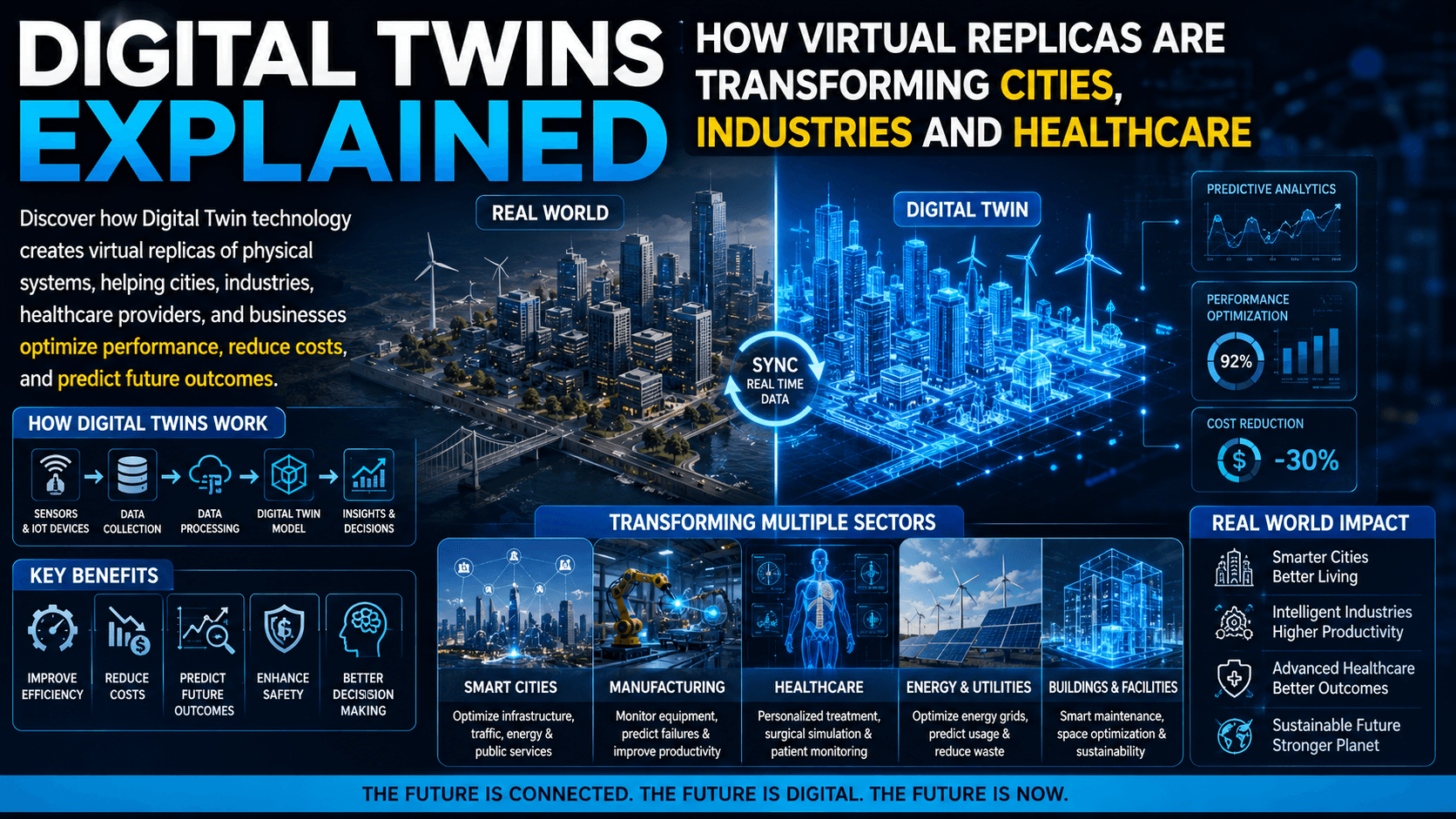
A digital twin is a highly detailed, virtual replica of a physical object, process, or system that updates in real time. It acts as a digital mirror, using live sensor data, artificial intelligence, and software analytics to simulate how the real-world counterpart behaves, performs, and reacts to different scenarios.
The concept was first formally introduced by Dr. Michael Grieves at the University of Michigan in 2002, though NASA had been using similar models for space missions even earlier. Today, digital twins have evolved far beyond simple 3D models. They are living, breathing simulations powered by IoT sensors, machine learning, cloud computing, and big data analytics.
Think of it this way: your physical asset exists in the real world, but its digital twin exists in cyberspace — constantly receiving data from sensors, processing that information through AI models, and reflecting the exact state of its physical counterpart at any given moment.
A Simple Analogy
If a physical bridge is the body, its digital twin is like a living medical record that tracks every heartbeat, every stress, every crack, every vibration — and alerts engineers before a problem becomes catastrophic. Instead of inspecting the bridge after damage occurs, engineers can monitor its digital twin 24/7 and intervene before anything goes wrong.
How Digital Twins Work: The Core Process
Unlike traditional static simulations, true digital twins operate on a continuous, two-way flow of information. Here is a step-by-step breakdown of how they function:
Step 1: Data Collection via IoT Sensors
Physical assets are equipped with hundreds or thousands of sensors that continuously gather real-time data — such as temperature, vibrations, usage statistics, pressure, speed, and environmental conditions. These sensors form what is called the Digital Thread — the continuous connection between the physical and digital worlds.
Step 2: Data Transmission to the Virtual Model
This live data is streamed directly into the virtual model through secure cloud or edge computing networks, bridging the physical and digital worlds in milliseconds. The data pipeline is always active, ensuring the digital twin is never out of date.
Step 3: Simulation and AI Analysis
The digital twin uses artificial intelligence, machine learning algorithms, and physics-based models to process the incoming data. It analyzes how the asset operates right now and uses predictive modeling to forecast how it will perform in the future under various conditions.
Step 4: Actionable Feedback Loop
Because the connection is bidirectional, insights or optimizations discovered in the virtual model can be sent back to the physical object — automatically adjusting settings, triggering maintenance alerts, or even controlling machines remotely to improve efficiency or prevent breakdowns.
| Step | Process | Technology Used | Output |
|---|---|---|---|
| 1 | Data Collection | IoT Sensors, RFID, Cameras | Raw real-time data streams |
| 2 | Data Transmission | Cloud Computing, Edge Computing, 5G | Synchronized virtual model |
| 3 | Simulation & Analysis | AI, Machine Learning, Physics Models | Predictive insights and scenarios |
| 4 | Feedback & Action | Automation, Robotics, Control Systems | Optimized real-world performance |
The Four Main Types of Digital Twins
Digital twins are not one-size-fits-all. They exist at different scales and levels of complexity, from individual parts to entire interconnected systems.
| Type | Scope | Example | Key Benefit |
|---|---|---|---|
| Component Twin | Individual part | A jet engine turbine blade | Monitor smallest unit performance |
| Asset Twin | Whole asset | An entire aircraft engine | Understand part interactions |
| System / Unit Twin | Group of assets | A complete power plant | Optimize system-wide performance |
| Process Twin | End-to-end workflow | An entire supply chain | Maximize operational efficiency |
Digital Twins vs. Traditional Simulations: What Is the Difference?
This is one of the most common questions asked about digital twin technology. While both use virtual modeling to test scenarios, they are fundamentally different:
| Feature | Traditional Simulation | Digital Twin |
|---|---|---|
| Data | Static, predefined inputs | Live, real-time sensor data |
| Update Frequency | Run manually when needed | Continuously updated 24/7 |
| Connection to Reality | Hypothetical scenarios only | Mirrors actual physical state |
| AI Integration | Limited or none | Deep AI and ML integration |
| Feedback Loop | One-way: model to insight | Two-way: model to reality and back |
| Use Case | Design and planning only | Operations, prediction, optimization |
The key distinction is that a traditional simulation tells you how something could work under hypothetical conditions, while a digital twin shows you exactly how something is working right now — and predicts what will happen next.
Digital Twins in Smart Cities: Building the Future of Urban Life
One of the most exciting and impactful applications of digital twin technology is in smart city development. Urban planners, city administrators, and government agencies are now using digital twins of entire cities to manage infrastructure, optimize services, reduce costs, and improve the quality of life for millions of residents.
What Is an Urban Digital Twin?
An urban digital twin is a virtual model of an entire city — including its roads, buildings, utilities, transportation networks, water systems, and population patterns — all connected to live data sources and updated continuously. Cities like Singapore, Helsinki, Shanghai, and Dubai have already deployed large-scale urban digital twins.
Key Applications in Smart Cities
Traffic Optimization: Digital twins allow cities to simulate thousands of traffic scenarios and automatically adjust traffic light timings, reroute vehicles, and predict congestion hours before it happens. In cities like Singapore, real-time traffic digital twins have reduced average commute times significantly.
Emergency Management: When a flood, earthquake, or fire occurs, emergency responders can use the city's digital twin to simulate evacuation routes, predict resource needs, and coordinate response in real time — saving lives that would otherwise be lost to slow decision-making.
Energy Management: Urban digital twins monitor energy consumption across every building and district, identifying waste, balancing load distribution, and integrating renewable energy sources far more efficiently than traditional grid management.
Urban Planning and Development: Before a single brick is laid, architects and planners can build new neighborhoods inside the digital twin, testing how they will affect traffic flow, sunlight, noise pollution, and green space — making smarter development decisions at a fraction of the cost of physical prototypes.
| Application Area | Problem Solved | Digital Twin Capability | Real-World Example |
|---|---|---|---|
| Traffic Management | Congestion and accidents | Real-time signal optimization | Singapore Virtual Singapore |
| Energy Grids | Power waste and outages | Load balancing and renewable integration | Helsinki 3D City Model |
| Emergency Response | Slow disaster coordination | Real-time evacuation simulation | Los Angeles Emergency Twin |
| Urban Planning | Poor development decisions | Pre-construction scenario testing | Shanghai Digital Twin City |
| Water Management | Leaks and inefficiency | Pipe pressure monitoring and prediction | Dubai Smart Water Network |
Digital Twins in Manufacturing and Industry 4.0
The manufacturing sector was one of the earliest and most enthusiastic adopters of digital twin technology, and it is easy to see why. In an industry where machine downtime can cost thousands of dollars per minute and quality defects can destroy brand reputation, having a real-time virtual mirror of every machine, production line, and factory floor is invaluable.
How Factories Use Digital Twins
Predictive Maintenance: Instead of waiting for a machine to break down — or replacing it on a fixed schedule whether it needs it or not — factories use digital twins to monitor the actual health of every motor, conveyor, pump, and press in real time. AI algorithms detect the early warning signs of failure weeks or months in advance, allowing maintenance teams to fix problems before they cause costly downtime.
Production Optimization: Digital twins of entire production lines allow factory managers to simulate different production scenarios — testing new workflows, identifying bottlenecks, and optimizing throughput — entirely in the virtual world, with zero disruption to real production.
Quality Control: By monitoring every step of the manufacturing process in real time, digital twins can detect quality issues at the moment they occur, rather than at the end of the line when defective products have already been produced in large quantities.
New Product Development: Engineers can design, test, and iterate on new products entirely within the digital twin environment, dramatically reducing the need for expensive physical prototypes and shortening development cycles from years to months.
The famous example is Formula 1 racing: teams like Mercedes and Red Bull use digital twins of their race cars to simulate aerodynamics in virtual wind tunnels, test suspension settings for specific tracks, and even simulate race strategy — all before the physical car ever touches a circuit.
| Use Case | Industry Benefit | Estimated Cost Saving | Leading Companies |
|---|---|---|---|
| Predictive Maintenance | Reduced unplanned downtime | Up to 30% maintenance cost reduction | Siemens, GE, Rolls-Royce |
| Production Line Simulation | Higher throughput efficiency | 10-25% productivity increase | BMW, Toyota, Bosch |
| Virtual Prototyping | Faster product development | 40-50% reduction in prototype costs | Airbus, Tesla, Boeing |
| Quality Monitoring | Fewer defective products | 20-35% defect rate reduction | Unilever, P&G, 3M |
| Supply Chain Optimization | Reduced inventory and waste | 15-20% supply chain cost saving | Amazon, DHL, Maersk |
Digital Twins in Healthcare: The Future of Medicine
Perhaps the most profound and personally impactful application of digital twin technology is in healthcare. The idea of creating a virtual replica of a human body — or even a specific organ — and using it to plan treatments, predict outcomes, and personalize medicine is no longer theoretical. It is happening right now in leading hospitals and research institutions around the world.
What Is a Patient Digital Twin?
A patient digital twin is a virtual model of an individual's body or specific organs, built from data including medical imaging, genomic data, blood test results, wearable sensor data, and medical history. This virtual model is then used by doctors and researchers to simulate how the patient's body will respond to specific treatments, medications, or surgical procedures — before they are actually applied.
Key Applications in Healthcare
Surgical Planning: Surgeons can use a patient's digital twin to practice complex operations in a virtual environment before performing them in the real world — identifying potential complications, testing different approaches, and arriving at the operating table fully prepared.
Personalized Drug Therapy: Instead of prescribing medication based on general population statistics, doctors can simulate how a specific patient's body will respond to a given drug at a given dose — enabling truly personalized medicine that is more effective and has fewer side effects.
Clinical Trial Simulation: Pharmaceutical companies can use digital twins to simulate clinical trials on virtual patient populations, dramatically speeding up the drug development process and reducing the need for large-scale human trials in the early stages of research.
Chronic Disease Management: Patients with conditions like diabetes, heart disease, or cancer can have ongoing digital twins that monitor their health data continuously, alerting doctors when readings deviate from safe ranges and predicting health crises before they occur.
Hospital Operations Optimization: Beyond individual patients, digital twins of entire hospitals can simulate patient flow, bed allocation, staffing needs, and equipment utilization — helping administrators reduce waiting times and improve care quality system-wide.
| Application | Current Status | Key Benefit | Example Institution |
|---|---|---|---|
| Cardiac Digital Twins | Active clinical use | Predict heart attack risk with high accuracy | Johns Hopkins, King's College London |
| Surgical Simulation | Widely deployed | Reduce surgical complications by up to 40% | Mayo Clinic, Cleveland Clinic |
| Personalized Oncology | Research and early deployment | Improve chemotherapy targeting accuracy | MD Anderson Cancer Center |
| Virtual Clinical Trials | Growing adoption | Reduce trial timelines by 30-50% | Pfizer, Novartis, AstraZeneca |
| Hospital Operations Twin | Mainstream in large hospitals | Reduce patient waiting times by 20-30% | NHS UK, Singapore General Hospital |
AI-Powered Digital Twins: The Next Level
If digital twins are powerful on their own, combining them with advanced artificial intelligence and machine learning takes their capabilities to an entirely different level. AI-powered digital twins do not just reflect the current state of a physical system — they actively learn from it, improve their predictions over time, and can eventually make autonomous decisions without any human input.
How AI Enhances Digital Twin Technology
Machine Learning for Predictive Analytics: AI models trained on months or years of sensor data learn the normal patterns of a system and can detect the earliest, most subtle signs of deviation — predicting failures with remarkable accuracy far in advance.
Generative AI for Scenario Testing: Generative AI models can create thousands of hypothetical scenarios and run them through the digital twin simultaneously, rapidly identifying the optimal configuration or strategy from an enormous solution space.
Natural Language Interfaces: With the integration of large language models, operators can now interact with digital twins using plain English — asking questions like "What will happen to production output if Line 3 goes offline for two days?" and receiving instant, data-driven answers.
Autonomous Optimization: The most advanced AI digital twins can not only identify problems and opportunities — they can automatically implement solutions. A smart factory digital twin might automatically adjust machine parameters, reschedule production orders, and contact maintenance crews — all without human intervention.
| AI Capability | How It Works | Digital Twin Enhancement | Industry Application |
|---|---|---|---|
| Predictive ML Models | Learn from historical sensor patterns | Predict failures weeks in advance | Manufacturing, Energy |
| Generative AI | Create and test thousands of scenarios | Rapid optimization across solution space | Urban Planning, Healthcare |
| Computer Vision | Analyze visual data from cameras | Detect physical defects in real time | Manufacturing, Construction |
| Reinforcement Learning | Learn optimal decisions through trial and error | Autonomous real-time system control | Smart Grids, Robotics |
| Natural Language AI | Understand plain-language queries | Conversational interface to twin data | All industries |
Digital Twins in Transportation and Logistics
The transportation sector is undergoing a massive transformation driven by digital twin technology. From individual vehicles to entire national rail networks and global shipping routes, digital twins are making transportation safer, more efficient, and more sustainable.
Smart Roads and Highways: Digital twins of road networks monitor traffic flow, weather conditions, accident hotspots, and infrastructure wear in real time. They can automatically adjust speed limits, reroute traffic, and trigger maintenance alerts — making roads both safer and more efficient.
Aviation: Airlines and aircraft manufacturers use digital twins of every aircraft in their fleet. These twins track engine health, structural integrity, and fuel efficiency continuously, enabling predictive maintenance that prevents in-flight failures and reduces fuel consumption.
Maritime Shipping: Global shipping companies like Maersk use digital twins of their container ships and shipping routes to optimize fuel usage, predict weather-related delays, and plan maintenance during port calls rather than at sea.
Rail Networks: National rail operators build digital twins of entire rail networks — tracking train positions, track conditions, signal health, and passenger loads in real time — enabling proactive maintenance and significantly reducing delays.
Digital Twins in Energy and Utilities
The global energy sector is facing enormous pressure to become cleaner, more efficient, and more resilient. Digital twin technology is playing a central role in meeting these challenges across electricity generation, transmission, distribution, and consumption.
Smart Grids: Digital twins of power grids allow utility companies to monitor the flow of electricity across thousands of nodes in real time, predict demand spikes, balance load distribution, and seamlessly integrate variable renewable energy sources like wind and solar.
Wind Farm Optimization: Each wind turbine in a modern wind farm has its own digital twin that monitors blade performance, wind conditions, mechanical health, and energy output — allowing operators to maximize energy generation while minimizing wear.
Oil and Gas: Offshore oil platforms are among the most complex and dangerous industrial environments on Earth. Digital twins allow operators to monitor thousands of sensors across a platform in real time, preventing equipment failures that could cause both environmental disasters and loss of life.
| Energy Sector | Digital Twin Application | Key Outcome | Example |
|---|---|---|---|
| Electric Grids | Real-time load monitoring and balancing | Reduced blackouts and energy waste | National Grid UK |
| Wind Farms | Turbine performance optimization | Up to 20% more energy generated | Siemens Gamesa, Vestas |
| Solar Installations | Panel health and yield monitoring | Faster fault detection and repair | First Solar, Enel Green Power |
| Oil and Gas Platforms | Equipment failure prediction | Improved safety and reduced downtime | BP, Shell, Equinor |
| Water Utilities | Pipe pressure and leak detection | Reduced water loss and infrastructure damage | Thames Water, SUEZ |
The Future of Digital Twin Technology: What Comes Next?
Digital twin technology is evolving at a breathtaking pace, and the next decade promises developments that will make today's applications look primitive by comparison.
1. The Metaverse and Digital Twin Convergence
The metaverse — the persistent, immersive virtual world that technology companies are building — is fundamentally built on digital twin technology. As the metaverse matures, we will see perfect virtual replicas of entire cities, buildings, and physical environments where people can work, collaborate, and make decisions with the same confidence as if they were physically present.
2. Human Digital Twins
The most personal frontier is the creation of individual human digital twins — comprehensive virtual models of a person's entire body, continuously updated with health data from wearables, regular medical scans, and genetic information. These personal health twins will enable doctors to practice truly personalized, preventive medicine, potentially predicting and preventing diseases years before they would otherwise manifest.
3. Planetary-Scale Digital Twins
Companies like NVIDIA with its Earth-2 project and Google with its AI-powered global mapping are working toward a digital twin of the entire Earth — a planetary-scale simulation that can model climate change, predict natural disasters, and help policymakers make more informed decisions about our planet's future.
4. Autonomous AI Digital Twins
As AI capabilities advance, digital twins will move from advising human operators to making and executing decisions autonomously. A factory digital twin will not just predict a machine failure — it will automatically order the replacement part, schedule the maintenance crew, adjust the production schedule, and reroute orders to other facilities, all without human involvement.
5. Edge Computing Integration
As 5G networks expand and edge computing infrastructure matures, digital twins will be able to process data and make decisions at the edge — directly on the factory floor, in the hospital room, or on the street corner — rather than sending data to distant cloud servers. This will dramatically reduce latency and enable new real-time applications that are impossible today.
| Future Trend | Timeline | Key Technology | Expected Impact |
|---|---|---|---|
| Metaverse Digital Twins | 2025–2028 | VR/AR, 5G, Spatial Computing | Immersive planning and collaboration |
| Human Body Digital Twins | 2026–2030 | Genomics, Wearables, Medical AI | Truly personalized preventive medicine |
| Planetary Digital Twins | 2027–2035 | Satellite Data, Climate AI, Supercomputing | Better climate prediction and policy |
| Autonomous AI Twins | 2026–2030 | AGI, Reinforcement Learning, Robotics | Fully self-managing industrial systems |
| Edge Digital Twins | 2025–2027 | 5G, Edge Computing, Micro Data Centers | Ultra-low latency real-time control |
Advantages and Disadvantages of Digital Twin Technology
Like any powerful technology, digital twins come with both significant advantages and real challenges that organizations must address.
| Advantages | Disadvantages / Challenges |
|---|---|
| Real-time monitoring of physical assets | High initial implementation cost |
| Predict failures before they happen | Requires large amounts of quality data |
| Dramatically reduce downtime and maintenance costs | Complex integration with legacy systems |
| Test scenarios with zero real-world risk | Cybersecurity and data privacy concerns |
| Enable personalized products and services | Shortage of skilled professionals |
| Optimize energy consumption and sustainability | Model accuracy depends on sensor quality |
| Accelerate innovation and product development | Requires ongoing maintenance of the twin itself |
| Improve safety in dangerous environments | Data silos between departments can limit effectiveness |
Who Is Using Digital Twins Today? Industry Leaders
Digital twin technology is no longer confined to tech giants and aerospace companies. Today, organizations across virtually every sector are implementing digital twins at scale:
- Siemens — Offers one of the world's most comprehensive industrial digital twin platforms, used across manufacturing, energy, and infrastructure worldwide.
- General Electric (GE) — Was among the first companies to deploy large-scale industrial digital twins for its jet engines and power turbines, reducing maintenance costs by hundreds of millions of dollars annually.
- Rolls-Royce — Maintains digital twins of every one of its aircraft engines in service globally, tracking health data in real time and offering predictive maintenance as a service to airlines.
- NVIDIA — Its Omniverse platform is a comprehensive development environment for building industrial digital twins, used by companies from BMW to Ericsson.
- Microsoft Azure — Provides a cloud-based digital twin service (Azure Digital Twins) that allows organizations to build and deploy digital twin solutions at scale.
- Philips Healthcare — Has deployed digital twins in hospital operations management, improving patient flow and resource utilization significantly.
How to Implement a Digital Twin in Your Organization
If you are a business leader or technology manager considering implementing digital twin technology, here is a practical roadmap to get started:
Step 1 — Define Your Goal: Identify the specific problem you want to solve or the opportunity you want to capture. Predictive maintenance? Energy optimization? Product development acceleration? Clarity of purpose is essential.
Step 2 — Assess Your Data Infrastructure: Digital twins require high-quality, real-time data. Audit your existing sensor infrastructure, data pipelines, and IT systems to understand what you have and what gaps need to be filled.
Step 3 — Choose Your Platform: Select a digital twin platform that suits your industry and scale. Options include Siemens MindSphere, Microsoft Azure Digital Twins, NVIDIA Omniverse, IBM Maximo, and many specialized industry-specific platforms.
Step 4 — Start Small and Scale: Begin with a pilot project focused on a single asset or process. Demonstrate clear ROI before expanding to larger systems. A single predictive maintenance digital twin for one production line can generate compelling evidence for broader investment.
Step 5 — Build Cross-Functional Teams: Successful digital twin implementation requires collaboration between operational technology (OT) experts, IT teams, data scientists, and domain specialists. Break down silos early.
Step 6 — Continuously Improve: A digital twin is not a one-time project — it is a living system that must be continuously updated, refined, and expanded as your physical assets and business needs evolve.
Frequently Asked Questions About Digital Twins
What is a digital twin in simple terms?
A digital twin is a virtual copy of a real thing — whether that is a machine, a building, a city, or a human organ — that is continuously updated with live data so it always reflects the current state of the real thing. It lets you monitor, analyze, and test the real thing without physically touching it.
Do digital twins need AI?
Not all digital twins require AI, but the most powerful ones do. AI and machine learning enable digital twins to go beyond simply reflecting the current state to actively predicting future states, identifying hidden patterns, and making autonomous optimization decisions. Without AI, a digital twin is essentially a very sophisticated dashboard. With AI, it becomes a predictive intelligence engine.
Can a person have a digital twin?
Yes, and this is one of the most exciting emerging frontiers in healthcare. Patient digital twins are already being created in research hospitals and medical institutions around the world, using data from medical imaging, blood tests, genomics, and wearable devices to create personalized virtual health models.
Is Google Earth a digital twin?
Google Earth has some characteristics of a digital twin in that it creates a virtual replica of the Earth's surface. However, it is not a true digital twin in the technical sense because it is not updated in real time and does not have a bidirectional feedback loop with the physical world. More advanced projects, like Google's DeepMind climate models and NVIDIA's Earth-2, are moving closer to a true planetary digital twin.
How much does a digital twin cost?
The cost of implementing a digital twin varies enormously depending on scope, complexity, and the platforms used. A simple asset-level digital twin for a single piece of manufacturing equipment might cost $50,000 to $200,000 to implement. A full enterprise-wide digital twin covering an entire factory might cost $1 million to $10 million. Urban digital twins for entire cities can cost tens or hundreds of millions of dollars. However, the ROI from reduced downtime, energy savings, and improved efficiency typically delivers payback within 1 to 3 years.
Conclusion: The World Is Getting a Digital Mirror
Digital twin technology is not a futuristic concept — it is a present-day reality that is already transforming how we build cities, run factories, treat patients, generate energy, and move goods around the world. As AI becomes more powerful, IoT sensors become cheaper and more ubiquitous, and cloud computing continues to expand, the capabilities of digital twins will grow exponentially.
We are moving toward a world where every significant physical system — every bridge, every building, every power plant, every human body — will have its own continuously updated digital counterpart. This digital mirror of the physical world will give us unprecedented ability to understand, optimize, and improve the systems that sustain modern civilization.
Whether you are a business leader looking to reduce costs and improve efficiency, a healthcare provider seeking to deliver better patient outcomes, a city planner trying to build more sustainable urban environments, or simply a curious person interested in the technologies shaping our future — digital twins are a story you need to understand. Because the virtual replicas being built today are going to transform the physical world of tomorrow.
The future is not just digital. The future is a twin.