Future Technology Guide Part 2B — Web 3.0 & Web 4.0 Explained, Next-Generation Networking, M2M Communication, Internet of Behaviors, IoE vs IoT, 7 Types of Networks, Photonics & AI, Smart Home Trends 2026 & Zero Trust Security
This is Part 2B of our comprehensive future technology series — covering the internet evolution, connectivity, and networking technologies that most people do not yet fully understand. This guide answers: What is Web 3.0 and what are its examples? What is Web 4.0 and the Symbiotic Web? What is next-generation networking (NGN)? What is machine-to-machine (M2M) communication and how does it differ from IoT? What is the Internet of Behaviors (IoB)? What is the Internet of Everything (IoE) and what are its 4 pillars? What are the 7 types of computer networks? Is photonics the future of AI? What are the smart home automation trends for 2026? What are the 7 pillars of Zero Trust security according to DoD? — and much more, with every keyword from your research included.
Part 1: How Spatial Computing Works — The 3-Step Process, History of AR & VR, and the Role of AI
What is spatial computing in simple terms? What is an example of spatial computing? What are the 4 types of computing devices? What is the role of AI in spatial computing? Who is the father of virtual reality? Is VR safe for your eyes? Why is VR better than AR? What came first, AR or VR? What skills are needed for spatial computing? Is AR still a thing? What are the 4 types of AR? Is Google Lens AR or VR? What are 7 computer types? Spatial computing examples. Spatial computing Apple. Spatial computing devices. Spatial computing jobs. Spatial computing courses. Spatial computing brands. How does spatial computing work. Spatial computing pronunciation. Nvidia spatial computing. History of spatial computing. Spatial computing explained wikipedia.
Spatial computing in simple terms is technology that understands and interacts with three-dimensional physical space — allowing digital content to exist in and respond to your real-world environment. Instead of a flat screen that you look at, spatial computing creates a digital layer around you that you look through, walk through, or interact with using hands, eyes, and voice.
The 3-Step Process: How Spatial Computing Works
Spatial computing relies on three core mechanisms working simultaneously:
- Data Capture (See the World): Wearables like the Apple Vision Pro and Meta Quest use built-in cameras, infrared sensors, and LiDAR to continuously scan and map your physical environment — detecting walls, furniture, floors, lighting conditions, and the position of your hands and eyes
- Spatial Mapping (Understand the World): AI algorithms process this visual data in real time to build a 3D digital twin of your space — understanding where every surface and obstacle is, and how to anchor digital objects to specific real-world locations so they stay in place as you move around
- Digital Overlay (Blend the Worlds): The system projects digital apps, 3D graphics, and interactive interfaces directly into your field of view — blending virtual lighting and shadows with your actual room so digital objects appear physically present. Interaction happens through eye tracking, hand gestures, and voice commands rather than keyboards or touchscreens
History of AR and VR — What Came First?
What came first, AR or VR? Who is the father of virtual reality? The history of AR and VR began in the 1960s. VR emerged first — Ivan Sutherland created the "Sword of Damocles" in 1968, the world's first head-mounted display, considered the foundation of virtual reality. Sutherland is widely regarded as the father of virtual reality and computer graphics. AR followed soon after, using digital overlays to blend content with physical reality. Nvidia spatial computing — Nvidia's Omniverse platform and its work on photorealistic 3D simulation are central to the enterprise spatial computing ecosystem, providing the AI and rendering infrastructure that powers digital twins and virtual collaboration environments.
The 4 Types of Computing Devices
What are the 4 types of computing devices? Computer hardware broadly divides into: (1) Input devices — keyboards, mice, cameras, microphones, scanners — that send data into the system; (2) Output devices — monitors, printers, speakers — that present processed results; (3) Storage devices — HDDs, SSDs, USB drives, RAM — that store data temporarily and permanently; (4) Processing devices — CPU (the brain), GPU (graphics and AI), and the motherboard connecting everything. In spatial computing, the equivalent is sensors (input), displays/speakers (output), onboard flash storage, and the specialized chips (Apple M2+R1, Snapdragon XR2) that process spatial data in real time.
Part 2: Web 3.0 — The Decentralized Internet Explained
What is the next future internet? Is blockchain still a thing in 2026? Will AI replace blockchain? What does Elon Musk think of Web3? Will there ever be a decentralized internet? Web 3.0 examples. Web 3.0 applications. When will Web 3.0 be released. Web 3.0 is also known as. Web 3.0 advantages and disadvantages. Web 3.0 timeline. Future of decentralized internet reddit. Future of decentralized internet 2022. What is Web 3.0 called? Can Solana reach $10,000 dollars? Does Bill Gates believe in Bitcoin? What is Elon Musk's favorite cryptocurrency? What internet does Elon Musk use?
Web 3.0 — also called the Semantic Web, the Decentralized Web, or simply Web3 — is the next evolutionary phase of the internet, built on blockchain and decentralized technologies. It aims to shift control from centralized tech monopolies (Google, Meta, Amazon) back to individual users through cryptographic ownership, peer-to-peer interactions, and transparent public ledgers.
The Evolution: Web 1.0 → Web 2.0 → Web 3.0
- Web 1.0 (1990s–2004) — Read-Only: Static pages where users could only consume information. No interaction, no profiles, no user-generated content
- Web 2.0 (2004–present) — Participatory: Social media era — Facebook, YouTube, Twitter. User-generated content, interactive platforms, but all data owned and monetized by centralized corporations
- Web 3.0 (emerging) — Decentralized: Blockchain-backed web where users own their data, identities, and digital assets via cryptographic keys. Transactions happen peer-to-peer without middlemen
Core Pillars of Web 3.0
- Data Ownership: Users maintain control of their identity and content through cryptographic private keys — not through a username/password stored on corporate servers
- Trustless Networks & dApps: Decentralized Applications (dApps) run on public blockchains — smart contracts execute automatically when conditions are met, without needing a central authority to verify
- Semantic Web & AI: AI and machine learning allow the internet to understand information contextually, making digital environments more personalized and intelligent
- Tokenized Economy: NFTs, cryptocurrencies, and DeFi (Decentralized Finance) enable new economic models where creators own their work and earn directly
What does Elon Musk think of Web3? Musk has been famously skeptical — calling Web3 "more marketing than reality" and saying he "doesn't get it." He described the metaverse as not compelling. Is blockchain still a thing in 2026? Yes — blockchain infrastructure underlies major financial systems, supply chain tracking, digital identity, and cross-border payments. However, consumer-facing Web3 applications are still developing. Elon Musk's favorite cryptocurrency — Musk has publicly expressed support for Dogecoin and Bitcoin at different times. He accepts Dogecoin for Tesla merchandise and SpaceX merchandise. What internet does Elon Musk use? Starlink — his SpaceX satellite internet constellation providing global broadband via low-Earth orbit satellites.
Part 3: Web 4.0 — The Symbiotic Web Explained
Is web 4.0 related to AI? What is Web 3.0 called? What will web 5.0 look like? Which country is no 1 in internet users? How will life be in 2035? When will web 4.0 be released. Web 4.0 definition and examples. Web 4.0 examples. Web 4.0 automaton. Web 5.0 examples. Web 4 download. Web 4.0 wikipedia. Current Web version.
Web 4.0 — also called the Symbiotic Web — is the next evolutionary phase beyond Web 3.0. Where Web 3.0 focuses on decentralization and user data ownership, Web 4.0 is about intelligence and symbiosis: AI systems that understand your intent, anticipate your needs, and act on your behalf autonomously. The "symbiotic" refers to the collaborative partnership between humans and intelligent systems — shifting from tool-user to co-creator relationships.
Table 1: Web Evolution 1.0 to 5.0 — Complete Comparison
| Web Version | Also Called | Era | Core Characteristic | User Relationship | Key Technology |
|---|---|---|---|---|---|
| Web 1.0 | Static Web / Read-Only Web | 1990–2004 | One-way information consumption — static HTML pages | Passive reader — no interaction possible | HTML, HTTP, basic browsers |
| Web 2.0 | Social Web / Participatory Web | 2004–present | User-generated content, social interaction, platforms as middlemen | Active creator — but platform owns the data | AJAX, mobile apps, cloud computing, social media |
| Web 3.0 | Semantic Web / Decentralized Web | Emerging 2020s | Blockchain ownership, data sovereignty, peer-to-peer transactions | Data owner — cryptographic control of own identity and assets | Blockchain, smart contracts, NFTs, DeFi, IPFS |
| Web 4.0 | Symbiotic Web / Intelligent Web | 2030s+ | AI anticipates needs and acts autonomously; XR and physical-digital fusion | Collaborative partner — AI acts as personal agent | AGI-level AI, spatial computing, quantum computing, blockchain |
| Web 5.0 | Emotional Web / Sentient Web | 2040s+ (theoretical) | AI that understands and responds to human emotions; personalized at neural level | Emotional bond — AI understands feelings and adapts | Brain-computer interfaces, emotional AI, ambient computing |
Is Web 4.0 related to AI? Yes — AI is the foundational technology of Web 4.0. The key characteristics of Web 4.0 are all AI-driven: predictive intelligence (AI agents that book flights or order groceries based on your habits), immersive experiences (XR environments powered by AI scene understanding), symbiotic collaboration (AI that learns your preferences and negotiates on your behalf), and decentralized autonomous networks. What will Web 5.0 look like? Web 5.0 is theoretical — an "emotional web" where AI systems understand and respond to human emotional states, combined with neural interfaces that make the web accessible through thought and feeling rather than screens.
Part 4: Next-Generation Networking (NGN) Technologies Explained
What is next generation networking? What is the latest technology in networking? Next generation networking technologies pdf. Next generation networking technologies ppt. Next generation networking technologies wikipedia. Next generation networking technologies in Pakistan. Next generation network architecture. NGN network. What is NGN currency. Next generation network pdf. What is next generation internet? What is the next-generation internet network? Is NGI open source? What is the new technology for the internet? What are the 7 advanced technologies? Which country is no. 1 in internet speed? Is LiFi faster than WiFi? What is new internet technology in 2026? Future internet infrastructure. What's the future of internet infrastructure? Is FWA better than fiber? What is future internet technology? Will 6G replace fiber? Is 8G available in China? Is 5G or 10G better? Future wireless networks ppt. Future wireless networks pdf.
Next-Generation Networking (NGN) refers to an evolving, packet-based network infrastructure that converges voice, data, and multimedia onto a single unified IP-based platform. Built around Internet Protocol, NGN optimizes network management, security, and scalability through advanced software and hardware. The fundamental shift: from fixed, hardware-defined networks to flexible, software-defined, AI-managed connectivity infrastructure.
Core Technologies of NGN
- Software-Defined Networking (SDN) & SD-WAN: Centralized software control separates the control plane from physical routing hardware — administrators manage traffic and deploy services dynamically through software rather than configuring individual routers
- AI/ML Network Intelligence: AI algorithms analyze network telemetry in real time — proactive threat detection, automated troubleshooting, predictive maintenance, and dynamic traffic optimization without human intervention
- Edge Computing Integration: Processing data closer to source devices reduces latency from 50–200ms (cloud round-trip) to 1–5ms (edge) — critical for real-time applications in autonomous vehicles, industrial robotics, and remote surgery
- 5G/6G Integration: Ultra-high speeds, massive device capacity, and sub-millisecond latency — 6G targets 1 TB/s peak data rates, integrating sensing and precise spatial tracking alongside communication
- Post-Quantum Cryptography: NGN security adopts quantum-resistant encryption algorithms to protect infrastructure against future quantum decryption threats — NIST published first PQC standards in 2024
- Cloud-Native & SASE Architectures: Secure Access Service Edge (SASE) bundles software-as-a-service and security controls into a unified, globally distributed edge service
NGN in Pakistan: Pakistan's telecommunications sector is actively working on NGN deployment through PTA (Pakistan Telecommunication Authority) initiatives focused on IPv6 migration, fiber expansion, and 5G spectrum allocation. Pakistan's internet infrastructure report (2025) highlights ongoing fiber backbone expansion and NGN transition planning. Will 6G replace fiber? No — every wireless generation has increased reliance on fiber, not reduced it. 6G will require even more fiber in the backhaul infrastructure. The real evolution is in the "last mile" — how fiber reaches devices.
Part 5: The 7 Types of Computer Networks Explained
What are the 7 types of networks? What are the 4 types of networks? What is L1, L2, L3, L4 in networking? What is NGN crypto? What are the latest technology in networking? Types of networks explained.
Table 2: 7 Types of Computer Networks — Complete Guide
| # | Network Type | Full Name | Geographic Scope | Key Use Case | Primary Technology |
|---|---|---|---|---|---|
| 1 | PAN | Personal Area Network | ~10 meters — single person | Connecting smartphone to smartwatch, headphones, or car infotainment | Bluetooth, NFC, USB |
| 2 | LAN | Local Area Network | Single building, home, or office | Connecting office computers to central server; home network | Ethernet cables, switches |
| 3 | WLAN | Wireless Local Area Network | Same as LAN — wireless | Laptops and phones connecting via Wi-Fi router in home or cafe | Wi-Fi (IEEE 802.11 standards — currently WiFi 6E/7) |
| 4 | CAN | Campus Area Network | University campus or corporate HQ | Connecting multiple department buildings at university or large company | Fiber optics, switches, routers |
| 5 | MAN | Metropolitan Area Network | City or large geographic region | City-wide cable TV network; connecting municipal buildings across a city | Metro Ethernet, fiber optics |
| 6 | WAN | Wide Area Network | Countries, continents, global | The Internet is the largest WAN; connecting global corporate branch offices | Leased telecom circuits, cellular, satellite |
| 7 | SAN | Storage Area Network | Within a data center | Enterprise data centers and large banking networks with massive databases | Fibre Channel, iSCSI |
What is L1, L2, L3, L4 in networking? These refer to the OSI (Open Systems Interconnection) model layers: L1 = Physical layer (cables, signals, hardware); L2 = Data Link layer (MAC addresses, switches, Ethernet frames); L3 = Network layer (IP addresses, routers, routing packets); L4 = Transport layer (TCP/UDP, port numbers, end-to-end communication). In cybersecurity, L1/L2/L3 in SOC analyst roles refers to Security Operations Center tier levels — L1 handles initial alert triage, L2 investigates escalated incidents, L3 handles complex threat hunting and incident response.
Part 6: Machine-to-Machine (M2M) Communication — Definition, Examples & Difference from IoT
What is an example of machine-to-machine communication? What is M2M with an example? What is machine-to-machine communication? What is the difference between IoT and M2M? Machine to machine communication example. Machine to machine communication pdf. Machine to machine communication protocols. Machine to machine communication notes. M2M application. M2M Gateway. M2M definition. What is M2M in Banking. Is M2M still relevant today? What are the 4 types of IoT?
Machine-to-Machine (M2M) communication is the automated exchange of data between devices without human intervention. Devices use built-in sensors and communication modules to share information directly with other machines, triggering automated responses based on predefined parameters. M2M is the foundational technology that made the Internet of Things (IoT) possible.
Classic M2M Example vs Modern IoT Example
The clearest way to understand the difference between M2M and IoT is through the vending machine comparison: M2M: A vending machine detects low inventory and sends an automated SMS directly to a warehouse technician. Communication happens machine-to-machine via dedicated cellular network — closed, point-to-point, no cloud, no analytics. IoT: The same smart vending machine sends inventory data, payment metrics, and environmental temperature to a central cloud network. AI analyzes sales trends, predicts restocking based on weather patterns, sends push notifications to the nearest supplier's app, and allows contactless mobile payments. The data connects to a broader business intelligence system.
Table 3: M2M vs IoT vs IoE — Key Differences Explained
| Feature | M2M (Machine-to-Machine) | IoT (Internet of Things) | IoE (Internet of Everything) |
|---|---|---|---|
| What It Connects | Machines to machines — point-to-point | Physical devices to the internet and each other | People + Processes + Data + Things — everything |
| Architecture | Closed, isolated, hardware-specific | Open, cloud-based, software-integrated ecosystem | Holistic intelligent ecosystem — IoT + human intelligence + workflows |
| Connectivity | Cellular, wired, or local dedicated networks | Public internet (IP-based) | Any — internet, cellular, satellite, sensors |
| Data Usage | Localized — immediate mechanical response | Cloud-stored — big data, AI analytics, apps | Globalized — transforms data into actionable intelligence for humans and machines |
| Internet Dependency | Can work offline — dedicated local networks | Entirely internet-dependent | Internet-dependent but adds human context layer |
| Scalability | Hard to scale — homogeneous dedicated devices | Highly scalable — thousands of diverse devices | Maximum scalability — connects all layers including human behavior |
| Real-World Example | Vending machine SMS to warehouse; GPS fleet tracker | Smart home thermostat, connected health wearable | Smart city traffic system coordinating sensors + buses + commuter apps + engineers |
M2M Applications in Practice
- Telematics & Fleet Management: Monitoring vehicle speed, fuel consumption, and GPS location — alerting dispatchers to route deviations and scheduling maintenance automatically
- Industrial Automation: Factory equipment sensors tracking performance and triggering predictive maintenance workflows without human monitoring
- Smart Utilities: Smart meters automatically transmitting electricity and water consumption data to utility providers in real time — enabling dynamic pricing and early fault detection
- M2M in Banking: ATMs communicating cash levels to bank operations centers; point-of-sale terminals transmitting transaction data to payment processors; fraud detection systems flagging anomalies in real time
- M2M Gateway: A hardware device that acts as a translator between legacy M2M devices (using older protocols like Modbus or RS-232) and modern IP networks — enabling older industrial equipment to connect to IoT platforms
Part 7: Internet of Behaviors (IoB) — Technology, Applications & Privacy Concerns
What is an example of the Internet of behavior? What is the difference between IoT and IoB? What is IoB? Internet of behaviors technology wikipedia. Internet of behaviors technology examples. Internet of Things. Internet of Bodies. What is IoB? The Internet of Behaviors (IoB) is an extension of IoT dedicated to gathering and analyzing data on human behavior.
The Internet of Behaviors (IoB) is an emerging technology paradigm that collects data from IoT devices and big data analytics, then analyzes it through the lens of behavioral psychology. Where IoT asks "what are devices doing?", IoB asks "what are people doing, and why?" — and uses those insights to predict and proactively influence human decisions, consumer habits, and preferences.
How IoB Works
- Data Aggregation: IoB captures "digital dust" from wearables, geolocation trackers, social media activity, facial recognition cameras, purchase histories, and online browsing patterns — building a comprehensive behavioral profile
- Psychological Mapping: Merges physical tracking data with behavioral psychology models to interpret the "why" behind human actions — not just what people did but what motivated the choice
- Behavioral Influence: Uses these insights to adjust environments, push personalized notifications, or design systems that nudge users toward desired behaviors — from healthier habits to purchasing decisions
IoB Applications
- Healthcare: Fitness trackers and remote health monitors collecting patient data to nudge users toward healthier habits, monitor medication compliance, and detect early signs of mental health deterioration through behavioral pattern changes
- Retail & Marketing: Hyper-personalized product recommendations based on browsing behavior, purchase history, and real-time location — the most commercially deployed form of IoB today
- Smart Cities: Analyzing citizen movement patterns and infrastructure usage to improve public safety, optimize traffic flow, and plan urban development — while raising significant privacy concerns
- Insurance: Telematics-based auto insurance using driving behavior data (speed, braking, cornering) to set premiums dynamically — rewarding safe drivers
IoB Privacy Concerns: IoB faces serious ethical scrutiny. The massive scale of behavioral data collection raises concerns about surveillance capitalism, psychological manipulation, and the erosion of individual autonomy. The EU's GDPR and expanding privacy regulations directly target IoB practices, requiring explicit consent for behavioral data collection and limiting the use of behavioral profiling without user knowledge. Internet of Bodies — a related concept involving sensors implanted inside or worn on the body (implantable chips, smart pills, continuous glucose monitors) that feed health data into IoB systems.
Part 8: Internet of Everything (IoE) — 4 Pillars, Difference from IoT & Real-World Impact
What is the concept of the Internet of everything? What is the difference between IoT and IoE? What are the 4 pillars of IoE? What is the simple explanation of Internet of Things? What are the 4 types of Internet of Things? Who gave the name IoT? What are the 5 C's of IoT? What are the 4 stages of IoT? Where is IoE used? Internet of everything explained pdf. Internet of Everything examples. Internet of everything vs internet of things. Internet of everything explained ppt. IoT definition and examples. Internet of everything explained wikipedia. Internet of everything pdf. Internet of Everything (IoE). Internet of everything ppt. Internet of everything project. Importance of IoT. Is IoT replaced by AI?
The Internet of Everything (IoE) is a concept pioneered by Cisco that goes beyond the Internet of Things (IoT). While IoT focuses primarily on connecting physical devices (things), IoE unifies four elements into one intelligent networked ecosystem: People, Processes, Data, and Things. IoE recognizes that the most valuable insights and outcomes come not from connected devices alone, but from the intelligent connection of all these elements together.
Table 4: The 4 Pillars of IoE — Explained with Real-World Examples
| Pillar | What It Represents | How It Connects | Smart City Example | Healthcare Example |
|---|---|---|---|---|
| 1. People | The human element — individuals interacting with networks through wearables, phones, and biometric trackers | People become nodes in the network — generating data through daily activity and receiving intelligent responses | Commuters whose smartphones receive dynamic rerouting notifications based on real-time traffic | Patients wearing health monitors whose data is monitored by doctors in real time |
| 2. Process | The logic and workflows dictating how information flows between people, data, and devices | Ensures the right information reaches the right person or machine at the right time to trigger the right action | Traffic algorithm that adjusts stoplights, reroutes buses, and alerts traffic engineers simultaneously | Automated system that cross-references patient history, alerts the doctor, and orders a prescription — all from a single vital sign alert |
| 3. Data | Raw information generated by devices, translated into actionable insights through AI and analytics | Streams from sensors → cloud processing → pattern recognition → decision support | Traffic volume data, weather data, event calendars — combined to predict congestion 2 hours in advance | Continuous biomarker data compared against population baselines to identify early disease signals |
| 4. Things | Physical internet-enabled devices, sensors, machines — the IoT layer of IoE | Collect context-aware data about environments, locations, and operations — feeding into the network | Traffic cameras, road sensors, smart streetlights, connected buses | Wearable glucose monitors, smart scales, implantable cardiac devices |
Is IoT replaced by AI? No — AI enhances IoT and IoE rather than replacing them. IoT provides the data through connected sensors; AI provides the intelligence to interpret and act on that data. The combination (AIoT) is the evolutionary direction, not replacement. Who gave the name IoT? Kevin Ashton, a British technology pioneer, coined the term "Internet of Things" in 1999 while working at Procter & Gamble. He used RFID tags connected to the internet as the original concept.
Part 9: Is Photonics the Future of AI? — Light-Based Computing for the AI Era
What is photonics in computing? Is photonics the future of AI? Is Nvidia working on photonics? Is Nvidia investing in photonics? Which country is leading in photonics? What are the different types of photonic computing? Photonic computing explained pdf. Photonic computing explained wikipedia. Photonic computing vs quantum computing. Photonic computing explained ppt. Photonic computing companies. Optical computing. Photonic computing stocks. Photonic quantum computer. Which 5 jobs will remain after AI?
Photonics in computing is rapidly emerging as a critical solution to AI's mounting physical limits. The explosive growth of AI data centers has created a "power wall" — traditional copper wiring and silicon chips get exponentially less efficient and hotter as data rates increase. Photonic technology uses light (photons) instead of electricity (electrons) to process and transmit data, offering massive speed boosts while consuming a fraction of the energy.
The Bottleneck Photonics Solves
Modern AI training clusters — like those running GPT-4 or Gemini — require linking thousands of GPU chips together. The bottleneck is the communication between chips: copper interconnects become a significant source of heat generation, power consumption, and latency at high data rates. Optical interconnects (Co-Packaged Optics) replace copper wires between chips with light-based fiber connections — transmitting information at the speed of light with minimal heat generation. Companies including Nvidia, TSMC, and major data center operators are actively deploying silicon photonics for GPU cluster networking.
Photonic AI Accelerators — Beyond Interconnects
Beyond data center networking, startups are building photonic chips specifically for AI inference. Lightmatter — backed by Google and other investors — is building fully optical computing chips designed for AI model inference. These chips perform the matrix multiplication operations at the core of neural networks using light, achieving significantly lower power consumption than GPU-based inference. Is Nvidia investing in photonics? Yes — Nvidia has integrated silicon photonics into its Quantum InfiniBand networking switches and is developing photonic interconnects for its GPU clusters. Nvidia calls these co-packaged optics a key part of its future AI infrastructure strategy.
Which country is leading in photonics? The US leads in research and commercial development (MIT, Stanford, Lightmatter, PsiQuantum). The Netherlands is crucial through ASML's monopoly on the photonic lithography machines that manufacture all advanced chips globally. Japan (Sumitomo Electric, NTT) and Germany (Fraunhofer Institute) are also major players. India announced strategic investments in photonic chips and quantum technology in 2025, positioning itself as an emerging player.
Part 10: Smart Home Automation Trends 2026 — Matter, Thread, AI & Energy Management
What are the trending topics in smart home automation? What are the latest trends in automation? What are the future trends in smart homes? What is the home automation trend in 2026? What are the 4 types of automation? AI-powered home automation systems list. Best AI-powered home automation systems. AI smart home devices. Home automation AI. Best home automation system 2025. Home automation system companies. Top 10 smart home devices. AI smart home assistant. List of smart devices for home. Smart gadgets for home and kitchen. Top 10 smart devices. Best smart home ecosystem. Best smart home devices. Smart home app. Smart home gadgets website.
Table 5: Smart Home Automation Trends 2026 — Technology, Products & Impact
| Trend Category | 2026 Technology | Leading Products/Platforms | Key Benefit | Future Direction |
|---|---|---|---|---|
| Universal Compatibility (Matter Standard) | Matter protocol — universal open-source smart home standard adopted by Apple, Google, Amazon, Samsung simultaneously | Apple HomeKit, Google Home, Amazon Alexa, Samsung SmartThings — all Matter-compatible | Eliminates brand lock-in — any Matter device works with any platform | Thread mesh networking replaces hub-based architectures entirely by 2028 |
| True Presence Detection | mmWave radar sensors detect breathing and micro-movements — knows if someone is home even if perfectly still | Aqara FP300, Presence Sensor FP2, Somfy radar sensors | More accurate than motion detection — enables true automation responses to human presence | Full biometric health monitoring via in-room radar (heart rate, breathing rate) without wearables |
| AI-Driven Climate & Energy | Machine learning thermostats learning household patterns; solar + battery + grid balancing | Google Nest, Ecobee, Tesla Powerwall + Gateway, Emporia Energy | 20–40% energy cost reduction; automatic solar/battery arbitrage | Home as energy-positive grid node — selling excess power to neighbors |
| Biometric Security | 3D facial recognition, palm-vein scanning, and behavioural recognition for seamless entry | Ring, Eufy, Arlo cameras with AI face recognition; Level smart locks | Keyless, codeless entry; family recognized automatically; strangers flagged | Full perimeter AI predicting threats before they materialize |
| AI Voice Assistants (Contextual) | Conversational AI understanding context, room awareness, and complex multi-step commands | Josh.ai (privacy-focused), Apple Siri (HomeKit), Amazon Alexa+, Google Gemini Home | "Dim the lights" works in whatever room you're in — true contextual awareness | Proactive AI that speaks first — "You usually leave in 20 minutes, shall I warm the car?" |
| Sleep & Wellness Monitoring | Smart bedroom sensors, sleep tracking rings, circadian lighting systems | Oura Ring, Eight Sleep Pod, Philips Hue circadian lighting, Withings ScanWatch | Optimizes sleep quality through automatic temperature, light, and sound adjustment | Bedroom that detects illness onset from biometric patterns — alerts you before symptoms appear |
What is the Matter standard? Matter is an open-source universal smart home protocol developed by the Connectivity Standards Alliance (CSA) with Apple, Google, Amazon, and Samsung as founding members. Before Matter, smart home devices only worked within their own ecosystem — a Philips Hue bulb might not work with Amazon Alexa unless properly bridged. Matter eliminates this fragmentation. What is Thread network? Thread is a low-power, mesh-networking wireless protocol that operates alongside Matter — devices form a self-healing mesh network where each device can relay messages, eliminating single points of failure and reducing dependence on central hubs.
Part 11: Zero Trust Security — 7 Pillars (DoD), ZTNA vs VPN & Implementation
What are the 5 pillars of zero trust? Is ZTNA better than VPN? What are the 5 pillars of ZTA? What are three principles of zero trust? What are the 7 pillars of zero trust DoD? What is l1 l2 l3 SOC analyst? What are the 7 P's of security? What are the 4 levels of security? What is IEC 62443 and NIST standards? Zero trust security model geeksforgeeks. Zero trust security model architecture. Zero trust security model in cyber security. Zero trust security model example. Zero Trust Cloudflare. Zero Trust VPN. What is Zero Trust.
Table 6: The 7 Pillars of Zero Trust (DoD Framework) — Complete Breakdown
| # | Pillar | What It Protects | Core Principle | Key Technology | Implementation Example |
|---|---|---|---|---|---|
| 1 | User | Human identities accessing systems | Verify every user continuously — not just at login | Multi-Factor Authentication (MFA), Identity Provider (IdP), behavioral analytics | Employee must complete MFA for every access request; unusual login location triggers re-verification |
| 2 | Device | Every endpoint connecting to the network | Only managed, compliant, and healthy devices get access | Mobile Device Management (MDM), Endpoint Detection & Response (EDR) | Personal phone denied corporate email access; only company-managed, updated laptop allowed |
| 3 | Application & Workload | All apps, APIs, and cloud services | Applications are never inherently trusted; access controlled per request | Application-level micro-segmentation, API security gateways | Employee can use HR app but cannot access finance app — even from same device on same network |
| 4 | Data | All organizational data at rest and in transit | Data-centric security — protect the data itself, not just the perimeter | Data classification, encryption (at rest and in transit), DLP (Data Loss Prevention) | Sensitive HR files automatically encrypted; copying to USB blocked; access logged and audited |
| 5 | Network & Environment | All network traffic, segments, and environments | Microsegment all networks — assume breach is already inside | Software-Defined Perimeter (SDP), microsegmentation, Network Detection & Response (NDR) | Finance department's servers isolated from marketing — breach in one cannot spread to other |
| 6 | Automation & Orchestration | Security response workflows | Automate security responses — human response is too slow for modern threats | SOAR (Security Orchestration, Automation, Response), automated policy enforcement | Compromised account automatically isolated and flagged within seconds — no human needed |
| 7 | Visibility & Analytics | All activity across the entire environment | You cannot protect what you cannot see — comprehensive logging and AI-driven threat detection | SIEM (Security Information & Event Management), User & Entity Behavior Analytics (UEBA) | AI detects that an employee is downloading 10x more data than usual — flags for investigation |
Is ZTNA better than VPN? For most modern enterprise use cases — yes. Traditional VPN gives authenticated users broad network access (similar to handing someone a key to the whole building). ZTNA (Zero Trust Network Access) gives users access only to specific applications they need (handing them a key to one specific room only). ZTNA is more secure, scales better for remote work, and does not require routing all traffic through a central VPN gateway. What is IEC 62443 and NIST standards? IEC 62443 is the international standard for industrial control system (OT/ICS) cybersecurity — specifically relevant for manufacturing, utilities, and critical infrastructure. NIST Special Publication 800-207 is the US government's Zero Trust Architecture framework, forming the basis of the DoD Zero Trust Strategy.
Part 12: Future Wireless Networks — 6G, WiFi 7, Reconfigurable Intelligent Surfaces & LiFi
Is there 6G and 7G? What are the 4 types of networks? What is the future of wireless? Is 8G available in China? Is 5G or 10G better? Future wireless networks ppt. Future wireless networks pdf. Is LiFi faster than WiFi? Is WiFi 7 overkill? Will 6G replace fiber? Why can't 5G penetrate walls? Will Starlink replace fiber? Secure communication sensing and computation in future intelligent wireless networks. What is NGN crypto?
The future of wireless communications is not simply faster speed — it is the integration of AI, sensing, and communication into a unified intelligent radio infrastructure. Here is the complete landscape:
- 6G (expected ~2030): Targets peak data rates up to 1 TB/s — 1,000 times faster than 5G. Beyond speed, 6G integrates sensing and imaging into the network itself — base stations that can detect the precise position, speed, and even health indicators of nearby devices and humans. Uses terahertz (THz) frequencies which offer enormous bandwidth but limited range and wall penetration
- 7G (theoretical ~2040): The 7G concept involves satellite-terrestrial integration, ubiquitous coverage including deep ocean and space environments, and direct neural interface connectivity. Currently theoretical — more marketing than engineering reality at this stage
- WiFi 7 (IEEE 802.11be): The current standard as of 2026 — operates on 2.4GHz, 5GHz, and 6GHz simultaneously using Multi-Link Operation (MLO). Theoretical maximum speed 46 Gbps. Is WiFi 7 overkill? For most users today — yes. Unless you have a multi-gigabit fiber internet plan, transfer large files between local devices, or run heavy VR environments, WiFi 6E is sufficient. WiFi 7 is a forward investment for high-density smart home environments and commercial deployments
- LiFi (Light Fidelity): Uses visible light, ultraviolet, and infrared to transmit data. Theoretically capable of 224 Gbps — far faster than WiFi. Limitations: requires line-of-sight and does not penetrate walls. Best suited for specific indoor environments: hospitals (no radio interference with medical equipment), secure government facilities, and high-density venues
- Reconfigurable Intelligent Surfaces (RIS): One of the most innovative concepts in next-gen wireless — panels embedded in walls and surfaces that can be programmed to reflect and focus wireless signals, improving coverage and speed without deploying additional power-hungry base stations. Essentially turning every wall into a smart antenna
Is 8G available in China? No — 8G is not a real commercial standard. China is deploying 5G at scale and conducting 6G research. Claims of "8G" or "10G" in China refer to cable TV infrastructure specifications (DOCSIS standards), not mobile wireless generations. Will Starlink replace fiber? No — Starlink provides broadband in rural and remote areas currently without fiber access. In urban areas with fiber, Starlink cannot match fiber's speed, latency, or cost. The technologies are complementary: fiber for dense areas, satellite for where fiber cannot reach.
Part 13: Digital Twins Extended — Agriculture, Civil Engineering, Heritage Preservation & Advanced Applications
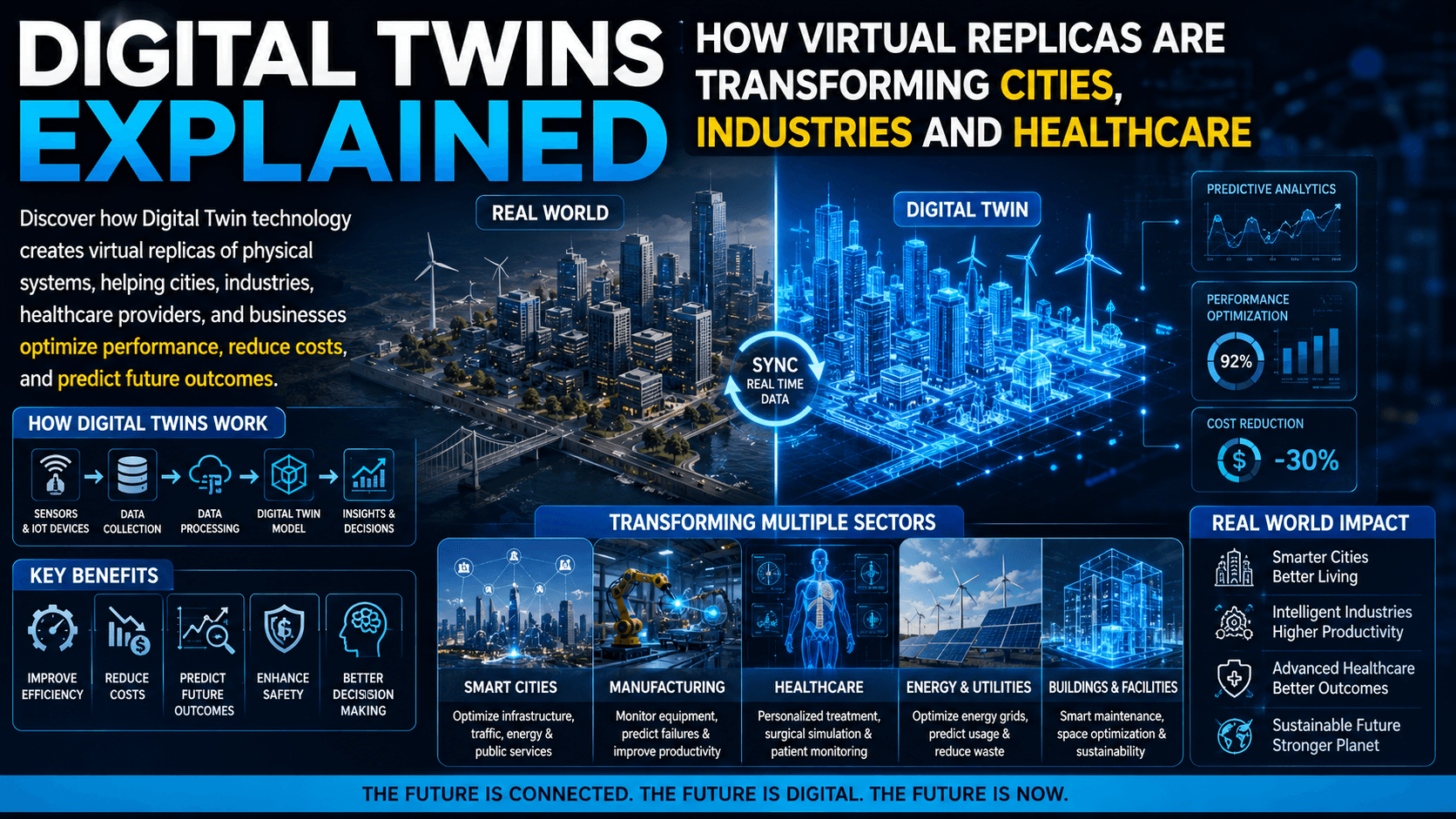
Why are digital twins important? What is digital twins in AI. Digital twin presentation. Digital twin case study. Digital twins mckinsey. Working of digital twin. Visual Components digital twin. Dataparc digital twin. Digital twin examples. Digital twin software. Digital twin technology in construction. Digital twin technology in healthcare. Digital twin technology PDF. Digital twin technology course. Digital twin technology in civil engineering. Digital twin technology in agriculture. Digital twin technology in agriculture. Why are organizations transforming their factories to digital twins? What is a digital twin in digital transformation? How are digital twins reinventing innovation? How are digital twins used in industry?
Digital twin technology has expanded far beyond its manufacturing origins. Here are the most exciting extended applications:
- Digital Twins in Agriculture: Precision farming digital twins model entire fields — soil sensors, weather data, satellite imagery, and crop health indicators — enabling farmers to optimize irrigation, fertilizer, and harvest timing for maximum yield and minimum resource waste. Vertical farm operators use single connected software layers linking rootzone tracking to automation and crop steering systems
- Digital Twins in Civil Engineering: BIM (Building Information Modeling) digital twins of bridges, dams, and tunnels continuously monitor structural health through embedded sensors — detecting micro-cracks, measuring stress loads, and alerting engineers to maintenance needs before visible failure occurs. The UK's National Digital Twin Programme is creating interconnected digital twins of entire infrastructure networks
- Digital Twins in Heritage Preservation: 3D scanning technologies create digital twins of historical artifacts, buildings, and archaeological sites — providing a permanent digital record that survives physical deterioration. Notre-Dame Cathedral's reconstruction after the 2019 fire was guided by a detailed pre-fire digital twin created by Andrew Tallon
- Digital Twins in Energy: Wind turbine digital twins optimize blade pitch angle in real time based on wind conditions, predicted wear patterns, and maintenance schedules — maximizing energy generation while minimizing turbine stress. GE Digital reports 20% reduction in unplanned downtime through turbine digital twins
- Digital Twin McKinsey Research: McKinsey Global Institute research finds that digital twins could enable $1.3 trillion to $1.5 trillion in value across manufacturing, infrastructure, and healthcare by 2030 — primarily through predictive maintenance, improved design, and operational optimization
Part 14: 7 Types of Ecosystems Explained & Connected Ecosystems of the Future
What are the 7 types of ecosystems? What are the 4 main ecosystems? What is the largest ecosystem on Earth? What are the benefits of a connected ecosystem? How are ecosystems connected? What does interconnectedness of ecosystems mean? What are the 3 types of ecosystems? What are the 7 types of ecosystems? Connected ecosystems. Connected device ecosystems. Connected product ecosystems. Connected vehicle ecosystems. Connected car ecosystems. Connected ecosystems of things.
Table 7: The 7 Types of Natural Ecosystems & Their Digital/Connected Counterparts
| # | Natural Ecosystem | Characteristics | Coverage / Size | Digital/Connected Ecosystem Parallel |
|---|---|---|---|---|
| 1 | Forest Ecosystem | Dominated by trees; high biodiversity; vital for oxygen production and carbon capture | 31% of Earth's land surface | Cloud computing ecosystem — vast infrastructure supporting diverse services (AWS, Azure, GCP) |
| 2 | Aquatic Ecosystem | Freshwater (rivers, lakes) + marine (oceans, coral reefs); produces 50% of world's oxygen | Over 70% of the planet | Internet infrastructure — the invisible connective tissue linking all digital life globally |
| 3 | Grassland Ecosystem | Grasses dominant, sparse trees; rich soil; home to grazing mammals (savannas, prairies, steppes) | 25% of Earth's land | Mobile app ecosystem — broad, open, accessible platforms like iOS App Store and Google Play |
| 4 | Desert Ecosystem | Extreme environments under 250mm annual rainfall; unique adaptations for scarcity | 33% of Earth's land | Edge computing ecosystem — sparse, distributed processing nodes optimized for extreme conditions |
| 5 | Tundra Ecosystem | Coldest biome; permafrost; short growing seasons; locks away enormous carbon stores | Arctic and high mountains | Blockchain ecosystem — frozen, immutable record that locks data permanently and securely |
| 6 | Wetland Ecosystem | Nature's "kidneys" — water purification, nursery for species, flood control | 6% of Earth's surface | Cybersecurity ecosystem — filters threats, purifies data flows, protects the broader digital environment |
| 7 | Artificial Ecosystem | Human-engineered environments — croplands, cities, managed systems; sustains human populations | Growing — all urban areas | Smart city ecosystem — fully engineered digital-physical environment designed and managed by humans |
Connected Ecosystems of the Future — 4 Domains
In the technology sense, connected ecosystems dissolve traditional boundaries between industries, allowing real-time data sharing and resource optimization across previously siloed domains: (1) Digital Business Ecosystems — supply chain platforms like Catena-X and Manufacturing-X where companies across Europe share data securely to optimize production and reduce carbon emissions; (2) Smart City Ecosystems — integrated command centers linking power, water, transport, and healthcare into unified digital nervous systems; (3) Ecological Connectivity — environmental monitoring networks tracking biodiversity, water quality, and climate indicators across entire watersheds; (4) Agricultural Ecosystems — precision farming platforms connecting soil sensors, weather stations, satellite imagery, and market prices into a single decision-support layer for farmers.
People Also Ask — Technology FAQ
What is the difference between Web 3.0 and Web 4.0?
Web 3.0 is the decentralized internet built on blockchain — users own their data, identity, and digital assets through cryptographic keys. Interactions happen peer-to-peer without middlemen. Web 4.0 is the Symbiotic Web — built on AI, spatial computing, and ambient intelligence. Where Web 3.0 gives users control over their data, Web 4.0 creates AI systems that anticipate your needs and act autonomously on your behalf. Web 3.0 is about ownership; Web 4.0 is about intelligence and symbiosis. Web 4.0 is expected to emerge in the 2030s as AGI-level AI becomes commercially available.
What is M2M communication and how is it different from IoT?
M2M (Machine-to-Machine) is point-to-point automated data exchange between devices without human intervention — closed systems using dedicated networks. IoT (Internet of Things) is the broader ecosystem connecting devices through the public internet with cloud computing, AI analytics, and app integration. Think of M2M as the foundation: a vending machine sending an SMS when inventory is low. IoT is the evolution: the same vending machine sending inventory, payment, temperature, and usage data to a cloud platform where AI forecasts restocking needs and integrates with supplier ordering systems. M2M is a subset of IoT. IoE (Internet of Everything) extends IoT further by adding people and business processes as equal pillars.
Is photonics really the future of AI or just hype?
Photonics is genuinely transforming AI infrastructure, but with nuance. Optical interconnects (replacing copper wires between GPU chips with light-based fiber) are already being deployed by Nvidia, TSMC, and major data centers — this is real, happening now, and solving AI's energy and latency bottlenecks. Fully optical AI processors (chips that perform AI computation entirely in light) are in early commercial development — Lightmatter and similar companies are building them, but mainstream deployment is 5–10 years away. The honest picture: photonics for data center networking = near-term transformative. Photonics for full AI computation = promising but still developing. Not hype — but also not replacing silicon chips overnight.
What is the Matter protocol and why does it matter for smart homes?
Matter is a universal open-source smart home connectivity standard developed by Apple, Google, Amazon, Samsung, and 500+ other companies under the Connectivity Standards Alliance. Before Matter, smart home devices only worked within their own ecosystem — a Philips Hue bulb needed a separate Hue bridge and might not work properly with Amazon Alexa without workarounds. Matter eliminates this by creating a universal language all smart home devices speak. A Matter-certified light bulb works with Apple HomeKit, Google Home, Amazon Alexa, and Samsung SmartThings simultaneously — with no bridges or separate apps. Combined with Thread (a mesh networking protocol), Matter devices form self-healing networks that operate even if your internet connection goes down.
What are the solid-state battery price in Pakistan and availability?
Solid-state batteries are not yet commercially available for consumer purchase in Pakistan or most markets globally. As of 2026, solid-state batteries are in late-stage research and limited production — Toyota targets commercial EV use by 2027–2028. Small solid-state batteries used in medical devices and specialty electronics do exist but are not consumer-purchasable products. For home solar systems in Pakistan, lithium-ion LFP (Lithium Iron Phosphate) batteries like BYD Battery-Box and Pylontech remain the current best option — reliable, commercially available, and increasingly affordable. Solid-state batteries for home solar will likely become available in Pakistan by 2030–2033 as manufacturing scales and costs decrease.
Conclusion: The Converging Technology Revolution of Our Time
From the evolution of the internet through Web 3.0 and Web 4.0, to the networking revolution of NGN, 6G, and WiFi 7, to the fundamental rethinking of computing through photonics and neuromorphic chips, to the behavioral intelligence layer of IoB and IoE, to the security transformation driven by Zero Trust — the technologies in this guide represent the converging revolution of our time.
Understanding these technologies does not require a computer science degree — it requires the right framework. When you understand that M2M is to IoT what a single phone call is to a social network, that Web 4.0 is to Web 3.0 what a personal assistant is to a filing cabinet, and that Zero Trust is to cybersecurity what biometric locks are to a master key — the complexity becomes clarity.
The organizations and individuals who understand these technologies — not just use them — will lead the next decade.
Need a Website That Ranks in the Age of AI Search?
As search evolves from Google's blue links to AI-generated answers, Voice Search, and Zero-Click results — your website's technical foundation and content structure matter more than ever. We build professional websites optimized for modern search: fast-loading, schema-marked, mobile-first, and structured for AEO and GEO alongside traditional SEO.
Business websites, eCommerce stores, portfolios, and landing pages — live domain included. Message us with your requirements and we will respond with a plan.