Hydrogen Solar Panels Explained 2026 — How They Work, Hydrogen vs Lithium Battery Comparison, Green Hydrogen Production, Fuel Cell Systems, Pakistan Energy Future & Complete Technology Guide
The world is witnessing a new chapter in clean energy — and the headline of that chapter is hydrogen solar panels. These revolutionary devices can generate electricity during the day using sunlight, store that energy as hydrogen gas, and then produce electricity again at night through a fuel cell — all without a single expensive lithium battery. This guide covers everything: how the technology works, who is building it, what it costs, how it compares to lithium batteries, and what it means for Pakistan's energy future.
Part 1: What Are Hydrogen Solar Panels? — The Technology Explained
What are hydrogen solar panels. How hydrogen solar panels work. Hydrogen solar panels explained. What is the difference between hydrogen solar panels and normal solar panels. Solar hydrogen panel. Hydrogen powered electricity. Future solar panels. Next generation solar technology. Clean energy innovation. Solar powered hydrogen production. Hydrogen from sunlight. Solar water splitting. Hydrogen electrolysis. Converting sunlight into hydrogen. Solar to hydrogen technology.
A hydrogen solar panel is a device that performs what scientists call artificial photosynthesis — mimicking how plants use sunlight to create energy, but instead of producing sugar, it produces hydrogen gas. The technical term for the process it uses is Photovoltaic-Electrochemical (PV-EC) water splitting.
Here is the fundamental difference between a conventional solar panel and a hydrogen solar panel: a standard photovoltaic (PV) panel converts sunlight into electricity, which must either be used immediately or stored in a battery. A hydrogen solar panel takes that solar-generated electricity one step further — it uses that electricity to split water molecules (H₂O) into hydrogen gas (H₂) and oxygen (O₂). The oxygen is safely released into the atmosphere, while the hydrogen is captured, piped into a storage tank, and used on demand.
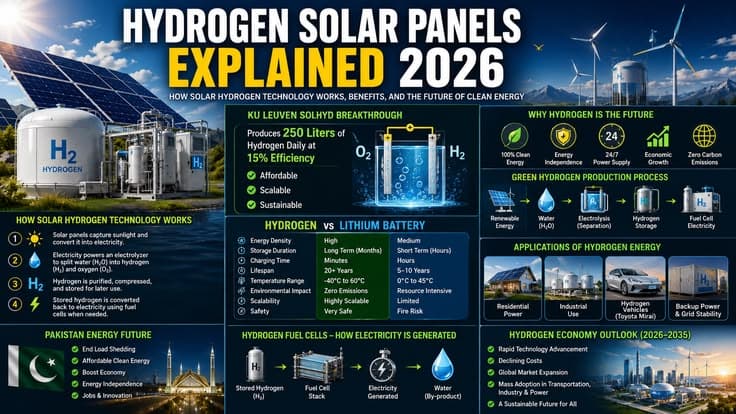
The Step-by-Step Process
- Solar Absorption: The panel captures sunlight using photovoltaic cells, generating direct current (DC) electricity — identical to a standard solar panel.
- Water Splitting (Electrolysis): The generated electricity is fed into an integrated electrolyzer, a device that uses electrical current to split water into hydrogen and oxygen. Hydrogen forms at the cathode, oxygen at the anode.
- Hydrogen Storage: The hydrogen gas is collected and stored in specialized high-pressure or cryogenic storage tanks located near the home or facility. Unlike a battery that loses charge over time, hydrogen can be stored for weeks, months, or even years without significant energy loss.
- Electricity on Demand: When the sun goes down — or during cloudy days — the stored hydrogen passes through a hydrogen fuel cell, where it recombines with oxygen from the air. This electrochemical process generates electricity, with pure water vapor as the only byproduct.
The result is a complete 24/7 clean energy cycle: solar energy in the daytime → hydrogen storage → electricity at night. No fossil fuels. No lithium batteries. No CO₂ emissions.
Hydrogen Solar Panel vs Normal Solar Panel — Key Differences
| Feature | Normal Solar Panel (PV) | Hydrogen Solar Panel |
|---|---|---|
| Primary Output | Electricity (DC) | Hydrogen gas (H₂) |
| Energy Storage | Requires lithium/lead-acid battery | Stores as hydrogen — no battery needed |
| Night Electricity | From battery (limited capacity) | From fuel cell using stored hydrogen |
| Storage Duration | Hours to days (battery degrades) | Weeks to months (hydrogen stable) |
| Visual Appearance | Standard solar panel with electrical wires | Looks same — but has gas pipes instead of wires |
| Environmental Impact | Clean energy — battery disposal issue | Zero emissions — only water vapor byproduct |
| System Complexity | Simple (panel + inverter + battery) | Complex (panel + electrolyzer + tank + fuel cell) |
| Market Availability | Fully commercial — widely available | Near-commercial — Solhyd targets 2026 launch |
Part 2: The Solhyd Breakthrough — Belgium's KU Leuven Changed Everything
KU Leuven hydrogen panel. Solhyd hydrogen panel. Solar hydrogen panel 15% efficiency. Hydrogen panel 250 liters per day. Is there any hydrogen solar panel. Is hydrogen solar panel available. Solar hydrogen panel company. SunHydrogen company. When will hydrogen solar panels be available.
The most significant advance in hydrogen solar panel technology came from KU Leuven University (Katholieke Universiteit Leuven) in Belgium. In 2019, scientists at KU Leuven's Center for Surface Chemistry and Catalysis created a solar hydrogen panel that achieved a world-record 15% solar-to-hydrogen efficiency — a monumental leap from the previous maximum of 0.1% recorded just a decade earlier.
What makes this panel remarkable is that it absorbs moisture directly from the surrounding air and uses solar energy to convert those water vapors into hydrogen gas. It produces 250 liters of hydrogen per day — enough to power an average European home through an entire winter night when connected to a fuel cell. The panel looks virtually identical to a conventional solar panel, with one key physical difference: instead of electrical wires running along the back, it has gas pipes that carry the produced hydrogen to storage.
The KU Leuven spin-off company Solhyd was created to commercialize this technology. They secured €6 million in investment funding and set a target of manufacturing 5,000 panels per year by 2026, with commercial availability planned for that same year. The founder, Jan Rongé, confirmed that this technology moves the hydrogen panel from a laboratory curiosity to a real market product.
Another key player is American company SunHydrogen, which has been working on solar hydrogen panels since 2009 — making it one of the longest-running commercial ventures in this space. While neither company has reached full mass-market scale yet, the race to commercialization is very much on.
In June 2026, the world's largest solar-hydrogen storage project went online in China — a mega-scale integrated PV-hydrogen-storage plant that directly connects solar farms to industrial electrolyzers. This is proof that the technology works at scale; the question now is reducing cost for residential use.
Part 3: Green Hydrogen Explained — Types, Production Methods & Technology
Green hydrogen production. Green hydrogen technology. What is green hydrogen. Green hydrogen how it works. Green hydrogen uses. Types of hydrogen. Solar hydrogen production. How to convert solar to hydrogen. Photoelectrochemical water splitting. Photocatalysis hydrogen. Solar thermochemical hydrogen. Alkaline electrolyzer. PEM electrolyzer. SOEC electrolyzer. Who is the biggest producer of hydrogen. Which country is leading in hydrogen.
Not all hydrogen is equal. The industry categorizes hydrogen by its production method and environmental impact:
Grey Hydrogen is produced from natural gas through steam methane reforming (SMR) — the most common and cheapest method, but it releases significant CO₂ emissions. Blue Hydrogen is also produced from natural gas, but with carbon capture and storage (CCS) to reduce emissions. Green Hydrogen is produced through water electrolysis powered exclusively by renewable energy (solar, wind, hydropower) — producing zero greenhouse gas emissions. Turquoise Hydrogen comes from methane pyrolysis, splitting natural gas into hydrogen and solid carbon without CO₂ release.
For solar-powered hydrogen panels, we are specifically interested in green hydrogen — the most sustainable but currently the most expensive option.
Three Main Pathways to Generate Solar Hydrogen
Photovoltaic Electrolysis (PV-EC) is the most mature method: standard solar panels generate electricity, which powers an electrolyzer to split water. This is what Solhyd's panels use. Three types of electrolyzers are used: Alkaline Electrolyzers (most established, cost-effective, suited for steady power), Proton Exchange Membrane (PEM) Electrolyzers (ideal for fluctuating renewable power — fastest response time), and Solid Oxide Electrolyzers (SOEC) (highest efficiency at high temperatures — ideal for industrial applications).
Photoelectrochemical (PEC) Cells are a more direct approach: specialized solar-absorbing materials submerged in water directly convert sunlight into the chemical energy needed to split water molecules — skipping the intermediate electricity generation step. This method is simpler and potentially cheaper but currently has lower efficiency than PV-EC.
Photocatalysis uses nanoparticles or advanced materials — such as conductive plastics — that interact directly with sunlight in water to produce hydrogen bubbles. Researchers at Chalmers University of Technology (Sweden) have recently demonstrated that this can be done without rare metals like platinum, dramatically reducing potential costs.
Green Hydrogen Production Methods — Comparison
| Method | How It Works | Current Efficiency | Cost (per kg) | Maturity Level | Best Application |
|---|---|---|---|---|---|
| PV + Alkaline Electrolyzer | Solar electricity splits water via alkaline solution | 59–70% electrolyzer | $3–$7/kg | Commercial | Large-scale industrial hydrogen production |
| PV + PEM Electrolyzer | Solar electricity splits water via polymer membrane | 65–75% electrolyzer | $4–$8/kg | Commercial | Paired with variable renewable energy (solar/wind) |
| PV + SOEC Electrolyzer | High-temperature electrolysis with industrial waste heat | 80–90% (with heat) | $3–$6/kg (with heat) | Pilot/Early Commercial | Industrial plants with available waste heat |
| Photoelectrochemical (PEC) | Semiconductor directly splits water using sunlight | 5–15% solar-to-H₂ | Projected $2–$4/kg at scale | Research/Pilot | Integrated solar-hydrogen panels (like Solhyd) |
| Photocatalysis | Nanoparticles in water produce H₂ from sunlight | 1–5% solar-to-H₂ | Potentially very low | Early Research | Future low-cost distributed hydrogen |
Current Cost of Green Hydrogen
The global average unsubsidized price of green hydrogen is currently $2.50 to $5.00 per kilogram. In regions with abundant cheap renewable energy (Australia, Saudi Arabia, parts of the USA), costs can reach $1.50–$2.50/kg. In the USA, with government subsidies like the Inflation Reduction Act's $45V tax credit, some projects achieve $0.50–$2.00/kg.
For comparison: 1 kg of hydrogen contains approximately 33.3 kWh of usable energy — roughly equivalent to 1 gallon of gasoline in energy content. At retail hydrogen fueling stations, prices range from $12–$20/kg in the USA and €12–€18/kg in Europe due to refining, transport, and station overhead costs.
Part 4: Hydrogen vs Lithium Battery — Which Is Better for Solar Storage?
Hydrogen vs battery storage. Hydrogen vs lithium battery. Can hydrogen replace solar batteries. Hydrogen vs lithium batteries comparison. Can hydrogen replace traditional solar storage. Battery free solar storage. Long term energy storage. Future energy storage solutions. Renewable energy storage. Hydrogen power backup. Hydrogen battery alternative. Why is hydrogen better than batteries. What is Elon Musk's new battery. Why does Elon Musk not like hydrogen.
This is the central question for anyone considering clean energy storage: should you choose hydrogen or a lithium battery for your solar system? The answer is not one-or-the-other — they serve fundamentally different purposes, and the smartest future energy systems will likely combine both.
Hydrogen vs Lithium Battery — Full Comparison
| Feature | Lithium-Ion Battery | Hydrogen Storage System | Winner |
|---|---|---|---|
| Round-Trip Efficiency | 85–95% (very efficient) | 30–40% (significant energy loss) | 🔋 Lithium Wins |
| Storage Duration | Hours to days — self-discharges over time | Weeks to months — minimal energy loss | 💧 Hydrogen Wins |
| Energy Density (per kg) | ~0.2–0.3 kWh/kg (battery weight) | ~33.3 kWh/kg of hydrogen | 💧 Hydrogen Wins massively |
| Lifespan | 5–15 years (3,000–10,000 cycles) | 10–40+ years (fuel cell + tank) | 💧 Hydrogen Wins |
| Upfront Cost | Lower — Rs 80,000–400,000 for home system | Higher — complete system very expensive currently | 🔋 Lithium Wins |
| Environmental Impact | Battery mining/disposal issues; lithium extraction pollutes | Zero emissions — only water vapor byproduct | 💧 Hydrogen Wins |
| System Complexity | Simple plug-and-play installation | Complex — electrolyzer, tank, fuel cell, piping | 🔋 Lithium Wins |
| Space Requirement | Compact — fits in a small cabinet | Large — high-pressure tanks take significant space | 🔋 Lithium Wins |
| Scalability | Limited — more batteries = much higher cost | Highly scalable — just add bigger tanks cheaply | 💧 Hydrogen Wins |
| Best Use Case | Daily cycling, short-term backup (hours) | Seasonal storage, off-grid, industrial scale | Different purposes |
Why Elon Musk Doesn't Like Hydrogen
Elon Musk has famously called hydrogen fuel cells "mind-bogglingly stupid" for passenger cars — and from a pure efficiency standpoint, he has a valid argument. The round-trip efficiency of hydrogen is only 30–40%, meaning that of every 100 units of renewable energy you put into producing hydrogen, only 30–40 units come back out as electricity. Compare this to lithium batteries at 85–95% efficiency, and the energy waste is enormous.
However, Musk's criticism applies specifically to passenger vehicles and short-term storage — not to seasonal energy storage or heavy industrial applications. For a home that needs to store summer solar power for winter use (6 months), or a remote community that needs months of energy backup, hydrogen's ability to store energy indefinitely with minimal loss makes it far superior to batteries that would self-discharge over the same period. The debate is about application, not absolute superiority.
The Future: Hybrid Systems
The smartest approach — and where most energy engineers are heading — is a hybrid system: lithium batteries handle daily cycling (morning to evening) with high efficiency, while hydrogen storage handles longer periods of low solar generation (cloudy weeks, winter months). Together they provide true 365-day energy independence.
Part 5: Hydrogen Fuel Cells — How They Generate Electricity from Hydrogen
Hydrogen fuel cells. Hydrogen fuel cell electricity. How hydrogen fuel cells produce electricity. Hydrogen fuel cell cars how it works. Hydrogen fuel cell diagram. Hydrogen fuel cell uses. Hydrogen fuel cell power plant. Hydrogen energy conversion. Clean fuel technology. Future fuel cells. Do hydrogen fuel cells make electricity. How much electricity does 1 kg of hydrogen produce. Are hydrogen fuel cells AC or DC.
A hydrogen fuel cell is the device that converts stored hydrogen back into usable electricity. It is essentially the reverse of electrolysis — where electrolysis uses electricity to split water into hydrogen and oxygen, a fuel cell combines hydrogen and oxygen to produce electricity and water.
How a Fuel Cell Works — Step by Step
A standard Proton Exchange Membrane (PEM) fuel cell consists of an anode, a cathode, and a polymer electrolyte membrane between them. At the anode, hydrogen gas (H₂) is introduced. A catalyst — typically platinum — splits hydrogen molecules into protons (H⁺) and electrons (e⁻). At the membrane, protons pass through the polymer membrane to the cathode side. Electrons, however, cannot pass through the membrane — they are forced through an external circuit, creating an electric current (electricity). At the cathode, the electrons, protons, and oxygen from the air combine in an electrochemical reaction to produce water (H₂O) and heat — the only byproducts.
One kilogram of hydrogen through a fuel cell produces approximately 15–33 kWh of electricity (depending on fuel cell efficiency, typically 40–60%). The fuel cell outputs DC electricity, which is then converted to AC through an inverter — exactly like a solar panel system.
Hydrogen Fuel Cell Applications — Overview
| Application | Technology Used | Current Examples | Output Range | Status |
|---|---|---|---|---|
| Passenger Vehicles (FCEV) | PEM Fuel Cell | Toyota Mirai (400 miles range), Hyundai Nexo | 100–200 kW | Commercial — limited fueling stations |
| Heavy Trucks & Buses | Large PEM Fuel Cell | Hyundai XCIENT, Toyota Class 8 Truck | 200–500 kW | Commercial — growing |
| Residential Backup Power | PEM or SOFC | Generac H2 Home, Panasonic ENE-FARM | 1–10 kW | Pilot/early commercial |
| Commercial & Industrial Backup | PEM Fuel Cell Arrays | Plug Power for warehouses, data centers | 10 kW–1 MW | Commercial |
| Grid-Scale Power Storage | Large Fuel Cell Power Plants | 2 GW Irish project — 600MW hydrogen turbine | 100 MW+ | Development/Planned |
| Maritime Shipping | High-Temperature Fuel Cells | NYK + Yanmar hydrogen vessel project | Megawatts | Pilot |
Part 6: Hydrogen Vehicles — Toyota Mirai, Hyundai Trucks & the Future of Transport
Hydrogen vehicles. Hydrogen fuel cell cars. Toyota Mirai technology. Hydrogen trucks. Hydrogen buses. Future transportation fuels. Clean mobility solutions. Hydrogen powered transport. Zero emission vehicles. Future vehicle technology. Hydrogen cars vs electric cars. Why does Elon Musk not like hydrogen cars. Hydrogen vs electric cars. Future of hydrogen in transport.
While passenger hydrogen vehicles face significant infrastructure challenges (few fueling stations), heavy-duty transport is where hydrogen genuinely excels over battery-electric alternatives.
The Toyota Mirai is the world's most prominent hydrogen fuel cell passenger vehicle, capable of traveling over 400 miles on a single tank that can be refueled in under 5 minutes — compared to 30–60 minutes for a typical EV fast charge. The Mirai combines hydrogen and oxygen in a fuel cell stack, producing electricity to drive an electric motor. The only emission is water vapor.
Hyundai has taken hydrogen further into commercial transport with its XCIENT hydrogen truck — a heavy-duty semi-truck capable of hauling commercial loads over long distances without the weight penalty of massive lithium battery packs. Heavy trucks need to carry enormous energy reserves, and lithium batteries become prohibitively heavy — hydrogen's superior energy density solves this. Hyundai has also deployed hydrogen buses in multiple cities.
Europe is investing heavily in hydrogen transport infrastructure. Germany, France, and the Netherlands are building hydrogen fueling corridor networks along major freight routes, enabling long-haul trucking to transition away from diesel.
For Pakistan specifically, hydrogen vehicles remain a distant prospect: the country currently has no hydrogen production plants for transport use, no fueling stations, and no distribution infrastructure. The technology exists, but the ecosystem does not yet. Pakistan's hydrogen opportunity in the near term is in stationary energy storage (homes and industries), not transportation.
Part 7: Pakistan's Energy Crisis & Hydrogen's Role — Load Shedding, Solar & the Future
Hydrogen energy in Pakistan. Solar energy Pakistan. Future electricity Pakistan. Load shedding solutions. Renewable energy Pakistan. Green energy Pakistan. Pakistan solar future. Energy crisis solutions. Hydrogen projects Pakistan. Pakistan clean energy. Hydrogen solar panels price in Pakistan. Solar hydrogen panel in Pakistan. Pakistan energy future 2030. Hydrogen solar panels for homes Pakistan. Pakistan clean energy future.
Pakistan's energy situation makes hydrogen solar technology particularly relevant — and urgently needed. Load shedding in many rural areas reaches 8–12 hours per day, while electricity bills in most DISCO zones have crossed Rs 60 per unit. This crisis has already driven millions of Pakistani households toward rooftop solar — and the next logical step is solar storage that doesn't depend on expensive, degradable lithium batteries.
The Sindh Hydrogen Project — Pakistan's First Major Step
Pakistan is not waiting passively. A major project already exists in Sindh province: a 260 MW battery storage and hydrogen production facility developed jointly by Oracle Energy and Chinese company CET, approved by SEPA (Sindh Environmental Protection Agency) in 2024. This facility will produce 150,000 kg of hydrogen per day — a massive industrial-scale green hydrogen operation that could eventually supply hydrogen for both energy storage and industrial use.
When Will Hydrogen Solar Panels Reach Pakistani Homes?
Realistically, residential hydrogen solar panels for individual Pakistani homes will not arrive before 2030–2035. The sequence will be: Solhyd and similar companies launch commercial panels in Europe and Japan first (2026–2028), prices drop through manufacturing scale-up (similar to how solar panel prices fell 80% over a decade), and then importers bring the technology to South Asian markets. The 2030–2035 window is when Pakistan could realistically see its first imported hydrogen solar home systems.
Pakistan Energy Context — Why Hydrogen Technology Is Critical
| Problem | Current Scale in Pakistan | How Hydrogen Helps | Timeline for Hydrogen Solution |
|---|---|---|---|
| Load Shedding | 8–12 hours/day in rural areas; 4–6 hours in urban | Hydrogen storage provides 24/7 backup — even without grid | 2030–2035 for residential; industrial sooner |
| High Electricity Bills | Rs 60+ per unit in most DISCO zones | Complete off-grid solar-hydrogen eliminates electricity bills | 2030+ for full off-grid home systems |
| Lithium Battery Cost | Rs 200,000–800,000 for a good home battery system | Hydrogen storage eliminates need for expensive batteries | When hydrogen panel prices fall (2030+) |
| Energy Import Dependency | Pakistan imports oil for Rs 2–3 trillion/year | Domestic green hydrogen from solar can reduce import bill | Industrial scale by 2028 (Sindh project) |
| LPG & Gas Shortage | Cylinder shortages common in winter | Hydrogen can supplement or replace LPG for heating/cooking | 2030+ with infrastructure development |
Part 8: The Hydrogen Economy — Global Investment, Future Trends & 2030 Outlook
Hydrogen economy. Green hydrogen market. Hydrogen industry growth. Hydrogen infrastructure. Hydrogen transportation. Hydrogen investment. Hydrogen energy projects. Future hydrogen market. Hydrogen economy explained. Future of renewable energy. Next generation energy systems. Sustainable energy future. Energy innovation 2030. Future clean energy. Smart energy systems. Energy transition technology. Global energy transformation. Green technology trends. Energy revolution. What country is leading in hydrogen. Which country is no 1 in hydrogen.
The global hydrogen economy is accelerating. According to the International Energy Agency (IEA), global clean hydrogen demand needs to reach 90 million tonnes per year by 2030 to stay on track with net-zero emissions pathways. Currently, the world produces about 95 million tonnes of hydrogen annually — but over 95% of it is grey hydrogen from fossil fuels.
The shift to green hydrogen is the central challenge of the energy transition. Countries leading hydrogen investment include: Germany (€9 billion National Hydrogen Strategy), Australia (vast renewable potential for export), Japan (world's most developed hydrogen economy for transport and industry), South Korea (Hyundai + government hydrogen roadmap), USA (Inflation Reduction Act hydrogen tax credits), Saudi Arabia (NEOM project — world's largest green hydrogen facility), and China (world's largest solar farm + hydrogen integration).
Future of Hydrogen Technology — Key Milestones 2026 to 2035
| Year | Expected Milestone | Impact |
|---|---|---|
| 2026 | Solhyd (KU Leuven) begins commercial hydrogen panel production — 5,000 panels/year | First commercially available integrated solar-hydrogen panels |
| 2026–2027 | World's largest solar-hydrogen storage plants operational in China & Australia | Green hydrogen prices begin falling toward $2/kg |
| 2027–2028 | European hydrogen fueling corridor networks operational for trucks | Long-haul trucking begins diesel-to-hydrogen transition |
| 2028 | Pakistan's Sindh Oracle-CET hydrogen project fully operational | 150,000 kg/day green hydrogen production — Pakistan's first large-scale green H₂ |
| 2028–2030 | Helion Energy and other fusion companies target first commercial fusion plants | Unlimited clean electricity — potential game-changer for hydrogen production cost |
| 2030 | Green hydrogen prices projected to reach $1–$2/kg with subsidies in favorable regions | Hydrogen becomes cost-competitive with fossil fuels for many applications |
| 2030–2035 | Hydrogen solar panels reach Pakistan, India & other developing markets | Rural electrification and load shedding solutions become viable |
| 2035 | Perovskite solar cells + hydrogen integration could push solar-to-H₂ efficiency above 20% | Complete transformation of residential energy systems in developed markets |
Alternative Energy Storage Technologies — Comparison with Hydrogen
| Technology | How It Works | Round-Trip Efficiency | Best For | vs Hydrogen |
|---|---|---|---|---|
| Lithium-Ion Battery | Chemical electrochemical storage | 85–95% | Daily residential cycling | Better for short-term; worse for seasonal |
| Solid-State Battery | Solid electrolyte instead of liquid | 85–98% (projected) | EVs, premium residential | Higher energy density than Li-ion, same seasonal weakness |
| Sodium-Ion Battery | Abundant sodium replaces lithium | 80–90% | Low-cost residential, developing markets | Cheaper than lithium but same duration limits |
| Redox Flow Battery | Liquid electrolyte stored in tanks | 65–80% | Grid-scale medium-term storage | Scalable but lower energy density than hydrogen |
| Green Hydrogen | Electrochemical storage as gas | 30–40% | Seasonal, industrial, heavy transport | Unmatched for long-term and large-scale |
| Pumped Hydro | Water pumped uphill; released through turbines | 70–85% | Large-scale grid balancing | No infrastructure flexibility; geography dependent |
Frequently Asked Questions — Hydrogen Solar Panels
What are hydrogen solar panels and how do they work?
Hydrogen solar panels are devices that use sunlight to produce hydrogen gas through a process called photovoltaic-electrochemical (PV-EC) water splitting. The panel captures solar energy, uses it to split water molecules into hydrogen and oxygen (electrolysis), stores the hydrogen in tanks, and then converts the hydrogen back to electricity via a fuel cell when needed — including at night or during cloudy days. The KU Leuven Solhyd panel is the current world-record holder at 15% solar-to-hydrogen efficiency, producing 250 liters of hydrogen per day. Unlike lithium batteries, hydrogen can be stored for months without energy loss.
What is the cost of 1 kg of hydrogen fuel in 2026?
The cost of 1 kg of hydrogen varies significantly by production method: Grey hydrogen (from natural gas) costs $1–$3/kg; Blue hydrogen (natural gas + carbon capture) costs $2–$4/kg; Green hydrogen (from renewable electricity) costs $2.50–$5.00/kg globally, with subsidized production in favorable regions reaching $1.50–$2.50/kg. At retail hydrogen fueling stations for vehicles, costs are much higher — $12–$20/kg in the USA and €12–€18/kg in Europe due to transport, compression, and station overhead. 1 kg of hydrogen contains approximately 33.3 kWh of energy, roughly equivalent to 1 gallon of gasoline.
Can hydrogen replace lithium batteries for solar storage?
Hydrogen can replace batteries for seasonal and long-term solar storage, but it cannot replace them entirely for daily cycling — at least not economically yet. Lithium batteries have 85–95% round-trip efficiency (ideal for daily use), while hydrogen systems have only 30–40% efficiency (lots of energy lost in conversion). However, hydrogen's ability to store energy indefinitely without self-discharge, and its massive energy density (33 kWh/kg), makes it far superior for storing summer solar power for winter use. The future is hybrid systems: lithium batteries for daily cycling, hydrogen for seasonal backup.
When will hydrogen solar panels be available in Pakistan?
Residential hydrogen solar panels for Pakistani homes are realistically expected between 2030 and 2035. The technology will first reach European and Japanese markets (Solhyd targets commercial production starting 2026), then prices will fall through manufacturing scale-up (similar to how solar panel prices dropped 80%+ over a decade), and importers will then bring the technology to South Asian markets. However, Pakistan already has an industrial-scale green hydrogen project in Sindh (Oracle Energy + CET, SEPA approved 2024) that will produce 150,000 kg/day of hydrogen — proving the technology is being adopted at scale in Pakistan's energy sector right now.
How many kWh can 1 kg of hydrogen produce?
1 kg of hydrogen contains approximately 33.3 kWh of chemical energy (lower heating value). When passed through a hydrogen fuel cell at 40–60% efficiency, it produces approximately 15–20 kWh of usable electricity. An average Pakistani home consuming 10–15 kWh per day would need roughly 0.5–1 kg of hydrogen to run for a full day from hydrogen storage alone. This makes hydrogen a very energy-dense storage medium — far more so than lithium batteries by weight.
Conclusion: Hydrogen Solar Panels — The Real Revolution Is Coming
The story of hydrogen solar panels is a story of patience paying off. From John Bockris's 1975 theoretical framework to the world's first solar hydrogen plant in Germany in 1990, to KU Leuven's world-record 15% efficiency breakthrough in 2019, to Solhyd's planned commercial launch in 2026 — this technology has been steadily, quietly maturing for over half a century.
What makes 2026 genuinely different is that the technology has crossed from laboratory demonstration to commercial production. The gap between "it works" and "you can buy it" is closing. And as history shows with solar panels, wind turbines, and lithium batteries, once a clean energy technology crosses into commercial production, costs fall faster than any expert predicts.
For Pakistan, hydrogen solar technology represents more than just another energy option — it represents a potential solution to three simultaneous crises: load shedding, energy import dependency, and the financial burden of electricity bills. The country's abundant solar irradiance, especially in Balochistan and Sindh, makes it an ideal candidate for solar-hydrogen systems once the technology becomes affordable.
The technology is real. The revolution is coming. The question is not whether hydrogen will transform our energy systems — it is when. Based on current trajectories, that "when" for Pakistan is somewhere between 2030 and 2035. The time to understand and prepare for it is now.