Killed By Their Own: 7 World Leaders Assassinated by Insiders, Not Enemies
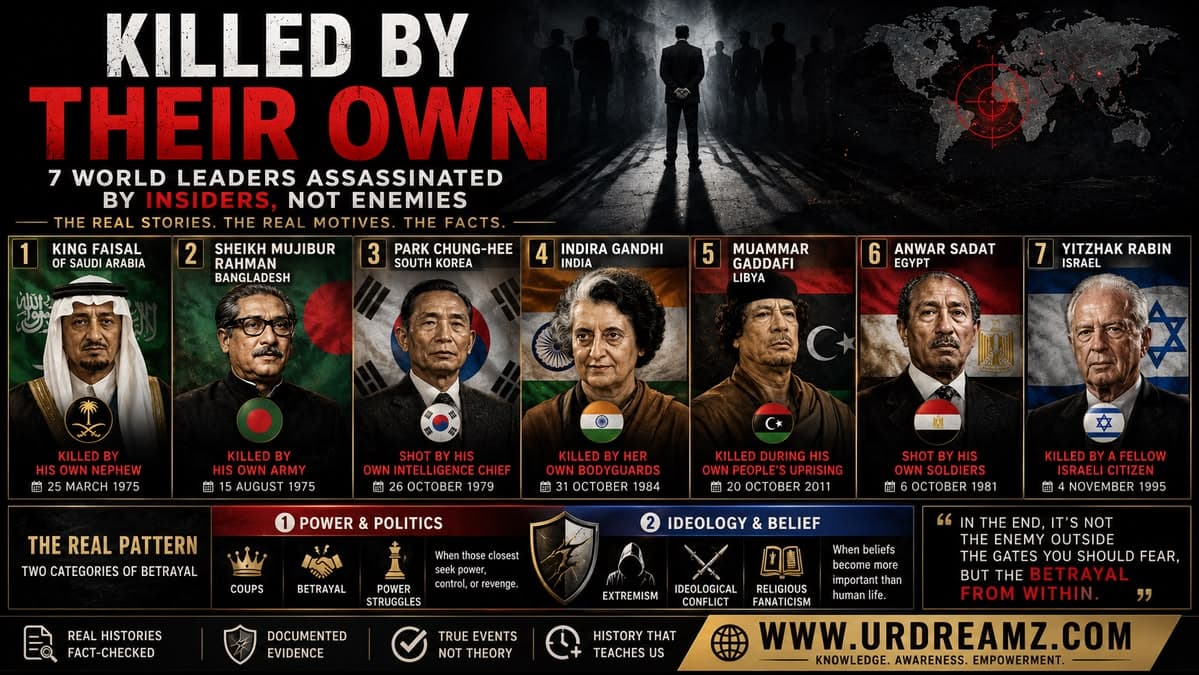
There's a persistent assumption that powerful leaders are protected from the inside out - layers of security, loyal guards, family members who would never turn against them. History tells a very different story. This guide covers seven heads of state who weren't killed by a foreign enemy, a rival nation, or an anonymous attacker - they were killed by their own nephew, their own bodyguards, their own soldiers, or their own countrymen. Each case is presented here based on the actual, documented historical record, separating what's genuinely established from what remains disputed or unproven.

1. Why "Insider" Assassinations Are So Historically Significant
Most political assassinations that make headlines involve a stranger, a foreign agent, or a rival political faction. The seven cases in this guide are different, and more unsettling for exactly that reason - each leader was brought down by someone inside their own inner circle: a relative, a trusted security officer, or a member of their own armed forces. That pattern says something important about the nature of power itself: the most sophisticated external security apparatus in the world cannot fully protect a leader from betrayal that originates from within their own trusted circle.
2. King Faisal of Saudi Arabia: Killed by His Own Nephew
King Faisal bin Abdulaziz Al Saud, who ruled Saudi Arabia from 1964 until his assassination in 1975, was shot and killed by his own nephew, Prince Faisal bin Musaid, during a public audience at the royal court. The assassin was a member of the royal family itself, making this one of the clearest examples of a leader killed not by an outsider but by his own blood relative.
3. The Real, Documented Motive Behind King Faisal's Assassination
The most widely accepted historical explanation for the assassination centers on a personal family grievance rather than any single geopolitical event. Prince Faisal bin Musaid's brother, Prince Khalid bin Musaid, had been killed years earlier by Saudi security forces during a 1965 protest against the introduction of television into the kingdom, which conservative religious factions viewed as culturally objectionable. Many historians point to this earlier family loss as the primary, most credible motive behind the 1975 assassination - a delayed act of personal revenge rather than a politically coordinated act.
4. Separating Fact From Popular Theory in Faisal's Case
A popular theory circulating online links King Faisal's assassination directly to his leadership role in the 1973 Arab oil embargo against nations supporting Israel during the Yom Kippur War - suggesting the killing was retaliation for that specific decision. It's important to be clear about the historical record here: this specific connection has never been definitively established or widely accepted by mainstream historians, and the assassin was officially described by Saudi authorities at the time as mentally unstable, acting largely on personal motives tied to his brother's death rather than any documented broader political conspiracy. Readers should treat the oil embargo connection as an unproven popular theory rather than an established historical fact.
5. Sheikh Mujibur Rahman: Bangladesh's Founding Leader, Killed by His Own Army
Sheikh Mujibur Rahman, widely regarded as the founding father of Bangladesh, was assassinated on August 15, 1975, along with most of his immediate family, in a coup led by a group of mid-ranking army officers. Only his two daughters survived, largely because they happened to be outside the country at the time of the attack.
6. The One-Party BAKSAL System That Triggered the Coup
A significant and well-documented factor behind the coup was Mujib's decision, earlier in 1975, to dissolve Bangladesh's multi-party political system and establish BAKSAL, a single, centralized national party structure. This move, intended to consolidate political control during a period of severe economic hardship and instability, alienated many within the political and military establishment who saw it as an authoritarian consolidation of power, contributing directly to the resentment that ultimately fueled the coup.
7. Park Chung-hee: Shot by His Own Intelligence Chief
Park Chung-hee, president of South Korea for eighteen years, was assassinated on October 26, 1979, by Kim Jae-gyu, the director of South Korea's own Central Intelligence Agency (KCIA) - one of the most senior and trusted figures within his own government.
8. What Actually Happened at the Dinner Table
The shooting took place during a private dinner at a KCIA safe house, where Kim Jae-gyu shot Park directly at the table. The most widely cited motive centers on internal disagreements over how to handle escalating pro-democracy protests, particularly the Busan-Masan uprising - with Kim reportedly opposing harsher, more repressive crackdown measures being pushed by other figures within Park's inner circle, alongside broader personal and political power struggles within the regime's senior ranks.
9. Indira Gandhi: Killed by Her Own Bodyguards
Indira Gandhi, Prime Minister of India, was assassinated on October 31, 1984, by two of her own Sikh bodyguards, Satwant Singh and Beant Singh, who opened fire on her as she walked through the garden of her official residence.
10. Operation Blue Star and the Motive Behind the Killing
The assassination came roughly four months after Operation Blue Star, a June 1984 military operation Gandhi had ordered against militants who had taken control of the Golden Temple in Amritsar, Sikhism's holiest site. The operation resulted in significant damage to the temple complex and considerable loss of life, deeply angering many within the Sikh community, including her own bodyguards, who saw the operation as a profound act of desecration against their faith - a grievance serious enough that two men entrusted with protecting her life ultimately chose to end it instead.
11. Muammar Gaddafi: Killed During His Own People's Uprising
Muammar Gaddafi, who ruled Libya for 42 years, was killed on October 20, 2011, after being captured by rebel fighters near his hometown of Sirte during the Libyan civil war - a conflict in which large segments of Libya's own population had risen up against his decades-long rule, alongside international military intervention.
12. Why Gaddafi's Case Is Different From the Others
Gaddafi's death differs meaningfully from the other cases in this guide. Rather than a single, targeted assassination carried out by one or two individuals from his own trusted inner circle, Gaddafi died during a nationwide armed uprising, compounded by NATO military intervention - a broader civil war rather than a targeted insider betrayal. What connects it to this list is that the uprising was driven substantially by his own citizens, many of whom had grown deeply resentful after decades of authoritarian rule, rather than being a purely foreign-led invasion. Specific claims about exact statements Gaddafi made that further inflamed public anger during the uprising circulate widely but vary considerably between sources, so they're best treated as part of the broader historical narrative rather than a single precisely confirmed quote.
13. Anwar Sadat: Shot by His Own Soldier During a Military Parade
Anwar Sadat, President of Egypt, was assassinated on October 6, 1981, during a military parade commemorating the 1973 war with Israel. Khalid Islambouli, an Egyptian army officer taking part in the parade, broke formation and opened fire on Sadat directly from within his own country's armed forces.
14. The Camp David Accords and Why They Made Sadat a Target
The clearly documented motive behind Sadat's assassination was his decision to sign the 1978 Camp David Accords and the subsequent 1979 peace treaty with Israel - a move that ended formal hostilities between the two nations but was viewed by Islamist extremist groups, including the one Islambouli belonged to, as an unacceptable betrayal. This assassination stands out because the motive was rooted specifically in an act of peacemaking rather than a personal or purely political power struggle.
15. Yitzhak Rabin: Killed by a Fellow Israeli at a Peace Rally
Yitzhak Rabin, Prime Minister of Israel, was assassinated on November 4, 1995, by Yigal Amir, a Jewish Israeli law student and far-right extremist, while Rabin was leaving a peace rally in Tel Aviv that he himself had just addressed.
16. The Oslo Accords and the Extremist Backlash
Rabin's assassination was directly tied to his role in negotiating the Oslo Accords with the Palestine Liberation Organization, a peace process that Amir and other religious-nationalist extremists viewed as a dangerous betrayal of Israeli and Jewish interests. Like Sadat, Rabin was killed not despite pursuing peace, but specifically because of it - by someone from within his own nation and, in a narrower sense, his own broader community.
17. The Real Pattern: Two Very Different Categories of Motive
Looking across all seven cases honestly, two distinct patterns emerge rather than one single unifying cause. King Faisal, Sheikh Mujib, Park Chung-hee, and Indira Gandhi were killed primarily over domestic political grievances - family revenge, resistance to authoritarian consolidation, internal power struggles, and anger over a specific military operation. Sadat and Rabin, by clear contrast, were killed specifically because they pursued peace agreements that extremists within their own societies viewed as unacceptable betrayals. Gaddafi's death sits somewhere in between, reflecting a broader popular uprising rather than a narrowly targeted act by one or two individuals.
18. What This Teaches About Security and Power
The most important, well-supported lesson across these seven cases isn't about any single hidden global conspiracy - it's a much simpler and better-documented truth: the closer someone is trusted to stand next to a leader, the more damage that trust can do if it breaks. Bodyguards, family members, senior intelligence officials, and fellow soldiers were, in every one of these cases, positioned precisely because they were trusted - and it was exactly that trusted access that made the assassination possible in the first place.
19. Why External Threats Get More Attention Than Internal Ones
Governments and security services have historically invested enormous resources into defending against external threats - foreign spies, rival nations, outside attackers - often at a level far exceeding the resources devoted to vetting and monitoring the loyalty of the people already inside the security perimeter. These seven cases collectively illustrate why that imbalance can be dangerous: the threat that actually materialized in each case came from someone who had already passed every external security check by definition, simply because they were already on the inside.
20. Addressing the "Hidden Hand" Theory Directly
It's worth addressing a theory that often accompanies lists like this one directly: the idea that a single hidden global power orchestrated all seven of these assassinations behind the scenes. Based on the actual documented historical record, each of these seven cases has its own distinct, well-established context - a family feud, a domestic political power struggle, a religiously and politically motivated backlash against a specific peace agreement, or a broad popular uprising. Treating them as evidence of one single coordinated global conspiracy requires ignoring how different, specific, and well-documented each individual motive actually is. The genuinely useful lesson here isn't a conspiracy - it's the specific, repeated vulnerability of trusted inner circles, which is a far more mundane, and far better supported, explanation.
21. Frequently Asked Questions
Who assassinated King Faisal of Saudi Arabia?
His own nephew, Prince Faisal bin Musaid, in 1975 - widely attributed by historians to personal family revenge over his brother's death a decade earlier, rather than the oil embargo, which remains an unproven popular theory.
Who killed Sheikh Mujibur Rahman?
A group of army officers in a 1975 coup, largely in response to his establishment of a one-party political system known as BAKSAL.
Why was Park Chung-hee assassinated by his own intelligence chief?
Reported motives include disagreement over how harshly to suppress pro-democracy protests, alongside broader internal power struggles within his government.
Why did Indira Gandhi's own bodyguards kill her?
In direct retaliation for Operation Blue Star, a military operation she ordered against militants at the Golden Temple, which deeply angered many in the Sikh community, including her own guards.
Was Gaddafi's death the same kind of assassination as the others?
Not exactly - he died during a broad civil uprising and NATO intervention rather than a single targeted assassination by one or two individuals from his inner circle.
Why were Sadat and Rabin killed by their own countrymen?
Both were assassinated specifically because they pursued peace agreements - the Camp David Accords and the Oslo Accords respectively - that extremists within their own societies viewed as unacceptable.
22. Conclusion
Seven different leaders, seven different countries, seven different decades - and yet the same underlying vulnerability runs through every single case: none of them were brought down by an outside enemy breaking through their defenses. Each was brought down by someone already trusted enough to be standing right next to them. That's not evidence of one hidden global conspiracy - it's a far more sobering and well-documented truth about power itself: the most dangerous threat to any leader has rarely come from outside the walls. It has come from inside the room where the decisions were actually made.