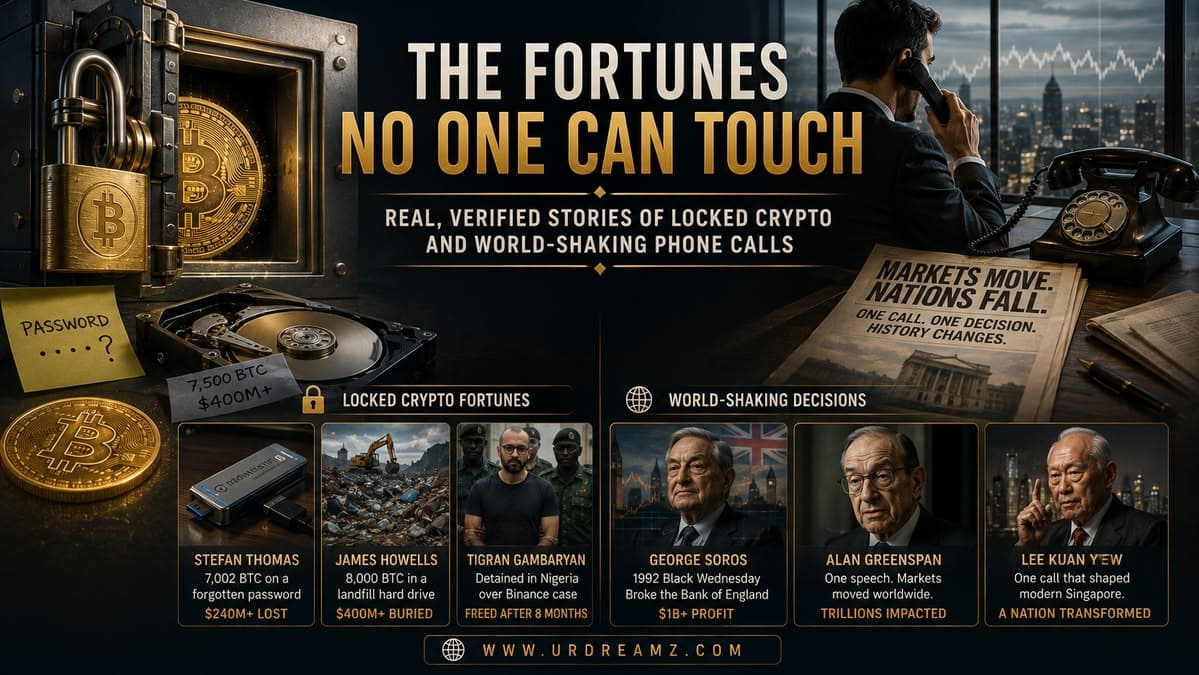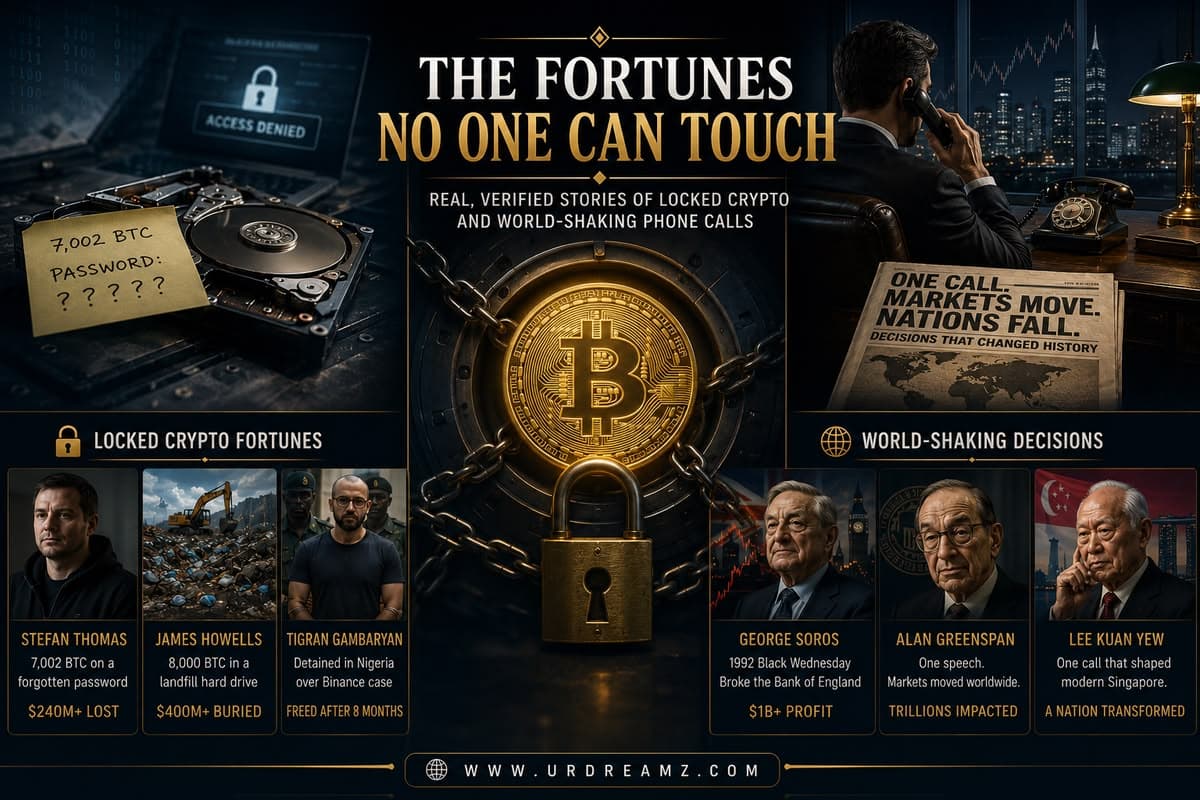
The Fortunes No One Can Touch: Real, Verified Stories of Locked Crypto and World-Shaking Phone Calls
Everyone loves talking about who's the richest person alive right now, but some of the strangest, most genuinely verified stories in the world of money aren't about who has the most. They're about people who technically own fortunes worth hundreds of millions, sometimes close to a billion dollars, and simply cannot touch a single coin of it. And on the flip side, history is full of individuals whose single decisions, made quietly from an office or over one phone call, moved markets or toppled governments entirely. Both of these categories are real, documented, and honestly stranger than most fiction. Let's go through them properly, with names, dates, and court records rather than vague, secondhand claims.
The Man Whose Bitcoin Fortune Is Two Wrong Guesses Away From Vanishing
Stefan Thomas is a German-born software developer living in San Francisco, and back in 2011 he made an educational animated video titled "What is Bitcoin?" that helped explain the then-obscure cryptocurrency to newcomers, a video that became one of the earliest widely shared explainers in the space. A grateful member of the early Bitcoin community paid him for the work in the only currency that made sense at the time: 7,002 Bitcoin, worth roughly two thousand dollars back then, a sum that would have seemed unremarkable to almost anyone watching the transaction happen.
Thomas stored the private keys to that wallet on a small encrypted USB device called an IronKey, and, like any responsible person handling a password for something valuable, wrote the password down on a piece of paper as backup. Then, at some point, he lost the paper. And here's the brutal design detail that turned a simple mistake into a fifteen-year nightmare: an IronKey permanently wipes and destroys its own encrypted contents after ten incorrect password attempts. Thomas has already used eight of his ten guesses. He has exactly two attempts left before those 7,002 Bitcoin, worth somewhere between six hundred million and nearly eight hundred million dollars depending on the day's price, are erased forever, with absolutely no way to recover them.
A cybersecurity firm called Unciphered claims to have developed a method capable of extracting data from an IronKey without triggering its self-destruct mechanism, reportedly simulating as many as 200 trillion password attempts without ever touching the device's built-in counter. They reached out to Thomas offering to help. He declined, citing prior verbal agreements with two other recovery teams he'd promised a cut to if they succeeded first. As of the most recent reporting, the IronKey remains locked in a vault in Switzerland, untouched, with Thomas still holding onto those final two guesses rather than risk losing everything permanently.
The Hard Drive Buried Under Tons of Household Garbage
If Stefan Thomas's story sounds painful, James Howells's story might be worse, because at least Thomas knows exactly where his fortune physically is. Howells, an IT engineer from Newport, Wales, mined 8,000 Bitcoin back in 2009, when the cryptocurrency was so new and worthless that mining it on an ordinary home computer was still realistic. He stored the private keys on a hard drive and, being sensible, kept it separate from his everyday devices.
In the summer of 2013, during a household clear-out, that hard drive ended up in a black rubbish bag that was thrown away and hauled off to the Docksway landfill site in Newport. Howells realized what had happened almost immediately, but by then it was already buried under the ordinary daily churn of a working landfill. The Bitcoin themselves are not lost in any technical sense; they sit at a fully public, traceable wallet address anyone can look up online. What's missing is simply the physical hard drive containing the private key needed to move them, somewhere inside millions of tons of compacted waste.
Howells has spent more than a decade trying every possible route back to that drive. He petitioned Newport City Council directly. He proposed funding a precise, professionally managed excavation at his own expense. He offered to split the recovered value with the council and the local community, at one point proposing thirty percent go toward public benefit. He formally offered twenty-five million pounds to simply buy the section of landfill he believes contains the drive. He sued the council outright in 2024, seeking either access to dig or financial compensation equivalent to the Bitcoin's value, which by that point was estimated at well over seven hundred million dollars.
Every legal route has now closed. In January 2025, the High Court in Cardiff dismissed his claim entirely, ruling it had "no realistic prospect of succeeding" and confirming that, under UK law, anything deposited at the landfill legally belongs to Newport City Council. His appeal was rejected by the Court of Appeal in March 2025. By 2025 and into 2026, Howells confirmed he was no longer pursuing excavation or purchase of the site, shifting his energy instead toward an unrelated cryptocurrency project, while the hard drive, and the fortune on it, remains exactly where it has been since 2013.
| Person | Amount | Approx. Value | Why It's Locked | Current Status |
|---|---|---|---|---|
| Stefan Thomas | 7,002 BTC | ~$650–780 million | Forgot IronKey password; only 2 of 10 attempts remain | Device intact, unopened, held in a Swiss vault |
| James Howells | 8,000 BTC | ~$750–900 million | Hard drive accidentally thrown away, buried in a landfill | All legal routes to excavate have been rejected by UK courts |
| Gerald Cotten (QuadrigaCX) | ~190,000 BTC/ETH equivalent | ~$190 million CAD at the time | Exchange founder died suddenly; he alone held the private keys | Funds never recovered; case remains one of crypto's biggest scandals |
| Satoshi Nakamoto (est.) | ~1.1 million BTC | Tens of billions of dollars | Creator's original wallets have never moved since roughly 2010 | Presumed dormant; identity of Satoshi remains unconfirmed |
The Exchange Founder Who Took the Password to His Grave
Not every locked fortune belongs to just one person. When Gerald Cotten, founder of the Canadian cryptocurrency exchange QuadrigaCX, died unexpectedly in India in December 2018, he was reportedly the only person who held the passwords and private keys controlling the exchange's cold wallets, the offline storage where customer funds were kept for safekeeping. Those wallets held roughly 190 million Canadian dollars worth of Bitcoin and other cryptocurrency belonging to tens of thousands of ordinary customers who had trusted the exchange with their savings.
When Cotten died, that money effectively became unreachable overnight. Investigations later found that some of the wallets believed to hold customer funds were actually empty, long since moved elsewhere, and the case became one of the largest and most scrutinized scandals in cryptocurrency history, an entire exchange's promises evaporating because critical financial infrastructure depended on the memory and honesty of a single individual.
The Untouched Fortune of Bitcoin's Own Creator
Perhaps the strangest entry on this list belongs to Bitcoin's own pseudonymous creator, Satoshi Nakamoto, whose real identity has never been confirmed. Blockchain researchers estimate that wallets associated with Nakamoto from Bitcoin's earliest days in 2009 and 2010 hold approximately 1.1 million Bitcoin, a sum that has been worth tens of billions of dollars at various points as the price has climbed. These coins have essentially never moved since they were mined, sitting untouched for well over a decade.
Nobody knows for certain whether this represents a deliberate choice, lost keys, a death, or simply someone who walked away entirely from the project they created. What's verifiable is the blockchain data itself: those specific addresses, publicly visible to anyone, have shown no outgoing transactions in all this time, making it, by a wide margin, the largest dormant fortune in the entire cryptocurrency world.
How Much Bitcoin Is Actually Lost Forever?
Independent estimates of Bitcoin's total circulating supply that is likely permanently inaccessible
A widely cited 2020 Chainalysis study estimated that up to 20% of all mined Bitcoin, worth well over a hundred billion dollars at current prices, is likely permanently lost due to forgotten passwords, discarded devices, or deceased owners who never shared their keys.
The Nigerian Prison Cell That Held a Crypto Detective Instead of a Criminal
Not every extraordinary money story involves lost passwords. Some involve someone getting caught in the middle of a fight between a company and a government. Tigran Gambaryan spent years as a special agent with the United States Internal Revenue Service's criminal investigation division, where he became one of the most respected cryptocurrency investigators in the world, helping trace the digital money trails that led to the arrests of Silk Road founder Ross Ulbricht and AlphaBay founder Alexandre Cazes. In 2021, he left government work to lead financial crime compliance at Binance, the world's largest cryptocurrency exchange.
In February 2024, Gambaryan traveled to Abuja, Nigeria, alongside a colleague, Nadeem Anjarwalla, to meet with Nigerian officials who were investigating Binance over allegations that the exchange had contributed to the collapse of the Nigerian naira, which had lost more than half its value that year. Instead of a normal diplomatic meeting, the two men were detained without charge, held first in a government guest house and later transferred to Kuje prison, one of Nigeria's most notorious correctional facilities, where they were held alongside members of the Boko Haram militant group.
Anjarwalla managed a dramatic escape from custody and left the country. Gambaryan remained, formally charged with money laundering and tax evasion, and spent eight harrowing months in detention. During that time he contracted malaria and pneumonia and suffered from a severely herniated spinal disc that left him struggling to walk, at one point collapsing in the courtroom itself. His wife, Yuki, campaigned publicly from their home in Georgia, in the United States, for his release, while advocates argued he had effectively become a bargaining chip in a larger dispute between the Nigerian government and Binance itself, rather than someone genuinely accused of a real crime.
In October 2024, a Nigerian court finally dropped all charges against him and ordered his release on humanitarian grounds so he could seek urgent medical treatment outside the country. He later described surviving the ordeal as coming close to death on two separate occasions. Nigerian authorities continued pursuing separate tax claims against Binance itself, but Gambaryan, the individual, walked free and returned home to his family. It remains one of the most striking real examples of how a single employee can become caught in the crossfire when a government and a global financial company clash, a story that needs no embellishment to be genuinely dramatic.
Why IronKeys and Hardware Wallets Are Designed to Be This Unforgiving
It's worth understanding why devices like Stefan Thomas's IronKey are built with such an unforgiving, self-destructive design in the first place, because it isn't an accident or an oversight. These devices exist specifically to protect against a very real threat: someone physically stealing the hardware and then trying to brute-force guess the password, systematically trying every possible combination until one works. A device that allowed unlimited attempts would be far less secure against exactly that kind of attack. By wiping itself after ten failed tries, an IronKey makes brute-force attacks essentially useless, since an attacker would need to guess correctly within just ten tries out of potentially trillions of possible combinations.
This security feature, in other words, works exactly as intended. The tragedy in Thomas's case isn't a flaw in the device. It's the fact that the same protection designed to stop a thief from stealing his fortune is now the only thing standing between him and his own fortune, with no distinction the device can make between an attacker and the legitimate owner who simply forgot a password. This is one of the core, uncomfortable trade-offs of cryptocurrency's entire design philosophy: there is no bank manager to call, no "forgot password" email link, no customer service line that can verify your identity and restore access. The same feature that makes cryptocurrency resistant to theft and government seizure also makes it completely unforgiving of ordinary human forgetfulness.
The Legal Question Nobody Expected: Who Owns Garbage?
James Howells's case ended up raising a genuinely fascinating legal question that UK courts had to seriously grapple with: once something is thrown away and collected as household waste, who actually owns it? Newport City Council's argument, ultimately accepted by the court, rested on the Control of Pollution Act 1974, which establishes that waste deposited at a licensed landfill site becomes the property of the operator managing that site. Howells argued he never intended to discard the hard drive and that its true owner shouldn't change simply because of an accident.
The court's ruling in January 2025 didn't just reject Howells's specific claim. It set a meaningful legal precedent regarding how English law treats accidentally discarded property at a landfill, regardless of its value. Judge Keyser KC's judgment specifically noted that even extraordinarily high value doesn't change the basic legal principle at play, and that allowing exceptions for valuable items would create impossible practical problems for how landfills are legally allowed to operate. It's a strange, almost philosophical outcome: a nearly billion-dollar fortune, sitting entirely intact and traceable on a public blockchain, rendered permanently unreachable not by any technical limitation, but by a fairly ordinary property law principle about garbage collection.
What the QuadrigaCX Collapse Revealed About Trust in Crypto
The Gerald Cotten story deserves a bit more context, because it became one of the most consequential scandals in cryptocurrency's short history, well beyond just one man's unfortunate death. QuadrigaCX was, at the time, Canada's largest cryptocurrency exchange, and roughly 76,000 customers had entrusted the platform with their savings. When Cotten died in India in December 2018, reportedly from complications related to Crohn's disease, the company announced it could not access the "cold wallets," offline storage systems specifically designed to be extra secure precisely because they aren't connected to the internet, holding the vast majority of customer funds.
What made the case a full-blown scandal rather than simply a tragic accident was what independent investigators found afterward. When court-appointed monitors eventually examined the wallets Cotten had supposedly used to store customer funds, several were found to be empty, some having been emptied years before his death, with funds apparently moved to other accounts and cryptocurrency exchanges entirely unrelated to the missing cold storage. This raised serious, still not fully resolved questions about whether some or all of the missing funds had actually been lost through Cotten's death, or whether they had been diverted long before that, with his death simply making a pre-existing shortfall impossible to hide any further. It remains a stark cautionary example of what can go wrong when an entire platform's security depends on a single, unaccountable individual holding every key.
The Ongoing Mystery of Satoshi Nakamoto's Real Identity
Beyond the sheer size of Satoshi Nakamoto's dormant fortune, the mystery of who Nakamoto actually is remains one of the most persistent unsolved puzzles in modern technology history. Nakamoto published Bitcoin's original whitepaper in 2008, actively communicated with early developers and contributors through 2010, and then disappeared from public communication entirely, never once revealing a real name, location, or identity. Numerous individuals have been publicly speculated to be Nakamoto over the years, and several have even claimed the identity themselves, but none of these claims has ever been definitively, independently proven to the satisfaction of the broader cryptocurrency and cybersecurity research community.
This unresolved mystery adds another layer of intrigue to the dormant fortune itself. If Nakamoto is a single living individual, that person could, in theory, become one of the wealthiest people on the planet simply by moving those coins. If Nakamoto has passed away, or if the identity represents a small group who lost internal coordination or access, those coins may be genuinely, permanently unreachable, much like Howells's landfill drive or Thomas's IronKey, just at an almost incomprehensibly larger scale.
How Nigeria's Currency Crisis Set the Stage for Gambaryan's Detention
To fully understand why Tigran Gambaryan ended up detained, it helps to understand the broader economic pressure Nigeria was facing at the time. Throughout 2023 and into 2024, Nigeria's currency, the naira, lost more than half its value against the US dollar, a devastating blow to ordinary citizens' purchasing power and savings. Nigerian officials publicly blamed cryptocurrency platforms, and Binance specifically, for contributing to this collapse, alleging that peer-to-peer crypto trading was being used to manipulate the naira's exchange rate outside official channels.
Economists largely attributed Nigeria's currency troubles to a combination of corruption, economic mismanagement, and structural issues entirely unrelated to cryptocurrency trading, but the political pressure to find a visible, punishable cause remained intense. Gambaryan and his colleague arrived in Nigeria specifically to engage constructively with these allegations on Binance's behalf, making their sudden detention, without formal charges for the first month, feel to many outside observers like an attempt to hold a visible individual accountable for a much larger, more complicated national economic problem.
When One Person's Decision Moves an Entire Market
Beyond locked fortunes and detained executives, history also holds a smaller, more exclusive category: individuals whose single decisions were powerful enough to shake entire national economies or governments. These aren't urban legends. They're documented, dated, and in most cases, the individuals themselves have spoken openly about what they did.
The Trade That Broke the Bank of England
On September 16, 1992, a date now remembered in British financial history as Black Wednesday, hedge fund manager George Soros made a decision that would define his reputation for decades. Soros bet heavily against the British pound, wagering that the UK government would be unable to keep the currency within the exchange rate band it had committed to under the European Exchange Rate Mechanism. He was right. The Bank of England spent billions of pounds trying to prop up the currency's value and raised interest rates dramatically within a single day, all without success. By evening, Britain was forced to withdraw the pound from the mechanism entirely, and Soros's fund reportedly profited by roughly one billion dollars from the trade, a single, enormous bet that earned him the nickname "the man who broke the Bank of England."
The Coup Directed From an Embassy Office
Some of the most consequential government-toppling decisions in modern history were made not by armies storming a capital, but by intelligence officers working quietly through local contacts, payments, and coordinated pressure campaigns. The best-documented example is Operation Ajax, the 1953 CIA-led operation in Iran, publicly acknowledged decades later through declassified US government documents. American intelligence officer Kermit Roosevelt Jr., working out of the US embassy in Tehran, coordinated a campaign of bribery, propaganda, and organized street unrest that contributed directly to the overthrow of Iran's democratically elected prime minister, Mohammad Mossadegh. The operation, run with a budget the CIA itself later described as remarkably small relative to its consequences, reshaped Iranian politics for the following quarter century and remains one of history's clearest documented examples of how a small, coordinated effort directed from a single office could redirect the fate of an entire nation.
| Person | Event | Year | Documented Impact |
|---|---|---|---|
| George Soros | Shorted the British pound (Black Wednesday) | 1992 | UK forced out of the European Exchange Rate Mechanism; Soros profited ~$1 billion |
| Kermit Roosevelt Jr. | Operation Ajax | 1953 | Contributed to the overthrow of Iran's elected prime minister, Mohammad Mossadegh |
| Nick Leeson | Unauthorized derivatives trading | 1995 | Single trader's losses (~$1.4 billion) collapsed Barings Bank, Britain's oldest merchant bank |
| Jerome Kerviel | Unauthorized trading position | 2008 | Losses of roughly €4.9 billion at Société Générale, one of the largest trading losses in history |
The Trader Who Sank Britain's Oldest Bank
Nick Leeson worked as a derivatives trader for Barings Bank, a 233-year-old British institution that had financed the Napoleonic Wars and counted the British monarchy among its former clients. Operating out of Singapore in the early 1990s, Leeson began making unauthorized trades to hide mounting losses, using a secret internal account to conceal the scale of the problem from his superiors in London. By the time the losses were discovered in early 1995, they totaled roughly 1.4 billion dollars, more than the bank's entire capital reserves. Barings, one of the oldest and most prestigious merchant banks in the world, collapsed within days and was ultimately sold for a single pound to a Dutch bank willing to absorb its liabilities. One trader's decisions, compounded over several years, ended a financial institution older than the country's own industrial revolution.
Other Traders Who Moved Billions With a Few Keystrokes
Nick Leeson's story at Barings Bank wasn't an isolated incident in financial history. More than a decade later, in January 2008, Société Générale, one of France's largest banks, discovered that a junior trader named Jérôme Kerviel had built up unauthorized trading positions worth nearly fifty billion euros, far beyond his actual authority, by exploiting gaps in the bank's internal oversight systems and disguising his real exposure through fake offsetting trades. When the bank unwound these positions in a rush over just a few days, it lost approximately 4.9 billion euros, one of the largest trading losses in banking history at the time, caused entirely by decisions made by a single trader operating largely unnoticed within a massive institution.
What connects Leeson's and Kerviel's stories is a shared pattern: both were relatively junior employees who discovered that internal oversight systems had blind spots, and both used those blind spots to hide escalating losses for extended periods before the truth finally became impossible to conceal. Their stories are frequently studied in business schools and financial regulation courses specifically because they demonstrate how a single individual, given enough unsupervised access to a trading system, can generate consequences on a scale usually associated with entire institutions or even national economies.
What Regulators Learned From These Collapses
The Barings and Société Générale collapses didn't just make headlines; they directly reshaped how banks and financial regulators approach internal oversight. Following the Barings collapse, regulators worldwide pushed for stricter separation between the traders who execute transactions and the back-office staff who verify and settle them, a safeguard specifically designed to prevent any single individual from having enough unchecked control to hide fraudulent activity the way Leeson did for years. Basel banking regulations, which set international standards for how much capital banks must hold in reserve, were also strengthened partly in response to these kinds of single-point-of-failure risks.
Despite these reforms, the Kerviel case at Société Générale, which happened more than a decade after Barings collapsed, demonstrated that these vulnerabilities hadn't been fully eliminated, simply reduced. This is part of why financial regulation continues to evolve constantly rather than settling into a permanently fixed set of rules: each major single-actor collapse tends to reveal a specific gap that the previous round of reforms didn't fully anticipate, and closing that gap often takes a real, costly failure to make the risk visible enough to act on.
The Common Thread Between a Landfill and a Trading Floor
It might seem strange to place a story about a hard drive lost in household garbage alongside a story about a trader who brought down a 233-year-old bank, but both illustrate the same underlying fragility: enormous value, whether held in cryptocurrency or in a bank's trading positions, often depends on a single point of failure that seems minor until the exact wrong moment arrives. A password on a piece of paper. A hard drive in the wrong bag. A trader's unsupervised access to a settlement system. A single verbal handshake agreement about an oil price forecast that turns out to be catastrophically wrong.
This is, in many ways, the real lesson connecting every story in this article, more useful and more grounded than any claim about a single trillion-dollar account. Enormous financial systems, whether built on cryptography, corporate trust, or national currency policy, are ultimately held together by ordinary human systems: memory, physical objects, oversight structures, and individual judgment calls. When those ordinary human systems fail, even briefly, the consequences can be extraordinary, whether that means a fortune trapped forever in a landfill or an entire national bank collapsing within a matter of days.
What These Stories Teach Ordinary People About Digital Wealth
For anyone holding cryptocurrency today, or considering it, these stories carry a genuinely practical lesson well beyond their entertainment value. Self-custody, meaning holding your own private keys rather than relying on an exchange or custodian, is often promoted as cryptocurrency's greatest strength, since it removes the need to trust a bank, government, or company with your money. But as Stefan Thomas and James Howells both demonstrate in the most painful way possible, that same freedom comes with total, unforgiving personal responsibility. There is no institution to call, no identity verification process, no fraud department that can restore access if a password is forgotten or a device is lost.
This is precisely why cryptocurrency security experts consistently recommend redundant backups stored in multiple secure physical locations, methods like splitting a recovery phrase across several safe deposit boxes, or using specialized hardware specifically designed to allow secure, verified recovery without the harsh all-or-nothing risk of something like an IronKey's ten-attempt limit. The stories in this article aren't really cautionary tales about cryptocurrency being dangerous in some abstract sense. They're cautionary tales about what happens when enormous value is protected by systems with zero tolerance for the very human mistakes that all of us make from time to time.
Why These Stories Matter Beyond Their Shock Value
What connects every story in this article, the men locked out of their own fortunes, the exchange founder whose death erased other people's savings, the detective who became a prisoner, the trader who broke a currency, and the officer who helped topple a government, is a single underlying theme: extraordinary financial and political power can rest on remarkably fragile foundations. A password written on a single piece of paper. A hard drive tossed in with household rubbish. One person holding the only keys to an entire company's customer funds. A single trader's authority to move billions without sufficient oversight. A modest covert budget aimed at exactly the right pressure points in a fragile government.
None of these stories required a conspiracy or an exaggerated, unverifiable claim to be genuinely remarkable. Real financial history, when you actually dig into named individuals, court records, and documented events, is consistently stranger and more compelling than embellished rumors, precisely because these events actually happened to real, identifiable people, and their outcomes are still unfolding in landfills, vaults, and courtrooms today.
Locked Fortunes vs. World-Changing Decisions: A Quick Comparison
Two very different categories of extraordinary financial stories covered in this article
Bar length here reflects narrative weight within this article, not a financial ranking, since these cases span entirely different kinds of impact and cannot be measured on a single scale.
A Final Word on Verifying Extraordinary Claims
It's worth ending on a practical note. Stories about impossibly large sums of money, a single account worth trillions, an exchange holding more money than the entire global cryptocurrency market has ever been worth, tend to spread because they sound almost too fascinating not to share. But the genuinely real stories, the ones with named individuals, court judgments, blockchain records, and on-the-record interviews behind them, are already remarkable enough without needing any exaggeration. Stefan Thomas really does have two guesses left on a fortune worth hundreds of millions. James Howells really did lose a fortune in a landfill and really did fight a UK council through multiple courts over it. Tigran Gambaryan really did spend eight months in a Nigerian prison cell as a former federal agent caught in a dispute between a government and the company he worked for. None of it needed to be inflated into trillions to be worth telling, and if anything, the exact, verifiable numbers make each story easier to trust and more satisfying to actually understand.
Frequently Asked Questions
Is it true that someone has $4 trillion locked in a Binance account? No. There is no verified case of any individual holding $4 trillion on Binance or any exchange; the entire global cryptocurrency market has never been worth that much in total. This appears to be a viral exaggeration, possibly confused with real, much smaller (though still enormous) cases like Stefan Thomas's locked $650–780 million in Bitcoin.
How much cryptocurrency is actually lost forever? A widely cited 2020 Chainalysis study estimated that around 20% of all mined Bitcoin, worth well over a hundred billion dollars at current prices, is likely permanently inaccessible due to lost passwords, discarded hardware, or deceased owners.
Did James Howells ever get access to his landfill hard drive? No. UK courts dismissed his claims in January 2025 and again on appeal in March 2025, ruling that the landfill and everything in it legally belongs to Newport City Council. As of the most recent reporting, Howells has stopped pursuing excavation or purchase of the site.
What happened to Tigran Gambaryan? He was detained in Nigeria in February 2024 while representing Binance, held for eight months including time in a notorious prison, and released in October 2024 on humanitarian grounds after charges against him were dropped.
Who is believed to hold the largest untouched cryptocurrency fortune? Bitcoin's pseudonymous creator, Satoshi Nakamoto, is believed to hold roughly 1.1 million Bitcoin in wallets that have never moved since around 2010, making it the largest known dormant cryptocurrency holding in the world.
Can a single person's trading decision really collapse a bank or break a currency? Yes, this has happened multiple times in documented financial history, including George Soros's 1992 bet against the British pound and Nick Leeson's unauthorized trades, which collapsed Britain's oldest merchant bank, Barings, in 1995.