What Is HLH? The Rare Immune Disease Explained Through a Conversation Between Two Friends
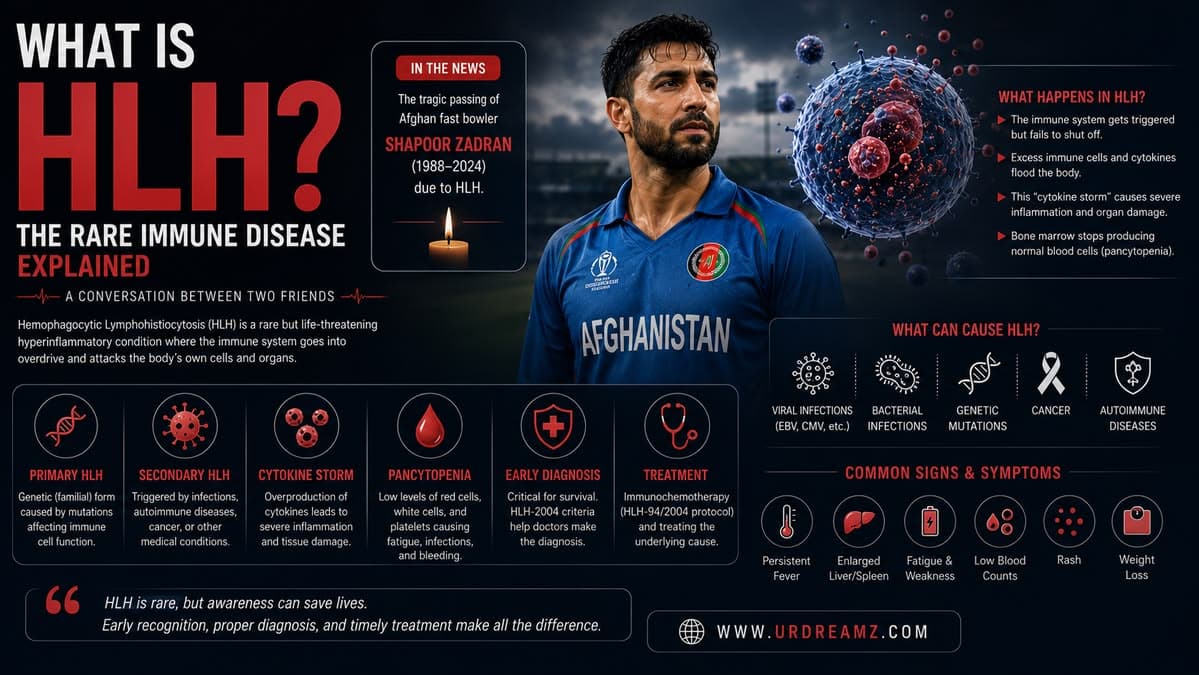
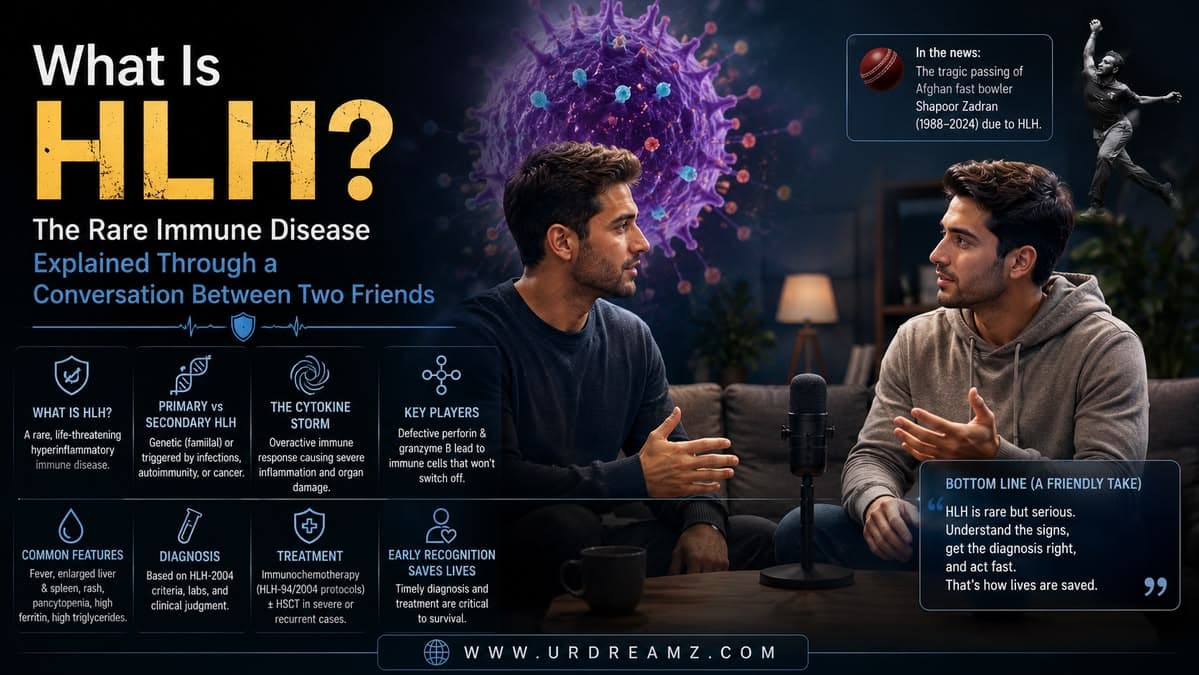
Two friends, John and Deo, sit down over tea after hearing the news that Afghan fast bowler Shapoor Zadran had passed away from a rare disease called HLH. Neither of them had heard the term before. What follows is their conversation — working through, question by question, exactly what HLH is, why the immune system itself becomes the danger, what separates the genetic form from the acquired form, and what modern medicine can actually do about it.
1. A Sad Piece of News
Deo: Did you see the news? Shapoor Zadran, the Afghan fast bowler, passed away. It's genuinely shocking — he wasn't even that old.
John: Yeah, I saw it too. What really got my attention is that the reports mentioned something called HLH. I'd never even heard of it before. Have you?
Deo: Not at all. I looked it up a little, but honestly, most of what I found was written in dense medical language. Can you break it down for me in plain words?
John: I actually spent some time reading about it earlier, so let me walk you through it properly. It's a genuinely fascinating — and honestly kind of terrifying — condition once you understand what's actually happening inside the body.
Deo: Before we get into the science — how rare is this thing? I'd genuinely never heard the term before today.
John: That's part of why it caught my attention too. It's classified as a rare disease, and it's not something most people, even healthcare workers outside of hematology and immunology, encounter very often. That rarity is actually part of the danger — because it's so uncommon, and because its early symptoms look like a dozen other more ordinary illnesses, it can be genuinely difficult to catch quickly, which matters a lot given how fast it can progress.
2. So What Actually Is HLH?
Deo: Okay, so in the simplest terms — what is HLH?
John: Think about it this way. Our immune system is supposed to be our defense force — it protects us from colds, bacteria, viruses, basically anything harmful that tries to invade the body. Normally, that system works exactly the way it should: something bad shows up, the immune system fights it, the threat gets eliminated, and everything calms back down.
Deo: Right, that's how it's supposed to work.
John: Exactly. But HLH is what happens when something goes wrong in that very system — not an outside threat causing the damage, but the defense system itself. HLH stands for Hemophagocytic Lymphohistiocytosis, and in plain language, it's a condition where the immune system essentially malfunctions and starts causing serious damage to the very body it's supposed to be protecting.
3. Wait — the Immune System Attacking Us? How Is That Possible?
Deo: Hold on, that sounds like an autoimmune disease, no? Like when the body attacks itself?
John: That's a really good question, and it's actually the most important distinction to understand here. HLH is not a typical autoimmune disorder. Let me explain the difference. Imagine your body develops some kind of problem, somewhere. Your immune system detects it and starts fighting it — that's completely normal and healthy. Once the problem is actually solved, the immune system is supposed to calm down and stop.
Deo: Makes sense so far.
John: But in HLH, here's the twist: the immune system keeps firing — even after the original threat is already gone. It doesn't stop. It keeps attacking your own organs even though there's nothing left to fight. That's called a hyperinflammatory response. It's not that the immune system is confused about what's "self" versus "foreign," the way it is in classic autoimmune diseases — it's that the immune system simply never receives the signal to switch off.
4. Two Kinds of Immune Failure
Deo: Okay, so walk me through the distinction more carefully. What are the two failure types you mentioned?
John: There are essentially two separate ways the immune system can fail. The first is when the problem is somewhere in your body, but the immune system attacks a completely different, healthy part of you by mistake — that's a true autoimmune disorder. Wrong target, essentially.
Deo: Okay, and the second?
John: The second is the hyperinflammatory response — the threat may already be dealt with, or the target might even be correct, but the immune response simply refuses to stop. It just keeps escalating and firing indefinitely. That second type is exactly what HLH is. It's our own fault, in a sense — not because the target is wrong, but because the "stop" mechanism completely fails.
5. Breaking Down the Name Itself
Deo: The name itself is a mouthful — Hemophagocytic Lymphohistiocytosis. What does it even mean?
John: It actually breaks down really neatly once you split it into its parts. "Hemo" refers to blood. "Phagocytic" means engulfing — basically, eating or consuming something. "Lympho" refers to lymphocytes, which includes your T-cells and B-cells. And "histiocytosis" refers to hyperactive macrophages, which are another type of immune cell. So put together, the name is literally describing blood cells being engulfed by an overactive population of immune cells — T-cells, B-cells, and macrophages that have all gone into overdrive.
Deo: Huh, that's actually a pretty literal, descriptive name once you break it apart.
John: Exactly. Medical terminology looks intimidating, but a lot of it is just Latin and Greek roots stitched together to describe exactly what's happening.
6. Okay, So What Are the Two Types of HLH?
Deo: You mentioned different types earlier. What are they?
John: There are two main types: Primary HLH, also called Familial HLH, and Secondary HLH, also called Acquired HLH. The difference basically comes down to where the problem originates — whether you were born with it, hardwired into your genetics, or whether something in life triggered it later on.
7. Tell Me About Primary HLH
Deo: Let's start with primary. What's going on there?
John: Primary HLH mostly shows up in infants and young children, and it's almost always caused by an inherited genetic issue — specifically, a mutation. One of the most significant genes involved is called PRF1. When there's a mutation in this gene, the child's immune system has a fundamental design flaw from birth — it simply cannot properly shut down an immune response once it's triggered.
Deo: That sounds serious.
John: It genuinely is. Without treatment, survival is extremely difficult. In most cases, the only real long-term solution is a stem cell transplant — essentially replacing the child's faulty immune system with a healthy donor's. Without that transplant, the underlying genetic defect never goes away, and the disease keeps recurring.
Deo: Is PRF1 the only gene involved, or are there others?
John: PRF1 is the most well-known one, but it's not the only one. There are several other genes tied to familial HLH — for example, mutations in genes like UNC13D and STXBP2 are also known culprits. What all of them have in common is that they each play some role in that same cell-killing pathway we'll talk about a little later — the perforin and granzyme mechanism. Different specific genes, but the same broader system failing in the end.
Deo: And since it's inherited, does that mean both parents have to carry the mutation for a child to actually develop it?
John: In most cases, yes — it's typically what's called an autosomal recessive condition, meaning a child generally needs to inherit a defective copy of the gene from both parents to actually develop the disease. If a child only inherits one defective copy, they're usually just a carrier, without necessarily developing the disease themselves.
8. And Secondary HLH?
Deo: And what about secondary — the acquired kind?
John: This one's different. A person with secondary HLH is usually born completely normal — no genetic defect at all. Then, at some point later in life, something triggers it. It could be a viral infection, a bacterial infection, a fungal or parasitic infection, a bad reaction to a medication, an underlying cancer, or even a pre-existing autoimmune disorder that somehow tips the immune system into this runaway state.
Deo: So it's not something you're born with — it's more like your immune system gets pushed over an edge by something external.
John: Exactly right.
Deo: Which infections are the most common triggers?
John: Viral infections tend to top the list, and one that comes up again and again in the medical literature is the Epstein-Barr virus — the same virus responsible for mono, or glandular fever, in most people who catch it. In the vast majority of people, Epstein-Barr causes a completely manageable, self-limiting illness. But in a small subset of cases, for reasons still being actively researched, it can trigger this kind of runaway hyperinflammatory response instead.
Deo: That's unsettling — such a common virus, with such a rare but severe possible outcome.
John: It really is. And that's exactly why secondary HLH can genuinely appear in an otherwise healthy adult, seemingly out of nowhere, following what looked like an ordinary infection at first.
9. Which One Did Shapoor Zadran Have?
Deo: So which type did Shapoor Zadran actually have?
John: Based on reports, it was Secondary HLH, not the primary genetic form. That distinction actually matters a lot, because primary HLH is extremely rare in adults — it's overwhelmingly a childhood disease, and children with it survive only in rare cases without a transplant. Secondary HLH, on the other hand, can strike someone who was otherwise perfectly healthy, at any age, triggered by something like a severe infection.
10. Let's Go Inside the Blood — What Actually Happens?
Deo: Okay, I think I understand the big picture now. But can you actually walk me through what's happening at the cellular level? Like, step by step?
John: Sure, let's go there. Imagine a virus enters your body and gets inside one of your cells. Once inside, it starts replicating — dividing and multiplying — until eventually it ruptures that cell open, releasing itself and all its newly made copies out into the bloodstream.
Deo: Okay, standard viral infection stuff so far.
John: Right. Now, meanwhile, your immune system is constantly patrolling your bloodstream, on guard, looking for exactly this kind of thing.
11. The Immune System Sounds the Alarm
Deo: So how does the immune system actually notice the virus?
John: Your immune cells are constantly scanning the proteins floating around and on the surface of cells, using specific receptors, almost like little sensors, to check whether each protein matches something recognized as "self" — belonging to your own body — or something foreign. The moment it detects this new viral protein doesn't match, it recognizes it as a threat.
Deo: And then what?
John: Then it sounds the alarm — by releasing specific signaling chemicals into the bloodstream.
12. Meet the Cytokines
Deo: What are these signaling chemicals called?
John: They're called cytokines. There are several key ones involved here specifically: Interferon-beta, IL-1, IL-6, and Interferon-gamma. These are genuinely powerful chemical messengers — think of them as emergency broadcast signals. Once released, they travel through the blood and recruit the rest of your immune army to converge on the site of the threat.
Deo: So it's like sounding a citywide alarm to call in reinforcements.
John: Exactly that. And in a normal, healthy response, this works beautifully — the reinforcements arrive, the virus gets destroyed, and the operation is over.
13. The Virus Is Dead — So Why Doesn't It Stop?
Deo: Okay, so the virus gets killed. Shouldn't that be the end of the story?
John: It should be — but here's the critical part. Killing the virus is only half the job. The immune system also needs to formally "announce" that the operation is over and stand everyone down. If that announcement never happens, the operation just... keeps going. Forever, essentially. And that is exactly what happens in HLH.
Deo: So the threat is gone, but nobody tells the army to stand down.
John: Precisely.
14. The "Off Switch" Chemicals
Deo: So is there an actual "off switch" chemical that's supposed to handle this?
John: Yes, exactly — there's a separate set of cytokines whose entire job is to calm the immune system back down once the threat has been dealt with. These include IL-4, IL-10, IL-35, and TGF-beta. Normally, once these are released, the immune system relaxes and returns to its resting state.
Deo: And in HLH, that part fails?
John: That's the core problem in HLH. These calming chemicals either don't get released properly, or the immune cells don't respond to them the way they should. So the "attack" signal just keeps firing, over and over, with no brakes.
15. This Is the Cytokine Storm
Deo: Is this the "cytokine storm" I've heard about — I think from COVID coverage a few years back?
John: Exactly the same underlying concept. Since the shutdown signal isn't working, the operation continues nonstop, and the attacking cytokines just keep pouring into the bloodstream in massive, uncontrolled quantities. This flood of inflammatory chemicals is what's called a cytokine storm — and it's genuinely one of the most dangerous states the human body can enter, because these chemicals start causing collateral damage throughout the entire body, not just at the original site of infection.
Deo: That's a good connection — I do remember hearing that term a lot during severe COVID cases.
John: Right, and it's genuinely the same underlying biological phenomenon, just triggered by a different starting condition. In severe COVID, the storm was triggered by the specific way that virus interacted with the immune system. In HLH, it's triggered either by a missing brake mechanism (in primary HLH) or by a particularly severe trigger overwhelming the system's ability to shut down properly (in secondary HLH). But once the storm itself gets going, the downstream damage it causes throughout the body looks remarkably similar, regardless of what originally set it off.
16. What Happens to Blood Pressure?
Deo: You mentioned earlier that this affects blood pressure too?
John: Right, this is one of the more dangerous downstream effects. These same inflammatory cytokines — Interferon-beta, IL-1, IL-6, Interferon-gamma — cause fluid, essentially water, to leak out of your blood vessels into surrounding tissue. As that fluid leaves the bloodstream, your overall blood volume drops, and blood pressure drops right along with it.
Deo: And low blood pressure is obviously bad for every organ.
John: Exactly — once blood pressure drops significantly, blood flow to every organ in the body slows down, which starves those organs of oxygen and nutrients. This is part of why HLH can spiral so quickly into a life-threatening, multi-organ crisis if it isn't caught and treated early.
17. Now Let's Go Into the Bone Marrow
Deo: You mentioned bone marrow gets affected too. What's happening there?
John: This is actually one of the most important parts of the whole disease. Since the immune system's macrophages and T-cells never get the "stand down" signal, they remain constantly, endlessly active. And eventually, some of them migrate into the bone marrow — the soft, red tissue inside your bones.
Deo: How does it even spread from wherever the original infection was into the bone marrow specifically?
John: Because immune cells aren't fixed in one location — they constantly circulate throughout the bloodstream, patrolling the entire body as part of their normal job. Under normal conditions, that patrolling is exactly what allows them to detect threats anywhere in the body quickly. But in HLH, since these cells never receive the shutdown signal, that same constant circulation means they eventually make their way into essentially every part of the body, including deep tissue like the bone marrow, carrying their unregulated, hyperactive state along with them wherever they go.
Deo: Why does the bone marrow matter so much?
John: Because that's where all your blood cells are actually made — red blood cells, white blood cells, platelets, everything. The bone marrow houses what are called hematopoietic stem cells — the "mother cells" responsible for producing your entire blood supply.
Deo: I always assumed blood cells just kind of existed, circulating around — I never really thought about where they actually come from.
John: It's genuinely one of the more remarkable things about the human body. Every single red blood cell, white blood cell, and platelet in your bloodstream right now originated from these hematopoietic stem cells in your bone marrow, constantly dividing and maturing into whichever specific cell type your body needs at that moment. It's a nonstop production line running literally every day of your life, which is exactly why any serious disruption to that production line — like what happens in HLH — has such far-reaching consequences throughout the entire body.
18. Why the Bone Marrow Gets Attacked Too
Deo: So what do these overactive immune cells actually do once they get into the bone marrow?
John: This is the truly destructive part. The hyperactive macrophages and T-cells start killing off these mother stem cells inside the bone marrow — literally consuming them, which is where that "hemophagocytic" part of the name comes from, since "phagocytic" means engulfing. They're quite literally eating the very cells responsible for producing new blood.
Deo: That's... genuinely terrifying. So your body is destroying its own blood-manufacturing factory.
John: Exactly. And once that factory is being actively destroyed, blood cell counts across the board start crashing.
19. Pancytopenia: Three Problems at Once
Deo: What does that actually look like in terms of symptoms?
John: Three specific things happen together. First, anemia — a drop in red blood cells, since they're being destroyed at the source. Second, leukopenia — a drop in white blood cells, meaning less ability to fight off future infections. And third, thrombocytopenia — a drop in platelets, meaning the blood can't clot properly, leading to bruising or bleeding.
Deo: All three happening at once sounds catastrophic.
John: It is. When all three occur together, it's called pancytopenia — and it's one of the hallmark features doctors look for when diagnosing HLH.
20. What Is Macrophage Activation Syndrome?
Deo: You mentioned another term earlier — Macrophage Activation Syndrome. Is that a different disease?
John: Not really a different disease — think of it more like a specific name used for a specific circumstance. When this exact same hyperinflammatory pancytopenia pattern develops specifically because of an underlying autoimmune disorder — rather than an infection or cancer — doctors often call it Macrophage Activation Syndrome (MAS) instead of just "HLH." It's essentially HLH with autoimmune disease as the specific trigger.
21. Now Explain Perforin and Granzyme B
Deo: Okay, I want to understand the actual killing mechanism now. How does the immune system normally destroy an infected cell?
John: Great question — this actually gets right to the heart of why primary HLH happens genetically. When your immune system identifies a cell that's infected with a virus, it needs to destroy that entire cell, not just the virus floating around outside. To do this, it uses two specific "poisons," so to speak.
Deo: Why does it need to kill the whole cell instead of just neutralizing the virus itself?
John: Because once a virus gets inside a cell, it essentially hijacks that cell's own internal machinery to make copies of itself. The infected cell becomes a virus-production factory, in a sense. Simply attacking free-floating virus particles outside the cell wouldn't stop that factory from continuing to churn out more copies. The only reliable way to fully shut it down is to destroy the infected cell itself, factory and all.
Deo: Two poisons?
John: The first is called perforin. As the name suggests, it literally perforates — punches a hole — into the membrane of the infected cell. Once that hole is open, the second poison, granzyme B, gets injected directly inside through that hole. Once inside, granzyme B destroys the virus's genetic material and kills the infected cell entirely, cleanly eliminating the threat.
22. So What Goes Wrong in Familial HLH Specifically?
Deo: Okay, so where does the genetic mutation you mentioned earlier — PRF1 — fit into this?
John: This is exactly where it fits. Remember, perforin is what punches the initial hole into the infected cell. In children with familial HLH, the PRF1 gene — the gene responsible for producing perforin — is defective. Their T-cells simply cannot manufacture functional perforin.
Deo: So they can't punch the hole in the first place.
John: Exactly. Without that hole, granzyme B has no way to get inside the infected cell, so the cell never actually gets killed. But here's the cruel twist: the T-cells are still fully "switched on" and active — they just can't finish the job. So they keep trying, keep signaling, keep recruiting more immune cells, endlessly, because from their perspective, the threat is never actually eliminated.
Deo: So it's not that the immune system is too weak — it's stuck in permanent, failed attack mode.
John: That's a perfect way to put it. And that endless, failed attack mode is exactly what produces the runaway cytokine storm we talked about earlier.
23. What Are the Actual Symptoms?
Deo: Okay, that mechanism finally makes sense to me now. So what would someone with HLH actually notice, symptom-wise?
John: The most common ones are a persistent, long-lasting fever that doesn't respond well to normal treatment, an enlarged liver or spleen, unusual skin rashes, extreme fatigue and weakness, easy bruising or unusual bleeding (because of that low platelet count we discussed), and frequent or worsening infections due to the low white blood cell count.
Deo: That's a pretty broad, nonspecific list — could easily be mistaken for something else early on.
John: That's exactly the problem, and exactly why HLH can be so dangerous — it often gets misdiagnosed early on as a routine infection or fever of unknown origin, precisely because the initial symptoms look so generic.
Deo: Is there anything that would make a doctor specifically suspect HLH rather than just a normal, prolonged infection?
John: Usually it's the combination and persistence of symptoms together, rather than any single symptom on its own. A fever that simply will not resolve despite standard treatment, paired with an enlarging liver or spleen and worsening blood counts on repeated lab tests, is the kind of pattern that starts raising real concern. It's rarely a single red flag — it's the way several specific warning signs stack up together over days that pushes doctors toward considering HLH specifically and ordering the more specialized tests needed to confirm it.
24. How Do Doctors Actually Diagnose HLH?
Deo: So how do doctors actually confirm it's HLH and not something else?
John: It involves a combination of blood tests and, sometimes, a bone marrow examination. Doctors look for that pancytopenia we talked about — low counts across red cells, white cells, and platelets — along with several other specific lab markers that, together, paint a fairly clear picture.
25. The HLH-2004 Diagnostic Criteria
Deo: Is there an official checklist doctors use?
John: Yes, there's a widely used set of diagnostic criteria, often referred to as the HLH-2004 criteria. Generally, if a patient meets at least five out of eight specific findings — things like persistent fever, an enlarged spleen, pancytopenia, elevated ferritin, low fibrinogen or high triglycerides, evidence of hemophagocytosis on a bone marrow biopsy, low or absent natural killer cell activity, and elevated levels of a specific receptor called soluble CD25 — doctors can confidently diagnose HLH.
Deo: That's actually a fairly clear checklist for something that sounded so complicated at first.
John: It is, once it's laid out this way. And it's worth noting that these criteria were actually developed specifically for pediatric cases originally, as part of a clinical trial protocol back in the mid-2000s, but doctors have since found them broadly useful for diagnosing adult cases as well, even though some specialists argue that adult HLH may need slightly different or additional diagnostic considerations, since the disease can look a little different depending on age and the underlying trigger.
26. What About Ferritin? Why Does That Matter So Much?
Deo: You mentioned ferritin. Isn't that just an iron-related blood marker?
John: Normally, yes — ferritin is mostly known as a marker of the body's iron storage. But it's also released in large amounts during severe inflammation, essentially acting as an inflammation marker as well. In HLH, ferritin levels often spike dramatically — sometimes reaching levels far higher than what's seen in almost any other condition. This makes it one of the single most useful, and most frequently checked, warning signs doctors look for.
Deo: Is there a specific number that raises alarm bells?
John: There isn't one single universal cutoff, since ferritin levels can vary depending on the lab and the specific clinical context, but extremely elevated levels — dramatically higher than what you'd typically see in ordinary infections or inflammation — are considered a strong warning sign specifically pointing toward HLH, especially when combined with the other findings we already discussed, like fever and pancytopenia. It's really the combination of an extreme ferritin spike alongside those other criteria that gives doctors real diagnostic confidence, rather than ferritin being used entirely on its own.
27. Okay, So How Is HLH Actually Treated?
Deo: Alright, so once it's diagnosed, what's the actual treatment plan?
John: The overall goal of treatment is twofold: calm down the out-of-control immune response as quickly as possible, and, if there's an identifiable underlying trigger — like an infection or cancer — treat that root cause at the same time. It's usually a combination of several different medications working together.
Deo: Is this something that's handled in a regular hospital ward, or does it need something more intensive?
John: Given how quickly this can escalate — remember the blood pressure dropping, the organ damage compounding — patients are frequently managed in an intensive care setting, at least in the initial, most critical phase. It really is treated as a genuine medical emergency, not something that can wait for a routine outpatient appointment.
28. Dexamethasone: Calming the Storm
Deo: What's typically the first medication given?
John: Usually a high-dose corticosteroid called dexamethasone. It works quickly to reduce overall inflammation and helps block some of that cytokine release we talked about earlier, essentially trying to put a lid on the storm as fast as possible.
29. Etoposide: Targeting the Overactive Cells
Deo: And what does etoposide do? I think I saw that mentioned somewhere too.
John: Etoposide is actually a chemotherapy drug, but in this context, it's used specifically to target and kill off the overactive, inflammatory T-cells and macrophages that are driving the whole runaway process. It's a more aggressive step, but often necessary to actually interrupt the cycle.
30. Cyclosporine and the Newer Biologic Drugs
Deo: Are there other drugs used alongside those two?
John: Yes — cyclosporine is often added, which is a broader immunosuppressant that helps keep the immune activation under control during and after the initial treatment phase. More recently, newer, more targeted biologic drugs have also become available — for example, emapalumab, which specifically blocks interferon-gamma, one of those key attacking cytokines we discussed earlier, and ruxolitinib, a JAK inhibitor that interferes with the broader signaling pathway driving the inflammation.
Deo: So the treatment is really about directly disrupting that cytokine signaling chain we walked through earlier.
John: Exactly — everything ties back to that same mechanism.
31. Why Stem Cell Transplant Is the Only True Cure for Primary HLH
Deo: You mentioned stem cell transplant earlier for primary HLH. Why is that necessary if these drugs already calm things down?
John: Because those medications only manage the symptoms — they calm the storm temporarily, but they don't fix the underlying genetic defect. Remember, in primary HLH, the problem is baked into the child's own T-cells at the genetic level — they simply cannot produce functional perforin. As long as those genetically defective immune cells remain in the body, the disease can and will come back.
Deo: So the transplant actually replaces the faulty immune system entirely?
John: Exactly. A stem cell transplant from a healthy, matched donor essentially replaces the child's entire blood-and-immune-producing system with one that can properly manufacture perforin and correctly shut down immune responses. Without it, long-term survival for primary HLH is extremely unlikely.
32. Treating Secondary HLH: You Have to Treat the Trigger Too
Deo: And for secondary HLH — is a transplant needed there too?
John: Not usually, at least not as a first step. Since secondary HLH doesn't stem from a genetic defect, treatment focuses heavily on identifying and treating whatever triggered it in the first place — whether that's antiviral or antibacterial medication for an infection, cancer-directed chemotherapy if a malignancy is behind it, or targeted therapy if an autoimmune flare (Macrophage Activation Syndrome) is the cause — alongside the same immune-calming medications used in primary HLH.
Deo: Are there situations where secondary HLH does eventually require a transplant?
John: It can happen in more severe or relapsing cases, yes — particularly if the disease keeps recurring even after the trigger has apparently been treated, or if the immune-calming medications alone aren't enough to bring lasting control. In those harder-to-manage cases, doctors may still consider a stem cell transplant, even without an underlying genetic cause, essentially as a way of resetting an immune system that has become persistently dysregulated. But this is generally reserved for more difficult or relapsed cases, rather than being a routine, first-line treatment for secondary HLH the way it is for the primary, genetic form.
33. What's the Actual Prognosis?
Deo: Realistically, how serious is this? What are someone's actual chances?
John: It's genuinely serious — HLH is considered a medical emergency, and without prompt treatment, it can be fatal within a relatively short period. That said, outcomes have improved considerably with modern treatment protocols, especially when the disease is caught early. The single biggest factor influencing survival, across almost every source I read, is how quickly the disease is recognized and treatment is started.
Deo: Does the outcome differ much between primary and secondary HLH?
John: It can, yes. Primary HLH, left completely untreated, has historically had an extremely poor outlook — most affected infants did not survive without treatment, which is exactly why the stem cell transplant became such a critical, defining part of managing that form of the disease. Secondary HLH's outlook depends heavily on the underlying trigger — if it's caused by an infection that responds well to treatment, and the immune-calming medications work quickly, outcomes can be considerably better. If it's driven by an aggressive underlying cancer, the prognosis is understandably tied closely to how that cancer itself responds to treatment.
34. Is HLH the Same as Cancer?
Deo: Is HLH itself a form of cancer, or is it something separate?
John: It's not classified as cancer itself — it's an immune system disorder, not a malignancy. That said, cancer can sometimes be the specific trigger behind secondary HLH, particularly certain blood cancers like lymphoma. So while HLH and cancer are distinct conditions, they can definitely be connected in certain cases.
35. Why Is Early Diagnosis So Critical?
Deo: You keep emphasizing "early." Why does timing matter so much here specifically?
John: Because of everything we walked through — the longer that cytokine storm continues unchecked, the more organ damage accumulates from the dropping blood pressure and the destruction happening in the bone marrow. The disease essentially compounds on itself the longer it goes untreated. Catching it in the early stages, before extensive organ damage sets in, makes a massive difference in whether treatment can actually reverse the course of the disease.
Deo: So it's genuinely a race against time once things start progressing.
John: That's a fair way to describe it. And that's exactly why doctors treating suspected HLH often don't wait for every single diagnostic test result to come back before starting treatment — if the clinical picture strongly suggests HLH, they'll frequently begin the initial immune-calming treatment right away, in parallel with confirming the diagnosis, precisely because the cost of waiting can be so much higher than the risk of starting treatment slightly ahead of a fully confirmed diagnosis.
36. One Last Question — Can Adults Get This Too?
Deo: Just to be totally clear — this isn't only a childhood disease, right? Since Shapoor Zadran was an adult.
John: Right, that's an important point to close on. While primary HLH is overwhelmingly a disease of infancy and early childhood, secondary HLH can affect people of any age, including fully healthy adults, if the right trigger comes along — a severe viral infection, an underlying cancer, or an autoimmune flare. It's rare, but it's absolutely not limited to children.
Deo: That's honestly the part I find most sobering about this whole conversation — that someone in peak physical condition, a professional athlete, could still be vulnerable to something like this.
John: It really does put things in perspective. Physical fitness and athletic conditioning don't offer any specific protection against this particular disease process, because it's not about physical strength or stamina — it's about a very specific, narrow signaling failure deep within the immune system, something that can affect anyone, regardless of how fit or otherwise healthy they are.
37. Wrapping Up the Conversation
Deo: This has honestly been one of the more eye-opening conversations we've had. I had no idea the immune system could fail in this specific way — not being wrong about the target, but just never getting the memo to stop.
John: That's exactly what makes HLH so unusual compared to most illnesses. It's not a foreign invader causing the damage directly — it's our own defense system, doing exactly what it's designed to do, just without the crucial ability to know when the job is finished. And honestly, that's part of why I think it's worth talking about openly like this, rather than just letting it stay a scary, unfamiliar acronym people only encounter through a headline. The more people understand what a persistent, unexplained fever combined with worsening blood counts might actually mean, the better the odds that someone, somewhere, gets to a doctor a little sooner.
Deo: May Shapoor Zadran rest in peace. It's a genuine tragedy, but I'm glad we took the time to actually understand what took him, rather than just reading a headline and moving on.
John: Agreed. Understanding it is at least a small way of honoring that.
38. Frequently Asked Questions
- Q1: What does HLH stand for?
- HLH stands for Hemophagocytic Lymphohistiocytosis, a rare and severe condition in which the immune system becomes hyperactive and attacks the body's own organs and blood cells.
- Q2: Is HLH an autoimmune disease?
- No. HLH is a hyperinflammatory response, meaning the immune system fails to shut down after fighting a threat, rather than a classic autoimmune disorder where the immune system attacks a healthy target by mistake.
- Q3: What are the two main types of HLH?
- Primary (Familial) HLH, caused by inherited genetic mutations and typically seen in infants, and Secondary (Acquired) HLH, triggered later in life by infections, cancer, or autoimmune conditions.
- Q4: What gene is most associated with primary HLH?
- PRF1, the gene responsible for producing perforin, a protein T-cells need to properly destroy infected cells.
- Q5: What is a cytokine storm?
- A cytokine storm is a massive, uncontrolled release of inflammatory signaling chemicals (cytokines) that continues because the immune system's normal shutdown signals fail to work.
- Q6: What is pancytopenia?
- Pancytopenia is a combined drop in red blood cells (anemia), white blood cells (leukopenia), and platelets (thrombocytopenia), commonly seen in HLH due to bone marrow damage.
- Q7: What is Macrophage Activation Syndrome?
- Macrophage Activation Syndrome (MAS) is essentially HLH triggered specifically by an underlying autoimmune disorder.
- Q8: What do perforin and granzyme B do?
- Perforin punches a hole in an infected cell's membrane, allowing granzyme B to enter and destroy the cell; in familial HLH, defective perforin prevents this process from completing.
- Q9: How is HLH diagnosed?
- Diagnosis typically uses the HLH-2004 criteria, requiring at least five of eight findings including fever, enlarged spleen, pancytopenia, elevated ferritin, and evidence of hemophagocytosis in bone marrow.
- Q10: Why is ferritin important in diagnosing HLH?
- Ferritin rises sharply during severe inflammation, and extremely high ferritin levels are one of the most notable and frequently checked warning signs of HLH.
- Q11: What medications are used to treat HLH?
- Common treatments include dexamethasone, etoposide, cyclosporine, and newer targeted biologic drugs like emapalumab and ruxolitinib.
- Q12: Is stem cell transplant always required for HLH?
- It is generally required for primary (familial) HLH to achieve a lasting cure, but is not always necessary for secondary HLH if the underlying trigger can be successfully treated.
- Q13: Is HLH a form of cancer?
- No, HLH is an immune system disorder, not cancer, though certain cancers, particularly lymphomas, can trigger secondary HLH.
- Q14: Can adults get HLH?
- Yes. While primary HLH mostly affects infants and young children, secondary HLH can affect adults of any age if triggered by a severe infection, cancer, or autoimmune flare.
- Q15: Why is early diagnosis of HLH so important?
- Because the ongoing cytokine storm and bone marrow damage compound over time, early treatment significantly improves the chances of reversing the disease before extensive organ damage occurs.
39. Conclusion
HLH is a stark reminder that the same immune system built to protect us can, under very specific and rare circumstances, become the very thing that endangers us — not through malice or misdirection, but through a simple failure to receive the signal to stop. From the genetic perforin defect behind primary HLH in infants, to the infection- or cancer-triggered cytokine storms behind secondary HLH in adults like Shapoor Zadran, the underlying story is the same: an immune response that never learns the battle is already over. Understanding this mechanism — the cytokines, the bone marrow damage, the pancytopenia, and the treatments designed to interrupt this cycle — turns a frightening, unfamiliar medical term into something genuinely comprehensible, and hopefully makes it easier to recognize the warning signs early, when treatment has the best chance of making a real difference.