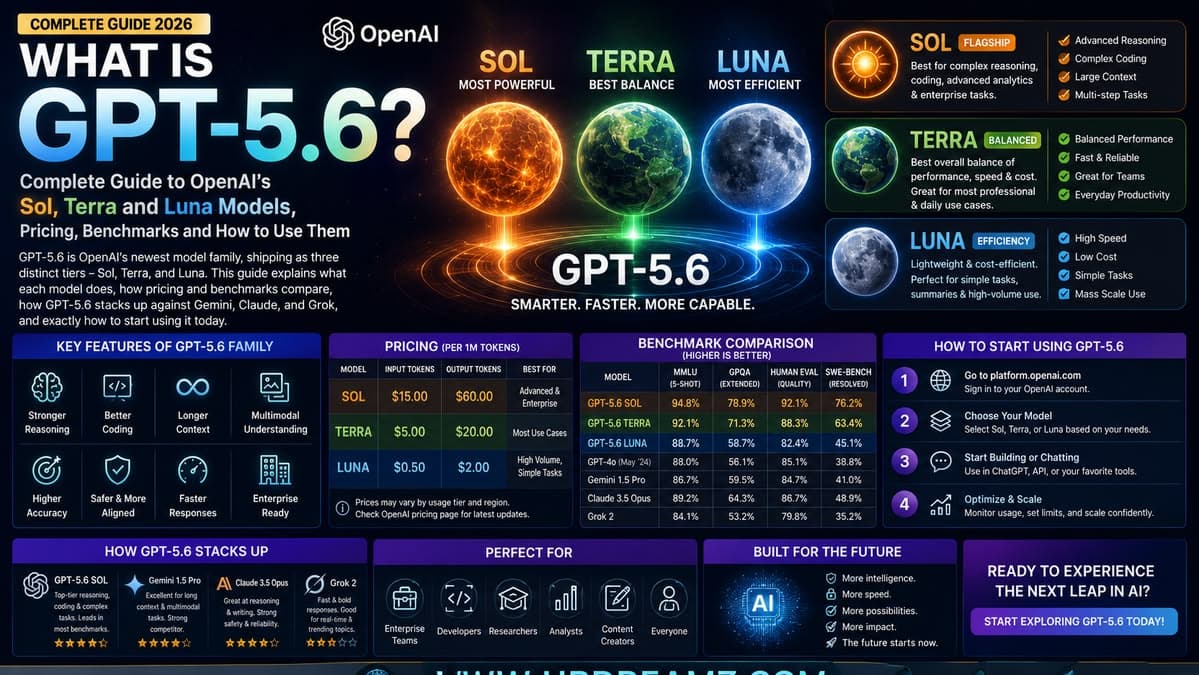
What Is GPT-5.6? Complete Guide to OpenAI's Sol, Terra and Luna Models, Pricing, Benchmarks and How to Use Them
OpenAI has just shipped its newest model generation, and for the first time, it isn't a single model at all - it's a family of three, each built for a different job. GPT-5.6 arrives as Sol, Terra, and Luna, a naming shift OpenAI designed specifically so each tier can improve on its own schedule without the entire lineup needing a fresh name every time. This guide breaks down exactly what each model does, how much it costs, how it performs against Gemini, Claude, and Grok, and how to actually start using it today.
1. What Is GPT-5.6?
GPT-5.6 is OpenAI's newest frontier model generation, released as a family of three distinct tiers rather than a single model: Sol, Terra, and Luna. Instead of one do-everything model, OpenAI built a tiered lineup so developers and everyday users can match the right balance of intelligence, speed, and cost to whatever task they're working on, spanning coding, professional knowledge work, scientific research, computer use, and cybersecurity.
2. The Sun-and-Moon Naming System Explained
OpenAI made a deliberate naming change with this release. The number, 5.6, marks the overall generation, while Sol, Terra, and Luna are meant to function as durable capability tiers - good, better, best - that can each be upgraded independently over time without renaming the entire family. This solves a real naming problem OpenAI had previously: a label like "Instant" didn't clearly signal which underlying generation a user was actually talking to, whereas a tier name paired with a generation number gives a clearer, more stable reference point going forward.
3. Timeline: From Limited Preview to Public Launch
GPT-5.6 didn't appear all at once. It first went live on June 26, 2026, as a tightly restricted preview available only to around 20 organizations that had been vetted by the US government, accessible solely through the API and Codex. On July 9, 2026, following a review by the US Commerce Department's Center for AI Standards and Innovation, OpenAI moved GPT-5.6 into a broader public rollout across ChatGPT, Codex, and the API, with availability expanding globally over roughly the following 24 hours.
4. GPT-5.6 Sol Explained
Sol is the flagship of the GPT-5.6 family - the model built for frontier reasoning, complex coding, and long-horizon agentic work where multiple steps need to be planned and executed reliably. It's the tier OpenAI leads with on nearly every published benchmark in the release, and it's the only model in the family that unlocks the new "max" reasoning effort and "ultra" multi-agent mode. Sol is also where the release's cybersecurity and biology-related capability gains are most pronounced, and it carries the highest per-token cost in the lineup as a result of that added capability.
5. GPT-5.6 Terra Explained
Terra sits in the middle of the lineup as the balanced, everyday-work model - the tier OpenAI positions as the practical default for most interactive and agentic coding tasks. According to OpenAI's own comparisons, Terra performs competitively with the previous GPT-5.5 model while costing roughly half as much, making it the natural choice for teams that want strong general performance without paying flagship-tier pricing for every request.
6. GPT-5.6 Luna Explained
Luna is the fastest and most cost-efficient model in the family, designed for simple tasks, quick summaries, everyday chat, and high-volume automated workflows where speed and low cost matter more than maximum reasoning depth. It's the tier most likely to power free-tier access and lightweight integrations, since it delivers solid performance for straightforward requests at a fraction of Sol's cost.
7. Table: Sol vs Terra vs Luna at a Glance
| Model | Best For | Relative Cost |
|---|---|---|
| Sol | Complex reasoning, advanced coding, long-running agentic work | Highest |
| Terra | Balanced everyday and agentic coding, general business use | Medium |
| Luna | Simple tasks, summaries, fast chat, high-volume automation | Lowest |
8. GPT-5.6 Pricing Explained
GPT-5.6 pricing follows the standard per-million-token model used across the industry, with each tier priced differently to reflect its capability level. As of launch, published API pricing places Sol at the top of the range, Terra in the middle, and Luna at the most affordable end, giving developers a genuine cost-versus-capability dial to turn depending on the task rather than a single fixed price for every request.
9. Table: GPT-5.6 Pricing by Tier
| Model | Input Price (per 1M tokens) | Output Price (per 1M tokens) |
|---|---|---|
| Sol | $5 | $30 |
| Terra | $2.50 | $15 |
| Luna | $1 | $6 |
These figures reflect standard API pricing at launch and, as with any actively developing product, are worth double-checking directly on OpenAI's official pricing page before budgeting a production workload, since providers periodically adjust pricing as usage patterns and infrastructure costs evolve.
10. Prompt Caching and How It Affects Cost
GPT-5.6 supports prompt caching with explicit cache breakpoints and a minimum cache life of around thirty minutes, a feature aimed squarely at developers running repeated or similar prompts. Writing to the cache costs a modest premium over the standard uncached input rate, but reading from an existing cache continues to receive a substantial discount compared to the full input price - meaning workloads that repeatedly reuse the same context, like a long system prompt or a large document, can see a meaningful reduction in overall cost once caching is properly configured.
11. Where You Can Access GPT-5.6
GPT-5.6 is available across four main surfaces: the regular ChatGPT consumer app, ChatGPT Work (OpenAI's business-focused product), Codex for coding-specific workflows, and directly through the OpenAI API for custom integrations. It has also begun rolling out inside GitHub Copilot, extending its reach directly into developers' existing coding environments rather than requiring a separate destination entirely.
12. GPT-5.6 in ChatGPT
Inside ChatGPT, Plus, Pro, Business, and Enterprise subscribers gain access to Sol at medium and higher reasoning effort levels, while Pro and Enterprise users can additionally select a dedicated "Sol Pro" option for the deepest available reasoning. This tiered access mirrors the broader philosophy behind GPT-5.6 itself: give users a dial to turn between speed, cost, and depth rather than a single fixed experience for everyone.
13. GPT-5.6 in Codex
Within ChatGPT Work and Codex specifically, free and entry-level users are directed to Terra as the default model, while paying users can choose freely among all three tiers and adjust the reasoning effort per model depending on the complexity of the coding task at hand.
14. GPT-5.6 in the API
All three tiers - Sol, Terra, and Luna - are available directly through the OpenAI API, alongside two notable additions specific to this release: Programmatic Tool Calling and a multi-agent beta, both accessed through the newer Responses API rather than the older completions-style interface.
15. GPT-5.6 in GitHub Copilot
GPT-5.6's rollout into GitHub Copilot brings all three tiers directly into the coding environment developers already use daily, letting them match a model to the job at hand - Sol for reasoning over a large, complex codebase, Terra for everyday interactive and agentic coding, and Luna for fast, lightweight assistance. Access is billed under Copilot's usage-based billing system, with Sol specifically reserved for Copilot Pro+, Business, and Enterprise plans.
16. What Is "Ultra" Mode?
Ultra is a new setting available with Sol that coordinates multiple AI agents working across parallel workstreams on a single demanding task, using four agents by default. The trade-off is straightforward: ultra mode consumes noticeably more tokens in exchange for stronger results and faster completion on genuinely complex, multi-step work, and early benchmark results show a clear, measurable improvement when ultra mode is enabled compared to Sol running alone.
17. Programmatic Tool Calling Explained
Programmatic Tool Calling allows GPT-5.6 to write and execute its own JavaScript code inside an isolated runtime environment with no network access, letting it coordinate multiple tools, run them in parallel, use loops and conditional logic, and process intermediate results before producing a final answer. In practical terms, this lets the model handle far more complex, multi-step workflows programmatically instead of relying purely on a single linear chain of tool calls.
18. Multi-Agent Beta in the Responses API
Beyond the built-in ultra mode, developers can build similar multi-agent workflows themselves using the multi-agent beta inside the Responses API, giving teams direct control over how multiple agent instances are coordinated for their own specific applications rather than relying solely on OpenAI's default ultra configuration.
19. Key Benchmarks Explained: What They Actually Measure
Before diving into specific scores, it helps to understand what these benchmarks actually test. Coding benchmarks like Terminal-Bench and SWE-Bench measure how well a model can solve real, practical software engineering tasks. Reasoning benchmarks like GPQA Diamond test deep, expert-level scientific and logical reasoning. Agentic benchmarks like Agents' Last Exam test how well a model handles long-running, multi-step professional workflows rather than single-turn question answering.
20. Terminal-Bench 2.1 Results
On Terminal-Bench 2.1, a benchmark measuring real terminal and command-line task completion, GPT-5.6 Sol scores 88.8% on its own, and jumps to 91.9% when running in ultra mode - one of the clearest published examples of ultra mode's multi-agent approach producing a measurable performance gain on a real, practical benchmark.
21. SWE-Bench Pro Results and the Audit Controversy
On SWE-Bench Pro, a benchmark built around real-world software engineering issues, Sol scores 64.6%. This result comes with an important asterisk: on July 8, 2026, OpenAI itself published an audit finding that roughly 30 percent of SWE-Bench Pro's tasks contain flaws - overly strict tests, incomplete problem descriptions, or misleading task framing - meaning scores on this specific benchmark should be read with real caution rather than treated as a precise, fully reliable measurement.
22. Artificial Analysis Coding Agent Index
On the independent Artificial Analysis Coding Agent Index, Sol scores 80, which OpenAI and multiple independent reviewers note as roughly 2.8 points ahead of Anthropic's Claude Fable 5 on this specific index - though as with any single benchmark, this shouldn't be read as a definitive, universal ranking across every possible coding task.
23. Agents' Last Exam Benchmark
Agents' Last Exam evaluates long-running, professional-grade workflows spanning 55 different fields, designed specifically to test sustained, realistic agentic performance rather than short, isolated tasks. OpenAI reports Sol achieving a new high score of 53.6 on this benchmark, its best published result in this specific evaluation category.
24. ExploitBench and Cybersecurity Performance
On ExploitBench, a cybersecurity-focused benchmark, OpenAI reports that Sol performs competitively with Anthropic's unreleased Mythos Preview model while using roughly a third of the output tokens to get there - a notable efficiency claim in a category where OpenAI says this release shows some of its most significant gains. On ExploitGym, a related benchmark built by UC Berkeley researchers, all three GPT-5.6 tiers show meaningful cybersecurity improvement as their reasoning effort increases.
25. GPQA Diamond and Reasoning Benchmarks
On GPQA Diamond, a demanding graduate-level science reasoning benchmark, Sol scores 94.6%, landing extremely close to Gemini 3.1 Pro's 94.3% on the same test - one of the tightest published margins between GPT-5.6 and its closest competitor across any major benchmark category.
26. Table: GPT-5.6 Sol Benchmark Summary
| Benchmark | What It Measures | Sol's Score |
|---|---|---|
| Terminal-Bench 2.1 | Real terminal/command-line task completion | 88.8% (91.9% with ultra) |
| SWE-Bench Pro | Real-world software engineering issues (flagged as partly flawed) | 64.6% |
| Artificial Analysis Coding Agent Index | Independent coding agent capability ranking | 80 |
| Agents' Last Exam | Long-running professional workflows across 55 fields | 53.6 |
| GPQA Diamond | Graduate-level science reasoning | 94.6% |
| ARC-AGI-3 | Abstract reasoning and novel problem-solving | 7.78% |
| BrowseComp | Complex web browsing and research tasks | 90.4% |
27. GPT-5.6 vs GPT-5.5: What Changed
The jump from GPT-5.5 to GPT-5.6 isn't just an incremental score bump - it's a structural change from a single model to a three-tier family, alongside genuinely new capabilities like Programmatic Tool Calling and ultra mode that didn't exist in the previous generation at all. OpenAI's own comparisons position Terra, the mid-tier GPT-5.6 model, as roughly matching GPT-5.5's performance while costing about half as much, meaning even a "step down" tier in the new generation can match or beat the previous flagship on a cost-adjusted basis.
28. GPT-5.6 vs Gemini 3.1 Pro
Independent comparisons published around launch show Sol clearly ahead of Gemini 3.1 Pro on several agentic and coding-focused benchmarks - for example, 80 versus 42.7 on the Artificial Analysis Coding Agent Index, and 88.8% versus 70.7% on Terminal-Bench 2.1. Gemini 3.1 Pro's own strengths lie elsewhere: it offers a considerably larger 1 million token context window, and leads specific benchmarks like WebDev Arena for front-end and web development work, making it a strong choice specifically for large-document analysis and visual, UI-heavy development tasks.
29. GPT-5.6 vs Gemini 3.5 Flash
Gemini 3.5 Flash occupies a different niche entirely - it's Google's fast, low-cost option, priced at roughly $1.50 input and $9 output per million tokens, positioned as a strong value pick for high-volume, budget-sensitive workloads rather than a direct head-to-head competitor with Sol's flagship-level reasoning depth.
30. GPT-5.6 vs Claude Models
Against Anthropic's models, the comparison shifts depending on which specific Claude model is being referenced. Claude Sonnet 5 and Sol land in roughly the same range on SWE-Bench Pro (63.2% versus 64.6%), essentially a statistical tie once the benchmark's known flaws are accounted for. Claude Fable 5, Anthropic's higher tier, leads several published coding rankings by a wider margin, including a notably higher SWE-Bench Pro score around 80%, while typically carrying a higher per-token price than Sol. Independent evaluators have also noted that Claude models tend to score well on human preference and expert-evaluation rankings specifically, a dimension that doesn't always show up in pure benchmark percentages.
31. GPT-5.6 vs Grok 4.5
Grok 4.5, xAI's competing model, has been described by several independent reviewers as a genuine cost-efficiency threat in this generation's model race - strong enough on relevant benchmarks to be a serious consideration for teams prioritizing lower cost without giving up meaningful capability, even if it doesn't top the outright highest benchmark scores that Sol or Claude Fable 5 claim in specific categories.
32. Table: GPT-5.6 vs Competitors at a Glance
| Model | Standout Strength | Approximate Pricing (input/output per 1M tokens) |
|---|---|---|
| GPT-5.6 Sol | Best full-stack coding and agentic performance | $5 / $30 |
| Claude Fable 5 | Strongest published high-end coding scorecard | $10 / $50 |
| Claude Sonnet 5 | Strong agentic reasoning at lower production cost | Lower than Fable 5 |
| Gemini 3.1 Pro | 1M token context window, strong web/UI development | Roughly $2 / $12 |
| Gemini 3.5 Flash | Best value for high-volume, budget-sensitive tasks | Roughly $1.50 / $9 |
| Grok 4.5 | Strong cost-efficiency relative to capability | Competitive, varies by use case |
33. Important Caveats About Benchmark Comparisons
No single benchmark tells the whole story, and treating any one score as a definitive ranking is a mistake independent reviewers consistently warn against. Vendor-reported scores and independently reproduced scores frequently diverge - sometimes significantly, as seen with Gemini's SWE-Bench Verified figure dropping from an 80.6% vendor-reported score to somewhere between 69.6% and 75.6% in independent testing. The SWE-Bench Pro audit controversy covered earlier is a further reminder that even widely cited benchmarks can carry real, acknowledged flaws. The most reliable approach is matching a specific benchmark to your actual real-world use case rather than chasing a single headline number.
34. GPT-5.6 for Developers
For developers specifically, GPT-5.6's biggest additions are Programmatic Tool Calling and the multi-agent Responses API beta, both aimed at handling genuinely complex, multi-step engineering workflows that a single linear model call struggles with. Combined with strong published scores on Terminal-Bench and reasonable API pricing across three tiers, it gives development teams real flexibility to match model cost to task complexity rather than defaulting to the most expensive option for every request.
35. GPT-5.6 for Coding
Sol is positioned as the strongest coding option in the family, particularly for large, complex codebases and demanding agentic coding tasks, while Terra handles everyday interactive coding at a meaningfully lower cost, and Luna covers lightweight, fast assistance for smaller coding tasks. Its integration directly into GitHub Copilot makes this tiered approach immediately usable inside an environment many developers already work in daily.
36. GPT-5.6 for Businesses and Enterprises
For businesses, GPT-5.6's tiered pricing and capability structure allows genuinely cost-conscious deployment - using Luna or Terra for routine, high-volume tasks like summarization and customer support drafting, while reserving Sol specifically for complex, high-value reasoning tasks where the added cost is clearly justified by the outcome.
37. GPT-5.6 for Everyday Chat Users
For a typical ChatGPT user, GPT-5.6 mostly shows up as Sol becoming available at different reasoning effort levels depending on subscription tier, alongside Terra and Luna handling lighter everyday requests behind the scenes - meaning most casual users will experience GPT-5.6 as a general quality and speed improvement rather than needing to actively choose between the three tiers themselves.
38. GPT-5.6 for Content Creation and Writing
For writing and content creation tasks, Terra's balance of quality and cost makes it a practical default for regular content production, while Sol's added reasoning depth is more likely to show its value on complex research-driven writing or long-form pieces requiring careful structure and argument, rather than on simpler, shorter content.
39. GPT-5.6 for Students
Students working on complex assignments involving genuine multi-step reasoning - advanced math, detailed research synthesis, or coding projects - are the group most likely to benefit from Sol's deeper reasoning capability, while Luna's speed and lower cost make it well suited to quicker, everyday study tasks like summarizing reading material or checking simple work.
40. How to Choose Between Sol, Terra and Luna
As a simple rule of thumb: choose Sol when the task involves genuinely complex reasoning, high-stakes accuracy, or long, multi-step agentic work where getting it right matters more than saving cost. Choose Terra as your everyday default for most general tasks, since it offers strong, GPT-5.5-competitive performance at roughly half the cost. Choose Luna specifically for simple, high-volume, or latency-sensitive tasks where speed and cost efficiency matter more than maximum reasoning depth.
41. How to Access GPT-5.6 Right Now
Existing ChatGPT Plus, Pro, Business, or Enterprise subscribers can access Sol directly inside the regular ChatGPT interface at the appropriate reasoning effort level, while developers can access all three tiers immediately through the OpenAI API using standard API keys, with no separate approval process required now that the model has moved past its initial restricted preview phase.
42. Export Controls and the US Government Review
GPT-5.6's initial restricted rollout to a small group of vetted organizations, followed by a formal review from the US Commerce Department's Center for AI Standards and Innovation before wider release, reflects the increasingly common pattern of frontier AI models facing government oversight before reaching full public availability, particularly given this release's notable gains in cybersecurity-related capability.
43. Is GPT-5.6 Multimodal?
GPT-5.6 continues to support multimodal capabilities consistent with recent GPT generations, including image understanding alongside text, though its headline improvements in this specific release are concentrated more heavily in agentic reasoning, coding, and tool use rather than net-new multimodal features - an area where competitors like Gemini's larger context window and native video handling currently hold a more distinct edge.
44. Strengths of GPT-5.6
- Strong, competitive performance across major coding and agentic benchmarks
- A genuinely useful three-tier structure that lets cost scale directly with task complexity
- New Programmatic Tool Calling and multi-agent capabilities not present in the prior generation
- Broad availability across ChatGPT, Codex, the API, and GitHub Copilot
- Notable efficiency gains in cybersecurity-focused benchmark performance
45. Limitations and Weaknesses of GPT-5.6
- Trails Claude Fable 5 on several published high-end coding benchmarks
- SWE-Bench Pro scores carry a known reliability caveat following OpenAI's own audit
- Smaller context window compared to Gemini 3.1 Pro's 1 million token capacity
- Ultra mode's stronger results come at a real, additional token cost
- As with any newly launched model, pricing and availability details may continue to shift after launch
46. The Broader AI Model Naming Shift
GPT-5.6's move to a tiered naming system reflects a broader pattern spreading across the AI industry, where multiple major labs are increasingly separating a numbered "generation" from a named "capability tier," rather than releasing a single flagship model per release cycle. This approach gives companies more flexibility to update individual tiers independently while giving users a more stable mental model of what each name actually represents.
47. What This Means for the Future of AI Models
As frontier labs increasingly ship tiered families rather than single models, the practical skill for developers and businesses is shifting from simply "picking the best model" toward building routing logic that sends each specific task to the most cost-appropriate tier or provider - a pattern several independent reviewers now describe as the emerging best practice, rather than betting entirely on one flagship model for every use case.
48. Common Questions and Misconceptions
A common misconception is that "GPT-5.6" refers to a single model the way earlier GPT generations did - in reality, it's a family of three, and asking "which GPT-5.6 model" someone means is now a genuinely meaningful question. Another common point of confusion is assuming all three tiers are equally available everywhere at once; in practice, access varies by product surface and subscription level, so it's worth checking exactly which tier a given plan actually unlocks before assuming full access.
49. Frequently Asked Questions
What is GPT-5.6?
GPT-5.6 is OpenAI's newest model generation, released as three distinct tiers - Sol, Terra, and Luna - rather than a single model, each built for a different balance of intelligence, speed, and cost.
What is the difference between Sol, Terra, and Luna?
Sol is the flagship model for complex reasoning and advanced coding, Terra is the balanced everyday option, and Luna is the fastest, most cost-efficient tier for simple tasks.
How much does GPT-5.6 cost?
At launch, published API pricing places Sol at $5 input / $30 output per million tokens, Terra at $2.50 / $15, and Luna at $1 / $6.
Is GPT-5.6 better than Gemini or Claude?
It depends on the specific task - Sol leads several coding and agentic benchmarks, Claude Fable 5 leads on some high-end coding scores, and Gemini 3.1 Pro offers a much larger context window, so the "best" choice depends on what you actually need it for.
How do I access GPT-5.6?
Through ChatGPT (Plus, Pro, Business, or Enterprise plans), ChatGPT Work, Codex, the OpenAI API, or GitHub Copilot, depending on which tier and plan you have.
Is GPT-5.6 available for free?
Free and entry-level users generally get access to Terra in Codex-related products, while full access across all three tiers typically requires a paid plan or API usage.
50. Conclusion
GPT-5.6 represents a genuine structural shift in how OpenAI ships models - not a single upgrade, but a full family built around matching capability to cost. Sol pushes the frontier on complex reasoning and agentic coding, Terra delivers strong, GPT-5.5-competitive performance at roughly half the price, and Luna covers everyday tasks fast and cheap. Whichever tier fits your specific need, GPT-5.6 arrives in a genuinely competitive AI landscape alongside Gemini, Claude, and Grok, where no single model wins every benchmark - making the smartest strategy, as it increasingly is across this entire industry, choosing the right tool for the specific job rather than committing to one model for everything.