Vidkun Quisling: The Most Infamous Traitor in History Who Sold Norway to Hitler
Learn the shocking story of Vidkun Quisling, the Norwegian politician whose betrayal during World War II became so infamous that his name turned into a dictionary synonym for traitor. Discover how Quisling helped Hitler invade Norway and changed history forever.
1. A Name That Became a Curse
History has produced countless traitors — men and women who betrayed their nations for wealth, power, or vengeance. Throughout the long record of human conflict, there have always been figures willing to sell out their own people, their own armies, and their own homelands for personal gain. But only one name among them has crossed the boundary from biography into language itself, embedding itself permanently into how English speakers across the world describe the deepest form of betrayal a human being can commit. Open any English dictionary today and search for the word "quisling," and you will find a definition that has nothing to do with the man's actual life story and everything to do with what he came to represent: a collaborator, a puppet ruler installed by a foreign power, a traitor who sells out his own people for personal gain.
This is the story of Vidkun Quisling, the Norwegian politician whose name became so synonymous with betrayal that the word entered common usage as a general term for a traitor who collaborates with an occupying government. Locale Norway, the era World War II, and the consequence permanent: his treachery was so complete, so calculated, and so consequential that it reshaped the English language itself. Few historical figures can claim to have altered a language through the sheer weight of their actions. Benedict Arnold remains America's most famous traitor, yet "Arnold" never became a verb or a noun describing treachery in general. Quisling achieved something rarer and darker — his very name dissolved into the vocabulary of betrayal itself.
But to understand how a man's surname became a permanent insult, we have to understand the man — and the story is far stranger, and far more disturbing, than most people realize. It is not a story about a career criminal or a man raised in deprivation and resentment. It is the story of a celebrated intellectual, a humanitarian hero, a man whose early life seemed to promise greatness of the most admirable kind. Understanding how that promise curdled into one of history's most notorious betrayals requires examining not just what Quisling did, but the psychological and ideological forces that drove him to do it.
Quisling's life did not begin in darkness. It began with extraordinary promise. And that is precisely what makes his fall into infamy one of the most chilling case studies in how unchecked ambition, wounded pride, and ideological fanaticism can transform a gifted individual into one of history's most reviled figures. His is a cautionary tale that transcends its specific historical moment — a warning about what happens when intelligence is divorced from humility, and when the rejection of a man's political ambitions by the democratic will of his own people is reinterpreted, in his own mind, not as a legitimate verdict but as an injustice requiring violent correction.
2. The Brilliant Beginning: A Hero in the Making
Vidkun Abraham Lauritz Jonssøn Quisling was born on July 18, 1887, in Fyresdal, a small town in southern Norway. He did not come from poverty, criminality, or any background that might predict the path he would eventually take. Quite the opposite — he was born into a respected, devout, and well-educated family. His father was a senior pastor in the church, a man whose position commanded deep respect throughout the community. The household young Vidkun grew up in was one defined by religious discipline, intellectual seriousness, and an expectation of moral rectitude. From childhood, Vidkun displayed an intelligence that set him apart from his peers — the kind of precocious academic ability that teachers and relatives alike recognized as exceptional even before he reached adulthood.
When the young Quisling entered Norway's military academy, he did not merely perform well — he shattered records that had stood for years. His examination scores were so extraordinarily high that he became something of a legend within the institution, a benchmark against which future cadets would be measured for decades afterward. Teachers, fellow students, and Norwegian military leadership alike believed they were watching the early career of a man destined to become the country's greatest military commander — a figure who would stand as an impenetrable wall protecting Norway's sovereignty against any future threat. This was not idle flattery; Quisling's combination of academic brilliance, strategic thinking, and disciplined bearing genuinely marked him as one of the most promising young officers Norway had produced in a generation.
For a time, that promise seemed to be fulfilling itself in the most admirable way imaginable. When a catastrophic famine struck Russia in the early 1920s — one of the great humanitarian disasters of the early twentieth century, claiming millions of lives across the Volga region and beyond — Quisling worked alongside Norway's celebrated humanitarian Fridtjof Nansen, the polar explorer and statesman who had taken on the role of organizing international relief efforts. Together, they helped save millions of Russians from starvation through one of the most significant humanitarian relief operations of the era. This humanitarian work earned him genuine, well-deserved acclaim. He was treated as a hero, not merely within Norway but in international diplomatic and humanitarian circles. Medals were pinned to his chest. The Norwegian public, and indeed much of the international community, viewed him as a man of conscience and competence — a rare combination of brilliant strategist and compassionate humanitarian.
But beneath this celebrated public image, something far more dangerous was quietly taking root, invisible to the colleagues, mentors, and admirers who saw only the decorated officer and humanitarian. Hidden behind the medals and the academic accolades was a man developing a deeply arrogant, self-aggrandizing worldview — one that held democracy in contempt as a system designed for fools, and that viewed ordinary citizens as little more than a flock of sheep requiring a firm and authoritarian shepherd. This was not a passing political opinion or an intellectual flirtation with alternative governing philosophies; it was, by all later accounts, a deeply held conviction that grew more entrenched with every accolade he received. And in Quisling's own mind, there was no question about who that shepherd ought to be. He had, after all, spent his entire life being told he was exceptional. It was a short and dangerous step from believing himself exceptional to believing himself entitled to rule.
3. Defense Minister: The First Crack in the Mask
As the years passed, Quisling moved from military distinction into Norwegian politics, eventually rising to the position of Minister of Defense. This appointment came during a period of significant political unrest across Europe. The Russian Revolution had already toppled the Tsarist order and installed a communist government, and Quisling lived in a state of near-constant anxiety that a similar workers' uprising might take hold in Norway. His experience working in Russia during the famine relief operation had brought him into direct contact with the chaos and violence of the early Soviet state, and this exposure seems to have hardened into a lasting, almost obsessive fear of communism — a fear that would shape virtually every political decision he made for the remainder of his career.
As Defense Minister, his decisions reflected this fear in increasingly harsh and authoritarian ways. When Norwegian laborers organized strikes to demand better working conditions and rights — a perfectly legitimate form of political expression within any functioning democracy — Quisling responded not with negotiation but with threats — going so far as to threaten to deploy the military against unarmed striking workers. This was not a measured response to a genuine security threat; it was the reflexive overreaction of a man who viewed any organized dissent as the first stage of revolutionary collapse. These authoritarian impulses, repeated across his tenure, ignited intense public anger. The nation that had once celebrated him as a humanitarian hero now increasingly viewed him as an arrogant and oppressive politician, disconnected from the people he was meant to serve. The contrast could not have been starker: the same man who had helped feed starving Russian peasants was now threatening to turn his own country's army against its own working class.
The backlash eventually became severe enough that Quisling was removed from his position as Defense Minister. For a man who had spent his entire life believing himself destined for greatness — convinced, in fact, that he had been born specifically to rule — this dismissal represented a devastating blow to his sense of self. He had imagined himself as Norway's savior, a man uniquely qualified to lead the nation through any crisis. Instead, the democratic process he despised had thrown him out through entirely ordinary political mechanisms — a vote of confidence, a cabinet reshuffling, the routine churn of parliamentary politics that he had always considered beneath a man of his caliber. This humiliation planted a poison within him whose consequences the entire Norwegian nation would eventually be forced to endure. Rather than reflecting on what his removal might say about his own judgment or temperament, Quisling internalized the experience as further proof that Norway's democratic system was fundamentally broken — incapable of recognizing or rewarding true merit.
4. Building a Fascist Movement: Nasjonal Samling
Following his removal from government, Quisling did not retreat from public life. Instead, drawing direct inspiration from Adolf Hitler in Germany and Benito Mussolini in Italy, he founded his own fascist political party in Norway: Nasjonal Samling, meaning "National Union" or "National Unity." A former military officer and defense minister, Quisling grew to despise Western democracy, and he was heavily influenced by Nazi racial and political theories. The party, founded in 1933 — the same year Hitler seized total power in Germany — was conceived as Norway's answer to the fascist movements then sweeping across the continent, and Quisling positioned himself unambiguously as its supreme leader.
The party's structure and aesthetics mirrored the fascist movements he admired with remarkable precision. He outfitted his followers in uniforms reminiscent of the Brownshirts and Blackshirts of Germany and Italy. He invented a distinctive salute for the movement, modeled deliberately on the gestures that had become synonymous with fascist political theater across Europe. He organized marches through the streets of Norwegian cities, attempting to project an image of disciplined, unstoppable momentum — the same visual language of mass mobilization that Hitler and Mussolini had used so effectively to project an aura of inevitability around their respective movements. He actively encouraged Norwegian citizens to abandon their faith in parliamentary democracy entirely, urging them to dissolve their own government and accept him as their absolute leader, a Führer figure for the Norwegian people.
This was not a fringe gesture or a brief political experiment — it was a serious, sustained attempt to seize power through the cultivation of a domestic fascist following, built on the explicit model of the totalitarian regimes rising elsewhere in Europe. Quisling poured years of effort, organizational resources, and personal conviction into building Nasjonal Samling into a genuine political force, fully believing that the same currents of nationalist and authoritarian sentiment that had propelled Hitler and Mussolini to power could be harnessed in Norway as well.
5. Rejected at the Ballot Box
Despite his confidence, organization, and the financial and ideological backing of a genuine political party, Quisling's fascist movement met with resounding rejection from the Norwegian electorate. Despite having almost zero popular support in Norway, his party never won a parliamentary seat. Election after election, Nasjonal Samling failed to secure a single seat in the Norwegian parliament. The Norwegian people, by and large politically literate and deeply committed to their democratic traditions, simply refused to embrace him.
This repeated, total rejection at the ballot box represented the second and arguably more shattering blow to Quisling's ego. It was one thing to be removed from a ministerial post by political maneuvering; it was another thing entirely to be rejected, election after election, by the explicit will of the people he believed himself destined to rule. This was the turning point at which Quisling's already distorted worldview curdled into something far more dangerous. If the Norwegian people would not recognize his right to lead through legitimate democratic means, he resolved that he would seize that position through force — even if it meant making a pact with the most destructive figure in Europe.
6. The Secret Meetings in Berlin
By 1939, Europe stood on the edge of catastrophe. In December 1939, the fascist Norwegian politician traveled to Berlin from Oslo for a secret meeting with Adolf Hitler. Germany had already invaded Poland, and the continent braced for what would become the Second World War. Norway, for its part, had declared a position of strict neutrality, believing that by refusing to take sides in the unfolding conflict, it could avoid becoming a target of German aggression. The Norwegian King and government operated on the assumption that neutrality alone would be sufficient protection — a reasonable enough assumption given Norway's historical position outside the great power conflicts of the continent, and given that Hitler's immediate strategic focus at the time lay elsewhere.
They had no idea that their own former Defense Minister was already engaged in secret negotiations with the German high command and figures close to Hitler himself. Quisling traveled covertly to Berlin to make his case directly to the Nazi leadership — a former cabinet minister of a neutral country, working in the shadows to convince a foreign dictator to invade his own homeland. The journey itself was an act of staggering audacity: a Norwegian political figure, still publicly operating within his own country's political system, slipping across borders to negotiate the violent subjugation of that very country with the most dangerous regime in Europe. There was no ambiguity in what he was attempting. This was not diplomacy, espionage in service of his nation, or even ordinary political maneuvering. It was the deliberate solicitation of a foreign invasion of his own homeland, undertaken in pursuit of personal power that his own countrymen had repeatedly and emphatically refused to grant him.
7. The Pitch That Changed History
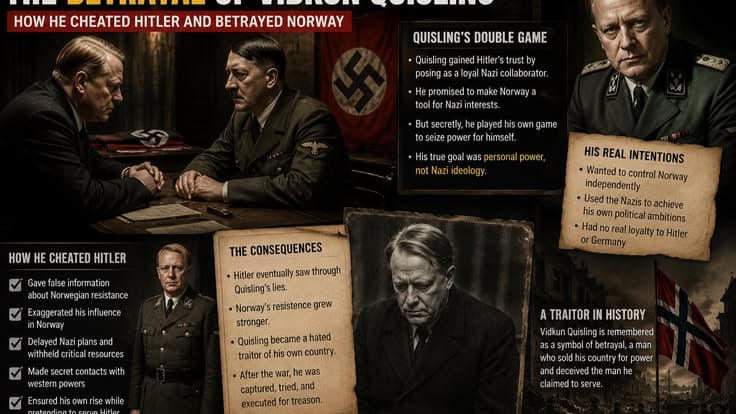
Hitler, according to multiple historical accounts, initially had little strategic interest in invading Norway. The German war machine in late 1939 was focused on consolidating its conquest of Poland and preparing for the campaigns that would follow in Western Europe. Scandinavia, with its formal neutrality and relatively modest strategic value, did not feature prominently in early German planning. It was Quisling who supplied the argument that shifted German calculations. He warned Hitler that if Germany did not seize Norway first, Britain would establish military bases along the Norwegian coastline, permanently severing Germany's access to crucial sea routes and strangling its naval capabilities. This was a carefully constructed strategic argument, designed specifically to appeal to German anxieties about British naval dominance and the vulnerability of German shipping routes to Scandinavian iron ore, which Germany's war industry depended upon heavily.
This strategic argument caught Hitler's attention — but a naval invasion of any country, particularly one with Norway's rugged coastline, formidable coastal fortifications, and modern artillery installations, was no simple undertaking. Norway's geography presented genuine military challenges: a long, fjord-indented coastline studded with defensive positions, narrow sea channels that could be devastatingly defended by well-placed artillery, and a population that, while small, possessed a long martial tradition. An invasion attempted against a fully alert and resistant Norwegian military could have proven costly and uncertain for Germany.
It was at this point that Quisling crossed from political opportunism into outright military treason. As a former Defense Minister, he possessed intimate, detailed knowledge of Norway's most sensitive military secrets — exact troop deployments, the specific vulnerabilities of coastal fortresses, weapons inventories, and defensive strategies. This was not generalized political commentary or strategic speculation; it was classified, specific, operational military intelligence of the kind that any nation would consider an absolute matter of highest security. He compiled this classified information and delivered it directly into German hands, offering to neutralize Norwegian military resistance from within in exchange for being installed as Norway's prime minister once the German occupation was complete. He was, in effect, offering to act as a fifth column within his own nation's defense establishment — using contacts, sympathizers, and his own residual influence within military and administrative circles to sabotage Norway's ability to defend itself, in direct exchange for a personal political reward.
It was an offer that reportedly startled even Hitler himself — a man willing to dismantle his own nation's defenses purely to secure a position of personal power. Hitler approved the plan. The military operation, codenamed Operation Weserübung, moved forward. The machinery of invasion had been set in motion, and it had been set in motion not primarily by German ambition, but by the calculated betrayal of a Norwegian citizen who had once sworn to defend his country. This is perhaps the single most chilling detail of the entire episode: Norway was not invaded primarily because Hitler had identified it as a strategic necessity from the outset, but because one of its own former defense ministers actively campaigned, lobbied, and supplied intelligence to make that invasion happen — and to make it succeed.
8. The Night of the Invasion
In the early hours of April 9, 1940, German warships moved silently through the dark waters of the North Sea toward Oslo, Norway's capital. Thousands of German soldiers, equipped with modern weaponry, approached under cover of darkness. The Norwegian population slept, unaware of what was unfolding off their coastline. The King remained in his palace with no knowledge of the impending attack. The sentries stationed at coastal fortresses had no idea how rapidly catastrophe was approaching. Across the country, ordinary Norwegians went to sleep that night believing, as their government had assured them for months, that their nation's careful neutrality would continue to shield them from the war consuming the rest of Europe.
Yet inside a luxury hotel room in Oslo, the lights remained on through the night. Vidkun Quisling stood at the window, gazing out toward the sea, watching for the German ships that were coming to crush his own nation — ships he had personally helped summon. According to accounts of that night, his expression carried an unsettling mixture of anticipation and triumph, the look of a man watching the long-awaited fulfillment of his ambitions, even as that fulfillment required the violent subjugation of his own people. It is difficult to imagine a more morally inverted scene in modern European history: a man standing in quiet vigil, waiting not for rescue or salvation but for the armed forces of a foreign power to deliver him the position his own countrymen had refused to give him through legitimate means.
One of the most haunting questions historians and the Norwegian public have asked ever since concerns the Oslofjord — the narrow sea channel leading to the capital, lined with powerful coastal artillery specifically designed to repel exactly this kind of naval incursion. Why did these guns not open fire on the approaching German fleet as it sailed through this narrow, heavily defended passage? Norway possessed genuinely formidable coastal defenses, and under ordinary circumstances, a fleet attempting to force its way through such a narrow, fortified channel could have suffered catastrophic losses. Through networks of sympathizers and operatives loyal to Quisling embedded within the Norwegian military and administrative structure, enough confusion, delay, and sabotage had reportedly been introduced into the chain of command that the nation's own coastal defenses failed to respond with the force and speed they should have. The mechanisms of betrayal that Quisling had cultivated for years — within the military, within the bureaucracy, within sympathetic officer corps connections — bore their poisoned fruit at precisely the moment Norway needed its defenses to function flawlessly.
When Germany invaded on April 9, 1940, Quisling broadcast a radio coup declaring himself prime minister, expecting to rule a sovereign, Nazi-allied state. As German forces moved through Oslo, Quisling seized control of the national radio broadcasting apparatus and delivered an announcement to the shocked Norwegian public — declaring that the legitimate government had been deposed and that he, Vidkun Quisling, was now the rightful leader of Norway. It was a moment of staggering audacity — a man seizing a national radio station to announce, to his own stunned and terrified countrymen, that he was now their leader, installed not by their vote but by the invading army of a foreign dictator. The King and the legitimate government, refusing to accept this self-declared coup, fled Oslo and eventually Norway itself, continuing to lead the nation's resistance and government-in-exile from London for the duration of the war.
9. Minister President: A Puppet on a Throne
Quisling's vision of himself as Norway's absolute ruler, however, did not unfold as he had imagined. Though Hitler eventually appointed him "Minister President," he remained a hated, powerless puppet who helped the Nazis carry out brutal policies, including the deportation of Norwegian Jews to death camps. The position he had betrayed his country to obtain turned out to be largely ceremonial — real authority over occupied Norway remained firmly in German hands, exercised through a German Reichskommissar and the broader apparatus of Nazi occupation administration. Quisling functioned less as a head of state and more as an instrument through which the Nazi occupation implemented its policies, including some of its most horrific. The throne he had imagined himself ascending to turned out to be little more than a decorated chair, positioned for German propaganda purposes but stripped of any genuine independent authority.
For five years, from 1942 to 1945, Quisling presided over a puppet administration that enforced Nazi directives on Norwegian soil. His name became inseparably linked with collaboration and complicity in some of the regime's worst atrocities, including actions targeting Norway's Jewish population, who were rounded up and deported to concentration and death camps under policies that Quisling's administration helped implement and enforce. The hero of the Russian famine relief effort — a man once celebrated for saving lives on a massive humanitarian scale — had become the chief domestic instrument of a foreign occupying power's brutality against his own people, including some of the most vulnerable members of Norwegian society. Throughout this period, Norway's resistance movement grew increasingly active, sabotaging German operations and gathering intelligence for the Allies, while ordinary Norwegians overwhelmingly viewed Quisling's government with contempt, viewing him not as a legitimate national leader but as exactly what he was: a German-installed collaborator presiding over the occupation of his own homeland.
10. Downfall, Trial, and Execution
The war that Quisling had helped unleash upon his homeland eventually turned against the power he had served. As Allied forces closed in and Nazi Germany collapsed in 1945, the Norwegian resistance and returning legitimate authorities moved swiftly to hold collaborators accountable. In August and September of 1945, the nine-judge high court of Oslo held the trial of Vidkun Quisling for treason and eight other charges.
The trial proceedings drew immense attention, both within Norway and internationally, as the nation sought to formally reckon with the betrayal that had cost it five years of occupation, suffering, and loss. Quisling was found guilty of high treason. He was sentenced to death and executed by firing squad in October 1945. According to historical accounts, his final words insisted on his own innocence — a final, almost surreal display of the same self-belief and detachment from reality that had characterized his entire downfall.
11. The Word That Outlived the Man
What makes Vidkun Quisling's story so uniquely significant in the history of betrayal is not merely the scale of his treachery, but its linguistic afterlife. "Quisling" became a general term for a traitor who collaborates with an occupying government. Few individuals in recorded history have had their own surname transformed into a permanent fixture of everyday language — a word stripped of its original biographical context and repurposed as shorthand for the deepest possible betrayal of one's own nation.
This linguistic legacy means that Quisling's name continues to surface in political discourse, journalism, and historical analysis whenever discussions turn to collaboration, treason, or the installation of puppet governments by occupying powers. Decades after his execution, his name remains instantly recognizable as an insult of the highest order — proof that the consequences of his actions extended far beyond the five years of his puppet government, reshaping how English speakers around the world describe betrayal itself.
12. What Quisling's Story Teaches Us
The story of Vidkun Quisling resists easy categorization as a simple tale of greed or villainy. What makes it genuinely disturbing is the trajectory it reveals — a man of extraordinary natural gifts, raised in a respected and devout household, celebrated as a humanitarian hero in his early adulthood, who nonetheless harbored a corrosive belief in his own destined supremacy over ordinary democratic processes.
His path to infamy was not a single decision but an accumulating series of wounds to his pride. The humiliation of being removed as Defense Minister. The repeated, total rejection of his fascist party at the ballot box. Each setback did not humble him but instead deepened his conviction that the fault lay not with his ideas but with a public too foolish to recognize his rightful authority. It was this toxic combination of wounded ego and genuine ideological fanaticism — not mere financial corruption — that ultimately led him to conclude that handing his own country's defense secrets to a foreign dictator was an acceptable price for personal power.
Quisling's case stands as a stark historical warning about what happens when intelligence and ambition are not anchored by humility, accountability, or genuine respect for the will of one's fellow citizens. It demonstrates how a democratic rejection, rather than being accepted as the verdict of the people, can instead be reinterpreted by a sufficiently self-deluded individual as evidence that democracy itself must be destroyed.
13. Conclusion
Vidkun Quisling began life with every advantage that might have produced a genuine national hero — intellect, education, respectability, and even a record of real humanitarian achievement. He ended it standing before a firing squad, convicted of the highest treason a nation can recognize, having delivered his own country's military secrets into the hands of the regime that would occupy and brutalize it for five years.
His name endures not in monuments or memorials, but in dictionaries — a permanent linguistic monument to the specific danger of unchecked ambition married to ideological conviction. Every time the word "quisling" is used today to describe a modern-day collaborator or puppet leader installed by a foreign power, it carries forward the memory of April 1940, when one man's wounded pride and totalitarian fantasies opened the door for an entire nation's tragedy.
It remains one of history's starkest illustrations of how the thirst for power, when it festers long enough inside a brilliant but unaccountable mind, can transform a celebrated hero into history's most enduring synonym for betrayal.