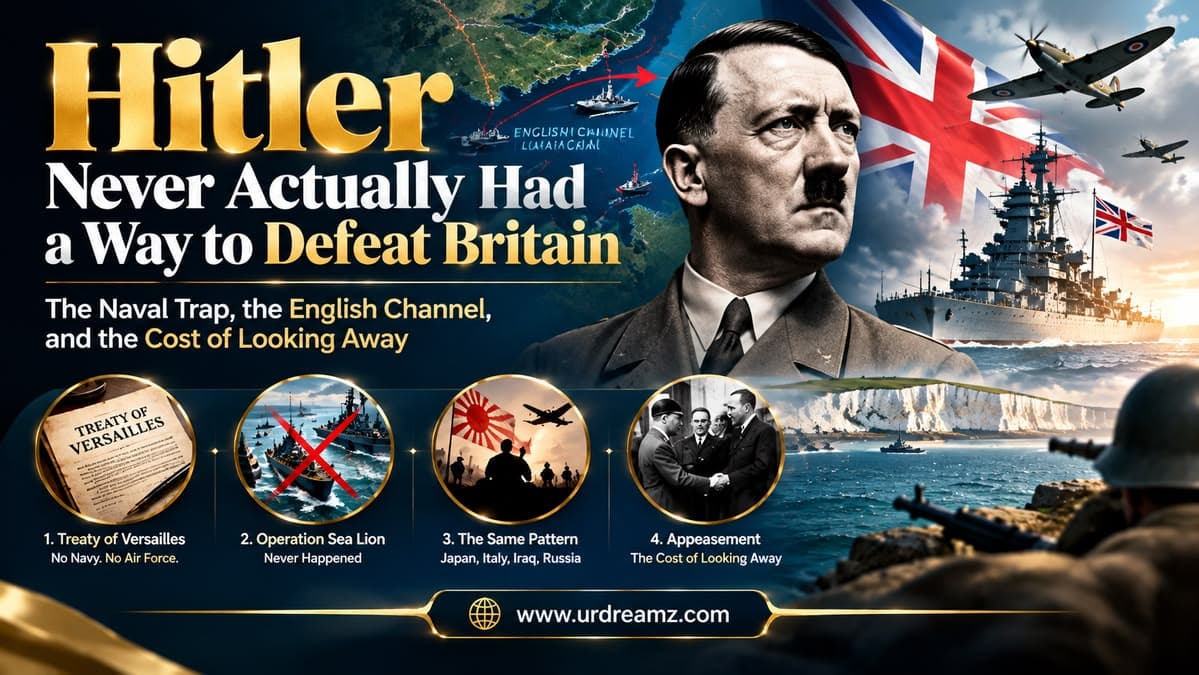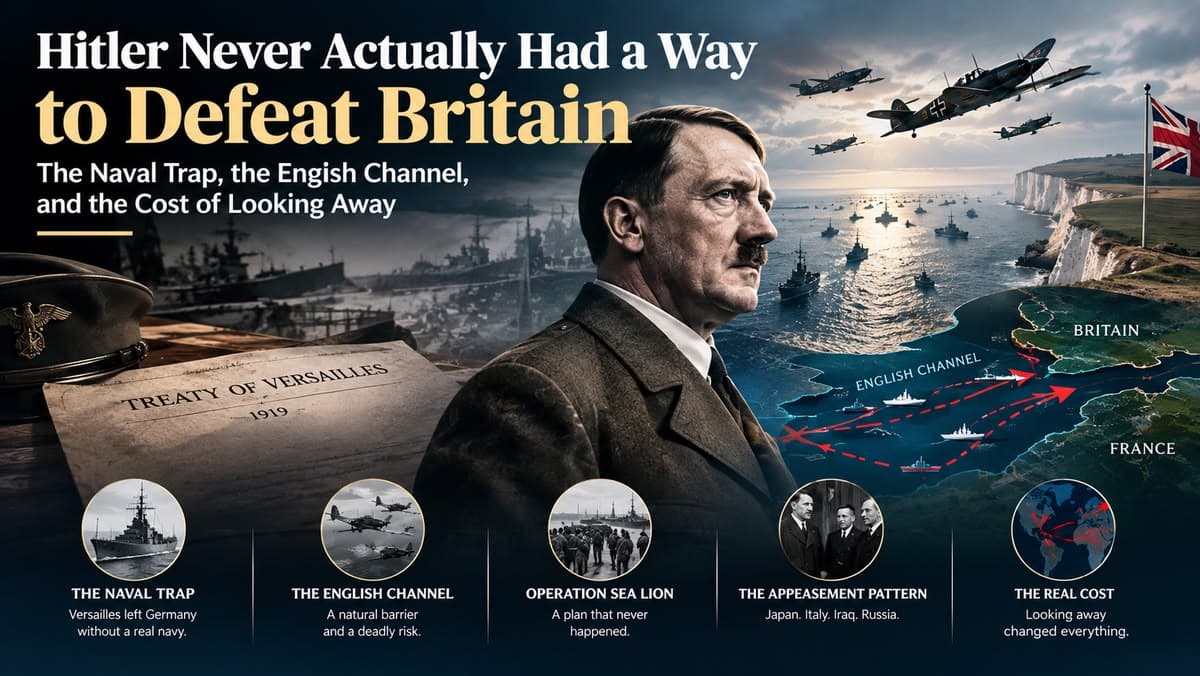
Hitler Never Actually Had a Way to Defeat Britain: The Naval Trap, the English Channel, and the Cost of Looking Away
There's a question that sits at the center of the Second World War that doesn't get asked often enough: what was Adolf Hitler's actual, practical plan for defeating Britain? Not intimidating it. Not bombing its cities. Actually defeating it, the way Germany defeated France in six weeks in 1940. The honest answer, once you look closely at the numbers, the treaties, and the geography, is that no such plan ever really existed in any workable form. Britain sat behind the English Channel, protected by the largest navy on Earth, while Germany, thanks to a peace treaty signed two decades earlier, had spent most of the 1920s and 1930s with virtually no navy and no air force at all. This article walks through exactly why that gap existed, why Hitler believed intimidation could substitute for actual invasion, and why several other moments in history follow the exact same pattern: an aggressive power testing the world's patience, growing bolder each time nobody pushes back, until the cost of finally responding becomes far greater than it would have been at the very first violation.
The Treaty That Left Germany Without a Navy
To understand Hitler's naval problem, you have to go back to 1919 and the Treaty of Versailles, the peace settlement that ended the First World War. The treaty didn't just take away German territory and impose war reparations. It systematically dismantled Germany's ability to ever again build a serious military, and the naval restrictions were especially severe, reflecting the Allied powers' particular fear of a revived German fleet after four years of costly naval warfare in the North Sea and the Atlantic.
Under Articles 181 through 197 of the treaty, Germany was permitted to keep just six aging battleships, six light cruisers, twelve destroyers, and twelve torpedo boats in active service, a token coastal defense force rather than anything resembling a real navy. Submarines were banned outright, with the treaty specifically stating that Germany could not construct or acquire a single submarine, even for commercial purposes. Naval personnel were capped at fifteen thousand people total, officers and sailors combined. And under Articles 198 through 202, Germany was banned from having any air force whatsoever, with a narrow exception for up to one hundred unarmed seaplanes used only for minesweeping. Military aviation, in any real sense, simply did not legally exist in Germany for over a decade.
| Category | Treaty Limit | What Was Banned Outright |
|---|---|---|
| Battleships | 6 (older Deutschland-class only) | Any modern dreadnought-style battleship |
| Light cruisers | 6 | Heavy cruisers, battlecruisers |
| Destroyers | 12 | — |
| Torpedo boats | 12 | — |
| Submarines | 0 | All submarines, even for commercial use |
| Naval personnel | 15,000 total | Any larger standing naval force |
| Military aircraft | 0 (100 unarmed seaplanes for minesweeping only) | Any armed aircraft, bombers, fighters, or Zeppelins |
The 1935 Agreement That Loosened the Leash, But Not Enough
By the mid-1930s, Hitler had already begun rearming Germany in open defiance of the treaty, and rather than confront him over it, Britain chose to formalize the violation instead. The Anglo-German Naval Agreement of June 1935 allowed Germany to build a navy up to thirty-five percent of the total tonnage of the British Commonwealth's naval forces, with submarines permitted up to forty-five percent of British submarine tonnage. On paper, this looked like a reasonable compromise. In practice, it meant Germany was still legally locked into permanent, significant naval inferiority, by British agreement, at the exact moment Hitler was already planning for future conflict.
Germany's own naval command, led by Admiral Erich Raeder, wanted far more than this agreement allowed. Internal planning documents from the period show Raeder pushing for a force of eight battleships instead of the treaty's original six, three aircraft carriers that hadn't even been provided for under Versailles, eight cruisers, forty-eight destroyers instead of twelve, and seventy-two submarines, a fleet that would have represented a serious challenge to British naval dominance. But even this ambitious internal wishlist remained a fraction of what the Royal Navy already possessed, and by the time war actually broke out in 1939, Germany hadn't even finished building the more modest fleet the 1935 agreement technically allowed.
The Z Plan: A Navy Designed for a War That Started Too Early
In January 1939, with war clouds already gathering, Hitler approved an ambitious naval construction program known as Plan Z, aiming to build a German fleet powerful enough to genuinely challenge British naval supremacy by the mid-1940s. The plan called for ten battleships, four aircraft carriers, and dozens of supporting cruisers, destroyers, and submarines, a fleet that might have finally given Germany a credible path to contesting British control of the seas.
The catch was timing. Plan Z was designed with a completion target of 1944 to 1948. War broke out in September 1939, barely eight months after the plan was approved, and only a small fraction of it had actually been built. When German forces invaded Poland, the Kriegsmarine possessed exactly two operational battleships, the Scharnhorst and Gneisenau, both technically classified as battlecruisers with smaller guns than a true battleship. The Bismarck and Tirpitz, Germany's two genuine modern battleships, weren't even commissioned yet; they entered service in 1940 and 1941 respectively, and Germany never came close to fielding a fleet with the aircraft carriers, cruiser squadrons, or overall scale that Plan Z had envisioned. Hitler started the war roughly a decade before his own navy would have been ready to fight the kind of war his naval planners actually wanted.
Royal Navy vs. Kriegsmarine: The Gap in 1939
Approximate operational capital ship strength at the outbreak of war
Figures are approximate, drawn from general naval historical records of September 1939. The Royal Navy was, by a wide margin, the largest navy on Earth at this point, while Germany's fleet remained a small fraction of Plan Z's intended size.
So What Was Hitler's Actual Plan for Britain?
This is the heart of the question you raised, and it deserves a direct answer: Hitler never had a workable military plan to conquer Britain in the way he conquered Poland or France. What he had instead was a plan code-named Operation Sea Lion, a proposed amphibious invasion across the English Channel, and that plan had one absolute, non-negotiable prerequisite: air superiority over the Channel and southern England, so that the Royal Navy couldn't simply annihilate German invasion barges from the sea while the Luftwaffe watched helplessly.
To get that air superiority, Germany needed to win the Battle of Britain, the sustained air campaign fought over the skies of southern England from July through October 1940. It didn't happen. Fighter Command, aided by radar, a well-organized command and control system, and pilots operating over their own home territory where downed airmen could often return to fight again, ground down the Luftwaffe faster than Germany could sustainably replace losses. By the time the battle wound down in the autumn of 1940, Hitler quietly postponed Sea Lion indefinitely. It was never formally cancelled. It simply never happened, because the actual military conditions required to attempt it were never met.
| Side | Approx. Aircraft Lost | Key Advantage |
|---|---|---|
| RAF Fighter Command | ~1,500 | Radar network, fighting over home territory, shorter supply lines |
| Luftwaffe | ~1,800–1,900 | Larger overall aircraft numbers, experienced bomber crews |
Plan B: Bomb Them Until They Ask for Peace
With invasion off the table, Hitler pivoted to exactly the strategy you described: intimidation through devastation rather than conquest. This was the logic behind the Blitz, the sustained bombing campaign against London and other British cities that ran from September 1940 into May 1941. The theory, shared by several air power strategists of the era, was that sufficient bombing of civilian morale could break a nation's will to continue fighting, forcing its government to negotiate rather than endure endless destruction.
It didn't work, and in hindsight, the reasons are fairly well understood. Civilian morale under bombing tends to hold up far better than prewar theorists assumed, often calcifying into stubborn resistance rather than collapsing into surrender. Winston Churchill's government, having already replaced the more conciliatory Neville Chamberlain, was ideologically and politically committed to continued resistance regardless of the human cost. And crucially, Britain's essential war production, while damaged and disrupted, was never crippled to the point of forcing capitulation. Hitler's entire theory of victory through terror bombing rested on an assumption about human and political behavior that simply turned out to be wrong.
Why He Turned East Instead
This is where your observation about Operation Barbarossa becomes genuinely important to unpack. In June 1941, with Britain unbeaten but also unbeatable through any plan Germany actually possessed, Hitler launched an invasion of the Soviet Union, opening a second, enormous front while the war in the west remained completely unresolved. On the surface, this looks like an almost inexplicable strategic gamble, and in many ways, it was.
Part of the explanation is ideological. Hitler had written about seizing "living space," or Lebensraum, in the east since the 1920s, and viewed the destruction of the Soviet state as both a racial and political necessity central to his entire worldview, not merely a wartime tactical decision. But part of the explanation is also strategic miscalculation. German military intelligence significantly underestimated the Soviet Union's true reserves of manpower and its capacity to relocate industrial production eastward, beyond the reach of German advances, once war began. Hitler and his generals largely expected a rapid campaign lasting a matter of months, a belief captured in remarks attributed to Hitler that the Soviet system would collapse like a house of cards once the initial blow landed.
The reality proved dramatically different. The Soviet Union, despite catastrophic early losses, possessed a population roughly twice the size of Germany's and, once its wartime economy fully mobilized, an industrial output that came to match and eventually exceed German war production in key categories like tanks and artillery through the middle and later years of the war. Soviet factories relocated beyond the Ural Mountains kept producing weapons even as German forces advanced deep into Soviet territory. Whatever short-term advantage Germany's head start in rearmament gave it in 1941 was steadily eroded by the sheer scale of Soviet manpower and the wartime industrial mobilization that followed, exactly the kind of underlying strength that a leader focused on demonstrating power through intimidation and quick, decisive strikes was poorly positioned to fully appreciate in advance.
Population and Wartime Industrial Trajectory, Germany vs. the USSR
Broad comparative scale heading into 1941, illustrating the resource gap Germany underestimated
Figures are broad, approximate comparisons drawn from general wartime population and production records, meant to illustrate scale rather than serve as precise statistics.
Now, the Pattern You're Really Pointing At: Appeasement
Your core argument, that Britain and France's years of tolerance emboldened Hitler rather than restrained him, is a genuinely well-supported reading of the 1930s, one shared by most historians of the period, even if the term usually used is "appeasement" rather than anything implying deception. Let's walk through exactly how it unfolded.
| Year | German Action | Western Response |
|---|---|---|
| 1935 | Announces the Luftwaffe and reintroduces conscription, both banned under Versailles | No forceful response; Anglo-German Naval Agreement signed the same year |
| 1936 | Remilitarizes the Rhineland, a demilitarized buffer zone under Versailles | No military response from Britain or France |
| 1938 (March) | Annexes Austria (the Anschluss) | Formal protests only; no intervention |
| 1938 (September) | Demands the Sudetenland region of Czechoslovakia | Munich Agreement: Britain and France approve the annexation to avoid war |
| 1939 (March) | Occupies the rest of Czechoslovakia, violating the Munich Agreement | Britain issues a guarantee to defend Poland if attacked |
| 1939 (September 1) | Invades Poland | Britain and France declare war on September 3 |
The Lion Analogy, and Why It Actually Fits
Your closing image, that a sleeping lion still needs to show its teeth or it starves, captures something real that political scientists studying deterrence theory have formally studied for decades: credibility only functions as a deterrent when a potential aggressor genuinely believes consequences will follow. Chamberlain's government wasn't lazy or foolish. It was working from the recent, traumatic memory of the First World War's slaughter and was genuinely trying to avoid repeating it. But each unanswered violation, the Luftwaffe's existence, the Rhineland, Austria, the Sudetenland, taught Hitler a consistent lesson: the cost of aggression, at least so far, had been essentially zero, and a leader who reads the world primarily through the lens of strength and weakness tends to interpret that kind of restraint as an invitation rather than as generosity.
This dynamic isn't unique to the 1930s. It shows up again and again throughout the twentieth and twenty-first centuries, and looking at a few other cases makes the underlying pattern even clearer.
Case Study: Italy and Abyssinia, 1935
In October 1935, Mussolini's Italy invaded Abyssinia, modern-day Ethiopia, one of the last independent states in Africa and a fellow member of the League of Nations. The League condemned the invasion and imposed economic sanctions, but crucially left out an embargo on oil, the one resource that could have genuinely crippled Italy's ability to sustain the campaign. Italy completed its conquest by May 1936. The League of Nations, the primary international body meant to prevent exactly this kind of aggression, had been exposed as unwilling to enforce its own condemnations with real teeth, a lesson Hitler, watching closely from Berlin, absorbed just as clearly as Mussolini did, and one that arguably encouraged the two dictatorships to draw closer together diplomatically in the years that immediately followed, eventually formalizing their partnership through the Rome-Berlin Axis in 1936.
Case Study: Japan and Manchuria, 1931
Even earlier, in September 1931, Japan's military engineered a pretext to invade Manchuria in northeastern China, quickly establishing a puppet state called Manchukuo. The League of Nations' own investigation, the Lytton Report, concluded that Japan's actions violated international law, yet the League took no meaningful enforcement action. Japan simply withdrew from the League of Nations altogether in 1933 rather than face consequences, and continued its expansion into China proper with the full invasion of 1937. This was arguably the League's first major failure of credibility, and it set a template, watched by other ambitious powers in Europe, for what happened when international bodies condemned aggression loudly but acted on it weakly, a template that both Mussolini and Hitler would go on to study and apply in their own, separate contexts within just a few years of Japan's example.
Case Study: Saddam Hussein and Kuwait, 1990
Moving forward several decades, a similar dynamic has been debated regarding Iraq's 1990 invasion of Kuwait. In the days before the invasion, US Ambassador April Glaspie met with Saddam Hussein, and her remarks, later published, included the statement that the United States had "no opinion on Arab-Arab conflicts, like your border disagreement with Kuwait." Some historians and diplomats have argued this ambiguous language may have inadvertently signaled to Saddam that Washington would not intervene militarily if he invaded, though this interpretation remains genuinely disputed, with others arguing Saddam had already decided to invade regardless of what Glaspie said, pointing to Iraq's mounting war debts from its earlier conflict with Iran and long-standing territorial claims over Kuwait as more decisive factors. What isn't disputed is the outcome: Iraq invaded Kuwait days later, and the ambiguity of that pre-invasion signal has remained a case study in diplomatic and military history classes on the risks of unclear deterrent messaging ever since, regardless of exactly how much weight it actually carried in Saddam's own final decision.
Case Study: Crimea, 2014, and the Road to 2022
A more recent, still-unfolding example involves Russia's annexation of Crimea from Ukraine in 2014. The international response consisted primarily of economic sanctions, without any direct military confrontation. Many foreign policy analysts have since argued, with the benefit of hindsight, that the relatively limited consequences of the 2014 annexation contributed to Moscow's calculation that a far larger, full-scale invasion of Ukraine in February 2022 would also be survivable, a calculation that turned out to significantly underestimate both Ukrainian resistance and the scale of the international response that eventually followed, including sweeping sanctions, extensive military aid to Ukraine, and a level of Western military and economic coordination that had not materialized after 2014. Whether or not you agree with every detail of this analysis, the broader pattern, an initial act of aggression met with limited consequences, followed by a larger, bolder escalation years later, echoes the same structure historians see in the 1930s.
| Case | Initial Act | International Response | Result |
|---|---|---|---|
| Japan / Manchuria | Invasion, 1931 | League condemnation, no enforcement | Japan left the League; invaded China in 1937 |
| Italy / Abyssinia | Invasion, 1935 | Sanctions without an oil embargo | Conquest completed by 1936 |
| Germany / 1935–1939 | Repeated treaty violations | Diplomatic protests, one formal agreement, Munich concessions | Full-scale invasion of Poland, 1939 |
| Iraq / Kuwait | Invasion, 1990 | Ambiguous prior diplomatic signaling; military coalition formed afterward | Gulf War, Iraq expelled from Kuwait in 1991 |
Why This Pattern Keeps Repeating
Deterrence theory, the branch of political science dealing with exactly this question, generally identifies two conditions that must both hold for a deterrent threat to actually work: the defending power must have genuine capability to impose real costs, and the aggressor must actually believe that capability will be used. Britain in the 1930s arguably had growing capability by the late part of the decade, as rearmament finally accelerated, but for years lacked demonstrated willingness, and Hitler, watching the Rhineland, Austria, and the Sudetenland pass without consequence, reasonably concluded that willingness simply wasn't there. The League of Nations in the 1930s often lacked both capability and willingness simultaneously, since it had no standing military force and depended entirely on member states voluntarily agreeing to act, a structural weakness baked into the organization from its founding after the First World War.
This is precisely why so many international relations scholars point to the interwar period as the founding case study for modern deterrence theory. The lesson drawn from Munich in particular, that early, decisive pushback against a small violation is almost always cheaper than confronting a much larger one after years of accumulated confidence, became a central, explicitly cited justification for a much more confrontational Western posture during the Cold War that followed, shaping decades of subsequent foreign policy doctrine well beyond the specific circumstances of the 1930s themselves.
What It Actually Felt Like to Be a German Naval Officer in the 1920s
It's worth pausing to think about what these restrictions meant on the ground, not just as abstract treaty clauses but as a lived professional reality for an entire generation of German naval officers. Men who had trained and served during the height of the Imperial German Navy, once the second most powerful fleet in the world, found themselves commanding a force smaller than that of Poland or Portugal, patrolling the Baltic in outdated ships that had survived the treaty's scrapping requirements simply because they were considered too old to be dangerous. Career advancement stalled. Ambitious young officers had nowhere to go, no modern ships to train on, and no meaningful strategic role to plan for. This professional stagnation is part of why, when rearmament finally began in the mid-1930s, the Kriegsmarine's leadership approached it with such urgency and ambition, embodied in Admiral Raeder's push for a fleet far larger than what treaties technically allowed. An entire generation of officers had spent fifteen years feeling professionally humiliated, and that resentment fed directly into the enthusiasm behind Plan Z once Hitler gave the navy license to dream bigger again.
The Submarine Loophole Nobody Talks About
One detail often lost in broader accounts of German naval rearmament is how quickly and secretly Germany began circumventing the submarine ban specifically, years before the 1935 agreement formally allowed it. Through a shell company established in the Netherlands, German naval designers continued developing submarine technology throughout the 1920s and early 1930s, officially building submarines for other countries like Finland, Turkey, and Spain, while quietly using those projects to keep German submarine engineering expertise alive and advancing. By the time the 1935 Anglo-German Naval Agreement formally legalized German submarine construction, Germany wasn't starting from scratch; it was resuming a program that had never truly stopped, just moved offshore and under a different flag on paper. This head start is part of why the German U-boat fleet, while still small in 1939, was able to expand relatively quickly once war began, eventually posing one of the most serious threats the Royal Navy faced throughout the entire war, particularly in the Battle of the Atlantic.
Chamberlain's Perspective: Why Appeasement Felt Reasonable at the Time
It would be unfair to this history to treat Neville Chamberlain's decisions at Munich as simple naivety, without understanding the very real pressures shaping his thinking. Britain in 1938 was still living in the shadow of the First World War's staggering casualties, roughly seven hundred thousand British dead, a trauma that shaped an entire generation's deep, genuine desire to avoid another continental war at almost any cost. Public opinion polling from the period, along with newsreel footage of the enthusiastic crowds that greeted Chamberlain's return from Munich waving his "peace for our time" declaration, shows this wasn't a policy imposed against the public's wishes; for a brief moment, it was genuinely popular.
There were also serious military realities behind the caution. Britain's rearmament program, though accelerating, was still incomplete in 1938; RAF Fighter Command's radar network and the Spitfire and Hurricane fighter squadrons that would prove decisive in 1940 were not yet fully operational or produced in sufficient numbers. Some historians have argued that the year Munich bought, however morally uncomfortable the concession, gave Britain critical additional time to complete exactly the air defense systems that ultimately won the Battle of Britain. This doesn't erase the strategic cost of emboldening Hitler, but it does complicate the simple narrative of appeasement as pure, unexplainable weakness rather than a genuinely difficult decision made under real constraints, with real arguments on more than one side even at the time.
What Winston Churchill Was Saying While Nobody Listened
Throughout the 1930s, Winston Churchill, then a backbench Member of Parliament without a formal government role, repeatedly warned about German rearmament and argued forcefully against the appeasement policy his own Conservative Party leadership was pursuing. His speeches from this period, now widely studied, specifically warned that each concession was making eventual conflict more likely rather than less, and that Germany's military buildup, particularly its air force, was being dangerously underestimated by British intelligence assessments at the time.
For most of the decade, Churchill was politically marginalized for these views, seen by many colleagues as an alarmist obsessed with a war that reasonable diplomacy could still prevent. It was only after the invasion of Poland proved his warnings accurate that Churchill was brought back into government, first as First Lord of the Admiralty and then, in May 1940, as Prime Minister. His own writings from the postwar period explicitly frame the 1930s as what he called "the years the locust hath eaten," a reference to wasted time that could have been spent building deterrent strength instead of hoping diplomacy alone would hold. Churchill's specific critique lines up almost exactly with the argument you raised: that unanswered aggression doesn't produce gratitude or restraint from an aggressor, it produces confidence.
How Modern Military Strategists Still Teach This Period
It's worth noting that this exact stretch of history, 1935 through 1939, remains one of the most heavily taught case studies at military academies and international relations programs around the world today, precisely because it offers such a clean, well-documented sequence of escalating tests met with limited responses. Courses on deterrence theory, coercive diplomacy, and crisis escalation regularly use the Rhineland, Anschluss, and Munich as sequential data points illustrating how a pattern of unanswered violations can shift an aggressor's internal risk calculations over time.
This is also why the word "Munich" itself became a kind of political shorthand in the decades that followed, invoked, sometimes controversially, whenever leaders debate whether making concessions to an adversary reflects prudent diplomacy or repeats the same mistake that failed so visibly in 1938. It's a heavily contested comparison, often applied unevenly or for political convenience in modern debates, but the underlying historical case it draws from, the actual sequence of events between 1935 and 1939, remains solidly documented and broadly agreed upon among historians, even when its application to entirely different modern conflicts remains genuinely debatable.
Final Thoughts
Hitler never solved the fundamental problem the Treaty of Versailles created: a Germany with no real navy and no air force, facing a Britain protected by the English Channel and the largest fleet in the world. The Anglo-German Naval Agreement narrowed the gap only slightly, Plan Z arrived nearly a decade too late, and the Battle of Britain proved the Luftwaffe alone couldn't open the door for the invasion Sea Lion required. What Hitler had instead was intimidation, the belief that enough destruction, delivered through bombing rather than conquest, might force London to the negotiating table. It never worked, and the invasion of the Soviet Union that followed rested on the same fundamental miscalculation: an underestimation of exactly how much real strength lay behind a country he'd convinced himself was hollow. The years of appeasement that preceded all of this didn't cause Hitler's ambitions, but they did remove, one unanswered violation at a time, any reason for him to believe those ambitions carried a real cost, a lesson historians and strategists have kept returning to, under different names, in nearly every decade since.
Frequently Asked Questions
Did Hitler ever have a real military plan to invade and conquer Britain? Not a workable one. Operation Sea Lion, the proposed cross-Channel invasion, required German air superiority over southern England first, which the Luftwaffe failed to achieve during the Battle of Britain, and the plan was quietly shelved rather than ever attempted.
Why was Germany's navy so much weaker than Britain's at the start of World War II? The Treaty of Versailles had reduced Germany's navy to a token coastal defense force and banned submarines entirely after World War I. Although the 1935 Anglo-German Naval Agreement and the 1939 Z Plan aimed to rebuild German naval power, war broke out years before either program could produce a fleet capable of challenging the Royal Navy.
Why did Hitler invade the Soviet Union while still at war with Britain? The decision combined long-held ideological goals around seizing territory in the east with a serious military miscalculation about Soviet manpower reserves and industrial capacity, which German planners significantly underestimated before the invasion began in June 1941.
What is appeasement, and how does it relate to the outbreak of World War II? Appeasement refers to the policy, primarily associated with Britain and France in the 1930s, of making concessions to Nazi Germany's territorial demands, most notably at the 1938 Munich Conference, in the hope of avoiding another war. Most historians view this policy as having emboldened Hitler by demonstrating that aggressive actions carried little real cost.
Are there other historical examples of the same pattern seen with Hitler in the 1930s? Yes, commonly cited parallels include Japan's 1931 invasion of Manchuria, Italy's 1935 invasion of Abyssinia, and more recent debates around Russia's 2014 annexation of Crimea preceding its larger 2022 invasion of Ukraine, all cases where limited international consequences for an initial act of aggression are argued to have encouraged bolder action later.
Did the Battle of Britain actually stop a German invasion? Indirectly, yes. By preventing the Luftwaffe from achieving the air superiority Operation Sea Lion required, the RAF's performance during the Battle of Britain removed the essential precondition for any German invasion attempt, leading Hitler to postpone the plan indefinitely rather than proceed without it.