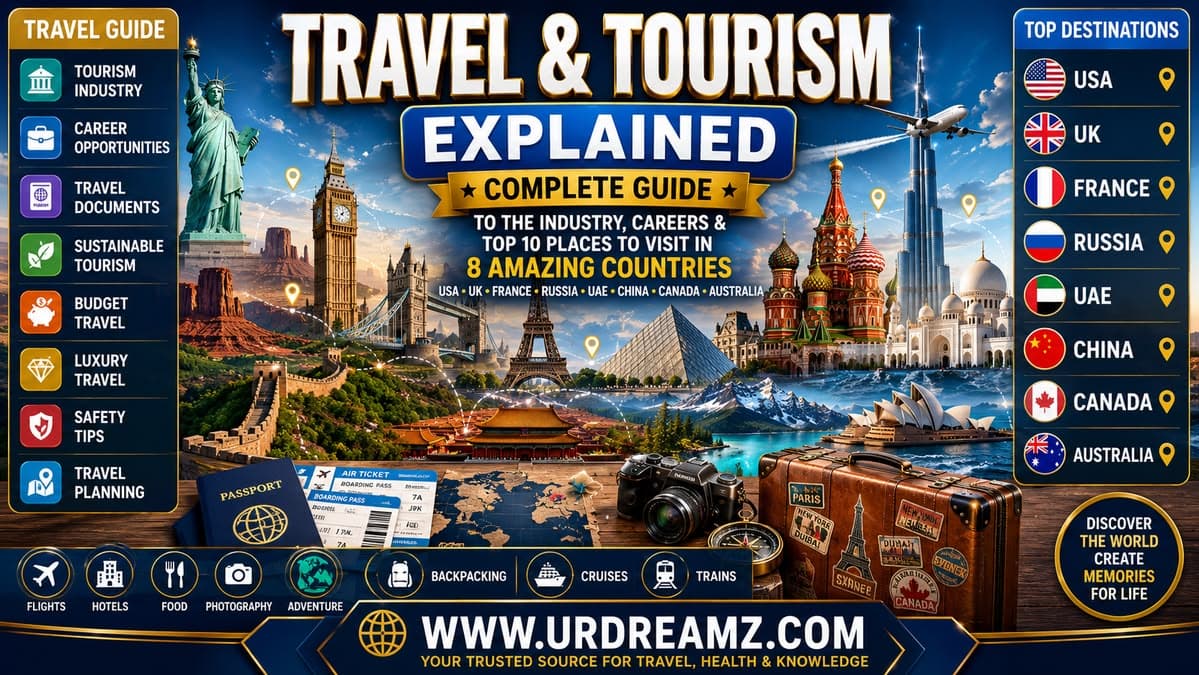
Travel & Tourism Explained: Complete Guide to the Industry, Careers and Top 10 Places to Visit in 8 Amazing Countries
Travel and tourism is one of the largest industries on earth, employing hundreds of millions of people worldwide and shaping how entire nations build their economies, infrastructure, and global reputation. This guide covers the complete picture - what travel and tourism actually means, how the global industry works, the careers built around it, practical travel knowledge every traveler should know, and a detailed, country-by-country breakdown of the top 10 places to visit across eight remarkable destinations: the USA, UK, France, Russia, UAE, China, Canada, and Australia.
Few industries touch as many different parts of everyday life as tourism does. A single traveler's decision to visit a country ripples through airlines, hotels, restaurants, museums, taxi drivers, souvenir sellers, and government tourism boards, all at once. Understanding this industry properly means understanding both sides of it - the practical, structural side of how travel actually gets planned, booked, and delivered, and the purely inspirational side of knowing exactly where in the world is worth the trip in the first place. This guide is built to cover both halves fully, so it works equally well as a reference for someone considering a tourism career and as a genuine travel bucket list for planning a real trip.
1. What Is Travel and Tourism?
Travel refers simply to the act of moving from one place to another, while tourism refers specifically to traveling for leisure, business, or other purposes and staying away from your usual environment for a limited time, typically involving activities like sightseeing, cultural exchange, and spending money in the local economy. Together, "travel and tourism" describes the entire ecosystem built around people moving through the world - transportation, accommodation, attractions, and the countless services that support that movement.
2. The Difference Between Travel and Tourism
Though used interchangeably in casual conversation, travel is the broader act of movement itself, while tourism is a specific category of travel undertaken for pleasure, exploration, or non-essential business purposes rather than relocation or daily commuting. A person moving permanently to a new city is traveling but not engaging in tourism, while a visitor exploring that same city for a week on holiday is doing both.
3. Types of Tourism
Tourism takes many distinct forms depending on motivation and activity. Leisure tourism covers vacations and holidays taken purely for relaxation and enjoyment. Cultural tourism focuses on historical sites, museums, and local traditions. Adventure tourism centers on physically active experiences like hiking, diving, or extreme sports. Business tourism (sometimes called MICE - meetings, incentives, conferences, and exhibitions) covers travel tied to work rather than leisure. Eco-tourism prioritizes environmentally responsible travel to natural areas. Medical tourism involves traveling specifically to access healthcare or treatment, often at lower cost than at home. Religious tourism centers on pilgrimage and spiritual sites. Each type draws a different traveler profile and requires a different kind of infrastructure to support it.
4. Why Travel and Tourism Matters Economically
Tourism is a major direct and indirect contributor to global GDP, supporting jobs in hospitality, transportation, food service, retail, and countless supporting industries. For many countries, tourism represents one of the largest sources of foreign currency income and employment, particularly in nations where manufacturing or heavy industry play a smaller economic role. A single tourist's spending ripples outward - a hotel stay supports the hotel itself, but also its cleaning staff, local food suppliers, tour guides, taxi drivers, and souvenir vendors, making tourism one of the most broadly distributive economic activities available to a country.
5. The Global Tourism Industry Overview
The global tourism industry spans airlines, hotels, cruise lines, travel agencies, online booking platforms, tour operators, and destination marketing organizations, all coordinating to move hundreds of millions of international travelers each year. Organizations like the World Tourism Organization and the World Travel & Tourism Council track industry trends, advocate for sustainable growth, and publish data used by governments and businesses to plan tourism policy and investment.
6. The Travel & Tourism Development Index
The Travel & Tourism Development Index, published periodically in partnership with the World Economic Forum, ranks countries on how well-positioned their travel and tourism sectors are for sustainable, resilient long-term development, factoring in elements like infrastructure, natural and cultural resources, safety, and environmental sustainability. Countries topping this index tend to combine strong infrastructure with rich natural or cultural assets and stable governance, making the index a useful benchmark for understanding which destinations are genuinely built to support tourism at scale.
7. Careers in Travel and Tourism
The tourism industry supports an enormous range of careers well beyond the visible roles of flight attendants or hotel staff - tour guides, travel agents, event and conference planners, hospitality managers, destination marketers, airline and cruise staff, tourism board officials, and hotel revenue managers all fall under this broad umbrella. Many of these roles require specialized qualifications in tourism and hospitality management, a field of study offered at both the school and university level in many countries.
8. Tourism and Hospitality Management as a Field of Study
Tourism and hospitality management programs, offered at both diploma and degree level, typically cover destination marketing, hotel and resort operations, event planning, customer service, and increasingly, digital tools for managing bookings and guest experience. Graduates often move into hotel management, travel agency operations, airline customer service, or destination marketing roles, with career paths ranging from entry-level hospitality positions to senior tourism board leadership over time.
9. How to Start a Travel Agency
Starting a travel agency generally involves registering the business formally, obtaining any required travel industry licenses in your country or region, building relationships with airlines, hotels, and tour operators, and establishing either a physical office or an online booking platform. Many new agencies specialize early - honeymoon packages, adventure tourism, corporate travel, or a specific regional focus - since a clear niche makes marketing and building supplier relationships considerably easier than trying to serve every type of traveler at once.
10. Travel Agency Licensing Requirements
Licensing requirements for travel agencies vary considerably by country, typically involving registration with a national tourism or commerce authority, proof of adequate financial bonding to protect customer deposits, and sometimes membership in an industry association like IATA for agencies selling international air travel. Costs and specific requirements differ significantly from country to country, so checking directly with the relevant national tourism authority is essential before launching a new agency rather than relying on general assumptions.
11. Travel Insurance Explained
Travel insurance protects against financial loss from trip cancellations, medical emergencies abroad, lost luggage, and other travel disruptions, and is considered essential for any international trip, particularly to destinations where local healthcare costs for visitors can be extremely high. Policies vary widely in coverage, so comparing what's actually included - medical evacuation, trip interruption, baggage loss - matters more than simply choosing the cheapest available option.
12. Travel Documents and Visas Explained
International travel typically requires a valid passport, and depending on the destination and traveler's nationality, may also require a visa obtained in advance, a visa on arrival, or an electronic travel authorization. Requirements shift periodically based on bilateral agreements between countries, so confirming current visa requirements directly through the destination country's official immigration website before booking travel is always the safest approach.
13. Sustainable and Eco-Friendly Tourism
Sustainable tourism aims to minimize negative environmental and cultural impact while maximizing benefit to local communities - supporting locally owned businesses, respecting wildlife and natural habitats, and reducing waste and carbon footprint associated with travel. As global tourism volume continues to grow, sustainable practices have become an increasingly central concern for both destinations trying to protect their natural and cultural resources and travelers wanting their visit to leave a positive rather than depleting impact.
14. Popular Travel Booking Platforms and Tools
Modern travelers rely on a mix of platforms to plan trips - flight and hotel comparison sites, dedicated airline and hotel booking engines, review platforms for researching destinations and accommodations, and increasingly, AI-powered trip planning tools that can build a rough itinerary in minutes. Using multiple sources to cross-check pricing and reviews before booking remains one of the most reliable ways to avoid overpaying or booking a poor-quality stay.
15. Smart Packing Tips for International Travel
Efficient packing means checking the destination's climate and cultural dress expectations in advance, packing versatile clothing that can be layered or mixed across multiple outfits, keeping essential documents and medication in carry-on luggage rather than checked bags, and leaving some extra space for items purchased during the trip itself.
16. Travel Safety Tips Every Traveler Should Know
Basic travel safety includes registering with your home country's embassy or consulate for longer international trips, keeping digital and physical copies of important documents stored separately, staying aware of local scams targeting tourists specifically, and researching a destination's current safety advisories before departure rather than relying purely on general reputation.
17. Budget Travel Tips
Traveling affordably generally means booking flights and accommodation well in advance, traveling during shoulder or off-peak seasons, using local transportation instead of tourist-oriented options, eating where locals eat rather than at tourist-district restaurants, and taking advantage of free museum days, city walking tours, and public parks that many destinations offer.
18. Solo Travel Tips
Solo travelers benefit especially from researching accommodation safety reviews carefully, sharing an itinerary with someone at home, staying in well-reviewed, centrally located lodging, and remaining socially open to meeting other travelers through hostels, group tours, or local meetup communities, which often meaningfully improves the overall experience of traveling alone.
19. Family Travel Tips
Traveling with children generally works best when the itinerary is built with realistic pacing in mind - fewer destinations covered more slowly rather than an ambitious multi-city sprint, accommodation with enough space and kitchen access to manage meals and rest on the family's own schedule, and a mix of structured attractions alongside genuinely unstructured downtime, since exhausted children rarely produce good travel memories no matter how impressive the itinerary looks on paper.
20. Group Travel vs Independent Travel
Guided group tours offer convenience, built-in expertise, and the safety of a structured itinerary, making them well suited to first-time visitors to an unfamiliar or challenging destination. Independent travel offers far more flexibility and often a more personal, unscripted experience, at the cost of needing to handle logistics, language barriers, and local navigation without built-in support. Many experienced travelers eventually settle into a hybrid approach - booking a guided tour for a genuinely complex or remote leg of a trip while traveling independently everywhere else.
21. How Technology Has Changed Modern Travel
Smartphones, translation apps, ride-hailing services, and instant digital booking have fundamentally changed what independent travel looks like compared to even a decade ago, removing much of the uncertainty that once made unfamiliar destinations feel intimidating. Real-time flight tracking, digital boarding passes, and instant currency conversion tools have similarly reduced the everyday friction of international travel, while user-generated review platforms have shifted enormous influence away from traditional guidebooks and toward real traveler experiences shared online.
22. The Rise of Experiential Travel
A noticeable shift in modern tourism has been the move away from simply visiting famous landmarks toward genuinely experiential travel - cooking classes, local homestays, immersive cultural workshops, and small-group experiences led by local guides. This shift reflects a broader traveler preference for authentic connection and memorable, personal experiences over a purely photograph-driven checklist of famous sights.
23. Digital Nomads and the New Face of Travel
Remote work has created an entirely new category of long-term traveler - the digital nomad, who works online while living temporarily in one destination after another. Dozens of countries have introduced dedicated digital nomad visas specifically to attract this group, recognizing the meaningful, sustained economic contribution long-staying remote workers can bring to a local economy compared to a typical short holiday visitor.
24. Seasonal Pricing in the Travel Industry
Airlines and hotels adjust pricing dynamically based on demand, meaning the same flight or room can cost dramatically different amounts depending on the season, day of the week, and how far in advance it's booked. Traveling during a destination's shoulder season - just before or after its peak tourist months - often delivers a strong balance of good weather, thinner crowds, and noticeably lower prices compared to peak season travel.
25. The Travel and Tourism Job Market Outlook
As global tourism volume continues recovering and growing, demand for skilled hospitality and tourism professionals has followed closely behind, particularly in destinations investing heavily in new infrastructure and attractions. Roles blending traditional hospitality skills with digital marketing, data analysis, and sustainability expertise are increasingly in demand, reflecting how much the industry itself has evolved beyond its traditional service-only image.
19. Top 10 Places to Visit in the United States
- New York City - Times Square, the Statue of Liberty, Central Park, and Broadway make this the country's most iconic urban destination
- Grand Canyon National Park, Arizona - one of the most dramatic natural landscapes on earth, carved by the Colorado River over millions of years
- Yellowstone National Park - famous for geothermal wonders like Old Faithful and abundant wildlife across Wyoming, Montana, and Idaho
- Las Vegas, Nevada - a desert city built around entertainment, casinos, and an ever-changing skyline of themed resorts
- San Francisco, California - known for the Golden Gate Bridge, historic cable cars, and a famously scenic bay setting
- Walt Disney World, Florida - the world's most visited theme park resort, drawing families from across the globe
- Hawaii - a volcanic island chain offering beaches, rainforests, and a distinct Polynesian culture unlike anywhere else in the country
- Washington, D.C. - home to the White House, the Smithsonian museums, and the nation's most significant historical monuments
- New Orleans, Louisiana - celebrated for its jazz heritage, French and Creole culture, and vibrant French Quarter
- Yosemite National Park, California - towering granite cliffs, giant sequoia trees, and some of the most photographed waterfalls in the country
20. Top 10 Places to Visit in the United Kingdom
- London - Buckingham Palace, the Tower of London, the British Museum, and the West End theatre district anchor the country's global capital
- Edinburgh, Scotland - a dramatic hilltop castle overlooking a historic old town, especially famous during its annual arts festival
- Bath, England - a city built around ancient Roman baths and elegant Georgian architecture
- The Scottish Highlands - vast, dramatic landscapes of lochs, mountains, and castles, including the legendary Loch Ness
- Stonehenge, England - one of the world's most famous prehistoric monuments and a UNESCO World Heritage Site
- Oxford and Cambridge - historic university towns known for centuries-old colleges and picturesque riverside settings
- The Lake District, England - a scenic national park of lakes and fells that inspired generations of poets and writers
- Liverpool, England - famous as the birthplace of The Beatles, with a lively waterfront and music heritage
- Belfast, Northern Ireland - home to the Titanic Museum and gateway to the dramatic Giant's Causeway coastline
- Cardiff, Wales - a compact capital blending a medieval castle with a modern waterfront and strong sporting culture
21. Top 10 Places to Visit in France
- Paris - the Eiffel Tower, the Louvre, Notre-Dame, and the Champs-Élysées make it one of the most visited cities on earth
- Palace of Versailles - the opulent former royal residence just outside Paris, famous for its Hall of Mirrors and vast gardens
- the French Riviera (Côte d'Azur) - glamorous Mediterranean coastal towns including Nice, Cannes, and Saint-Tropez
- Mont Saint-Michel - a striking island abbey rising dramatically out of tidal flats in Normandy
- the Loire Valley - a region famous for elegant Renaissance châteaux and rolling vineyard landscapes
- Provence - known for lavender fields, charming hilltop villages, and classic Mediterranean countryside
- Strasbourg - a city blending French and German heritage, especially beloved for its Christmas markets
- Bordeaux - the heart of French wine country, surrounded by some of the world's most celebrated vineyards
- the French Alps - home to Chamonix and Mont Blanc, a premier destination for skiing and mountain scenery
- Lyon - France's culinary capital, known for its historic old town and renowned gastronomy scene
22. Top 10 Places to Visit in Russia
- Moscow - Red Square, the Kremlin, and the colorful domes of St. Basil's Cathedral define the country's capital
- Saint Petersburg - home to the vast Hermitage Museum and stunning imperial palaces along the Neva River
- Lake Baikal - the world's deepest and oldest freshwater lake, prized for its crystal-clear water and surrounding wilderness
- the Golden Ring cities - a cluster of historic towns northeast of Moscow known for ancient monasteries and traditional Russian architecture
- the Trans-Siberian Railway route - one of the world's great train journeys, crossing thousands of miles from Moscow toward the Pacific
- Kazan - a city blending Russian and Tatar culture, home to a striking hilltop kremlin and mosque
- Sochi - a Black Sea resort city and former Winter Olympics host, framed by the Caucasus Mountains
- Veliky Novgorod - one of Russia's oldest cities, rich with medieval churches and historic architecture
- Kamchatka Peninsula - a remote volcanic region known for dramatic landscapes and abundant wildlife
- the Hermitage Museum in Saint Petersburg - one of the largest and most significant art museums in the world, housing millions of pieces across a vast palace complex
23. Top 10 Places to Visit in the United Arab Emirates
- Burj Khalifa, Dubai - the tallest building in the world, offering observation decks with sweeping desert and city views
- The Dubai Mall - one of the world's largest shopping and entertainment complexes, home to an aquarium and ice rink
- Palm Jumeirah - a man-made palm-shaped island lined with luxury resorts and beach clubs
- Sheikh Zayed Grand Mosque, Abu Dhabi - one of the largest mosques in the world, celebrated for its stunning white marble design
- Louvre Abu Dhabi - a striking museum built in partnership with the original Louvre, showcasing art and artifacts from across world history
- Dubai Desert Conservation Reserve - a protected desert area offering safari experiences, dune bashing, and traditional Bedouin camps
- Ferrari World, Abu Dhabi - a car-themed indoor amusement park featuring some of the world's fastest roller coasters
- Dubai Marina - a glittering waterfront district of skyscrapers, yachts, and waterside dining
- Al Fahidi Historic District, Dubai - a preserved old quarter showcasing traditional wind-tower architecture and Emirati heritage
- Yas Island, Abu Dhabi - a major entertainment hub combining theme parks, a Formula 1 circuit, and beach resorts
24. Top 10 Places to Visit in China
- The Great Wall of China - an ancient defensive wall stretching thousands of miles, with the most visited sections located near Beijing
- The Forbidden City, Beijing - the former imperial palace complex and one of the best-preserved ancient palace structures in the world
- Shanghai - a futuristic skyline along the Bund waterfront, contrasted with historic French Concession neighborhoods
- The Terracotta Army, Xi'an - thousands of life-sized clay soldiers built to guard a Chinese emperor's tomb over two thousand years ago
- Zhangjiajie National Forest Park - dramatic sandstone pillar formations that inspired the floating mountains in the film Avatar
- Guilin and the Li River - iconic karst mountain scenery frequently featured on Chinese currency and classical paintings
- The Li Jiang (Lijiang) Old Town - a beautifully preserved ancient town in Yunnan province with canals and traditional architecture
- Chengdu - home to the Chengdu Research Base of Giant Panda Breeding, a top destination for seeing pandas up close
- Hong Kong - a dense, dramatic skyline paired with hiking trails, islands, and a distinct blend of Eastern and Western culture
- The Yellow Mountains (Huangshan) - dramatic granite peaks often shrouded in mist, a recurring subject in classical Chinese art and poetry
25. Top 10 Places to Visit in Canada
- Niagara Falls, Ontario - one of the most powerful waterfall systems in the world, straddling the Canada-US border
- Banff National Park, Alberta - turquoise glacial lakes and dramatic Rocky Mountain peaks in Canada's oldest national park
- Toronto - the country's largest city, home to the CN Tower and a richly multicultural food and arts scene
- Vancouver, British Columbia - a coastal city framed by mountains, known for its outdoor lifestyle and scenic harbor
- Quebec City - a walled old town with distinctly European charm and North America's only fortified city north of Mexico
- Jasper National Park, Alberta - remote mountain wilderness known for dark-sky stargazing and abundant wildlife
- Montreal - a bilingual cultural hub blending French heritage with a vibrant modern food and festival scene
- Prince Edward Island - a small, scenic island province known for red sand beaches and its literary ties to Anne of Green Gables
- Whistler, British Columbia - a premier ski resort town and former Winter Olympics host surrounded by mountain scenery
- The Canadian Rockies' Icefields Parkway - widely regarded as one of the most scenic drives in the world, connecting Banff and Jasper
26. Top 10 Places to Visit in Australia
- Sydney - the Sydney Opera House and Harbour Bridge anchor one of the world's most recognizable city skylines
- The Great Barrier Reef - the largest coral reef system on earth, a premier destination for snorkeling and diving
- Uluru (Ayers Rock) - a massive sacred sandstone monolith at the heart of the Australian Outback
- Melbourne - known for its laneway culture, coffee scene, and status as the country's arts and sporting capital
- The Great Ocean Road, Victoria - a dramatic coastal drive featuring the famous limestone stacks known as the Twelve Apostles
- The Whitsunday Islands - a cluster of tropical islands off the Queensland coast famous for pure white silica sand beaches
- Tasmania - an island state known for rugged wilderness, unique wildlife, and a growing gourmet food and wine scene
- The Blue Mountains, New South Wales - dramatic eucalyptus-covered cliffs and valleys just outside Sydney
- Kakadu National Park, Northern Territory - one of the largest national parks in the country, rich with Aboriginal rock art and wetland wildlife
- Perth and Rottnest Island, Western Australia - a relaxed coastal city paired with a nearby island famous for its quokkas and pristine beaches
27. Best Time to Visit Each of These Countries
Timing a trip well can make an enormous difference to both cost and experience. The USA and Canada generally reward late spring through early autumn for most regions, though winter brings its own appeal for skiing destinations. The UK and France are most pleasant from late spring through early autumn, avoiding the colder, wetter winter months. Russia is best visited in late spring through summer for milder weather, though winter has its own distinct appeal for those specifically seeking a snow-covered experience. The UAE is far more comfortable in the cooler months from November through March, since summer heat can be extreme. China varies enormously by region, but spring and autumn generally offer the most comfortable travel conditions across most of the country. Australia's seasons run opposite to the Northern Hemisphere, making its spring and autumn (roughly September to November and March to May) pleasant almost nationwide.
28. Common Travel Mistakes to Avoid
- Booking flights or accommodation too close to the travel date, missing better early pricing
- Skipping travel insurance to save a small amount upfront
- Overpacking instead of traveling with versatile, lighter luggage
- Not checking visa and passport validity requirements far enough in advance
- Trying to see too many destinations in too little time, leaving no real time to enjoy any of them
- Ignoring local customs, dress codes, or etiquette expectations at cultural and religious sites
Frequently Asked Questions
What is the difference between travel and tourism?
Travel is the general act of moving from one place to another, while tourism specifically refers to travel undertaken for leisure, business, or exploration rather than relocation or daily commuting.
What are the main types of tourism?
Leisure, cultural, adventure, business, eco-tourism, medical, and religious tourism are among the most common categories, each drawing a different kind of traveler.
What careers are available in travel and tourism?
Careers span travel agents, tour guides, hotel and hospitality managers, airline staff, event planners, destination marketers, and tourism board officials, among many others.
Do I need travel insurance for international trips?
It's strongly recommended, since it protects against trip cancellations, medical emergencies, and lost luggage, especially in destinations where healthcare costs for visitors can be very high.
Which country is best for travel and tourism?
It depends entirely on personal interest - the USA and Canada suit nature and city variety, France and the UK suit culture and history, the UAE suits modern luxury, China suits ancient history and dramatic landscapes, Russia suits deep cultural heritage, and Australia suits unique wildlife and coastline.
What is the best time of year to travel internationally?
It varies significantly by destination and hemisphere, so checking the specific country's seasonal weather patterns well before booking is the most reliable approach.
Conclusion
Travel and tourism is far more than a leisure activity - it's a global industry supporting millions of livelihoods and connecting cultures across every continent. Whether you're drawn to the towering skyline of Dubai, the ancient wonder of the Great Wall of China, the natural drama of the Grand Canyon, or the historic charm of Paris and London, understanding how the tourism industry actually works - and coming prepared with the right documents, insurance, and realistic expectations - is what turns a good trip into a genuinely great one.